University of East London Institutional Repository: http://roar.uel.ac.uk
This paper is made available online in accordance with publisher policies. Please scroll down to view the document itself. Please refer to the repository record for this item and our policy information available from the repository home page for further information.
To see the final version of this paper please visit the publisher’s website. Access to the published version may require a subscription.
Author(s):Chaharbaghi, Kazem
Article Title:The problematic of strategy: a way of seeing is also a way of not seeing
Year of publication:2007
Citation:Chaharbaghi, K. (2007) ‘The problematic of strategy: a way of seeing is also a way of not seeing’ Management Decision 45 (3) 327 - 339
Link to published version:www.emeraldinsight.com/0025-1747.htm DOI:10.1108/00251740710744981
Publisher statement:
The problematic of strategy: a way of seeing is also a way of
not seeing
Kazem Chaharbaghi, University of East London, London, UK
Abstract
The paper aims to question the post-rational observations and traditional
constructions of strategy in terms of what they achieve and what they fail to achieve,
and seeks to reconstruct strategy as a multi-dimensional, dynamic concept. For this
purpose, the study uses and interrelates the dualities between continuity principle
and discontinuity principle, knowledge and imagination, opportunity exploitation and
opportunity exploration, and conformist innovation and deviant innovation. The paper
makes explicit, through the notion of performance paradox, the context for the
framework that results from the mutual relation of these four dualities. The paper
finds that failure to understand these dualities and their interrelatedness will ensure
that strategy will remain largely an illusive, unexplained and rhetorical concept. It
demonstrates that the greatest benefit of understanding these dualities and their
interrelatedness is that it can show how organisations should be by illuminating who
they might be. The paper identifies opportunities for innovation, research and
reflection by establishing the need for balancing the seemingly conflicting opposites
of these interrelated dualities and ways in which they can be located on their
strengths. The paper suggests that the understanding that emerges from the
treatment of strategy as a multi-dimensional, dynamic construct, allows organisations
to align the corporate, business and functional dimensions more effectively in making
progress and receiving more in terms of the results they want to achieve. The paper
introduces a radical shift in thinking, arguing for a move away from simplified,
unbalanced, static constructions of strategy that focus on one dimensionality,
asymmetry and post-rationalisation.
Introduction
The conceptualisation of strategy in terms of corporate, business and functional
strategies has gained widespread acceptance in the study and practice of strategy.
There is also a growing recognition that organisations will achieve a greater
performance if their corporate, business and functional strategies are aligned,
supporting each other. For this purpose, the design and planning schools, for
example, emphasise the notion of hierarchy of strategies in the process of alignment
lead to a one-dimensional, mono-logical thinking in today's multidimensional world
that presents organisations with multi-logical problems which call for accommodating
multiple perspectives. By treating multi-logical problems as though they were
mono-logical, one-dimensional thinking reduces strategy to a meaningless concept thereby
constraining organisations in making progress and achieving sustainable success.
This can be illustrated by first examining the overuse and misuse of strategy in
practice as an inert term and then questioning the post-rational observations and
traditional constructions of strategy both in their virtues and failings. Such an
examination and questioning will pave the way to rethink and reconstruct strategy as
a multi-dimensional, dynamic construct that allows organisations to align the
corporate, business and functional dimensions more effectively in making progress
and receiving more in terms of the results they want to achieve.
Strategy is a borrowed term from the military. The origin of this term is the Greek
strategia, meaning the art of war. Within its original context, it was simply understood
as a military means to political ends (Sun Tzu, 1981). Strategy has now become the
new mantra of contemporary organisations, an inert term with no substance and
meaning, incapable of producing any reaction from those who utter or hear it. It is
taking over meeting rooms and corporate documents like a virus. The overuse and
misuse of this term can be explained in terms of the presence of inherent
contradictions that derive from the disjunction between the existing assumptions on
which organisations are run and the reality that no longer fits these assumptions. In
such circumstances, when organisations call for strategy they are simply
acknowledging its felt absence rather than its presence. The crisis that follows is not
only epidemic, but also endemic within the context in which these organisations find
themselves. This is because the solutions that helped solve the old problems have
created a new set of problems that cannot be solved by the same solutions that
created them. Unfortunately, the purpose of using the term strategy in organisations
that cannot divorce their past is not to create an alternative future but rather to justify
and reinforce the old familiar solutions that maintain status quo. Huxley's hypothetical
world provides an interesting parallel. In Huxley's (1989) brave new world, happiness
is achieved through a repetitive message and a pleasure drug called “soma”. This
drug enabled its users to experience any pleasure they could dream, while the
repetitive message promoted pleasure as an end in itself, which must be pursued ad
infinitum. Soma together with the repetitive message that promoted pleasure
culminated in a form of social conditioning where the users accepted their
questions asked, thinking was curtailed and thereby social stability was maintained.
In organisations that find themselves in a state of perpetual decline, strategy has
become like Huxley's soma where the constant call for it is providing a psychology of
comfort. Such a comforting placebo, however, can only provide a false appearance
of stability for these organisations. This is because, whilst in Huxley's hypothetical
world social stability could be imposed by soma and its associated repetitive
message, the constant call for strategy in the real world of organisations provides
little more than a vacuous belief to displace anxiety, a form of escapism from the
recurrent crisis that remains unresolved.
The problem of strategy also stems from the study of strategy itself, while its solution
lies in how strategy emerges in practice. Although strategy is one of the most studied
and taught of concepts, it is paradoxically one of the least understood. The reason for
this is at least threefold. First, the studies and teachings of strategy only focus on
what can be studied and what is teachable respectively thereby ignoring what cannot
be studied and taught. Second, and relating to the first, most studies and teachings
of strategy assume that it is possible to condition what is essentially a matter of
emergence in a way that creates an objective, linear world in which organisations can
objectively plot some step-by-step course of action that turns them into innovative
powerhouses over a short predetermined period of time. While such objective, linear
representations of the world can provide some illusion of control, experience shows
that the real world is structured by potent forces many of which cannot be controlled
at all. Third, and following from the first and second, most studies and teachings of
strategy assume that it is possible to rationalise observations of successful
behaviours and transform these post-rational observations into a formula for success
that ignores not only the crisis or overwhelming opportunity that led to it but also the
experimental, iterative and non-linear process from which it emerged. Even more
worrying is the dangerous assumption that a universal meaning can be generated
from such observations, which are always changing and incomplete.
Leading organisations, however, are strangely unconcerned by the availability of
post-rational observations and formulas that claim to explain their behaviour. They
probably realise that post-rationalisation embodies the past and not the future. It can
only explain their last creativity, the sell-by-date of which is already passing. In any
case, leading organisations are too busy replacing an obsolete formula with a new
one based on a recent creativity. The irony is that it is precisely the unpredictable
observations in order to create more formulas for success. A powerful example
illustrating this problem can be found in the literary success of Peters and
Waterman's (1982) study of “best-run” companies where the authors pioneered a
qualities approach based upon the content of generalisable observations that
appeared to be common to several seemingly successful organisations, only for
several key subjects within their study to fail publicly within months of publication. It is
therefore not surprising to see Peters openly stating that “I decide to write a new
book when I feel disgusted and embarrassed by my previous one” (Crainer, 1997).
The exponential growth of literature, fuelled by the constant post-rational
observations and abstract constructions that compete for attention, is reminiscent of
the fashion industry whose audience are made to discard unfashionable clothes and
replace them with the latest fashion. A cursory examination of the growing literature
on strategy displays this in action with the following famed examples having already
been paraded on the “cat-walk” of strategy, where it has been dressed up to be:
• About differentiation and cost leadership (Porter, 1985); stretch and
leverage (Hamel and Prahalad, 1994); vision (Mintzberg, 1995); choosing
what not to do (Porter, 1996); revolution (Hamel, 1996); and, fit and scope
(Johnson and Scholes, 1997).
• Treated as a plan, a pattern, a position, a ploy and a perspective
(Mintzberg, 1995).
• Generic (Porter, 1980); rational or incremental (Johnson, 1988); deliberate
or emergent (Mintzberg, 1994); and, prescriptive, descriptive,
configurational, implicit or explicit (Mintzberg and Ansoff, 1994).
• Approached from either a classical, evolutionary, processualist or systemic
framework (Whittington, 1993), and from a process, content or context
perspective (De Wit and Meyer, 1994).
The breadth and abundance of literature together with the variability of the
perspectives and vocabulary used make it seem that the central problem, that is,
strategy, is a secondary issue. The exponential growth of literature on strategy is
directing attention in different ways, is adding greater complexity and is provoking
more and more uncertainty while communicating less and less meaning to its
asymmetry. In competing for attention, each perspective places two concepts in
opposition and attaches value to one over the other. For example, Porter (1996)
argues that the essence of strategy is choosing what not to do, as without trade-offs
there would be no need for choice, and thus no need for strategy. He concludes that
improving operational effectiveness is a necessary part of good management, but it
is not strategy. Using a similar line of argument, Hamel (1996), in advocating strategy
as revolution, rejects incrementalism by considering it to be depressingly futile as a
strategy, claiming that corporations around the world are reaching the limits of
incremental improvements. This perspective, however, is not ill-conceived, just partial
and unbalanced, obscuring the merits of the alternative. It is important to recognise
that a way of seeing is also a way of not seeing and that a central emphasis on one
alternative involves neglecting the importance or significance of the others. Within the
context of strategy as revolution, for example, the advocates of incrementalism would
argue that if continuity leads to a prosperous existence then incrementalism is highly
pertinent as there is no context for revolution. Furthermore, they would assert that the
impact of incrementalism should not be considered in incremental but in cumulative
terms. Moreover, incrementalists would claim that incrementalism is necessary in any
case if the fruits of revolution are to be reaped and enjoyed.
In order to return organisations to the basic principles that provide the necessary
direction to achieve sustainable success and in order to bring about the much
needed clarity to the strategy field, this study reveals that four dualities, interrelated,
offer a framework for understanding strategy as a multi-dimensional, dynamic
construction and for evaluating different observations and perspectives of strategy
available today. It is shown that these dualities drive and support these observations
and perspectives of strategy and permeate the fundamental vocabulary. These are
the duality between:
1. continuity principle and discontinuity principle;
2. knowledge and imagination;
3. opportunity exploitation and opportunity exploration; and
4. conformist innovation and deviant innovation.
Before presenting the framework, however, it is useful to introduce, through the
notion of performance paradox, the context that makes this framework valid, reliable
Performance paradox
Vilfredo Pareto (1848-1923), in developing his polemical essay Trattato di Sociologia
Generale (Pareto, 1916), which was translated into English under the title The Mind
and Society in 1935, investigated the patterns of wealth and income in nineteenth
century England. In this investigation, he discovered that the distribution of wealth
was predictably unbalanced as 20 per cent of the population owned 80 per cent of
the usable land. The basic imbalance observed by Pareto over a century ago, also
known as the 80:20 rule or the law of the trivial many and the critical few, can usefully
be paralleled to a recurrent crisis in organisational life: the performance paradox,
which manifests when a significant majority of effort leads to a minority of the results.
This apparent contradiction can be explained through the decay of cause-and-effect
models.
Organisations are the product of an idea, a winning way of thinking and doing that
their members want to repeat again and again because it generates similar results
thereby making them feel like winners. Cause and effect are assumed through
feedback loops and a process of intensification. A negative feedback loop is
employed to focus effort through minimal deviation and maximum control whilst the
amplification of effects indicates positive feedback. Thus, as intensified repetition
increases conformity, it appears that its effect is growing. However, a
cause-and-effect model is only cause-and-effective within the original context that made it relevant and thus
emerging contextual changes make the construction upon which such causality was
founded increasingly irrelevant. This is because as a cause-and-effect model loses
its relevance the amplifiers and reducers weaken the link between cause and effect.
In this way, a crisis emerges both from within and outside as the
contextually-misaligned organisation shows signs of diminishing returns. A common approach to
deal with such a crisis is to work harder by conforming even more rigidly to the
decaying cause-and-effect model in order to make it work. Although such an
approach may prolong life, it cannot succeed as the nature of causality has changed
which means that there is an emerging strategy vacuum. This implies that the only
remaining alternative is to create another causeand- effect model, which like its
predecessor is initially powerful but decays over time.
The problem for organisations with a decaying cause-and-effect model and no viable
alternative cannot be underestimated. In such times of difficulty, organisations want
and wonder why problems multiply, the effort for each problem solved inflates and
the time between problems solved increases. They intervene and direct more only to
receive less in terms of the results they want to achieve. However, what these
organisations fail to notice is that, in increasing conformity through intensifying
repetition, minimising deviation and maximising control, they have developed,
through an unconscious process, a danger model, the aim of which is to identify
divergence and destroy it through exclusion and rejection mechanisms. The
implication of such a danger-model is at least twofold. First, it renders organisations
unable to perceive the end for which conformity was emphasised, and as a result,
obsessive conformity, originally conceived as a means, becomes transformed into an
end-in-itself. Second, to keep on doing what worked in the past, even though it
means steady decline, no matter how hard the organisation works, necessarily
involves neglecting other alternatives. This is because the fixation on “what is”
obscures “what is not” or “what might be”. As a result, when a cause-and-effect
model that was once powerful starts to decay, in the absence of an alternative, there
is a transitional period when work that used to generate results becomes symbolic
work that produces no effect. Symbolic work is like running on a treadmill, all motion
but no direction. It involves constructing appearances of “busyness”, examples of
which included endless crisis meetings, creation of numerous corporate documents
and the consumption of fashionable behavioural models of “success”, which if aped,
symbolic workers assume, will deliver similar riches to those gained by their
exemplars. Thus, symbolic work provides little more than a false hope, an unrealistic
expectation based on a denial of reality. It is an expensive prescription for
maintaining status quo.
As symbolic work can only accelerate the rate of decline, organisations that find
themselves in a state of perpetual crisis eventually come to realise that effort without
the rejection of the prevailing cause-and-effect model and substitution of a new
powerful cause-and-effect model, is fatal. In other words, they have to become their
own creative destroyers. It is this fundamental recognition that transforms strategy
from a rhetorical into a meaningful concept.
Rethinking and reconstructing strategy
Four interrelated dualities can account for resolving the performance paradox. These
are the duality between continuity principle and discontinuity principle, the duality
between knowledge and imagination, the duality between opportunity exploitation
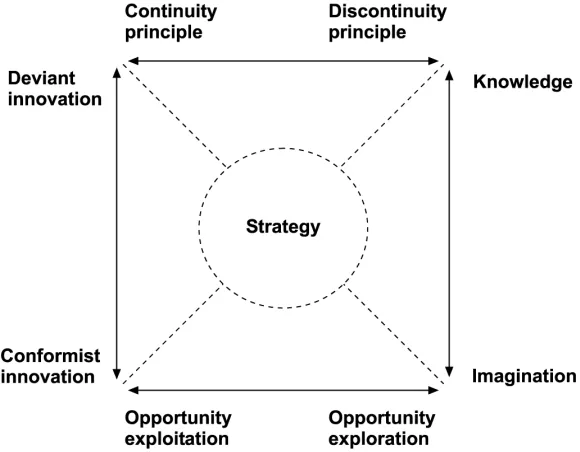
deviant innovation. The interrelatedness of these four dualities, depicted in Figure 1,
culminates in a framework that constructs strategy as a multi-dimensional, dynamic
concept.
Duality, as a key concept guiding the development of this framework, must not be
confused with other bipolar concepts such as dilemmas and paradoxes. What is
common across all bipolar concepts are mutual exclusivity and simultaneity.
However, while dilemmas are viewed as an “either/or” scenario in which one
attractive and or undesirable alternative must be selected or rejected vis-à-vis its
equally attractive and or undesirable counterpart, and while paradoxes are the
apparent contradictions arising from the simultaneous presences of two seemingly
conflicting forces, events, factors or tendencies that do not necessarily call for a
choice between them, a duality within the context of this study is characterised as:
• A distinction between two realms, each very different, valid, having a
different tendency with differing influences, and of utmost importance in
understanding organisational life in general and strategy in particular.
• A never-ending concern of a divergent nature that grows out of the
differences between two seemingly conflicting opposites that are both
permanent and existing simultaneously.
• An “and/both” scenario in which the principal task is not to eliminate but to
balance such differences.
• A way of accommodating two seemingly conflicting opposites which locates
them on their strengths while avoiding their weaknesses.
• An opportunity for making progress and receiving more in terms of the
results organisations want to achieve.
In capturing the above characteristics, the methodological underpinnings of this study
have been based on what Chaharbaghi and Cripps (2006) term “metalectics”, the
logic of which they state stems from:
[…] the recognition that the world of values is inconsistent because it is made up of
antagonistic elements; that full commitment to opposing perspectives simultaneously
is impossible, yet each demands total acceptance; that this is not a case of logical
contradiction because it involves human values; and that it represents a kind of
these recognitions, metalectics can be considered as a way of describing
choice-making through three kinds of complimentary inquiries: namely, an empathetic
enquiry, a sympathetic inquiry, and a dialectic inquiry applied dialectically. An
empathetic inquiry attempts to understand as much as possible the value
assumptions, hidden motivations and arguments of differing positions that support
their rationale. A sympathetic inquiry does not deny the value assumptions of
assertions, models or paradigms of others but nevertheless raises as many critical
questions as possible about them. The idea is to play the devil's advocate in the role
of a critical friend and consider whether alternative arguments are more convincing.
At the meta-theoretical level of exploration a dialectic applied dialectically goes
beyond competing explanations to establish an alternative way of thinking about
choice. A dialectic applied dialectically avoids the limitations of compromise that is
reached by a dialectic that is applied objectively i.e. the weakening of polarised
discourses through a process of denying the strengths of each position. This is an
important point because where compromise between argument positions is reached,
individuals have no rational or good reason to accept or reject it. In other words,
compromise is founded on an individual's or a group's participation in the solution but
weak engagement with the struggle. The artistry involved in metalectics is exposed
where the individual perceiving extremes in conflict uses their emotional intelligences
such as empathy and sympathy to enable engagement with the struggle without
commitment to a particular position. The aim is to keep polarised positions in the
struggle of opposition because only through this struggle can true dialectic survive. It
is therefore necessary to ensure that each discursive theme is not destroyed. A
metalectic discourse is thus one that masters the art of argument using the strengths
of each of the diverse argument positions to transform understanding.
In resolving the performance paradox, using metalectics, the continuity principle must
first be delineated from the discontinuity principle. Although continuity and
discontinuity represent two opposing tendencies, the former favouring the status quo
and stability and the latter emphasising transformation and radical change, it is
ultimately the relative orientation with regard to time that explains the basis of their
conflict. If time can be can considered as a continuum in which events pass from the
future through the present into the past, two assumptions concerning the future
determines the way in which the world is considered to work. First, the past will
repeat itself or the past trends will continue. In other words, the future is a simple
extension of the past or an extrapolation of past trend lines. As a result, memory, that
is, the ability of retaining and recalling past experience arising from actual
observation of or practical acquaintance with historical facts or preceding events, is
the future to represent a radical departure from the past, shifting the emphasis from a
single future to a range of alternative futures, including, for example, those deemed
probable, those considered as possible, although not necessarily probable, and
those viewed as the unintended consequences of past decisions and actions. The
proponents of the continuity principle maintain that stability arising from, for example,
norms, mores and routines, brings about certainty, safety, security and emotional
comfort, and that it promotes and reinforces community. Those who emphasise the
discontinuity principle, on the other hand, present transformation and radical change
as a promise of a better future, ensuring survival and driving progress. Without
discontinuities, they argue, human beings would still live in caves, miserable and
naked, and that out of discontinuities in the past have come meaningful, beneficial
advances. Although the continuity and discontinuity principles may appear to be
opposites, they are not hostile to one another for at least three reasons. First, the
strengths of each can be found in the weaknesses of the other and vice versa.
Second and relating to the first, continuity is favoured when it contributes to
well-being and prospering. However, when continuity leads to a miserable existence then
discontinuity is preferred. This is because in such circumstances continuity helps
preserve unsatisfactory life conditions while discontinuity helps escape them. Third
and corresponding to the second, without periods of continuity it is not possible to
enjoy the beneficial advances brought about by discontinuities. Thus, when the
continuity and discontinuity principles are seen as complementing one another, that
is, working together and supporting each other, a virtual spiral emerges where the
emphasis on one increases the benefits of emphasising more of the other. A
disturbed harmony between these two tendencies, on the other hand, results in a
vicious circle in which the persistent domination of one, for example, weakens both
as the dominator allows its weaknesses to outweigh its strengths by neglecting or
playing down the strengths of the dominated.
The duality between continuity principle and discontinuity principle provides the
context for the duality between knowledge and imagination. A useful starting point for
examining this duality is to consider the way in which Albert Einstein placed
knowledge in opposition to imagination. In an interview, the poet and journalist
George Sylvester Viereck asked Einstein, how does he account for his discoveries?
I am enough of an artist to draw freely on my imagination, which I think is more
important than knowledge. Knowledge is limited. Imagination encircles the world
(Viereck, 1929).
Einstein's words attach value to imagination over knowledge and point to two factors
that lie at the heart of this asymmetry. First, knowledge is limited, that is, what is
known cannot be otherwise and what is otherwise cannot be known whether it exists
or not. Second, imagination is infinite, that is, it is without limits or boundaries. The
question is not whether Einstein was right in thinking imagination is more important
than knowledge, but under what condition was he right? When human beings first
turned a stone into a tool, they demonstrated a fundamental part of human mental
ability: imagination. Although imagination is unlimited and a privilege given by birth,
very few use its powers in their daily life. As knowledge and imagination facilitate
continuity and discontinuity respectively, when continuity is preferred, knowledge is
emphasised to preserve it. On the other hand, when discontinuity is called for,
imagination is favoured in order to respond to new life conditions, develop novel
solutions, discover new possibilities and invent alternative realities. This, however,
does not mean that knowledge is not supportive of the imaginative process and vice
versa. Imagination is what extends the boundaries of knowledge while knowledge
provides the criticality that is necessary for the evaluation of imaginative ideas. The
insight that emerges from such a criticality unites hindsight and foresight in a way
that provides a greater sense of anticipation while helping avoid the pitfalls of
unintended consequences when imaginative ideas are introduced. This mutual
relation between knowledge and imagination turns on a different but related
recognition, which is, while Einstein's words regard knowledge as limited and
imagination as without limits, imagination is not bounded by that which is already
within the current vision or field of knowledge such that an advance may surprise
those who hold such knowledge, but does not completely confound them. In such
circumstances, imagination enables them to see things differently within what might
be considered as existing knowledge rather than opening the possibility of seeing
different things of a kind never seen before. From this perspective, seeing things
differently may alter practice radically, but it does not necessarily revolutionise
“knowledge”.
The duality between opportunity exploitation and opportunity exploration follows
logically from the duality between knowledge and imagination. In this duality,
and maximum control with a view to achieving greater reward and payback in milking
an existing opportunity. Exploration, on the other hand, privileges diversification,
emphasising variety by regarding regeneration deriving from having ample choices.
While exploitation limits choice through retention and conservative play by focusing
on options proven to work in the past, exploration increases the potential for choice
by embarking upon journeys of discovery and invention in the hope of favourable
outcome which cannot be known in advance and which often lead to multiple paths.
Within the context of organisations, as exploitation and exploration efforts compete
for resources, both at times of scarcity and plenty, the allocation of resources often
favours exploitation over exploration. This is because the former is considered as
having immediate payback while the latter is viewed as lacking significance given its
uncertain outcomes. Such an imbalance, however, can spell certain death as in the
absence or reduction of exploration the stock of opportunities to exploit will eventually
be exhausted. This, however, does not mean that an imbalance towards exploration
is desirable. Too much emphasis on opportunity exploration can result in too many
costly journeys that cannot be afforded because of inadequate exploitation. It
therefore follows that without opportunity exploitation there is no context for
opportunity exploration and vice versa, and that a balance between them is
necessary in order to meet the needs of today without compromising the ability of
organisations to meet future needs.
The duality between conformist innovation and deviant innovation brings together the
three dualities considered above in a common cause to resolve the performance
paradox. Conformist innovation emphasises continuity, knowledge and exploitation
by recognising achievement as engaging in a conforming conduct. It implies
adaptation of the individual practices to the requirements of minimising deviation
though maximising control. It emerges from identifying ways in which organisations
can conform more and more rigidly to a cause-and-effect model in order to make its
effect grow. As the presence of a powerful cause-and effect model is what makes
increasing conformity effectual, there is no context for conformist innovation as soon
as a cause-and-effect model starts to decay. In such circumstances, conformist
innovation only becomes useful again to organisations after another powerful
cause-and-effect model emerges out of deviant innovation. Deviant innovation emphasises
discontinuity, imagination and exploration in rewarding deviance. It implies
challenging the prevailing assumptions on which organisations are run. It emerges
differently. Thus, while the direction is defined by deviant innovation, the most
appropriate way to move in that direction is mapped out by conformist innovation.
The above four dualities together with their interrelatedness construct strategy in a
way that makes it a valid, reliable, meaningful and significant concept. In this
construction, strategy is neither the continuity principle nor the discontinuity principle,
neither knowledge nor imagination, neither opportunity exploration nor opportunity
exploitation, neither conformist innovation nor deviant innovation, but a third entity
independent of the two. It is simply a link, a mental bridge that facilitates the
seemingly conflicting opposites of these four dualities working together in harmony
and in support of each other in resolving the performance paradox. Although such a
mental bridge may not be immediately apparent, it nonetheless exists. It has an
effect and one intuitively knows what it is when a movement from one end to the
other takes place. This mental bridge as much as providing a means for such a
movement, and as much as being a bearer of exchange, keeps both ends apart,
making the best of both worlds by allowing each end to play to its strengths, and in
doing so, preserves the four dualities. This has to be the case because a bridge
ceases to exist unless both ends remain in place. From this perspective, both
conformist innovation and deviant innovation, for example, although very different,
are of utmost importance and strategy is what links or bridges them, allowing
conformist innovators to receive and exploit what deviant innovators have delivered
in the form of a powerful cause-and-effect model. The most important consideration
is that although the conformist and deviant innovators see this same bridge and use
the term strategy to refer to it, they attach a different meaning to it because their
purposes are dichotomous. For conformist innovators, who sit at one end of the
bridge, receiving and exploiting cause-and-effect models, strategy is what makes
conformity effectual. For deviant innovators, who sit at the other end of the bridge,
creating and delivering cause-and-effect models, strategy is what makes deviance
valuable. For those who locate themselves on the bridge, strategy is a philosophy of
running a dynamic organisation in which the requirements for a chain of timely
cause-and-effect models is understood. The purpose of this chain is to continually
stock up cause-and-effect models emerging from deviant innovation, sequence and
time their release both to succeed the decaying cause-and effect models and to
introduce opportunities of a kind never exploited before. In a dynamic organisation,
such a task is never complete. Indeed it can never end. New cause-and-effect
models are continuously introduced, powerful cause-and-effect models are
maintained by a strong corporate culture which facilitates the effective operation of
the chain of timely cause-and-effect models.
Implications and opportunities for corporate, business and functional dimensions
In facilitating the effective operation of the chain of timely cause-and-effect models,
the alignment of corporate, business and functional dimensions cannot be
underestimated. Traditionally, the corporate dimension has been viewed as being
concerned with the portfolio of businesses an organisation should be in, the business
dimension has been considered as emphasising the way in which each business
should compete while the functional dimension has been treated as serving the
needs of the two higher levels. Such a view creates, in the name of efficiency, an
asymmetry through a hierarchy that involves a vertical relation of subordination and
superordination in the process of coordination. The word hierarchy derives from two
Greek words, hieros, meaning “sacred”, and arkho, meaning “rule”, implying a
system of ranking and organising things or people, where each element, except for
the top element, is subordinated to a single other element. From this perspective,
conflict is seen as a competition with an eventual winner and loser while peace is
treated as the absence of conflict due to hierarchal domination. This approach often
assumes that such a structure is flexible enough to allow each dimension perform the
role it is best suited for. This, however, is only possible if original structure accepts it.
It can be argued that a dependent relationship between corporate, business and
functional dimensions can be made in both directions. One, in fact, can accept that
the functional dimension follows the business dimension which, in turn, is led by the
corporate dimension but equally one can accept that the corporate dimension follows
the business dimension which in turn is driven by the functional dimension. One
position would be to consider “unless the former and or the latter is the case
inefficiency results” as meaning “unless the corporate dimension matches the
business dimension and the business dimension matches the functional dimension
inefficiency results, the disengagement cost of which can be high”. In practice, there
is a constant interplay between the corporate, business and functional dimensions.
These dimensions are locked together in a trilogy. In making the corporate dimension
to match the business dimension and the business dimension to match the functional
dimension it is useful to think of their alignment in terms of mobilisation. To mobilise
is to think of those located in the corporate, business and functional dimensions as a
dimension must contribute its force to the collective in a mobilised or directed way to
make an impact. This metaphor of mobilisation is enlightening as the context within
which the trilogy of corporate, business and functional dimensions is placed can
cause them to play together in different, non-linear ways, with each dimension
performing the role it is best suited for and or the role it is not suited for.
The emerging context in which organisations find themselves points to two important
considerations. First, the recognition that heterogeneity, and not just homogeneity,
can be a productive way of doing business. Second, a complex world creates tricky
problems that need intricate solutions beyond the wit of one dimension. Within this
emerging context, it is necessary to make a distinction between heterogeneous
communities of interest and homogenous communities of practice. Many examples of
human achievements involve the collaboration between many individuals and
groups, each with unique experiences, varying interests and different perspectives.
Such heterogeneous communities of interest form naturally in order to meet a
multi-faceted challenge of common concern that cannot be met individually. These
communities differ markedly from and must not be confused with homogenous
communities of practice whose members specialise and focus on undertaking similar
work. This distinction implies that the collective does not diminish the importance of
the individual and vice versa. New promising directions, for example, does not
necessarily have to originate from the corporate dimension and can emerge from
existing capabilities of a business function or new capabilities developed within a
business function and even from the individual imagination of a lone genius working
in isolation.
The importance of the heterogeneous communities of interest lies in the benefits
derived from differences that are balanced through horizontal alignment whereas the
contribution of the homogenous communities of practice grows out of the benefits of
normalising through vertical alignment. They exist in an “and/both” rather than in an
“either/or” relationship. From this perspective, the effective operation of the chain of
timely cause-and-effect models is not simply the sum of individual mental and
physical efforts, but rather their intensification and multiplication through
complementarities. It is such complementarities that provide direction, focus efforts
and coordinate actions in meeting this challenge of common concern. Within the
context of facilitating the effective operation of the chain of timely cause-and-effect
models, corporate, business and functional dimensions render themselves ineffectual
dichotomised in competition with one another and heterogeneous communities of
[image:17.595.90.380.132.358.2]interest are treated as homogenous communities of practice and vice versa.
Figure 1 A framework for constructing strategy as a multi-dimensional, dynamic
concept
References
Chaharbaghi, K., Cripps, S. (2006), "Intellectual capital: direction, not blind faith", Journal of Intellectual Capital, Vol. 7 No.1, pp.29-42.
Crainer, S. (1997), "Tom Peters", Management Today, No.May, pp.74-5. De Wit, B., Meyer, R. (1994), Strategy: Process, Content and Context, West Publishing, New York, NY.
Hamel, G. (1996), "Strategy as revolution", Harvard Business Review, No.July/August, pp.69-82.
Hamel, G., Prahalad, C.K. (1994), Competing for the Future, Harvard Business School Press, Boston, MA.
Huxley, A. (1989), Brave New World, Harper Perennial, New York, NY, . Johnson, G. (1988), "Rethinking incrementalism", in De Wit, B., Meyer, R. (Eds),Strategy: Process, Content and Context, West Publishing, New York, NY, pp.61-9.
Johnson, G., Scholes, K. (1997), Exploring Corporate Strategy: Text and Cases, Prentice- Hall, London.
Mintzberg, H. (1995), "The entrepreneurial organisation", in Mintzberg, H., Quinn, B., Ghoshal, S. (Eds),The Strategy Process, Prentice-Hall, London, pp.588-97.
Mintzberg, H., Ansoff, I. (1994), "A discussion on strategy paradigms", in De Wit, B., Meyer, R. (Eds),Strategy: Process, Content and Context, West Publishing, New York, NY, pp.69-84.
Pareto, V. (1916), Trattato di Sociologia Generale, Barbera, Firenze.
Peters, T., Waterman, R. (1982), In Search of Excellence: Lessons from America's Best Run Companies, Harper & Row, New York, NY.
Porter, M.E. (1980), Competitive Strategy: Techniques for Analysing Industries and Competitors, The Free Press, New York, NY.
Porter, M.E. (1985), Competitive Advantage: Creating and Sustaining Superior Performance, The Free Press, Boston, MA.
Porter, M.E. (1996), "What is strategy?", Harvard Business Review, No.November/December, pp.61-78.
Sun Tzu (1981), The Art of War, Hodder & Stoughton, London.
Viereck, G.S. (1929), "What life means to Einstein: an interview by George Sylvester Viereck", The Saturday Evening Post, No.October 26, pp.117.