Munich Personal RePEc Archive
Management decision making by the
analytic hierarchy process: A proposed
modification for large-scale problems
Islam, Rafikul and Abdullah, Nur Anisah
2005
Online at
https://mpra.ub.uni-muenchen.de/10811/
Management decision-making by the analytic
hierarchy process: a proposed modification
for large-scale problems
Rafikul Islam
Department of Business Administration,
Faculty of Economics and Management Sciences, International Islamic University Malaysia, Jalan Gombak, 53100 Kuala Lumpur, Malaysia
E-mail: [email protected]
Nur Anisah Abdullah*
Department of Management Science, University of Strathclyde, 40 George Street, G1 1QE, Glasgow, UK
E-mail: [email protected] *Corresponding author
Abstract:The use of the analytic hierarchy process (AHP) for decision making is sometimes marred by the laborious effort of conducting a large number of pairwise comparisons, especially in the presence of a large number of criteria. The present empirical study attempts to investigate the possibility of eliminating insignificant criteria in order to reduce AHP computational time. Using Expert Choice software, findings confirmed that criteria assigned with comparatively lesser weights can be excluded from the hierarchy and thereby the total time required for making pairwise comparisons is reduced. To solve large-scale enterprise multi-criteria decision-making problems (that involve large number of criteria) by AHP, it is proposed that, at the very outset, decision-makers can apply nominal group technique to identify the more significant criteria and drop lesser important criteria from the list. This proposed methodology is expected to enhance the applicability of AHP in solving various kinds of larger sized multi-criteria decision-making problems in any enterprise.
Keywords:analytic hierarchy process; decision support; international business; large-scale problems; multiple criteria decision-making; nominal group technique.
Reference to this paper should be made as follows: Islam, R. and Abdullah, N.A. (2006) ‘Management decision-making by the analytic hierarchy process: a proposed modification for large-scale problems’,
Journal for International Business and Entrepreneurship Development, Vol. 3, No. 1/2, pp.18–40.
Biographical notes:Rafikul Islam received his MSc in Applied Mathematics from Calcutta University in 1988 and his PhD in Operations Research from the Indian Institute of Technology, Kharagpur, in 1996. Presently he is working as an Associate Professor at the Department of Business Administration, International Islamic University, Malaysia. He has published papers in several international journals. His research areas include multiple criteria decision making, operations and quality management.
111 2 3 4 5 6 7 8 9 1011 1 2 3 4 5 6 7 8 9 2011 1 2 3 4 5 6 7 8 9 30 1 2 3 4 5 6 7 8 9 40 1 2 3 4 5 6 711 8
18 J. International Business and Entrepreneurship Development, Vol. 3, No. 1/2, 2006
Management decision-making by the analytic hierarchy process 19
Nur Anisah Abdullah is a Lecturer with the Department of Business Administration, Kulliyyah of Economics & Management Sciences, International Islamic University, Malaysia. Her interests focus on operational research and in particular, public sector performance measurement. Before her academic career she spent two years in company secretarial practice and three years in retail management.
1
Introduction
Making decisions is an important part of all managers’ jobs. There are numerous types of decision-making problems with which a typical manager has to deal – where to locate a new facility or a new branch, which supplier to select, whether or not to opt for outsourcing, how much budget to allocate among competing departments, etc. Most of these decision-making problems involve multiple criteria. Many quantitative methods have been developed to facilitate making rational decisions involving multiple criteria. One such method is the Analytic Hierarchy Process (AHP) developed by Professor Thomas Saaty in 1977 (Saaty, 1977). Since its development, the AHP has been successfully applied to solve a wide range of multi-criteria decision-making problems. Some areas where AHP has been applied are: location analysis (Min, 1994), resource allocation (Cheng and Li, 2001; Ramanathan and Ganesh, 1995), outsourcing (Udo, 2000), evaluation (Cheng, 1997; Chin et al., 1999; Davis and Williams, 1994; Liang, 2003), manufacturing (Joh, 1997; Labib et al., 1998; Razmi et al., 1998), marketing (Bahmani et al., 1986; Davies, 2001; Dyer et al., 1992), supplier selection (Bhutta and Huq, 2002), finance (Bolster et al., 1995), energy (Kim and Min, 2004; Saaty and Gholamnezhad, 1981), education (Saaty, 1991; Tadisina et al., 1991) and risk analysis (Millet and Wedley, 2002; Saaty, 1987). All these applications amply show the suitability of AHP in solving various types of business decision-making problems.
Despite the impressive success of AHP in solving myriad types of decision-making problems, the method suffers from the fact that it requires a large number of pairwise comparisons (consequently, a significant amount of computational time), especially for the problems that involve larger numbers of criteria. The primary objective of this paper is to propose a new mode of application of AHP, which is expected to enhance its applicability in solving large-scale problems. To demonstrate, we will apply AHP to solve a multi-criteria decision-making problem in two stages. In the first stage, the problem will be solved using the traditional approach of AHP and in the second stage, AHP will be applied to solve the same problem but by considering only the relatively more important criteria. Results and findings will then be presented. The significance of this proposed methodology on managerial decision-making and how practical applicability can be enhanced by incorporating the Nominal Group Technique are also discussed. Before presenting our proposed mode of application of the AHP for large-scale problems, we provide a brief description of the AHP.
2
The analytic hierarchy process (AHP)
The analytic hierarchy process (AHP) is a method that solves multi-criteria decision-making problems involving objective as well as subjective criteria (Saaty, 1977). The method has the following four steps:
Step 1: decompose the decision-making problem and find out the salient factors
or elements (criteria, sub-criteria, alternatives, etc.) of the problem. Then construct the linear hierarchy of the problem consisting of a finite number of levels or components. Each level consists of a finite number of decision elements. The goal, or focus, of the problem lies at the first level. Usually, the criteria and sub-criteria occupy the second and third levels respectively. Lastly, the decision alternatives are placed at the lowest level of the hierarchy.
Step 2: construct pairwise comparison matrices for all the criteria, sub-criteria, and alternatives. The typical form of a pairwise comparison matrix is as follows:
where (for i, j= 1,2, . . ., n) represents the strength of importance/preference of the factor (criterion/alternative) Fi over Fjwith respect to the objective ‘O’,
wi, i = 1, 2, . . ., n are the priority weights (to be determined) of the factors. The entries aijs are normally taken from the (1/9–9) ratio-scale (Saaty, 1980). The semantic interpretation of the matrix elements is provided in Table 1.
111 2 3 4 5 6 7 8 9 1011 1 2 3 4 5 6 7 8 9 2011 1 2 3 4 5 6 7 8 9 30 1 2 3 4 5 6 7 8 9 40 1 2 3 4 5 6 711 8
[image:4.595.120.477.509.681.2]20 R. Islam and N.A. Abdullah
Table 1 Scale of relative measurement of AHP
Intensity of importance/preference Definition Explanation
1 Equal importance Two activities contribute
equally to the objective
3 Weak importance of one Experience and judgment
over another slightly favour one
activity over another
5 Essential or strong importance Experience and judgment
strongly favour one activity over another
7 Very strong or demonstrated An activity is favoured
importance very strongly over
Management decision-making by the analytic hierarchy process 21
Step 3: determine the weights of the criteria, sub-criteria, alternatives, etc. from the pairwise comparison matrices obtained in Step 2 by using the eigenvalue method. This is done by solving the following linear simultaneous equations:
where λ
maxis the largest eigenvalue of the pairwise comparison matrix A. For uniqueness,
we normalise the set of weights such that
Step 4: using the principle of hierarchical composition, synthesise all the local set of weights and obtain the set of overall or global weights for the alternatives. The alternative that receives the overall highest weight with respect to the goal of the problem is selected as the best.
3
Literature review
Harker (1987a) suggested that the number of pairwise comparisons could be reduced by using his incomplete pairwise comparison technique. His suggestion was based on the premise that there might be times when the decision maker would not be able to decide his/her preferences for some alternatives, thereby allowing the decision maker to skip those comparisons and move on. Harker’s proposed method was to complete less than the required comparisons for an n×n pairwise comparison matrix but still there would remain sufficient comparisons for deriving a meaningful measure of the alternatives’ relative weights. Harker (1987b) also proposed an extension of the eigenvector approach of AHP to approximate non-linear functions of the ratios of weights.
[image:5.595.119.478.156.362.2]111 2 3 4 5 6 7 8 9 1011 1 2 3 4 5 6 7 8 9 2011 1 2 3 4 5 6 7 8 9 30 1 2 3 4 5 6 7 8 9 40 1 2 3 4 5 6 711
Table 1 Scale of relative measurement of AHP (continued)
Intensity of importance/preference Definition Explanation
1 Equal importance Two activities contribute
equally to the objective
9 Absolute importance The evidence favouring
one activity over another is of the highest possible order of affirmation
2, 4, 6, 8 Intermediate values between When compromise is
adjacent scale values needed
Reciprocals of above If activity ihas one of the A reasonable assumption
nonzero ratios above nonzero numbers
The method was based on the theory of non-negative, quasi-reciprocal matrices but it was found to be ineffective for problems with a large number of criteria and could be difficult to understand and apply by a non-mathematician.
On the other hand, Weiss and Rao (1987) presented a balanced incomplete block design (BIBD) technique to reduce the number of pairwise comparisons. Their work was different from Harker’s (1987a, 1987b) in the sense that they developed a factorial design of the comparisons for large scale problems. The proposal was to allocate the appropriate portions of the hierarchy to different respondents rather than having each respondent working on the entire hierarchy. The proposal was also based on the assumption that people who make large numbers of comparisons become less consistent. They also suggested deleting attributes that were identical to one another. However, their guidelines for deletion of attributes seemed arbitrary.
In view of the above shortcomings of the various proposed methodologies, Saaty (1980) suggested making clusters of alternatives according to a common attribute. The practicality of this approach was tested and found to be effective by Islam et al. (1997). The authors made several clusters of the set of alternatives and solved six problems adopting from the existing AHP literature and compared the results with the actual ones published in the corresponding literature. The results of this experimental study were found to be exactly the same as the actual ones. Another technique was proposed by Lim and Swenseth (1993), called the iterative procedure for reducing problem size in large-scale AHP problems. The iterative procedure was very similar to Harker’s (1987a) incomplete pairwise comparison technique. In the proposed technique, when one dominant solution is obtained the remaining comparisons need not be completed, therefore, it reduces the effort required to arrive at a decision. The major drawback of this iterative procedure is that it is only relevant for problems with a dominant solution, otherwise, the analysis will be carried out as it is normally in the traditional AHP method.
Our proposed mode of application of AHP for large-scale problems is presented through an experiment in the following section.
4
The experiment: choosing a venue to host an international conference
The authors’ department organised an international conference on Islamic Gold Dinar during August 19–20, 2002. Initially, the organising committee members considered 12 hotels in Kuala Lumpur to host the conference. Of those 12 hotels, only one was finally selected based upon a large number of criteria. Twenty six independent criteria/attributes were initially thought to be important for the decision. Firstly, using AHP we have solved the problem considering all the 26 criteria. Secondly, the problem has been solved considering only the relatively more important criteria. The results from both the phases have been compared and correlation between the two sets of ranking for the alternatives has been computed and statistically tested.
111 2 3 4 5 6 7 8 9 1011 1 2 3 4 5 6 7 8 9 2011 1 2 3 4 5 6 7 8 9 30 1 2 3 4 5 6 7 8 9 40 1 2 3 4 5 6 711 8
Management decision-making by the analytic hierarchy process 23
4.1
Phase 1: considering all the criteria
4.1.1
Developing the decision hierarchy
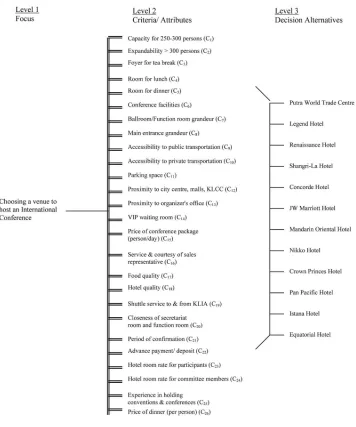
The goal of the decision problem lies in level 1 of the hierarchy. The second level of the hierarchy contains the criteria (attributes) that contribute to the goal of the decision. The lowest level of the hierarchy contains decision alternatives, i.e. the hotels. The hierarchy is shown in Figure 1.
[image:7.595.120.476.260.687.2]111 2 3 4 5 6 7 8 9 1011 1 2 3 4 5 6 7 8 9 2011 1 2 3 4 5 6 7 8 9 30 1 2 3 4 5 6 7 8 9 40 1 2 3 4 5 6 711
Level 1:the focus/goal is the decision of choosing a venue to host an international
conference.
Level 2:this level consists of criteria/attributes that are considered important in
choosing the venue. In this study, a total of 26 criteria were identified based on a focus group involving five organising committee members: the chairman, deputy chairman, the secretary (the first author of this paper) and two other members. The group identified 26 criteria which were perceived to be important in the venue selection process. The criteria are shown at level 2 of the decision hierarchy. Some of the criteria are discussed in the following: though the exact number of participants was unknown at the time of booking the venue, the committee estimated the figure to be in the range of 250–300 persons (C1). So the hotel, which could not accommodate 250 persons, was not considered as a possible venue. Some of the hotel’s accommodation capacity exceeded 300 persons. The committee also felt that after booking for 300 persons, if needed, the hotel should be ready to accommodate the additional number of participants (C2). ‘Service and courtesy of sales representative (C16)’ will be judged when the hotels are visited – careful attention is to be paid on how the committee members are treated by the hotel staff. Hotel room rate for participants and committee members (C23and C24) are not equal for all the hotels. Some hotels provide complimentary rooms for the committee members. Some hotels insist on an advance payment/deposit (C22) whereas others do not require this. The conference organiser’s office is located at Gombak, which is about 10 km north of Kuala Lumpur. In view of traffic jams in the early morning, the distance of the hotel from Gombak (C13) is a matter of concern. Conference facilities (C6) must include internet facilities for the participants, photocopying facilities, flip charts, projectors, etc. Hotel quality (C18) is to be evaluated by the members on the basis of surroundings, overall cleanliness, etc. The price of dinner (C26) varies from one hotel to another even for a pre-specified menu.
Level 3:this level consists of the 12 decision alternatives (hotels) to host
the international conference. The set of hotels includes Putra World Trade Centre (PWTC) (actually this is not a hotel but frequently considered for organising large conferences), Legend Hotel, Renaissance Hotel,
Shangri-La Hotel, Concorde Hotel, JW Marriott Hotel, Mandarin Oriental Hotel, Nikko Hotel, Crown Princes Hotel, Pan Pacific Hotel, Istana Hotel, and
Equatorial Hotel.
4.1.2
Assessing relative importance/preference of criteria/alternatives
After constructing the hierarchy, the next task is to assess the relative importance of the criteria in level 2 with respect to the goal of the decision problem and preference of level 3 decision alternatives with respect to each of the criteria in level 2.
111 2 3 4 5 6 7 8 9 1011 1 2 3 4 5 6 7 8 9 2011 1 2 3 4 5 6 7 8 9 30 1 2 3 4 5 6 7 8 9 40 1 2 3 4 5 6 711 8
Management decision-making by the analytic hierarchy process 25
The pairwise comparisons start with comparing criteria at level 2 with one another in relation to the importance in choosing the venue. A typical question in constructing the pairwise comparison matrix (PCM) for the criteria is: how important is ‘capacity for 250 persons’ relative to ‘expandability to cater for more than 300 persons’? If the importance of ‘capacity for 250 persons’ relative to ‘expandability to cater for more than 300 persons’ is 2, then the importance of ‘expandability to cater for more than 300 persons’ relative to ‘capacity for 250 persons’ is 1/2. The ratios then form a matrix called a ‘reciprocal matrix’ where the lower triangular part is the reciprocal of the upper triangular part. The PCM is constructed using Saaty’s (1/9–9) scale as shown in Table 1.
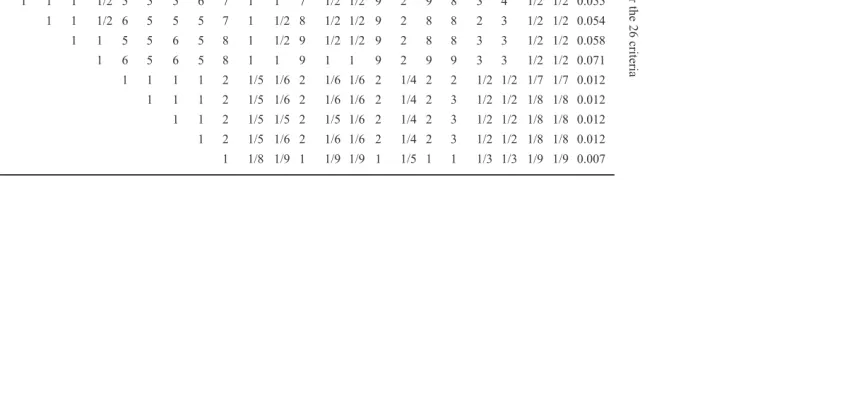
Since the diagonal elements are all equal to one, only comparisons are required where ‘n’ is the number of factors in the level. Each of the group members (previously mentioned) constructed the PCM for the criteria separately. The members were briefed about AHP by the second author of this paper. The conference secretary’s pairwise comparison matrix is shown in Table 2.
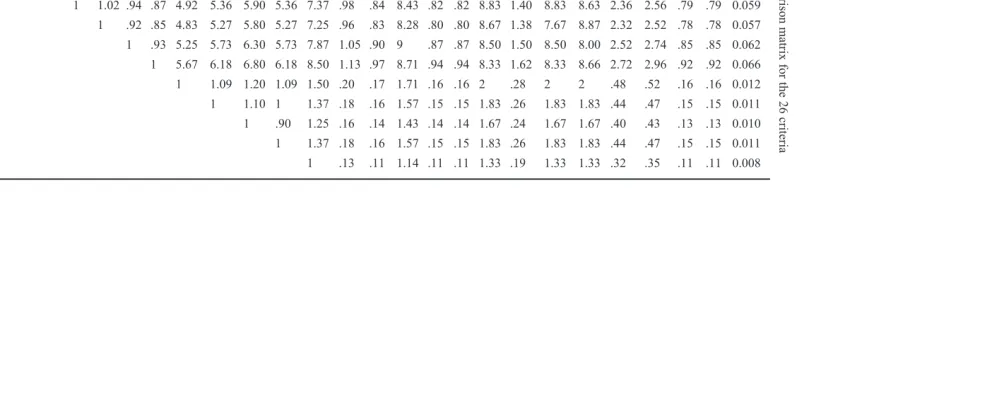
Matrices of the other four members were constructed similarly. Afterwards, the elements for each pairwise comparison (for all the five members) were synthesised using Team Expert Choice software which, in turn, uses geometric mean rule (Basak and Saaty, 1993). The synthesised PCM is shown in Table 3 where the weights are shown in the last column.
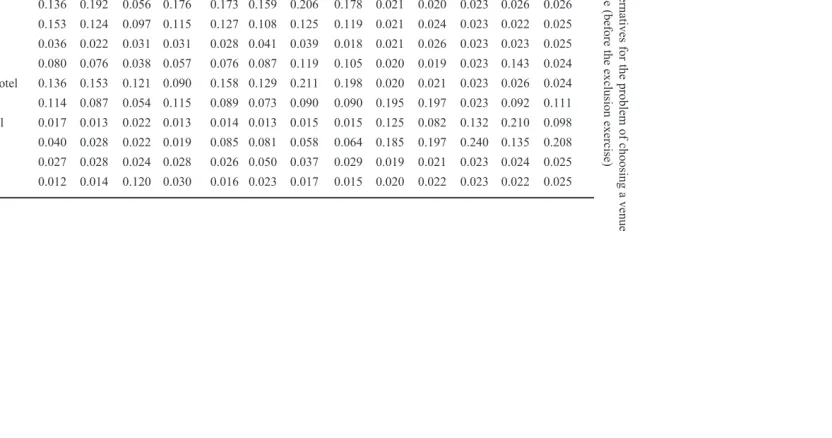
In the next stage, weights of the alternatives with respect to each of the criteria are computed in the same way as has been done for the criteria set. The prerequisite for determining the weights of the alternatives is to know the performances of the individual hotels on various criteria. For this matter, the committee members visited the hotels to collect first-hand information on their performances on the listed criteria. The weights of the alternatives are shown in Table 4. The weights of the alternatives with respect to the first criterion are to be noted. One may think that when two hotels have the capacity for 250 to 300 persons, they should receive the same weights or same preference but, in reality, this may not be the case on account of room size (how the chairs are arranged – cramped or sufficient space between chairs) and the arrangement (layout) of chairs. Since PWTC is not a hotel, for criteria C19, C23, and C24, Legend Hotel is considered in lieu of PWTC. This is because Legend Hotel and PWTC are located in close proximity and Legend can be used for those criteria where PWTC is not applicable. The second last column provides the global weights (also computed using Team Expert Choice) of the alternatives. The last column provides the rank of the alternatives based upon the global weights.
Tab
le
2
A
pa
irw
is
e c
om
pa
ri
son m
at
ri
x for t
he
26 c
ri
te
ri
a
111
2
3
4
5
6
7
8
9
101
1
1
2
3
4
5
6
7
8
9
201
1
1
2
3
4
5
6
7
8
9
30
1
2
3
4
5
6
7
8
9
40
1
2
3
4
5
6
71
1
8
26
R
. Is
lam
and N.A
.
A
bdul
lah
C1 C2 C3 C4 C5 C6 C7 C8 C9 C10 C11 C12 C13 C14 C15 C16 C17 C18 C19 C20 C21 C22 C23 C24 C25 C26 wts.
C1 1 6 2 1 1 1 1 1/2 5 5 5 5 7 1 1/2 8 1/2 1/2 9 2 9 9 3 3 1/2 1/2 0.053
C2 1 1/5 1/6 1/6 1/6 1/7 1/7 1/2 1/2 1/2 1/2 1 1/7 1/8 1 1/8 1/8 2 1/5 2 2 1/3 1/3 1/9 1/9 0.008
C3 1 1/2 1/2 1/2 1/3 1/3 4 3 4 4 6 1/2 1/3 7 1/2 1/2 8 1 8 8 2 3 1/2 1/2 0.038
C4 1 1 1/2 1/2 1/3 5 4 4 5 7 1/2 1/3 6 1/2 1/2 9 2 9 9 3 3 1/3 1/3 0.046
C5 1 1 1 1/2 5 5 5 6 7 1 1 7 1/2 1/2 9 2 9 8 3 4 1/2 1/2 0.055 C6 1 1 1/2 6 5 5 5 7 1 1/2 8 1/2 1/2 9 2 8 8 2 3 1/2 1/2 0.054
C7 1 1 5 5 6 5 8 1 1/2 9 1/2 1/2 9 2 8 8 3 3 1/2 1/2 0.058
C8 1 6 5 6 5 8 1 1 9 1 1 9 2 9 9 3 3 1/2 1/2 0.071
C9 1 1 1 1 2 1/5 1/6 2 1/6 1/6 2 1/4 2 2 1/2 1/2 1/7 1/7 0.012
C10 1 1 1 2 1/5 1/6 2 1/6 1/6 2 1/4 2 3 1/2 1/2 1/8 1/8 0.012
C11 1 1 2 1/5 1/5 2 1/5 1/6 2 1/4 2 3 1/2 1/2 1/8 1/8 0.012
C12 1 2 1/5 1/6 2 1/6 1/6 2 1/4 2 3 1/2 1/2 1/8 1/8 0.012
[image:10.595.174.675.196.400.2]Manage
m
ent
de
ci
si
on-m
ak
ing by
t
he
anal
yt
ic
hi
er
ar
chy
pr
oc
es
s
Tab
le
2
A
pa
irw
is
e c
om
pa
ri
son m
at
ri
x for t
he
26 c
ri
te
ri
a (c
ont
inue
d)
111
2
3
4
5
6
7
8
9
101
1
1
2
3
4
5
6
7
8
9
201
1
1
2
3
4
5
6
7
8
9
30
1
2
3
4
5
6
7
8
9
40
1
2
3
4
5
6
71
1
8
C1 C2 C3 C4 C5 C6 C7 C8 C9 C10 C11 C12 C13 C14 C15 C16 C17 C18 C19 C20 C21 C22 C23 C24 C25 C26 wts.
C14 1 1/2 9 1/2 1/2 9 2 9 9 3 3 1/2 1/2 0.057
C15 1 9 1 1 9 2 9 9 3 3 1 1 0.077
C16 1 1/9 1/9 1 1/6 1 1 1/4 1/3 1/9 1/9 0.077
C17 1 1 9 2 9 9 3 3 1 1 0.076
C18 1 9 2 9 9 3 3 1 1 0.077
C19 1 1/7 1 1 1/4 1/4 1/9 1/9 0.006
C20 1 3 3 2 2 1/2 1/2 0.036
C21 1 1 1/4 1/3 1/9 1/9 0.007
C22 1 1/4 1/3 1/9 1/9 0.007
C23 1 1 1/3 1/3 0.023
C24 1 1/3 1/3 0.021
C25 1 1 0.085
[image:11.595.170.692.199.403.2]Tab
le
3
T
he
s
ynt
he
si
se
d pa
irw
is
e c
om
pa
ri
son m
at
ri
x for t
he
26 c
ri
te
ri
a
111
2
3
4
5
6
7
8
9
101
1
1
2
3
4
5
6
7
8
9
201
1
1
2
3
4
5
6
7
8
9
30
1
2
3
4
5
6
7
8
9
40
1
2
3
4
5
6
71
1
8
28
R
. Is
lam
and N.A
.
A
bdul
lah
C1 C2 C3 C4 C5 C6 C7 C8 C9 C10 C11 C12 C13 C14 C15 C16 C17 C18 C19 C20 C21 C22 C23 C24 C25 C26 wts.
C1 1 6.22 1.22 1.10 .95 .97 .89 .82 4.67 5.09 5.60 5.09 7 .93 .80 8 .78 .78 8.33 1.33 7.33 8.53 2.24 2.43 .76 .76 0.056 C2 1 .19 .16 .15 .16 .14 .13 .75 .82 .90 .82 1.13 .15 .13 1.29 .13 .13 1.50 .21 1.50 1.50 .36 .39 .12 .12 0.009
C3 1 .84 .78 .79 .73 .68 3.83 4.18 4.60 4.18 5.75 .77 .66 6.57 .64 .64 7.67 1.09 7.67 7.67 1.84 2 .62 .62 0.047
C4 1 .93 .95 .87 .81 4.58 5 5.50 5 6.87 .92 .78 7.86 .76 .76 9.17 1.31 8.17 7.17 2.20 2.39 .74 .74 0.055
C5 1 1.02 .94 .87 4.92 5.36 5.90 5.36 7.37 .98 .84 8.43 .82 .82 8.83 1.40 8.83 8.63 2.36 2.56 .79 .79 0.059
C6 1 .92 .85 4.83 5.27 5.80 5.27 7.25 .96 .83 8.28 .80 .80 8.67 1.38 7.67 8.87 2.32 2.52 .78 .78 0.057
C7 1 .93 5.25 5.73 6.30 5.73 7.87 1.05 .90 9 .87 .87 8.50 1.50 8.50 8.00 2.52 2.74 .85 .85 0.062
C8 1 5.67 6.18 6.80 6.18 8.50 1.13 .97 8.71 .94 .94 8.33 1.62 8.33 8.66 2.72 2.96 .92 .92 0.066
C9 1 1.09 1.20 1.09 1.50 .20 .17 1.71 .16 .16 2 .28 2 2 .48 .52 .16 .16 0.012
C10 1 1.10 1 1.37 .18 .16 1.57 .15 .15 1.83 .26 1.83 1.83 .44 .47 .15 .15 0.011
C11 1 .90 1.25 .16 .14 1.43 .14 .14 1.67 .24 1.67 1.67 .40 .43 .13 .13 0.010
C12 1 1.37 .18 .16 1.57 .15 .15 1.83 .26 1.83 1.83 .44 .47 .15 .15 0.011
[image:12.595.99.686.194.402.2]Manage
m
ent
de
ci
si
on-m
ak
ing by
t
he
anal
yt
ic
hi
er
ar
chy
pr
oc
es
s
Tab
le
3
T
he
s
ynt
he
si
se
d pa
irw
is
e c
om
pa
ri
son m
at
ri
x for t
he
26 c
ri
te
ri
a (c
ont
inue
d)
111
2
3
4
5
6
7
8
9
101
1
1
2
3
4
5
6
7
8
9
201
1
1
2
3
4
5
6
7
8
9
30
1
2
3
4
5
6
7
8
9
40
1
2
3
4
5
6
71
1
8
C1 C2 C3 C4 C5 C6 C7 C8 C9 C10 C11 C12 C13 C14 C15 C16 C17 C18 C19 C20 C21 C22 C23 C24 C25 C26 wts.
C14 1 .86 8.57 .83 .83 9 1.42 9 9 2.40 2.61 .81 .81 0.060
C15 1 9 .97 .97 8.67 1.67 8.66 8.66 2.80 3.04 .94 .94 0.068
C16 1 .09 .09 1.16 .17 1.16 1.16 .28 .30 .09 .09 0.007
C17 1 1 9 1.71 8 8.50 2.88 3.13 .97 .97 0.070
C18 1 8 1.71 9 8.50 2.88 3.13 .97 .97 0.070
C19 1 .14 1 1 .24 .26 .08 .08 0.007
C20 1 7 7 1.68 1.82 .57 .57 0.043
C21 1 1 .24 .26 .08 .08 0.007
C22 1 .24 .26 .08 .08 0.007
C23 1 1.09 .34 .34 0.025
C24 1 .31 .31 0.023
C25 1 1 0.075
[image:13.595.91.688.184.392.2]Tab
le
4
W
ei
ght
s of t
he
c
ri
te
ri
a a
nd t
he
a
lte
rna
tive
s for t
he
probl
em
of c
hoos
ing a
ve
nue
to hos
t a
n i
nt
erna
tiona
l c
onfe
re
nc
e (be
fore
t
he
e
xc
lus
ion e
xe
rc
is
e)
111
2
3
4
5
6
7
8
9
101
1
1
2
3
4
5
6
7
8
9
201
1
1
2
3
4
5
6
7
8
9
30
1
2
3
4
5
6
7
8
9
40
1
2
3
4
5
6
71
1
8
30
R
. Is
lam
and N.A
.
A
bdul
lah
Criteria C1 C2 C3 C4 C5 C6 C7 C8 C9 C10 C11 C12 C13
(0.056) (0.009) (0.047) (0.055) (0.059) (0.057) (0.062) (0.066) (0.012) (0.011) (0.010) (0.011) (0.008)
Alternatives
PWTC 0.186 0.224 0.322 0.291 0.168 0.195 0.041 0.126 0.176 0.185 0.251 0.117 0.208
Legend Hotel 0.062 0.039 0.093 0.036 0.039 0.040 0.041 0.041 0.176 0.185 0.193 0.158 0.199
Renaissance Hotel 0.136 0.192 0.056 0.176 0.173 0.159 0.206 0.178 0.021 0.020 0.023 0.026 0.026 Shangri-La Hotel 0.153 0.124 0.097 0.115 0.127 0.108 0.125 0.119 0.021 0.024 0.023 0.022 0.025
Concorde Hotel 0.036 0.022 0.031 0.031 0.028 0.041 0.039 0.018 0.021 0.026 0.023 0.023 0.025
JW Marriot Hotel 0.080 0.076 0.038 0.057 0.076 0.087 0.119 0.105 0.020 0.019 0.023 0.143 0.024
Mandarin Oriental Hotel 0.136 0.153 0.121 0.090 0.158 0.129 0.211 0.198 0.020 0.021 0.023 0.026 0.024
Nikko Hotel 0.114 0.087 0.054 0.115 0.089 0.073 0.090 0.090 0.195 0.197 0.023 0.092 0.111
Crown Princess Hotel 0.017 0.013 0.022 0.013 0.014 0.013 0.015 0.015 0.125 0.082 0.132 0.210 0.098
Pan Pacific Hotel 0.040 0.028 0.022 0.019 0.085 0.081 0.058 0.064 0.185 0.197 0.240 0.135 0.208
Istana Hotel 0.027 0.028 0.024 0.028 0.026 0.050 0.037 0.029 0.019 0.021 0.023 0.024 0.025
[image:14.595.179.666.198.417.2]Manage m ent de ci si on-m ak ing by t he anal yt ic hi er ar chy pr oc es s Tab le 4 W ei ght
s of t
he c ri te ri a a nd t he a lte rna tive
s for t
he probl em of c hoos ing a ve nue to hos t a n i nt erna tiona l c onfe re nc e (be fore t he e xc lus ion e xe rc is e) (c ont inue d) 111 2 3 4 5 6 7 8 9 101 1 1 2 3 4 5 6 7 8 9 201 1 1 2 3 4 5 6 7 8 9 30 1 2 3 4 5 6 7 8 9 40 1 2 3 4 5 6 71 1 8
Criteria C14 C15 C16 C17 C18 C19 C20 C21 C22 C23 C24 C25 C26 GW* R**
(0.060) (0.068) (0.007) (0.070) (0.070) (0.007) (0.043) (0.007) (0.007) (0.025) (0.023) (0.075) (0.075)
Alternatives
PWTC 0.359 0.149 0.149 0.028 0.153 0.164 0.169 0.094 0.082 0.163 0.214 0.433 0.085 0.188 1
Legend Hotel 0.129 0.165 0.207 0.090 0.054 0.164 0.168 0.064 0.087 0.163 0.214 0.042 0.085 0.088 4
Renaissance Hotel 0.042 0.042 0.016 0.108 0.166 0.088 0.024 0.099 0.121 0.041 0.055 0.040 0.128 0.109 2
Shangri-La Hotel 0.042 0.028 0.038 0.076 0.125 0.066 0.038 0.094 0.082 0.014 0.025 0.041 0.082 0.083 6
Concorde Hotel 0.042 0.098 0.043 0.041 0.021 0.062 0.032 0.084 0.067 0.171 0.025 0.039 0.087 0.045 10
JW Marriot Hotel 0.055 0.172 0.040 0.065 0.123 0.07 0.073 0.079 0.093 0.030 0.025 0.038 0.101 0.081 7
Mandarin Oriental Hotel 0.080 0.012 0.045 0.088 0.148 0.062 0.073 0.082 0.082 0.010 0.045 0.044 0.069 0.101 3
Nikko Hotel 0.080 0.036 0.044 0.079 0.095 0.081 0.079 0.067 0.093 0.022 0.025 0.145 0.077 0.086 5
Crown Princess Hotel 0.037 0.064 0.118 0.033 0.017 0.062 0.146 0.082 0.082 0.077 0.074 0.042 0.056 0.043 11 Pan Pacific Hotel 0.054 0.099 0.022 0.030 0.035 0.075 0.082 0.094 0.064 0.099 0.207 0.042 0.085 0.068 8
Istana Hotel 0.046 0.064 0.090 0.036 0.027 0.046 0.058 0.087 0.067 0.099 0.025 0.042 0.067 0.041 12
Equatorial Hotel 0.032 0.070 0.188 0.327 0.032 0.062 0.054 0.076 0.082 0.109 0.068 0.053 0.079 0.065 9
[image:15.595.129.692.153.415.2]4.2
Phase 2: the exclusion exercise
Since there are 26 criteria, altogether 26(26 - 1)/2 = 365 comparisons are made to construct the criteria PCM. Further, for each of these 26 criteria, a PCM is constructed for the alternatives. The size of each matrix is 12. Hence for all the 26 criteria, the total number of pairwise comparisons made (for alternatives only) is 26 × 12(12 - 1)/2 = 1716. Therefore, at the first phase, the total number of pairwise comparisons made is 365 + 1716 = 2081.
In the next phase of the study, we exclude the criteria that carry relatively lesser weights. In order to observe the effect on the ranking of the alternatives, we kept the following 12 criteria:
1) capacity for 250–300 persons (C1)
2) room for lunch (C4)
3) room for dinner (C5)
4) conference facilities (C6)
5) ballroom/function room grandeur (C7)
6) main entrance grandeur (C8)
7) VIP waiting room (C14)
8) price of conference package (C15)
9) food quality (C17)
10) hotel quality (C18)
11) experience in holding conventions and conferences (C25)
12) price of dinner (C26).
These 12 criteria are selected because they possess relatively higher weights compared with the rest. The weights of these criteria are adjusted so that the sum becomes unity. Since the weights of the alternatives with respect to these criteria are already computed, no further pairwise comparison matrix is required to be constructed. The ranking of the alternatives with respect to these 12 criteria has been shown in Table 5.
The correlation coefficient of the ranks obtained for the alternatives in the above two exercises is 0.923, which is highly significant (p < 0.001). This result suggests that there is a strong positive correlation between the ranks of the alternatives before and after the exclusion exercise. It is also to be noted that, in the second phase, the total number of pairwise comparison required is:
Therefore, if only the dominant criteria are used, then we can save about 2081 - 858 = 1223 pairwise comparisons (58.77% saving). Even after these savings we have been able to derive rankings of the alternatives in two exercises that are sufficiently close to each other.
111 2 3 4 5 6 7 8 9 1011 1 2 3 4 5 6 7 8 9 2011 1 2 3 4 5 6 7 8 9 30 1 2 3 4 5 6 7 8 9 40 1 2 3 4 5 6 711 8
Manage m ent de ci si on-m ak ing by t he anal yt ic hi er ar chy pr oc es s Tab le 5 W ei ght
s of t
he c ri te ri a a nd a lte rna tive
s for t
he probl em of c hoos ing a ve nue to hos t a n i nt erna tiona l c onfe re nc e (a ft er t he e xc lus ion e xe rc is e) 111 2 3 4 5 6 7 8 9 101 1 1 2 3 4 5 6 7 8 9 201 1 1 2 3 4 5 6 7 8 9 30 1 2 3 4 5 6 7 8 9 40 1 2 3 4 5 6 71 1 8
Criteria C1 C4 C5 C6 C7 C8 C14 C15 C17 C18 C25 C26 GW R
(0.072) (0.071) (0.076) (0.074) (0.080) (0.085) (0.078) (0.088) (0.090) (0.090) (0.097) (0.097)
Alternatives
PWTC 0.186 0.291 0.168 0.195 0.041 0.126 0.359 0.149 0.028 0.153 0.433 0.085 0.183 1
Legend Hotel 0.062 0.036 0.039 0.040 0.041 0.041 0.129 0.165 0.090 0.054 0.042 0.085 0.069 7
Renaissance Hotel 0.136 0.176 0.173 0.159 0.206 0.178 0.042 0.042 0.108 0.166 0.040 0.128 0.127 2
Shangri-La Hotel 0.153 0.115 0.127 0.108 0.125 0.119 0.042 0.028 0.076 0.125 0.041 0.082 0.093 4
Concorde Hotel 0.036 0.031 0.028 0.041 0.039 0.018 0.042 0.098 0.041 0.021 0.039 0.087 0.044 10
JW Marriot Hotel 0.080 0.057 0.076 0.087 0.119 0.105 0.055 0.172 0.065 0.123 0.038 0.101 0.090 5
Mandarin Oriental Hotel 0.136 0.090 0.158 0.129 0.211 0.198 0.080 0.012 0.088 0.148 0.044 0.069 0.111 3
Nikko Hotel 0.114 0.115 0.089 0.073 0.090 0.090 0.080 0.036 0.079 0.095 0.145 0.077 0.089 6
Crown Princess Hotel 0.017 0.013 0.014 0.013 0.015 0.015 0.037 0.064 0.033 0.017 0.042 0.056 0.029 12
Pan Pacific Hotel 0.040 0.019 0.085 0.081 0.058 0.064 0.054 0.099 0.030 0.035 0.042 0.085 0.057 9
Istana Hotel 0.027 0.028 0.026 0.050 0.037 0.029 0.046 0.064 0.036 0.027 0.042 0.067 0.040 11
[image:17.595.160.684.168.416.2]5
Reducing the number of criteria
The above experimental study shows the minimal effect of exclusion of the less important criteria from the decision tree. However, it is to be noted that, in the foregoing experiment, we have identified the less important criteria only after determining the weights of all the criteria by AHP. The proposal of this paper is to exclude less important criteria at the beginning of the exercise. Now the question is: in the beginning how do we know which criteria are important and which are not? A simple solution to this problem is to apply Nominal Group Technique (NGT) at the beginning of the exercise.
NGT is a highly useful, structured brainstorming technique that is used to produce a large number of ideas pertaining to an issue/problem while ensuring balanced participation among the group members (Delbecq et al., 1975). NGT not only generates a large number of ideas, but also it prioritises those ideas using certain voting techniques. After the voting session, the ideas that receive a higher number of votes are generally considered superior or important ideas. In the following, we provide the working rule of NGT that can be applied to reduce the number of criteria by eliminating the lesser important criteria.
Nominal Group Technique requires a group of about eight people. This group is facilitated by someone who is expected to have prior experience in conducting some nominal group sessions. The group members meet in a meeting room equipped with a marker board and marker pen and each of them has a few sheets of paper. The steps to be followed are as follows:
Step 1: silent generation of criteria in writing – participants are given about ten minutes to write down as many criteria as possible pertaining to the decision making problem.
Step 2: round-robin recording of criteria – the facilitator asks every participant (starting from one end of the room) to provide the most important criterion (participants have to judge which one is the most important criterion) from his/her list. If there are eight participants then there should be eight important criteria recorded in the first round. After this, the facilitator goes for the second round, collecting the second most important criterion from the lists of all the participants. Subsequent rounds are carried out till all the criteria are exhausted from the participants’ lists. By this time, all the relevant criteria are written down on the marker board. The list generated is usually called the master list.
Step 3: voting to select the most important criteria – each participant is asked to identify the most important five criteria from the master list on the board and rank them using a 1 to 5 scale according to their importance. The most important criterion is assigned a rating of 5 and the least among these five criteria receives the rating of 1. When all the participants finish the ranking task, cards are collected from them and votes are written against the criteria on the board. When the votes are aggregated, it is easy to single out the important criteria. If there are, say, 25 criteria in the master list and we want to consider the most important ten, then the ten criteria that receive higher votes are to be chosen.
With the above proposed modification of the traditional AHP, the number of criteria is reduced significantly. The nominal group session eliminates those criteria that are insignificant. The removal of such criteria has minimal effect on the choice of the best
111 2 3 4 5 6 7 8 9 1011 1 2 3 4 5 6 7 8 9 2011 1 2 3 4 5 6 7 8 9 30 1 2 3 4 5 6 7 8 9 40 1 2 3 4 5 6 711 8
Management decision-making by the analytic hierarchy process 35
alternative as shown in the foregoing experimental study. With the reduction of the number of criteria, the number of pairwise comparisons is also reduced, decision analysis is simplified and the time needed for the whole work is reduced significantly. This makes the use of AHP less taxing on the part of the decision maker.
In the following, we cite an example where NGT has been applied to reduce the number of criteria for a multi-criteria decision-making problem.
5.1
Example
Choosing a foreign country for expansion of a certain manufacturing business – there are numerous multinational companies in the business world. To extend business across nations, these companies choose countries systematically and after thorough analysis. In fact, choice of a country is a well-known MCDM problem. For a typical manufacturing (electronics, electrical, chemical, etc) company, 24 criteria are identified from relevant literature which are shown in Table 6. Initially, the manufacturing company which is planning to expand business overseas may choose, say, 15 countries. All these countries are to be evaluated based upon all the 24 criteria. Application of AHP to solve the problem requires altogether 2796 pairwise comparisons. However, it is to be noted that all these criteria are not equally important. In the initial phase, the criteria can be reduced by applying NGT. In fact, we conducted a nominal group session and seven academic staff from the authors’ department and one academic staff member from the Economics department participated1. The results are shown in the third column of
Table 6. The outcome of the nominal group session is the identification of the major criteria (out of a total 24) in choosing the foreign country for expansion of a manufacturing business.
[image:19.595.118.475.465.689.2]111 2 3 4 5 6 7 8 9 1011 1 2 3 4 5 6 7 8 9 2011 1 2 3 4 5 6 7 8 9 30 1 2 3 4 5 6 7 8 9 40 1 2 3 4 5 6 711
Table 6 Major criteria in choosing a country for expansion of a manufacturing business
No. Criteria Weights Rank
1 Economy of the country 4 + 4 + 4 + 3 = 17 3
2 Language
3 Threat of expropriation
4 Government interference 2 + 4 = 6 7
5 Government stability 5 + 5 + 5 + 5 + 5 + 2 = 27 1
6 Labour skill (training requirement) 2
7 Work culture/worker productivity 1
8 Local equity and financing
9 Availability of technology 3 + 3 = 6 7
10 Transportation and distribution systems 3 + 4 + 2 + 3 + 1 + 5 = 18 2
11 Competitors’ strength
12 Distance from market concentration
13 Climate
For the actual evaluation of the countries by AHP, the decision makers can consider those criteria that receive higher weights. They may consider five, seven or ten criteria. For the current exercise, the seven most important criteria (obtained from the nominal group session) are listed below:
government satiability
transportation and distribution systems
economy of the country
wage rate
financial incentive by the local government
tax structure
availability of technology (or Government interference).
If the decision makers decide to consider only these seven criteria, then the total number of pairwise comparisons required for the 15 countries is 756. Therefore, elimination of insignificant criteria saves 2796 - 756 = 2040 pairwise comparisons.
Occurrences of multi-criteria decision-making (MCDM) problems are quite common in many areas. Saaty and Forman (2000) have compiled about 352 MCDM problems in the areas of conflict analysis, education, energy, finance, forestry, health, information system, marketing, military, polities, resource allocation, sports, technology, etc. Many of these problems involve large numbers of criteria. Table 7 provides 29 MCDM problems (adopted from Saaty and Forman (2000)) that involve 20 or more than 20 criteria.
111 2 3 4 5 6 7 8 9 1011 1 2 3 4 5 6 7 8 9 2011 1 2 3 4 5 6 7 8 9 30 1 2 3 4 5 6 7 8 9 40 1 2 3 4 5 6 711 8
[image:20.595.117.480.167.337.2]36 R. Islam and N.A. Abdullah
Table 6 Major criteria in choosing a country for expansion of a manufacturing business (continued)
No. Criteria Weights Rank
15 Tax structure 1 + 3 + 3 = 7 6
16 Availability of raw materials 5
17 Construction cost
18 Business climate/opportunity 2 + 4 = 6
19 Wage rate 2 + 2 + 1 + 4 = 9 4
22 Quality of life
21 Real estate, utility costs
22 Exchange rate 1 + 2 + 2 = 5
23 Financial incentive by local government 1 + 4 + 3 = 8 5
Management decision-making by the analytic hierarchy process 37
In view of the widespread occurrences of MCDM problems involving large numbers of criteria, application of the proposed methodology in this paper may be considered promising.
[image:21.595.119.474.155.637.2]111 2 3 4 5 6 7 8 9 1011 1 2 3 4 5 6 7 8 9 2011 1 2 3 4 5 6 7 8 9 30 1 2 3 4 5 6 7 8 9 40 1 2 3 4 5 6 711
Table 7 Selected MCDM problems that involve large numbers of criteria
No. Problem No. of criteria
1 Deciding whether to bid for a contract 20
2 Deciding which banks should be considered as candidates for acquisition? 19
3 Selecting the best company to acquire 23
4 Acquiring an MIS system for vehicle fleet management 31
5 Selecting a software package for local union’s membership and dues 39
processing
6 Selecting a desktop publishing software 32
7 Selecting a database system 25
8 Establishing priorities for recommended projects in order to distribute limited 29 resources and time
9 Evaluating the quality of software products 28
10 Deciding which areas of land are suitable for commercial development 30
11 Prioritising new and backlog projects 33
12 Selecting a caterer 22
13 Selecting a site for a shopping centre 26
14 Choosing the best entry mode for a foreign market 38
15 Choosing a successor for a university president 32
16 Should the college of Arts and Sciences have a language requirement? 20
17 Establishing a policy for AIDS in a community college 20
18 Determine which MBA programmes best foster creative, competent managers 44
19 Should the US support an Arab Rapid Development Force? 30
20 Determining viable solutions to the problem of homelessness 20
21 Prioritising hazardous wastes to determine a schedule for clean up 44
22 Determining the best level of dam reservoir 30
23 Selecting a candidate to succeed to a vacated mid-level management position 21
24 Choosing an information network system for an economic community 28
25 Choosing the best health care plan 22
26 Should a public hospital continue operations, sell, or lease its facilities 20
to a private organisation?
27 Selecting candidates for promotion to the coast guard officer crops 25
28 Selecting a graduate business school 25
29 Choosing stock(s) for portfolio selection 42
6
Conclusions
The Analytic Hierarchy Process is a useful multi-criteria decision making technique where a problem is represented in a hierarchical form. Frequently, the users of AHP encounter the problem of performing all the necessary pairwise comparisons. The task of forming all the pairwise comparison matrices is greater in the presence of larger number of criteria. Business managers who are frequently constrained by time are rather discouraged to apply AHP for large-scale problems. The proposal (integrating AHP with NGT) put forward in this paper is expected to provide a new insight in applying AHP for solving large-scale multi-criteria decision-making problems.
The proposed methodology is applicable when all the criteria are put in one level (usually level 2) of the hierarchy, as shown in Figure 1. However, when a large number of criteria exists, in AHP they are usually put under major categories, like ‘economical’, ‘technological’, ‘social’, etc. In this case, too, the proposed methodology can be applied by segregating the criteria from the categories and, after application of NGT, returning the reduced number of criteria to their respective original categories. Furthermore, NGT can also be applied for each of the categories should they consist of a large number of criteria.
Acknowledgements
The financial support provided by the Research Centre, International Islamic University Malaysia (Grant number: IIUM/1.11/RC/07/01), to carry out the work is gratefully acknowledged.
References
Bahmani, N., Javalgi, G. and Blumberg, A. (1986) ‘An application of the analytic hierarchy process for a consumer choice problem’, Marketing Science, Vol. 9, pp.402–406.
Basak, I. and Saaty, T.L. (1993) ‘Group decision making using the analytic hierarchy process’,
Mathematical and Computer Modelling, Vol. 17, pp.101–109.
Bhutta, K.S. and Huq, F. (2002) ‘Supplier selection problem: a comparison of the total cost of ownership and analytic hierarchy process approaches’, Supply Chain Management, Vol. 7, Nos. 3/4, pp.126–135.
Bolster, J., Janjigian, V. and Trahan, A. (1995) ‘Determining investor suitability using the analytic hierarchy process’, Financial Analysis Journal, Vol. 51, No. 4, pp.63–73.
Cheng, C.H. (1997) ‘Evaluating naval teaching missile systems by fuzzy AHP based on the grade value of membership function’, European Journal of Operational Research, Vol. 96, No. 2, pp.342–350.
Cheng, E.W.L. and Li, H. (2001) ‘Information priority-setting for better resource allocation using analytic hierarchy process’, Information Management and Computer Security, Vol. 9, No. 2, pp.61–70.
Chin, K.S., Chiu, S. and Tummala, V.M.R. (1999) ‘An evaluation of success factors using the AHP to implement ISO 14001-based EMS’, International Journal of Quality and Reliability Management, Vol. 16, No. 4, pp.341–361.
111 2 3 4 5 6 7 8 9 1011 1 2 3 4 5 6 7 8 9 2011 1 2 3 4 5 6 7 8 9 30 1 2 3 4 5 6 7 8 9 40 1 2 3 4 5 6 711 8
Management decision-making by the analytic hierarchy process 39
Davies, M. (2001) ‘Adaptive AHP: a review of marketing applications with extensions’,
European Journal of Marketing, Vol. 35, Nos. 7/8, pp.872–893.
Davis, L. and Williams, G. (1994) ‘Evaluating and selecting simulation software using the analytic hierarchy process’, Integrated Manufacturing System, Vol. 5, No. 1, pp.23–32.
Delbecq, A.L., Van de Ven, A.H. and Gustafson, D.H. (1975) Group Techniques for Program Planning: A Guide to Nominal Group and Delphi Process, Glenview, IT: Scott-Foresman. Dyer, R.F., Forman, E.H. and Mustafa, M. (1992) ‘Decision support for media selection using
the analytic hierarchy process’, Journal of Advertising, Vol. 21, No. 1.
Harker, P.T. (1987a) ‘Alternative modes of questioning in the analytic hierarchy process’,
Mathematical Modelling, Vol. 9, pp.41–46.
Harker, P.T. (1987b) ‘Incomplete pairwise comparisons in the analytic hierarchy process’,
Mathematical Modelling, Vol. 9, pp.353–360.
Islam, R., Biswal, M.P. and Alam, S.S. (1997) ‘Clusterization of alternatives in the analytic hierarchy process’, Military Operations Research, Vol. 3, No. 1, pp.69–78.
Joh, C.H. (1997) ‘Analytic hierarchy process for robot selection’, Journal of Manufacturing Systems, Vol. 16, No. 5, pp.381–386.
Kim, S.C. and Min, K.J. (2004) ‘Determining multi-criteria priorities in the planning of electric power generation: the development of an analytic hierarchy process for using the opinions of experts’, International Journal of Management, Vol. 21, No. 2, pp.186–193.
Labib, A.W., O’Connor, R.F. and Williams, G.B. (1998) ‘An effective maintenance system using the analytic hierarchy process’, Integrated Manufacturing System, Vol. 9, No. 2.
Liang, W.Y. (2003) ‘The analytic hierarchy process in project evaluation: an R & D case study in Taiwan’, Benchmarking, Vol. 10, No. 5, pp.445–456.
Lim, K.H. and Swenseth, S.R. (1993) ‘An iterative procedure for reducing problem size in large scale AHP problems’, European Journal of Operational Research, Vol. 67, pp.64–74. Millet, I. and Wedley, W.C. (2002) ‘Modelling risk and uncertainty with the analytic hierarchy
process’, Journal of Multicriteria Decision Analysis, Vol. 11, No. 2, pp.97–107.
Min, H. (1994) ‘Location analysis of international consolidation terminals using the analytic hierarchy process’, Journal of Business Logistics, Vol. 15, No. 2, pp.25–44.
Ramanathan, R. and Ganesh, L.S. (1995) ‘Using AHP for resource allocation problems’,
European Journal of Operational Research, Vol. 80, pp.410–417.
Razmi, J., Rahnejat, H. and Khan. M.K. (1998) ‘Use of analytic hierarchy process in classification of push, pull and hybrid push-pull systems for production planning’, International Journal of Operations and Production Management, Vol. 18, No. 11, pp.1134–1151.
Saaty, T.L. (1977) ‘A scaling method for priorities in hierarchical structures’, Journal of Mathematical Psychology, Vol. 15, pp.234–281.
Saaty, T.L. (1980) The Analytic Hierarchy Process, New York: McGraw-Hill.
Saaty, T.L. (1987) ‘Risk – its priority and probability: the analytic hierarchy process’,
Risk Analysis, Vol. 7, pp.159–172.
Saaty, T.L. (1991) ‘Modelling the graduate business school admission process’,
Socio-Economic Planning Science, Vol. 25, pp.155–162.
Saaty, T.L. and Forman, E.H. (2000) The Hierarchon: A Dictionary of Hierarchies,
Pittsburgh: AHP Publications Series, RWS Publications.
Saaty, T.L. and Gholamnezhad, H. (1981) ‘Oil prices: 1985 and 1990’, Energy System and Policy,
Vol. 5, pp.303–318.
Tadisina, S.K., Troutt, M.D. and Bhasin, V. (1991) ‘Selecting a doctoral program using the analytic hierarchy process – the importance of perspectives’, Journal of Operational Research Society, Vol. 12, No. 8, pp.631–638.
Udo, G.G. (2000) ‘Using analytic hierarchy process to analyze the information technology outsourcing decision’, Industrial Management and Data Systems,Vol. 100, No. 9, pp.421–429. Weiss, E.N. and Rao, V.R. (1987) ‘AHP design issues for large-scale systems’, Decision Science,
Vol. 8, pp.43–68.
Notes
1 The participants are: one professor (International Business), two associate professors
(International Trade/Operations Management), two assistant professors (International Business/General Management), three lecturers (Finance/Management Science).
111 2 3 4 5 6 7 8 9 1011 1 2 3 4 5 6 7 8 9 2011 1 2 3 4 5 6 7 8 9 30 1 2 3 4 5 6 7 8 9 40 1 2 3 4 5 6 711 8