Volume 65– No.7, March 2013
Hybrid Analytic Hierarchy Process Fuzzy Linear
Programming Approach for Weapon Systems Screening
Remica Aggarwal
Department of Management Birla Institute of Technology & Science
Pilani-333031, Rajasthan
ABSTRACT
Screening weapon-systems is a critical task in determining whether a systems development effort will be successful and eventually provide the increased war fighting capability the user had originally envisioned. Weapon system selection is a multi-criteria decision problem that must be accomplished within a constrained resource environment. Several alternatives must be considered and evaluated in terms of many different conflicting criteria and sub criteria and therefore an effective evaluation approach is essential to improve decision quality. Analytic hierarchy process (AHP) is one such technique used by the researchers over the years in establishing the relative values of military weapon system. Despite its popularity, some shortcomings of AHP have been reported in the literature, which have limited its applicability. This research presents a hybrid AHP-FLP approach, integrating an analytic hierarchy process (AHP) with a linear programming model under fuzzy environment (FLP) to a hypothetical case of screening new weapon systems.
General Terms
Multi-criteria decision making, Multi -Objective Optimization
Keywords
AHP, linear programming, fuzzy linear programming.
1.
INTRODUCTION
Weapon systems are regarded as crucial to the outcome of war and therefore the selection of weapon systems is a critical national decision. It is an important issue as an improper weapon selection can negatively affect the overall performance and productivity of a defense system. Selecting the new weapon is a time-consuming and difficult process, requiring advanced knowledge and deep experience. The rapid development of military technologies makes weapon systems ever more sophisticated, expensive, and quickly accelerates research on methods for selection of these systems. The Republic of Korea (ROK) Ministry of National Defense [1] (MND) has been raising its force investment budget to more than 30% of its defense budget, most of which is for weapon systems procurement. Finance minister Pranab Mukherjee has announced more than 17% hike in India's defense expenditure for the financial year 2012-13, as the country looks to off-set growing Chinese dominance in Asia. All this reflects the current system demands from the analysts to develop concrete and tangible methods for the selection of weapon systems.
Like most real-world decision making problems, the selection of a weapon systems requires a multiple criteria decision analysis (MCDA). Ho [2] classified MCDAs into two technical categories, multiple objective decision making (MODM) and multiple attribute decision making (MADM). MADM selects the best alternative among the various attributes that are to be considered. One of the most popular MADM techniques includes AHP [3]. AHP structurally combines tangible and intangible criteria with alternatives in decision making and logically integrates the judgment, experience, and intuition of decision makers. Because of its usability and flexibility, AHP has been widely applied to complex and unstructured decision making problems such as military decision making. Several literatures are available which makes use of AHP for weapon system selection. Some of the prominent are by Cheng [4] which proposes performance evaluation and optimal selection of weapon systems having multi-level and multi-factor features. On weapon system projects, some researchers applied combined approaches such as a hybrid AHP-integer programming approach to screen weapon systems projects [5] and an AHP approach based on linguistic variable weights ( [4], [6]). A detailed review of various applications of AHP in different settings is provided by [7].
Although the purpose of crisp AHP is to capture the expert’s knowledge, the traditional AHP still may not reflect the human thinking style [8]. Uncertainty of the information along with inherent difficulties related to human knowledge make the decision making relating to weapon system selection highly complicated. The multiple criteria are considered at the same time, with various weights and thresholds, having the potential to reflect at a very satisfactory degree the vague preferences of the Decision makers. Assigning different weights to various criteria, a fuzzy multi-objective model enables the decision makers to consider the vagueness of information. Therefore, AHP methodology integrated with the fuzzy multi-objective linear programming model has been adopted as an alternative to the conventional and singular methods of weight derivation in AHP. This paper applies a hybrid method of Analytical Hierarchy Process weighted Fuzzy Linear Programming model (AHP-FLP) to a hypothetical case of weapon system selection. It is shown that the weights calculated by AHP-FLP approach are in line or better than the conventional AHP approach.
2.
METHODOLOGY
2.1
Analytic Hierarchy Process
The AHP consists of three main operations, including hierarchy construction, priority analysis and consistency verification. First of all, the decision makers need to break down complex multiple criteria decision problems into its component parts of which every possible attributes are arranged into multiple hierarchical levels. After that, they have to compare each cluster in the same level in a pair wise fashion based on their own experience and knowledge. Since the comparisons are carried out through personal or subjective judgments, some degree of inconsistency may be occurred. To guarantee the judgments are consistent, the final operation called consistency verification is incorporated in order to measure the degree of consistency among the pair wise comparisons by computing the consistency ratio. If it is found that the consistency ratio exceeds the limit (i.e. if CR>0.1), the decision makers should review and revise the pair wise comparisons. Once all pair wise comparisons are carried out at every level, and are proved to be consistent, the judgments can then be synthesized to find out the priority ranking of each criterion and its attributes.
2.2 Analytical Hierarchy Process - Fuzzy
Linear Programming Model (AHP-FLP)
For weapon system selection problems, the collected data may not behave crisply and they are typically fuzzy in nature. Bellman and Zadeh [9] suggested a fuzzy programming model for decision making in fuzzy environment. Later, this method was used by [10] to solve fuzzy multi-objective linear programming problems. In this subsection, the general fuzzy multi-objective model for weapon system selection is presented in the following manner ([11],[12]).
Find a vector X[ ,x x1 2,...xn] which maximizes the employee performance using objective function Zk with for number of m criteria. An imprecise aspiration levels has been assigned to the objective by incorporating the objective function as a fuzzy constraint with a restriction (aspiration) level. The inequalities are defined softly if the requirement (resource) constants are defined imprecisely.
Find X
Subject to
0 1
1
( ) 1, ,...
n
k ki i k
i n
ri i r i
Z X c x Z k m
a x b
(P1) kic
,a
riandb
rare crisp values. In this model, the sign indicates the fuzzy environment. denotes the fuzzified version of
interpretation “essentially greater than or equal to” . Zk0 is the aspiration level that the decision maker wants to reach. Every objective function value Zk , changeslinearly from Zk* (minimum value of ) to Zk0 (maximum value of
Z
k ).Based on linear membership function, maximization goals k
Z are given as follows :
1 0 1 0 * 0 1 1 0 * *
1 ; ( )
( )
( ) ; ( ) , 1, 2,...
0 ; ( )
k
k
Z k k
k k
k k
Z X Z
Z Z X
X Z Z X Z k m
Z Z
Z X Z
The model formulated in (P1) can be solved using weighted additive model which is widely used in vector – objective optimization problems, the basic concept is to use a single utility function to express the overall performance of decision maker draw out the relative importance of criteria [13] . In this approach, multiplying each membership function of fuzzy goals by their corresponding weights and then adding the results together to obtain a linear weighted utility function. The weighted additive model proposed by Sakawa [14] is equivalent to solving the following crisp single objective programming model[15]:
Maximize 1 m k k k w
Subject to 1 ( )[0,1] 1, 2,... 0
1; 0 1, 2,... k Z k k k m k k i X k m w w
x i n
(P2)
Where w andk Zk(X) represents the weighting coefficients that presents the relative importance among the fuzzy goals and membership function of objective function. The problem (P2) can be solved using standard mathematical programming approach. Overall formulation of this model is summarized in the following stages of Fig.1.
Stage 1
Stage 2
Stage 3
Stage 4
Stage 5
Criteria related to missile selection are determined and the hierarchical structure of the missile selection is developed
At each level the weights are calculated to obtain the overall score of each missile with respect to all criteria and pair wise
comparisons of main selection criteria.
Constructing the missile selection model according to criteria, constraints & missiles.
Criteria related to missile selection are determined and the hierarchical structure of the missile selection is developed
Finding the lower bound
* k
Z
and upper bound
0 k
Z
Volume 65– No.7, March 2013
Stage 6
[image:3.595.52.290.83.259.2]Stage 7
Fig.1: Stages of AHP-FLP model
3.
APPLICATION
OF
AHP-FLP
MODEL
To illustrate the procedure involved in the proposed hybrid approach and to demonstrate its effectiveness, a hypothetical case on surface-to-air missile system selection is presented.
3.1 Problem setup and data
The problem is designed as a hierarchical structure of four levels: First the goal of the decision problem, followed by the criteria, sub criteria, and alternative levels. As shown in Fig 2,
to select an optimal alternative, six candidate missile systems are considered and evaluated based on three criteria and 18 sub criteria. Each sub criterion, identified and structured in the previous stage, has its own characteristic data about the candidate missile system. The criteria and characteristic data were identified based on Ahn’s study [16] and shown in the following Fig 2. . Data has been arbitrary but meaningfully generated to suits the requirements.
Fig 2 : Hierarchical structure for missile system selection
After structuring the hierarchy of factors affecting the missile performance, opinion of the experts can be obtained on the following issues:
a) Comparative effects of main criteria on the performance of the Missile.
b) Comparative contribution of various sub factors on the factors mentioned above, e.g effect of range, hit probability, altitude etc. on the basic capability of the missile. c) Relative ranking of each alternative missile with respect to each sub factor.
[image:3.595.307.549.356.495.2]The qualitative information is obtained in a suitably designed format enabling pair wise comparison of factors, sub factors and missiles (Fig 3). This is communicated in the format by marking ‘X’ appropriately in one of the columns depending on intensity of comparisons, i.e. equal, moderate, strong, very strong and extremely strong. It may be mentioned that in multiple criteria decision making problems, the opinion though consistent may be prejudiced or biased towards a specific aspect of system. It is therefore suggested that to eliminate such bias, the opinion of several experts from different disciplines may be elicited. To combine their opinion geometric mean of the corresponding values of the paired comparison at each stage in the hierarchy may be used for the final analysis. (Ms : missiles )
Fig 3: Format used for pair wise comparisons
3.2 Calculation of weights of criteria
After obtaining the comparison matrices, next step involves the weight calculation of each level to obtain the overall score of each missile with respect to all 18 sub-criteria and pair-wise comparisons of the main selection criteria.
3.2.1 Evaluation of the third level decision
alternatives
The third level of the hierarchy, as previously described, has been analyzed using AHP methodology. Decision-makers could be asked to specify the relative importance of missile selection criteria. In table 1 panel A, seven missile selection criteria related to basic capabilities of the missile selection system which include range, altitude, hit probability etc. are
Ms ES VS S MS EQ MS S VS ES MS
M-1 M-2
M-1 X M-3
M-1 X M-5
M-2 M-3
M-2 X M-4
M-2 X M-5
M-3 M-4
M-3 X M-5
M-4 X M-5
Range (R ) Altitude (AL) Hit probability (HP) Reaction time (RT) Set up time (ST) Detection targets (DT) Engagement targets (ET)
Inter operability (IO)
ECM
Anti ARM (AA) Mobility (MO) Trainability (TY)
Acquisition cost (AC) Maintenance cost (MC) Offset trade (OT) Technological effects (TE)
Industrial effects (IE) Corporation growth (CG)
M -1
M-2
M-3 M-4 M-5
Basic capabilities (BC) Costs & technical effects (C&T) Operational capabilities (OC)
Missile system selection
The optimal solution vector X is obtained , where X is the efficient solution of the original multi-objective missile
selection problem.
[image:3.595.22.308.478.713.2]compared with each other in pair-wise form. In panel B inter comparison of missiles with respect to one of the sub criteria i.e. range has been shown. In the similar manner inter comparison of missiles with respect to other sub criteria of the basic capabilities has been computed. (Here R: Range; AL: altitude; HP: hit probability; RT: reaction time; ST: setup time; DT: Detection targets; ET: Engagement targets).
Table 1: Pair wise comparison of criteria (Basic capabilities) and its sub criteria
3.2.2 Evaluation of the second level decision
alternatives
Once local weights of suppliers are obtained in the third level, then they are aggregated to obtain second level of weights of the decision alternatives. For example ,
Second level weights for the criteria =
local weight of A with sub criterion C1 j
local weight of sub criterion Cj
j
1E. Comparison of missiles with respect to hit probability sub criteria (HP)
M-1 M-2 M-3 M-4 M-5 AHP
M-1 1 1/4 1 4 1/5 0.203769
M-2 4 1 4 7 1 0.227753
M-3 1 1/4 1 4 1/7 0.0932281
M-4 1/4 1/7 1/4 1 1/8 0.0331091
M-5 5 1 7 8 1 0.442141
1A. Comparison of sub criteria with respect to basic capability criteria
R AL HP RT ST DT ET AHP
R 1 5 4 5 1 4 4 0.3162
AL 1/5 1 1 5 2 ½ 4 0.1387
HP 1/4 1 1 4 1 2 4 0.1431
RT 1/5 1/5 1/4 1 1/5 1/5 1/2 0.0319
ST 1 1/2 1 5 1 2 4 0.0465
DT ¼ 2 1/2 5 1/2 1 4 0.133
ET ¼ 1/3 1/4 2 1/5 1/3 1 0.0439
1B . Comparison of missiles with respect to range sub criteria (R)
M-1 M-2 M-3 M-4 M-5 AHP
M-1 1 1/6 1 4 1/7 0.084729
M-2 6 1 6 7 1 0.40800
M-3 1 1/6 1 4 1/7 0.080868
M-4 1/4 1/7 1/4 1 1/8 0.036765
M-5 7 1 7 8 1 0.402633
1G. Comparison of missiles with respect to detection targets sub criteria (DT)
M-1 M-2 M-3 M-4 M-5 AHP
M-1 1 1/6 1 4 1/6 0.082813
M-2 6 1 6 7 1 0.387061
M-3 1 1/6 1 4 1/7 0.080918
M-4 1/4 1/7 1/4 1 1/9 0.033730
M-5 7 1 7 9 1 0.415478
1C. Comparison of missiles with respect to Altitude sub criteria (AL)
M-1 M-2 M-3 M-4 M-5 AHP
M-1 1 1/6 3 5 1/7 0.1095
M-2 6 1 5 7 1 0.3698
M-3 1/3 1/5 1 4 1/7 0.0676
M-4 1/5 1/7 1/4 1 1/8 0.0324
M-5 7 1 7 9 1 0.4206
1D. Comparison of missiles with respect to set up time sub criteria (ST)
M-1 M-2 M-3 M-4 M-5 AHP
M-1 1 1/4 3 4 1/5 0.123305
M-2 4 1 6 8 1 0.367871
M-3 1/3 1/6 1 6 1/7 0.0815948
M-4 1/4 1/8 1/6 1 1/6 0.0346843
M-5 5 1 7 6 1 0.392545
1F . Comparison of missiles with respect to reaction time sub criteria (RT)
M-1 M-2 M-3 M-4 M-5 AHP
M-1 1 1/4 3 4 1/5 0.124632
M-2 1/4 1 6 7 1 0.367522
M-3 1/3 1/6 1 4 1/7 0.07216
M-4 1/4 1/7 1/4 1 1/6 0.03859
M-5 5 1 7 6 1 0.397092
1H. Comparison of missiles with respect to engagement targets sub criteria (ET)
M-1 M-2 M-3 M-4 M-5 AHP
M-1 1 1/6 1 4 1/7 0.084729
M-2 6 1 6 7 1 0.40800
M-3 1 1/6 1 4 1/7 0.080868
M-4 1/4 1/7 1/4 1 1/8 0.036765
Volume 65– No.7, March 2013
Table 2: Computation of final weights for the missiles with respect to basic capability (BC) criteria
Similarly final weights of missiles can be computed with respect to other two criteria viz. Operational capabilities and Cost and technical effects.
3.2.3 Level 1 analysis
At level 1 three main criteria namely basic capability, operational capability and costs and technical effects has been identified and then again the principles of AHP and DEA has been used as in the above manner to compute the local weights of the main factors also .
Table 3: Comparison of main criteria with respect to objective
[image:5.595.365.549.506.572.2]Performance rating of missiles: Finally the performance rating of missiles can be computed by again using the AHP approach as discussed above. In this case local priorities or the relative weights of three main factors i.e. basic capabilities, operational capabilities, costs and technical effects are taken into consideration. Performance index of various missiles comes out as the final weights of different missiles. For example, the performance rating of missile 1 (M-1) with respect to other missiles (M-2 to M-5) is given in the following table 4.
Table 4: Performance indices of missiles using AHP
Each missile’s local weight related to the respective selection criterion (column 1, 2, 3 of the above table ) is taken as an objective function coefficient in multi-objective linear programming model.
3.3 Constructing Multi-Objective Linear
Programming Models
This stage involves construction of multi-objective linear programming model as a single objective missile selection problem using each time only one objective. The multi-objective programming of our application presented as Z1
to Z3 (for three main criteria). The multi-objective linear
programming model corresponding to missile selection can be written as
Maximize 1 1 2 3 4 5
2 1 2 3 4 5
3 1 2 3 4 5
0.17 0.3 0.07 0.04 0.4
0.22 0.06 0.04 0.37 0.3
0.1 0.25 0.29 0.06 0.3
Z x x x x x
Z x x x x x
Z x x x x x
Subject to 1 2 3 4 5
1 2 3 4 5
1;
, , , , 0
x x x x x
x x x x x
(P3)
3.4. Constructing the bounds for each main
criterion
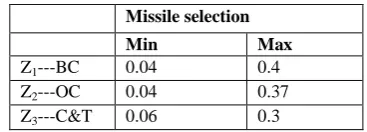
The linear membership function is used for fuzzifying the objective functions and the constraints for the above problem. The data set values of the lower bounds (Z*k) and the upper bounds (Zk0) of the objective functions are provided below:
Table 3. Bounds of the objective functions
3.5. Finding fuzzy multi-objective model
The fuzzy multi-objective formulation can be written as :
Find X So as to satisfy
0
1 1 2 3 4 5 1
0
2 1 2 3 4 5 2
0
3 1 2 3 4 5 3
0.17 0.3 0.07 0.04 0.4
0.22 0.06 0.04 0.37 0.3
0.1 0.25 0.29 0.06 0.3
Maximize Z x x x x x Z
Maximize Z x x x x x Z
Maximize Z x x x x x Z
(P4)
R AL HP RT ST DT ET
(BC)
Local weight
0.317 0.139 0.143 0.032 0.046 0.133 0.04
M-1 0.084 0.109 0.204 0.124 0.123 0.082 0.08 0.17 M-2 0.408 0.369 0.228 0.367 0.367 0.387 0.40
0.30 M-3 0.081 0.067 0.093 0.072 0.081 0.080 0.08
0.07 M-4 0.037 0.032 0.033 0.038 0.034 0.033 0.04
0.04 M-5 0.402 0.420 0.442 0.397 0.392 0.41 0.40
0.40
BC OC C&T AHP
BC 1 1/3 1/2 0.15706
OC 3 1 3 0.59364
C&T 2 1/3 1 0.24931
Criteria BC OC C&T Missile
performance index
Performan ce rating
Relative weights
0.157 0.594 0.25
M-1 0.17 0.22 0.10 0.182 1.0
M-2 0.30 0.06 0.25 0.145 0.796
M-3 0.07 0.04 0.29 0.108 0.593
M-4 0.04 0.37 0.06 0.241 1.324
M-5 0.40 0.30 0.30 0.316 1.74
Missile selection
Min Max
Z1---BC 0.04 0.4
Z2---OC 0.04 0.37
[image:5.595.50.303.629.775.2]1 2 3 4 5
1 2 3 4 5
1;
, , , , 0
x x x x x
x x x x x
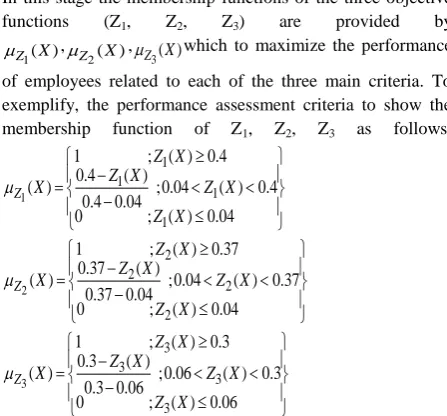
In this stage the membership functions of the three objective functions (Z1, Z2, Z3) are provided by
1( )
Z X
,
2( )
Z X
,
3( )
Z X
which to maximize the performance of employees related to each of the three main criteria. To exemplify, the performance assessment criteria to show the membership function of Z1, Z2, Z3 as follows:
1
1 1
1 1
1 ; ( ) 0.4
0.4 ( )
( ) ;0.04 ( ) 0.4
0.4 0.04
0 ; ( ) 0.04
Z
Z X Z X
X Z X
Z X 2 2 2 2 2
1 ; ( ) 0.37
0.37 ( )
( ) ;0.04 ( ) 0.37
0.37 0.04
0 ; ( ) 0.04
Z
Z X Z X
X Z X
Z X 3 3 3 3 3
1 ; ( ) 0.3
0.3 ( )
( ) ;0.06 ( ) 0.3
0.3 0.06
0 ; ( ) 0.06
Z
Z X Z X
X Z X
Z X
3.6 Developing AHP-FLP model
The weights (wk) associated with kth objective are taken from
the pair wise comparison of the main selection criteria using AHP which are provided in the table 4 (relative weightage and local weights of each missile). It can be noted from the table that the total weights are equal to 1. Based on the AHP-weighted additive model (P3), the crisp single objective programming model, equivalent to the defined fuzzy model (P4) above, can be stated as follows:
Maximize
0.157
1
0.594
2
0.25
3 Subject to1 2 3 4 5
1
1 2 3 4 5
2
1 2 3 4 5
3
1 2 3
1 2 3 4 5
0.4 (0.17
0.3
0.07
0.04
0.4 )
0.4 0.04
0.37 (0.22
0.06
0.04
0.37
0.3 )
0.37 0.04
0.3 (0.1
0.25
0.29
0.06
0.3 )
0.3 0.06
,
,
[0,1]
0,
0,
0,
0,
0
x
x
x
x
x
x
x
x
x
x
x
x
x
x
x
x
x
x
x
x
(P5)3.7 Solving the AHP-FLP model
Problem (P5) is solved using optimization software LINGO 10. The optimal solution is obtained as follows. X1=0; X2=0 ; X3=0.909 ; X4=0.09 ; X5 =0; suggesting that
missile M-3 is the best choice according to decision maker’s preferences .
Objectives (Zk) and membership function values are obtained
as follows:
Z1 =0.06723 , Z2 =0.06966 , Z3 =0.26901
1( )
Z X
= 0.92425,
2( )
Z X
=1,
3( )
Z X
=1 .
Membership values represents that the achievement levels of Z2 and Z3 are more than Z1. In other words, the achievement
level of the objective functions corresponds with the priority of the missile selection criteria (based on decision maker preferences) indicating that missile M-3 is selected as the best missile.
3.8 Comparing AHP and AHP-FLP results
Table 4 shows the overall scores of each missile using AHP & AHP-FLP. Missile M-5 was identified to be the best missile using the crisp AHP approach under no restrictions. In this approach, criteria OC & C&T (local weights 0.594 and 0.25 resp.) were identified as more important criteria than BC. When AHP-FLP approach is applied, missile M-3 is identified as best missile with criteria OC and C&T as most important criteria.
Table 4. Comparing the AHP and AHP-FLP results for Missile Selection
Missile AHP approach AHP-FLP
approach
M-1 0.182 0.00
M-2 0.145 0.00
M-3 0.108 0.909
M-4 0.241 0.09
M-5 0.316 0.00
4.
CONCLUSIONS
An attempt here has been made to provide an alternative approach to the traditional AHP method for the computation of local weights or priorities and the final weights. The research can be extended by incorporating additional selection criteria or deleting some of the criteria depending on the needs of the army system. Different alternative methodologies such as fuzzy analytic network process, fuzzy TOPSIS and fuzzy ELECTRE can also be implemented.
5.
REFERENCES
[1] Ministry of National Defense of Republic of Korea.
Defense White Paper,
<http://www.mnd.mil.kr/cms_file/info/mndpaper/e20080 0008.pdf>, 2008, pp. 205–208.
[2] Ho, W. 2007. Combining analytic hierarchy process and goal programming for logistics distribution network design”. IEEE International Conference on Systems, Man and Cybernetics. pp 714–719.
[3] Saaty, T.L.," How to make a decision", European Journal of Operational Research, 1985, vol.48(1) , pp.9-26. [4] Cheng, C.H.,Yang, K.L. , and Hwang. C.L., “Evaluating
[image:6.595.53.277.118.326.2]Volume 65– No.7, March 2013 [5] Greiner. M.A. ,Fowler. J.W. ,Shunk D.L. , Carlyle. W.M.
,McNutt. R.T. 2003. A hybrid approach using the analytic hierarchy process and integer programming to screen weapon systems projects. IEEE Transaction on Engineering Management, vol. 50(2), pp 192–203. [6] Cheng, C.H. , Lin, Y. , “Evaluating the best main battle
tank using fuzzy decision theory with linguistic criteria evaluation, European Journal of Operational Research, 2002, vol. 142, pp. 174–186.
[7] Vaidya, O.S. Kumar,S. Analytic hierarchy process: An overview of applications, European Journal of Operational Research, 2006, 169(1),pp 1–29.
[8] Kahraman, C., Cebeci, U. and Ruan, D. 2004, “Multi-attribute comparison of catering service companies using fuzzy AHP: the case of Turkey”, International Journal of Production Economics, 2004, Vol. 87, pp. 171-84. [9] Bellman R.E. , Zadeh ,L.A. Decision making in fuzzy
environment, Management Science, 17B: pp 141-164, 1960.
[10] Zimmermann, H.-J. 1994. Fuzzy set theory—and its applications. Boston:Kluwer Academic Publishers
[11]Tiwari, R.N., Dharmahr, S. and Rao, J.R. , “Fuzzy goal programming-an additive model”, Fuzzy Sets and Systems,1987, Vol. 24, pp. 27-34.
[12]Amid, A., Ghodsypour, S.H. and O’Brien, C. , “Fuzzy multiobjective linear model for the supplier selection in a supply chain”, International Journal of Production Economics, 2006, Vol. 104, pp. 394-407.
[13]Lai., Y.J. and Hawang, C.L. 1994. Fuzzy Multiple Objective Decision Making. Methods and Applications. Springer. Berlin.
[14] Sakawa, M. 1993. Fuzzy Sets and Interactive Multi-objective Optimization. Plenum Press. New York. NY. [15] Ravichandran T. and Lertwongsatien C. , Effect of
information systems resources and capabilities on firm performance: a resource-based perspective , Journal of Management Information System.,2005, 21(4)pp 237-276.