Munich Personal RePEc Archive
Foreign Capital Flows, Real Exchange
and Interest Rates: An Analytical
Framework
Goyal, Ashima
1997
Online at
https://mpra.ub.uni-muenchen.de/73537/
Preprint from Journal of Foreign Exchange and International Finance, Vol. 9(3), pp. 215-232. Oct.-Dec. 1997
Foreign Capital Flows, Real Exchange and Interest Rates: An Analytical Framework
Ashima Goyal
Indira Gandhi Institute of Development Research Gen. Vaidya Marg, Santosh Nagar,
Goregaon (E), Mumbai-400 065 ashima @ igidr.ac.in
Tel.: +91-22-28416512 Fax: +91-22-28402752 http://www.igidr.ac.in/~ashima
Abstract
We build a framework to explain surges in capital flows, volatility in real exchange and interest rates and derive implications for policy. Our framework is adapted to the features of a labour surplus developing country with a large share of non-traded goods, and focuses on the medium-run. Classes of high and low growth equilibria are shown to occur. Movements in expected and actual real exchange rates, reinforce those in normalized output and inflation. In such circumstances, a traditional monetary stabilization, following on a supply shock or surge in foreign inflows, can lead to an overshooting of the real rate of interest or the exchange rate and raise inflation from the supply side. Careful coordination of monetary and fiscal policies can, however, shift the economy to the high growth path and minimize fluctuations.
Keywords:Capital flow surges; real exchange rate; developing country; high and low growth
paths
JEL classification code:F36, E52, F43
I thank Raghbendra Jha for helpful discussions. The credit for the graphics goes to Rajeev Ahuja and Santanu
1. Introduction
As both the volume of international capital flows and the share going to developing countries
(DCs) rise, important questions of short-term management and optimal long-term use arise.
Countries in South-East Asia have managed better than those in Latin America; they have
turned these inflows into an opportunity. When reform is accompanied by an inflow of
foreign capital, market forces can appreciate nominal exchange rate. But this is incompatible
with the goal of stimulating exports and keeping foreign liabilities at sustainable levels. If
authorities adopt a managed float, money supply can over expand as foreign exchange
reserves accumulate. If reserves are sterilized pressure is felt on interest rates as money
supply contracts.
To be helpful analysis must be conducted in models that reflect the institutional structure of
the economy concerned. We adapt the Mundell-Fleming (M-F) model of the open economy
to target a medium run for a small open but large domestic economy such as India, and to
give priority to growth. It is then used to understand the surges in foreign capital, the
fluctuations in interest, exchange rates and activity they give rise to, and the policies required
to harness them in the interests of development. These are vital issues facing reformers today.
The literature on exchange rate movements is concerned either with the very short-run
activities of speculators, or very long-run monetary stock adjustment processes. Kenen
(1985) has argued that we need to find ways of analyzing the medium-run. This is
particularly urgent in a DC, where the key concern is to find policies that trigger growth.
Transition to a steady state with full utilization of resources, naturally has a medium-run
dimension. Excess volatility in a DC is caused not so much by short-run speculative
movements as by expectations about medium-run growth prospects. Extensive empirical tests
have not found support for either the simple speculative efficiency hypothesis or for
monetary models of exchange rate determination (Taylor, 1995). The time is ripe to explore
alternatives.
A constant real exchange rate is desirable, after a devaluation, to maintain export
competitiveness. A fixed exchange rate will implement the targeted real exchange rate only
under certain conditions including equality of domestic and world rate of inflation. Free
floating leads to undesirable fluctuations in exchange rates. The current account is forced to
In Dornbusch's 1976 model, the exchange rate appreciates over its fundamental value because
asset prices move faster than goods prices or output, and therefore tend to move too much to
compensate for a sluggish goods price response. Instead of prices falling, when money supply
contracts, interest rates rise, capital flows in, the exchange rate overshoots until expected
future depreciation compensates for the high interest rates.
We show that, because of this speed of movement in asset prices and quantities, monetary
tightness can lead to a sharp rise in real interest rates matched by an expected devaluation, in
a managed float. But instead of prices eventually falling, fundamentals worsen, and the rate
of inflation can actually rise. The stage is set for a panic flight of capital. Adverse shocks, if
treated with traditional macro stabilization policies, can lead to sharp movements in interest
rates, that precipitate the crisis they are designed to avoid. Stabilization includes monetary
tightening in order to control inflation. But it can raise the real rate of interest and cause
inflation from the supply side. The monetary theory of the nominal exchange rate regards it
as the relative price of domestic and foreign money, if domestic money stock falls, the
equilibrium rate should appreciate; we show that if real factors determining the real exchange
rate are allowed for the opposite result holds. In a world of high capital mobility, the
monetary theory is suspect.
Equilibrium real exchange rates depreciate in the case of low growth. The equilibrium real
exchange rate is ultimately determined by real factors, such as productivity. We show that if
investment rises, rising net imports and inflows can be sustained at a constant real exchange
rate. A shock to the real interest rate, by lowering the present value of future discounted
output, will lower investment, inflows, and require a depreciation of the real exchange rate.
Even so, it is possible to coordinate macro policies to enhance development. Movements in
expected and actual real exchange rates, reinforce those in normalized output and inflation, so
that classes of high and low growth multiple equilibria can occur. Policies must be carefully
chosen to shift the economy to the set of "good" equilibria. Then fluctuations in exchange or
real interest rates, and abrupt movements in foreign capital may be avoided. These are very
relevant issues. In India both in 1995 and 1997 high real interest rates were correlated with a
sudden depreciation of the real exchange rate. In Malaysia the policy was to depreciate the
domestic interest rates were allowed to exceed international. Crises struck in 1997 with a
forced depreciation exceeding 30 per cent.
The structure of the paper is as follows: First we compare institutions and events across
countries to decide the most relevant model for our purpose. Section 3 adapts aggregate
demand-supply and M-F models to the medium run. Section 4 checks that this is consistent
with intertemporal optimization and derives the equilibrium real exchange rate. Next we
discuss co-movements in key variables in the multiple equilibria and offer suggestions for
policy. The final section contains a brief summary.
2. Institutional Features and Modeling Strategies
Bruno and Sachs (1985) argue that it is incorrect to apply a generic macro model to all
countries, and it is especially necessary to distinguish between developed and DCs. We want
to extend the argument to allow for institutional variations among DCs themselves. A model
that incorporates institutional features will give more reliable answers. This section attempts
to develop an understanding of relevant institutional structure in India and use it in designing
our model.
The Foreign Exchange and Asset Markets
As capital transactions of most DCs are a small percentage of world totals, they cannot affect
world interest rates. But can the latter influence domestic rates? If there is no full
convertibility on the capital account, domestic and foreign assets cannot be close substitutes
and domestic interest rates have a measure of autonomy. Non-Resident Indians (NRIs) and
Foreign Portfolio Investors can freely bring in and take out capital but domestic residents
cannot. But, since the mid-seventies, those who have legal or illegal full capital account
convertibility have become large marginal players in the domestic economy. It is still feasible
to pay internal savings less than the world interest rate, but foreign savings must be paid a
competitive rate, taking account of country risk and expected changes in the exchange rate.
Therefore the assumption of perfect international arbitrage is a reasonable working
Many asset markets are thin or non-existent. The foreign exchange market is dominated by a
few large public institutions. Therefore the academic literature1 on speculation and the
exchange rates is somewhat irrelevant. Speculation is more a function of the entry and exit
decision of foreign portfolio companies and NRIs, and the more easily orchestrated response
of the public institutions. Capital inflows are the result of the decisions of institutions and
foreign residents rather than portfolio diversification decisions of domestic individuals.
Instead of being determined by the expectations of millions of individual traders about the
sustainability of the level of the exchange rate, speculation is determined much more by
uncertainty relating to the fundamentals. Especially in a period of structural change, there is
always uncertainty about the future rate of growth. Variables such as investment, inflation
and exports help form these expectations. Unfortunately, the adjustments in these variables
can themselves be deviation amplifying and feed into self-fulfilling prophecies. The presence
of multiple equilibria helps make speculation destabilizing.
The Goods Market
Purchasing power parity or PPP states that arbitrage in commodities is perfect enough to keep
the real exchange rate at a constant equilibrium value. But DCs are small in world commodity
markets, border prices are exogenous for them. So that if PPP holds in the one good M-F
model, the real exchange rate cannot vary. Disaggregation is therefore essential for realism.
DCs typically have a large non-traded (NT) goods sector. A depreciation would lead to a shift
of resources to the traded (T) goods sector. In the dependent economy model the Dutch
Disease can occur when exports rise. The prices of non-traded goods rise and welfare falls. In
addition, if a distinction is made between exportables and importables, changes in the terms
of trade affect income and demand. For a primary goods exporter, these latter effects can be
large, particularly with a secular worsening of the terms of trade.
In India, the import of consumer goods is still banned and the assumption of surplus labour is
a useful first approximation. Therefore the demand and labour supply effects of terms of
trade shocks are not dominant. There is a distinct possibility of expanding the exports of
1
skilled and unskilled labour intensive commodities. Labour is severely underutilized.
Therefore we assume the Marshall-Lerner condition holds. A rise in the real exchange rate
both draws resources to the export sector and raises export demand. The absorption of more
labour in higher productivity activities as exports expand can raise incomes and demand, as
in South-East Asia, without immediately raising the prices of NT goods.
The share of NT goods was forty per cent of Indian output in the eighties—the share of the
domestic economy is large. A combination of a large domestic and small open economy has
to be modelled. World prices are exogenous but a devaluation can lead to a rise in the real
exchange rate if the rise in prices of NT goods is lower than that of T goods. Therefore it is
the impact of devaluation on domestic inflation that will ultimately decide if the depreciation
of the real exchange rate can be sustained.
A devaluation raises the burden of both intermediate imports (largely oil) and repayment of
external debt. But their impact is first on the Government budget. It is a policy decision
whether to allow devaluation to reflect on domestic oil prices. In addition, insofar as
devaluation is accompanied by a reduction in very high rates of duties on intermediates, its
inflationary impact is muted. As reforms seek to open out more of what was a closed
economy, the key factor to analyze in transition, is the shrinking of the NT sector, or the
rising weight of the T sector (exportables) in the consumption basket, and its impact on
wages and inflation.
The Labour Market
Institutional features can influence the design of macro policies. It is argued that in Germany,
for example, real wages are rigid since the average contract length is only one year.
Therefore, in the face of an adverse supply shock a tight monetary policy is necessary to
prevent inflation. In the US the average nominal wage contract is for 3 years.
Stimulatory monetary policy by raising prices can lower real wages and maintain
employment. In a DC with vast reserves of human resources, utilized at below the production
frontier, real wages are low and a further fall cannot be the major mode of adjustment2. In
2
such countries stimulatory macro policies can actually lower the rate of inflation, and raise
real wages, even in the face of a supply shock. The reason is that productivity rises as labour
is reallocated to more productive industries, and mark-ups fall as overheads are spread. It is
not essential for some industries to shrink for others to expand.
After the oil shock, middle income countries sustained such policies by foreign borrowing
and did much better than the West (Bruno and Sachs, 1985).
In a poor and populous DC, the more realistic assumption to make is that the firm is on its
supply curve of labour. Although the labour market is a buyer's market, real wages are rigid
in terms of food, because poor nutrition leads to a drop in worker efficiency in the informal
and agricultural sectors. The optimizing employer would therefore want to keep real
consumption wages constant.
Nominal wages, in the NT goods sector, are closely linked to the price of food. A supply
shock that impinges on the latter can set off a wage price spiral. It would be moderated,
however, if growth remained high and output and productivity rose with reallocation of
labour. If growth slowed, and the supply shock built into an expected rise in nominal wages,
a higher rate of inflation would result.
Devaluation directly causes inflation in Latin American countries, as strong income conflict
works as a propagation mechanism, converting a supply shock into an accelerating inflation.
No group is willing to take a fall in its income share in response to terms of a trade shock.
But in India the average per capita income level is about one fourth that in Latin America,
and this affects the range of feasible choices. One implication is the absence of sharp income
conflict. The trade share is low and food comprises a major part of NT goods. Where almost
two-thirds of the average budget is spent on food, the price of the latter is a major
determinant of inflation. A large drop in real wages is not feasible.
A policy decision was made, coinciding with the devaluation, to raise food procurement
prices, as a precursor of agricultural trade liberalization. It was this attempt to reduce the gap
between domestic food prices and their border prices, rather than the devaluation itself, that
lead to inflation and the accumulation of huge domestic food grain stocks soon after the
reform (Goyal 1995a). The transition dynamics to a more open regime needs to be carefully
international prices are often not affordable. Food habits take time to alter, and in the
medium-run substitutability at the new international margin of adjustment is low.
In the formal sector, real wages can respond flexibly to macroeconomic shocks. The average
wage contract is negotiated after three years. Only four per cent of the labour force is
unionized and minimum wage laws are not strictly enforced. COLA or automatic cost of
living adjustments, widespread in Latin America, are rare. Inspite of trade unions and
restrictions on exit, real wages adjust through changes in composition. For example, by
increasing the tasks contracted out to the informal sector many margins of adjustment are
available. Wages were rising in the organized sector, in the eighties, but there was a
contraction even in the absolute numbers employed. If a rise in wages is correlated with
productivity, it would not impact on inflation. Although real wages are procyclical, the net
rise would be positive over the cycle. It would reflect not only cyclical factors, but the rise in
productivity as development takes place.
Macroeconomic policy can be stimulatory, especially if foreign capital is available on
demand, as long as price of food remains low.
Implications for Macroeconomic Shocks
The features catalogued above imply that an adverse supply shock would lead to a correlated
demand shock. The supply shock need not be restricted to technology but could be in the
price of wage goods, terms of trade or industry structure.
After a supply shock, industrial demand falls as consumers protect their food basket inspite of
a rise in its price. There is high political sensitivity to inflation. Therefore public investment,
which accounts for a large part of total investment, is routinely cut in inflationary periods.
Public investment, especially in infrastructure, has been shown to crowd in private
investment. The latter also slows down. In addition, money supply is tightened in such
periods and strong credit restraints are enforced. The real interest rate can rise. In periods of
greater uncertainty, investment decisions are postponed because of the irreversibility of
investment. As a result lower investment accompanies higher inflation.
If nominal interest rates are rigid, real interest rates fall with inflation, giving a stimulus to
stringent. Implicit interest rates then rise. The present discounted value of future expected
marginal products that determine the investment decisions of a forward looking firm, fall as
inflation rises. It has been widely documented that across the world, high interest rates,
inflation and low investment tend to occur together (Bruno 1993).
Countries, Institutions and Events
Variety in institutions, as outlined above, has been reflected in the divergent experiences of
DCs with foreign inflows.
In India, starting in the seventies, there was a jump in remittances from nationals abroad.
Initially foreign exchange reserves accumulated and the savings ratio rose. Domestic
borrowing financed rising public investments. This was one of the factors stimulating the
economy (Goyal 1993) and the eighties saw higher growth and lower inflation. Revenue
deficits combined with the low productivity of public investment, however, led to an
unsustainable accumulation of domestic debt. The tapering off of remittances and their
substitution by NRI deposits and other debt at high interest rates, the oil price rise of 1989,
and the Kuwait war were all shocks that the economy could not withstand.
In 1991 reforms included a steep devaluation, rupee convertibility on the current account, and
gradual import liberalization. Inflows of foreign capital accelerated, but these were neither
steady, nor large enough, and were accompanied by fluctuations in interest and exchange
rates. Annual rates of output growth reached above 7 per cent over 1994-96 after an initial
dip. But 1997 saw an industrial slowdown, caused partly by real rates of interest that reached
22 per cent.
Reform in many Latin American countries succeeded in reversing earlier capital flight.
Outflows on private account normally accounted for a large part of this. Citizens could easily
shift from holding domestic currency to dollar balances, a phenomenon known as
dollarization. Monetary policy did not accommodate the rise in demand for real balances as
inflation fell from triple digits. Interest rates rose to absurd levels that pulled in foreign
capital, even while they led to a fall in investment, and carried the seeds of a future reversal
of capital flows. If investment did not rise and consumption and inflation did, inflows
reversed once more. Agenor and Monteil (1996) report that it remains a puzzle why real
occurred under the stabilization of the eighties. Our analysis will suggest that the use of the
exchange rate as a nominal anchor, in the later period, may have been partly responsible,
since large changes would have occurred in expected real exchange rates.
There are countries, mostly in South-East Asia that managed to absorb large inflows of
foreign capital as long as output and export growth was high. Imports could then safely rise.
A rising absorptive capacity can keep expected profits high enough to exceed world interest
rates and induce a steady inflow of foreign capital in accordance with the requirements of
domestic investors.
The safest alternative is to follow growth enhancing policies. If this is done foreign inflows
can become an opportunity, allowing capital and budgetary constraints to be relaxed. The
country experience suggests that high and fluctuating real interest or inflation rates serve as a
warning signal of incorrect policies and choices. It is possible for India to grow as South-East
Asia did, avoid financial bubbles if it ensures that real interest rates remain low, and financial
deepening provides hedging instruments. Therefore it is very important to understand
potential causes for the steep rise in real interest rates. Standard reasons are a sudden rise in
money demand, or very high government borrowing. But inflation has never been very high
in India; therefore even if stabilization lowers inflation it will not have major effects on
money demand on that count. If domestic and foreign capital assets are imperfect substitutes,
the shift from monetary to debt financing of an unchanged budget deficit can drive up real
interest rates very steeply (Dornbusch 1982), in a narrow market for Government debt. But
under perfect mobility of foreign capital government borrowing alone cannot raise the real
interest rate. Our model focuses on the effect of real exchange rate expectations on the real
interest rate.
Model Related Assumptions
What are the assumptions most suited to the structure of the Indian economy? The arguments
of the earlier section suggest the following simplifications in modeling:
1. Perfect arbitrage, or that foreign and domestic financial assets are perfect substitutes.
But domestic currency is not held abroad.
2. The small country assumption of a given world interest rate, and prices of imports and
3. Quantity variables in the M-F model are normalized to reflect a medium-run where
capital and prices can vary. The normalization does not imply fixed coefficients. But
in steady state output and capital grow at the same rate. The output capital ratio, u, is
then constant. The components of aggregate demand have a simple and transparent
specification. Investment is a function of the real interest rate and normalized output.
Both investment and savings can be derived from constrained intertemporal
optimization decisions. Savings is less responsive to the real interest rate as wealth
and substitution effects work in opposite directions. The interest rate drops out with a
logarithmic utility function. Output is demand determined and there is excess
capacity.
4. The aggregate supply function reflects the dualistic labour market and the dynamics
of inflation in NT goods. It is derived from the maximization decision of a
representative firm.
5. The policy and dynamic response of the system leads to demand shocks that are
positively correlated with, and magnify, supply shocks.
6. The nominal exchange rate is fixed, or there is a managed float3.
7. The LM curve drops out, because of 6, and the real interest rate is determined by the
arbitrage equation. This is compatible with the medium-run focus, and captures the
effect of the real interest rate on investment and savings. But there is some degree of
policy freedom: stabilization and sterilization policies can vary the ratios of money
stock to output. Under a managed float a hybrid of nominal exchange targeting and
nominal money targeting is possible for extended periods.
3. Aggregate Demand and Supply in the Medium-run
The M-F model addresses questions such as: “What are the effects of monetary and fiscal
policies on output in an open economy with capital mobility, under a fixed or floating
exchange rate?” We want to substitute growth for output, discover if monetary variables can have long-term effects on real variables, and derive implications for surges in foreign capital
flows.
3
We start with the equations of the model. The first four are definitional. Next the key
equations used in the analytics4 are derived: aggregate demand (AD), aggregate supply (AS),
external balance (FF).
The nominal exchange rate, E (Rs. per $) has as its rate of devaluation or depreciation. The
foreign price level is P*, domestic P, and the rate of inflation π. The real exchange rate, z =
EP*/P. The equilibrium value of z is ̃. We work with two rates of inflation, .
Investment is I, savings S, and output normalized by capital is u. Superscripts e denotes an
expected value. * refers to the rest of the world, '(a dash) denotes the percentage rate of
change. Equation (1) shows the rate of change of z.
As we are considering the medium-run we take the Fisherian relation to hold with :
The nominal rate of interest i adjusts to the rate of inflation. Therefore the real rate, r, is not
affected by inflation. Assets are perfect substitutes, therefore the return from domestic assets
must equal the return in domestic currency from foreign assets. That is, the arbitrage equation
3 must be satisfied. If the LHS exceeds the RHS then there would be an inflow of foreign
capital and vice versa.
The expected rate of change of the real exchange rate, , is a function of the difference
between the equilibrium and the actual exchange rate. Under rational expectations, the speed
of adjustment can be taken to be large enough to be neglected as in equation 4, which sets out
the relationship between u, r, the shock ηm, and ̃. This is derived in section 4, where equating
the current to the capital account of the balance of payments determines ̃. The real exchange
rate rises (depreciates) as u falls and π rises. But under a fixed nominal exchange rate if,
, z itself will fall (appreciate) (equation 1), therefore the gap between the two, will be larger. Because the nominal exchange rate is fixed under our managed float, the terms in
the inflation rates get added to equation 4. If equilibrium and actual z, move in opposite
directions , will be larger.
̃
4
The M-F model refers to a short-run. Over the long-run, if output was less than capacity,
prices should fall and as real balances rose, so would output. If prices can rise even if output is below capacity, and there are multiple equilibria in u, π,, this mechanism would not work. Some degree of endogeneity of money can prevent the real balance effect from leading to full
capacity. Alternatively, counter cyclical speculative demand for money can absorb excess
money balances. High(low) investment associated with the equilibria would lead to high(low)
growth. We examine the implications of such multiple equilibria below.
The downward sloping AD in Figure 1 has been derived from medium-run IS-LM curves in
Goyal (1995b), where it is argued that the Indian economy has switched between high and
low u associated with low and high π in the medium-run without hitting the boundary of full
capacity. It has been trapped by equilibria such as E1 and E2. Growth and inflation have been
inversely related. Normalized demand falls with the real rate of interest and inflation, and
rises with the real exchange rate (equation 5). A depreciation stimulates net exports. The
effect of comes in through r. With multiple equilibria and positive fixed costs, not only is
the AS curve (equation 6) downward sloping, but adverse supply shocks, s are magnified,
and the AS curve shifts upwards. Correlated demand shocks, , shift the AD to the left.
There is an inverse relation between u and π.
The AS is derived from the firm's point of view. Lucas obtained a very simple supply curve
by considering the labour leisure decision of the worker. We consider a firm with some fixed
costs; unit costs are lower at higher levels of production, as overheads get stretched. The
goods and labour market structure of section 2 underlies the open economy supply curve. As
the AS curve is almost flat, inflation will be determined by shocks that shift it up. Is a
devaluation one such shock? To answer this, we need to look at the interaction between
wages and prices in our typical DC.
There is a real wage target determined by the nutritionally efficient wage. Over the medium
run, a rise in price that lowers real wages below this target will lead to arise in nominal wage
inflation. NT goods prices are set as a mark-up on nominal wages (equation 7). We continue
to assume that inflationary expectations are realised. Inflation in nominal wages is then a
of any devaluation in E and the world rate of inflation (equation 9). The domestic rate of
inflation is a weighted average of inflation in T and NT goods (equation 10). Finally,
inflation in NT goods is directly proportional to that in nominal wages.
Therefore if the weights and Θ are high, devaluation will not have a large impact on
domestic inflation. Reforms that lower the weights as NT goods become traded, can reverse
this result. In India policy shocked the price of NT goods when agricultural support prices
were raised to coincide with the devaluation. Food has a very large weight in the
consumption basket, therefore high rates of inflation followed the devaluation. After any such
shock equilibrium is re-established after expectations are realized, and lags in the system are
worked through giving us a shift in the medium-term aggregate supply (equation 7). Lag
subscripts have been omitted from equations 7 to 11, for simplicity.
We now come to the key analytics of this paper: the volatility of r due to . Although it is a
r by the arbitrage equation and ̃ by the current and capital account (section 4). But
[image:16.595.154.435.451.712.2]depends on all these variables and can orchestrate a jump from one equilibrium to another.
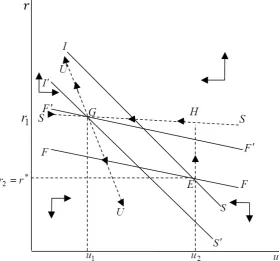
Figure 2 graphs the external balance FF, or the combination of r and u such that the demand
for foreign and domestic assets are balanced. Also in the Figure is the downward sloping IS
curve. Equations 12 and 13 depict the disequilibrium adjustment in the foreign exchange and
goods markets respectively. The speed of adjustment of the former exceeds that of the latter.
Equation 12 gives specific functional forms by substituting equation 4 in the arbitrage
equation 3. FF and IS depict equilibrium values for these equations. That is, they give the
points where r' and u' respectively are zero.
There is a unique equilibrium at r2 = r* when , and π = π* = π2. If u is lower than this
value, there would be an expected depreciation of z in line with the change in ̃. Any attempt
to reduce the money supply, as it leads to r > r* would induce foreign inflows. Such a policy
would be compatible with the perfect substitutability of domestic and foreign assets only if it
led to an expected depreciation of z, or upward shift of FF. At the same time, the AS would
To satisfy the arbitrage equation r must be rising above FF and falling below it. This explains
the direction of the vertical arrows in Figure 2. Foreign inflows should appreciate the
exchange rate, to equate the demand and supply of foreign exchange, but here they lead to an
expected depreciation of z; the arbitrage equation must be satisfied because of the faster
mobility of capital. When a further rise in r occurs since becomes unstable in
such a situation. Since E is fixed and the volatility of prices cannot match that of financial
expectations, the only jump variable whose speed matches that of foreign inflows is r. It must
rise to prevent an outflow. But a rise in r will raise ̃ and r again. Moreover, in a narrow
money market, attempts to restrict the money supply require ever rising r as the latter attracts
more inflows that in turn need to be sterilized. Stabilization policies accompanying
liberalization often imply a tight money policy that harms fundamentals. A rise in the
domestic over the world rate of real interest is compensated by an expected depreciation of
the exchange rate.
Above (below) the IS curve there will be excess supply (demand) and u will shrink (expand),
explaining the direction of the horizontal arrows in Figure 2. When demand exceeds supply, u
will rise (equation 13).
The curves may be non-linear, but they can be linearized around the equilibrium point. This
gives a valid picture of the local dynamic flow, as long as the trace of the Jacobian of the
dynamic system is not zero. The signs of the latter indicate the nature of the equilibrium. The
Jacobian J is shown below:
| |
Subscripts indicate partial derivatives.
follows from the stability of the aggregate demand curve and because of the negative effect of the real interest rate on aggregate demand. The large induced response of
of aggregate demand follows from the adjustments derived in Goyal (1995b). a3 captures the
effect of r on ̃ coming through the effect of r on .
The equilibrium is a saddle point. The sign of the trace(tr) is indeterminate and that of the
determinant (det) is < 0. The absolute value of the negative first component of the
determinant exceeds the positive second component. The reason is the interest inelasticity of
the IS curve, and the quantitative insignificance of u in the arbitrage equation. In Figure 2, SS
is the stable arm, and UU is unstable. This is clear from the direction of adjustment in each
quadrant. Adjustments in the mark-up make the goods market equilibrium stable inspite of a
periodic high propensity to invest (Goyal 1995b). But the excess of induced investment over
savings in response to a change in u (section 4), combined with the volatility of capital flows,
and of expectations that can cause a jump in r or E, lead to saddle instability and multiple
equilibria in an open economy.
Reforms constitute a favourable supply shock and can raise foreign inflows, but sterilization
in a narrow money market can lead to a monetary squeeze. Then, according to our model,
there would be a sharp rise of the interest rate along EH with u falling along HG. The
expected depreciation of z must rise, that is, FF must shift up to . As r rose the IS curve
would shift to the left, compounding the fall in u. After a number of such shocks, r and E
would be too high to be sustained, leading to a further devaluation5. Credit will now be
available at a higher cost. Its demand for productive purposes would therefore be reduced.
The rise in r constitutes an adverse supply shock that counters positive ones, associated with
structural change.
Proposition 1: If E is fixed, a tight money policy leads to a sharp rise in r and . Inflation
can be rising at the same time.
The M-F model tells us that a fiscal stimulus is possible6 under a fixed exchange rate, but we
see below that it is viable over the long run only if it leads to a rise in investment and exports
without a reduction in savings. Policies that help stimulate these are the only sustainable
5
Such a scenario is supported by the discovery of a positive or zero correlation between exchange rates and interest differentials (Svensson, 1992).
6
ones. Can foreign borrowing be too much? Can it reduce savings? In order to answer this we
need to look at the sustainability of debt.
4. The Equilibrium Exchange Rate and the Sustainability of Debt
Two basic accounting identities that follow from national income accounts are:
where f is gross foreign inflows and the current account deficit, nf is inflows net of interest
payments; b stock of foreign debt; I investment; S gross domestic savings7; nm net imports or
m-x, x exports, r the real rate of interest.
But what are the behavioural determinants of I,S, nf and nm? Consider a planner’s
intertemporally optimum decision on the amount of savings, investment and foreign debt in
an open economy (Blanchard and Fischer, 1989, Chapter 2). Under perfect markets and
information, foreign borrowing would be used to smooth consumption. The world interest
rate is taken to be fixed and equal to the rate of discount on consumption8. The decision of
the representative consumer would then coincide with that of the planner.
For a DC there would be an initial period of accumulation of foreign debt. The latter would
finance current account deficits in the balance of payments. The accumulated sum of these
deficits should be equal to the discounted value of future surpluses. There are limits to
borrowing. Debt cannot increase asymptotically faster than the interest rate. In the limit, the
current account surplus will be just sufficient to finance interest payments on steady state
debt.
Figure 3 graphs and equation 17 showing a positive net foreign inflow, nf, at the world
interest rate, r*. S is taken to be independent of r, because the intertemporal wealth and
substitution effects work in opposite directions9. A rise in r decreases I.
7
Gross national savings equal gross national product (GNP) minus consumption, while gross domestic savings are gross domestic product (GDP) minus consumption. GNP = GDP - rb.
8
A ‘patient’ country with a consumption rate of discount lower than the world interest rate would come to own most of the world's capital. This is an unrealistic result and can be ruled out by allowing for boundary
conditions, changing rates of discount, and many consumers. 9
Investment is determined not by domestic savings, but by ‘q’ or the discounted present value
of future expected marginal product. Temporal mismatches between the two are made good
by nf. Gross national savings are high when output is high compared to future expected
output, and are independent of the level of debt and of r if the utility function is logarithmic
in consumption. Consumption is smoothed over time. Any change in the level of debt leads to
an adjustment in the level of output and consumption. Savings net of interest payments on
debt are unchanged. A temporary adverse shock to productivity does cause savings to fall to
maintain consumption, but could be offset by a future positive shock.
In such conditions the fear that a rise in foreign borrowing would lower domestic savings is
misplaced. The former would be determined by investment requirements. Too much of
foreign inflows could not come in, where the discipline of future repayments are recognized
by the omniscient borrowers.
Intertemporal optimization is only a useful benchmark. In DCs it is difficult to know and to
reach the ideal level of consumption smoothing. Myopia might lead to a desire for over or
under consumption, but capital markets do not make it possible to implement the desire. High
risk and the lack of perfect capital markets could imply that current consumption is too low.
But it is also possible that the consumption of the Government and of the rich may be too
high. Permanent adverse shocks, if they lower expected future consumption and growth, will
lower current investment and borrowing. Temporary shocks would lower domestic savings.
Ideally, as development occurs, consumption should increase more slowly than its potential,
so that both savings and investment rise. The decisions of risk averse foreign creditors under
uncertainty, and their interaction with domestic policy over a medium-run, have to be taken
into account. There can arise a consensus, in the face of adverse shocks, that the level of debt
is too high, given reduced potential growth prospects. Still we assume that the excess of I
over S determines net inflows, except during a panic.
The current account balance must be equated to the capital, to satisfy equation 16. The
current account deficit is a function of the real exchange rate. Sustainable net capital inflows
(nf = I-S), that constitute the capital account surplus, depend on expected future productivity.
The equating of the two determines ̃ as a function of real factors.
The net demand for foreign goods (supply of foreign currency) is given by I-S and the net
supply of foreign goods (demand for foreign currency) by nm. Net inflows equal I-S and
supply the foreign currency. The demand for it, nm, is a declining function of z: The equality
of demand and supply gives ̃ (Mankiw 1994). Assuming simple linear specifications,
I-S is a positive function of u, because of our assumption of a strong induced response of
investment to u. A negative relationship can also occur if an exogenous fall in I causes a fall
in u through the Keynesian multiplier. By equating the two equations we can solve for ̃. The
a coefficients are simple algebraic transforms of the p and q coefficients.
̃
To the left of the dashed zero line in the Figure nm < 0, so that x > m and S > I. Underlying
optimization of firms and households. Equations 16 and 17 must be satisfied ex-post10, but
the ex-ante neo-classical equilibrium presupposes equilibrating movements in prices,
exchange or interest rates. Further, the current account deficits and I-S gap must be at a level
that can be sustained over the long-run. That is, they can be financed by expected future
surpluses. As E, r*,π* are fixed, the only way the current and capital accounts can be equated,
in the medium-run IS through a change in domestic prices, output and interest rates. Does this
work?
The nm curve is not flat. Net imports respond inelastically to a change in . A rise induces an
expansion in the labour intensive exports essential for development. But a nominal
devaluation can raise only if two conditions are met. First, after the devaluation, internal
inflation must be less than the world rate of inflation. For this, the prices of NT goods must
be relatively constant, and there must not be indiscriminate monetary expansion. Second,
after the equilibrium ̃ and nm are attained, S and I must be rising at similar rates, so that net
10
Two gap models, once popular in the development literature, worked with an ex-ante inequality between nm and I-S. A trade (savings) constraint meant that the former exceeded (fell short of) the latter. In the short run the trade constraint often held and the ex-post equality was attained by rationing and import restrictions at an overvalued exchange rate. There were many other possible macroeconomic adjustment mechanisms and one of the major contributions of the recent two gap literature is to highlight these. Taylor (1994) provides an
foreign inflows are constant. Ideally a rise in exports should raise income and domestic
savings, shifting the vertical S curve in Figure 3 rightward11, even as I is rising. From Figure
4, if the growth in I is less (more) than in S, ̃ will be depreciating (appreciating), or the I-S
curve shifting leftward (rightward). Indeed, if liberalization is accompanied by an upward
shift in the nm curve, ̃ can be constant only if I-S and therefore nf is also rising.
Now assume a supply shock such as a rise in administered food prices. If , the real
exchange rate would be appreciating or falling from equation 1. However, as the I-S curve
shifts left-ward, due to the correlated demand response (including monetary tightening), ̃
rises to ̃ above its original level ̃ . That is, the devaluation required exceeds the amount
that would compensate for the inflation. The automatic adjustment mechanisms in the
economy magnify the disequilibria rather than remove it. If liberalization leads to an upward
shift of the nm curve12, the problem would be accentuated, with a further rise in ̃.
Proposition 2: If E is fixed, nm is not perfectly elastic, and then ̃ will be
depreciating while z appreciates.
A devaluation itself may not cause inflation, but if the devaluation is accompanied by an
inflation it would become useless.
How will foreign investors be affected? Under rational expectations, if would be
positive as the equilibrium value of the real exchange rate ̃, rose. The domestic interest rate
must rise to compensate. The I-S gap determines nf if the arbitrage equation is satisfied, but if
the required rise in interest rates becomes too large, a panic withdrawal of foreign capital can
arise. A cumulative outflow that leads to the devaluation it fears can be triggered off. Such a
case is of more than just academic curiosity. Similar crises are endemic in DCs, examples in
the nineties include Mexico and Thailand.
11
Savings can rise in the Keynesian fashion with exports if income and productivity rise, or if propensities to save out of export income are higher. From the intertemporal optimization and consumption smoothing point of view, of section 4, savings would rise if a boom in exports leads to current income being higher than expected future income.
12
The variables will behave virtuously if foreign inflows finance rising investment, savings and
exports at low rates of inflation and a constant real exchange rate. In developed countries, the
recipe for inflation control has normally been tight money, low government budget deficit,
and wage restraint. Our model shows that this recipe need not be valid for DCs. In the latter,
growth stimulating policies are the most successful.
5. Multiple Equilibria and Expectations
Multiple equilibria with an inverse relationship between growth and inflation are reinforced
by movements in exchange rates. From Figure 4 we know that the lower growth equilibrium
would have a higher ̃ associated with it. As u falls ̃ will rise13. If, in the low growth
equilibrium, , z would be appreciating, while z would be depreciating. It follows that
would also be rising (expected depreciation). Multiple equilibria in π, u and z reinforce
each other.
Proposition 3: A rise in π, ̃, r and fall in u tend to occur together.
Multiple equilibria associated with development increase uncertainties regarding the
equilibrium level of z, and the potential for crises14.
Liberalization reform is normally undertaken in an inflationary environment, and is
accompanied by stabilization policies, including a reduction or constancy in key monetary
ratios, and a cut in budget deficits. Rising r reinforces the adverse shock on investment. On
the initial opening out, expected profits normally exceed both domestic and foreign interest
rates, leading to a large inflow of capital. But if macro policies do not stimulate growth, the
surge would only feed a bubble that would eventually collapse, necessitating a major
devaluation. Rising interest rates may no longer compensate for an expected depreciation. An
outflow of foreign capital occurs, leading to a massive devaluation.
13
Jaime Sera pointed out that in Brazil, as interest rates rose it became profitable to utilize trade credit from abroad by raising imports of intermediate goods. Commenting on Anne Krueger’s paper at the Seminar in honour of Gustav Ranis, Yale University, May 1996.
14
It is ironic that traditional stabilization policies, that emphasize fiscal and monetary
discipline, have their roots in a concern about inflation, and a belief that if this kept low
evaluation will not be necessary. But monetary tightness needs to be carefully defined, if a
unique market clearing equilibrium does not exist. As we saw, monetary tightening can cause
an overshooting of nominal exchange rates or real interest rates leading to inflation from the
supply side. Even without inflation, r can rise. Then ̃ would rise although z was unchanged.
Remark: Capital inflows can be unsustainable without policies that support growth, and are
designed to suit the institutional structure and context.
Our analysis can explain the combined presence, in many developing countries of high rates
of inflation, high and fluctuating real rates of interest, combined with a collapse of output and
investment and surges in capital flow. South-East Asia has shown a quantum leap in feasible
rates of growth to be possible. Foreign capital that comes in anticipation of high growth can
panic at setbacks. But in a labour surplus DC foreign inflows do represent a resource to be
utilized. The pitfalls are many, but, there exists the possibility of designing positive
adjustment mechanisms that shift the economy to the “good” set of equilibria.
Some of these are:
1. The nominal exchange rate must be constant or, if , depreciating slightly.
India’s current policy rule, that is, to intervene when E is appreciating but not when it
is depreciating seems designed to achieve this. The unspecified weights tying the
home currency to a basket of currencies can be used to outguess speculators. But there
is a need to be careful about possible overshooting.
2. Policy must concentrate on improving fundamentals by raising investment, both
public and private, lowering inflation and raising exports.
3. Money supply must target output or interest rates rather than inflation. The latter
should be tackled by supply side measures. World real interest rates are low, and are
not expected to rise in the near future. This should be made use of to ensure low
domestic interest rates. If r can be kept at around r* while profit rates are higher, the
share of foreign direct investment (FDI) in foreign inflows would rise. FDI is more
stable and contributes directly to investment.
4. The allocation of investment has a major role to play in controlling inflation. An
purchasing power must be ensured. The market may need some help in making such
an allocation of investment. For example, it has been noted that in Indian agriculture,
private investment follows public.
5. Equity financing of investment should be encouraged. Use of foreign inflows and
deepening of financial markets make this possible. Risk would be reduced with lower
fixed interest payments. Forcing marketability of equity in public enterprises will
improve the productivity of public investment.
6. Where there is no immediate balance of payments crises short-run capital gains taxes
can prevent speculative and “follow the leader” type of behaviour on the part of
foreign investors. Allocative flexibility would not be lost if exemptions are allowed
for reinvestment within the country. Such taxes can temper unsustainable enthusiasm,
while a consistent policy package can ensure that the inflows promote growth.
7. Structural changes that raise efficiency, deepen financial markets and raise incentives
for savings are required
6. Conclusion
Heterodox stabilization programs are a via-media between Keynesian and the PPP perfect
markets monetarist paradigm. But they still need to be adapted to suit the structural features
of the particular economy they are applied to and to have more of a growth orientation. It is
argued that macro policies can create an unnecessarily adverse environment that makes it
more difficult for structural reforms to succeed. It is not that there is a unique way to succeed,
but policies that are inconsistent with structure can raise the costs of change.
In the intertemporal optimization model a known stream of future output is obtained by full
utilization of resources. The role of foreign capital is primarily to smooth consumption over
time. Capital markets are perfect and there are no liquidity constraints. In the medium run this
determines the gap between I and S, and the deficit or surplus on the current account of the
balance of payments required to finance it.
In a developing economy, there are two flies in the ointment. First, uncertainty regarding
potential development and rates of growth. Second, the effect of this and the policy rule
followed on ̃ and . Policies that do not recognize the existence of multiple equilibria can
unwittingly push the economy to the worse set. Excessive movements of foreign capital
If foreign capital is a kind of money, then can these movements not be neutralized by
allowing its price E, to change? Unfortunately under a flexible nominal exchange rate, the
requirements of the capital and current accounts often conflict. For instance, under a capital
inflow, E would fall or the rupee would appreciate. This is not consistent with the rise in
exports required for development and long term servicing of the foreign capital. There is also
the possibility of excess volatility in E, arising from rapid movement in foreign money.
The predicament does not end there. If the Central Bank buys foreign exchange in order to
keep the exchange rate fixed, the money supply would rise and with it possibly, inflation
leading to a real appreciation of the exchange rate. If the money supply is neutralized by sale
of government bonds, the interest rate could overshoot enhancing the foreign inflow, and
harming output and investment. Even if z is kept constant ̃, , r could be rising and could
instigate a snowballing of pessimistic expectations.
A clear perspective emerges for policy in the face of rapid foreign inflows following reforms.
In labour surplus DCs, where a quantum leap in productivity is possible, macro policies that
stimulate this are the only viable ones.
References
Agenor, P R and P J Monteil, Development Macroeconomics, Princeton University Press, Princeton, New Jersey, 1996.
Bacha, E L, “A Three-Gap Model of Foreign Transfers and the GDP Growth Rate in
Developing Countries”, Journal of Development Economics, 32, 1990, pp. 279-296.
Banerjee, A V, “A Simple Model of Herd Behavior”, The Quarterly Journal of Economics, CVlI, 1992, pp. 797-817.
Blanchard, 0 J and S Fischer, Lectures on Macroeconomics, MIT Press, Cambridge, Massachusetts, 1989.
Bruno, M, Crisis, Stabilization and Economic Reform, Therapy by Consensus, Clarendon Press, Oxford, 1993.
---- and J D Sachs, Economics of Worldwide Stagflation, Harvard University Press, Cambridge, Massachusetts, 1985.
----, “Stabilization Policies in Developing Countries: What Have We Learned?”, World Development, 9, 1982,701-708.
Goyal, A, “The Role of Foreign Aid and the Foreign Exchange Constraint in Growth: Some
Extensions”, Journal of Foreign Exchange and International Finance, 7, 1993, pp. 30-43.
----,“Putting Structure on Structural Adjustment”, Economic and Political Weekly, May 6-13, 30, 1995a, pp. 1013-1020.
----, “The Simple Analytics of Supply Demand and Structural Adjustment”, Indian Economic Review, 30, 2, 1995b, pp. 37-56.
Jha, R, Macroeconomics for Developing Countries, Routledge, London, 1995.
Kenen, P B, “Macroeconomic Theory and Policy: How the Closed Economy was Opened”, in
Handbook of International Economics, Vol. II, ed. R W Jones and P B Kenen, North-Holland, 1985.
Krugman, P, “Target Zones and Exchange Rate Dynamics”, Quarterly Journal of Economics, 1991, p. 106.
Mankiw, N G, Macroeconomics, Worth Publishers, New York, 1994.
Svensson, LEO, “An Interpretation of Recent Research on Exchange Rate Target Zones”,
Journal of Economic Perspectives, 6, 1992, pp. 119-163.
Taylor, L, “Gap Models”, Journal of Development Economics, 45, 1994, pp. 17-34.
Taylor, M, “The Economics of Exchange Rates”, Journal of Economic Literature, 33, 1, 1995, pp. 13-47.