Is the U.S. Dancing to a Different
Drummer?
Marcus, J. Scott
Communications Strategies
December 2005
Online at
https://mpra.ub.uni-muenchen.de/2514/
COMMUNICATIONS & STRATEGIES, no. 60, 4th quarter 2005, p.39.
Is the U.S. Dancing to a Different Drummer?
J. Scott MARCUS
WIK-Consult GmbH, Bad Honnef, Germany
Abstract:Is the United States in full retreat from internationally recognized regulatory best practice? Or is it instead headed toward some different destination – "dancing to the beat of a different drummer"? Where is this likely to lead?
Key words: broadband, regulation, competition, VoIP
"If a man does not keep pace with his companions, perhaps it is because he hears a different drummer. Let him step to the music which he hears, however measured or far away."
Henry David Thoreau, Walden, 1854
n a widely read white paper that I wrote while at the FCC in 2002 (FCC, 2002a) 1, I argued that the then-nascent European regulatory framework
for electronic communications should generally reach regulatory conclusions similar to those of the United States. The U.S. and the EU had similar pro-competitive objectives. U.S. regulators over the prior forty years had been consistently reaching conclusions that would have been logical outcomes under the new European system.
In revisiting these themes a scant three years later, I find that subsequent experience no longer supports them. On the one hand, the European system is in full swing, and the system that seemed novel and radical three years ago is generally functioning as was expected and hoped (European Commission, 2004; 4th ZEW Conference, 2004). What has radically changed is telecoms regulatory practice in the United States. The U.S., in a long
1 The article and derivative works also appear in CRANOR & WILDMAN, 2003; in the Journal on Telecommunications and High Technology Law 111 (2003); and in the 2004 Annual Review of the European Competitive Telecommunications Association (ECTA). The original white paper is available at:
series of regulatory decisions, has largely abandoned its long-standing regulatory principles and moved in an entirely new direction.
The European sector-specific regulatory system for electronic communications rests primarily on formal mechanisms of market definition, determination of Significant Market Power (SMP), and imposition of proportionate (minimally adequate) remedies if, and only if, SMP is present. These core elements are implemented in a technologically neutral, all-embracing framework that is harmonized with European competition law.
Telecommunications law and regulation in the United States lacks this elegant formal structure, it emphatically lacks technological neutrality, and it largely pre-empts the operation of competition law (antitrust). Nonetheless, U.S. law implicitly recognizes market power by identifying categories of telecommunications carriers who could reasonably be presumed to possess it. Moreover, U.S. law and regulation until roughly 2002 generally assigned an array of obligations (obligations similar to European SMP remedies) to carriers who were presumed to possess market power, including: interconnection, non-discrimination, transparency, unbundling of loops (and other elements), accounting separation and controls on pricing.
Consequently, it seemed to me that the U.S. and the EU should generally reach similar regulatory conclusions, despite major differences in their regulatory processes.
That conclusion turns out to have been incorrect. The U.S. subsequently reached one regulatory conclusion after another that would have been implausible or impossible under the European regulatory framework.
In a series of rulings over the past few years, the FCC has systematically deregulated wired facilities, especially those used in support of broadband Internet services 2. Deregulation is generally viewed globally, and in Europe
specifically, as the appropriate response to the emergence of competition. As SMP fades, remedies are no longer necessary.
The concern that must be raised with this series of FCC rulings is that none of them contains any economic analysis worthy of the name. Indeed, in
reading the rulings, it is difficult to escape the conclusion that they refrain from rigorous analysis because they know that it would not support the desired conclusions 3. Instead, they deregulate in response to non-binding
statements of intent on the part of wired incumbents, and in the hope that new technologies might generate sufficient competition at some unspecified time in the distant future to warrant the deregulation granted in the present 4.
The regulatory system in the U.S. has thus been characterized in recent years by deregulation, despite the likely presence (at least in some relevant geographic markets) of SMP.
Several other factors are reinforcing an apparent abandonment of pro-competitive principles and a tilt toward the wired incumbents including:
- a series of large-scale mergers, permitted with only minimal conditions imposed on the parties 5,
- an apparent willingness to impose new regulations – in at least one case, harsh and lopsided regulations 6 (MARCUS, forthcoming) – only
when they disadvantage new entrants to a greater degree than wired incumbents,
- as regulatory changes cause financial losses at formerly competitive firms, forcing market exit or acquisition, funds for pro-competitive lobbying decrease correspondingly. In the context of the U.S. regulatory and political system, this creates a feedback loop, reinforcing the regulatory tilt.
So regulators are abdicating at the very moment that the industry is consolidating. Where is all of this likely to lead?
It is important to bear in mind that there are fundamental differences between the U.S. market and that of most European countries. Cable TV is far more prevalent in the U.S. than in most European countries. In the U.S., the suppression of competitive market entrants leads, not to monopoly, but rather (for the foreseeable future) to duopoly. More precisely, it leads to a series of non-overlapping geographically specific duopolies for wired broadband services at the retail level in most parts of the United States, and
3 In the MMDS/ITFS NPRM, the FCC inadvertently let slip their (probably correct) assessment that the market for wired broadband was highly concentrated, thus contradicting their contention in the other proceedings.
4 We discuss the proceedings at greater length below. 5 See below.
to continued decline in an already patently ineffective wholesale market for wired broadband access 7.
This is not to suggest that the FCC's commissioners all woke up one morning, miraculously and simultaneously inspired with the notion that duopoly was the very thing that America needed. To the contrary, these effects are more likely to have been inadvertent than intentional. Intent aside, a long series of U.S. government actions (discussed in the following sections of this paper) have tended to strengthen wired incumbents at the expense of new market entrants. These decisions are mutually consistent and synergistic; moreover, they appear to have had considerable collective effect. This is not a cheerful result. In economic terms, duopoly is not a good thing. It is not something to be sought out (except perhaps by the duopolists). The best that one can say is that it is a lesser evil than monopoly.
For the moment, one must say in fairness that the economic results to date are mixed. In terms of consumer welfare, they may not be as negative as one might otherwise anticipate. The future implications depend heavily on the success or failure of local telephony incumbents with video services transmitted over Fiber to the Home (FTTH) – if FTTH is widely deployed and widely adopted, and to the extent that it leads to effective competition for triple-play services, the U.S. might conceivably wind up with an enviable electronic communications environment.
Nonetheless, this is a radically different long-term vision from that of Europe. Moreover, it is a duopolistic world in which neither market forces nor regulation can be presumed to adequately protect consumer welfare.
The next section of this paper describes the FCC's deregulatory rulings, which fail to properly analyse possible SMP. We then briefly consider two recent orders that appear to impact new entrants more than incumbent fixed providers. The subsequent section contains a few brief remarks on the trend towards industry consolidation. We then consider the economic implications of the system that appears to be on the horizon. The last section contains concluding remarks.
Deregulation failing to account for SMP
In the interest of brevity, we confine ourselves to only the most noteworthy proceedings, and to those directly relevant to wired broadband Internet access:
Shared access to DSL
The FCC eliminated the obligation for incumbents to provide shared DSL access to competitors (FCC, 2003) 8. Prior to its elimination, this program
had effectively spurred deployment and competition (KAHN, 2001) 9.
Unbundling obligations for last mile fiber
The FCC decided not to require loop unbundling for fiber-to-the-premises, ostensibly in order to spur deployment 10.
Internet access via cable modem
Access to the Internet sold bundled with cable modem access was declared to be an information service, making it by default exempt from common carrier regulation. Possible SMP associated with last mile facilities was not addressed (FCC, 2002b).
Internet access via DSL
Access to the Internet sold bundled with DSL access was declared to be an information service, making it by default exempt from common carrier regulation (FCC, 2005a).
Non-discrimination obligations and obligations to offer DSL at wholesale
These obligations were eliminated for all wired broadband connections offered by telecommunications carriers (FCC, 2005) 11. The FCC asserts
8 This decision was triggered by a case in the D.C. Circuit: USTA, 290 F.3d at 429 (citing Iowa Utils. Bd., 525 U.S. at 386-88).
9 In light of Prof. Kahn's virulent opposition to unbundling in general, his modest support for line sharing (shared access) is striking.
10 TRO (Triennial Review Order). The order was effectively expanded to include multiple dwelling units by the FCC's Order on Reconsideration released August 9th, 2004.
that the wholesale market for DSL and cable modem Internet access services is effective, and will remain so in the absence of regulation.
To put this in a European context, these FCC proceedings have had the collective effect of breaking most of the rungs on the "ladder of investment" whereby new entrants would seek to progressively grow their businesses. European broadband adoption and deployment took off in the 2003-2005 period through the combined effect of (1) local loop unbundling (LLU), (2) shared access, (3) bitstream access, and (4) resale (European Commission, 2004; IEEE CommunicationsMagazine, 2005). In the United States, the only rung that solidly remains is the unbundling of copper loops. European experience strongly suggests that LLU alone is not sufficient to ensure a robustly competitive market.
In general, these proceedings were justified on the basis of encouraging broadband deployment. None contains an SMP analysis that an economist would credit. If a European member state had notified it of such an analysis, the Commission would have sent the country home packing with polite – or perhaps not so polite – instructions to come back when they had done the job properly.
This reflects an important difference between telecoms regulation in the EU and the U.S. In Europe, the regulator is required to make decisions that are transparent and objective; furthermore, meta-regulation at the European level provides standards by which those decisions are to be made (Directive 2002/20.EC). In the U.S., by contrast, nothing prevents the supposedly expert agency from making subjective decisions 12 (TABELLINI, 2002).
Courts may intervene if these decisions are contrary to law, but the courts lack a consistent basis for intervening where decisions are flawed in a public policy sense. They could in principle reject a decision based on flawed analysis as "arbitrary and capricious", but only if the judges understand the subject matter well enough to recognise the flaws. In practice, there is a strong tendency to defer to the nominally expert agency 13.
12 From the perspective of political science, this is arguably a flaw in the U.S. system. Since regulators lack political accountability, it is essential that they operate within a defined framework of regulatory accountability.
13 In legal terms, this deference is referred to as the Chevron doctrine (based on the court case
The combined effect of these proceedings has been to substantially eliminate all regulatory obligations associated with last mile Internet access facilities, at both wholesale and retail levels, without consideration of whether SMP might be present in the underlying transmission facilities or not. Moreover, deregulation was carried out in a manner that makes it particularly difficult to subsequently reimpose remedies should they prove to be necessary.
The recent FCC decision eliminating wholesale obligations specifically argues that wholesale competition is not essential to effective retail competition (and then fails to rigorously analyse either). In Europe, we strive to ensure effective markets at the wholesale level, in order to avoid the need to regulate at the retail level.
These effects were reinforced by other FCC actions that served to benefit wired incumbents and to impede new entrants who offered traditional voice services. A particularly noteworthy ruling eliminated the most popular and cost-effective form of local loop unbundling, UNE-P 14. Other FCC
proceedings effectively deregulated prices on private lines within a metropolitan area. The combined effect of these two rulings has been to increase the cost of a number of critical inputs that Internet service providers (ISPs) need, and to cause many actual or potential competitive suppliers to the ISPs (including MCI and AT&T) to exit the market or be acquired.
It is not my intent to argue the absolute rightness or wrongness of any particular one of these decisions 15. Rather, I observe that they collectively
set a course that is very much at odds with pre-existing U.S. policy, and also with European notions of regulatory best practice.
Had such a regulatory course been followed in Europe, competition law might have provided a partial correction. That is not possible in the United States. Pursuant to a number of court cases, competition law is largely pre-empted where sector-specific regulation is possible 16. More specifically, the
provisions of the Communications Act do not constitute a separate cause of antitrust action. It is also worth noting that competition law in the United
14 This was the result of a series of rulemakings and court decisions beginning with the TRO,
op. cit.
15 In the case of FTTH, for example, some form of "regulatory holiday" was probably appropriate.
16 Notably Goldwasser v. Ameritech Corp. 222 F.3d 390 (7th Cir. 2000) and Law Offices of
States differs in many ways from that of Europe – for example, if a firm has achieved market power through legal means, it is not illegal to charge a monopoly price.
Hobbling new entrants
The record on this point is not clear-cut, but there are reasons to suspect that this may be an emerging problem. Some of what follows is speculative.
In recent years, it has been rare for new obligations to be imposed on wired telephone providers or on cable TV providers. Both industries maintain effective lobbying organizations.
Nonetheless, two significant orders impose new obligations on Voice over IP (VoIP) providers that interconnect with the Public Switched Telephone Network (PSTN), and one of them also imposes obligations on broadband Internet access providers. The first requires interconnected VoIP providers and broadband Internet access providers to instrument their networks in advance in order to facilitate any requests that they may get for lawful intercept (such as wiretaps). The second requires interconnected VoIP providers to fully support the most enhanced form of access to emergency services (E-911) by means of access to the E-911 services provided by wired incumbents.
That both orders were adopted at all suggests that wired incumbents did not lobby aggressively against them. A possible reason suggests itself immediately: the wired incumbents had already internalized most of the cost associated with these regulations, and thus had no reason to oppose them. On the one hand, they had expected to eventually be subject to these mandates; on the other, their implementations drew heavily on capabilities already in place for their conventional PSTN operations.
The costs to new entrants, however, are significant. Thus, incumbents could reasonably conclude that these orders provided them, all things considered, with a significant competitive advantage.
(MARCUS, forthcoming). Given the VoIP industry's active engagement with the emergency services community, and their significant investment in customer education on this point 17, it is difficult to understand the rationale.
The order provides a time frame of only 120 days to fully implement the system. (By contrast, mobile operators have been working on E-911 systems for many years.) It recognizes that the order, by effectively forcing new entrants to use the E-911 access of the wired incumbents, creates incumbent market power, but it fails to adequately address the issue. It required VoIP providers to obtain confirmation from 100% of their customer base that the customer had read and understood any limitations in the provider's emergency service capabilities within just 30 days of publication of the order – a requirement so extreme as to be unenforceable. (The date has already been extended twice.) The order recognizes the technical infeasibility of reliably determining the physical location of nomadic VoIP users, but goes on to impose the same aggressive 120-day implementation schedule for an error-prone and incompletely specified system of self-registration.
It is not yet clear whether this apparent willingness to impose regulation that has the effect of hobbling new entrants should be viewed as a trend, or merely as an anomaly. "A single swallow doth not a summer make" 18. Two swallows? Perhaps still not. We should watch the skies to see if more swallows appear.
Industry consolidation
The elimination of regulatory support for competitive providers appears to have had a significant financial impact on them. The results vary from firm to firm, with some becoming less profitable or unprofitable, some being forced into bankruptcy, some exiting the market, and some choosing to be acquired.
17 Based on my own experience as a Vonage customer, I would say that Vonage did everything that could have been asked of it, and more, to inform customers of capabilities and limitations in their emergency services capabilities.
Most notable among recent acquisitions are: - Cingular's acquisition of AT&T Wireless, - SBC's acquisition of AT&T,
- Verizon's acquisition of MCI.
Two years ago, the U.S. mobile telephone industry included six nationwide players, and was characterised by intense competition. Today, with the Cingular/AT&T Wireless and the Sprint/Nextel mergers, there are four nationwide players – still enough to provide a reasonable level of competition. But the two largest firms are both controlled by fixed incumbents (Verizon Wireless by Verizon, Cingular by SBC and Bell South). Competition is probably still quite adequate; however, there are grounds for wondering whether this complex cross-ownership landscape will serve to limit the degree to which the competitive mobile industry serves as a check on the ability of wired incumbents to exploit market power.
A few years ago, the United States had a vigorous competitive market for long distance services comprised primarily of AT&T, MCI, Sprint, and WorldCom (prior to the WorldCom/MCI merger). This market has eroded through normal evolutionary processes, not as a regulatory failure. Instead of constituting a distinct service, long distance became merely a feature of mobile and fixed telephony. AT&T and MCI were motivated to be acquired partly by the decline in their respective core long distance markets, and partly by the decline in their competitive local provider (CLEC) business precipitated by the elimination of UNE-P noted earlier.
The absorption of AT&T and MCI by local wired incumbents will probably prove to be problematic for another reason. AT&T and MCI were the only firms other than the incumbents that operated significant metropolitan fiber access rings in most major cities in the United States. The mergers will result in substantial increases in the cost of private lines within metropolitan areas, which will increase costs for new entrants, thus impeding market entry. The Department of Justice mandated divestitures, but they are grossly inadequate 19. Firstly, they relate to just 789 buildings across the U.S. Secondly, the divestitures totally ignore the disincentives for Verizon to compete aggressively with SBC, and vice versa. Thirdly, the undertakings permit separate purchasers in each metropolitan area, thus enabling the divesting parties to ensure that no purchaser acquires a sufficient footprint to
19 The case filings are available at:
compete effectively 20. The FCC obtained some additional merger undertakings, but even should those commitments prove to be effective they are scheduled to lapse in 24 to 30 months (FCC, 2005b). Higher costs for new entrants appear to be in the cards.
The net impact of industry consolidation, in a political economy sense, is quite marked. There are very few companies of any size remaining that have an interest in furthering pro-competitive regulation. Many of those that remain are ill-equipped to make substantial lobbying expenditures. The commercial interests of cable TV providers and of wired telephony incumbents will tend to be primarily to maintain, enhance or create market power.
In the context of the United States, this has to be viewed as a serious concern. The system is sensitive to lobbying dollars. Furthermore, there is little prospect of consumer advocacy groups correcting the imbalance – they lack not only money, but also privileged access to decision makers. The risk of a self-reinforcing cycle of regulatory capture is worrying.
Economic implications
To a European, it is natural to assume that the potential evolution of the U.S. broadband marketplace – and thus eventually of the totality of the U.S. communications market – into local duopolies will necessarily result in a massive loss of consumer welfare.
It is important to remember that there are appreciable differences between the U.S. communications marketplace and that of most European countries. In most European member states, cable TV has only limited deployment and adoption. In many, the wired fixed telephony incumbent controls the largest mobile operator. The wired incumbent is, to all intents and purposes, the only game in town.
In the United States, competition between the cable TV industry (and broadcast satellite) with the telephony world provides a richer tapestry. Voice substitution with a still robustly competitive mobile industry serves as a
further competitive check. Moreover, while long distance appears to be disappearing as distinct market with the absorption of AT&T and MCI, it may be too early to predict exactly how things will play out in the end.
With all of this in mind, we proceed to consider likely developments in various segments of the U.S. telecommunications market going forward.
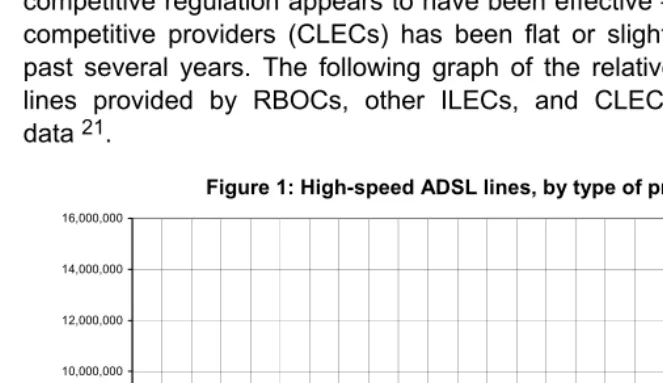
[image:13.595.63.395.286.478.2]Firstly, on the wired broadband side, competitive providers have never been a major force. Moreover, the FCC's systematic elimination of pro-competitive regulation appears to have been effective – the market share of competitive providers (CLECs) has been flat or slightly declining over the past several years. The following graph of the relative proportions of DSL lines provided by RBOCs, other ILECs, and CLECs is based on FCC data 21.
Figure 1: High-speed ADSL lines, by type of provider
0 2,000,000 4,000,000 6,000,000 8,000,000 10,000,000 12,000,000 14,000,000 16,000,000 De c-00 Feb-01 Apr -01 Ju n-01 Au g-01 Oct-0 1 Dec -01 Feb -02 Apr-02Ju
n-02 Aug-0
2 Oct-02De
c-02 Fe b-03 Apr -03 Ju n-03 Au g-03 Oct -03 Dec -03 Feb-04 Apr -04 Ju n-04 Au g-04 Oct-0 4 De c-04 S u b scr ib er s CLEC ILEC RBOC
As a percentage of all ADSL lines, CLEC lines were at 5.4% in June of 2003 22. They have steadily declined since, arriving at a paltry 4.3% by
December of 2004 23.
21 The graph is based on FCC semi-annual reports of broadband deployment, which are based, in turn, on data provided by carriers on FCC Form 477. The FCC data can be difficult to interpret, and difficult to rigorously compare to European data. For now, assume arguendo that cross comparison is not too far off.
Figure 2 - CLEC high-speed ADSL lines as a percentage of all high-speed ADSL lines 0.0% 1.0% 2.0% 3.0% 4.0% 5.0% 6.0%
Dec-01 Ja
n-02 F e b-02 Ma r-0 2 A p r-02 Ma y -0 2 J u n-02 Jul -02 A u g-02 S e p-02 Oc t-0 2
Nov-02 Dec-02 Ja
n-03 F e b-03 Ma r-0 3 A p r-03 Ma y -0 3 J u n-03 Jul -03 A u g-03 S e p-03 Oc t-0 3
Nov-03 Dec-03 Ja
n-04 F e b-04 Ma r-0 4 A p r-04 Ma y -0 4 J u n-04 Jul -04 A u g-04 S e p-04 Oc t-0 4 Nov-04 Dec-04
To put these figures into a European context, consider that the corresponding overall figure for the EU25 is 30% (and increasing over time), and that by this metric the United States has achieved less competitive market entry for wired ADSL broadband services than 21 of the 25 EU member states, including all EU15 member states 24. The best that can be said of these results is that the United States has achieved a higher percentage of competitive DSL penetration to date than Slovenia, Estonia, Cyprus and Latvia.
This competitive DSL supply at the wholesale level is essential in most European countries, as there tend to be few alternatives to the wired telephony network. France, for example, has obtained superb results in recent years thanks to shared access and bitstream access, which collectively represent a third of the market. Cable modem competition could not have driven sufficient competition in France – only 9% of the domestic broadband market reflects alternatives other than DSL.
23 These aggregate figures are not inconsistent with results of individual CLECs. Covad, a leading CLEC supplier of DSL, achieved 500,000 DSL lines in November, 2003, with annual growth of about 35%. Their Q3 2005 financial results reflect just 578,400 DSL lines in service, indicating that subsequent growth had nearly stalled, corresponding to a rate of less than 8% per year. See: http://www.covad.com/companyinfo/pressroom/pr_2005/102605_news.shtml. 24 European Commission, 10th
Figure 3 - Percentage of the European market of DSL lines held by incumbents July 2004
Figure 4 - The French broadband market - July 2004 (*)
Incumbent DSL Lines, 2,270,407 , 46%
Full ULL, 13,066 , 0% Shared Access, 717,654 , 15%
Bitstream Access, 854,205 , 17%
Resale, 635,155 , 13%
Cable, FTTH, WLL, PLC, Other, 425,000 , 9%
(*) Based on data from the 10th Implementation Report. This graph appeared in a previous paper by this author: "Broadband Adoption in Europe", IEEE Communications Magazine, April 2005.
[image:15.595.96.360.317.490.2]Denmark, all of which enjoy significantly higher overall broadband penetration than the United States 25. Their experiences would appear to contradict any suggestion that the widespread availability of cable broadband necessarily implies that the regulator should suppress the wholesale market on the DSL side.
[image:16.595.84.365.288.452.2]Despite the lack of competitive ADSL supply at a wholesale level in the United States, most geographic areas enjoy a second source of broadband supply at the retail level. As of December 2004, 56.4% of the 38+ million high-speed lines (over 200 Kbps in at least one direction) in the United States were based on a cable TV service (coaxial cable) 26. This results in the gross market structure for wired and wireless broadband shown in figure 5 below.
Figure 5 - The U.S. retail broadband market (wired and wireless) – Dec. 2004 (*)
ILEC DSL / other telco, 14,134,865 , 37%
CLEC DSL / other telco, 1,150,981 , 3% Cable modem, 21,319,224 ,
57%
Other, 1,163,357 , 3%
(*) FCC July 2005 report, based on Form 477 data.
Cable and telephone company executives appear to be increasingly inclined to mutually view each other as their most significant competitors. In a recent interview, Ed Whitacre (CEO of SBC), said: "I think the cable companies will be the biggest competitor across the footprint" 27.
25 European Commission, 10th Implementation Report.
26 FCC July 2005 report, based on Form 477 data.
27 Business Week (Online Extra), November 7th, 2005. See also the remarks of Jim Robbins, CEO of Cox, in a keynote speech at the Telecom 2005 conference, as reported at:
One might not anticipate aggressive rivalry between cable and DSL under conditions approximating duopoly; nonetheless, prices for entry-level DSL service are low by global standards. Basic DSL with unlimited usage is typically available from large RBOCs on a promotional basis at prices in the neighbourhood of USD15 (just over EUR12) per month 28. This is, to be
sure, a price for a slow service – of 13,817,280 high-speed DSL lines reported in December, 2004, only 5,695,548 provided speeds of at least 200 Kbps in both directions 29. This implies that 58.8% of all DSL services in the
United States are slower than 200 Kbps in one direction (generally upstream). The price nevertheless remains impressive.
Retail prices for entry-level DSL services have been declining in the United States. Whether they will continue to do so is unclear.
At present, there are a number of possible indications of real rivalry between cable operators and wired telephony incumbents. Cable operators have gradually amassed a customer base of some 3.7 million conventional voice customers over their cable plant (FCC, 2005c). This establishes the leading cable operators as significant CLECs.
Conversely, some of the largest RBOCs have committed substantial investments in FTTH, and indications to-date are that they are making those investments and offering production services to customers. They are looking to establish so-called triple-play offers, as are cable operators, and to use them to lock in customers before the market settles into a new form. Potentially, both telephony carriers and cable operators will compete for customers with a package comprising voice, data, and video.
For now, however, there are more questions than answers about the long-term prospects of rivalry between cable and telephony. Is the present rivalry real, or are operators merely putting on a show for the regulators? Is the rivalry likely to be sustainable over time? Will price competition continue, or will the industry settle into a comfortable duopoly pattern with supracompetitive rents? Will FTTH continue to roll out? Will operators succeed in getting the municipal franchise rights that they need? Will telephone carriers get the rights that they need to distribute the content that consumers want to watch? Will customers accept FTTH as a substitute for
28 For SBC, for example, this is typically offered for a one-year introductory period, after which the price reverts to the current rate.
cable TV and DBS satellite? Will the incredible bandwidth of FTTH ultimately provide telephone companies with a "trump card" in their rivalry with cable operators?
Returning to the wholesale market for broadband Internet access, it is difficult to analyse the significance of media other than DSL/telephony. The FCC either fails to systematically capture and report the data that would be needed to make an assessment, or else it systematically fails to capture and report it.
It is consequently not altogether clear whether cable is relevant to the wholesale market for wired broadband (FCC's claims to the contrary notwithstanding). Cable operators have never been under an overall regulatory obligation to provide wholesale services to unaffiliated ISPs. Historically, the ISP Earthlink was explicitly given certain rights to third party access in the AOL-Time Warner merger, and was able to build a customer base on that foundation. The record indicates that other ISPs, who also had rights in that merger agreement, were unable to make effective use of them. There were contracts, but no subscribers to speak of.
The cable industry may have concluded other contracts as well, but there are no indications that the number of subscribers through third party access to cable is sufficient to have a meaningful economic impact on rivalry at the wholesale level.
Broadband alternatives may be important in the long run, but in the short term they do not appear to have much impact on the competitive landscape in the United States. 3G has played no significant role in the United States to date. Wireless alternatives such as WiFi and eventually WiMax might be important in the long run, but no one (including the FCC) has decent data on deployment to date, and it is doubtful whether they can provide any effective competitive constraint on wired broadband prices today. (The WiFi service in the Starbucks coffee shop across the street from my apartment in Washington, DC, did not represent a meaningful substitute for my Verizon DSL service). Broadband over powerline might be significant in time, or it might not. All of these options have varying degrees of long term potential, but in the short term none of them provides an effective competitive constraint.
moderate degree of confidence, but many others remain highly speculative. The FCC's assessments in the series of proceedings noted earlier should be viewed as exceedingly optimistic and naïve, but the possibility that the FCC will ultimately get lucky cannot be excluded.
Concluding remarks
A few years ago, it appeared that telecoms regulation in the U.S. and in the EU would routinely reach similar results, despite different underlying regulatory processes. Today, by contrast, it seems clear that the U.S. is moving in a different direction than Europe, and also in a different direction than U.S. regulatory policy prior to about 2002. The U.S. is, at best, dancing to the beat of a different drummer.
On balance, the current U.S. approach seems more likely than not to lead to a less competitive environment than that enjoyed in the EU. It has already led to a vastly less competitive environment at the intra-modal wholesale level. At the same time, the U.S. environment differs from that of Europe in ways that might possibly serve to mitigate the potential negative impact. Many scenarios are possible, many of them bad, but not all of them irredeemably bad.
References
CRANOR Lorrie Faith & WILDMAN Steven S. (Eds) (2003): Rethinking Rights and Regulations: Institutional Responses to New Communications Technologies, MIT Press.
Directive 2002/20.EC of the European Parliament and of the Council of 7 March 2002 on a common regulatory framework for electronic communications networks and services (Framework Directive), Official Journal of the European Communities, L108, April 24th, 2002.
ECTA (European Competitive Telecommunications Association) (2004): Annual Review.
European Commission (2004), 10th Implementation Report, December.
"Europe's New Regulatory Framework for Electronic Communications in Action", presented at the 4th ZEW Conference on the Economics of Information and Communication Technologies, Mannheim, Germany, July 2004. Available at: ftp://ftp.zew.de/pub/zew-docs/div/IKT04/Paper_Marcus_Invited.pdf
FCC (Federal Communications Commission):
- (2002a): Office of Strategic Planning and Policy Analysis (OSP), Working Paper 36, "The Potential Relevance to the United States of the European Union's Newly Adopted Regulatory Framework for Telecommunications", July.
- (2002b): Cable Modem Declaratory Ruling and Notice of Proposed Rulemaking, March 14th.
- (2003): In the Matter of Review of the Section 251 Unbundling Obligations of Incumbent Local Exchange Carriers; Implementation of the Local Competition Provisions of the Telecommunications Act of 1996; Deployment of Wireline Services Offering Advanced Telecommunications Capability, generally referred to as the
Triennial Review Order (hereinafter TRO), adopted February 20th, 2003, released
August 21st, 2003, starting at §255.
- (2005a): In the Matters of Appropriate Framework for Broadband Access to the Internet over Wireline Facilities; Universal Service Obligations of Broadband Providers Review of Regulatory Requirements for Incumbent LEC Broadband Telecommunications Services; Computer III Further Remand Proceedings: Bell Operating Company Provision of Enhanced Services; 1998 Biennial Regulatory Review – Review of Computer III and ONA Safeguards and Requirements; Conditional Petition of the Verizon Telephone Companies for Forbearance Under 47 U.S.C. § 160(c) with Regard to Broadband Services Provided Via Fiber to the Premises; Petition of the Verizon Telephone Companies for Declaratory Ruling or, Alternatively, for Interim Waiver with Regard to Broadband Services Provided Via Fiber to the Premises; Consumer Protection in the Broadband Era (hereinafter Computer Inquiries Order), adopted August 5, released September 23.
- (2005b): "FCC Approves SBC/AT&T and Verizon/MCI Mergers (Corrected)", October 31st.
IEEE Communications Magazine (2005): "Broadband Adoption in Europe", April.
KAHN Alfred E. (2001):, "Whom the Gods Would Destroy, or How Not to Regulate", AEI-Brookings Joint Center for Regulatory Studies, p. 23.
MARCUS J.S. (forthcoming), "Voice over IP (VoIP) and Access to Emergency Services: A Comparison between the U.S. and the European Union", in IEEE Communications Magazine.