
http://dx.doi.org/10.4236/am.2015.65081
Effect of Rotation and Initial Magnetic Field
in Fibre-Reinforced Anisotropic Elastic
Media
F. S. BayonesMathematics Department, Faculty of Science, Taif University, Taif, Saudi Arabia Email: [email protected]
Received 28 January 2015; accepted 26 May 2015; published 29 May 2015
Copyright © 2015 by author and Scientific Research Publishing Inc.
This work is licensed under the Creative Commons Attribution International License (CC BY).
http://creativecommons.org/licenses/by/4.0/
Abstract
In this work, we study an analytical procedure for evaluation of the displacement and stresses in fibre-reinforced anisotropic elastic media under effects of rotation and initial magnetic field, and due to the application of the rotation and initial magnetic field. Effects of rotation and initial mag-netic field are analyzed theoretically and computed numerically. Numerical results have been given and illustrated graphically. Comparison was made with the results obtained in the presence of ro-tation and initial magnetic field in fibreinforced anisotropic and isotropic elastic media. The re-sults indicate the effect of rotation and initial magnetic field.
Keywords
Fibre-Reinforced Medium, Harmonic Vibrations, Initial Magnetic Field, Rotation, Anisotropic
1. Introduction
infinite generalized magneto-thermoelastic diffusion body with a spherical cavity. Effects of rotation and initial stress on generalized-thermoelastic problem in an infinite circular cylinder are due to Abd-Alla et al. [7]. Bayones [8] studied effects of rotation and hydrostatic initial stress on propagation of Raylegh in waves in an elastic so-lide half-space under the GN theory. The solution to the problems of homogeneous isotropic rotating cylinders may be found in Love [9] and Sokolnikoff [10]. Abd-Alla and Abo-Dahab [11] and Sharma et al. [12] studied the effect of the time-harmonic source in a generalized thermoelasticity. Chandrasekharaiah [13], Green and Nagh-di [14], and Hossen and Mallet [15] Nagh-discussed the problem of thermoelasticity without energy Nagh-dissipation. Abd-Alla et al. [16] studied M. I. Helmy’s Propagation of S-Wave in a Non-Homogeneous Anisotropic Incompressi-ble and Initially Stressed Medium under Influence of Gravity Field. Effects of the rotation on a non-homogeneous infinite cylinder of orthotropic material are due to Abd-Alla et al. [17].
Fibre-reinforced composites are used in a variety of structures due to their low weight and high strength. The mechanical behavior of many fibre-reinforced composite materials is adequately modeled by the theory of linear elasticity for transversely isotropic materials, with the preferred direction coinciding with the fibre direction. In such composites, the fibres are usually arranged in parallel straight lines. The characteristic property of a rein-forced composite is that its components act together as a single anisotropic unit as long as they remain in the elastic condition.
The idea of introducing a continuous self-reinforcement at every point of an elastic solid was discussed by Belfied et al. [18]. The model was later applied to the rotation of a tube as discussed by Verma and Rana [19]. The problem of surface waves in fiber-reinforced anisotropic elastic media was discussed by Sengupta and Nath [20]. The elastic moduli for fiber-reinforced materials was given by Hashin and Rosen [21]. The problem of reflection of plane waves at the free surface of a fiber-reinforced elastic half-space was discussed by Singh and Singh [22]. The dispersion of Loves waves in a self-reinforced layer over an elastic non-homogeneous half-space was studied by Pradhan et al. [23]. The propagation of plane waves in a fiber-reinforced media was dis-cussed by Chattopadhyay et al. [24]. The problem of wave propagation in thermally conducting linear fiber-reinforced composite materials was discussed by Singh [25]. Recently, the effect of rotation on plane waves at the free surface of a fiber-reinforced thermoelastic half-space using the finite element method was studied by Oth-man and Abbas [26].
In this paper, we studied an analytical procedure for evaluation of the displacement, and stresses in fibre-reinforced anisotropic elastic media under effect of rotation and initial magnetic field. Using the harmonic vibra-tions, we found the general solution, determining the displacements and stress components. The special case was studied in isotropic generalized elastic medium with rotation and initial magnetic field. Finally, we represented this case graphically.
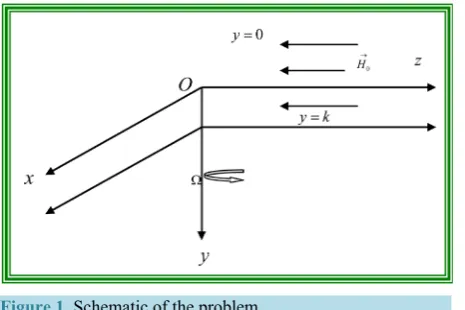
2. Formulation of the Problem (Figure 1)
The propagation of general surface waves is examined here for a fiber-reinforced elastic solid semi-infinite me-dium M covered by another fiber-reinforced elastic medium M1 (M1 above M and mechanical properties dif-ferent from M and which is welded in contact with M to prevent any relative motion or sliding during distur-bance). We consider an orthogonal Cartesian coordinate system ox x x1 2 3 with origin O at the common plane boundary surface and ox2 directed normally into M. The elastic medium is rotating uniformly with angular ve-locity Ω= Ωn where n is a unite vector representing the direction of the axis of rotation Ω≡
(
0,0,Ω)
.Both media are under the primary magnetic field Ho acting on Z-axis, HO≡
(
0,0,HO)
. The displacement equation of motion in the rotating frame has two additional terms Ω ∧ Ω ∧(
u)
is The centripetal acceleration due to time varying motion only, and 2Ω∧u is the Coriolis acceleration.Figure 1.Schematic of the problem.
where
(
0)
(
)
0 0(
0)
curl , µe , , 0,0,H
= ∧ = ∧ = + ≡
h u H f J H H H h H (2)
where h is the perturbed magnetic field over the primary magnetic field vector, E is the electric intensity, J is the electric current density, µe is the magnetic permeability, Ho is the constant primary magnetic field vector,
u the displacement vector.
The constitutive equation for the fiber reinforced linearly elastic anisotropic medium with respect to preferred direction a is Belfied et al. [28]
(
)
(
)
(
) (
)
2 2
ij kk ij T k m km ij kk i j
L T i k kj j k ki k m km i j
e eij a a e e a a
a a e a a e a a e a a
τ λ δ µ α δ
µ µ β
= + + +
+ − + + (3)
where are τij components of stress,
(
, ,)
1 2
ij i j j i
e = u +u (4) Are the components of strain, , λ µT are elastic parameter; α β, ,
(
µL−µT)
are reinforced anisotropicelas-tic parameters; uj are the displacement vector components and a
(
a a a1, ,2 3)
where a12+a22+a32 =1 if a a has components the are (1,0,0) so that the preferred direction is x1-axis, (3) simplifies as given below:( )
(
)
(
)(
)
(
)
2
11 11 1
2
1 1 1 1 1
2
2 ; , 1,2,3
kk T k m lm kk
L T k k k k k m km
e e a a e e a
a a e a a e a a a a k m
τ λ µ α
µ µ β
= + + +
+ − + + =
(
)
(
)
(
)
(
)
(
)
(
)
(
)
11 11 22 33
22 11 22 33
33 11 22 33
23 23
13 13
12 12.
2 4 2 ,
2 , 2 , 2 , 2 , 2 . L T T T T L L
e e e
e e e
e e e
e e e
τ λ α µ µ β λ α λ α
τ λ α λ µ λ
τ λ α λ λ µ
τ µ τ µ τ µ = + + − + + + + + = + + + + = + + + + = = = (5)
The equations of motion are:
2
2 13
11 12 1
2 1 2
1 2 3
2
x u
F u u
x x x t
τ
τ τ ∂ ρ
∂ ∂ ∂
+ + + = − Ω − Ω
∂ ∂ ∂ ∂ (6)
2
2 23
21 22 2
1 2 2
1 2 3
2
y u
F u u
x x x t
τ
τ τ ∂ ρ
∂ ∂ ∂
+ + + = + Ω − Ω
2
31 32 33 3
2
1 2 3 z
u F
x x x t
τ θτ τ ρ
∂ ∂ ∂ ∂
+ + + =
∂ ∂ ∂ ∂ (8)
where,
(
)
e H µ = ∧ F J2 2 2 2 2 2
2 1 2 1 2 1 2 2
0 2 2 0 2 2
1 2 3 1 2 2 3
, ,0
eH xu x xu xu eH x xu xu xu
µ µ ∂ ∂ ∂ ∂ ∂ ∂ ≡ ∂ +∂ ∂ − ∂ ∂ ∂ + ∂ + ∂ F
where ρ is the density of the elastic medium. Using (5)-(8) and assuming all derivatives with respect to x3 va-nish, the equations of motion become
(
2)
2 1(
2)
2 2 2 10 2 0 2
1 2 1 2 2 2 1 2 1 2
2 4 2
2
L T eH xu L eH x xu L xu
u u u
t t
λ α µ µ β µ λ α µ µ µ
ρ ∂ ∂ ∂ + + − + + + + + + + ∂ ∂ ∂ ∂ ∂ ∂
= − Ω − Ω
∂ ∂
(9)
(
)
(
)
2 2 2
2 2
2 2 1
0 0 2 2 1 2 1 2 2 2 2 1 2 2 2 2
L xu T eH xu L eH x xu
u u u
t t
µ λ µ µ µ λ α µ
ρ ∂ ∂ ∂ + + + + + + + ∂ ∂ ∂ ∂ ∂ ∂ = + Ω − Ω
∂ ∂
(10)
(
)
2 3 2 3 2 3 2 32 2 2 2
1 1 2
L T xu T xu xu tu
µ −µ ∂ +µ ∂ +∂ =ρ∂
∂ ∂ ∂ ∂ (11)
To examine dilatational and rotational disturbances, we introduce two displacement potentials φ and ϕ by the relations:
1 2
1 2 2 1
,
u u
x x x x
φ ϕ φ ϕ
∂ ∂ ∂ ∂
= + = −
∂ ∂ ∂ ∂ (12)
The component u3 is associated with purely distortional movement. Using (12) in (9) we obtain the following equation in M satisfied by φ and ϕ as:
(
2)
2(
2)
20 2 0 2
1 2
2
2 2
2 4 2 2
2
L T eH L eH
x x
t t
φ φ
λ α µ µ β µ λ α µ µ
φ ϕ ρ φ ∂ ∂ + + − + + + + + + ∂ ∂ ∂ ∂
= + Ω − Ω
∂ ∂
(13)
(
)
2 2 2 22 2 2
1 2
3 L 2 T x L x t 2 t
ϕ ϕ ϕ φ
α+ µ − µ +β ∂ +µ ∂ =ρ∂ − Ω∂ + Ωϕ
∂
∂ ∂ ∂ (14)
And for medium M1:
(
2)
2 1(
2)
2 11 1 1 1 1 0 2 1 1 1 0 2
1 2
2
2 1
1 2 1
2 4 2
2
L T eH x L eH x
t t
φ φ
λ α µ µ β µ λ α µ µ
ϕ φ ρ φ ∂ ∂ + + − + + + + + + ∂ ∂ ∂ ∂
= + Ω − Ω
∂ ∂
(
)
2 1 2 1 2 1 1 21 1 1 1 2 1 2 2 1
1 2
3 L 2 T x L x t 2 t
ϕ ϕ ϕ ϕ
α + µ − µ +β ∂ +µ ∂ =ρ∂ − Ω∂ + Ωϕ
∂
∂ ∂ ∂ (16)
3. Boundary Conditions
The boundary conditions for the titled problem are:
a) The component of displacement at the boundary surface between the media M and M1 must be continues at all times and places.
1 1, 2 2, 3 3 at 2 0 u =u′ u =u′ u =u′ x =
( )1
3 3
1 1 2
2 2
at 0
T ux T ux x
µ ∂ =µ ∂ =
∂ ∂
b) The stress components τ τ21 22 and τ23 must be continuous a crass the interface of M and M1 at all times and place s.
( )1 ( )1 (1 ) ( )1
21 21, 22 22 Hei x ctω , 23 23 at x2 0
τ =τ τ −τ = − τ =τ =
where τ21, τ22 and τ23 can be written in terms of φ and ϕ in medium M from (5) to (12)
2 2 2 2
2
22 2 2
1 2 1 2
1 2
2 T
x x x x
x x
φ ϕ φ ϕ
τ = ∇ +λ φ α∂ + ∂ + µ ∂ − ∂
∂ ∂ ∂ ∂
∂ ∂
(17)
2 2 2
21 2 2
2 1 2 1 2
L x x x x
φ ϕ ϕ
τ =µ ∂ +∂ −∂
∂ ∂ ∂ ∂
(18)
3 23
2 T ux
τ =µ ∂
∂ (19)
where ∇2 is the two dimensional Laplaci an operator given by 2 2 2 2 2 1 2 x x ∂ ∂ ∇ = + ∂ ∂
Similar relations in M1:
2 2 2
1 1
21 1 2 2
1 2 2 1
L x x x
φ ϕ ϕ
τ′ =µ ∂ +∂ −∂
∂ ∂ ∂ ∂
(20)
2 2 2 2
2 1 1 1 1
22 1 1 1 2 1 2
1 2 1 2
1 2
2 T
x x x x
x x
φ ϕ φ ϕ
τ′ = ∇λ φ α+ ∂ +∂ ∂∂ + µ ∂ +∂ ∂∂
∂ ∂
(21)
3 23 1
2 T ux
τ′ =µ ∂ ′
∂ (22)
4. Solution of the Problem
We seek harmonic solutions for (11), (13) and (14) in the form (see Bullen [29])
(
)
{
( ) ( ) ( )
}
(1 )3 2 2 3 2
, ,u x , x u x, eiw x ct
φ ϕ = φ ϕ − (23)
where is a complex frequency. In M and similar relations in M1 with the factions φ, ϕ, u3 being replaced by 1
(
)
(
)
(
)
1
2 2 2
1
2 2 2 2
0 2 0 1
2 2 2
;
2 4 2
; 2 3 2 . L T
L T e
L e L T L c h c H r H c s ρ µ µ
ρ λ α µ µ β µ
λ α µ µ
ρ α µ µ β
µ − = − + + − + + + Ω
= + + + − + − + − Ω
=
(24)
And similar expressions h1, r1 and s1 for the medium M1. The positive value of the square root being taken in each case.
Now substituting from (23) into (11), (13) and (14), we obtain for the medium M
( )
( )
( )
( )
( )
( )
2
3 2 2 2 3 2 2
2 2
2 2 2 2 2
2 2
2 2 2 2 2 2 d ; d d ; d . d u x
h u x x x r x dx x s x x ω φ ω φ ϕ ω ϕ = − = − = − (25)
Equation (25) has solutions:
(
)
(
)
(
)
(
)
(
)
(
)
3 2 1
2 1
2 1
exp ;
exp ;
exp ;
u C i hx x ct
A i rx x ct
B i sx x ct
ω φ ω ϕ ω = − + − = − + − = − + − (26)
And for the medium M1
(
)
(
)
(
)
(
)
(
)
(
)
3 1 1 2 1
1 1 2 1
1 2 1
exp exp exp
u C i h x x ct
A i r x x ct
B i sx x ct
ω φ ω ϕ ω ′ = + − ′ = + − ′ = + − (27)
In the above, for the effect to be essentially a surface one ,each expression must diminish indefinitely with in-creasing distance from the boundary this with be the case if each expression contains an exponential factor in with the exponent is teal and negative. Hence, h r s, , and similarly h r s1, , 1 1 are taken to be imaginary. From (12), we have
( )
( 2 1 )(
)
( 2 1 )1 ei rx x ct ei sx x ct
u =A iω ω− + − +B i s−ω ω− + −
(28)
(
)
( 2 1 )( )
( 2 1 )2 ei rx x ct ei sx x ct
u =A i r−ω ω− + − −B iω ω− + −
(29)
( )
(1 2 1 ) (1 2 1 )1 1 ei r x x ct 1 1ei s x x ct
u′ =A iω ω + − +i s Bω ω + − (30)
(
)
(1 2 1 )( )
(1 2 1 ) 2 1 1 ei r x x ct ei s x x ctu′ =A i r+ω ω + − −B iω ω + − (31)
(
)
(
)
( )(
)
(
)
( ) 2 1 2 1 2 2 11 22 4 2 e
2 4 2 e ,
i rx x ct
L T
i sx x ct
L T
r r A
i s B
ω
ω
τ λ α µ µ β ω λ α ω
λ α µ µ β ω ω λ α
+ −
− + −
= + + − + + +
+ + + − + + + (32)
(
)
(
)
( )(
)
(
)
( ) 2 1 2 1 2 2 22 2 2 e 2 ei rx x ct T
i sx x ct T
r r A
i s B
ω
ω
τ λ α ω λ µ ω
λ α ω ω λ µ
+ −
− + −
= + + +
(
)
2 2 ( 2 1 )(
)
2 ( 2 1 )33 r r Aeiw rx x ct i s Beiw sx x ct
τ = λ α ω+ +λω + − + λ α ω+ + ω λ − + −
(34)
(
2)
( 2 1 )(
2)
( 2 1 )12 L i s Aei rx x ctω i s Beiω sx x ct
τ =µ ω + ω + − + ω + ω − + −
(35)
Similar relations in M1 with , , , µ λ α µL T are replaced by µL1, , , λ α µ1 1 T1.
By using the boundary conditions a and b, we can determined the constants A, B, A1 and B1.
We can study the components of displacement and stresses in fibre-reinforced anisotropic elastic media under effect of rotation and initial magnetic field from Equations (28)-(35) by using Maple program, is clear up from Figures 2-9.
5. Particular Case: Isotropic Generalized Elastic Medium with Rotation and Initial
Magnetic Field
In this case, substituting µL=µT =µ and β =0 in Equations (28)-(35), we obtain the corresponding expres-sions of displacement and stress in isotropic generalized elastic medium with rotation and initial magnetic field, is clear up from Figures 10-17.
6. Numerical Results and Discussions
[image:7.595.89.541.354.702.2]To study the surface waves in fibre-reinforced we use the following physical constants for anisotropic elastic media under the in influence of rotation and initial magnetic field, are considered [18] [19], for mediums M and M1 respectively.
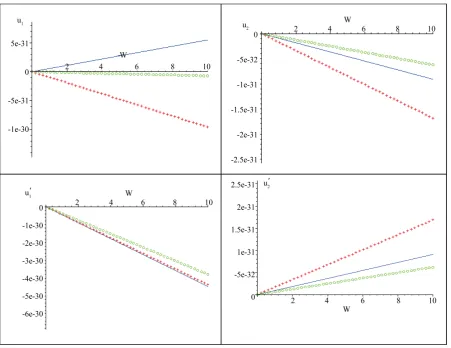
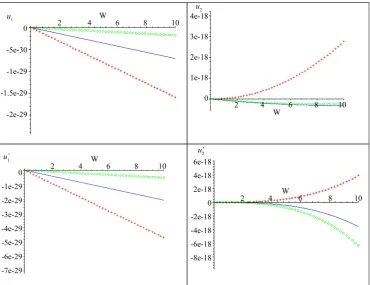
Figure 3. Effects of initial magnetic field H on displacements with change values of complex frequency Ω, H = 0.1, H = 0.4,
H = 0.9.
9 2 9 2 9 2
9 2 9 2 2
10 2 10 2 10 2
1 1 1
10 2 10 2
1 1
7.59 10 N m , 1.89 10 N m , 2.45 10 N m , 1.28 10 N m , 0.32 10 N m , 7800 Kg m , 5.65 10 N m , 2.46 10 N m , 5.66 10 N m ,
1.28 10 N m , 220.90 10 N m
T L
T L
λ µ µ
α β ρ
λ µ µ
α β
= × = × = ×
= − × = × =
= × = × = ×
= − × = × , ρ =7800 Kg m ,2
The numerical technique outlined above was used to obtain of the displacement, stresses in fibre-reinforced anisotropic and isotropic elastic media under effect of rotation and initial magnetic field. These distributions are shown in Figures 2-17. For the sake of brevity some computational results are being presented here.
6.1. Effect of Rotation and Initial Magnetic Field in Fibre-Reinforced Anisotropic Elastic Media
Figure 2 shows that the components of displacement in fibre-reinforced anisotropic elastic media under effect of rotation, we find that in medium M, the components of displacement u1 and u2 are decreasing with increasing values of the rotation Ω, put in medium M1, u1′ decreasing and u2′ increasing with increasing values of Ω re-spectively.
Figure 3 shows that the components of displacement in fibre-reinforced anisotropic elastic media under effect of initial magnetic field, we find that in medium M, the components of displacement u1 increasing and u2 de-creasing with inde-creasing values of initial magnetic field H respectively, put u1′ decreasing and u2′ increasing with increasing values of H .
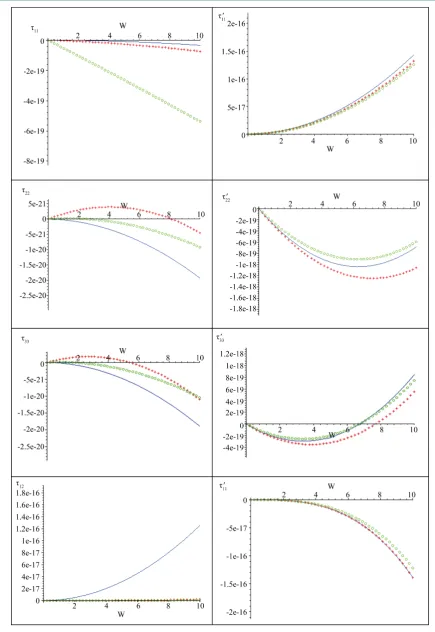
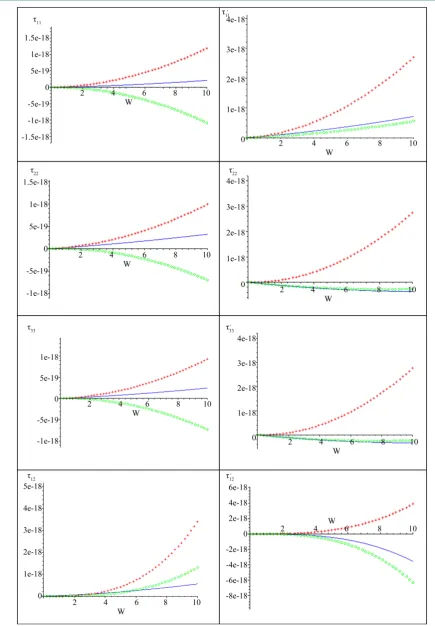
Figure 5. Effects of initial magnetic field H on stresses with change values of complex frequency Ω, H = 0.1, H = 0.4,
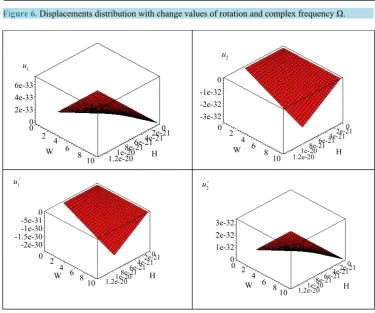
Figure 6. Displacements distribution with change values of rotation and complex frequency Ω.
Figure 7. Displacements distribution with change values of initial magnetic field and complex
[image:11.595.124.500.382.695.2]Figure 10. Effects of rotation Ω on displacements with change values of complex frequency Ω, Ω =
0.1, Ω = 0.5, Ω = 0.9.
Figure 11. Effects of initial magnetic field H on displacements with change values of complex
[image:14.595.129.500.408.693.2]Figure 14.Displacements distribution with change values of rotation and complex frequency Ω.
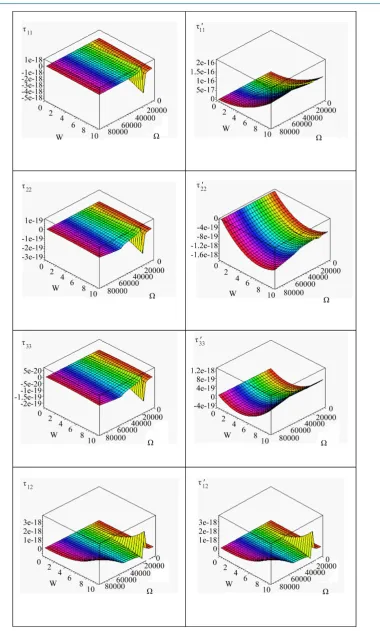
[image:17.595.120.506.421.708.2]rotation, we find in medium M the components of stresses τ11, τ22 and τ33 are increasing with increasing val-ues of the rotation Ω, put τ12 decreasing with increasing values of Ω. While, in medium M1 the components of stresses τ ′11, τ ′22, τ ′33 and τ ′12 are decreasing with increasing values of Ω.
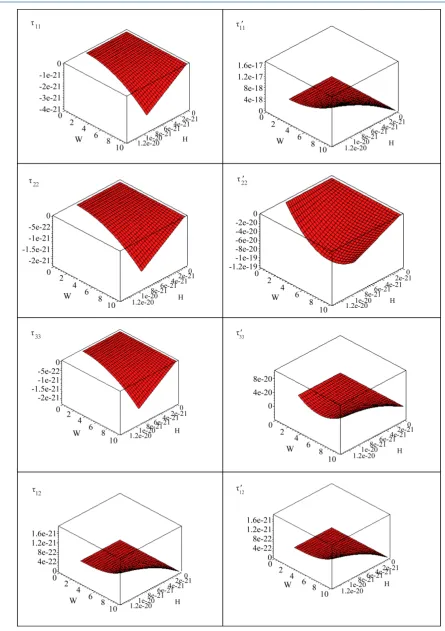
Figure 5 shows that the components of stresses in fibre-reinforced anisotropic elastic media under effect of initial magnetic field, we find in medium M the components of stresses τ11, τ22, τ33 and τ12 are decreasing with increasing values of initial magnetic field H . While, in medium M1 the components of stresses τ ′11 and
12
τ ′ are decreasing with increasing values of initial magnetic field H, put τ ′22 and τ ′33 are increasing with in-creasing values of values of H.
Figure 6 shows that the displacements distribution with change values of rotation and complex frequency ω in fibre-reinforced anisotropic elastic media, we find in medium M the components of displacement u1 and u2 are decreasing with increasing values of the rotation Ω, put in medium M1, u1′ decreasing and u2′ increasing with increasing values of Ω respectively.
Figure 7 shows that the displacements distribution with change values of initial magnetic field H and com-plex frequency ω in fibre-reinforced anisotropic elastic media, we find we find that that in medium M, the components of displacement u1 increasing and u2 decreasing with increasing values of initial magnetic field
H , put in medium M1, u1′ decreasing and u2′ increasing with increasing values of H , respectively.
Figure 8 shows that Stresses distribution with change values of rotation and complex frequency Ω in fibre-reinforced anisotropic elastic media under effect of rotation, we find for the medium M the components of stresses τ11, τ22, τ33 and τ12 are increasing with increasing values of the rotation Ω. While, for the medium
1
M the components of stresses τ ′11 and τ ′12 are increasing with increasing values of Ω, put the components of stresses τ ′22and τ ′33 are decreasing with increasing values of Ω.
Figure 9 shows that Stresses distribution with change values of initial magnetic field and complex frequency Ω in fibre-reinforced anisotropic elastic media under effect of rotation, we find in the medium M the compo-nents of stresses τ11, τ22 and τ33 are increasing with increasing values of the initial magnetic field H , put τ12 decreasing with increasing values of H . While, in the medium M1 the components of stresses τ ′11, τ33 and τ ′12 are increasing with increasing values of Ω, put τ ′12 decreasing with increasing values of H.
6.2. Effect of Rotation and Initial Magnetic Field in Fibre-Reinforced Isotropic Elastic Media
Figure 10 shows that the components of displacement in fibre-reinforced isotropic elastic media under effect of rotation, we find in tow medium M and M1, all components of displacement are increasing with increasing values of the rotation Ω.
Figure 11 shows that the components of displacement in fibre-reinforced anisotropic elastic media under ef-fect of initial magnetic field, we find that in the medium M the components of displacement u1 and u2 are de-creasing and inde-creasing with inde-creasing values of initial magnetic field H , put u1′ and u2′ are decreasing and increasing with increasing values of H , respectively .
Figure 12 shows that the components of stresses in fibre-reinforced isotropic elastic media under effect of ro-tation, we find in tow medium M and M1 all components of stresses are increasing with increasing values of the rotation Ω.
Figure 13 shows that the components of stresses in fibre-reinforced isotropic elastic media under effect of ini-tial magnetic field, we find for the medium M the components of stresses τ11, τ22, τ33 and τ12 are increasing with increasing values of initial magnetic field H . While, for the medium M1 the components of stresses τ ′11 increasing with increasing values of initial magnetic field H , put τ ′22, τ33 ans τ ′12 are decreasing with increas-ing values of values of H .
Figure 14 shows that the displacements distribution with change values of rotation and complex frequency ω in fibre-reinforced isotropic elastic media, we find in tow medium M and M1, all components of displacement are increasing with increasing values of Ω.
Figure 15 shows that the displacements distribution with change values of initial magnetic field H and com-plex frequency ω in fibre-reinforced isotropic elastic media, we find the components of displacement u1, u2 and u1′ are decreasing with increasing values of the initial magnetic field H, put u2′ increasing with increasing values of H .
fibre-reinforced isotropic elastic media, we find in tow medium M and M1, all components of stresses are increasing with increasing values of the rotation Ω.
Figure 17 shows that stresses distribution with change values of initial magnetic fieldH and complex
fre-quency ω in fibre-reinforced isotropic elastic media, we find in medium M , all components of stresses are in-creasing with inin-creasing values of H , put in medium M1, τ ′11 and τ ′12 are increasing with increasing values of
H and τ ′22 and τ ′33 are decreasing with increasing values of H .
7. Conclusions
In the light of the above analysis, the following conclusions may be made:
- Effects of rotation and initial magnetic field are cleared on the components of displacement and stresses; - Effect of complex frequency is cleared on the components of displacement and stresses;
- There is a clear difference in the two cases, anisotropic and isotropic elastic media;
- Deformation of a body depends on the nature of the forces applied as well as the type of boundary condi-tions.
References
[1] Lord, H.W. and Shulman, Y. (1967) A Generalized Dynamical Theory of Thermo-Elasticity. Journal of the Mechanics and Physics of Solids, 15, 299-309.
[2] Green, A.E. and Lindsay, A. (1972) Thermoelasticity. Journal of Elasticity, 2, 1-7.
http://dx.doi.org/10.1007/BF00045689
[3] Lebon, G.A. (1982) A Generalized Theory of Thermoelasticity. Journal of Technical Physics, 23, 37-46.
[4] Roychoudhuri, S.K. and Banerjee, S. (1998) Magneto-Thermoelastic Interactions in an Infinite Viscoelastic Cylinder of Temperature Rate Dependent Material Subjected to a Periodic Loading. International Journal of Engineering Science, 36, 635-643. http://dx.doi.org/10.1016/S0020-7225(97)00096-7
[5] Roychoudhuri, S.K. and Mukhopadhyay, S. (2000) Effect of Rotation and Relaxation Times on Plane Waves in Gene-ralized Thermo-Viscoelasticity. International Journal of Mathematics and Mathematical Sciences, 23, 497-505. [6] Abd-Alla, A.M., Abo-Dahab, S.M. and Bayones, F.S. (2011) Effect of the Rotation on an Infinite Generalized
Magne-to-Thermoelastic Diffusion Body with a Spherical Cavity. International Review of Physics, 5, 171-181.
[7] Abd-Alla, A.M., Abo-Dahab, S.M. and Bayones, F.S. (2011) Effect of Rotation and Initial Stress on Generalized- Thermoelastic Problem in an Infinite Circular Cylinder. Advances in Theoretical and Applied Mechanics, 4, 15-42. [8] Bayones, F.S. (2012) Effects of Rotation and Hydrostatic Initial Stress on Propagation of Raylegh in Waves in an
Elas-tic Solide Half-Space under the GN Theory. Pioneer Journal of Advances in Applied Mathematics, 5, 1-17. [9] Love, A.E.H. (1944) A Treatise on the Mathematical Theory of Elasticity. Dover Publications Inc., New York, 146. [10] Sokolnikoff, I.S. (1946) Mathematical Theory of Elasticity. Dover Publications Inc., New York, 230-304.
[11] Abd-Alla, A.M. and Abo-Dahab, S.M. (2009) Time-Harmonic Sources in a Generalized Magneto-Thermo-Viscoelastic Continuum with and without Energy Dissipation. Applied Mathematical Modelling, 33, 2388-2402.
http://dx.doi.org/10.1016/j.apm.2008.07.008
[12] Sherief, H., Hamza, F. and Saleh, H. (2004) The Theory of Generalized Thermoelastic Diffusion. International Journal of Engineering Science, 42, 591-608. http://dx.doi.org/10.1016/j.ijengsci.2003.05.001
[13] Chandrasekharaiah, D.S. (1996) One-Dimensional Wave Propagation in the Linear Theory of Thermoelasticity without Energy Dissipation. Journal of Thermal Stresses, 19, 695-710.
http://dx.doi.org/10.1080/01495739608946202
[14] Green, A.E. and Naghdi, P.M. (1993) Thermoelasticity without Energy Dissipation. Journal of Elasticity, 31, 189-208.
http://dx.doi.org/10.1007/BF00044969
[15] Golam, F.R. and Mallet, H.A. (2000) Thermoelastic Waves without Energy Dissipation in an Elastic Plate Due to Suddenly Punched Hole. Science and Technology Research Journal, 6, 1-17.
[16] Abd-Alla, A.M., Mahmoud, S.R., Abo-Dahab, S.M. and Helmy, M.I. (2011) Propagation of S-Wave in a Non-Homo- geneous Anisotropic Incompressible and Initially Stressed Medium under Influence of Gravity Field. Applied Mathe-matics and Computation, 217, 4321-4332. http://dx.doi.org/10.1016/j.amc.2010.10.029
[17] Abd-Alla, A.M., Mahmoud, S.R. and AL-Shehri, N.A. (2011) Effect of the Rotation on a Non-Homogeneous Infinite Cylinder of Orthotropic Material. Applied Mathematics and Computation, 217, 8914-8922.
[18] Belfield, A.J., Rogers, T.G. and Spencer, A.J.M. (1983) Stress in Elastic Plates Reinforced by Fibre Lying in Concen-tric Circles. Journal of the Mechanics and Physics of Solids, 31, 25-54.
http://dx.doi.org/10.1016/0022-5096(83)90018-2
[19] Verma, P.D.S. and Rana, O.H. (1983) Rotation of a Circular Cylindrical Tube Reinforced by Fibers Lying along He-lices. Mechanics of Materials, 2, 353-359. http://dx.doi.org/10.1016/0167-6636(83)90026-1
[20] Sengupta, P.R. and Nath, S. (2001) Surface Waves in Fiber-Reinforced Anisotropic Elastic Media. Sãdhanã, 26, 363- 370. http://dx.doi.org/10.1007/BF02703405
[21] Hashin, Z. and Rosen, W.B. (1964) The Elastic Moduli of Fibre-Reinforced Materials. Journal of Applied Mechanics,
31, 223-232. http://dx.doi.org/10.1115/1.3629590
[22] Singh, B. and Singh, S.J. (2004) Reflection of Planes Waves at the Free Surface of a Fibre-Reinforced Elastic Half-Space, Sãdhanã, 29, 249-257. http://dx.doi.org/10.1007/BF02703774
[23] Pradhan, A., Samal, S.K. and Mahanti, N.C. (2003) Influence of Anisotropy on the Love Waves in a Self-Reinforced Medium. Tamkang Journal of Science and Engineering, 6, 173-178.
[24] Chattopadhyay, A., Venkateswarlu, R.L.K. and Saha, S. (2002) Reflection of Quasi-P and Quasi-SV Waves at the Free and Rigid Boundaries of a Fibre-Reinforced Medium. Sãdhanã, 27, 613-630.
http://dx.doi.org/10.1007/BF02703354
[25] Singh, B. (2006) Wave Propagation in Thermally Conducting Linear Fibre-Reinforced Composite Materials. Archive of Applied Mechanics,75, 513-520. http://dx.doi.org/10.1007/s00419-005-0438-x
[26] Othman, M.I.A. and Abbas, I.A. (2011) Effect of Rotation on Plane Waves at the Free Surface of a Fibre-Reinforced Thermoelastic Half-Space Using the Finite Element Method. Meccanica, 46, 413-421.
http://dx.doi.org/10.1007/s11012-010-9322-z
[27] Mukhopadhyay, S. (2000) Effects of Thermal Relaxations on Thermo-Viscoelastic Interactions in an Unbounded Body with a Spherical Cavity Subjected to a Periodic Loading on the Boundary. Journal of Thermal Stresses, 23, 675-684.
http://dx.doi.org/10.1080/01495730050130057
[28] Belfield, A.J., Rogers, T.G. and Spencer, A.J.M. (1983) Stress in Elastic Plates Reinforced by Fibres Lying in Concen-tric Circles. Journal of the Mechanics and Physics of Solids, 31, 25-54.
http://dx.doi.org/10.1016/0022-5096(83)90018-2


![(1S,3R,8R,9S,11R) 2,2 Dibromo 10,10 dichloro 3,7,7,11 tetramethyltetracyclo[6 5 0 01,3 09,11]tridecane](data:image/gif;base64,R0lGODlhAQABAIAAAP///wAAACH5BAEAAAAALAAAAAABAAEAAAICRAEAOw==)