http://dx.doi.org/10.4236/ojapps.2015.55021
On Solution of the Problem of Bending of
Orthotropic Plates on the Basis of
Bimoment Theory
Makhamatali K. UsarovInstitute of Seismic Stability of Structures, Academy of Sciences of Uzbekistan, Tashkent, Uzbekistan Email: [email protected]
Received 15 April 2015; accepted 8 May 2015; published 13 May 2015
Copyright © 2015 by author and Scientific Research Publishing Inc.
This work is licensed under the Creative Commons Attribution International License (CC BY).
http://creativecommons.org/licenses/by/4.0/
Abstract
This paper is devoted to the development of new theory of orthotropic thick plates with account of internal forces, moments and bimoments. An equation of motion of plates is described by two sys-tems with nine equations each. Boundary conditions depended on displacements, forces, moments and bimoments are given. An exact solution of the bending of thick plate under the effect of sine load is built. Numerical results for maximal values of displacements and stresses of the plate are obtained.
Keywords
Plate, Orthotropy, Isotropy, Force, Moment, Bimoment, Equation of Motion, Exact Solution
1. Introduction
Specified theories of plates are widely used in analysis of structure elements. Review and general technique for constructing a specified theory can be found in [1] [2]. In spatial case of bending and vibrations along the thick-ness of the plate, the displacements vary according to nonlinear law, and classical theories of plates and shells become unacceptable. In general case the field of displacement of thick plates does not obey to any simplifying hypotheses. It is necessary to take into account all the components of the tensor of stress and strain:
(
)
, , , 1, 3
ij ij i j
σ ε = ; by them we will introduce tensile and crosscutting forces, bending and torsion moments and the concept of bimoments [3], generated due to nonlinear law of distribution of displacements in cross-sections of the plate.
given.
2. Statement of the Problem
Consider orthotropic thick plate of constant thickness H=2h and dimensions ,a b in plan. Introduce the signs: E E E1, 2, 3—elasticity modulus and G12,G13,G23—shear modulus; ν ν ν12, 13, 23—Poisson’s ratio of plate material.
Introduce Cartesian system of coordinates x x1, 2 and z. Axis oz is directed vertically downwards. Let dis-tributed surface normal and tangential loads are applied to the lower and the upper face surfaces of the plate
z=h and z= −h. Normal loads in oz axis we will designate as q3( ),q3( )
+ −
, tangential loads in direction
1, 2
ox ox –qk( )+,q( )k−,
(
k=1, 2)
. Vlasov B. F. [4] has built an exact analytical solution of this problem in trigono-metric series.
Components of the vector of displacement are determined by the functions of three spatial coordinates and time u x x z t u1
(
1, 2, ,) (
, 2 x x z t u1, 2, ,) (
, 3 x x z t1, 2, ,)
. Components of the tensor of strain are determined by Cauchy correlation. The plate is considered as a three-dimensional body, its material obeying Hooke’s generalized law:11 11 11 12 22 13 33 22 21 11 22 22 23 33
33 31 11 32 22 33 33 12 12 12 13 13 13 23 23 23
, ,
, 2 , 2 , 2 ,
E E E E E E
E E E G G G
σ ε ε ε σ ε ε ε
σ ε ε ε σ ε σ ε σ ε
= + + = + +
= + + = = = (1)
where E11,E12,,E33—are elastic constants, defined by Poisson’s ratio and elasticity modulus in the form:
11 1 11, 22 2 22, 33 3 33,
E =E g E =E g E =E g
12 21 1 12 2 21, 13 31 1 13 3 31, 23 32 2 23 3 32,
E =E =E g =E g E =E =E g =E g E =E =E g =E g
23 32 13 31 12 21
11 2 22 2 33 2
1 1 1
, , ,
1 1 1
g ν ν g ν ν g ν ν
µ µ µ
− − −
= = =
− − −
12 13 32 21 31 23 13 21 32 31 12 23
12 21 2 2 , 13 31 2 2 ,
1 1 1 1
g g ν ν ν ν ν ν g g ν ν ν ν ν ν
µ µ µ µ
+ + + +
= = = = = =
− − − −
2 23 13 12 32 31 21
23 32 2 2 , 12 21 23 32 13 31 2 12 23 31.
1 1
g g ν ν ν ν ν ν µ ν ν ν ν ν ν ν ν ν
µ µ
+ +
= = = = + + +
− −
As an equation of motion of the plate we will use three-dimensional equations of motion of the theory of elas-ticity:
(
)
1 2 3
1 2
, 1, 3 .
i i i
i
u i
x x z
σ σ σ ρ
∂ ∂ ∂
+ + = =
∂ ∂ ∂ (2)
here ρ —is a density of plate material.
Boundary conditions on the lower and the upper surfaces z=h and z= −h have the form:
( ) ( ) ( )
33 q3 , 31 q1 , 32 q2 , atz h;
σ = + σ = + σ = + =
(3.a)
( ) ( ) ( )
33 q3 , 31 q1 , 32 q2 , atz h.
σ = − σ = − σ = − = −
(3.b)
3. Method of Solution
Methods of constructing a bimoment theory of plates is based on displacements expansions in infinite series, Hooke’s generalized law (1), three-dimensional equations of the theory of elasticity (2) and boundary conditions on face surfaces (3). Components of the vector of displacements are expanded inMacloren’sseries in the form [3]-[7]:
( ) ( ) ( ) 2 ( ) 3 ( )
(
)
0 1 2 3 , 1, 2 ,
m
k k k k k
k m
z z z z
u B B B B B k
h h h h
= + + + + + + =
2 3
3 0 1 2 3 ,
m m
z z z z
u A A A A A
h h h h
= + + + + + +
(4.b)
here Bm( )k ,Am—are unknown functions of two spatial coordinates and time:
( ) ( )
(
)
(
)
1 2
0
, , , 1, 2 ,
! m m
k k k
m m m
z
u h
B B x x t k
m z =
∂
= = =
∂
(
)
3 1 2
0
, , .
! m m
m m m
z
u h
A A x x t
m z =
∂
= =
∂
Offered bimoment theory of plates [5]-[8] is described by two unrelated problems, each of which is formu-lated on the basis ofnine two-dimensional equations with corresponding boundary conditions. It should be noted that proposed bimoment theory of plates presents a two-dimensional theory of elastic orthotropic layer, which is deformed in general three-dimensional form.
The first problem is described by two equations relative to longitudinal and tangential forces, by four addi-tionally constructed equations in relation to bimoments and three equations obtained from the boundary condi-tions (3) on the basis of expansion (4). The forces, moments and bimoments of the plate are determined bynine unknown kinematic functions from relationships [5]-[8]:
( ) ( )
(
)
2 3
1 1
, d , d , 1, 2 ,
2 2 2
h h
k k
k k k k k
h h
u u
u u z u z z k
h h
ψ β
+ −
− −
+
= =
∫
=∫
= (5.а)( ) ( )
3
3 3
3 3
2 4
1 1
, d , d .
2 2 2
h h
h h
u u
W r u z z u z z
h γ h
+ −
− −
−
= =
∫
=∫
(5.b)We will get the equations of equilibrium relative to longitudinal and tangential forces by integrating two first equations of the theory of elasticity in coordinate z (2):
11 12 21 22
1 1 2 2
1 2 1 2
2 , 2 ,
N N N N
q H q H
x x ρ ψ x x ρ ψ
∂ ∂ ∂ ∂
+ + = + + =
∂ ∂ ∂ ∂ (6)
where N11,N12,N22—are longitudinal and tangential forces determined from relationships
1 2
11 11 11 12 13
1 2
d 2 ,
h
h
N z E H E H E W
x x
ψ ψ
σ
−
∂ ∂
= = + +
∂ ∂
∫
(7.а)1 2
22 22 12 22 23
1 2
d 2 ,
h
h
N z E H E H E W
x x
ψ ψ
σ
−
∂ ∂
= = + +
∂ ∂
∫
(7.b)2 1
12 21 12 12
1 2
d ,
h
h
N N z G H H
x x
ψ ψ
σ
−
∂ ∂
= = = +
∂ ∂
∫
(7.c)( ) ( )
(
)
3( ) 3( ) 3, 1, 2 ,
2 2
k k
k
q q q q
q k q
+ − − + + −
= = = —terms of equations with external load.
On the basis of force expression (7) two Equations (6) include three unknown functions ψ ψ1, 2,r. To derive additional equations we will introduce bimoments, generated in tension and cross compression of the plate. Longitudinal and tangential bimoments are determined by expressions: T T11, 22,T12:
2 1 2
11 2 11 11 12 13
1 2
1 2 4
d ,
h
h
W r
T z z H E E E
x x H
h
β β
σ
−
∂ ∂ −
= = + +
∂ ∂
∫
(8.а)2 1 2
22 2 22 12 22 23
1 2
1 2 4
d ,
h
h
W r
T z z H E E E
x x H
h
β β
σ
−
∂ ∂ −
= = + +
∂ ∂
∫
(8.b)2 2 1
12 21 2 12 12
1 2
1
d .
h
h
T T z z HG
x x
h
β β
σ
−
∂ ∂
= = = +
∂ ∂
∫
(8.c)(
) (
)
3 2 3 3
2 1
d , 1, 2 ,
2 h
k k
k k k
k h
u r
p z z G k
x H
h
ψ σ
−
∂ −
= = ∂ + =
∫
(9.а)(
)
(
)
3
3 4 3 3
2 3 1
d , 1, 2 .
2
h
k k
k k k
k h
u
z z G k
x H
h
β γ
τ σ
−
∂ −
= = + =
∂
∫
(9.b)Introduce intensities of normal bimoments p33 and τ33 on normal stress σ33 in the form of relations:
1 2
33 33 31 32 33
1 2
1 2
d ,
2
h
h
W
p z E E E
h x x H
ψ ψ
σ
−
∂ ∂
= = + +
∂ ∂
∫
(10.а)2 1 2
33 3 33 31 32 33
1 2
1 2 4
d .
2
h
h
W r
z z E E E
x x H
h
β β
τ σ
−
∂ ∂ −
= = + +
∂ ∂
∫
(10.b)Equations in relation to longitudinal and transversal bimoments, acting in plate plane are obtained in the form:
11 12 12 22
13 1 1 23 2 2
1 2 1 2
4 2 , 4 2 ,
T T T T
p q H p q H
x x ρ β x x ρ β
∂ ∂ ∂ ∂
+ − + = + − + =
∂ ∂ ∂ ∂ (11)
13 23 33 3 13 23 33 3
1 2 1 2
2 2 6 2
, .
p p p q q
r
x x H H x x H H
τ τ τ
ρ ργ
∂ ∂ ∂ ∂
+ − + = + − + =
∂ ∂ ∂ ∂ (12)
By using series (4) and Formulas (5) are obtained expressions for series’ (4) coefficients
( )1 ( )2
(
)
2i , 2i , 2i 1, 0,1, 2
B B A + i= via uk,ψ βk, k functions and boundary conditions (3) let represent as next
equa-tions:
(
)
(
)
3
1 1 1
21 3 , 1, 2 ,
4 20 20
k
k k k
k k
Hq W
u H k
x G
β ψ ∂
= − − + =
∂ (13.а)
(
)
31 1 32 2 333 1 33 2 33
1 1
21 7 .
2 30 30
E u E u Hq
W r H
E x E x E
γ ∂ ∂
= − − + +
∂ ∂
(13.b)
Equations (6), (11), (12) and (13) make a combined system of differential equations of motion, which consists of nine equations relative to nineunknown functions: ψ ψ β β1, 2, 1, 1,u u r1, 2, , ,γ W.
The second problem is described by two equations of moments, one equation of crosscutting forces, three eq-uations of bimoments and three eqeq-uations, obtained from boundary conditions (3) on the bases of expansion (4). Here forces, moments and bimoments are determined relative to nine unknown kinematic functions in the form [5]-[8]:
( ) ( )
2
3 3
3 3 3
1 1
, d , d ,
2 2 2
h h
h h
u u
W r u z u z z
h γ h
+ −
− −
+
= =
∫
=∫
(14.а)
( ) ( )
(
)
3
2 4
1 1
, d , d , 1, 2 .
2 2 2
h h
k k
k k k k k
h h
u u
u u z z u z z k
h h
ψ β
+ −
− −
−
= =
∫
=∫
= (14.b)
The first three of these equations are the ones relative to bending, torsion moments and an equation relative to crosscutting forces, the rest three equations are derived in relation to bimoments.
Multiplying the first and the second equations of the theory of elasticity by coordinate z and integrating it by z, we will obtain an equation of equilibrium in moments and forces:
2 2
11 12 21 22
13 1 1 23 2 2
1 2 1 2
, .
2 2
M M H M M H
Q Hq Q Hq
x x ρψ x x ρψ
∂ ∂ ∂ ∂
+ − + = + − + =
∂ ∂ ∂ ∂ (15.а)
13 23 3 1 2 2 . Q Q q Hr
x x ρ
∂ ∂
+ + =
∂ ∂ (15.b)
Bending and torsion moments are determined in the form:
(
)
2
1 2
11 11 11 12 13
1 2 2 d , 2 h h r W H
M z z E E E
x x H
ψ ψ σ − ∂ ∂ − = = + − ∂ ∂
∫
(16.а)(
)
2
1 2
22 22 12 22 23
1 2 2 d , 2 h h r W H
M z z E E E
x x H
ψ ψ σ − ∂ ∂ − = = + − ∂ ∂
∫
(16.b)2
1 2
12 21 12 12
2 1 d . 2 h h H
M M z z G
x x ψ ψ σ − ∂ ∂ = = = + ∂ ∂
∫
(16.c)Expressions for crosscutting forces have the form:
13 13 13 1 23 23 23 2
1 2
d 2 , d 2 .
h h
h h
r r
Q z G u H Q z G u H
x x σ σ − − ∂ ∂ = = + = = + ∂ ∂
∫
∫
(17)In Equations (15) terms with external load are determined by the following formula: ( ) ( )
(
)
( )3 3( )3
, 1, 2 , .
2 2
k k
k
q q q q
q k q
+ + − + − −
= = =
To derive other equations we will introduce the following bimoments, generated at bending and shear of the plate. Bimoments P P11, 22,P12 are determined by the following formula:
(
)
2
3 1 2
11 2 11 11 12 13
1 2 2 3 1 d , 2 h h W H
P z z E E E
x x H
h γ β β σ − ∂ ∂ − = = + − ∂ ∂
∫
(18.а)(
)
2
3 1 2
22 2 22 12 22 23
1 2 2 3 1 d , 2 h h W H
P z z E E E
x x H
h γ β β σ − ∂ ∂ − = = + − ∂ ∂
∫
(18.b)2
3 1 2
12 21 2 12 12
2 1 1 d . 2 h h H
P P z z G
x x h β β σ − ∂ ∂ = = = + ∂ ∂
∫
(18.c)Intensity of transversal tangential and normal bimoments p13,p23 and p33 are determined by expressions
(
)
2
3 3 3 3
2 4
1
d , 1, 2 ,
2 h
k k
k k k
k h
u
p z z G k
H x h ψ γ σ − − ∂ = = + = ∂
∫
(19.а)
(
)
1 2
33 2 33 31 32 33
1 2 2 1 d . 2 h h r W
p z z E E E
x x H
h ψ ψ σ − − ∂ ∂ = = + − ∂ ∂
∫
(19.b)
Equations relative to bimoments at bending and transversal shear are derived in the form:
2 2
11 12 21 22
13 1 1 23 2 2
1 2 1 2
3 , 3 ,
2 2
P P H P P H
p Hq p Hq
x x ρβ x x ρβ
∂ ∂ ∂ ∂
+ − + = + − + =
∂ ∂ ∂ ∂ (20)
13 23
33 3
1 2
4 2 .
p p
H H p q H
x x ργ
∂ ∂
+ − + =
∂ ∂
(21)
From expressions for series (4) and Formulas (14) relations for series’ coefficients B2( )1i+1,B2( )2i+1,A2i,
(
i=0,1, 2)
(
)
(
)
3
1 1 1
21 7 , 1, 2 ,
2 30 30
k
k k k
k k
Hq W
u H k
x G
β ψ ∂
= − − + =
∂
(22.а)
(
)
31 1 32 2 333 1 33 2 33
1 1
21 3 .
4 20 20
E u E u Hq
W r H
E x E x E
γ ∂ ∂
= − − + +
∂ ∂
(22.b)
The system of differential equations of motion (15), (20), (21) and (22) makes combined system of nine equa-tions relative to nine unknown funcequa-tions ψ ψ 1, 2,u u 1, 2,β β 1, 1, , ,rγW.
Formula to determine the displacements and stresses in the layers of the plate z= −h and z=h are:
( ) ( )
(
)
( ) ( )( ) ( )
(
)
3 3
, , 1, 2 , , ,
, , 1, 2; 1, 2 .
i i i i i i
ij ij ij ij ij ij
u u u u u u i u W W u W W
i j
σ σ σ σ σ σ
− + − +
− +
= − = + = = − = +
= − = + = =
(23)
Thus, two unrelated problems of bimoment theory of thick plates are formulated in the paper. An accuracy of bimoment theory is defined in dependence on the number of held terms of the series (4). In construction of equ-ations of equilibrium eight terms are held, while for expressions (13) and (22) six terms of each series are held (4). The first equation in (13) and the second equation in (22) are built up to the fourth order relative to small
parameter of the plate 10
H
a. The second Equation in (13) and the first Equation in (22) are built up to the sixth
order relative to the parameter.
4. Solution of Tests Problem
As an example consider the problem of static bending of the plate, loaded by normal load:
( ) 1 2
3 0
π π
sin x sin x
q q
a b
− = −
along the upper face surface z= −h, where q0—is a load parameter. Let the ends
of the plate rest on the ends, then x1=const and x2=const, and we have the conditions :
11 0, 11 0, 2 0, 2 0, 11 0, 2 0, 0, 0, 0,
N = T = ψ = β = σ = u = r = γ = W = (24.а)
22 0, 22 0, 1 0, 1 0, 22 0, 1 0, 0, 0, 0,
N = T = ψ = β = σ = u = r = γ = W = (24.b)
11 0, 11 0, 2 0, 2 0, 11 0, 2 0, 0, 0, 0,
M = P = ψ = β = σ = u = r= γ= W = (25.а)
22 0, 22 0, 1 0, 1 0, 22 0, 1 0, 0, 0, 0.
M = P = ψ = β = σ = u = r= γ= W = (25.b) The values σ σ σ σ σ σ11, 22, 12, 11, 12, 22 are determined by Hooke’s law with conditions on face surfaces (3):
* 1 * 2 13 * 1 * 2 23 1 2
11 11 12 3 22 12 22 3 12 12
1 2 33 1 2 33 2 1
, , ,
E E
u u u u u u
E E q E E q G
x x E x x E x x
σ = ∂ + ∂ + σ = ∂ + ∂ + σ = ∂ +∂
∂ ∂ ∂ ∂ ∂ ∂ (26.а)
* 1 * 2 13 * 1 * 2 23 1 2
11 11 12 3 22 12 22 3 12 12
1 2 33 1 2 33 2 1
, , ,
E E
u u u u u u
E E q E E q G
x x E x x E x x
σ = ∂ + ∂ + σ = ∂ + ∂ + σ = ∂ +∂
∂ ∂ ∂ ∂ ∂ ∂
(26.b)
here * 13 * 23 * 23
11 11 31 22 22 32 12 12 31
33 33 33
, ,
E E E
E E E E E E E E E
E E E
= − = − = − .
Solution of the Equations (6), (11), (12) and (13), satisfying boundary conditions (24), is written in the form:
(
)
(
)
(
)
(
)
(
)
(
)
(
)
(
)
(
)
1 1 1 1 2 2 2 2 1 2 3 3 1 2 1 4 1 1 2 2 5 2 1 2
1 6 1 1 2 2 7 2 1 2 8 3 1 2 9 3 1 2
, , , , , , , , , , , , , , , , , ,
С f x x C f x x r C f x x C f x x C f x x
u С f x x u С f x x W C f x x C f x x
ψ ψ β β
γ
= = = = =
= = = = (27)
where
(
)
1 2(
)
1 2(
)
1 21 1 2 2 1 2 3 1 2
π π π π π π
, cos x sin x , , sin x cos x , , sin x sin x .
f x x f x x f x x
a b a b a b
= = =
(
)
(
)
(
)
(
)
(
)
(
)
(
)
(
)
(
)
1 1 1 1 2 2 2 2 1 2 3 3 1 2 1 4 1 1 2 2 5 2 1 2
1 6 1 1 2 2 7 2 1 2 8 3 1 2 9 3 1 2
, , , , , , , , , , , , , , , , , .
С f x x С f x x r C f x x C f x x C f x x
u С f x x u С f x x W C f x x C f x x
ψ ψ β β
γ
= = = = =
= = = =
(28)
Substituting solution (27) into Equations (6), (11), (12) (13), we will obtain the system of linear algebraic eq-uations relative to nineunknown constants C C1, 2,,C9. In similar way, substituting solution (28) into Equa-tions (15), (20), (21), (22), we will obtain one more system of linear algebraic equaEqua-tions relative to nine un-known constants.
Analysis for orthotropic square plate with elastic characteristics is conducted [1]:
1 4.6 0, 2 1.6 0, 1 1.12 0; 12 0.56 0, 13 0.43 0, 23 0.33 0,
E = ×E E = ×E E = ×E G = ×E G = ×E G = ×E
4
0 21 23 31
whereE =10 MPa; ν =0.27,ν =0.3,ν =0.07.
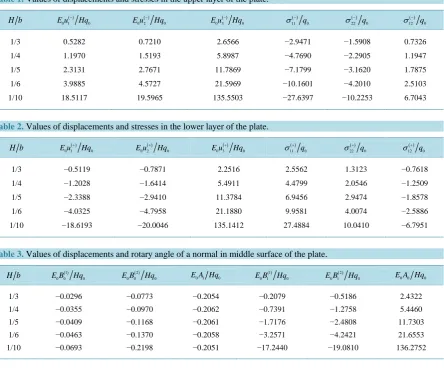
Table 1 and Table 2 give dimensionless numerical results of calculations of displacements and stresses in upper and lower layers of the plate. Maximal values of displacements and stresses of the plate are reached in face surfaces of the pate and are determined by solutions of the first and the second problems.
Table 3 and Table 4 give dimensionless numerical results of displacements and stresses in the middle surface.
It should be noted that coefficients of the series with zero indices are displacements B0( )1 =u1( )0,B0( )2 =u2( )0 ,A0 =u3( )0 and kinematic functions B1( )1,B1( )2,A1, characterize rotary angle of normal vector and strain of transversal com-pression of middle surface of the plate.
[image:7.595.94.539.359.727.2]Analysis has shown that the values of normal displacement u3 vary considerably along the thickness of the plate. In [4] [8] it is shown that maximal values of stresses and displacements, obtained according to bimoment theory for isotropic plates with high accuracy agree with calculations of an exact solution [4].
Table 1. Values of displacements and stresses in the upper layer of the plate.
H b E u0 1( ) Hq0
− ( )
0 2 0
E u− Hq E u0 3( ) Hq0
− ( )
11 q0
σ− ( )
22 q0
σ− ( )
12 q0
σ−
1/3
1/4
1/5
1/6
1/10
0.5282
1.1970
2.3131
3.9885
18.5117
0.7210
1.5193
2.7671
4.5727
19.5965
2.6566
5.8987
11.7869
21.5969
135.5503
−2.9471 −4.7690 −7.1799 −10.1601 −27.6397
−1.5908 −2.2905 −3.1620 −4.2010 −10.2253
0.7326
1.1947
1.7875
2.5103
6.7043
Table 2. Values of displacements and stresses in the lower layer of the plate.
H b E u0 1( ) Hq0
+ ( )
0 2 0
E u+ Hq E u0 3( ) Hq0
+ ( )
11 q0
σ+ ( )
22 q0
σ+ ( )
12 q0
σ+
1/3
1/4
1/5
1/6
1/10
−0.5119 −1.2028 −2.3388 −4.0325 −18.6193
−0.7871 −1.6414 −2.9410 −4.7958 −20.0046
2.2516
5.4911
11.3784
21.1880
135.1412
2.5562
4.4799
6.9456
9.9581
27.4884
1.3123
2.0546
2.9474
4.0074
10.0410
[image:7.595.87.541.367.469.2]−0.7618 −1.2509 −1.8578 −2.5886 −6.7951
Table 3. Values of displacements and rotary angle of a normal in middle surface of the plate.
H b ( )1
0 0 0
E B Hq ( )2
0 0 0
E B Hq E A Hq0 1 0
( )1
0 1 0
E B Hq ( )2
0 1 0
E B Hq E A Hq0 0 0
1/3
1/4
1/5
1/6
1/10
−0.0296 −0.0355 −0.0409 −0.0463 −0.0693
−0.0773 −0.0970 −0.1168 −0.1370 −0.2198
−0.2054 −0.2062 −0.2061 −0.2058 −0.2051
−0.2079 −0.7391 −1.7176 −3.2571 −17.2440
−0.5186 −1.2758 −2.4808 −4.2421 −19.0810
2.4322
5.4460
11.7303
21.6553
[image:7.595.87.537.625.718.2]Table 4. Values of stresses in middle surface of the plate.
H b ( )0
13 q0
σ ( )0
23 q0
σ ( )0
33 q0
σ ( )0
12 q0
σ ( )0
11 q0
σ ( )0
22 q0
σ
1/3 1/4 1/5 1/6 1/10
0.7033 1.0019 1.2986 1.5921 2.7469
0.6492 1.0019 1.0357 1.2274 1.9995
−0.4904 −0.4965 −0.4985 −0.4992 −0.4999
−0.0627 −0.0582 −0.0555 −0.0537 −0.0509
0.0089 −0.0093 −0.0210 −0.0285 −0.0410
−0.0438 −0.0552 −0.0612 −0.0647 −0.0702
5. Conclusion
So on the basis of expansion method, a theory of plates is improved by consideration of bimoments. In the case of spatial deformation of the plate along its thickness, there nonlinear laws of displacements distribution occur, without any simplifying hypotheses. Consequently, existing specified theories of plates and shells, built with a number of simplifying hypotheses could not be used in development of methods of calculation of stresses and displacements of thick plates and shells under the effect of various types of external influences. Calculations of thick plates from anisotropic materials with low strength characteristics could not be made on the basis of clas-sical or specified existing theory. In such cases it is advisable to conduct calculations based on rigorous metho-dologies developed on the basis of the theory of plates and shells, which takes into account all the components of stress and strain tensor σ εij, ij, ,
(
i j=1, 3)
.References
[1] Ambartsumyan, S.A. (1987) Theory of Anisotropic Plates. Nauka, Moscow, 360 p.
[2] Galimov, Sh.K. (1976) Specified Theories of Design of Rectangular Theory of Orthotropic Plate under Transversal Load. Studies on the Theory of Plates and Shells, Collection of Papers, Issue ХII, Kazan, 78-84.
[3] Vlasov, V.Z. (1958) Thin-Walled Spatial System. Gosstroyizdat, Moscow, 503 p.
[4] Usarov, M.K. (2011) Problem of Bending of Thick Orthotropic Plate in Three-Dimensional Statement. Engineering- Construction Journal, 4, 40-47.
[5] Usarov, M.K. (2014) Theory of Thick Plates with Consideration of Bimoments. Scientific-Technical Journal of FerPI,
3, 44-50.
[6] Usarov, M.K. (2014) Analysis of Thick Orthotropic Plates on the Basis of Bimoment Theory. Uzbek Journal of Prob-lems in Mechanics, 2, 41-44.
[7] Usarov, M.K. (2014) Analysis of Orthotropic Plates on the Basis of Bimoment Theory. Uzbek Journal of Problems in Mechanics, 3-4, 37-41.