Matching Dominating Sets of Direct Product Graphs of
Cayley Graphs with Arithmetic Graphs
S. Uma Maheswari
LecturerDepartment of Mathematics JMJ College For Women
Tenali, AP, India
B. Maheswari
Professor Department of Applied Mathematics S.P. Women’s UniversityTirupati, AP, India
M. Manjuri
Department of Applied Mathematics S.P. Women’s UniversityTirupati, AP, India
ABSTRACT
Graph Theory is one of the most flourishing branches of modern Mathematics finding widest applications in all most all branches of Science & Technology. It is applied in diverse areas such as social sciences, linguistics, physical sciences, communication engineering etc. Number Theory is one of the oldest branches of Mathematics, which inherited rich contributions from almost all greatest mathematicians, ancient and modern.
Every branch of mathematics employs some notion of a product that enables the combination or decomposition of its elemental structures. Product of graphs are introduced in Graph Theory very recently and developing rapidly.
In this paper, we consider direct product graphs of Cayley graphs with Arithmetic graphs and present Matching dominating set of these graphs.
Keywords
Euler totient Cayley Graph, Arithmetic graph, Direct Product Graph, Matching dominating set.
AMS (MOS) Subject Classification: 6905c
1. INTRODUCTION
1.1 Euler Totient Cayley Graph
Madhavi [1] introduced the concept of Euler totient Cayley graphs and studied some of its properties.
For any positive integer , the number of positive integers less than and relatively prime to is denoted by
and is called Euler totient function. Let denote the set of all positive integers less than and relatively prime to . That is Then
Now we define Euler totient Cayley graph as follows.
For each positive integer , let be the additive group of integers modulo and let be the set of all integers less than and relatively prime to . The Euler totient Cayley graph
is defined as the graph whose vertex set is given by and the edge set is
Clearly as proved by Madhavi [1], the Euler Totient Cayley graph ) is
1. a connected, simple and undirected graph, 2. regular and has edges, 3. Hamiltonian,
4. Eulerian for 5. Bipartite if is even,
6.
Complete graph if is a prime.1.2 Arithmetic
Graph
Vasumathi [2] introduced the concept of Arithmetic graphs and studied some of its properties. Their definition of Arithmetic graph is as follows.
Let be a positive integer such that . Then the Arithmetic graph is defined as the graph whose vertex set consists of the divisors of and two vertices are adjacent in graph if and only if GCD for some prime divisor of
In this graph vertex 1 becomes an isolated vertex. When we enumerate the parameters total domination, connected domination, the contribution of this isolated vertex is nothing. Hence we take the divisors of excluding 1 as the vertex set of our Arithmetic graph and the adjacency is defined as above.
Clearly, graph is a connected graph. If is a prime, then graph consists of a single vertex. Hence it is connected. In other cases, by the definition of adjacency in there exist edges between prime number vertices and their prime power vertices and also to their prime product vertices. Therefore each vertex of is connected to some vertex in
1.3 Direct Product Graphs
Products of graphs occur naturally in discrete mathematics as tools in combinatorial constructions. They give rise to important classes of graphs and deep structural problems. In the beginning the emphasis was on the structure of finite and infinite products, but later it shifted to recognition algorithms for classes of isometric subgraphs of products of graphs, which are referred as product graphs. The methods recently developed for recognizing them have been extremely fruitful, have led to a better perception of the earlier work, and have helped to simplify many of the original proofs, both for finite and infinite graphs.
modeled by subgraphs of powers of small graphs with respect to the direct product. This is one of many examples of the dichotomy between the structure of products and that of their subgraphs. For a detailed description on product graphs refer [3, 4].
There are four standard products of graphs, namely those of the Cartesian, the strong, the direct and the lexicographic product.
In this paper, we consider direct product graphs of Cayley graphs with Arithmetic graphs and present Matching dominating set of these graphs.
In the literature, the direct product is also called as the tensor product, categorical product, cardinal product, relational product, Kronecker product, weak direct product, or conjunction.
Let and be two simple graphs with their vertex sets as
and respectively. Then the direct product of these two graphs denoted by
is defined to be a graph with vertex set , where is the Cartesian product of the sets and such that any two distinct vertices and of are adjacent if is an edge of
and is an edge of .
The cross symbol shows visually the two edges resulting from the direct product of two edges.
Now we consider the direct product graph of Euler totient Cayley graphs with Arithmetic graph. The properties and some dominating parameters of these graphs are presented respectively in [ 5, 6, 7, 8, 9].
We state the following theorem without proof and the proof can be found in [7].
Theorem 1.3.1: Suppose is neither a prime nor
Let , where , , … are primes and are integers ≥ 1. Then the domination number of is given by
where is the length of the longest stretch of consecutive integers in , each of which shares a prime factor with
We state the following theorem without proof and the proof can be found in [9].
Theorem 1.3.2: If and
where then the domination number of is given by
where is the length of the
longest stretch of consecutive integers in of each of which shares a prime factor with and is the core of .
1.4 Matching Dominating Set
A matching in a graph is a subset of edges of such that no two edges in are adjacent. A matching in
is called a perfect matching if every vertex of is incident with some edge in
A dominating set of is said to be a matching dominating set if the induced subgraph admits a perfect matching.
The cardinality of the smallest matching dominating set is called matching domination number and is denoted by
The matching domination number of Euler totient Cayley graph is presented in [5] and we state the theorem without proof and the proof can be found in [5].
Theorem 1.4.1: Let be neither a prime nor and
, where , , … are primes and
are integers ≥ 1. Then the matching domination number of is given by
where is the length of the longest stretch of consecutive integers in each of which shares a prime factor with
2. RESULTS
2.1Matching Dominating Sets in Arithmetic
Graph
We now present the matching domination number of Arithmetic graph.
Theorem 2.1.1: Suppose where
Then the matching domination number of is
given by
where is the core of
Proof: Let where
Case 1: Suppose is an even number.
Let
and let All the vertices for which GCD for are adjacent with the vertex in All the vertices for which GCD for are adjacent
with the vertex Since every vertex in has atleast one
prime factor viz., (as they are the divisors of ) every vertex in is adjacent to atleast one vertex in Thus becomes a dominating set of .
Also the induced subgraph admits a perfect matching with the pairs of vertices given by
as follows.
Any pair of vertices say, in are adjacent
since GCD .
Also there is no edge between the vertices
as GCD for any . Further by the
selection of pairs of vertices in , no two pairs of vertices say, are adjacent.
We now claim that is minimal. Suppose we remove any vertex from Then the paired vertex of , viz.,
is not adjacent to any other vertices of and becomes isolated in Similar is the case if we delete any vertex from
Again if we remove two vertices say and from
then an edge is removed in But this does not make a dominating set.
Thus becomes minimal. If we construct matching dominating set in any other manner, then clearly it will be of larger size than or same size of because of properties of prime numbers.
Hence
Case 2: Let be an odd number. Similar to case 1, it can be
easily seen that
is a minimum matching dominating set where the induced subgraph admits a perfect matching given by
.
Hence
2.2 Matching Dominating Sets in Direct
Product Graph
Theorem 2.2.1: If where
then the matching domination number of is given by
where is the length of the longest stretch of consecutive integers in of each of which shares a prime factor with n and is the core of n.
Proof: Suppose where
Consider the graph By Theorem 1.3.2, we have where is the length of the
longest stretch of consecutive integers in of each of which shares a prime factor with n and k is the core of n. Hence . …………. (1)
We know that (by Theorem 1.3.1) and let
be a dominating set of with minimum cardinality, where are consecutive integers. By Theorem 2.1.1, we know that
matching dominating set of is
Hence two cases arise.
Case 1: Suppose k is an even number. Then by Theorem 2.1.1, it can be easily seen that
= is a
minimum matching dominating set of as the induced
sub graph admits a perfect matching by the pairs of vertices given by . Now to obtain matching dominating set of , we proceed as follows.
Let
Let be any vertex in in Then
is adjacent to for some , where as is a dominating set of . Vertex is adjacent to any of , for as is a
dominating set of
Hence every vertex of is adjacent to at least one vertex or in This
implies that is a dominating set of
We now prove that is a matching dominating set of
Again two subcases arise.
Subcase 1: Suppose is an even number. Then the induced
subgraph admits a perfect matching with the pairs of vertices given by
for = 1, 2, 3,……., and = 1, 3, 5, …., .
For = 1, 2 and = 1, and
are two pairs of vertices in Since and are all distinct and , no two vertices among these four vertices are equal.
Further , and , are adjacent vertices because GCD and GCD Also , are adjacent vertices since GCD
. Therefore there exists edges between the pair of vertices and
. This is true for all pairs of other vertices as these four vertices are arbitrary. Thus admits a perfect matching and hence becomes a matching dominating set of with cardinality . Then
Subcase 2: Suppose is an odd number. Then the induced subgraph admits a perfect matching with the pairs of vertices as follows.
for = 1, 3, 5…….,
and = 1, 3, 5, …., .
Consider any two pairs of vertices in . Let them be
and .
Since are consecutive integers, GCD
2, =1 and GCD 1, 1. 2 = 1. Hence there exist edges between the pairs of vertices
and .
Since and , no two vertices among these four are equal. This is true for all pairs of other vertices as these four vertices are arbitrary. Thus admits a perfect matching and hence becomes a matching dominating set of with cardinality . Then it follows
by equation (1) that
Case 2: Suppose is an odd number. Then by Theorem
2.1.1, we can see that =
is a matching dominating set of with minimum
cardinality . Proceeding in the same way as in case 1, we can prove that
is a dominating set with minimum cardinality. Further the induced sub graph admits a perfect matching as shown in the following two subcases.
Subcase 3: Suppose is an even number, then
for and gives a perfect matching.
For and consider two pairs of vertices
and Since and , are all distinct, it follows that no two vertices among these four vertices are equal. Also GCD GCD
and GCD it follows that there exist edges between the pairs of vertices and
Thus becomes a matching dominating set with minimum cardinality . Therefore .
Subcase 4: Suppose is an odd number. Then the induced
subgraph admits a perfect matching given by the pairs of vertices
for and as in subcase 3. Thus becomes a matching dominating set with minimum cardinality .
Therefore .
3. ILLUSTRATIONS
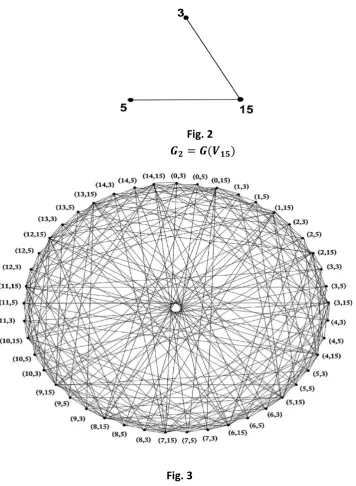
Let = 15
Fig. 2
[image:5.595.115.472.75.562.2]
Fig. 3
Table 1. Matching Dominations in Direct Product Graph
n Value
Dominating
sets
Domination Number in
n = 15
Minimum
Dominating set
Minimum Matching Dominating set
{ } { ;
4. REFERENCES
[1] Madhavi, L. Studies on domination parameters and enumeration of cycles in some Arithmetic Graphs, Ph. D. Thesis submitted to S.V.University, Tirupati, India, (2002).
[2] Vasumathi, N. Number theoretic graphs, Ph. D. Thesis submitted to S.V.University, Tirupati, India,(1994). [3] Hammack, R. Imrich, W. and Klavzar, Handbook of
product graphs, CRC Press, (2011).
[4] Weichsel, P.M. The Kronecker product of graphs, Proc. Amer. Math.Soc., 13, 47-52 (1962).
[5] Manjuri,M. and Maheswari, B.Matching dominating Sets of Euler Totient Cayley Graphs, International Journal of Computational Engineering Research (accepted).
[6] Uma Maheswari, S. and Maheswari, B. Domination parameters of Euler Totient Cayley graphs, Rev.Bull. Cal. Math.Soc.,19,(2),207-214(2011).
[7] Uma Maheswari, S. Some Studies on the Product Graphs of Euler Totient Cayley Graphs and Arithmetic Vn Graphs, Ph. D. Thesis submitted to S.P.Women’s University, Tirupati, India, (2012).
[8] Uma Maheswari, S. and Maheswari, B. Some Domination parameters of Arithmetic Graph Vn, IOSR Journal of Mathematics, 6(2),14-18, (2012).