Noise Cancellation Method for Robust Speech
Recognition
Shajeesh. K. U.
Centre for Excellence in Computational Engineering and Networking, Amrita Vishwa Vidyapeetham, Ettimadai,
Coimbatore, India
K. P. Soman
Centre for Excellence in Computational Engineering and Networking, Amrita Vishwa Vidyapeetham, Ettimadai,
Coimbatore, India
ABSTRACT
Noise cancellation is the process of removing background noise from speech signal. The degradation of speech due to presence of background noise and several other noises cause difficulties in various signal processing tasks like speech recognition, speaker recognition, speaker verification etc. Many methods have been widely used to eliminate noise from speech signal like linear and nonlinear filtering methods, adaptive noise cancellation, total variation denoising etc. This paper addresses the problem of reducing the impulsive noise in speech signal using compressive sensing approach. The results are compared against three well known speech enhancement methods, spectral subtraction, Total variation denoising and signal dependent rank order mean algorithm. An automatic speech recognition system for Digits in Malayalam Language is implemented using MFCC and GMM. The impulse noise corrupted speech signal and the enhanced speech signal (the output of the noise cancellation system) are given as input to the classification system. The speech recognition system gives 12.3 % accuracy for noisy signal where as 92.3 % accuracy for the enhanced signal Objective and subjective quality evaluation are performed for the four speech enhancement scheme. Results show that the signal processed by the compressive sensing based method outperforms the other three methods.
General Terms
Speech Enhancement, Compressive Sensing, and Automatic Speech Recognition.
Keywords
Speech Enhancement, Compressive Sensing, Over complete Dictionary, Quality Evaluation Metrics and Automatic Speech Recognition.
1.
INTRODUCTION
Speech enhancement aims in improving the quality of the speech signal by reducing the background noise. Quality of speech signal is weighed by its clarity, intelligibility and pleasantness [1]. Speech enhancement is a preliminary procedure in the speech processing area, including speech recognition, speech synthesis, speech analysis and speech coding.
In communication systems speech signal is sometimes corrupted with short duration noises like impulsive noise [2]. To listeners, these interferences are highly unpleasant and should be suppressed in order to enhance the quality and intelligibility of speech signal. Most of the speech-signal
processing algorithms are based on the assumption that the noise follows Gaussian distribution and is additive in nature. But noises like impulsive noise are characterized by non-Gaussian probability distribution. This will reduce the performance of the speech processing systems drastically, in presence of impulsive noise [2]. So we go for impulsive noise cancellation as a pre-processing step.
The classical method for impulsive noise cancellation from speech signal is noise reduction using median filtering method [2]. In this method each window of specific length is processed and the middle sample is replaced by the median of the window. The performance of this method can be improved by introducing adaptive threshold.
In [3] Charu Chandra et al. proposed a method for impulsive noise cancellation in speech based on signal dependent rank order mean (SD-ROM) algorithm. A window of five samples is examined iteratively for impulse sample and if detected within the sampled window, then the corresponding sample is replaced by an estimate based on neighboring samples. This method is very simple but efficient in case of ideal impulse and configurable to the type of impulse.
S. V. Vasighi and P. J. W. Rayner proposed a method for removing impulsive noise from speech and sound signals based on a detection interpolation scheme [2]. A linear prediction based scheme is used in this method. This method transforms the speech into excitation domain of the speech signal where the detectability of noise pulse is high. Samples that are detected as an impulse are replaced by an estimate based on LPC interpolation algorithm. This algorithm is applied to various speech signals and results shows that signal with a periodic structure shows better results.
Based on Discrete Wavelet Transform an impulse noise detection and removal method was reported by Zhiyong He et al [4]. This method uses two steps, impulse detection and noise removal. The first step is to find the difference of energy distribution between noise and impulsive colored noise in frequency domain. Based on this result, a new signal is constructed to detect impulsive colored noise. Evaluation of this method is done by improving signal to noise ratio (SNR). The experiment results show that the output SNR of enhanced speech is better than input SNR and the intelligibility of the enhanced speech is improved.
Based on soft decision and recursion, an impulse noise removal method was proposed by Sina Zahedpour et al [6]. In this method, the location and amplitude of the impulse is given by an adaptive threshold and soft decision. After estimating the position and amplitude of the impulse, an adaptive algorithm is implemented to reduce the noise. Then an approximation of the original signal is obtained using an iterative process. The method is tested using signals created by matlab simulation and it gives good results.
R. C. Nongpiur presented a novel method to remove impulsive type disturbances from speech signals in wavelet transform domain [7]. The method is works on the multi-resolution property of wavelet transform. The wavelet coefficients correspond to impulse noise is identified and removed based on two features, the slow time-varying nature and the Lipschitz regularity of the speech components. The method is tested with speech signals and results show the method is suitable for removing impulsive noise from speech. In this paper, we propose a robust noise cancellation method for speech signal corrupted by impulsive noise. The method is based on compressive sensing approach and make use of an over complete dictionary that consist of DCT matrix and identity matrix as bases. The method is compared against three well known speech enhancement methods. Section 2, briefly describes the basic theory behind compressive sensing. This section also describes the various quality evaluation metrics used. Section 3 covers discussion of the experimental results and finally the conclusion is provided in section 4.
2.
THEORY
2.1
Compressive Sensing
According to Shannon's theorem, a signal can be perfectly reconstructed if and only if the sampling rate is at least twice the maximum frequency present in the signal. This is known as Nyquist rate. Conventional approaches for sampling signals or images are based on Shannon's sampling theorem. Compressive sensing, compressed sensing or compressive sampling is a new method of reconstructing a sparse image or signal (A Signal is said to be sparse if it contains most of the elements as zeros) from fewer samples than the traditional Nyquist rate [8] [9].
Consider a signal x of length Nx1. The real time signals like speech signals are not sparse in time domain. Since compressive sensing is only applicable to sparse signals, we need to convert x into sparse. A dense signal in one domain (e.g. time domain) may be sparse in another domain (e.g. frequency domain). However, for natural signals and images, there exist some bases and dictionaries such that the projection of signal into the dictionary or bases (or some operation) converts our signal of interest to sparse or approximately sparse [10][11]. Let us assume our signal x is sparse in some basis
i, i1, 2,...,N
. Now our signal of interest became sparse. We have x where
i, i 1, 2,...,N
. We project the sparse signal into m bases where m<<n and we get m measurements called y. The bases can be DCT bases, random vectors, wavelet coefficients etc. The Mx1 projection vector y can be written as:
yx
The measurement matrix y is very less in size compared to the original signal x. The original signal x can be reconstructed from measurement matrix y. It is an optimization problem which relies on the compressibility of x in the base . The
signal x can be reconstructed by means of standard linear programming algorithms such as L1 Magic, Orthogonal Basis
Pursuit, Orthogonal Matching Pursuit etc. [10].
In the presence of impulse noise, the sparse property of the signal is lost forever (because presence of even one impulse will introduce all the frequency components) and the compressive sensing is no more applicable to the signals corrupted by impulsive noise. Another concept called an over complete dictionary can be applied here. An over complete dictionary D consist of a number of bases or atoms which is more than enough to reconstruct signal. Here some atoms are not unique.
For noise removal purpose we created a dictionary which consists of DCT bases and Identity matrix. Identity matrix in the dictionary has similar characteristics as the impulse noise. If we project our noisy signal x into the dictionary, the identity matrix in the dictionary captures the impulse noise alone from the signal. The actual signal is captured by the DCT bases. The original signal can be reconstructed by using the standard linear programming algorithm L1 magic[12].
2.2
Quality Evaluation Metrics
In speech enhancement, we need to evaluate the quality of the method based on some metrics. There are objective quality evaluation method and subjective quality evaluation methods.
2.2.1 Subjective Quality Evaluations:
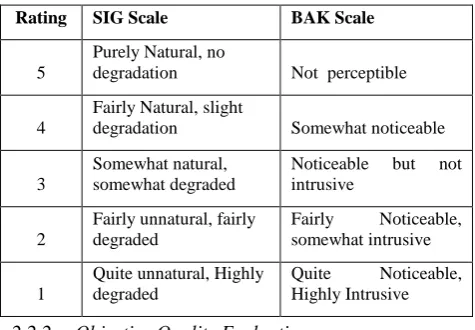
Subjective quality evaluations are done by a group of listeners. They are also called as test subjects. The quality of processed speech is expressed using a specific unit, called Mean Opinion Score (MOS). After listening, listeners have to rate that particular enhanced speech signal based on three factors. They are described below.
• The speech signal alone is rated based on signal distortion. • The background noise is rated based on background disturbances (BAK).
• The overall quality as the mean of SIG and BAK Scale values (OVRL).
The SIG and BAK scale [13] are listed in the Table 1.
[image:2.595.310.548.544.709.2]
Table 1. Description of SIG and BAK Scale
Rating SIG Scale BAK Scale
5
Purely Natural, no
degradation Not perceptible
4
Fairly Natural, slight
degradation Somewhat noticeable
3
Somewhat natural, somewhat degraded
Noticeable but not intrusive
2
Fairly unnatural, fairly degraded
Fairly Noticeable, somewhat intrusive
1
Quite unnatural, Highly degraded
Quite Noticeable, Highly Intrusive
2.2.2 Objective Quality Evaluations:
(WSS), Perceptual Evaluation of Speech Quality (PESQ) and Log Likelihood Ratio (LLR) [14]. A lower value of WSS and higher value of SNRSeg indicates better quality of speech. Usually LLR lies in the range between 0 and 2.
Composite objective measures are derived from basic objective measures to form a new and more accurate measure. Conventional objective measures like SNRseg and LLR, are not correlated highly with speech/noise distortions and overall quality. The composite measures are obtained by using multiple linear regression analysis or by using nonlinear techniques. In this paper, we have chosen a composite measure for signal distortion (CSIG), a composite measure for noise distortion (CBAK), and a composite measure for overall speech quality (COVRL).
3.
RESULTS AND DISCUSSIONS
The compressive sensing based noise cancellation method presented in section 2.1 is used for experimenting with a test database of speech signals. Digits (zero to nine) in Malayalam language is recorded with the help of 25 male and female speakers for the training and testing purpose. The speech signal was recorded with 16 KHz sampling rate 16 bit resolution and then the speech was stored as uncompressed .wav format. The impulsive noise is simulated using matlab. The proposed method is compared against the three well known speech enhancement techniques, spectral subtraction [15]-[17], SD-ROM Algorithm [3][18], and Total variation denoising [19][20]. Various parameter values in these four algorithms such as lambda, threshold, tolerance, spectral floor and subtraction factor are adjusted in such a way that the clarity and intelligibility of noisy speech is improved considerably.
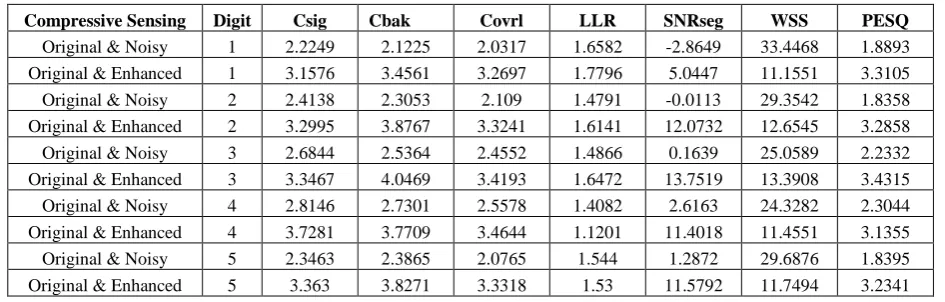
Subjective and objective quality measures are evaluated for each test speech signal and the results obtained are compared against the result of the other three methods. The objective quality measures are evaluated in two steps. The first step is to evaluate the objective measures of the clean speech signal and noisy speech signal. This measure gives to what extend the clean speech is degraded by background noise. In second step, the clean speech and the enhanced speech signal is processed. This gives the measure of similarity between enhanced speech signal and clean speech signal. From the results, we found that compressive sensing based methods outperforms the other three algorithms, spectral subtraction, total variation denoising and signal dependent rank order mean algorithm, by its high PESQ scores.
A voice digit recognition system (zero to nine) in Malayalam language is implemented using MFCC and GMM. The output of the noise removal system is given as input to the automatic speech recognition system. A test digit database consisting of 200 speech signals (Malayalam digits by both male and female) is fed as input to the automatic speech recognition system after the speech enhancement. The enhanced signal of compressed sensing method gives 92.3 % accuracy in classification while the noisy speech signal gives only 13.3 % accuracy. The result reveals the importance of impulsive noise cancellation as a pre-processing step in speech processing tasks.
3.1
Compressive sensing based method:
The compressive sensing based method is tested with two types of impulse affected signals, real and ideal impulses. Ideal impulse is one sample long and real impulse is more than one sample long. Ten test speech signals (digits in
[image:3.595.316.541.141.348.2]Malayalam language) are tested with this method. The parameters used in this method, such as lambda and tolerance are adjusted in such a way that the enhanced speech signal quality is as high as possible. The optimum value for lambda and tolerance is found to be 0.005 and 0.001 respectively. Also size of DCT matrix is fixed as 3200.
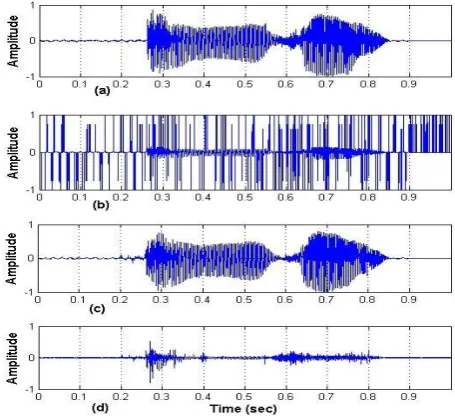
Fig 1: Impulsive noise cancellation using compressive sensing.
Figure 1(a) shows impulsive noise signal, 1(b) the reconstructed signal which is a combination of low frequency signal regions and high frequency signal regions. The first half contains high frequency portion (impulse) which is captured by the identity matrix. Figure 1(c) shows impulse alone and 1(d) shows the enhanced speech.
[image:3.595.314.542.465.673.2]Figure 2 (a) shows the clean speech, 2(b) the noisy speech, 2(c) the enhanced speech and 2(d) shows the error signal. In figure 2(c), we can see that the enhanced signal is almost equivalent to the original signal. The objective quality measures are evaluated and shown in Table 2.
In Figure 2, (a) shows the clean speech, (b) the noisy speech, (c) the enhanced speech and (d) shows the error signal. In (c), we can see that the enhanced signal is almost equivalent to the original signal. The objective quality measures are evaluated and shown in Table 2.
3.2
Signal Dependent Rank Order Mean
method:
The SD-ROM algorithm is first tested with ideal impulsive noise. The noise is perfectly removed and enhanced signal possess high perceptual quality. The algorithm uses two threshold values T1 and T2. The threshold is adjusted in such a way that the enhanced signal quality is maximum. The optimum threshold is found to be T1=0.05 and T2 =0.2 for a normalized signal.
The method is then tested with real impulses which are speech signals corrupted by triangular impulse. A triangular impulsive speech signal is the one in which three consecutive samples are impulses.
Figure 3 shows the output of SD-ROM algorithm, 3(a) clean speech, 3(b) Noisy speech, 3(c) enhanced speech and 3(d) error signal.
Fig 3: Impulsive noise cancellation using SDROM Algorithm.
[image:4.595.62.535.90.241.2]In figure 3(c), we can see that the amplitude (effect) of the noise is reduced to one half. By increasing the window size we can improve the result to an extent. But increasing window size increases the computational complexity and running time
Table 3: Objective Quality Measures for SDROM algorithm
SDROM Digit Csig Cbak Covrl LLR SNRseg WSS PESQ
Original & Noise 1 2.388 2.223 2.201 1.602 -2.5976 33.3928 2.0628 Original & Enhanced 1 2.599 2.299 2.341 1.468 -2.3041 28.0871 2.1057 Original & Noise 2 2.437 2.235 2.087 1.426 -0.714 27.9655 1.7618 Original & Enhanced 2 2.69 2.479 2.329 1.332 1.1751 24.8353 1.9757 Original & Noise 3 2.551 2.486 2.362 1.581 -0.1724 25.7758 2.1836 Original & Enhanced 3 2.83 2.716 2.555 1.397 2.361 21.7396 2.2716 Original & Noise 4 2.989 2.688 2.663 1.264 1.6372 23.7504 2.338 Original & Enhanced 4 3.175 2.944 2.83 1.186 4.3574 20.8671 2.4709
Original & Noise 5 2.346 2.387 2.077 1.544 1.2872 29.6876 1.8395 Original & Enhanced 5 2.611 2.663 2.325 1.46 3.4433 23.2627 2.0389
Table 2: Objective Quality Measures for Impulse Noiseancellation Using Compressed Sensing
Compressive Sensing Digit Csig Cbak Covrl LLR SNRseg WSS PESQ
[image:4.595.317.538.293.491.2] [image:4.595.68.532.547.698.2]of the algorithm. The objective quality measures are evaluated and shown in Table 3.
3.3
Spectral Subtraction method:
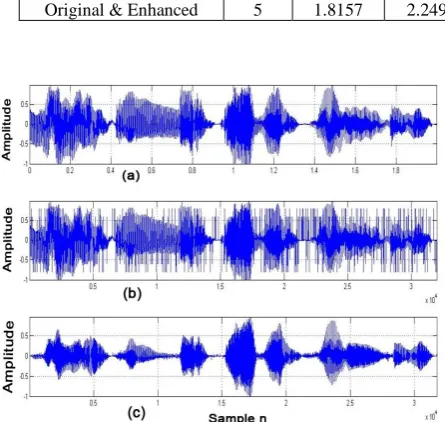
[image:5.595.314.548.71.275.2]The spectral subtraction method is applied for impulse noise removal. The parameter values such as spectral floor and subtraction factor are adjusted in such a way that the impulse noise is reduced. The value of subtraction factor varies according to the SNR value in each frame. So the maximum subtraction factor is set as 10 and the spectral floor parameter is set as 0.005. The performance of this method is not satisfactory in presence of impulsive noise. Figure 4(a) shows the clean speech, 4(b) input noisy speech and 4(c) is the enhanced speech signal. We can see that in enhanced speech signal, some of the impulses are not removed. This algorithm degrades the perceptual quality of the speech signal. The remaining impulses in the enhanced speech will affect the intelligibility of the speech signal. The objective quality measures are evaluated and shown in Table 4.
Fig 4: Spectral subtraction method.
3.4
Total variation denoising
[image:5.595.64.541.325.477.2]The total variation denoising method is then applied for impulse noise removal.
Fig 5: Total variation denoising.
The parameter value lambda, is adjusted in such a way that the impulse noise is reduced. The optimum value of lambda is found to be 10. This method is not suited for impulse noise removal. Figure 5(a) shows the clean speech, 5(b) input noisy speech and 5(c) is the enhanced speech signal, 5(d) is the error signal. From the results, we can observe that some of the impulses are still present in the signal and signal quality is degraded significantly. The objective quality measures are evaluated and shown in Table 5.
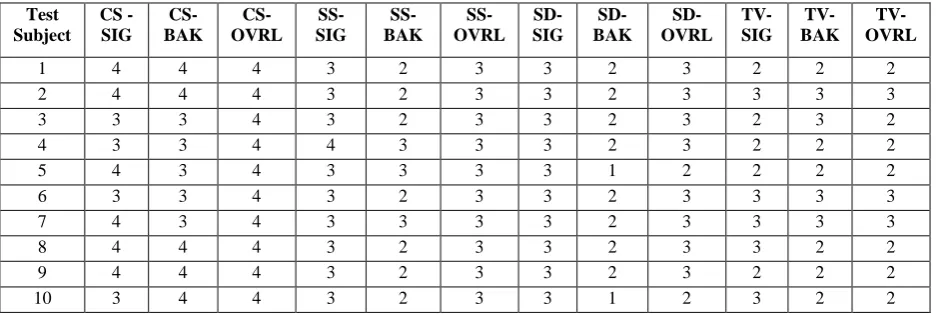
Subjective quality measures are done using ten test subjects for the three methods. Results are shown in Table 6. Compressed sensing based method gives better subjective measures than the other three methods.
4.
CONCLUSION
[image:5.595.57.280.464.675.2]This paper presents a novel and simple algorithm for automatically removing impulsive noise from speech signals. In this work, we have introduced compressive sensing based methods for noise cancellation. This method removes the impulsive noise from speech signal with the help of an over complete dictionary, which consist of an Identity matrix and DCT bases. It gives better results compared to the traditional methods like total variation and median filtering techniques.
Table 4: Objective Quality Measures for Spectral subtraction method
Spectral Subtraction Digit Csig Cbak Covrl LLR SNRseg WSS PESQ
The proposed algorithm is evaluated using different objective and subjective tests like LLR, SNRSeg, PESQ etc. The result shows that the quality of speech has been improved considerably. Also the output of the enhanced speech signal is shows 92.3 % accuracy in automatic speech recognition of
[image:6.595.64.531.163.312.2]Malayalam digits whereas the noisy speech signal shows only 12.3 % accuracy. This shows the importance of impulsive noise removal in speech processing algorithms as a pre-processing step.
Table 5: Objective Quality Measures for Total Variation Denoising
Total Variation Digits CSIG CBAK COVRL LLR SNRseg WSS PESQ
Original & Noisy 1 2.0838 1.9417 2.0051 1.799 -5.7974 41.5178 2.0159 Original & Enhanced 1 1.5266 2.0098 1.7667 2.2836 -4.018 59.0481 2.1804 Original & Noisy 2 2.0818 2.024 1.8545 1.6765 -2.8623 33.0581 1.6774 Original & Enhanced 2 1.4052 2.2647 1.8278 2.6123 -2.6755 47.0482 2.3611 Original & Noisy 3 2.1724 2.2038 2.0238 1.7517 -2.1158 29.7617 1.9068 Original & Enhanced 3 1.9683 2.3986 2.1997 2.1857 -2.1069 44.6115 2.5306 Original & Noisy 4 2.686 2.3987 2.4442 1.4345 -1.3808 31.3923 2.2415 Original & Enhanced 4 1.6299 2.3737 2.0241 2.4711 -1.9505 50.6451 2.5463 Original & Noisy 5 2.0023 2.1234 1.8576 1.7937 -1.8054 34.7147 1.7702 Original & Enhanced 5 1.6233 2.3568 1.9678 2.421 -1.4866 49.7773 2.437
Table 6: Subjective Quality Measures for Impulse Noise Cancellation.
Test Subject
CS - SIG
CS-BAK
CS-OVRL
SS-SIG
SS-BAK
SS-OVRL
SD-SIG
SD-BAK
SD-OVRL
TV-SIG
TV-BAK
TV-OVRL
1 4 4 4 3 2 3 3 2 3 2 2 2
2 4 4 4 3 2 3 3 2 3 3 3 3
3 3 3 4 3 2 3 3 2 3 2 3 2
4 3 3 4 4 3 3 3 2 3 2 2 2
5 4 3 4 3 3 3 3 1 2 2 2 2
6 3 3 4 3 2 3 3 2 3 3 3 3
7 4 3 4 3 3 3 3 2 3 3 3 3
8 4 4 4 3 2 3 3 2 3 3 2 2
9 4 4 4 3 2 3 3 2 3 2 2 2
10 3 4 4 3 2 3 3 1 2 3 2 2
5.
REFERENCES
[1] S.China Venkateswarlu, K.Satya Prasad and SubbaRami Reddy, “Improve Speech Enhancement Using Weiner Filtering”, Global Journal of Computer Science and Technology, Vol. 11, Iss. 7, Ver 1.0, May 2011.
[2] S. V. Vasighi and P. J. W. Rayner, "Detection and suppression of impulsive noise in speech communication systems,IEE Proc. of Communications, Speech and Vision, vol. 137, Pt. 1, no. 12, pp. 38-46, February 1990. [3] Charu Chandra, Michael S. Moore and Sanjit K. Mitra, "An efficient method for the removal of impulse noise from speech and audio signals, IEEE Proc. on Circuits and Systems, vol. 4, no. 8, pp. 206-208, June 1998. [4] Zhiyong He, Xuhong Guo, Maoqing Zhang, "Detection
and Removal of Impulsive Colored Noise for Speech Enhancement," IEEE Proc. on Information and Automation, pp. 2320-2324, June 2010.
[5] Mital A. Gandhi, Christelle Ledoux, and Lamine Mili, "Robust Estimation Methods for Impulsive Noise Suppression in Speech," IEEE Proc. on Signal Processing and Information Technology, pp. 755-760, December 2005.
[6] Sina Zahedpour,Soheil Feizi,Arash Amini, Mahmoud Ferdosizadeh, and Faroh Marvasti, "Impulsive Noise Cancellation Based on Soft Decision and Recursion," IEEE Trans. on Instrumentation and Measurement, vol. 58, no. 8, pp. 2780-2789, August 2009.
[7] R. C. Nongpiur, "Impulse Noise Removal in Speech Using Wavelets," IEEE ICASSP, pp. 1593-1596, 2008. [8] Massimo Fornasier and Holger Rauhut, ”Compressive
Sensing,” April 18, 2010.
[9] Emmanuel J. Cands, and Michael B. Wakin, ”An Introduction To Compressive Sampling,” IEEE signal processing magazine, March 2008
[10] K. P. Soman and R. Ramanathan, 2012, „Digital Signal and Image Processing- The sparse way‟, ELSEVIER Science and Technology book.
[image:6.595.65.535.342.499.2][12] Emmanuel Cand`es and Justin Romberg “L1
magic:Recovery of Sparse Signals via Convex Programming”, Caltech, October 2005.
[13] Monica FIRA, Liviu GORA, Constantin BARABASA, Nicolae CLEJU, "On ECG Compressed Sensing using Specific Overcomplete Dictionaries," Advances in Electrical and Computer Engineering Volume 10, Number 4, 2010.
[14] Hu, Y., Loizou, P. C., “Evaluation of Objective Quality Measures for Speech Enhancement”. IEEE Trans. on audio, speech and language processing, Vol. 16, No. 1, pp. 229-238, January 2008.
[15] Kamil K. W´ojcicki, Benjamin J. Shannon and Kuldip K. Paliwal, "Spectral Subtraction with Variance Reduced Noise Spectrum Estimates," Signal Processing Laboratory Griffith University, Nathan Q4111, Australia,March 1984.
[16] Upadhyay, Navneet, Karmakar and Abhijit, "The spectral subtractive-type algorithms for enhancing speech in
noisy environments," 2012, 1st International Conference on Recent Advances in Information Technology (RAIT) , pp.841-847, 15-17, March 2012.
[17] Miyazaki. R, Saruwatari. H, Inoue. T, Takahashi Y, Shikano K and Kondo. K, "Musical-Noise-Free Speech Enhancement Based on Optimized Iterative Spectral Subtraction," IEEE Transactions on Audio, Speech, and Language Processing, 2012.
[18] Michael S. Moore and Sanjit K. Mitra, “Statistical Threshold Design for the Two-State Signal Dependent Rank Order Mean Filter”, Department of Electrical and Computer Engineering, University of California , Santa Barbara.
[19] Ivan W. Selesnick and Ilker Bayram, "Total Variation Filtering," February 4, 2010.