A Hybrid Approach for Efficient Removal of Impulse,
Gaussian and Mixed Noise from Highly Corrupted
Images using Adaptive Neuro Fuzzy Inference System
(ANFIS)
C. Hemalatha
Azha Periasamy
S. Muruganand
Department of Electronics and Instrumentation
Department of Electronics and Instrumentation
Department of Electronics and Instrumentation
Bharathiar University Bharathiar University Bharathiar University
Coimbatore Coimbatore Coimbatore
India India India
ABSTRACT
The aim of the paper is to remove the noise in the images and at the same time to preserve the edges, fine details and texture in the image. This paper proposes a novel Adaptive Neuro Fuzzy Inference System (ANFIS) filter to remove impulse, Gaussian and mixed noise without affecting edges and texture of an image. It is a hybrid filter constructed by combining an appropriate noise filter, an edge detector and ANFIS. Different edge detectors are implemented such as canny, sobel and prewitt. The performance of the proposed filter is tested for impulse, Gaussian and mixed noise in Lena image. As a result, it is observed that the proposed hybrid filter effectively removes the noise in the following order: impulse > Gaussian > mixed noise with canny edge detector.
General Terms
Noise Filter, Adaptive Neuro Fuzzy Inference System , Edge Detector
Keywords
Adaptive Neuro Fuzzy Inference System, Median Filter, Wiener Filter, Image Processing.
1.
INTRODUCTION
Digital images are often corrupted by different kinds of noise while transmitting and acquisition of images due to errors produced by noisy sensors, faulty CCD elements and dust on the lens or communication channels. This noise could degrade the image quality and cause loss of image details. The performances of the subsequent image processing tasks such as segmentation, feature extraction and object recognition are severely degraded by noise [1]. Noise removal process is one of the pre-processing steps in image processing. So it is a very paramount important to remove noise from digital image. This paper presents a noise removal technique to suppress the noise and at the same time preserve thin lines, fine texture and image details. This paper takes into account to remove impulse noise, Gaussian noise and mixed noise (combination of impulse and Gaussian noise). Impulse noise may occur due to sudden fluctuations in image signals. It is like white and black dots over the image. So that it is called Salt and Pepper noise, i.e., dark pixels in the bright region and bright pixels in the dark region. Gaussian noise is an idealized form of white noise which is caused by random fluctuations in the signal. There are many different filtering methods has been proposed in the literature to remove impulse and Gaussian noise. One of the most popular non linear filters is median
filter to remove impulse noise which utilizes the rank order information of the pixels contained in the filtering window [2]. It replaces the centre pixel value of the filtering window with the median of the pixels in the window. It removes some reasonable noise at low noise density. But at high density it will not work effectively. Thus the output is blurred image. To overcome this drawback the following filters are used: Weighted Median (WM) filter [3] and Centre Weighted Median filter (CWM) [4] have been proposed. Weights are given to only centre pixel value of the filtering window [4]. Switching Median filter (SM) [5], if the centre pixel is corrupted, the window is filtered by standard median filter, otherwise window is not filtered. Here impulse noise detector is employed. The Tri-State median filter [6] performs better than switching median filter.
Recently, the application of artificial intelligence based non linear technique such as fuzzy systems and neural network are alternative for median based noise detection and reduction. Fuzzy inference rule by else action filter (FIRE) [7] which uses fuzzy rules to estimate degree of noisy pixels and calculates a correction term based on this estimation. The weighted fuzzy mean filter (WFM) [8] and the iterative fuzzy control based filter (IFCB) [9] are able to outperform rank order filter.
International Journal of Computer Applications (0975 – 8887) Volume 45– No.16, May 2012
2.
SCHEMATIC REPRESENTATION OF
[image:2.595.71.267.134.218.2]PROPOSED HYBRID FILTER
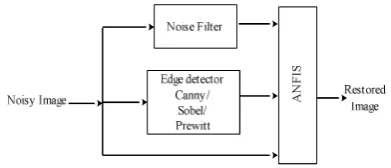
Fig 1: Schematic representation of proposed hybrid filter
[image:2.595.60.277.379.458.2]The proposed operator is a hybrid filter obtained by appropriately combining a noise filter, an edge detector and ANFIS. The ANFIS network utilizes the information from the noise filter, an edge detector and the noisy input image to find the output of the system, which is equal to the restored value of the noisy input pixel. In noise filter, median, wiener and both median and wiener filters are used to remove impulse noise, Gaussian noise and mixed noise. Before using noise filter an average filter is used for getting sharp edges. Three edge detectors (canny, sobel and prewitt) are used in the proposed approach.
[image:2.595.62.271.505.712.2]Fig 2: Schematic representation of Impulse Noise Removal
Fig 3: Schematic representation of Gaussian Noise Removal
Fig 4: Schematic representation of Mixed Noise Removal
2.1
Median Filter
The median filter is a simple rank selection filter that outputs the median of the pixels contained in its filtering window [2]. The input-output relationship of the median filter may be defined as follows:
Let x[r,c] denote the luminance value of the pixel at location (r,c) of the noisy input image. Here, r and c are the row and the column indices, respectively, with 1≤ r ≤ R and 1≤ c ≤ C for an input image having a size of R by C pixels. Let WN[r,c] represent the group of pixels contained in a filtering window centered at location (r,c) of the noisy input image and having the size of (2N+1) by (2N+1) pixels. WN[r,c] = ( x[r + p, c+q]);(p,q)= -N,…,N (1) Where N is a positive integer number related with the size of the filtering window and p,q are integer indices each individually ranging from –N to N.
The output of the median filter is equal to the median of the pixels contained in the filtering window WN[r,c]
m[r,c] = Median (WN[r,c]) (2)
2.2 Wiener Filter
To remove Gaussian noise Wiener filter is prescribed. The Wiener filter is the Mean Square Error (MSE)-optimal stationary linear filter for images degraded by additive noise and blurring. Calculation of the Wiener filter requires the assumption that the signal and noise processes are second order stationary (in the random process sense). Here power spectrum can be deemed as a constant. Then Wiener filter H (ω1, ω2) is given
(,)
(,) (,)
=
(3)
Where σ2f is the local variance of the original image and σ2v is
the variance of Gaussian noise. Adaptive wiener filter works well for removing Gaussian noise.
2.3
Edge Detector
Edge detector refers to the process of detecting meaningful discontinuities in intensity values. Edge detector detects the outlines of an object and boundaries between objects and the background in the image. An edge-detection filter can also be used to improve the appearance of blurred image. The edge-detection operator is calculated by forming a matrix centred on a pixel chosen as the centre of the matrix area. If the value of this matrix area is above a given threshold, then the middle pixel is classified as an edge. The gradient-based edge detectors are Roberts, Prewitt, and Sobel operators. All the gradient-based algorithms have kernel operators that calculate the strength of the slope in directions which are orthogonal to each other, commonly vertical and horizontal. The following three different edge detectors are used in the proposed approach:
• Sobel
• Prewitt
the input image. Therefore, canny, sobel and prewitt edge detectors are employed as the edge detectors in this work.
3.
IMPLEMENTATION OF PROPOSED
APPROACH
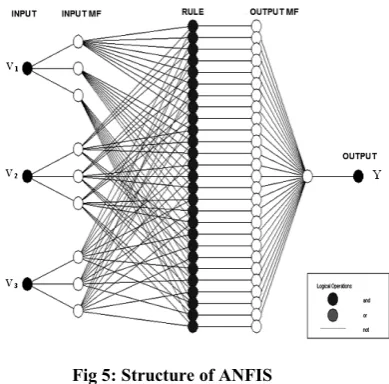
ANFIS is a multilayer feed forward network which uses neural network learning algorithms and fuzzy reasoning to map an input space to an output space. The ANFIS is a first order Sugeno type fuzzy system with three inputs and one output. Sugeno-type fuzzy systems are popular general nonlinear modelling tools because they are very suitable for tuning by optimization. Each input has three gauss type membership function where the output has linear membership function. Using given input/output data set, the MATLAB toolbox function ANFIS constructs a fuzzy inference system (FIS) whose parameters for membership function are tuned using least mean square method and back propagation algorithm. This allows the FIS to learn from the given training data to improve the performance in the case of ANFIS. ANFIS has three inputs and each input has three membership functions. Let V1, V2, V3 denote the inputs of the ANFIS and Y denote its output. Each noisy pixel is independently processed by the noise filter and the edge detector before being applied to the ANFIS. In the structure of the proposed operator, V1 represents the output of the noise filter for the noisy input pixel, V2 represents the output of the edge detector for that noisy pixel, and V3 represents the noisy pixel itself. The rule base contains total of (33) 27 rules which are as follows.
1. If (V1 is M11) and (V2 is M21) and (V3 is M31) then, R1 = F1(V1, V2, V3)
2. If (V1 is M11) and (V2 is M21) and (V3 is M32) then, R2 = F2(V1, V2, V3)
3. If (V1 is M11) and (V2 is M21) and (V3 is M33) then, R3 = F3(V1, V2, V3)
4. If (V1 is M11) and (V2 is M22) and (V3 is M31) then, R4 = F4(V1, V2, V3)
5. If (V1 is M11) and (V2 is M22) and (V 3 is M32) then, R5 = F5(V1, V2, V3)
.
27. If (V1 is M13) and (V 2 is M23) and (V 3 is M33) then, R27 = F27 (V1, V2, V3) (4) where, Mi,j denotes the jth membership function of the ith input. Rk denotes the output of the K
th
rule and Fk denotes the kth output membership function, with i = 1, 2, 3; j = 1, 2, 3; and K = 1, 2, 3,...,27.
The symmetric Gaussian function depends on two parameters σ and c as given by
f ( x; σ,c
) =
()
(5)
[image:3.595.342.537.79.271.2]The optimal values of these parameters are determined by training. The structure of an ANFIS is shown in fig. 5
Fig 5: Structure of ANFIS
The output of the ANFIS is the weighted average of the individual rule outputs. The weighting factor wk of each rule is calculated by evaluating the membership expressions Hence, the weighting factors of the rules are calculated as follows:
w1 = M11(V1). M21(V2). M31(V3) w2 = M11(V1). M21(V2). M32(V3) w3 = M11(V1). M21(V2). M33(V3) w4 = M11(V1). M22(V2). M31(V3) w4 = M11(V1). M22(V2). M32(V3)
.
.
w27 = M13(V1). M23(V2). M33(V3) (6) Once the weighting factors are obtained, the output of the ANFIS can be found by calculating the weighted average of the individual rule outputs
Y =
∑
∑ (7)
3.1 Training of the ANFIS
International Journal of Computer Applications (0975 – 8887) Volume 45– No.16, May 2012
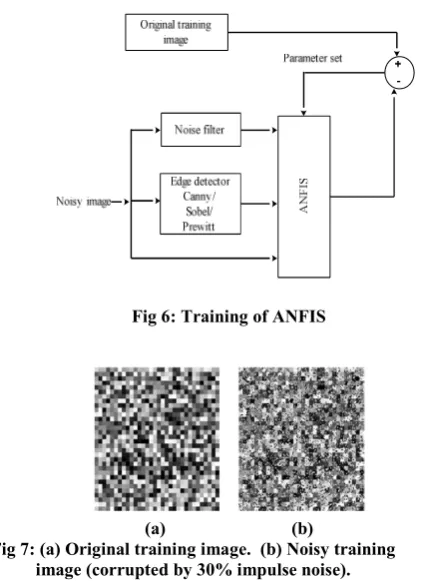
Fig 6: Training of ANFIS
(a) (b)
Fig 7: (a) Original training image. (b) Noisy training image (corrupted by 30% impulse noise).
Fig. 7 shows the images used for training. Only one image (image pair) is used in training. Fig. 7(a) shows the original training image, which is a 64 x 64 pixel artificial image that can easily be generated in a computer. Each square box in this image has a size of 4 x 4 pixels and the 16 pixels contained within each box have the same luminance value, which is a random integer number uniformly distributed in [0, 255]. Fig. 7(b) is obtained by original training image corrupted by impulse noise of 30% noise density. The proposed operator shows the best filtering performance when the noise density of the noisy training image is equal to the noise density of the actual input image to be restored. If the difference between two noise densities increases then the performance of proposed operator is decreased. Once ANFIS is trained, its internal parameters are fixed.
4.
RESULTS AND DISCUSSION
The performance of the proposed operator is tested for removing impulse, Gaussian and mixed noise on popular Lena image based on Adaptive Neuro Fuzzy Inference System (ANFIS). Noisy image is obtained by contaminating the original image by different noise with an appropriate noise density. The filtering performance was implemented on the well-known software MATLAB on Personal computer. In the present study 64x64 gray scale Lena image is corrupted by impulse noise, Gaussian noise and mixed noise at various noise densities. In the case of salt and pepper, image will be corrupted by “salt” (with value 255) and “pepper” (with value 0) with equal probability. A wide range of salt-and-pepper noise levels varied from 5% to 90% with an increment of 5%. The additive Gaussian white noise is zero mean with varied variance from 0.0005 to 0.90. And for mixed noise, Gaussian white is zero mean and 0.2 variance is fixed, impulse noise varied from 5 % to 90 % with increments of 5%. Restoration
PSNR =
10 !"#
$%%&'( dB (8)
MSE is the mean squared error (MSE) and defined as, MSE =
)
∑
∑
(
) *+
,+
-./, 01 − 3./, 01)
(9)Here, s[r,c] and y[r,c] represent the original image and filtered image of size RC, respectively. All experiments are related with noise and noise is a random process. So the same experiment gives different results even if the experimental conditions are the same. Therefore, each individual filtering experiment presented in this paper is repeated for ten times yielding ten different PSNR values for the same experiment. The averages of these values are then taken as the representative PSNR value for that experiment. This procedure is repeated for all noise densities from 5% to 90% for impulse noise. The same procedure employed for Gaussian noise and mixed noise resembles the same. Initially, Lena image was corrupted by impulse noise at various noise levels varied from 5% to 90% with an increment of 5%. The proposed hybrid filter removes the impulse noise using canny, sobel and prewitt edge detector and produced the restored image of original Lena. In the case of Gaussian noise, Lena image is corrupted by Gaussian white noise at mean zero and the variance is varied from 0.0005 to 0.90. With regard to the mixed noise Lena image is corrupted by Gaussian white with zero mean and variance 0.2 is fixed and impulse noise is varied from 5% to 90% with an increment of 5%
Table 1. MSE and PSNR using canny, sobel and prewitt edge detector in proposed approach for impulse noise
NOISE DENSITY (%)
CPSNR SPSNR PPSNR
9 36.5230 35.3638 34.5012 10 31.5542 30.0512 28.5140 15 26.6741 25.1771 24.0611 20 25.2639 24.1836 23.1962 25 25.0445 23.2524 22.5001 30 23.9310 22.8102 22.0142 40 21.5012 20.3810 19.5021 50 20.2001 19.0112 18.0215 60 18.5924 17.6583 16.6234 70 17.1345 16.0241 15.5695 80 16.2742 15.5335 15.4291 90 15.6907 15.4302 15.4112 Table 2. MSE and PSNR using canny, sobel and prewitt edge detector in proposed approach for Gaussian noise
VARIANCE CPSNR SPSNR PPSNR
[image:4.595.334.520.437.605.2] [image:4.595.331.525.634.762.2]0.03 22.0525 21.4551 0.035 21.6611 20.9360 0.04 21.3999 20.5347 0.045 21.0005 20.0205 0.05 20.9020 19.8778 0.10 19.5987 19.0298 0.20 18.0810 17.7513 0.30 17.5297 17.1041 0.40 16.7695 16.2280 0.50 16.4327 15.8602 0.60 16.1125 15.7086 0.70 15.9563 15.5514 0.80 15.7183 15.4301 0.90 15.4523 15.4102
Table 3. MSE and PSNR using canny, sobel and prewitt edge detector in proposed approach for mixed noise
IMPULSE
NOISE (%) CPSNR SPSNR
0.05 34.5324 34.3230 0.5 33.9479 33.5796
1 33.6781 33.3371
5 32.0021 31.2557
15 26.9521 21.5147
20 24.8972 24.3016
25 24.0215 23.8715
30 23.1458 23.0577
50 20.5641 20.1025
60 18.6717 17.5801
70 17.6384 16.5261
80 15.7469 15.6890
[image:5.595.325.530.70.234.2]90 15.4407 15.3902
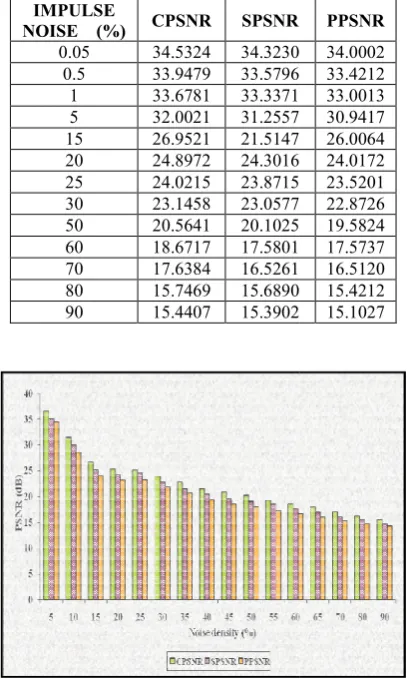
Fig 8: Comparison of PSNR values using canny, sobel and prewitt edge detector for impulse noise
20.9856 20.6481 20.0254 19.6712 19.0243 18.9334 17.0560 16.5107 15.9252 15.7195 15.5676 15.4251 15.4105 15.3098 Table 3. MSE and PSNR using canny, sobel and prewitt edge detector in proposed approach for mixed noise
PPSNR
[image:5.595.70.264.70.223.2]34.0002 33.4212 33.0013 30.9417 26.0064 24.0172 23.5201 22.8726 19.5824 17.5737 16.5120 15.4212 15.1027
[image:5.595.65.269.258.598.2]Fig 8: Comparison of PSNR values using canny, sobel and prewitt edge detector for impulse noise
[image:5.595.323.532.288.451.2]Fig 9: Comparison of PSNR values using canny, sobel and prewitt edge detector for Gaussian noise
Fig 10: Comparison of PSNR values using canny, sobel and prewitt edge detectors f
Table 1 lists the PSNR values using canny, sobel and rewitt edge detector in the proposed approach for impulse noise. clearly seen from Table 1 that proposed hybrid filter with canny edge detector removes impulse noise
compared to using sobel and p
noise densities (90%) restored image is not visually good in case of canny, sobel and prewitt. However, from their PSNR values canny seemed to be better than sobel and prewitt. Table 2 and Tables 3 list the average of the PSNR using canny, sobel and prewitt edge detectors for Gaussian and mixed noise in the proposed approach. Fig (8
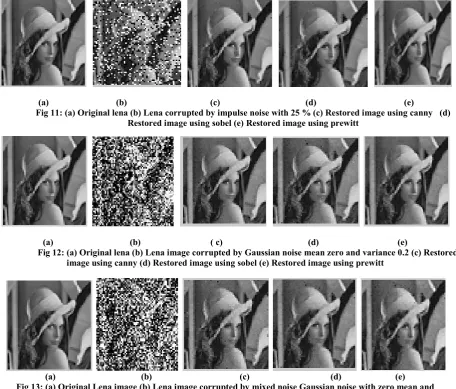
comparison of PSNR values using canny, sobel and prewitt edge detectors for impuse, Gaussian and mixed noise. image is corrupted by impulse noise with 25% and the noisy image is restored by proposed filter with canny, sobel and prewitt edge detector is shown in Fig 11
zero mean and variance is 0.2 and
noise is 25% and Gaussian noise is zero mean and variance is 0.2 of the restored image using proposed filter with canny, sobel and prewitt edge detector is shown in Fig.12 and Fig.13 respectively.
Fig 9: Comparison of PSNR values using canny, sobel and prewitt edge detector for Gaussian noise
Fig 10: Comparison of PSNR values using canny, sobel ctors for mixed noise
lists the PSNR values using canny, sobel and rewitt edge detector in the proposed approach for impulse noise. It is that proposed hybrid filter with canny edge detector removes impulse noise effectively prewitt edge detector. At high noise densities (90%) restored image is not visually good in case of canny, sobel and prewitt. However, from their PSNR values canny seemed to be better than sobel and prewitt.
International Journal of Computer Applications (0975 – 8887) Volume 45– No.16, May 2012
(a) (b) (c) (d) (e)
Fig 11: (a) Original lena (b) Lena corrupted by impulse noise with 25 % (c) Restored image using canny (d) Restored image using sobel (e) Restored image using prewitt
(a) (b) ( c) (d) (e)
Fig 12: (a) Original lena (b) Lena image corrupted by Gaussian noise mean zero and variance 0.2 (c) Restored image using canny (d) Restored image using sobel (e) Restored image using prewitt
(a) (b) (c) (d) (e)
Fig 13: (a) Original Lena image (b) Lena image corrupted by mixed noise Gaussian noise with zero mean and variance 0.2 and impulse noise is 25 %. (c) Restored image using canny (d) Restored image using sobel
(e) Restored image using prewitt
From these tables and graphs it was found that proposed method removes Gaussian and mixed noise using canny edge detector better than the sobel and prewitt. On comparing it could be stated that among three edge detectors canny’s performance was best in removal of impulse, Gaussian and mixed noise. Because sobel and prewitt method return edges at those points where the gradient of image is maximum. In the case of canny, it finds edges by looking for local maxima of the gradient of image. The method uses two thresholds, to detect strong and weak edges. It detects the weak edges in the output only if they are connected to strong edges. This method is employed to detect true weak edges. Prewitt and sobel filter have a major drawback of being very sensitive to noise. In prewitt, the size of the kernel filter and coefficients are fixed and cannot be adapted to a given image. The Canny edge is used in finding the most edges by minimizing the error rate, marking edges as closely as possible to the actual edges to maximize localization, and marking edges only once when a single edge exists for minimal response. Therefore, canny edge detector preserves edges than the sobel and prewitt edge detectors.
5.
CONCLUSION
Gaussian noise filter. Hence, the present paper proposes that hybrid filter effectively removes high (90%) density impulse noise from digital images while successfully preserving thin lines, edges, fine details and texture in the original image using canny edge detector than the Gaussian and mixed noise. The advantages of proposed filter are
1. It is a first order sugeno type system with three inputs and one output. It is a simple structure.
2. Internal parameters are tuned using training. So no need to train externally.
3. For training purpose artificial images are generated using a computer.
6.
REFERENCES
[1] S. E. Umbaugh, Computer Vision and Image Processing, Englewood cliffs, NJ: Prentice-Hall, 1988.
[2] T. A. Nodes and N. C .J Gallagher, “The output distribution of median type filters, ” IEEE Trans. Commun, vol. 32, no.5, pp. 532-541, 1984.
[image:6.595.72.529.73.462.2][4] S. J. Ko and Y. H. Lee. “Centre weighted median filters and their applications to image enhancement,” IEEE Trans Circuits Syst. Vol.38, no.9, pp. 984–993,1991. [5] S.Kalavathy and R.M.Suresh., “A Switching Weighted
Adaptive Median Filter for Impulse Noise Removal,” International Journal of Computer Applications,. vol.28, no.9 pp:8-13, August 2011
[6] T. Chen, K. K. Ma, and Chen L.H., “ Tri- State median filter for image denoising , ”IEEE Trans. Image Process., vol.8, no. 12, pp. 1834-1838, Dec.1999.
[7] F. Russo and G. Ramponi, “A fuzzy filter for images corrupted by impulse noise,” IEEE Signal Process Lett, vol.3, no.6, pp. 168-170, 1996.
[8]. C. S. Lee, Y. H. Kuo, and P. T. Yu, “Weighted fuzzy mean filters for image processing,” Fuzzy Sets Syst., no. 89, pp. 157–180, 1997.
[9] F. Farbiz and M. B. Menhaj, “Fuzzy Techniques in Image Processing,” Studies in Fuzziness and Soft Computing, ch. A fuzzy logic control based approach for image filtering, New York: Springer-Verlag, 2000, vol. 52, pp. 194–221.
[10] F. Russo, “Recent advances in fuzzy techniques for image enhancement,” IEEE Trans. Instrum. Meas, vol.47, pp.1428-1434, Dec. 1998.
[11] F. Russo, “Evolutionary neural fuzzy systems for data filtering,” IEEE Instrumentation and Measurement Tech. Conf. (IMTC/98) pp. 826-830, St. Paul, MN , USA, May 18-21, 1998.
[12] M. E. Yuksel and M. T. Yildirim, “A simple neuro-fuzzy edge detector for digital images corrupted by impulse noise,” Int. J. Electron. Commun, vol. 58, no. 1,pp. 71-75, 2004.
7.
AUTHORS PROFILE
C.Hemalatha received M.Sc and M.Phil degree in Electronics and Instrumentation from Bharathiar University, Coimbatore, Tamil Nadu, and India in 2010 and 2011 respectively. Her research interests include Digital Image Processing, Fuzzy Systems, Neural Network and Signal Processing.
Azha Periasamy received his M.Sc degree in Applied Physics and Computer Electronics in 1988 from Urumu Dhanalakshmi College, Trichy, Tamil Nadu, India. He was awarded M,Phil degree in 1995 from Bharathiar University, Coimbatore, Tamil Nadu, India. He is working as an Assistant Professor in the Department of Electronics and Instrumentation, Bharathiar University, Coimbatore, India. His field of interest is molecular Physics, VLSI System Design and Digital Image Processing.