ISSN: 1992-8645 www.jatit.org E-ISSN: 1817-3195
IMPROVED ARTIFICIAL FISH SWARM ALGORITHM AND
ITS APPLICATION IN OPTIMAL DESIGN OF TRUSS
STRUCTURE
YANCANG LI, CHENGUANG BAN, SHUJING ZHOU, SHUANGHONG PENG, XIAOHAN ZHANG
College of Civil Engineering, Hebei University of Engineering, Handan056038, Hebei, China
ABSTRACT
To overcome the defects of Artificial Fish-Swarm Algorithm, an adaptive particle swarm optimization was proposed. The new algorithm employs the inertia weight adjustment strategy to dynamically adjust the idea of artificial fish's visual and step on the basic artificial fish. The chaotic early initialization was employed to improve the quality of group solutions of artificial fish. Then, it was applied to the optimal design of truss structures in size. Engineering practice and comparison with the other optimization algorithms show that the algorithm has good convergence and stability.
Keywords: Artificial Fish-Swarm Algorithm, Adaptive, Truss, Structure Optimization, Chaos
1 INTRODUCTION
With the advancement in engineering structures design technologies, optimal design of truss structures becomes more and more important. Yet, traditional optimization methods usually require that the objective function should have good continuity[1-2]. So, it is difficult to solve the multi-peak optimization problems, namely the discrete variables problems. This situation has signified the study of the related methods.
In recent years, biomimetic optimization algorithms have been widely used in various fields of scientific research and optimization [3-6]. Artificial Fish-Swarm Algorithm is a bionic random optimization algorithm with global search capability and less demanding on the sensitivity of various parameters. And the algorithm is easy to implement. At present, the algorithm has been applied in many fields, and achieved good results. But the algorithm is not well coordinated balance between exploration and development capacity, and there is a big run late blindness in search behavior. With the disadvantage of low optimization accuracy and the slow speed optimization, the quality and efficiency of the algorithm are affected [5].
To overcome these shortcomings, the particle swarm optimization inertia weight adjustment strategy was employed to dynamically adjust the artificial fish's vision and step on the basic algorithm, and then it was applied to optimal design of truss structures in size. Comparison results with the
traditional particle swarm optimization algorithm and other algorithms show that the algorithm has good convergence and stability and can effectively optimize the design of truss structure size.
2 IMPROVED ARTIFICIAL FISH-SWARM
ALGORITHM
2.1 Introduction to the basic Artificial Fish Swarm Algorithm (AFSA)
With the advancement in networking and multimedia technologies enables the distribution and sharing of multimedia content widely.
AFSA [7-8] is a simulation of fish behavior based on random search optimization algorithm, mainly through the individual fish in the artificial feeding of fish, clusters, and rear-end behavior of local search, so that the global optimum value in the group is easy to see.The state of artificial fish can be expressed as
individual
X
=
(
x x
1,
2,
,
x
n)
as the optimization variables, the current location of the artificial fishfood concentration is expressed as
Y
=
f x
( )
.Where
Y
andX
are the corresponding objectivefunction values.
d
ij=
x
i−
x
j is the artificial fish's distance between the artificial fish with visualISSN: 1992-8645 www.jatit.org E-ISSN: 1817-3195 limit artificial fish-scale gathering. The number of
fish scale is
N
p.2.2 Adaptive Artificial Fish School Algorithm 2.2.1 Degree of premature convergence of
artificial fish
In the algorithm, set the number of fish scale
is
N
p, ifY
avg artificial fish is for all the current average value of the objective function, then
∑
= = n i i Y N 1 avg 1 Y (1)Where,
Y
i is the artificial fish in the current iteration when the objective function value. Let the optimal objective function value of artificial fishg
Y
, and the objective function value of the objective
function value is better than
Y
avg, definedY Yg avg
∗
− =
ϕ
(2)
Where,
ϕ
can be used to evaluate the extent of premature convergence of artificial fish, and the smaller shows the groups tend to premature convergence.2.2.2 Adaptive strategy
In the artificial fish swarm algorithm, when the optimal objective function value does not change for a long time, the fish should be based on the extent of premature convergence adaptively adjust the step size.
The objective function value of Yi in the artificial fish step size adjustment method is as follows:
(1) When
Y
i is better thanY
avg ∗ , ( ) Y avg Y Y Y Step Step Step Step g i ∗ ∗ − − ⋅ − − = min (3 )(2) When
Y
i is better thanY
avg but inferioravg
Y
∗,(
−)
×+
=Step Step Step
Step min max min
(
) (
)
(
)
2 1 1 cos1+ iter− π MaxStep−
(4)
At beginning
Step
max is the largest step ofsearch,
Step
min is the smallest step at the end ofsearch,
iter
is the iteration steps carried out,MaxStep
is the maximum number of iterationswhich is allowed.
(3)
Y
i is equal toY
avgMeeting this condition, the artificial fish is worse fish in the artificial fish, the adjustment of step [9] is:
(
− ⋅ϕ)
⋅ + − = K K Step 2 1 exp 1 1 5 . 1 (5)Where
k
1=
1.5
,k
2=
5
.Field of view of artificial fish is:
Visual
=
8
Step
(6)2.3 Obtain Of The Initial Solution Of Group Obtaining a better initial solution group, we will enhance the quality of reconciliation solution efficiently and we will get the initial solutions of good quality group by the use of chaotic initialization [10].
The initial solution equation can be obtained from:
Xk+1=µXk(1−Xk) (7)
The purpose of optimization is to minimize the weight of the structure. And the objective function can be expressed as:
l A w i n i i
∑
= = 1 min ρ (8) iA
is the sectional area of bar;l
iis the length ofbar;
ρ
is the material density; andi
is the number of design variables.The bar must meet the constraints of strength, stiffness, stability and the requirements of section size. The constraints can be expressed as
ISSN: 1992-8645 www.jatit.org E-ISSN: 1817-3195 Where:
σ
is the firsti
poles the axial normalstress,
[ ]
σ is the allowable stress of the material,ujis the displacement of node
j
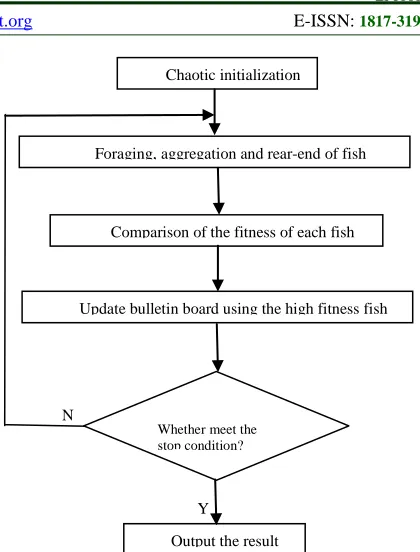
. Amin,Amaxare for the rod cross-sectional area of the upper and lower limits respectively.The framework of the improved algorithm is shown in Figure 1.
3 ENGINEERINGPRACTICE
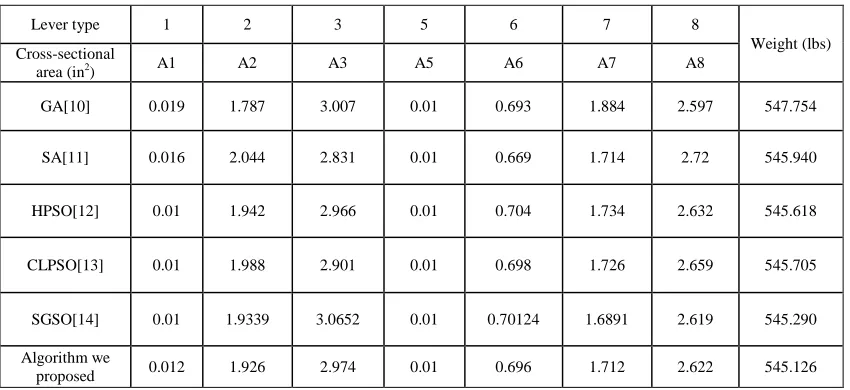
[image:3.612.307.517.71.347.2]In order to verify the effectiveness of the algorithm we proposed, we used it to the 25 space truss optimization and compared the performance with other algorithms. The 25 space truss structure is shown in Fig.2. The structure of the two load cases considered and the specific conditions are shown in Table I. The material density is 0.1l b/in3 and the modulus is 107 psi. Because of structural symmetry, 25 are divided into 8 categories, classification, and the allowable stress of the rods is shown in Table II. The optimized results of displacement point in all directions d ≤ 0.35in, the rod cross-section in2 are shown in TableIII.
Figure 1: Framework Of The Improved Algorithm
Y
Chaotic initialization
Foraging, aggregation and rear-end of fish
Update bulletin board using the high fitness fish
Whether meet the stop condition?
Output the result
Comparison of the fitness of each fish
N
Table 2: The Classification And Member Stress Limitations Of 25-Bar Spatial Truss Structure
Lever type 1 2 3 4 5 6 7 8
Number 1-2 1-4,2-3,1 -5,2-6
2-5,2-4,1-3,1-6 3-4,5-6 3-6,4-5
3-10,6-7,4-9,5-8
3-8,4-7,6-9,5 -10
3-7,4-8,5-9,6 -10
Allowed tensile
stress (ksi) 40.0 40.0 40.0 40.0 40.0 40.0 40.0 40.0
Allowed compressive
stress (ksi)
[image:3.612.93.515.459.570.2]35.092 11.590 17.305 35.092 35.902 6.759 6.959 11.802
Table 1: Load Cases Of 25-Bar Spatial Truss Structure
Node
Conditions 1 Conditions 2
Px/kips Py/kips Pz/kips Px/kips Py/kips Pz/kips
1 1.0 10.0 -5.0 0 20.0 -5.0
2 0 10.0 -5.0 0 -20.0 -5.0
3 0.5 0 0
ISSN: 1992-8645 www.jatit.org E-ISSN: 1817-3195
Table 3: Comparison Of Optimal Designs For 25-Bar Spatial Truss Structure
As can be seen from the table, the improved artificial fish swarm algorithm we proposed overcomes the disadvantages of basic AFSA, and can realize the optimization effectively.
4 CONCLUSION
Artificial Fish-Swarm Algorithm is a promising bionic random optimization algorithm. We proposed an improved algorithm and introduced it to optimize the design of truss structures after the establishment of the corresponding optimization model. The comparison results verified the efficiency and the feasibility of the method in solving practical optimization problems.
ACKNOWLEDGMENTS
This work was supported by the Natural Science Foundation of Hebei Province, China (No. E2012402030); Talents Program of Hebei Province (2011-33).
REFERENCES:
[1] R.E. Perez and K.Behdinan, “Particle swarm approach for structural design optimization”, Computers and Structures, Vol. 85, 2007, pp. 1579 -1588.
[2] Y. C. Frankin and Li Dan, “Multiobjective optimization design with pareto genetic algorithm”, Journal of Structure Engineering, Vol. 9, 1997, pp. 1252-1261.
[3] D. Whitley, S. Rana and J. Dzubera, “Evaluating evolutionary algorithms”, Artificial Intelligence. Vol. 85, No. 1-2, 1996, pp. 245-276.
[4] J.H. Holland, “Adaptation in Natural and Artificial Systems”, The University of Michigan Publishers, Ann Arbor, 1975.
[5] L. Wang, Y. Hong, F. Zhao and D. Yu, “Simplified artificial fish swarm algorithm”, Journal of Chinese Computer Systems. Vol. 30, No. 8, 2009, pp.1663-1667.
[6] X. Tang, “The theory and application of particle swarm optimization algorithm based on chaos”, Chongqing university, Chongqing , 2007. [7] X. Li, Z. Shao and J. Qian, “An optimizing
method based on autonomous animats: fish-swarm algorithm”, Systems Engineering Theory and Practice, Vol. 22, No. 11, 2002, pp. 32-38.
[8] E. Bonabeau and G. Theraulaz, “Swarm smarts”, Scientific American. Vol. 282, No. 3, 2000, pp. 72-79.
[9] H. Wu, C. Zhu, B. Chang and J. Liu, “Adaptive genetic algorithm to improve group premature convergence”, Journal of xi’an Jiaotong University. Vol. 33, No. 11, 1999, pp. 27-30. [10] L. Qu and D. He, “Novel artificial fish-school
algorithm based on chaos search”, Computer Engineering and Applications. Vol. 46, No. 22, 2010, pp. 40-42.
Lever type 1 2 3 5 6 7 8
Weight (lbs) Cross-sectional
area (in2) A1 A2 A3 A5 A6 A7 A8
GA[10] 0.019 1.787 3.007 0.01 0.693 1.884 2.597 547.754
SA[11] 0.016 2.044 2.831 0.01 0.669 1.714 2.72 545.940
HPSO[12] 0.01 1.942 2.966 0.01 0.704 1.734 2.632 545.618
CLPSO[13] 0.01 1.988 2.901 0.01 0.698 1.726 2.659 545.705
SGSO[14] 0.01 1.9339 3.0652 0.01 0.70124 1.6891 2.619 545.290
Algorithm we
ISSN: 1992-8645 www.jatit.org E-ISSN: 1817-3195 [11] W. Tang, “Structural optimization and
application of genetic algorithm”, Dalian University of Technology, 2002.
[12] B. Xian, “Structural optimization and application of simulated annealing algorithm”, Dalian University of Technology, Dalian, 2004. [13] Z. Zhang, “Particle Swarm Optimization in
research and application”. Dalian University of Techonlogy, Dalian, 2009.