ISSN: 1992-8645 www.jatit.org E-ISSN: 1817-3195
A NETWORK MANAGEMENT SYSTEM FOR EPON BASED
ON SNMP
HONGYU FENG,GUOYI MIAO
Henan Institute of Science and Technology, Xinxiang 453003, Henan, China
ABSTRACT
Now, the PON technologies become the preferred broadband access technology all over the world. In this paper, a network management system is designed for EPON. In Manager and Agent, the “simple and shortcut” protocol SNMP is adopted to develop the application program. As the Agent runs on the embedded system, protocol choice and database design are critical to the system. The paper focuses on the structural characteristics of the agent side, and achieves network communications management of agent side. Finally, the system is tested on the development board, and achieves better results. The system is real-time, timely capture of the trap, protect EPON network running well.
Keywords: EPON, Network Management, SNMP, Agent, Trap
1.
INTRODUCTIONIn recent years, the global raise a big wave of broadband speed, FTTx access become mainstream, and grow rapidly. Ovum's research report shows that in 2009, FTTx occupies 11% of the broadband connection, and is expected to reach 29% by 2016. China will become the fastest growing country using the FTTx, and is expected in 2016 50% of FTTx subscribers from China, while in 2009 the figure was 20% [1].
Now PON technologies become the hot broadband access technology all over the world. In this stage, 10G EPON has become the first choice of the broadband technology evolution. In China, China Telecom has made clear direction of the development of the 10G EPON. Rate demands more than 20M directly select 10G EPON. Network management is an integral part of modern communication system; it is an important guarantee to provide high stability and high-quality service for the system.
As the Agent runs on the embedded system, protocol choice and database design are critical to the real time and robustness of system. The system selects the embedded Linux systems to develop. Database MIB selects embedded database system
BDB, which was developed by Berkeley
University. The BDB not only saves the storage space, enhance query efficiency, but makes the design of program simple.
2.
EPON TECHNOLOGY AND SNMPPROTOCOL
2.1 EPON Structure and Principle
EPON is the abbreviation of Passive Optical Network Based over Ethernet. At the same time, it is a new access network technology adopting point-to-multipoint topology structures, using optical fibers and optical passive devices for transmission to provide various services on Ethernet [2].
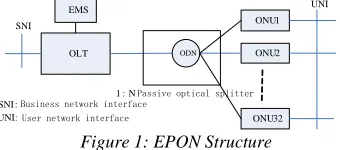
EPON is a point-to-multipoint system which is comprised of OLT (Optical Line Terminal), ONU (Optical Network Unit) and ODN (Optical Distribution Network). The downlink (from OLT to ONU) adopts the way of broadcasting, in this way, every ONU will receive all the information from downlink and extract the useful signal according to their MAC addresses; the uplink (from ONU to OLT) uses time-division mode to share system, and each ONU can be accessed through accessing to the control mechanisms[3]. The information rates of uplink and downlink both are 1.25 Gb/s, and using a single fiber with WDM makes the full-duplex communication come true. The EPON structure is as figure 1.
OLT
ONU1
ONU2
ONU32 ODN
1 : NPassive optical splitter
SNI
UNI EMS
SNI :Business network interface
[image:1.612.335.505.626.701.2]UNI:User network interface
Figure 1: EPON Structure
information channels, so it plays a function of real-time monitoring, management and maintenance functions. ONU is placed on the user side and connect with OLT through passive optical/splitter. EPON can deal with the bi-directional signaling transmission at the same time using WDM technology [4, 5]. The signals in uplink and downlink have different wavelengths, but transmit in the same fiber. EPON just make the necessary changes in the Ethernet frame format of IEEE802.3, for example, adding Time Stamp, LLID (Logic Link Identification) and so on. The Downlink principle is as figure 2.
OLT (Optical Line Terminal) splitter ONU 1
(Optical Network Unit)
ONU 3
(Optical Network Unit)
ONU 2
(Optical Network Unit)
User 1
User 3 User 2 2 1 2 3
2 3 2 1 2 3 2 1 2 1 2 3
3 2 2
[image:2.612.320.519.77.249.2]1
Figure 2: Downlink Principle
2.2 The Choice of Network Management Protocol
In the selection of network management protocol, SNMP protocol is the most suitable choice of the system. First of all, SNMP is common and mature internet management protocol at present and supported by majority of vendors. Running on the network, there won’t be any incompatibly problems. Secondly, EPON uses P2MP logical topology which is very suitable for SNMP manager/agent architecture. Thirdly, the Ethernet frame structure of EPON is based on IP, and SNMP is built on the base of TCP/IP network at the beginning. This provides a good support for variety of IP-based business management in EPON [6].
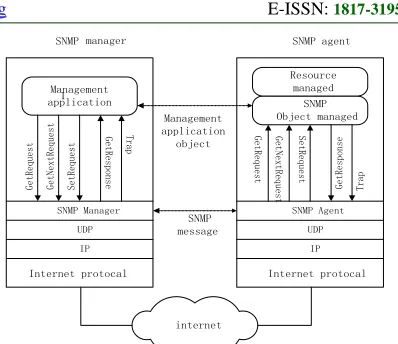
Figure 3 Describes the SNMP protocol environment. GetRequest, GetNextRequests and SetRequest issued three categories of SNMP management applications from the management station [7]. 3 messages are responded by proxy with GetResponse message, the message was handed over to the management application. In addition, the agent can be issued Trap news, events report to the managers of MIB and management resources.
SNMP rely on UDP and UDP is a connectionless type protocol, SNMP is connectionless type protocol too. Online connection between the management station and the agent does not need. Each exchange between the management and agent station is an independent transmission.
1 Management application SNMP Manager UDP IP Internet protocal Ge tR eq ue st Ge tN ex tR eq ue st Se tR eq ue st Ge tR es po ns e Tr ap SNMP Object managed SNMP Agent UDP IP Internet protocal Ge tR eq ue st Ge tN ex tR eq ue st Se tR eq ue st Ge tR es po ns e Tr ap Resource managed internet SNMP message Management application object
SNMP manager SNMP agent
Figure 3: SNMP Protocol Environment
3.
THE DESIGN OF EPON AGENT3.1 The Overall Structure Block
According to the needs of EPON system, Figure 4 shows the overall structure of EPON network element management system.
[image:2.612.107.282.252.327.2]SNMP MIB SNMP Agent OAM HOST SNMP Manager Database OLT 1 OLT 2 OLT n … ONU 1 ONU 2 ONUn … OAM、 MPCP reticle Localbus fiber DBA Configuration anagement Performance Anagement Fault Management Security Management Log Management
Figure 4: Structure of management system
[image:2.612.322.514.387.469.2]ISSN: 1992-8645 www.jatit.org E-ISSN: 1817-3195
3.2 The Agent Framework
3.2.1 Introduction to OAM layer
Ethernet as a second layer of the OSI protocol needs to have the ability to monitor network performance in the second layer, and traditional IP/ SNMP management is not competent operational management and maintenance of function. IEEE802.3 committee formulate OAM standard to in new Ethernet access standard 802.3ah. The OAM can monitor the network, detect the cause of the error and can help operators effectively manage the network [8, 9].
The EFM OAM defines the three main events: the OAM link monitoring, error alarm, remote loopback [10]. The link monitoring defines the basic run error used for the site detects an error occurs or deterioration link; error alarms provides a series of mechanisms for local site reports the remote site local error; remote loopback allows a site the remote site is set to loopback state.
3.2.2 The agent workflow
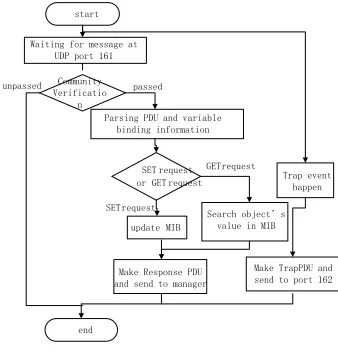
The agent OLT system was commissioned agents, on the one hand, and the management station to respond to the request of the management station, and send traps to a management station when the event is generated by the SNMP protocol communication. On the other hand, by the OAM protocol communication and ONU. By the conversion between SNMPDU and OAMPDU, control management ONU equipment, and receives the ONU transmission over the event notification and serious error. Figure 5 shows the workflow of agent.
Agent client software includes SNMP Agent, OAM Client and dynamic bandwidth allocation procedures DBA. Dynamic bandwidth allocation can be little cost-sharing system bandwidth, broadband integrated services access. EPON dynamic bandwidth allocation target is fair and efficient allocation of the system bandwidth to each ONU and various businesses. The software running on the embedded operating system, used to OLT and ONU management control of the operating system to use the self-development of embedded Linux system. The host processor (Host CPU) uses AT91ARM9200 chips.
SNMP protocol frame is transmitted on the UDP161, 162 port. Agent side and the management side communication, the agent with the well-known port 161 to receive a get or set the message and send a response to the response message (this port communication management end the use of temporary port). From the top-down process: when the agent end receive SNMPDU frame, first verify
the Community. Community here has played the role of certification services, the management station to agent message contains a Community, if verified, that the source is reliable. Then to resolve the SNMPDU package, if it is to get the frame, directly view the MIB database return RESPONSEPDU frame to manage end parsed view the priority of the parameters set frame, if it is urgent data is written to the MIB library and call notification function to notify the OAM sublayer also generate RESPONSEPDU frame to manage end. From the bottom-up process: If the following alarm events, OAM call notification function to notify the SNMP Agent, Agent constructor TrapPDU, and sent to the management end of the well-known port 162 port, management-side after the police received information analysis and processing.
Waiting for message at UDP port 161
Parsing PDU and variable binding information
SET request or GET request
GETrequest
SETrequest
Make Response PDU and send to manager start
end Community Verificatio
n
passed unpassed
Search object’s value in MIB update MIB
Trap event happen
[image:3.612.332.501.306.483.2]Make TrapPDU and send to port 162
Figure 5: Agent Workflow
4.
THE DESIGN OF MIB DATABASEMIB is a collection of all the managed objects in a network data structure, the only object in the MIB is the SNMP managed [11]. So the MIB library of design is an important part of the network element management. Database MIB selects embedded database system BDB, which was developed by Berkeley University.
First user-specific management information, write to standard MIB files, these MIB is privately held MIB, should be placed in the corresponding enterprises subtree (1.3.6.1.4.1), in order to separate MIB and other enterprises, must use a unique identifier (application) can go to the website, said the enterprise MIB information group.
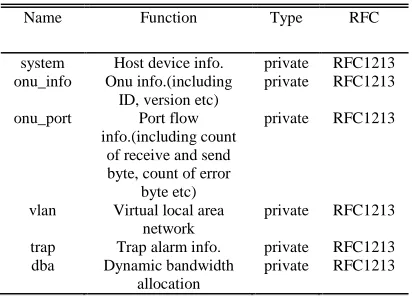
OID MIB library object programming. Listed below is a small part of the MIB library. Table 1 includes tables in the MIB database. Table 2 is express table.
Table 1 : Table Parameters
Name Function Type RFC
system Host device info. private RFC1213
onu_info Onu info.(including
ID, version etc)
private RFC1213
onu_port Port flow
info.(including count of receive and send byte, count of error
byte etc)
private RFC1213
vlan Virtual local area
network
private RFC1213
trap Trap alarm info. private RFC1213
dba Dynamic bandwidth
allocation
private RFC1213
The information in the system tables, including system name, contact, location, system uptime, the firmware version. ONU_Port table defines traffic information of each ONU port.
Table 2: Table Parameters
OID Data type limits
x.1.1 DisplayString RW
x.1.2 DisplayString RW
x.1.3 DisplayString RW
x.1.4 DisplayString RW
x.1.5 INTEGER RW
x.1.8 TimeTicks RO
[image:4.612.321.512.328.429.2]MIB table object includes single variables and table variables. Table 2 is an example of single variable. Table ONU_Port is table variables. ONU_Port table tree structure is as follows:
ONU_Port
[image:4.612.102.293.355.433.2].1.3.6.1.4.1.2021.3 |---- pNumber
.1.3.6.1.4.1.2021.3.1 +---- opTable
.1.3.6.1.4.1.2021.3.2
+---- opEntry .1.3.6.1.4.1.2021.3.2.1 |---- opIndex .1.3.6.1.4.1.2021.3.2.1.1 |---- upRecBytes .1.3.6.1.4.1.2021.3.2.1.2
|---- opFCSError .1.3.6.1.4.1.2021.3.2.1.8 |---- opHECError .1.3.6.1.4.1.2021.3.2.1.9
5.
ACHIEVING RESULTS5.1 Snmpset Function
The old value “system_syslogsize” from MIB library is stored in the variable old_intval. Key and data are DBT type, and the new value is assigned to data field of structure variable. Lastly BDB interface write_DB is called to write a new value in MIB library. Figure 6 shows the function SET.
Using snmpset command can change the value of an object.
Figure 6: Snmpset Results
5.2 Trap Function
In Agent MIB library specific value change or a specific value exceeds threshold snmptrap is sent [12]. So in Linux executive snmpset instruction to OID 1.3.6.1.4.1.2021.260.8.0, it will automatically generate a trap event. In Figure 7 shows that snmpset operation when modifying the OID value of 1.3.6.1.4.1.2021.260.8.0 produce trap. From the graph, we can see trap information is "onu 10 is shut down".
Figure 7: Snmptrap Results
6.
CONCLUSIONNetwork management is an integral part of modern communication system; it is an important guarantee to provide high stability and high-quality service for the system. Based on EPON, in the specific needs of the system, the paper designs the applicable SNMP network management solutions. In the system agent side runs in embedded systems, this article focuses on the research of agent side, and as agent works on the embedded systems, there designs a small database. In the last part of the paper the communication function of the agent side is tested, the system can effectively manage the entire system. It not only improves the robustness of the system, but also supports the dynamic expansion of the system.
ACKNOWLEDGEMENTS
ISSN: 1992-8645 www.jatit.org E-ISSN: 1817-3195
REFERENCES:
[1] WU Guo-dong, ZHAO Xiu-ming, “Typical Scheme for Intelligent Community PFTTH Networking Based on EPON Technology”, East
China Electric Power. Vol. 40, No. 7, 2012, pp.
1196-1198.
[2] Sun Wenyan, Guan Shaopeng, Wang Bin, Wang Yuling, “Upstream Synchronization and Simulation of EPON”, JDCTA, Vol. 5, No. 6, 2011, pp. 24 ~ 29.
[3] Gang Wang, Tianshu Huang, Zenggang Xiong, Yaogai Hu, “EPON Upstream Capacity Sharing with Auction Mechanism”, JCIT, Vol. 7, No. 2, 2012, pp. 108 ~ 115.
[4] IEEE 802.3ah EFM, Draft D3.1 of IEEE P802.3ah, IEEE 802.3ah Ethernet in the First Mile Task Force Draft Documents, Fub 2004. [5] http://www.ieee802.org/
[6] Yang-Guangchi, Lei-Lei, “EPON Technology and Application”, Network and Application,
May, 2010, pp. 35-38.
[7] Pengshou Xie, Zhiyuan RUI, Jie CAO, "A Software System Infrastructure and Integrated Service Implementation Model of Manufacturing Integrated Service Platform",
JCIT, Vol. 7, No. 9, 2012, pp. 136 ~ 146.
[8] Zhang hao, Pu Xiande. “Application of EPON Technology in Power Fonsumption Information Collection System”, Telecommunications for
Electric Power System, Vol. 31, No. 213, 2010,
pp. 42-45
[9] Kong Fanxi, Wang Shengda, “Comparison Analysis of EPON and GPON Techniques on Medium-Low Voltage Communication Access Network”, Telecommunications for Electric
Power System, Vol. 33, No. 232, 2012, pp.
30-32.
[10] G. Kramer, B. Mukherjee, and G.Pesavento, “Ethernet PON (ePON): Design and Analysis of an Optical Access Network, Photonic”, Network
Communications, Vol. 3, No. 3, 2001, pp. 307–
319.
[11] Wang Huizhong, Zhang Qixia, “Application of WiMAX and EPON Convergence Access Network in Power Communication”, Electrical
Automation, Vol. 34, No. 1, 2012, pp. 77-79.
[12] Tian Xiaoyan, “Network Design Based on EPON Technology for Villas”, Electrical
Technology of Intelligent Buildings, Vol. 6, No.