RESEARCH ON ENGINEERING MACHINERY FAULT
DIAGNOSIS BASED ON NEURAL NETWORK
1PEIJIANG CHEN
1School of Automobile, Linyi University, Linyi, 276000, China
E-mail: [email protected]
ABSTRACT
Because of the product variety and structure complexity of the engineering machinery, it was difficult to meet the requirements of fault detection and maintenance for the traditional diagnosis technologies. In order to improve the diagnostic level, the intelligent control technology of neural network and its application in engineering machinery fault diagnosis were studied. The basic concepts of engineering machinery fault diagnosis were introduced and several commonly used fault diagnosis methods were discussed. On the basis of analyzing the model and algorithm of BP neural network, a fault diagnosis system of roller’s electrical system was designed and implemented based on neural network. The experimental result showed that the sample output corresponded to the expected output, it was reliable and the requirement of fault diagnosis was achieved. The system had certain practical value in realizing intelligent fault diagnosis for engineering machinery.
Keywords: Engineering Machinery, Fault Diagnosis, Neural Network, BP Algorithm
1. INTRODUCTION
Engineering machinery plays an important role in the infrastructure, often working in the open air condition and the environment is very harsh which increases the failure chance and brings great loss. Moreover, with the technology development and the construction requirements, engineering machinery products develop towards automation and large scale, the structure is more complex and the importance of fault diagnosis is increasing. But the traditional manual or semi-automatic fault diagnosis methods have lagged behind which affects the project progress [1]. It is absolutely necessary to study the advanced methods for fault diagnosis.
Intelligent diagnosis is the application of the artificial intelligence technology in the field of equipment fault diagnosis [2]. Artificial intelligence means that the machine achieving its goal independently by computer simulating human intelligence. Neural network is one of the most important directions, and it has very strong self-learning and adaptive abilities, which provide new solution for equipment fault diagnosis [3]. On the basis of analyzing the fault diagnosis methods for engineering machinery, this paper realizes the intellectualization of engineering machinery fault diagnosis.
The remaining parts of this paper are as follows: The second section introduces the process of equipment fault diagnosis. Section three divides the fault diagnosis methods of engineering machinery into three types and analyzes their characteristics respectively. The forth part discusses the neutral network model, especially BP network and its algorithm. Part five makes roller’s electrical system as an example to implement the fault diagnosis system based on BP neutral network and analyzes the test result. Section six concludes the paper to show the fault diagnosis method is reliable and has practical value in engineering machinery intelligent fault diagnosis.
2. FAULT DIAGNOSIS
Fault diagnosis is to judge the operational status and unusual circumstances of equipments and provide the basis for repair and restoration of system failures. It makes reliability theory, information theory, control theory and systems theory as the theoretical basis and makes modern measuring instruments and computer as tools, combining the rule of diagnostic object to format
new technology, and its emergence and
development open a new way to improve the reliability and maintainability of equipments [4].
(1) Information collection
According to diagnostic target, the information expressing equipment operating status is changed into electrical signal that is state characteristic information.
(2) Signal processing
It analyzes and processes status signal, removes noise and extracts characteristic parameters that can reflect device status as basis for recognition.
(3) State recognition
It compares the diagnostic parameter values to the standard values, and makes the judgment that it is normal or not according to certain criterion.
(4) Diagnosis decision
According to the recognition result, it makes further analysis of the abnormal state, determines the cause, location, extent and category of the failures, speculates the development trend, and proposes appropriate measures based on the diagnostic results [6].
3. FAULT DIAGNOSIS METHODS OF ENGINEERING MACHINERY
Because of the diversity of engineering machinery, there are various diagnosis methods. What’ more, with the advance of technology, especially the rapid development of artificial intelligence, fault diagnosis technology constantly updates. To sum up, the fault diagnosis methods of engineering machinery can be divided into three types.
3.1. Fault Diagnosis Methods Based on Mathematical Model
This method makes modern control theory as guide based on the mathematical model, uses the state observer to generate residuals, makes analysis and evaluation and achieves fault diagnosis.
3.1.1. Fault diagnosis based on consistency test Failures can be detected by inspecting the consistency of the actual model and normal model of the engineering machinery. Supposing that the state equation of system is known, we can compute the orthogonal complement of the observable subspace and its subspace, and get the residua by projecting the output signal to it. Lastly, we analyze and process the residua and complete the fault diagnosis [7].
3.1.2. Fault diagnosis based on state estimate The state of controlled process reflects the system running state directly. It makes fault
diagnosis by estimating the system state and combining appropriate models. Firstly, it reconstructs the state of controlled process, compares with the measurable variables, generates a residual sequence, constructs a suitable model and algorithm, extracts fault features, and then makes further separation, estimation and decision, lastly realizes the function of fault diagnosis [8].
3.2. Fault Diagnosis Methods Based on Signal Processing
Fault diagnosis can be implemented through information processing and feature extracting for engineering machinery without accurate model and this method and has strong adaptability.
3.2.1. Fault diagnosis based on wavelet transform
The wavelet transform is developed on the basis of Fourier analysis [9]. It is a new method to express function space, can extract signal’s singular points through multi-scale analysis [10], detects the signal edge under the strong noise background effectively, and provides a powerful way for time frequency analysis. The methods of fault diagnosis based on wavelet transform can take advantage of the singularity of observed signal, the frequency structure changes of the observed signals and the wavelet transform of impulse response function [11].
3.2.2. Fault diagnosis based on information fusion
Information fusion is new technology of multi-source information processing, whose nature is comprehensive coordination and optimization of the system, organically combining the information of the same goal with different modes, different medium, different time, different representations and different levels to seek a more reasonable criteria and get consistency interpretation and comprehensive description. This method can effectively solve the problems, such as low signal-to-noise ratio and low diagnostic reliability in the fault diagnosis of complex systems. The current mathematical models of information fusion mainly include embedded constraint model, evidence combination model and artificial neural network model [12].
3.2.3. Fault diagnosis based on characteristic parameter
correspond to different characteristic parameters. According to the system function and structure characteristics, this method monitors certain signal, gets data information of the characteristic parameters, make fault diagnosis and prediction using reasoning algorithm. The fault criterion is divided into two categories, one has fault threshold with determined distribution, and the other can determine the spatial distribution of the characteristic parameters [14].
3.3. Fault Diagnosis Methods Based on Artificial Intelligence
It is very difficult to get accurate mathematical model of engineering machinery, but applying artificial intelligence techniques into fault diagnosis shows good application prospect and unique advantage [15].
3.3.1. Fault diagnosis based on fault tree
The fault tree analysis method takes the least expected fault as the target, finds all the factors which directly lead to the fault, gets all the direct factors of the next level events, so far traces to the last factors [16]. This method can intuitively reflect the relationship between faults and reasons. The diagnosis process is fast, but the diagnostic result is affected by the correctness and completeness of the fault tree.
3.3.2. Fault diagnosis based on expert system The expert system is a computer program based on knowledge and intelligence which uses expert knowledge to solve complex problems in certain field [17]. The structure of fault diagnosis expert system generally includes six parts, knowledge base, inference engine, comprehensive database, interface, explanation program, and knowledge acquisition. This method is mainly used in complex systems without accurate mathematical model. Its main disadvantage is that knowledge acquisition is difficult and fault diagnosis is slow [18].
3.3.3. Fault diagnosis based on neural network The neural network is an information processing system imitating human brain. In the fault diagnosis based on neural networks, it extract fault features of engineering machinery, determines fault judgment rule by learning training samples and makes fault diagnosis [19]. For the complex and multi-process engineering machinery, it is effective with the help of neural network system because the relationship between fault and reason is complex. But, the system performance is affected by the number and distribution of the selected training samples and it is difficult to get good diagnostic capability if the samples are selected improperly.
3.3.4. Fault diagnosis based on fuzzy mathematics
In the fault diagnosis of construction machinery, binary logic is obviously unreasonable if it is difficult to establish exact correspondent relationship between the faults and reasons, but we can use fuzzy mathematics theory to analyze them [20]. This method computes the membership of various faults through the membership of some failures and fuzzy relationship matrix to characterize the faults tendency and infer the maximum possibility of the equipment fault. It can reduce the difficulties brought by many uncertainties. But, it is difficult to establish right fuzzy rules and membership functions and the process is slow.
3.3.5. Fault diagnosis based on support vector machine
Support vector machine is a new machine learning method based on statistical theory, and its goal is to get the optimal solution under the available information [21]. It has a concise mathematical form and has the ability of intuitive geometric interpretation and avoiding excessive learning. The method needs less artificial parameters, and it is easy to use. It has strong practical value in the fault diagnosis of engineering machinery, but it has not gotten much achievement because the relevant research time is short [22].
4. NEURAL NETWORK MODEL
The neural network is widely interconnected by a large number of processing units, stimulates the characteristics of animal neural network behavior and implements the distributed and parallel processing algorithm. The model has strong robustness and fault tolerance and is good at associating, generalizing and reasoning. The local injury does not affect the overall result. The model also has strong self-learning ability and the system can continually improve itself in the learning process [23].
Neural network has unique structure and information processing method which is important branch range of artificial intelligence. It has broad application prospect in the field of fault diagnosis.
4.1. Neuron Model
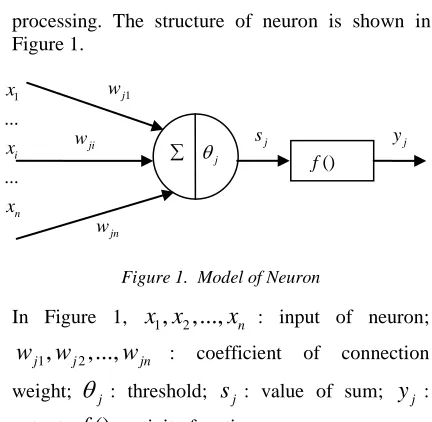
processing. The structure of neuron is shown in Figure 1.
Figure 1. Model of Neuron
In Figure 1,
x x
1,
2,...,
x
n : input of neuron;1
,
2,...,
j j jn
w
w
w
: coefficient of connectionweight;
θ
j : threshold;s
j : value of sum;y
j :output;
f
()
: activity function.Neural network is comprised of neural elements arranged in layers. The layer accepting the external input signal is be called input layer which neurons only transmit data not than process them. The output layer generates results. The layers between input layer and output layer are known as intermediate layers or hidden layers.
4.2. Training and Learning of Neural Network If a neural network wants to realize certain function, we must train it at first, making it know the responding task and store the knowledge in the network weights.
The so-called training and learning means that group sets of samples are input to the network which is used to train, by modifying the connection weights to let network output meet the requirements of the process [25]. Obviously, the performance of the neural network is influenced by the sample sets greatly. If the number of samples is too small, the network can only remember these examples, it is impossible to form the ability to think over.
The most common training method is to learn with supervisor. This method not only requires input data for training, and also requires the corresponding output expected values. The data are input to the network when training, the neutral network modifies the correction weights between neurons based on the relevant algorithms according to the errors between the actual value and the expected value of the network output. The process comes to an end until the errors meet the system requirement.
4.3. Characteristics of Neural Network 4.3.1. Parallel processing
Neural network has a parallel structure and the neurons within the same layer can parallel process data at the same time. Then it has high speed processing ability and can meet the requirements of real-time and online.
4.3.2. Fault tolerance
Neural network acquires knowledge through learning and stores them in a large number of neurons and their connections of the network [26]. Then, it does not affect the memory processing capability and the output of the network even if some neurons are damaged to stop working or have errors. That is, the system can learn and deal with the incomplete or local wrong data.
4.3.3. Adaptability
The connection strength or the weights of the network can be changed, then, the network has strong plasticity. Through training and learning, the neutral network can achieve the demand function, adapt to the external environment and has high adaptive capacity.
4.4. BP Neural Network
Many types of neural networks can be used for fault diagnosis, and the most widely used one is the BP network.
4.4.1. Structure of BP neural network
BP network is a multilayer feed forward neural network which network model is shown in Figure 2. The node number of input layer is equal to the dimension number of the equipment state diagnostic vector, and the node number of the output layer is the number of fault category. The number of hidden layers is generally not more than two; the node number of each layer can be determined by reliable experience. Or, we train the network of different node number of hidden layer with the same set of training samples; the reasonable number of nodes can make the system output error minimize. The activity function of neurons selects Sigmoid function.
4.4.2. BP algorithm
BP algorithm, also known as error back propagation training algorithm, is training and learning method with teachers [27]. The process of training and learning is composed of two parts: forward calculation and reverse calculation. The former is used to compute the actual output of the network by inputting training data. It computes error in the reverse direction if the network does not get the desired output values. Reverse calculation propagates the errors along the same route θj
∑ sj f() yj
1
...
... i
n x
x
x
1
j w
ji w
reversely, calculates the correction values of the connection weights between nodes and repeats the above calculation process with the corrected values until the error meets the requirement.
Figure 2. Model of BP network
Batch learning method can be used in the actual process of training and learning. We can take a number of samples at a time, and obtain the weight correction value corresponding to each sample respectively and then take their average value to modify the weight of each node. This method avoids the negative impact brought about by the noise of single sample training or the contradiction between samples, and then the training process is fast correspondingly.
5. REALIZATION OF ENGINEERING MACHINERY FAULT DIAGNOSIS BASED ON NEURAL NETWORK
The fault diagnosis system based on neural network can identify the type of equipment failure. As long as the network has been trained by different types of training sample set, it can be able to give the judgment of fault type according to the new monitoring fault information input to the system. This paper makes electrical system fault diagnosis of the roller as an example to design and realize a fault diagnosis system based on neural network.
[image:5.612.109.280.164.246.2]5.1. Fault Analysis of Roller’s Electrical System The roller is the key equipment in the road construction which working performance directly determines the quality of the road surface. The electrical system is an important part of the roller which has prominent function in guarantying the operating speed, compacting quality and monitoring alarm. Generally, the roller electrical system is composed of the basic electric system, traveling drive control circuit, vibration control circuit, auxiliary device control circuit, and so on. The basic electrical system including engine starting and charging systems, monitoring system, working lights, braking, etc. [28]. Table 1 lists the common faults and their causes of the charging system of roller.
Table 1. Common Faults And Reasons Of Roller’s Charging System
NO. Sample Fault Reason Sign
1 x1 Not rechargeable
Drive belt is loose Charging circuit
connection is poor Generator has
internal fault Electronic regulator fails
y1 y2 y3 y4
2 x2
Charging current is small
Drive belt is loose Charging circuit
connection is poor Generator has
internal fault Electronic regulator fails
y1 y2 y3 y4
3 x3
Charging current is large
Electronic regulator fails Capacity of battery is lost
y4 y5
4 x4
Charging current is not stable
Drive belt is loose Charging circuit
connection is poor Generator brush is wear Electronic regulator fails
y1 y2 y4 y6
We make the four common failures of charging system as the inputs of the BP neural network and make the six possible reasons as the network outputs. Then, the mapping relationship between faults and reasons is established.
5.2. Sample Selection of Neural Network
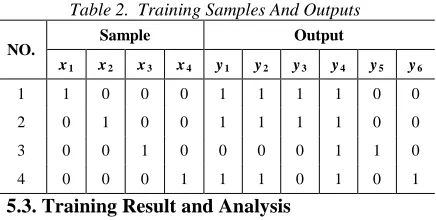
According to the above analyzed faults and their causes, we adopt the 3-layer BP neural network. There are four nodes in the input layer, six nodes in the output layer, five nodes in the hidden layer based on experience. The training samples and their outputs are shown in Table 2.
Table 2. Training Samples And Outputs
NO. Sample Output
x1 x2 x3 x4 y1 y2 y3 y4 y5 y6
1 1 0 0 0 1 1 1 1 0 0
2 0 1 0 0 1 1 1 1 0 0
3 0 0 1 0 0 0 0 1 1 0
4 0 0 0 1 1 1 0 1 0 1
5.3. Training Result and Analysis
Supposing the training error is 0.001, the training samples are inputted to the system program, the test results are shown in Table 3.
Table 3. Output Results Of Fault Diagnosis
NO. Y1 Y2 Y3 Y4 Y5 Y6
1 1.0045 0.9952 1.0001 1.0049 0.0057 -0.0010
2 0.9943 1.0041 1.0039 1.0198 -0.0032 -0.0006
3 -0.0016 -0.0008 0.0040 1.0017 0.9983 0.0041
4 0.9961 0.9918 -0.0158 1.0047 0.0029 1.0044
1
...
... i
n x
x
x
1
...
... i
m y
y
y 1
...
[image:5.612.310.528.483.593.2]It can be seen from Table 3 that the actual output values and the desired output values have relatively good matching degree which proves that this diagnosis method has high accuracy and reliability. In addition, when the error requirement is changed, it also can be found that if the smaller training error is establish, the required training time is longer and the need number of training steps is larger.
6. CONCLUSION
On the basis of analyzing the commonly used methods of engineering machinery fault diagnosis, an intelligent fault diagnosis system of roller’s electrical system is designed and implemented based on BP neural network. The test simulation results show that the method is feasible, diagnostic results correspond to the expected values. The system has preferable fault tolerance, stability and the ability of automated reasoning, and it has certain practical value. It is important to note that this method has contradiction between error and training time, the number of steps which should be carefully weighed in the actual application.
REFERENCES:
[1] YIN Hongchen, “Research on Remote Fault Diagnosis System for Hydraulic System of Construction Machine”, Dissertation for Master Degree, Nanjing, China: Southeast University, 2004.
[2] Jiaqiang E, Intelligent Fault Diagnosis Technology and Its Application, Changsha, China: Hunan University Press, 2006.
[3] FRANK P M, “New developments using AI in fault diagnosis”, Engineering Application of Artificial Intelligence, vol. 10, no. 1, 1997, pp. 3-14.
[4] WEI Xiao-bin, MA Xiao-ping, LI Ya-peng, “Survey of Fault Diagnosis Technology”, Colliery Mechanical & Electrical Technology, no. 1, 2009, pp. 63-65.
[5] Binglin Zhong, Ren Hang, Mechanical Fault Diagnosis (Third Edition), Beijing, China: China Machine Press, 2007.
[6] Yunyan Zhouy, “Research on Mechanical Fault Diagnosis Based on Image Analysis Theory”, Dissertation for Doctor Degree, Wuhan, China: Huazhong University of Science and Technolo gy, 2007.
[7] Guanghui Xue, Miao Wu, “Research Present Situation and Development Tendency of Electromechanical Equipment Fault Diagnosis
Methods”, Coal Engineering, no. 5, 2010, pp. 103-105.
[8] Ling LI, “Fault Diagnosis Technology and Its Application of Hydraulic Excavator Based on Neural Network”, Dissertation for Master Degree, Hangzhou, China: Zhejiang University, 2004.
[9] Changzheng Chen, Changtao Mo, “A method for intelligent fault diagnosis of rotating machinery”, Digital Signal Processing, vol. 14, no. 3, 2004, pp. 203-217.
[10] SHIBATA K, TAKAHASHI A, SHIRAI T, “Fault diagnosis of rotating machinery through visualization of sound signals”, Mechanical Systems and Signal Processing, vol. 14, no. 2, 2000, pp. 229-241.
[11] CHENG Hang, DU Lan-song, “Application of wavelet transforms on fault diagnosis”, Shanxi Machinery, no. 4, 2003, pp. 1-3.
[12] SHANG Yong, YAN Chun-jiang, YAN Zhang, CAO Jun-ling, “Synthetic Insulation Fault Diagnostic Model of Oil-immersed Power Transformers Utilizing Information Fusion”, Proceedings of the CSEE, vol. 22, no. 7, 2002, pp. 115-118.
[13] Kyung-Mo Tahk, Kee-Hyun Skin, “A Study on the Fault Diagnosis of Roller-Shape Using Frequency Analysis of Tension Signals and Artificial Neural Networks Based Approach in a Web Transport System”, KSME International Journal, vol. 16, no. 12, 2002, pp. 1604-1612. [14] Sun Bo, Kang Rui, Zhang Shunong, “An
Approach to Diagnostics and Prognostics Based on Evolutionary Feature Parameters”, Acta Aeronautica et Astronautica Sinica, vol. 29, no. 2, 2008, pp. 393-398.
[15] Yaguo Lei, Zhengjia He, Yanyang Zi, Qiao Hu, “Fault diagnosis of rotating machinery based on a new hybrid clustering algorithm”, International Journal of Advanced Manufacturi ng Technology, no. 35, 2008, pp. 968–977. [16] SU Xinping, WU Xueshen, YANG Chengyu,
XIAO Hui, YANG Gang, “Study on Fault Diagnosis for the Forklift Hydraulic System Based on Fuzzy Tree Analysis Method”, Machine Tool & Hydraulics, vol. 39, no. 17, 2011, pp. 138-139,86.
[18] Hang Qingwei, Zhang Ying, “The design of an expert system on diagnosing the malfunction of
hydraulic excavator”, China Modern
Educational Equipment, no. 15, 2010, pp. 58-60.
[19] Cai Guoqiang, Jia Limin, Yang Jianwei, Liu Haibo, “Improved Wavelet Neural Network Based on Hybrid Genetic Algorithm Applicationin on Fault Diagnosis of Railway Rolling Bearing”, International Journal of Digital Content Technology and its Applications, vol. 4, no. 2, 2010, pp. 135-141.
[20] JIAO Sheng-jie, CHEN Guang-he,
“Application of the Fuzzy Theory in the Trouble Diagnosis of the Construction Machinery”, Journal of Xi’an Mining Institute, vol. 19, no. 2, 1999, pp. 161-164.
[21] B. Samanta, “Gear fault detection using artificial neural networks and support vector machines with genetic algorithms”, Mechanical Systems and Signal Processing, vol. 18, no. 3, 2004, pp. 625–644.
[22] He Xue-wen, ZHAO Hai-ming, “Support Vector Machine and Its Application to Machinery Fault Diagnosis”, Journal of Central South University (Science and Technology), vol. 36, no. 1, 2005, pp. 97-101.
[23] Gong Fu-ting, Wang Jian-yong, “Research of Weighted Fuzzy Fault Diagnosis Based on Adaptive Neural Network”, International Journal of Digital Content Technology and its Applications, vol. 6, no. 9, 2012, pp. 118-124. [24] Renhou Li, Theory and Method of Intelligent
Control, Xi’an, China: Xidian University Press, 1999.
[25] ZHANG Dong, HU Shou-song, “An
Application Of Neural Network For Fault Aircraft Simulation”, Computer Simulation, vol. 20, no. 6, 200, pp. 24-273.
[26] Liqun Han, Theory, Design and Application of Artificial neural network (Second Edition), Beijing, China: Chemical Industry Press, 2007. [27] L I Zhan-feng, HAN Fang-fang, ZHENG De-zhong, “Research on Fault Diagnosis of Rot ors Based on BP Artificial Neural Network”, Journal of Hebei University of Science and Technology, vol. 22, no. 3, 2001, pp. 23-26. [28] Yong Peng, “Study on Fault Diagnosis Expert