Communications
Processors:
Market Overview
Synopsis
Editor's Note
This report examines the
communi-cations processor market. For
infor-mation on the technology, see
"Communications Processors:
Tech-nology Overview"; for comparison
columns detailing the features of key
products, see "Communications
Pro-cessors: Comparison Columns."
Report Highlights
The communications processor
in-dustry still exists, not as a shining
star in the communications
firma-ment, but as a reliable source of
light. Although IBM, NCR, Unisys,
and Amdahl dominate the market,
other vendors have managed to
infil-trate it. The major vendors continue
to enhance their products, while
NCR and Unisys have added new
models.
IBM recently announced that by the
middle of 1991, it will be adding
DS3, FDDI, and ESCON networking
support to the 3745 Communication
Controller, making the 3745
front-end processor a vital part in IBM's
networking strategy.
-By Barbara Rinehart
Associate Editor/Analyst
NCR added one new system, the
5645-B, and enhanced all the A
mod-els to B modmod-els. All the B modmod-els
have been substantially reduced in
physical size, number of
compo-nents, and power and cooling
re-quirements.
Amdahl enhanced the 4745 Series by
expanding the memory capacity to
8M bytes, allowing the 4745 to
con-nect up to four 4M bps token-ring
networks. Amdahl also expanded the
channel connectivity to support four
active channel adapters in the base
frame and extended the 4745's
Inte-grated Switching Architecture (ISA).
Unisys added three new models: the
DCP/25, DCP/35, and DCP/55.
En-hancements include support for
power-on-pluggable line modules,
input/output module (10M) power
supplies, three input/output
proces-sors (lOPs) in a single 10M (DCP/50
and DCP/55 models only), the newly
designed Maintenance Control
Fea-ture (MCF), and an improved power
control feature.
@ 1991 McGraw-Hili, Incorporated. Reproduction Prohibited. Datapro Research Group. Delran NJ 08075 USA
MAY 1991
C13-010-102
Processors
Analysis
Ma~ketOverview
Although communications processors do not
gen-erate bold headlines, the products sustain a steady
revenue stream for the four industry leaders: IBM,
NCR, Unisys, and Amdahl. The technology is
ma-ture, but it still fills a need for these market
seg-ments: IBM and plug-compatible communications
processors for the IBM mainframe environment,
communications processors dedicated to the
main-frame architectures of vendors other
th~n
IBM,
and intelligent concentrators designed to serve in
transparent network architectures.
Vendors did not allow their products to
stag-nate. Instead, the communications processors of
the '90s support the hot items oftoday's
communi-cations marketplace: Tl, LANs, SNA,
TCP/IP,
and
IBM's NetView.
In 1990, IBM and Amdahl did not introduce
new communications processor lines but dusted off
existing ones and made them shinier and more up
to date with token-ring and T 1 capabilities.
Am-dahl made an announcement in April 1990 about
supporting Tl, but as of February 1991, this major
feature was not available.
Vendor Survey Results
Twenty-eight vendors of communications
proces-sors responded to this year's survey requests. They
provided details on the principal characteristics of
65 products. The data collected indicates that the
communications processors are most widely used
as remote line concentrators. Forty-two of the
sixty-four products serve in that capacity, and five
vendors did not respond to the question.
Forty-seven processors can function as front-end
proces-sors. In last year's survey, 17 ofthe 42
communications processors were used as
distrib-uted processing nodes; in this year's survey, 27 of
the 65 products perform that function. All of the
processors perform protocol conversion.
MAY 1991
Communications
Proce_s=
Market Overview
Datapro Reports on Data Communications
IBM's Systems Network Architecture (SNA)
is the company's IQaster plan for communications
with and among IBM computers, terminals, and
office systems. It
is also the company's vehicle for
interconnection with other industry-standard
net-works, such as X.25. Without the capability to
communicate with IBM equipment, a product
starts its life cycle at a disadvantage. Aware of the
importance of penetrating the IBM world, vendors
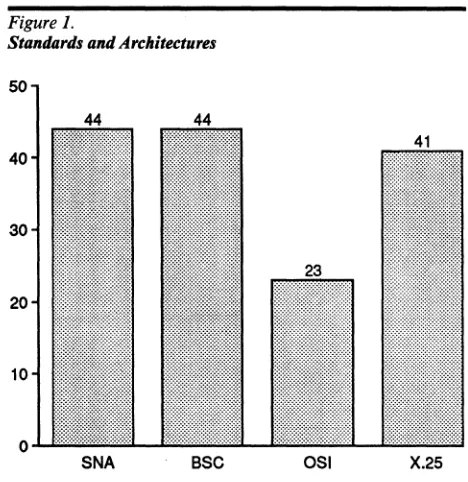
have incorporated support for SNA into 44 of the
64 products included in the survey (see Figure 1).
Open Systems Interconnection (OSI) emerged
in the late '70s as an attempt by the International
Organization for Standardization (ISO) to resolve
compatibility issues. The OSI model for open
ar-chitecture consists of seven layers. Many vendors
have released products that conform to OSI
re-quirements. In the communications processor
field, however, OSI conformity does not appear to
be a driving force. Of the 64 products in the
sur-vey, only 23 adhere to OSI specifications.
The X.25 Recommendation of the CCITT
was developed in response to the need for a
stan-dard interface between packet-switching networks.
The X.25 standard enables terminals and
comput-ers to be connected to public and private
packet-switching networks. More than half of the
communications processors in the survey conform
toX.25.
Vendor Strategies
Amdahl
In April 1990, Amdahl enhanced both 4745
mod-els with 4M bps token-ring adapters, extended the
memory capacity to a total of 8M bytes, extended
the channel connectivity of both models to support
up to four active channel adapters in the base
frame, and extended the Integrated Switching
Ar-chitecture (ISA) with automatic backup
capabili-ties. The base prices of the 4745 models have not
changed since November 1989.
IBII
The IBM product line currently consists of the
3745 Models 130, 150, 170,210, and 410.
IBM
3745
Models 130, 150, and 170
com-plete IBM's front-end processor line at the low end.
Model 130 accommodates four 4M bps or 16M bps
(
Token-Ring interfaces, two Tllines, and four host-
channel links. Model 150, a remote line
concentra-tor, supports 16 communications ports operating
at speeds up to 256K bps, two 4M bps or 16M bps
Token-Ring interfaces, and one TIline. Model
170, a general-purpose controller, supports upto
112 lines at speeds up to 256K bps, two 4M bps or
16M bps Token-Ring interfaces, and two Tllines.
IBM
3745
Model 210 and Model 410
are
high-end models. The Model 210 has a single
Cen-tral Control Unit (CCU) and is field upgradable to
the Model 410. The Model 410 has two
indepen-dent CCUs, each capable of running a separate
Network Control Program (NCP). Both the Model
210 and 410 support 16 or 256 hosts with
token-ring simultaneously, and up to 896 medium- and
high-speed lines. In the third or fourth quarter of
1991, IBM is expected to add DS3, FDDI, and
ES-CON networking support to the 3745
Communica-tions Controller, making the 3745 front-end
processor a key piece in IBM's networking strategy.
Other enhancements to the 3745 are expected
sometime during 1991.
NCR Network Products Division
In 1990, NCR added one new system and replaced
all the A models with B models.
The new model, the NCR 5645-B, was
an-nounced in August 1990. This new
communica-tions processor supports up to four T 1 links, 128
lines, four channel-connected hosts, 4M to 16M
bytes of main storage, 80M bytes of fixed disk
stor-age capacity, and support for up to 12 TCP/IP
Ethernet LANs and up to 16 token-ring LANs. All
of the line, LAN, and host connectivity maximums
cannot be achieved simultaneously.
The product line now consists of the
NCR
5645-B, NCR 5655-B, NCR 5665-B, and NCR
5675-B.
NCR enhanced the models by changing
the physical size, number of components, and
power and cooling requirements.
NCR also improved the processors' hardware
design: Instruction Execution Unit (lEU) has been
added on a single, 60,000-gate VLSI CMOS chip;
cache and main storage are now on a single Printed
Circuit Board (PCB); the total number of PCB
components has been reduced from 36 to 6; the
system cabinet size has been reduced from 9.9 to
4.67 square feet; the bulk power supply is now
silicon-based technology; and a Local
Communica-tion Interface (LCIF) allows direct attachment of
[image:3.612.341.575.74.315.2]I!l 1991 McGraw-Hili, Incorporated. Reproduction Prohibited. Datapro Research Group. Delran NJ 08075 USA
Figure 1.
Standards and Architectures
50
40
30
20
10
o
SNA
BSC
OSI
Indicates the number of communication
pro-cessors, scored on this year's survey, that
comply to the standards and architectures
fea-tured above.
X_2S
rack-mount, 16-line communications bases and
network interface adapters for low-end systems
that have no switching requirement.
Unisys
The newest models to Unisys' communications
processors product line include the
DCPI25, DCPI
35, and DCPI55.
In 1990, Unisys enhanced the
DCP/5, DCP/15, DCP/30, and DCP/55. The
en-hancements made to communications processors
include support for power-on-pluggable line
mod-ules, redundant 10M power supplies,
high-performance 10M capability, three input/output
Processors (lOPs) in a single input/output Module
(10M) (DCP/50 and DCP/55 systems only), a
newly designed Maintenance Control Feature
(MCF), and an improved power control feature.
Future Directions
As long as vendors prime their products for the
needs of the '90s, the communications processor
market will experience a steady but not spectacular
growth. As front-end processors, these machines
perform important tasks. As remote concentrators
and nodes in networks, they perform functions that
are not about to become obsolete.
C13·010-104
Processors
It
is doubtful that many newcomers will
ar-rive on the communications processor scene. Most
of the market belongs to IBM, NCR, Unisys, and
Amdahl. Taking on these giants is not likely to
ap-peal to start-up companies, which would probably
prefer entering a more dynamic field with more
possibilities.
MAY 1991
Communication.
Proc . . . .
r.:
".rket Ov.rvI.w .
Datapro Reports on Data Communications
Most of the activity in the communications
processor field will come from the big four.
Cur-rently, NCR and IBM appear to be sparring with
each other for supremacy, while Amdahl appears
to be banking on the ongoing success of its 4745
communications processor . •
@ 1991 McGraw-Hili, Incorporated. Reproduction Prohibited.
In this report:
Market
Overview ... -102
Vendor Survey
Results ... -102
Vendor
Strategies ... -103
Future Directions ... -105
Communications
Processors:
Market Overview
Synopsis
Editor's Note
This report examines the
communi-cations processor market. For
infor-mation on the technology, see Report
C13-010-201; for comparison
col-umns detailing the features of key
products, see Report C13-01O-30l.
Report Highlights
Communications processors date
back to the early '70s, tracing their
ancestry to the venerable and
effec-tive IBM 3705 Communications
Controller. The 3705 functioned as a
front-end or remote full-service
com-munications processor for the IBM
mainframe environment.
Aware of the potential in the
indus-try, Amdahl, NCR Comten, and
Unisys also produced equipment
that served as front-end processors,
remote concentrators, and network
nodes. Relieving the mainframe of
the burden of communications
cre-ated a new industry.
The industry still exists, not as a
shining star in the communications
firmament but as a reliable source of
light. Although IBM, NCR Comten,
and Amdahl dominate the market,
other vendors have managed to
infil-trate it. The major news last year
em-anated from the NCR Comten camp
when the company introduced a new
line of communications processors:
the 5655, 5665, and 5675. In
addi-tion to the new line, NCR Com ten
released several products for the
5660 communications processor,
introduced complementary software,
and added TCP/IP and Ethernet
in-terfaces to its offerings.
IBM added three lower-level models
to its 3745 communications
control-ler and enhanced the 3745, Models
210 and 410. Amdahl released a
soft-ware migration tool that allows its
4745 to run IBM networking
soft-ware releases on its machines.
Unisys incorporated the DCP/5 into
its Distributed Communications
Processors (DCP) Series. Designed
for small sites, the DCP/5 supports
up to seven lines.
Most of the activity in the market
reflects vendors' successful efforts at
making their products compatible
with current communications
stan-dards and protocols. Vendors have
also integrated support for T 1,
frac-tional T 1, and LAN s into their
prod-ucts.
@ 1990 McGraw-Hili, Incorporated. Reproduction Prohibited. Datapro Research.
Delran NJ 08075 USA
C13-010-102
Processors
Analysis
Market Overview
Although communications processors do not
gen-erate bold headlines, the products sustain a steady
revenue stream for the three industry leaders: IBM,
NCR Comten, and Amdahl. The technology has
been around for a while, but it still fills a need for
these market segments: IBM and plug-compatible
communications processors for the IBM
main-frame environment; communications processors
dedicated to the mainframe architectures of
ven-dors other than IBM; and intelligent concentrators
designed to serve in transparent network
architec-tures.
Vendors did not allow their products to
stag-nate. Instead, the communications processors of
the '90s support the hot items of today's
communi-cations marketplace: T1, fractional T1, LANs,
SNA,
TCP/IP,
and IBM's NetView.
NCR Comten stole the spotlight in 1989 by
introducing three new communications processors:
Comten 5655, Comten 5665, and Comten 5675.
Designed for SNA and multi vendor networks, the
processors offer up to 2
1h times the performance of
Figure 1.
Applications
50
40
30
20
10
o
Front-
Remote
End
Line
Processors Concentrators
MAY 1990
Distributed
Processing
Nodes
Communications Processors: Market Overview
Datapro Reports on Data Communications
an IBM 3745. The systems feature direct
termina-tion of up to 24 T1lines and up to 16 concurrently
active mainframes. In addition, the systems occupy
50 percent less floor space, consume 26 percent
less power, and generate 26 percent less heat than
the vendor's earlier systems.
In 1989, IBM and Amdahl did not introduce
new communications processor lines, but dusted
off existing ones and made them shinier and more
up to date with Token-Ring and Tl capabilities.
IBM rounded out the 3745 processor line with the
Models 130, 150, and 170, each of which features
additional Token-Ring support. The Model 130
also handles high-speed host or
host-to-LAN chores over T 1 lines.
Vendor Survey Results
Sixteen vendors of communications processors
re-sponded to this year's survey requests. They are:
• Amdahl Communications
• Bull HN Worldwide Information Systems
• Chi Corporation
• Computer Communications, Inc.
• Computer Network Technology Corporation
• Computerm Corporation
• Control Data Corporation
• Infotron Systems Corporation
• International Business Machines Corporation
(IBM)
• Lemcom Systems, Inc.
• NCRComten
• NTX Communications Corporation
• Periphonics Corporation
• SBE
• Thomas Engineering Company
• U nisys Corporation
The vendors provided details on the principal
characteristics of 42 products. The data collected
indicates that the communications processors are
most widely used as remote line concentrators.
Thirty-nine of the forty-two products serve in that
capacity. Thirty-seven processors can function as
front-end processors. The number of
communica-tions processors used as distributed processing
@ 1990 McGraw-Hili. Incorporated. Reproduction Prohibited. Datapro Research. Delran NJ 08075 USA
/
(
nodes is dwindling. Only 17 of the 42 products per-
form that function. All of the processors perform
protocol conversion.
IBM's System Network Architecture (SNA) is
the company's master plan for communication
with and among IBM computers, terminals, and
office systems. It
is also the company's vehicle for
interconnection with other industry-standard
net-works, such as X.25. Without the ability to
com-municate with IBM equipment, a product starts its
life cycle at a disadvantage. Aware of the
impor-tance of penetrating the IBM world, vendors have
incorporated support for SNA into 31 of the 42
products included in the survey.
Open Systems Interconnection (OSI) emerged
in the late seventies as an attempt by the
Interna-tional Organization for Standardization (ISO) to
resolve compatibility issues. The OSI model for
open architecture consists of seven layers. Many
vendors have released products that conform to
OSI requirements. In the communications
proces-sor field, however, OSI conformity does not appear
to be a driving force. Of the 42 products in the
sur-vey, only 15 adhere to OSI specifications.
The X.25 Recommendation of the CCITT
was developed in response to the need for a
stan-dard interface between packet-switching networks.
The X.25 standard enables terminals and
comput-ers to be connected to public packet-switching
net-works. More than half of the communications
processors in the survey conform to X.25.
Vendor Strategies
Amdahl
In May 1989, Amdahl enhanced its 4745 front-end
communications processor with a software
migra-tion tool that allows users to run IBM networking
software releases on the 4745. The 4745 Model 210
and Model 110 can run IBM's Network Control
Program (NCP) Version 5 and Release 5.2.
Amdahl increased prices by 10 percent. The
4745-210 costs $132,000, and the 4745-110 with
NCP-5 costs $100,650.
IBM
In May 1989, IBM added three lower level models
to its 3745 communications controller product line
and enhanced the 3745 Models 210 and 410.
© 1990 McGraw-Hili, Incorporated. Reproduction Prohibited. Datapro Research. Delran NJ 08075 USA
Figure 2.
Standards and Architectures
50
40
30
"IN;""""',.,.,.,.,.,.,.,10
Bse
OSI
X.25
IBM
3745
Models 130, 150, and 170.
These
models complete IBM's front-end processor line
at the low end. Model 130 accommodates four
4M bps or 16M bps Token-Ring interfaces, two
Tl lines, and four host-channel links. Model 150,
a remote line concentrator, supports 16
communi-cations ports operating at speeds up to 256K bps,
two 4M bps or 16M bps Token-Ring interfaces,
and one Tl line. Model 170, a general-purpose
controller, supports up to 112 lines at speeds up
to 256K bps, two 4M bps or 16M bps Token-Ring
interfaces, and two T 1 lines.
Upgrades to
3745
Model 210 and Model 410.
IBM upgraded these high-end models by including
connections for up to 896 medium- and
high-speed lines. IBM also added fractional T1
capabil-ities, line-interface and Token-Ring port swapping
capabilities, and PS/2 attachments.
NCR Com ten
NCR introduced new products and upgraded
exist-ing models.
Com ten
5655,5665,
and
5676
Communica-tions Processors.
This new family of
communica-tions processors supports up to 24 Tllines, 1,024
full-duplex lines, 64 token-ring LANs, 16M bytes
of main storage, and 80M bytes of fixed disk
stor-age. The systems support Net View and the
follow-ing protocols: SDLC/SNA, LU6.2, BSC, X.25, and
X.21.
Com ten 16-Line Communications Base
(16-Line CB).
Residing in the Comten 5660 and 3695
communications processors, the 16-Line CB
en-ables field engineers to perform routine or
emer-gency services on a single 16-line module without
C13-010-104
Processors
disrupting system operation. The 16-Line CB
ter-minates up to 16 communications lines. The
prod-uct consists of multiple processors that can handle
specific protocols or line speeds for cost-effective
line termination in mixed-protocol environments.
Based on complementary metal oxide
semiconduc-tor (CMOS) ASIC technology, the 16-Line CB
re-quires less power and cooling features.
The base price for 16-Line CB is $7,035.
Comten Universal Communications Adapter
(UCA). NCR Comten endowed UCA, which also
resides in Comten 5660 and 3695 communications
processors, with expanded switching options. U
s-ers can back up all or portions of their
communica-tions processors and attached communicacommunica-tions
lines for increased network uptime. UCA users can
switch among multiple communications
proces-sors, thereby making full use of all their
equip-ment. This switching flexibility offers benefits to
users because they do not have to pay for
infre-quently used backup systems. When backup is
nec-essary, users can switch network traffic from the
system in trouble to active systems.
UCA concentrates data from NCR Comten
communications line termination equipment, such
as communications bases, and routes it through
input/output channels on one or more attached
NCR Comten processors. For maximum network
availability, each UCA supports data routing
through two online and two backup channel
con-nections, thereby increasing users' options for data
routing during routine or emergency maintenance
and for load balancing during peak traffic periods.
UCA's aggregate throughput is 512K characters per
second.
The purchase price for UCA starts at
$21,000.
High Performance Feature (HPF) for Comten
5660.
HPF provides 50 percent more processing
power for the Comten 5660 communications
pro-cessor than 5660 models without the feature. The
processing power of the Comten 5660 with HPF
can lower network operating costs in some
net-works by allowing more users to join the existing
network without adding more communications
lines. In networks where the communications
pro-cessor is operating at near capacity, HPF can
re-duce networking costs by eliminating the need for
additional communications processors, while
al-lowing more throughput and improved response
time. HPF costs $60,000 for new Comten 5660
MAY 1990
Communications Processors; Market Overview
Datapro Reports on Data Communications
orders. A field-installed HPF upgrade for
already-installed 5660s costs $75,000.
Advanced Communications Function/Network
Control Program (ACF/NCP) Version 5. NCR
Comten supports SNA networking through the
Comten Advanced Communications
Functionl
Network Control Program
(ACF/NCP),
a network
routing and control software program residing in
NCR communications processors. In October
1989, the company expanded its SNA networking
capabilities with Version 5 of
ACFINCP,
which
expands support for distributed peer-to-peer
net-working that reduces host processing costs,
pro-duces value-added network statistics to assist in
lowering costs, and improves performance.
Through
ACF/NCP
Version 5's distributed
processing capability, users can access applications
in intelligent workstations or SNA hosts without
monopolizing host resources.
ACF/NCP
Version 5
enables Node Type (NT) 2.1 devices to use Logical
Unit (LU) 6.2 protocol to conduct peer-to-peer
ses-sions over wide area SNA networks with minimal
host intervention. Users can initiate and collect
host-independent network statistics through the
NCR Comten console, Comten Support Facility,
or IBM's NetView.
A licensed software product residing in a
Comten 5620 or 56X5 communications processor,
ACF/NCP
Version 5 is compatible with earlier
Comten communications processors and with
pre-vious
ACF/NCP
releases. Version 5 is functionally
compatible with, and provides features found in,
IBM's
ACF/NCP
Version 5 Release 1 and Release
2. Release 2 Version 5 debuted in second-quarter
1990.
Comten TCP/IP and Comten Ethernet LAN
Interface. Designed for communications
proces-sors, the software supports interoperability among
devices in SNA and
TCP/IP
networks, enabling
users to share communications lines and to
inter-operate among various software applications in the
network. By implementing these capabilities in a
multipurpose networking system, such as a
com-munications processor, users can integrate their
existing SNA and
TCP/IP
networks into a single,
multipurpose network. The resulting
TCP/IP/SNA
network provides two-way interoperability among
Ethernet LANs using
TCP/IP
and SNA devices.
Com ten Open Systems Interconnection/
Communications Processor (OSI/CP). This offering
@ 1990 McGraw-Hili, Incorporated. Reproduction Prohibited. Datapro Research. Delran NJ 08075 USA
(
adds OSI software to the
working software for Comten communications
TCP/IP
and SNA
net-processors. OSIICP enables users with OSI desktop
applications, like file transfer and electronic mail,
to interoperate with each other over a wide area
network, independent of the mainframe. With the
addition of OSIICP software, Comten's 56X5
com-munications processors can form the backbone of a
multipurpose, wide area network that routes OSI,
TCP/IP,
and SNA data traffic over a single
net-work.
Unisys
Unisys introduced the
DCP/5
into its Distributed
Communications Processors (DCP) Series.
De-signed for small sites, the
DCP/5
supports up to
seven lines, as well as BSC, HDLC, UDLC, X.21,
and X.25. Unisys bundled the
DCP/5
with its PW
Model 500 personal computer. The
communica-tions processor board ranges in price from $9,800
to $14,300.
Future Directions
As long as vendors prime their products for the
needs of the '90s, the communications processor
market will experience a steady, but not
spectacu-lar growth. As front-end processors, these machines
perform important tasks. As remote concentrators
@ 1990 McGraw-Hili, Incorporated. Reproduction Prohibited. Datapro Research. Delran NJ 08075 USA
and nodes in networks, they perform functions that
are not about to become obsolete.
It is doubtful that many newcomers will
ar-rive on the communications processor scene. Most
of the market belongs to IBM, NCR Comten, and
Amdahl. Taking on these giants is not likely to
ap-peal to start-up companies, who would probably
prefer entering a more dynamic field with more
possibilities.
Most of the activity in the communications
processor field will come from the big three.
Cur-rently, NCR Comten and IBM appear to be
spar-ring with each other for supremacy. At the time
NCR Comten released the 5655, 5665, and 5675,
IBM enhanced Models 210 and 410 of the 3745,
adding fractional Tl and Token-Ring port
swap-ping capabilities, and increasing line attachments.
In the future, the two companies will continue
bat-tling for the greater share of the communications
processor market.
Amdahl appears to be banking on the ongoing
success of its 4745 communications processor. As
indicated by its announcement this year of a
soft-ware migration tool enabling users to run IBM
net-working software releases on the 4745, Amdahl is
turning its attention to software and will pursue
this avenue more vigorously in the future . •
Communications Processors
Multifunctional products make it increasingly difficult to
pigeonhole equipment into specific categories.
It
used to be
simple: Devices converting signals from digital to analog
were modems, units combining data from many channels
onto one were multiplexers, and so forth. But integration is
now the goal of the communications industry, and
manu-facturers have begun to combine many functions in one
system. Modems incorporate multiplexing and/or protocol
conversion; terminals contain modem chips; and larger
systems integrate switching and multiplexing, as well as
providing gateways to other networks.
The definition of a communications processor varies
greatly, depending upon who is defining it. Different
pro-cessors have different capabilities, and while network
de-signers have one view of what a communications processor
does, equipment manufacturers have another. Everything
from an IBM 3745 to a four-port packet assembler/
disassembler (PAD) has been called a "communications
processor."
From a network designer's point of view, a
communica-tions processor should be capable of setting up conneccommunica-tions
to transmit and receive data, multiplex and demultiplex
data, frame and unframe messages, perform error
correc-tion and protocol conversion, choose transmission routes,
and collect performance and traffic statistics. This
design-er's definition has led many manufacturers to classify their
protocol converters, PADs, terminal controllers, and stat
muxes as communications processors. They consider
de-vices that connect terminals to communications networks
and maintain control through changing network conditions
"Communications processor" not only describes
a specific category of equipment. but also
in-cludes a broad array of systems that performs
communications processing functions and
pro-vides other services. Our definition of
communica-tions processors includes multifunctional.
intelligent systems that are dedicated to
commu-nications and can serve as nodes in the network.
These systems generally include three basic types
of products: front-end processors. intelligent
switches. and remote concentrators.
In addition to defining communications
process-ing. this report discusses communications
proces-sor design. its place in modern network
architectures. the evolution of the
communica-tions processor. general advantages and
restric-tions of today's systems. and the state of the
communications processor marketplace.
This report also includes comparison columns
out-lining the major characteristics of
communica-tions processors from vendors.
REPORT HIGHLIGHTS:
COMMUNICATIONS PROCESSORS
AND NETWORK ARCHITECTURES
ADVANTAGES AND RESTRICTIONS
PAGE
THE CURRENT MARKETPLACE ... .
103
107
107
Designed for large network users,
the NCR Comten 5660
Communi-cations Processor is a powerful data
communications processor that of
fers high levels of network control,
processing capacity, and device
sup-port.
C13-010-102
Processors
Communications Processors
TABLE 1. COMMUNICATIONS PROCESSORS
FUNCTIONS
Physical transmission and reception of data
Data buffering and queuing
Multiplexing
Message framing and unframing
Control of transmission errors
Message sequencing
Protocol conversion
Message pacing and flow control
Message or packet assembly and disassembly
Route selection
Session· establishment and disconnection
Formatting of data for use by specific host or terminal
applications
Reporting and logging of device or transmission errors or
failures
Fallback switching in case of host, device, or transmission
line failure
Gather and record network performance and traffic
statistics
to be communications processors. While marketing
depart-ments develop effective advertisedepart-ments around this
con-cept, it clouds the definition of the equipment. Marketing
impact aside, an IBM 3745 and a protocol converter do not
belong in the same category.
Several years ago, in an attempt to narrow the field of
de-vices that would be included in this survey, we placed
PADs and terminal controllers in a Protocol Conversion
Systems tab, which also included black-box protocol
con-verters, terminal emulators, and code and speed
convert-ers. This was in keeping with our premise that true
communications processors, concentrators included, are
involved in a dynamic process involving feedback from
other intelligent devices in the network. Protocol
convert-ers, PADs, and statistical multiplexers perform basically
static processes that remain constant as network conditions
change. This year we have further refined our
communica-tions processor coverage by identifying equipment that is
clearly defined as packet switches and channel extenders
and moving them to separate tabs.
Datapro defines a communications processor asa
multi-functional, intelligent device dedicated to communications
and serving as a control point, or node, in a data
communi-cations network. It serves as a front end to a mainframe, as
an intelligent switch, or as a remote concentrator. As a
front-end processor (FEP), the communications processor
serves as a peripheral device locally attached to one or
more large computers dedicated to applications processing,
relieving them of the overhead involved in message
han-dling and network control. An intelligent switch routes
messages among the network's various end points and
par-ticipates in the network's control and management, either
under the control of a master (usually front-end) processor
or as a peer of other intelligent switches. A concentrator
controls a community of terminals, clusters of terminals, or
distributed applications processors; gathers, queues, and
multiplexes their transmissions onto one or more
high-speed network trunks; and participates in the network's
control and management, again either under the direction
of a master processor or as a peer of other concentrators
and switches. (Table I lists the major functions of a
com-munications processor in the typical network.)
The network designer's definition would qualify two
de-vices as communications processors: the front-end
proces-sor and the network procesproces-sor. While the front-end
processor connects directly to the host processor's block/
byte multiplexer or selector channels, the network
proces-sor is a standalone unit that is not host dependent and has a
large degree of operating autonomy. Its primary function is
to provide a link between user terminal devices and the
front-end processor and/or other network processors.
Communications with the FEP is on the data link level.
While the network processor does not carry on a dialog
with the FEP, it does respond to FEP-initiated network
sig-nals.
While the above definitions seem black and white, some
equipment still falls into a gray area. Packet switches, for
example, often fit quite nicely into our definition but we
cannot classify them only as communications processors.
We have concluded that communications processing must
actually be classified in terms of application and/or
func-tionality.
We also recognize, however, that there is a small but
impor-tant class of equipment that belongs to the traditional
com-munications processing realm. This class includes IBM
372X/374X, NCR Comten, and Amdahl front-end
proces-sors. IBM controls a majority of this market, and only a
handful of vendors manufacture competing systems.
Uni-sys also manufactures communications processors for .its
mainframes. Full product reports on these systems are
In-cluded within this tab.
Front-end processing is the most complex task a
communi-cations processor can perform. In a large, complex network
governed by one or more mainframe hosts, a front end
must do all but the last three functions listed in Table 1 in
the normal course of its operations.
Intelligent switching is slightly less complex, since the
com-munications processor acting as a dedicated switch need
not carry on a running dialog with a host computer and is
not responsible for the end-to-end establishment and
dis-connection of sessions. Still, an intelligent switch, in
nor-mal operation, must perform all but the last five basic
functions in the table. An intelligent switch differs from a
simple switch, such as a port selection and contention
de-vice, because it must monitor the network's traffic and
per-formance either under the control of a master processor
(usually
~
front end) or as a peer among other
~ntelligent
switches and concentrators.
It
must also change lts
behav-ior, notably the routing and pacing of
mess~ges,
according
to theinformation
it
receives. A simple sWltch merely
es-COPYRIGHT
© 1989 McGRAW-HILL, INCORPORATED. REPRODUCTION PROHIBITED
DA TAPRO RESEARCH, DELRAN NJ 08075 USA
[image:12.612.62.299.60.277.2](
(
Communications Processors
tablishes an information path according to instructions it
receives from a user or computer on one end of the
connec-tion.
Concentration is the least complex task a communications
processor performs, and communications processors acting
as concentrators are easily confused with less sophisticated,
single-function devices such as statistical multiplexers,
pro-tocol converters, PADs, and terminal cluster controllers.
Indeed, with the widespread use of microprocessors and the
declining cost of silicon intelligence, many devices at the
high ends of these lines are beginning to approach the
func-tional breadth of true communications processors. The
dif-ference is that true communications processing,
concentration included, is a dynamic process involving
feedback from other intelligent devices in the network.
Sta-tistical multiplexing, protocol conversion, and packet
assembly/disassembly are basically static processes that do
not change as conditions change in the network.
An intelligent concentrator participates in the control of the
network, either under the direction of a master processor or
as a peer of other concentrators and switches, receiving
sta-tus information from the network and changing its
behav-ior accordingly. These changes include accelerating or
withholding transmissions, initiating diagnostic
proce-dures for pathways and devices in its local domain, and
controlling access to the network from its locally attached
devices. Some sophisticated terminal controllers, notably
IBM's 31745, perform some or all of these functions.
A concentrator differs from a sophisticated terminal cluster
controller by its position in the network's hierarchy. A
centrator concentrates data from a number of cluster
con-trollers, while a cluster controller concentrates data only
from a number of individual terminals. As an example,
consider the relative positions in an SNA network of an
IBM
3725
acting as a remote node (concentrator) and an
IBM 3174 within that concentrator's domain. A user builds
an entire network from intelligent concentrators
communi-cating with one another as peers, but does not do the same
with cluster controllers.
COMMUNICATIONS PROCESSORS
AND NETWORK ARCHITECTURES
The implementation of network architectures is perhaps
the most important ongoing theme in the development of
data communications. In general, there are two kinds of
network architectures: those designed to provide
commu-nications among computers and terminals from a specific
vendor, and those designed to provide open
communica-tions regardless of the vendor of the communicating
de-vices.
Mainframe vendor architectures include IBM's SNA,
Hon-eywell's DSA, and Unisys' BNA and DCA. Open
architec-tures include the CCITT X.25 packet-switching
specification and several "transparent" network schemes
marketed by communications vendors. The
communica-tions processor is the most important element in both
vendor-specific and open architectures. In the following
paragraphs, we will use the International Organization for
Standardization (ISO) reference model for Open Systems
Interconnection (OSI) to examine the different roles that
communications processors play in different kinds of
net-work architectures.
In network architectures designed by mainframe computer
vendors, the communications processor functions most
of-ten as a front end and controls communications in
conjunc-tion with one or more software systems in the host
computer. In general, the front-end processor handles the
Data Link through Session layers of the ISO model, with
host software implementing the Presentation and
Applica-tion layers. The balance varies, depending on the
architec-ture. In Unisys' DCA, the DCP-Series front end controls
many Presentation layer functions, while in IBM's SNA,
the host's access method (along with software residing in
the terminal controllers) handles communications down to
the Session layer, with the 37XX front end acting almost as
a channel-attached packet switch. The range of control
as-signed to front-end processors in other mainframe
architec-tures varies between those extremes.
In all mainframe architectures, the same communications
processor models that serve as front ends also function as
intelligent switches and as remote concentrators. In these
functions, the communications processors usually appear
in smaller configurations than in the front-end role.
Com-munications processors working in mainframe architecture
also perform intelligent gateway functions. In this
applica-tion, the communications processor provides the interface
between the mainframe network and communications
fa-cilities outside the architecture, particularly public, packet
switched data networks using the X.25 protocols.
The function of a communications processor differs
be-tween the two kinds of open architectures. In a full-scale
open architecture such as X.25, the communications
pro-cessor serves entirely as an intelligent packet switch,
imple-menting the Data Link through Transport layers via a
uniform set of complementary protocols. Designed
specifi-cally for public data networks, X.25 protocols ultimately
establish virtual circuits, or logical paths through the
net-work, for devices from any vendor. Communicating
devices-computers or terminals-at either end of the
vir-tual circuit must handle the Session, Presentation, and
Ap-plication layers according to their own protocols.
In a public network, the network provider is responsible for
network management. The X.25 communications
proces-sors in such a network, therefore, carry a heavy load of
ac-cess, error, and class-of-service control, along with
provisions for statistically recording traffic and usage data
to be sorted by individual users. Communications
proces-sors designed to function as switches in public networks are
C13-010-104
Processors
Communications Processors
Front-end Processor
Front·end
Processor
Front-end Processor
Intelligent Switch
Intelligent Switch
f - - - i - - - - I
ConcentratorConcentrator
[image:14.612.73.553.64.406.2]1---,....,.--...,
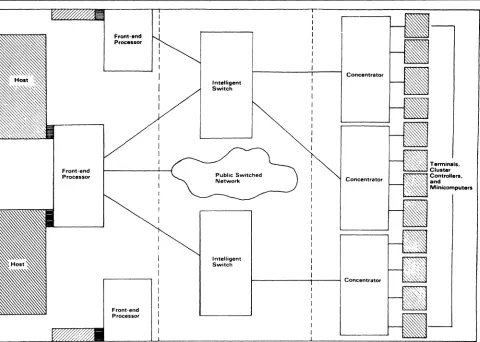
ConcentratorFigure
1.
A communications processor can/unction as a/ront end/or one or more host computers, as an intelligent switching node not
attached directly to any applications equipment, or as a remote terminal concentrator.
the most likely to support high-capacity, attached storage
devices such as disk and tape drives.
Communications processors operating in full-scale X.25
configurations seldom perform a gateway function. The
user must provide compatibility with the network's
stan-dard protocols, either through an X.25 software package
that resides in a participating host or its front-end
proces-sor, or through a packet assembler/disassembler (PAD)
that handles the Physical and Data Link layers of the
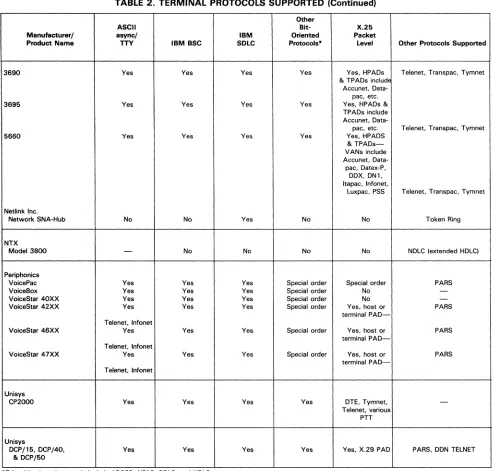
archi-tecture. Table 2 shows the protocols supported by various
vendors' communications processors.
Transparent architectures are offered by vendors of
com-munications equipment as a low-cost alternative to
main-frame architectures and full-scale X.25 implementations.
These architectures are usually stripped-down versions of
X.25 without the network administration and
c1ass-of-service overhead necessary to operate a public or very
large private network. In these architectures, the
communi-cations processor functions primarily as a switching
con-centrator, providing services at the Data Link, Network,
and Transport layers. Most such concentrators have
evolved at the high ends oflines of statistical multiplexers,
adding the crucial routing and flow control features that
qualify them as communications processors. Some of these
products offer integrated network management functions
such as error logging and performance statistics, but most
rely on a separate, complementary network management
system for these functions.
COMMUNICATIONS PROCESSOR
DESIGN
The basic design of almost all communications processors
follows the same three-tiered, hierarchical plan-a plan
that they share in common with their close cousins, the
digital PBXs, and more generally with a number of other
data communications components.
The device's central processing unit (CPU) sits at the top of
the hierarchy, along with its associated main memory.
It
controls the communications processor's operation
accord-ing to the rules and parameters of its operataccord-ing software
and, in front-end configurations, in conjunction with
in-structions from the host computer. In general, the CPU
per-forms the complex or dynamic tasks such as addressing,
route selection, protocol conversion, access control, session
COPYRIGHT
©
1989 McGRAW-HILL, INCORPORATED. REPRODUCTION PROHIBITED DA T APRO RESEARGH, ,DELRAN NJ 08075 USA(-Communications Processors
Host 1/0 }
Chennel
Common Control
J
Comp0n8nts1
Line B •• es
I
Line Sets
I
Host Computer
~---. Control end Meintenance Penelor
L - _ ... Console
[image:15.612.62.551.79.372.2]Communications Unes
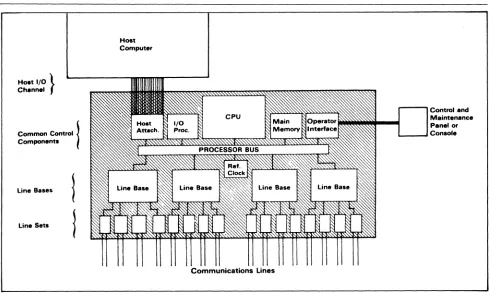
Figure
2.
The diagram shows the hierarchical, bus-based architecture of a typical communications processor. Such a processor can
contain more than one host interface, several I/O processors, and many line bases. Each line base serves communications lines of a
specific synchronization, speed, and protocol. Each line set serves lines with a specific, physical interface. The modular arrangement of
line bases and line sets on the processor bus allows easy configuration and reconfiguration.
establishment, application-level formatting, and error
log-ging.
It
also delegates the rote operations to subsidiary
com-ponents.
In most communications processors, some components
operating under the direction of the CPU perform general
functions involving the operation of the whole
communi-cations processor, while others perform functions
dedi-cated to specific groups of lines. Among the former are the
host interfaces, the input/output (I/O) processors, the
refer-ence clock, and the operator interface. Among the latter are
the processor's line bases and line sets.
Communications processors configured as front ends must
have at least one host interface. The host interface handles
communications between the front-end processor and the
host's byte or block multiplexer, or selector channel. The
host interface buffers data from the front end's CPU,
as-sembles it into parallel bit streams of a format specific to
the attached host channel, and transmits it up the channel
to the host. For data coming from the host, it performs the
same process in reverse. The host interface's principal
func-tion is to convert data from the communicafunc-tions
proces-sor's internal word size to that ofthe host computer.
Some communications processors contain one or more
input/output processors that transfer data between the
CPU and attached storage peripherals, such as disk or tape
drives. In some cases, the I/O processors arbitrate among
the various line bases for access to main memory and to the
CPU, handling interrupts generated by the line bases or
host interfaces to gain the attention of the CPU, or
control-ling the line bases' and host interfaces' access to main
mem-ory. In communications processors with more than one I/O
processor, each I/O processor usually controls a set
comple-ment of storage units or communications lines.
The reference clock generates a timing signal used by all
other components of the communications processor. In
many systems, reference timing is a function of the CPU.
Some systems have separate reference clocks for timing
sig-nals at different data rates.
The operator interface allows an operator to monitor and
control the communications processor and to run
diagnos-tic tests. In newer and more sophisdiagnos-ticated systems, the
op-erator interface works under software control from a
dedicated console, which usually contains a CRT or similar
display unit and a printer for logging. In most
communica-tions processors, the operator interface works through a
front panel that contains a number of manual switches and
indicator lights.
All of the aforementioned devices perform functions that
are shared among all communications lines; they sit just
below the CPU in the communications processor's internal
C13-010-106
Processors