Processors
Hewlett-Packard HP 1000
Communications Capabilities
The H P 1000 Model 60, Series E. shown above, with the RTE-6/ V M operating system offers large program data capabilities with virtual storage.
MANAGEMENT SUMMARY
The Hewlett-Packard 1000 is a modular board, box,
desktop, or cabinet small computer system which may be
used as a front-end processor, concentrator, terminal
controller or other communication function. Since the
inception of the HP 1000 in 1974, Hewlett-Packard has
continously enhanced this product's capabilities with new
processors and advanced features.
The product line presently consists of two distinct
segments: the more mature E, F, and M Series and the
more recent A and L Series. The A and L Series have a
different architecture, faster throughput, and better
performance than the older processors. The E, F, and M
Series of processors
is
still supported and offers at least as
many communications alternatives. Despite the
differ-ences, software may be executed on all models without
modification.
The L-Series was introduced in March of 1980. This new
family offers built-in Direct Memory Access (DMA) and a
transfer rate of 2.7 megabytes per second. In a
communications environment, this frees the processor
from many of the mundane interruptions that take place,
and allows the processor to devote more of its valuable
machine cycles to communications processing.
HP is moving so quickly, in fact, that they have already
replaced the first L-Series processor models with the even
faster A-Series, which was introduced in February of 1982.
Hewlett-Packard rates the A-Series' speed at one MIPS
(millions of instructions per second) or just slightly below
the rating for the top-of-line HP 3000 Model 64. The
A-Series has a transfer rate of 4.3 million bytes per second
and is also equipped with DMA.
1:>
A versatile family of small computers that may be used as front-end processors, terminal controllers, or network hosts when teamed with the appropriate hardware interfaces and support software. An H P 1000 may control its own terminal network or may be configured with other HP 1000s and HP 30005.
Communications capabilities via Hewlett-Packard's Distributed System Network include HP 1000 to 3000, HOLC, X.25, bisynchronous, and asynchronous communi-cations when using OS/1000-IV.
A typical configuration of an HP 1000 Model F, with 256K bytes of memory, 64-megabyte disk, RTE-6/VM operating system, OS/ 1000-IV communications software, 16 asynchronous ports, and two interface boards, sells for a purchase price of $60,940. Maintenance is $347 per month.
CHARACTERISTICS
VENDOR: Hewlett-Packard Company, Information Networks Division, 19420 Homestead Road, Cupertino, California 95014. Telephone (408) 725-8111.
DATE OF FIRST ANNOUNCEMENT: M-Series: Model 2108-May 1974; Model 2112-May 1975; E-Series: Models 2109 and 2113-December 1975; Model 40-May 1978; Model 60-September 1981; F-Series: Models 2111 and 2117-May 1978; Model 45-May 1978; Model 65-September 1981; L-Series: Models 2103 and 2122-March 1980; Model 5-May 1981; A-Series: all models-February 1982.
DATE OF FIRST DELIVERY: M-Series: Model 2108-August 1974; Model 2112-0ctober 1975; E-Series: Models 2109 and 2113-September 1976; Model 40-September 1978; Model60-September 1981; F-Series: Models 2111 and 2117-August 1978; Model 45-September 1978; Model 65-September 1981; L-Series: Models 2103 and 2122-March 1980; Model 5-May 1981; A-Series: all models-June 1982.
NUMBER DELIVERED TO DATE: 40,000 HP 1000 computers; over 5,500 HP 1000 DSN nodes.
SERVICED BY: Hewlett-Packard Company. CONFIGURATION
The HP 1000 processor family consists ofthe A, E, F, L, and M Series, which are offered in a variety of configurations to meet specific customer requirements. The E, F, and M families have a different architecture than that of the A and L processor families. Consequently, many of the communi-cation/terminal and other interfaces apply only to either the E, F, and M Series or the A and L Series of processors. ~ MAY 1982 © 1982 DATAPRO RESEARCH CORPORATION, DELRAN, NJ 08075 USA
Processors
Hewlett-Packard HP 1000
Communications Capabilities
I>
The HP 1000 product line may be expanded or adapted for
communications use by adding interface boards to
input/ output slots, the available number of which varies
from model to model. In another effort to free the main
processor from low-level tasks, Hewlett-Packard has also
been methodically upgrading many of these interface
boards. All of the new ones and some of the mature ones
now include their own intelligence and memory to relieve
potential burdens from the processor. Some are even user
programmable.
Distributed Systems Network (DSN) is the
communi-cations convention that has been established among
Hewlett-Packard computers. Under DSN, HP systems
may exchange information across Hewlett-Packard
product lines.
The HP 1000 software package which enables DSN
cross-computer communications is known as DS/ WOO-IV. This
software supports all communications activity.
It may beused to link an HP 1000 at data rates as high as 57,600 bits
per second to an HP 3000 as a front-end processor or to
interact with remote 3000s. Under DS/ WOO-IV and with
appropriate interfacing, X.25 Levelland 2 gateways are
provided. With software feature 91751A, the additional
software support for X.25 Level 3 packet switching is also
able to be achieved. HDLe protocol support and
multipoint interchange with terminals may also be
established under DS/ lOOO-IV's direction.
A characteristic of HP 1000 communications is
modularity and extreme flexibility. Even though the
communications software is loaded in the same machine
running applications software, the communications
software is segregated, permitting the user to modify
communications functions without disturbing the
applications. This is very similar to arrangements found in
much larger mainframes and is not only true for the
software which drives the HP 1000 in communications
with other processors, but also for the software that links a
single terminal to the 1000. A single support package is
available, for example, which facilitates the handling of all
mUltipoint terminals.
A peer relationship may also exist between HP WOOs
acting as nodes. Each node is capable of initiating or
responding to a remote processor's signal, such as a
request for a file transfer. DS / WOO-IV in a nodal
arrangement allows for configuration of ring, star, or other
topologies.
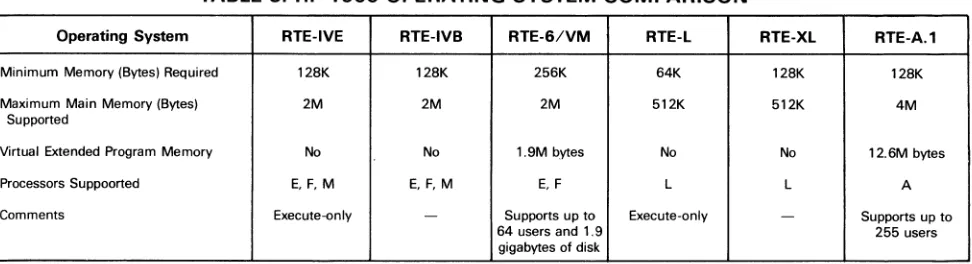
The HP 1000 performs under the supervision of six current
operating systems, as outlined in Tables I and 3. The two that
offer the greatest memory, disk file, and communications
support are the RTE-A.I forthe A-Series and R TE-6 / VM
for the E, F, or M Series. Software written on obsolete
operating systems within the product line may still be
executed by the current versions.
The result of these continuing enhancements is a powerful
small computer that a user may optimize for various
1:>
~ The HP 1000 processors are mounted in standard 19-inch racks along with the operator panel and chassis. The packaged system models offer both an upright cabinet and a desk-mounted configuration.
Depending upon model, each HP 1000 processor model offers a certain number ofI/O slots as standard:
• A-Series Processor 2197-13 I/O slots; Processor 2186A-three I/O slots; Processor 2186B-four I/O slots; Processors 2196 and 2137A-16 I/O slots; Processor 2156A-18 I/O slots; Processor 2136A-three I/O slots; and Processor 2136B-five I/O slots.
• E-Series Processors 2176 and 2178-11 I/O slots; Processor 2109-oine I/O slots; and Processor 2113-14 I/O slots.
• F-Series Processors 2179 and 2177-10 I/O slots; Processor 2111-nine I/O slots; and Processor 2117-14 I/O slots.
• L-Series Processors 2122A and 2142A-three I/O slots; Processor 2142B-four I/O slots; Processor 2103-eight I/O slots; and Processor 2122B-five I/O slots.
• M-Series Processor 2108-nine I/O slots; Processor 2112-14 I/O slots.
E. F. and M Series Processors
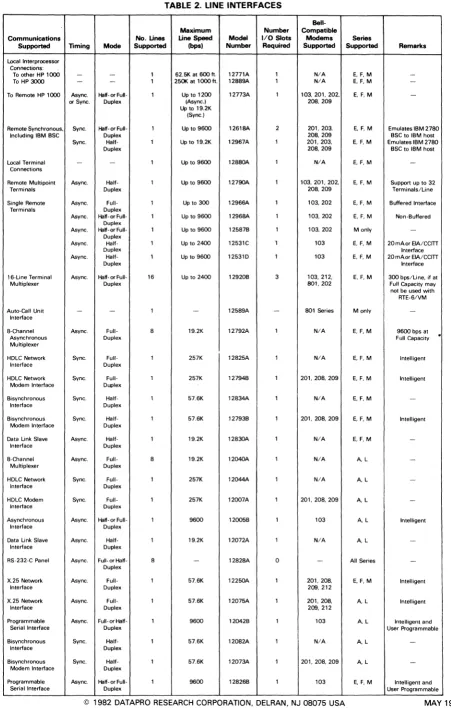
In addition to the standard slots, there are two 16 I/O slot extenders aHowed per processor. This yields a maximum, for example, of 42 I/O slots on the F-Series 2179 processor. Communications devices and line adapters must contend with peripherals, but not add-on memory units, for I/O slot space. GeneraUy, each device requires one I/O slot; however, some of the communication interfaces require more than one slot. Table 2 shows the number of slots required by each line interface.
There are two I/O mechanisms common to the E, F, and M Series processors: programmed I/O, and Direct Memory Access (DMA). DMA channels, such as those used for communications links to remote processors, access the host through an optional Dual-Channel Port Controller (DCPC). The DCPC contains all necessary logic to control DMA transfer for multiple devices. This arrangement avoids the need for redundant DMA control logic in each individual I/O controller. DMA data transfers, once the DCPC has been initialized by the program, proceed automatically. Programmed I/O, on the other hand, permits the computer to manipulate the data as it is transferred, and to do other work between interrupts.
The E, F, and M Series use a vectored priority interrupt system which has over 54 distinct interrupt (priority) levels. The top four levels are devoted to power failure, parity checking, memory protection, and then D MA transfers via the DCPC. The remaining 50 levels are assigned to all other I/O devices and communications interfaces. With M-Series processors, the maximum programmed I/O transfer rate is 91K bytes per second. The DMA transfer rate is 1.23 megabytes per second. In comparison, the E and F Series feature a programmed I/O transfer rate of 384K bytes per second, and over 2 megabytes per second via DMA.
Table 1 compares the various HP 1000 Series models including memory range, number ofI/O slots, and operating system compatibility.
A and L Series Processors
In addition to the standard slots, the L-Series processors can utilize up to two, five, 10, or 16 I/O slot extenders. The A- ~
© 1982 DATAPRO RESEARCH CORPORATION, DELRAN, NJ 08075 USA REPRODUCTION PROHIBITEO
MAY 1982
(
Hewlett-Packard HP 1000
Communications Capabilities
Processors
t:>
communication tasks by selecting the appropriate
hardware interfaces and support software. So impressive
are the HP 1000's communications qualities that
Hewlett-Packard now estimates that 12 percent of the 40,000 HP
1000 processors now installed are found performing a
major dedicated communications activity.D
. . Series chassis may not be extended beyond the standard number of I/O slots. Communication interfaces, peripherals, and memory add-ons require one slot each.
Like the E, F, and M Series, the A and L Series have dual I/O mechanisms, Direct Memory Access and programmed I/O. Unlike the E, F, and M Series, which require an optional DCPC for mUltiple DMA transfers, the A and L Series processors use faster CMOS memory and have their own microprocessors dedicated for DMA control as a standard feature. Programmed I/O is also possible and allows the computer to manipUlate data transfers on an interrupt basis. The A-Series transfer rate is 4.3 megabytes per second via DMA. The L-Series transfer rate is 2.7 megabytes per second forDMA.
COMMUNICATIONS INTERFACES
Hewlett-Packard otTers a choice of asynchronous communi-cations interfaces, asynchronous multiplexers, and synchro-nous communications interfaces to be used in conjunction with Distributed Systems/l000-IV software support. All will work with any operating system generic to the processor family unless specifically noted. Most may only be used with either the E, F, and M Series or the A and L Series. E. F. and M Series Interfaces
The interfaces compatible with the E, F, and M Series processors include:
• 12889A HARD-WIRED SERIAL INTERFACE: This is a non-intelligent special-purpose high-speed serial asynchronous interface for direct (point-to-point) data communications between two HP 1000 Series computers. At a distance of 1,000 feet the maximum data rate can be 250K bits per second; at 2,000 feet this data rate is halved. The feature is a single card, with data transmission taking place in one offour modes: program to program, program to DCPC, DCPC to program, or DCPC to DCPC. Included are automatic data acknowledgement (hand-shaking hardware), cyclic redundancy check (CRC) hardware for generation, transmission, and processing, and a 6-bit hardware address recognition circuit. The CRC uses a 15th degree polynomial. A pair of 75-ohm coaxial cables (30220A) functions as a unidirectional pair of transmission lines for fast turnaround. The cable is optically isolated at the receiving end, enabling long-distance transmission with a low probability of errors due
to common-mode noise or ground-level shifting. Software support is provided by DS/I000-IV.
• 12826B PROGRAMMABLE SERIAL INTERFACE: This Z-SO based intelligent device may be used to perform the same serial asynchronous tasks as the 12889A. However, unlike the 12889A, on which functions are implemented in firmware, this interface allows the user to program its functions to meet specific requirements. • 12792A 8-CHANNEL ASYNCHRONOUS
MULTI-PLEXER: This unit provides EIA or CCITT interfacing for up to eight asynchronous, full-duplex RS-232-C compatible devices. User-selectable data rates may be selected on an individual line basis up to 19.2K bps for a single channel, or up to 9600 bps when all eight channels
are used. Selectable data rates are: 50, 75, 110, 134.5, 156, 300, 1200, 1800, 2400, 3600, 4800, 9600, and 19.2K bps. Each of the eight channels has two 254-byte transmit and two 254-byte receive butTers. An RS-232-C 8-junction panel (12828A) is available to provide direct EIA 25 pin standard connection.
• 12920B 16-CHANNEL ASYNCHRONOUS MULTI-PLEXER: This interface provides EIA or CCITT interfacing for up to 16 full-duplex asynchronous devices of up to 2400 bps on any channel. The 12920B is compatible with Bell 103A and 212A or equivalent modems and the Bell SOIC or equivalent auto dial unit. This unit may be used with any E, F, or M Series processor running under any operating system except RTE-6/VM.
• 12825A AND 12794B HDLC NETWORK INTER-FACES: This unit allows direct connection of an E, F, or M Series processor to a full-duplex HOLC channel using DS/lOOO-IV network software. This intelligent interface provides 16K of RAM for message butTering. The 12794B provides the same capabilities using a modem interface instead of direct connect.
• 12256A X.25 NETWORK INTERFACE: This interface allows system or terminal to access private or public CCITT X.25 packet switched networks when accompanied by the prerequisite 91751A X.25 software support package. The 12250A provides connection via RS-232-C with maximum data rates of 19.2K bps for public data network connections and 57.6K bps for private point-to-point communications. An X.25 network may be entered via DS/I000-IV or through user-developed software. Compatible modems are Bell-type 201, 208, 209, and 212 data sets.
• 12834A AND 12793B BINARY SYNCHRONOUS INTERFACES: This unit manages a bisynchronous communication link between an HP 1000 Series E, F, or M and an HP 3000 computer system when both systems are operating in a DS/I000-IV environment. It supports full-or half-duplex modems at rates of up to 57,600 bps. It provides 16K of on-board RAM for butTering and CRC-16 error checking. The 12793B interface provides the same capabilities as the 12834A using a modem interface instead of direct connect. Both ofthese interfaces are not designed for general purpose BSC use, but strictly as HP 1000 to HP 3000 computer system links.
• 12830A DATA LINK SLAVE INTERFACE: This interface allows an E, F, and M Series computer to act as a host to a slave computer in a multipoint asynchronous or bisynchronous connection. This intelligent Z-80 based unit supports asynchronous data rates of up to 19.2K bps. • 12967A SYNCHRONOUS COMMUNICATIONS
INTERFACE: This is a half-duplex synchronous interface with reverse channel capability that is programmable in HP assembly language and operates with Bell-type 201, 203, 208 or equivalent data sets. Under program control are parity generation/checking (odd, even, or none) and data set status monitoring for interrupt (for any character with one masking instruction). The choice of a synchronization character is switch-selectable, and the character length is fixed at eight bits. The unit's maximum data rate is 19.2K bps. The 12967A has a 2-character butTer. No LRCC or CRCC checking or special character recognition is provided. A user-written driver, programmed in assembly language, is required to run this interface in a real-time computer system.
• 12618A SYNCHRONOUS COMMUNICATIONS INTERFACE: This is a full-duplex synchronous interface that operates with Bell 201, 203, or 20S-type modems. The interface is programmable in HP assembly language and ~
Processors
HP 1000 Model
2103L
2122A
2122B
2109E
2113E
2111F
2117F
2108M
2112M
2156A
2137A
HP 1000 Packaged Systems'
Model 5 (2142A)
Model 5 (2142B)
Model 6 (2136A)
Model 6 (2136B)
Model 6 (2186A)
Model 6 (2186B)
Model 16 (2196A)
Model 16 (2196B)
Model 17 (2197A)
Model 17 (2197B)
Model 40 (2176C)
Model 40 (2176D)
Model 45 (2177C)
Model 45 (2177D)
Model 60 (2178A)
Model 60 (2178B)
Model 65 (2179A)
Model 65 (2179B)
Processor Type
L-Series
L-Series
L-Series
E-Series
E-Series
F-Series
F-Series
M-Series
M-Series
A-Series
A-Series
L-Series
L-Series
A-Series
A-Series
A-Series
A-Series
A-Series
A-Series
A-Series
A-Series
E-Series
E-Series
F-Series
F-Series
E-Series
E-Series
F-Series
F-Series
Hewlett-Packard
HP 1000
Communications Capabilities
TABLE 1. HP 1000 PROCESSOR MODEL COMPARISON
Basic System Maximum System Standard Main Memory (Bytes) Memory (Bytes) 1/0 Slots
64K 512K 8
64K 512K 3
64K 512K 5
64K 640K 9
128K 1280K 14
64K 640K 9
128K 640K 14
64K 640K 9
128K 1280K 14
128K 3M 18
128K 3M 16
128K 512K 3
128K 512K 4
128K 512K 3
128K 512K 5
128K 512K 3
128K 512K 4
128K 512K 20
128K 512K 20
256K 4M 13
256K 4M 13
128K 2048K 11
128K 2048K 11
128K
/ ' '"2048K 10
128K 2048K 10
256K 2048K 11
256K 2048K 11
256K 2048K 10
256K 2048K 10
"Processor designations A and C are upright cabinet configurations; Band D are desktop configurations.
© 1982 DATAPRO RESEARCH CORPORATION, DELRAN, NJ 08075 USA REPRODUCTION PROHIBITED
Operating System Support
RTE-L, XL
RTE-L, XL
-RTE-IVB
RTE-IVB
-RTE-IV
RTE-IV
RTE-A.l
RTE-A.l
RTE-XL
RTE-XL
RTE-A.l
RTE-A.l
.
RTE-A.l
RTE-A.l
RTE-A.l
RTE-A.l
RTE-A.l
RTE-A.l
RTE-IVB
RTE-IVB
RTE-IVB
RTE-IVB
RTE-IV8
RTE-IVB
RTE-IVB
RTE-IVB
[image:4.612.67.567.70.754.2]I
"
c~
':1
.. ~
Processors
Hewlett-Packard HP 1000
Communications Capabilities
~ offers program-selectable character length (1 to 8 bits), choice of synchronization character, parity generation and checking (odd, even, or none), and special character recognition of any character provided by the program. The interface operates in either full- or half-duplex mode at a maximum data rate of 9600 bits per second. The 12618A has a 2-character buffer, and can attach modems via EIA or CCITT interfaces. Software support is provided by the RJE/lOOO software.
• 12589A AUTOMATIC DIALER INTERFACE: This EIA or CCITT interface can be used with any M-Series computer that is equipped for asynchronous or synchronous data communications, and includes a Be1l80l A or C or equivalent automatic dialing unit.
• l2771A COMPUTER SERIAL INTERFACE: This is a 2-card interface that forms a complete, hard-wired hardware communications link between two HP 1000 computer systems equipped with the 91740A/B DS/I000 Network Software-Firmware Package or 91750A DS/I000-IV network software package, and managed by the RTE-IV B, IV E or RTE-6/VM operating systems. Errors detected in the hardware word parity check on the 12771A board and in the longitudinal or diagonal parity checks on the blocks received are corrected by retranmission. Transmission speeds are user-selected by jumper on each interface card to correspond with the cable length used, as tabulated below. Software overhead will slow down network throughput rates:
Cable Length, feet 0-600 600-1200 1200-2000 2000-3000 3000-4000 4000-5400 5400-7300 7300-10000
Max. Transmission Speed, bytes per second
60,606 38,460 22,222 12,048 22,222 12,048 6,288 3,214
• 12773A COMPUTER MODEM INTERFACE: Provides for interconnection of E, F, and M Series computer systems in a DS/I000 network using full-duplex modems. The interface is supported by the 91740A/B Network Software-Firmware Package or 91750A DS/IOOO-IV and is compatible with the EIA RS-232-C and CCITT V.24 interfaces with full-duplex operation. The transmission link is full-duplex over switched (direct distance dial) or private (leased) common-carrier telephone lines. Modems may have automatic answering capability. Transmission is in bit-serial, synchronous, or asynchronous mode, depending on the modem used. Asynchronous data transfer rates of 75, 150, 300, 600, or 1200 bps are possible. Synchronous rates depend on the modem selected. The user may select from several modems, including the Bell-type 103A, 20tC, 202T, 208A, and 209A or compatible data sets.
Error detected in the hardware word parity check on the 12773A board and in the longitudinal or diagonal parity checks on the blocks received are corrected by retransmission.
A and L Series Interfaces
Available on the A and L Series processors are several asynchronous and synchronous interfaces and an asynchro-nous multiplexer as follows:
• 12040A 8-CHANNEL ASYNCHRONOUS MULTI-PLEXER: This unit provides EIA R8-232-C and RS-423-A or CCITT V.24 interfacing for up to eight asynchronous full-duplex devices. Selectable data rates are 50, 75, 110, 134.5, 150, 300, 1200, 1800, 2400, 3600, 4800, 9600, or 19,200 bps. Each of the eight channels has two 254-byte transmit and two 254-byte receive buffers. The optional 12828A panel provides RS-232-C pin connection for all
eight ports.
• 12044A AND 12007A HDLC DIRECT CONNECT INTERFACES: This unit allows direct connection to full-duplex HDLC protocol from an A or L Series processor using DS/I000-IV network software. The 12007A provides the same capabilities but permits the use of a modem instead of a direct connection.
• 12075A X.25 NETWORK INTERFACE: This interface allows the system to access private or public CCITT X.25 packet switched networks (except during forced cold load) when accompanied by the prerequisite 91751A X.25 software support package. Connection is made via RS-232-C with maximum data rates of 19.2K bps for public data network connections and 57.6K bps for private point-to-point communications. An X.25 network may be entered via DS/I000-IV or user developed software. Compatible modems are Bell-type 201, 208, 209, and 212 data sets. • 12005B ASYNCHRONOUS INTERFACE: This unit
provides EIA RS-232-C, RS-422, RS-423, and RS-449 serial interfacing for half- or full-duplex compatible devices. Selectable data rates of 50, 75, 110,134.5,150,300, 600, 900, 1200, 1800, 2400, 3600, 4800, 7200, and 9600 bps. The connection may be either local via cable or remote with use of a Bell 103 or equivalent modem. This interface includes built-in DMA capability that is designed for use on Series A and L processors only.
• 12042B PROGRAMMABLE SERIAL INTERFACE: This Z-80 based intelligent device may be used to perform the same serial asynchronous tasks as the 12oo5B except that this interface is not embedded with firmware. Instead, the user may program this interface to meet specific requirements.
• 12082A AND 12073A BINARY SYNCHRONOUS INTERFACES: This unit manages a bisynchronous communication link between an HP 1000 Series A or L system an an HP 3000 computer when both systems are operating in a DS/lOOO-IV environment. It supports full-or half-duplex modems at rates of up to 57,600 bps. It uses 16K of on-board RAM for buffering and CRC-16 error checking. The 12073A provides the same capabilities as the 12082A using a modem interface instead of direct connect. These interfaces are not designed for general purpose BSC use, but strictly for HP 1000 to HP 3000 computer system links.
• 12072A DATA LINK SLAVE INTERFACE: This interface allows A and L Series processors to act as a host to a slave computer in a mUltipoint asynchronous 'or bisynchronous connection. The Z-80 based unit supports asynchronous data rates of up to 19.2K bps.
TERMINAL INTERFACES
• 12966A ASYNCHRONOUS COMMUNICATIONS INTERFACE: The 12966A is the most capable of HP's single-line terminal asynchronous interfaces. It has a 128-character buffer and also a 256-128-character special 128-character memory that can be used to set an interrupt flag whenever one of the 256 characters is received. The interface also has flags to indicate buffer status. The 12%6A is programmed in HP's assembly language for one of 15 selectable data rates ranging from 50 to 9600 bits per second (these are also ~ MAY 1982 © 1982 DATAPRO RESEARCH CORPORATION, DELRAN, NJ 08075 USA
Processors
Communications Supported
lDcal Interproc:essor
Connections:
To other HP 1000 To HP 3000
To Remote HP 1000
Remote Synchronous, Including IBM BSC
Local Terminal Connections
Remote Multipoint Terminals
Single Remote Terminals
16-Une Terminal Multiplexer
Auto-Call Unit Interface
8-Channel Asynchronous Multiplexer
HDLC Network Interface
HDLC Network Modem Interface
Bisynchronous Interface
Bisynchronous Modem Interlace
Data Unk Slave Interface
8-Channel Multiplexer
HDLC Network Interface
HDLC Modem Interface
Asynchronous Interface
Data Unk Slave
Interlace
RS-232-C Panel
X.25 Network Interface
X. 25 Network Interface
Programmable Serial Interface
Bisynchronous Interface
Bisynchronous Modem Interface
Programmable Serial Interface
Timing Mode
-
--
-Async. HaW· or Ful· or Sync. Duplex
Sync. Haff-orFuU-Duplex
Sync.
Half-Duplex
-
-Async. Half-Duplex
Async. Full-Duplex Async.
HaW-orFuU-Duplex Async.
HaH-orFuU-Duplex Async.
Half-Duplex Async.
Half-Duplex
Async. HaW-orFuU-Duplex
-
-Async. Full-Duplex
Sync.
Full-Duplex
Sync.
Full-Duplex
Sync.
Half-Duplex
Sync.
Half-Duplex
Async. Half-Duplex
Async. Full-Duplex
Sync.
Full-Duplex
Sync.
Full-Duplex
Async. HaH-orFuU-Duplex
Async. Half-Duplex
Async. Full-orHaff-Duplex
Async. Full-Duplex
Async. Full-Duplex
Async. Full-orHaK-Duplex
Sync.
Half-Duplex
Sync.
Half-Duplex
Async. Haff-orFull-Duplex
Hewlett-Packard
HP 1000
Communications Capabilities
TABLE 2. LINE INTERFACES
Maximum Number
No. lines line Speed Model 1/0 Slots Supported (bpsl Number Required
1 62.51< at 600 ft. 12771A 1 1 2501< at 1000 It. 12889A 1
1 Up to 1200 12773A 1
(Async.) Up to 19.2K
(Sync.)
1 Up to 9600 12618A 2
1 Up to 19.2K 12967A 1
1 Up to 9600 12880A 1
1 Up to 9600 12790A 1
1 Up to 300 12966A 1
1 Up to 9600 12968A 1
1 Up to 9600 12587B 1
1 Up to 2400 12531C '1
1 Up to 9600 125310 1
16 Up to 2400 129208 3
1 - 125B9A
-8 19.2K 12792A 1
1 257K 12825A 1
1 257K 127948 1
1 57.6K 12834A 1
1 57.6K 12793B 1
1 19.2K 12830A 1
8 19.2K 12040A 1
1 257K 12044A 1
1 257K 12007A 1
1 9600 12005B 1
1 19.2K 12072A 1
8 - 12828A 0
1 57.6K 12250A 1
1 57.6K 12075A 1
1 9600 12042B 1
1 57.6K 12082A 1
1 57.6K 12073A 1
1 9600 128268 1
Bell-Compatible Modems Supported N/A N/A 103.201.202. 208.209 201.203. 208.209 201.203. 208.209 N/A 103.201.202. 208.209 103.202 103.202 103.202 103 103 103.212. 801.202
801 Series
N/A
NlA
201. 208. 209
N/A
201. 208. 209
N/A
N/A
N/A
201. 208. 209
103 N/A -201.208. 209.212 201.208. 209.212 103 N/A
201. 208. 209
103
© 1982 DATAPRO RESEARCH CORPORATION, DELRAN, NJ 08075 USA REPRODUCTION PROHIBITED
Series
Supported Remarks
E. F. M
-E. F. M
-E. F. M
-E. F. M Emulates IBM 2780 BSC to IBM host E. F. M Emulates IBM 2780
BSC to IBM host
E. F. M
-E. F. M Support up to 32 Terminals/Une
E. F. M Buffered Interface
E. F. M Non-Buffered
M only
-E. F. M 20 mAor ElA/CCm Interface E. F. M 20 mAor ElA/CCm
Interface
E. F. M 300 bps/Li ne. il at Full Capacity may not be used with
RTE-6IVM
Monly
-E. F. M 9600 bps at Full Capacity
.
E. F. M Intelligent
E. F. M Intelligent
E.F. M
-E. F. M Intelligent
E. F. M
-A. L
-AL
-AL
-A. L Intelligent
A. L
-All Series
-E. F. M Intelligent
AL Intelligent
A. L Intelligent and User Programmable
A. L
-A.L
-E. F. M Intelligent and User Programmable
[image:6.613.91.542.62.770.2](~
(
(.
~ /Processors
Hewlett-Packard HP 1000
Communications Capabilities
hardware-selectable), for a character size of 5, 6, 7, or 8 bits, for I, lVI, or 2 stop bits, and for odd, even, or no parity. Modem control for any Bell-type 103 or 202 modem (or equivalent) is implemented in software, with no modifications needed on the interface board. Attachment of local or remote terminals is via EIA RS-232-C or CCITT V.24 interfaces. The board can be used with hard-wired local terminals or with remotely connected terminals via modems. It has a secondary data channel capability (i.e., reverse channel, or the ability to receive, detect, and recognize control signals while transmitting). The I 2966A is compatible with E, F, and M Series computer systems. • 12968A ASYNCHRONOUS COMMUNICA nONS
INTERFACE: This unit is identical to the 12966A in all respects save three: I) it has a 2-character buffer instead of a 128-character buffer; 2) it does not have the ability to store and recognize special characters; and 3) it can connect 20-milliampere terminals. It is a lower-cost unit that is upward-compatible to the 12966A. The 12968A is hardware-compatible with all E, F, and M Series computer systems.
• 12587B ASYNCHRONOUS COMMUNICATIONS INTERFACE: This is a less programmable and lower-speed (when internal modem clocking is used) unit compared to the 12966A and 12968A. Like the 12966A, it can attach local or remote terminals via EIA RS-232-C or CCITT V.24 interfaces, but unlike the 12968A, it cannot attach 20 mA terminals. Its maximum rate using internal clocking is 2400 bits per second. The bit rate is jumper-selectable but the data rate is not program-jumper-selectable. Program-selectable are character size (I to 9 bits) and parity (odd, even, or none). The number ofstop bits (lor 2) is hardware-selectable. There is a 2-character buffer. Break detection is via software when a Bell-type 202 modem (or equiValent) is used.
The 12587B is compatible with M-Series processors only. • 12531C TELEPRINTER INTERFACE: Normally uses locally connected teleprinters communicating via 20 mA current-loop signals. Data rates are jumper-selectable from among a choice of 110, 220, 440, 880, or 1760 bits per second, or at up to 2400 bits per second using an external clock. The character size is fixed at eight bits, and the number of stop bits is a jumper-selectable one or two. Option -001 is used to locally connect EIA-compatible terminals. Also, as with the 12531D following, the optional type 103 data sets (option -002) can be used in the manual mode (hand-switched from send to receive) only. The standard 12531D Terminal Interface differs from the standard 12531C Teleprinter Interface in only one major respect: the internal clock, and hence the five jumper-selectable bit rates, are different; in this case, the internally clocked rates are 150, 300, 600, 1200, or 2400 bits per second. An option (-001) is used to locally connect EIA-compatible terminals; another option (-002) is used for connecting 103-type data sets in the manual mode. The 12531C and 12531D are compatible with all E, F, and M Series processors.
• 12790A MULTIPOINT INTERFACE: A micro-processor-based interface card that is microprogrammed to manage a hard-wired or modem-based RS-232-C interface, the binary synchronous multipoint line protocol, and an on-board data buffer. In conjunction with the 91730A Multipoint Software Package, the 12790A supports HP multipoint 2624B, 2626A, 2629D, 2645A, 2647A, 2648A, 2649C, 2649D, and 2649G CRT terminals in block mode for program development or program execution. Program execution is under the control of one or more user application programs.
Employing this interface, up to 32 HP terminals can be handled per multipoint line, subject to constraints of distance and operating system. The multipoint protocol implemented is similar to IBM's bisynchronous protocol. The microprocessor manages the routine communications processing, freeing the computer for other tasks. This processing includes control word decoding, data polling, error detection and up to 16 retransmissions, management of asynchronous or synchronous modem control signals, setting of modem control lines, management of the data buffer, and automatic text editing.
The 12790A incorporates a 1024-byte RAM as a data buffer, which allows up to 998-byte block data transfers to the computer and up to 1000-byte transfers from the computer. All transfers to and from the computer are via the DCPC.
The maximum line length between any two terminals is 2,000 feet; total line length cannot exceed 16,000 feet. Synchronous speed may be up to 9600 bps regardless of the number of terminals or line length. Asynchronous speed may be as high as 19.2K bps when used in data link configuration but normally, asynchronous speed is a function of line length and number of terminals per line, as indicated in the following table:
Line speed Terminals
per line 2400 bps 4800 bps 9600 bps 4 2000 ft. 2000 ft. 2000 ft. 8 2000 ft. 2000 ft. 1200 ft. 16 2000 ft. 1200 ft. 480 ft. 32 1200 ft. 480 ft. 120 ft. Error detection is through the use of CRC (cyclic redundancy checking). Error correction is via program-specified retransmission (up to 16 times).
The 12790A can be used with any E, F, or M Series processors. The user may select from the following Bell-type data sets: 201C, 202T, 208A, 209A or compatible modem.
SOFTWARE
Hewlett-Packard offers a series of real-time executive operating systems for the HP 1000 Series computers. A number of older operating systems are considered "mature," and while no longer available with new systems, they are still supported by Hewlett-Packard in existing systems. They include the Basic Control System (BCS), the Real-Time Executive-B (RTE-B), the Real-Time Executive-:C (RTE-C), the RTE-II and the Real-Time Executive-III (RTE-III), RTE-M, and RTE-IV A operating system.
The operating systems which are current for the E, F, and M processors are the IVE, a memory based system; RTE-IVB, a disk-based system; and RTE-6/VM, a more powerful disk-based system supporting up to 2 megabytes of main memory, virtual memory, and extended code address space. The operating systems for the L-Series are the RTE-L and the more powerful XL. The only operating system available for the A-Series is the RTE-A.I which supports up to 4 megabytes of main memory.
The RTE-IVE is a memory-based (no disk), execute only operating system. It requires at least 128K of main memory and supports up to 2 megabytes of main memory. RTE-IV can function in a DS/IOOO-IV network environment or as a
standalone program execution system. ~
Processors
Hewlett-Packard HP 1000
Communications Capabilities
~ The RTE-IVB is the next step up in the E, F, and M Series processor family. This operating system requires at least 128K bytes of memory and supports as much as 2 megabytes of main memory. This disk-based system has an Extended Memory Area which allows for an additional 1.9 megabytes of memory to be used for programming. It can manage up to 64 users and allows for simultaneous use of Basic, Fortran 77, HP ~embler, Pascal, and C programming languages. The RTE-6/VM is the mOst powerful of the operating systems designed for the E, F, and M Series family. It requires a minimum of 256K of memory in order to run. It supports as many as 64 multi-users, up to 2 megabytes of main memory, and 1.9 megabytes of disk storage (16 7925 disk drives on two disk interface channels). Although not a true virtual system, it does provide 1.9 megabytes of program address space. Programming languages include HP macro assembly, Fortran 77, Basic, C, and Pascal.
The two M-Series processors may have difficulty using some of the functions of the RTE-6/VM operating system due to insufficient address capacity. So, although compatible, Hewlett-Packard does not recommend using this operating system with them.
Like any good operating system, RTE-6/VM provides for the orderly flow of interface with peripherals and communi-cations lines by managing input/output and allows the user many conveniences when engaging the computer.
RTE-L and XL are the two operating systems used with the L-Series. RTE-L, an execute only operating system, requires 64K and RTE-XL 128K bytes ormain memory. Both can support up to 512K bytes of memory. Both may be used as either memory only or disk-based systems. The XL operating system, however, does extend DMA performance on the L-Series and generally provides a few more features. The newest operating system is the RTE-A.I for the A-Series of processors. The RTE-A.I requires a minimum of 128K bytes of memory and supports an HP 1000 high of 4 megabytes of main memory with DMA access to any section. It provides an additional 12.6 megabytes of virtual programming address space. It also supports up to 255 users with each user needing 64K allocated dynamically. Like many of the other RTE family, programming languages include HP macro assembly, Fortran 77, Basic, C, and Pascal. The current RTE family operating systems support DS/1000 network software including communications to an HDLC, X.25 network or to an HP 3000. The RTE family will still execute programs written under and by its mature predecessors. Table 3 provides comparisons of these six operating systems.
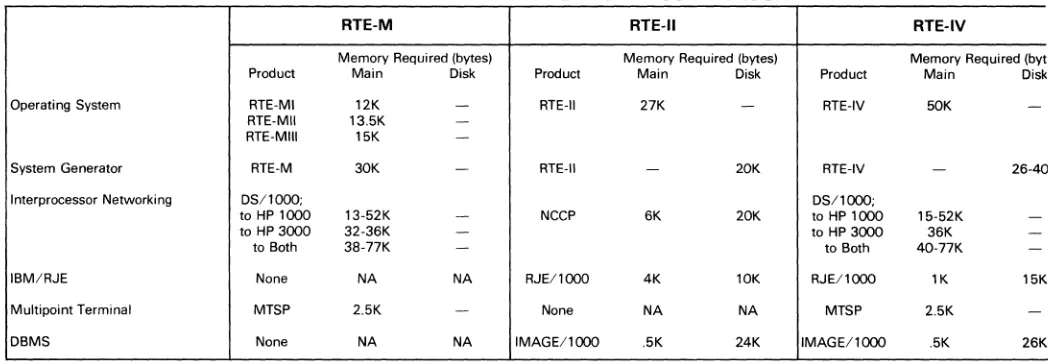
Hewlett-Packard offers several modular software and software/firmware products which afford a variety of communications and networking capabilities to the HP 1000 Series. These include DS/IOOO-IV, the networking product for all current RTE systems; NCCP, an older communi-cations product for RTE-II systems; RTE/lOOO, which offers IBM-compatible RJE communications for disk-based HP 1000 systems, the Multipoint Terminal Subsystem Software, and Data Link.
• 91750A DISTRIBUTED SYSTEM/IOOO-IV (DS/IOOO-IV): This product consists of software providing an integfllted set of high-level network facilities and procedures. These include network resource-sharing, distributed file management, communication between application programs (program-to-program data
ex-change), and coordinated distribution of processor workloads to other HP 1000 computers or systems and/ or HP 3000 Series 40, 44, and 64 or the older Series II, III, 30,. and 33 systems.
DS/IOOO-IV features network-wide nodal addressing with store-and-forward communications for maximum configuration flexibility, intelligent microprocessor-controlled interfaces offioading the CPU, remote system generation and remote program development and testing between HP 1000 systems, remote command processing between any two HP 1000 network nodes (even nodes that are not directly connected except through an intervening HP 1000 node), L-Series remote front panel, and HP 1000 virtual terminal capability with respect to HP 3000 Series II, III, 30, 33, 40, 44, and 64 systems.
The DS/IOOO-IV software in each system, or network node, consists of several layers. The Network Service Intrinsics (NSI/lOOO) are called by the user's application .programs or operator commands to generate the transaction format for master requests to remote nodes, with data as required. DS/IOOO-IV operates under all HP 1000 processors running current operating systems. The Network Interface Monitors (NIM/IOOO) process incoming master requests received from the Communi-cations Management software (CM/IOOO) and link them as required to the user's slave programs, file management routines, or the RTE exec. The CM/lOOO layer routes network transactions, queues them, and manages the local system resources necessary for network communications. CM/lOOO also manages the store-and-forward operations. The CM/lOOO layer communicates with the interface hardware, which may be several hard-wired and/ or modem interface cards, via the Communications Access Method/1000 (CAM/IOOO) software and firmware. CAM/lOOO provides a line protocol for the control of communications input and output, including error detection and correction by retranmission. The lower layers are managed by software, firmware, and hardware so as to be completely transparent to the user. Changes to these layers of the network can be made with little or no effect on the .user's application programs.
For HP 1000 to HP 3000 communications, the CM/IOOO layer includes translators for conversion of HP 1000 requests and replies to/from DS/3000 format. The CM/IOOO software does not provide for nodal addressing or store-and-forward operation to/from the HP 3000. CAM/IOOO for HP 1000 to HP 3000 communication is a software-only synchronous line controller.
• 91780A RJE/lOOO: This software/hardware package enables an HP 1000 E, F, and M Series computer system to communicate with mM 360/370 batch-oriented com-puters in a manner similar to an IBM 2780 Data Transmission Terminal. However, RJE/1000 does not support these IBM 2780 features: terminal identification, multipoint operation, and bell operation. RJE/lOOO is implemented under RTE-IVB and RTE-6/VM operating systems. The package can be employed in a multi-programming environment that allows concurrent program development, computation, and data acquisition while communicating with an IBM 360/370 batch system . Data is transmitted in either half- or full-duplex mode over dial-up or leased lines using Bisync protocol. Magnetic tape drives, disk drives, card readers, or CRT terminals can be used as remote job entry devices via modems at the speeds indicated in the table below. Line printers can serve as
output devices: , .
© 1982 DATAPRO RESEARCH CORPORATION, DELRAN, NJ 08075 USA REPRODUCTION PROHIBITED
(-Processors
Hewlett-Packard HP 1000
Communications Capabilities
TABLE 3. HP 1000 OPERATING SYSTEM COMPARISON*
Operating System RTE-IVE RTE-IVB RTE-6/VM RTE-L RTE-XL RTE-A.1
Minimum Memory (Bytes) Required 12BK 12BK 256K 64K 128K 128K
Maximum Main Memory (Bytes) 2M 2M 2M 512K 512K 4M
Supported
Virtual Extended Program Memory No No 1.9M bytes No No 12.6M bytes
Processors Suppoorted E, F, M E, F, M E, F L L A
Comments Execute-only - Supports up to Execute-only - Supports up to
64 users and 1.9 255 users
gigabytes of disk
'For comparison only; note that additional main memory may be required for language compilers, assemblers, utilities, device handlers, etc.
Connection and Modem Type Switched telephone network and:
Bell 201A modem Bell 201C modem Bell 208B modem Non-Bell modem Private lines and:
Bell 201B modem Bell 201C modem Bell 208A modem Bell 209A modem Non-Bell modem *Half-duplex only.
Max. Synchronous Data Rate, half- or full-duplex
2000 bps 2400 bps 4800 bps* 4800-9600 bps
2400 bps 2400 bps 4800 bps 9600 bps 4800-9600 bps
Features include EBCDIC transparency, auto turnaround, auto answer, multirecord transinission, end of media, and EBCDIC and ASCII code sets. RJE/1000 operates
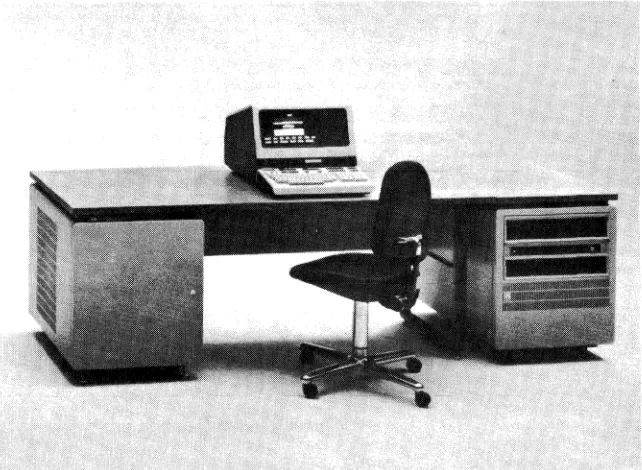
HP 1000 computers offer the versatility o/board, desktop, box, or cabinet configurations. The L-Series Model 5 is shown above.
directly with HASP in IBM operating systems using the BTAM, TCAM, or RTAM access methods. RJE/looO also operates with the HASP, RES, and JES/2 scheduler software. Also included is Trace, an off-line data link diagnostic analysis facility. Trace provides for logging communications on an RJE/IOOO link. Logging is on magnetic tape or disk for subsequent printout and analysis. The RJE/1000 hardware consists of two boards. The software is supplied on HP mini-cartridge tapes and operates on all processors except the 2105A and on all packaged systems except the Model 20 and Model 25. • 91730A MULTIPOINT TERMINAL SUBSYSTEM
SOFTWARE: This package provides mUltipoint terminal communications between HP 2624B, 2626A, 26290, 2645A, 2647A, 2648A, 2649C, 26290, and 2649G CRT Terminals and an HP 1000 E, F, and M Series computer system. Features of the package include support of single I/O channel communications with mUltiple CRT terminals on a single communications line, program development and/ or application program execution at multipoint terminals on RTE-IVB and RTE-6/VM-based systems, application program execution on RTE-IVE-based systems, computer interface block transfers up to 1000 characters long, support for up to eight 12790A Multipoint Terminal Interfaces, a multipoint master application program capability, a multipoint network status display program, command identification of mUltipoint terminals, auto-acknowledgement of data entry, group and line message broadcast capabilities, an intelligent polling algorithm, a system-level exerciser program, and a power fail restart subroutine. The 91730A software is also used for Data Link communications.
For further information, see the section on the 12790A Multipoint Terminal Subsystem Interface.
• 91731A ASYNCHRONOUS MULTIPLEXER SUB-SYSTEM SOFTWARE: This package provides multi-plexed terminal communications support for the 12920B 16-Channel Multiplexer Interface. Terminals supported are HP 2624B, 2626A, 26290, 2645A, 2647A, 2648A, 2649C, 26490, and 2649G. The 91731A may only be used with E, F, or M Series processors and may not be used with the RTE-6/VM operating system.
• 91751A X.25 COMMUNICATIONS SOFTWARE: Provides CCITT X.25 Packet Level three support for 12075A (A and L Series) and 12250A (E, F, and M Series) X.25 Network Interfaces. Inter-vendor user level services such as program-tn-program communications or remote file access may be implemented via user developed software.
HP communications software support packages are "backward compatible" in the sense that they may be used ~
[image:9.612.69.555.77.209.2]Processors
Hewlett-Packard HP 1000
Communications capabilities
with older or "mature" interfaces. Also, older communi-cations software support packages may be upgraded to current products.
PRICING
The HP 1000 is available for purchase only. Maintenance contracts are available, and the monthly maintenance charges are included in the following price list.
Maintenance is offered through over 200 offices worldwide. The standard Basic Monthly Maintenance Charge (BMMC) contract calls for 4-hour response time within a 25-mile radius of a Hewlett-Packard office. Coverage is provided Monday through Friday, 8 a.m. to 5 p.m. Extended coverage is available in most locations. The contract also covers
automatic software and reference manual updates and service on non-reproducible system failures.
On-site installation assistance from HP is included with certain software products. Installation in the U.S. includes travel up to 100 miles from the nearest HP service facility. Assistance for other software products is provided at prevailing service rates or through phone-in consulting of comprehensive software support. Assistance is provided for RTE family operating systems, programming languages, RJE/lOOO, and DS/100D-IV network software.
Several software and system support contracts are available to the user, and vary depending on whether the software is active or inactive (mature). The Software Subscription Service is a monthly fee paid for software and manual updates. The Comprehensive Software Support fee (also monthly) includes the subscription service and HP's phone-in _
consulting service.
-HP 1000 Configuration
2177C Processor
I
I
I
I
--- - -- -,. ----1
---l
I
I
I 1 1
Memory'
I
I
Dual-I
channelI
Port I : Controller1
I 1
L---t
I
I
I
I
I
I
I
I
I
:
I
Firmware Expansion Module
1---I
I
Time Base Generator
~---I
I
Systems Console
Interface f - - - to Systems Console
L _________ _
I
Cartridge DiskI Subsystem Interface f
-L _________ _
I
I
I
Peripheral Interface'
L
-I
Peripheral~
I
Interface' Ito Cartridge Disk Drive
1-42 attachments including communications lines, local attachment to computers and terminals, and other peripherals
(1) Basic system includes 10110 Bus Slots. Up to two 16 Slot 1/0 Expanders can be attached.
(2) Basic system includes 128K bytes of memory. Nine additional memory module slots permit main memory to be expanded to 2048K bytes.
© 1982 DATAPRO RESEARCH CORPORATION, DELRAN, NJ 08075 USA REPRODUCTION PROHIBITED
(
~A-Series
2186A
21868 2136A 21368 2196A 21968
2197A 21978
L-Series
2142A
21428 2103L 2122A
21228
E-Series
2178A 21788 2176C 21760
((
2109E 2113E""
F-Series2179A 21798 2177C 21770 2111F 2117F
M-Series
2108M 2112M
A-Series
12103A 121038 12103C 121030 12104A -012
L-Series
12002A 120028 -012 -011 -011
E-Series
(~/
12786A127868 12786C 127860
MAY 1982
Hewlett- Packard H P 1000
Communications Capabilities
EQUIPMENT PRICES
PROCESSORS
HP 1000 Model 6 with 128K bytes of main memory, two 5%-inch diskette drives, three I/O slots, and RTE-A.l operating system
HP 1000 Model 6 with 128K bytes of main memory, four I/O slots, and RTE-A.l operating system HP 1000 Model 6 with 128K bytes of main memory, two 5%-inch diskette drives, and four I/O slots HP 1000 Model 6 with 128K bytes of main memory, and five I/O slots
HP 1000 Model 16 with 128K bytes of main memory, RTE-A.l operating system, and 20 I/O slots HP 1000 Model 16 with 128K bytes of main memory, RTE-A.l operating system, and 20 I/O slots
in 28.3-inch cabinet
HP 1000 Model 17 with 256K bytes of memory, and 13 I/O slots in 56-inch cabinet HP 1000 Model 17 with 256K bytes of memory, and 13 I/O slots in 23-inch cabinet
HP 1000 Model 5 with 128K bytes of main memory, two 5%-inch diskette drives, three I/O slots, and RTE-XL operating system
HP 1000 Model 5 with 128K bytes of main memory, four I/O slots, and RTE-XL operating system L-Series microcomputer with 64K bytes of main memory, and eight I/O slots
L-Series microcomputer with 64K bytes, two 5-% inch diskette drives, three 110 slots, and RTE-L operati ng system
L-Series microcomputer with 64K bytes of main memory, and five I/O channels
HP 1000 Model 60 with 256K bytes of main memory, and 11 I/O slots in 56-inch cabinet HP 1000 Model 60 with 256K bytes of memory, and 11 I/O slots in desk cabinet HP 1000 Model 40 with 128K bytes of memory, and 11 I/O slots in 56-inch cabinet HP 1000 Model 40 with 128K bytes of memory, and 11 I/O slots in desk cabinet E-Series processor with 64K bytes of main memory, and nine I/O slots E-Series processor with 128K bytes of main memory, and 141/0 slots
HP 1000 Model 65 with 256K bytes of main memory, and 10 I/O slots in 56-inch cabinet HP 1000 Model 65 with 256K bytes of main memory, and 10 I/O slots in desk cabinet HP 1000 Model 45 with 128K bytes of main memory, and 10 I/O slots in 56-inch cabinet HP 1000 Model 45 with 128K bytes of memory, and 10 I/O slots in desk cabinet F-Series processor with 64K bytes of main memory, and nine I/O slots F-Series processor with 128K bytes of main memory, and 141/0 slots
M-Series processor with 64K bytes of main memory, and nine I/O slots M-Series processor with 128K bytes of main memory, and 141/0 slots
PROCESSOR OPTIONS
128K-byte memory add-on
256K-byte memory add-on (2137A and 2197 processors only) 512K-byte memory add-on
1 M-byte memory add-on
512K-byte memory add-on (2137A and 2197 processors only) 512K-byte memory substitution instead of 128K
128K-byte memory add-on 512K-byte memory add-on
512K-byte memory substitution instead of 128K 1 28K-byte memory substitution instead of 64K 512K-byte memory substitution instead of 64K
128K-byte memory add-on 256K-byte memory add-on 512K-byte memory add-on 1 M-byte memory add-on
© 1982 DATAPRO RESEARCH CORPORATION, DELRAN, NJ 08075 USA REPRODUCTION PROHIBITED
Processors
Purchase Monthly Price Maint.
$12,000 $57
8,700 37
10,000 57
6,800 31
13,800 46
13,200 46
21,600 60
2,000 60
10,600 57
8,250 38
4,675 26
8,100 48
4,750 24
23,500 172 23,500 173 42,420 276 42,420 278
10,000 79
12,000 112
32,500 189 32,500 188 53,570 301 53,570 303 16,000 123 20,000 126
8,900 74
12,000 111
1,700 4
2,500 9
4,000 16
7,000 33
6,000 25
2,500 22
2,800 17
5,000 32
2,500 15
800 9
3,000 24
3,500 49
4,900 74
7,700 124
Processors
Hewlett-Packard HP 1000
Communications Capabilities
EQUIPMENT PRICES
E and F Series
12788E 12788F 12788G 12788H
512K-byte memory add-on (64K RAM chips) 1 M-byte memory add-on (64K RAM chips) 1.5M-byte memory add-on (64K RAM chips) 2M-byte memory add-on (64K RAM chips)
E. F. and M Series
12979B 16 slot 1/0 extenders
COMMUNICATIONS EQUIPMENT
A and L Series
12040A 12044A 12007A 12005B 12072A 12828A 12075A 12042B
12082A 12073A
8-Channel Asynchronous Multiplexer HOLC Oirect Connect Interface HOLC Modem Interface Asynchronous Interface Oata Link Slave Interface RS-232-C Connection Panel X.25 Network Interface Pro9ra mmable Serial Interface
BSC Interface BSC Modem Interface
E. F. and M Series
12889A 30220A 12792A 129208 12825A 12794B 12834A 127938 12830A 12967A 12618A 12589A 12771A 12773A 12826B
12250A
HP 1000-3000 Hard-Wired Serial Interface HP 10oo-HP 3000 Cable
8-Channel Asynchronous Multiplexer 16-Channel Asynchronous Multiplexer HOLC Oirect Connect Interface HOLC Modem Interface BSC Interface 8SC Modem Interface Oata Link Slave Interface
Synchronous Communications Interface (half-duplex) Synchronous Communications Interface (full-duplex) Automatic Oialer Interface (M-Series only) OS/1000 Serial Interface
OS/1ooo Modem Interface Programmable Serial Interface
X. 25 Network Interface
TERMINAL INTERFACES*
E. F. and M Series
12966A 12968A 125878 12531C 125310 12790A
All Series
12828A
Asynchronous Interface Asynchronous Interface
Asynchronous Modem Interface (M-Series only) Teleprinter Interface
Teleprinter Interface Multipoint Interface
RS-232-C Connection Panel
'Contact vendor for A and L Series terminal interface pricing.
© 1982 DATAPRO RESEARCH CORPORATION. DELRAN. NJ 08075 USA REPRODUCTION PROHIBITED
Purchase Price
$ 7.300 12.300 17.300 22.300
6.300
2.100 2.520 2.205 1.400 630 630 2.200 2.000
2.200 2.200
790 185 2.100 2.730 2.100 1.785 1.890 1.890 1.200 840 895 790 1.260 630 1.600
1.720
735 790 735 370 370 1.575
630
Monthly Maint.
$40 58 76 94
12
12 10 14 7 6 4 9 not offered
9 9
11 nlc 11 7 9 9 8 9 5 4 8 11 16 8 not offered
9
3 4 6 3 3 8
4
MAY 1982
"
Hewlett-Packard HP 1000
Communications Capabilities
Processors
(
SOFTWARE PRICES
(
(
-~~
~ 92077A
92084A 92068A 92068E 92071A 920706 91750A 91780A 91730A 91731A 91751A
RTE-A.l operating system: for 2136 or 2156A for 2137A RTE-A. 1 execute-only:
for 2136 or 2156A for 2137A
RTE-6/VM operating system RTE-IV6 operating system RTE-IVE operating system RTE-XL operating system RTE-L operating system DS/l000-IV
RJE/l000 and two board synchronous modem interfaces Multipoint Terminal Subsystem software
Asynchronous Multiplexer Subsystem software X.25 Communications Support software
One-time Charge
$2.500 5,000
500 800
9,000 5,250 1,575 1,500 1,000 4,200 3,150 265 265 4,000
*SSS **CSS
$100 $390
100 390
15 65
15 65
110 400
100 300
30 65
55 240
55 240
30 65
20 65
15 45
15 40
30 90
'SSS is the Software Subscription Service which includes manual and software updates. "CSS is the Comprehensive Software Service which includes manual and software updates as well as telephone conSUlting .•
Processors
Hewlett-Packard HP 1000
Communications Capabilities
MANAGEMENT SUMMARY
According to information provided by Hewlett-Packard,
almost ten percent of the estimated 12,000 HP 1000
processors now in operation are employed as distributed
or nodal processors in multiprocessor networks with
other HP 1000 and HP 3000 systems. This has been
brought about as a result of the Hewlett-Packard
Distributed System Network (DSN); the architecture
first announced by HP years ago, but implemented
only recently as a result of enhanced operating and
networking software releases.
Since its introduction in May 1974, the HP 1000
proc-essor (then called the HP 21MX) has been progressively
enhanced with expanded peripheral offerings and new
frrmware/hardware features. The 1000 F-Series processor
is not only Hewlett-Packard's latest introduction, but
also its most sophisticated. It brings the HP 1000
proc-essor family up to 14 products built around the 1000
M-Series, 1000 E-Series, and 1000 F-Series processors.
HP originally introduced two 21MX models, the 210SA
and the 2108M; these are now part of the 1000 M-Series.
1>
The 211IF (top) and the 21I7F are the most advanced HP 1000 processors yet to be offered, and the only current members of the HP 1000 F-Series. The 21I7F is also the basic processor in the Models 25 and 45 packaged systems.
A family of minicomputers which, when configured with the appropriate hardware and software components, serve as the building blocks for HP's Distributed Systems Network (DSN). An HP 1000 may control its own terminal network, may be configured in a network with multiple other HP 1000's, or may be employed as a distributed proc-essor to a remote IBM 360/370.
Available networking software supports resource sharing, program-to-program com-munications, remote file access/transfer, and even store-and-forward message switch-ing in a network of HP 1000 nodes. Asyn-chronous and synAsyn-chronous transmission (including BSC) is supported on switched or leased lines to 19.2K bps.
A typical HP 1000, Model E, with 128K bytes of memory, 19.6-megabyte disk sub-system, operator terminal, RT-IVoperating system, DS/1000 software, and interfaces for 16 asynchronous and two interprocessor communications lines can be purchased for $45,700. Monthly maintenance is available for $278.
CHARACTERISTICS
VENDOR: Hewlett-Packard Company, Data Systems Division, 11000 Wolfe Road, Cupertino, California 95014. Telephone (408) 257-7000.
DATE OF FIRST ANNOUNCEMENT: M-Series Models 2105 and 2108, May 1974; Model 2112, May 1975; E-Series Models 2109 and 2113, December 1975; F-Series Models 2111 and 2117, May 1978; Model 30 Packaged System, October 1976; Model 20, March 1977; Models 25, 40 and 45, May 1978.
DATE OF FIRST DELIVERY: M-Series Models 2105 and 2108, August 1974; Model 2112, October 1975; E-Series Models 2109 and 2113, September 1976; F-E-Series Models 2111 and 2117, August 1978; Model 30 Packaged System, December 1976; Models 25, 40 and 45, September 1978.
NUMBER DELIVERED TO DATE: 12,000; Over 1,260 DSN nodes.
SERVICED BY: Hewlett-Packard Company. CONFIGURATION
All the HP 1000 Series processors are mounted in standard 19-inch racks along with the operator panel and memory chassis. The packaged system models offer both an upright cabinet and a desk-mounted configuration.
Depending on the HP 1000 model, each offers a different number of I/O channel slots as standard. A maximum of ~
Processors
Hewlett-Packard
HP 1000 Communications Capabilities
TABLE 1. HP 1000 PROCESSOR MODEL COMPARISON
Standard Operating Processor Basic System Maximum System* I/O Channel System HP 1000 Model Type Main Memory (bytes) Memory (bytes) Slots Support
2105 M-Series 32K 64K 4 ATE-MI. Mil
2108 M-Series 64K 640K/1792K 9 All RTE
2109 E-Series 64K 640K/1792K 9 All RTE
2111 F-Series 64K 640K/1792K 9 All RTE
2112 M-Series 128K 1280KI2048K 14 All RTE
2113 E-Series 128K 1280KI2048K 14 All RTE
2117 F-Series 128K 1280KI2048K 14 All RTE
HP 1000 Packaged Systems**
Model 20 E-Series 64K 1280KI2048K 12 RTE-MI. Mil. Mill
(2174A. B)
Model 25 F-Series 64K 1280K 12 RTE-MI. Mil. Mill
(2175A. B)
Model 30 E-Series 64K 64K 14 RTE-II
(2170.2171.2172)
Model 40 E-Series 128K 1280KI2048K 11 RTE-IV
(2176A, B)
Model 45 F-Series 128K 1280K 11 RTE-IV
(2177A, B)
'When two figures are given. smaller amount is maximum capacity within computer; larger amount is total system with 12990B Memory Extender. "Models A are upright cabinet configurations; Models B are desk cabinet configurations and are limited to smaller amount of maximum memory. when two figures
are given.
1:>
Both models use the same CPU and differ only in
configuration. The 2112M, the third and last member
of the 1000 M-Series, was announced in May 1975 and
features a 12Y4-inch chassis that contains space for up
to 10 memory modules (l280K bytes maximum). With the
memory extender chassis, the memory capacity can go to
2048K bytes. The 2112M has slots for
14110
modules
in the basic system and can accommodate a total
Of
up
to 46
110
channels through two
110
extender chassis.
The 2109E, announced in December 1976,
is the smallest
member of the 1000 E-Series and employs the same
housing and expansion capacities as the 2108M. The
2113E is the 1000 E-Series equivalent of the 2112M,
with the same expansion possibilities; it was announced
at the same time as the 2109E. The major difference in
the memory expansion capabilities of the E Series over
the M Series is the availability of both standard and
I>
~ two 16-slot I/O extenders are allowed per processor. This yields a maximum I/O capacity of 36 slots for the 2105; 41 for the 2108, 2109 and 2111; and 46 for the 2112, 2113 and 2117. Generally speaking, each peripheral device or communications line adapter requires an I/O slot. Several of the communications interfaces require more than one, and these are specifically mentioned in the following text, and in Table 3.
These are two I/O mechanisms common to the HP 1000 Series processors; programmed I/O, and Direct Memory Access (DMA). DMA channels, such as those used for communications links to remote processors, access the host tbrougb an optional Dual-Channel Port Controller (DCPC). The DCPC contains all necessary logic to control DMA transfer for multiple devices. This arrangement avoids the need for redundant DMA control logic in each individual I/O controller. DMA data transfers, once the DCPC has been initialized by the program, proceed automatically. Programmed I/O, on the other hand, permits the computer to manipulate the data as it is transferred,
and to do other work between interrupts. . .
TABLE 2. COMPARISON OF HP 1000 PACKAGED SYSTEMS
Model 20 Model 25 Model 30 Model 40 Proc;essor Type E-Series F-Series E-Series E-Series
(Model) (2113) (2117) (2113) (2113)
Operating System Memory-based Memory-based Disk-based Disk-based
ATE-M RTE-M RTE-II RTE-IV
Memory Range (K bytes) 64-2048 64-1280 64 128-2048
Mass Storage Diskette Diskette Disk Disk
Maximum Capacity (bytes) 1028K 1028K 370M 400M
DBMS Support (lMAGE/1000) No No Yes Yes
RJE/1000 Support OS/1000 Support Basic I/O Channel Slots
Max. Expandable
Multipoint Terminal Package Support
No No Yes Yes
Yes Yes No Yes
12 12 11 11
28 28 27 27
Yes Yes No Yes
© 1979 DATAPRO RESEARCH CORPORATION. DELRAN. NJ 08075 USA REPRODUCTION PROHIBITED
Model 45
F-Series (2117)
Disk-based RTE-IV
128-1280
Disk 400M
Yes
Yes
Yes
11 27
Yes
[image:16.612.60.558.97.296.2] [image:16.612.61.547.549.752.2]