- - - -
---
-INCORPORATED
INCORPORATED
PROCEEDINGS
Karen Friedman, Editor
SIXTEENTH SEMI-ANNUAL
CRAY USER GROUP MEETING
September 30 - October 3, 1985
Hotel du Parc Montreal, Quebec Canada
Prepared for publication and printed at the National Center for Atmospheric
Research, Boulder, Colorado (NCAR).*,t
*
The National Center for Atmospheric Research is operated by the UniversityCorporation for Atmospheric Research and is sponsored by the National Science Foundation.
t
Any opinions, findings, conclusions, or recommendations expressed in thisCONTENTS
PRELIMINARY INFORMATION
Acknowledgements. • • • • • • • • • • • • • • • • •
3
CRAY User Group, Inc. Board of Directors, 1985-1986 • •
4
Members of the Program Committee. • • • •
• • • •
5
Program . . . .
6
PRESENTATIONS
Cray Corporate Report, Robert H. Ewald • • . • • • •
CRAY Software Status, Margaret A. Loftus • . • • • • •
CFT77:
CRAY's New Fortran Compiler, Karen Spackman.
Multitasking in Operating Systems, Jeffrey C. Huskamp •
CFT Compiler Optimization and CRAY X-MP Vector Performance,
Ingrid Y. Bucher, Margaret L. Simmons • • • •
NAS Kernel Benchmark Results, David H. Bailey •
SSD User Experience Session, Mostyn Lewis • •
CRAY SSD Scheduling Concerns, Ronald Kerry. • • • • • • •
SSD Experience at Boeing Computer Services,
Conrad Kimball. • • • • • • • • • • • • •
User Requirements Committee Report, Stephen Niver •
SHORT PAPERS
9
11
13
15
19
22
26
27
28
33
Some User Experience in Migrating to CFT1.14, Chris Lazou •
39
SPECIAL INTEREST COMMITTEE REPORTS
Networking and Frontends Session I, Dean W. Smith • • • • •
CRAY Integrated Support Processor Installation
Experience, Ronald Kerry • • • • • • • • • • • • • • • •
Running Multiple CRAY Stations at Chevron Oil Field
Research Co., Annabella Deck • •
Enhanced Station Messages Support, Dean Smith • • • • • •
Languages Session, Mary Zosel • • • •
CFT77 Discussion, Karen Spackman. • • •
Special Interest Group on Operations, Gary Jensen •
Computer Operations at Environment Canada, Gary Cross
FOCUS at the Los Alamos National Laboratory,
Fred Montoya. • • • • • • • • • • • • • • • •
Multitasking Performance Workshop Summary, Ann Cowley.
Multitasking the Weather, David Dent • • • • • • • • •
CMTS - A CRAY Multitasking Simulator, J.D.A. David.
Multitasking, Margaret L. Simmons • • • • • • • • • • •
The Multi-Level Data Bus Approach to Multitasking,
J.L. Owens • • • • •
Experiences with CRAY Multitasking, Eugene N. Miya,
M.S. Johnson • • • • • • • • • • • • • • • •
43
43
44
45
47
48
50
51
56
59
60
68
72
72
CONTENTS
SPECIAL INTEREST COMMITTEE REPORTS (cont.)
Multitasking, Margaret L. Simmons (cont.)
Speedup Predictions for Large Scientific Parallel
Programs on CRAY X-MP-Like Architectures, Elizabeth
Williams, Frank Bobrowicz • • • • . • . • • . • • • • .
Los Alamos National Laboratory Control Library,
F.W. Bobrowicz • • • • • • . • • • . •
Networking and Frontends Session II, Dean W. Smith.
MVS Station Status, Peter Griffiths • . • . • •
Superlink Status, Stuart Ross • • . • •
Apollo and VAX Station Status, Martin Cutts • • . . •
VM and UNIX Stations, Allen Machinski
CRAY CYBER Link Software: Product Status and
Development Plan, Wolfgang G. Kroj . •
COS Session, David Lexton •
COS Experience Panel • . • • •
Claus Hilberg .
. • • •
Conrad Kimball • • • • •
Mostyn Lewis. .
COS Interactive:
A Developer's
Perspect~ve,Bryan Koch •
OSSIC Report, David Lexton. • • • • • • • • • . • . •
Microtasking Panel Session, Mary 20sel. . • • • . . • •
Performance and Evaluation Special Interest Committee,
Mostyn Lewis • • • • • • • • • • • • . . • • • . • • •
IIO
Workshop, Mostyn Lewis • • • • • • . • • • • • • .
Benchmarking CRAY's X-MP and SSD, Christoper Holl •
Software Paging for Large Matrices on CRAY X-MP,
U. Detert • • . • • . • . • • • . •
New COS Features, Clay Kirkland • • • . • • • . • .
Customer Experience with DD-49 Disks, Mostyn Lewis ••
Report on the Graphics Session, H.E. Kulsrud • • • • . .
ADDITIONAL REPORTS
100
101
102
102
102
103
103
104
106
106
106
107
108
109
114
115
116
117
118
135
145
158
159
President's Report, M.G. Schomberg. . . • • • • • • • .
163
Incorporation of the CRAY User Group, M.G. Schomberg.
165
Report of the Vice President, H.E. Kulsrud. •
. • • .
166
Report of the Program Committee, David Lexton • • . .
167
ADDITIONAL INFORMATION
Montreal CUG Meeting Participants by Organization. • • ••
171
CUG Site Contact List • • • • • . • • . • • • • • • • •
180
Call For Papers Form. •
• • • •
• • • •
203
ACKNOWLEDGH1ENTS
Thanks go to the following persons who comprised
the Local Arrangements
Co~mittee fro~Environment
Canada:
*
Raymond Benoit - Chair
*
Betty Benwell
*
Gary Cross
*
Jean-Fransois Gagnon
*
Claude Payette
CRAY USER GROUP, INCORPORATED
BOARD OF DIRECTORS
1985 - 1986
TITLE
NAME
ORGANIZATION
President
Helene Kulsrud
IDA
Vice President
David Lexton
ULCC
Treasurer
Robert Price
Westinghouse
Secretary
Ka ren Fri edman
NCAR
Member, Board of Directors
Stephen Niver
BCS
Member, Board of Directors
Sven Sandin
SAAB-Scania AB
Members of the Program Committee
Raymond Benoi t EC
Ann Cowley NCAR
Jacqueline Goirand CIFRAM
Gary Jensen NCAR
Helene Kulsrud IDA, Chair
Mostyn Lewis CHEVRON
David Lexton ULCC
Jerry Melendez LANL
David Sadler CRI
Margaret Simmons LANL
Dean Smith ARCO
TUESDAY OCTOBER 1
8:30 Welcome
B. Attfield (EC)
8:45 Keynote
J. Connolly (NSF)
9: 15 CRI Corporate Report
B. Kasson (CRI)
9:30 CUG Report
M. Schomberg (AERE)
9:45 CUG Elections
J. Goirand (CIS!)
10:00 BREAK
10:30 Presentation of New Officers
10:35 CRI Software Report
M. Loftus (CRr)
11:00 CFT-77
K. Spackman (CRI)
11:30 CRI Directions In Networking
D. Thompson (CRI)
12:00 LUNCH
Networking
D. Smith (ARCO)
1:30
Multitasking Tutorial
R. Brickner (LANL)
3:00 BREAK
Languages
M. Zosel (LLNL)
3:30
Operations I
G. Jensen (NCAR)
PROGRAM CRAY USER GROUP, INC.
8:30 10:00 10:30 11:00 11:30 12:00 1:30 3:00 3:30
FALL 1985 MONTREAL
WEDNESDAY OCTOBER 2
Multitasking Performance A. Cowley
I (NCAR)
Operations I I
G. Jensen (NCAR)
CTSS
G. Melendez (LANL)
BREAK
Multitasking In Operating Systems
J. Huskamp ( IDA)
Microtasking Overview
M. Booth (CRI)
Synchronization Speed and Multiprocessor Per forman ce
T. Axelrod (LLNL)
LUNCH
Multitasking
Performance I I
M. Simmons (LANL)
Front Ends
D. Smith (ARCO)
Short Papers
J. Goirand (CIS!)
BREAK
COS
D. Lexton (ULCC)
Microtasking Panel
M. Zosel (LLNL)
THURSDAY OCTOBER 3
I/O
M. Lewis (Chevron)
8:30
Graphics
H. Kulsrud ( IDA)
10:00 BREAK
10:30 Effects of Compiler Optimization on X-MP
I. Bucher (LANL)
11:00 NAS Kernel Benchmark Results
D. Bailey(NASA/Ames)
11: 30 Microtasking Benchmarks at CRI
L. Kraus (CRI)
12:00 LUNCH
1:30 User Requirements Report
S. Niver (Boeing)
1:45 SSD Update Users Report
M. Lewis (Chevron)
2:00 CRAY II Performance
R. Numrich (CRI)
2:45 CRAY-2 Users Report
J. Perdue(NASA/Ames) 3:15 Next Conference
S. Niver (Boeing)
3:25 CLOSING REMARKS
3:30 BREAK/END
Cray Corporate Report
Rober·t H. Ewald
Cray Research, Inc.
Minneapolis, MN
The first three quarters of 1985 have been
very busy and productive for Cray Research,
Inc. The sections below briefly review Cray's
organization, business, and product highlights
during 1985.
ORGANIZATION
Cray continues to operate in a decentralized
manner believing that small groups of people
dedicated to a common task with limited resources
and aggressive implementation schedules work well
in the fast moving high performance computing
business. As of September 30, 1985, Cray had
about 3,000 employees distributed in the
following major functional areas:
64% - Hardware Dev., Eng.,
&
Mfg.
22% - Field Support and Marketing
10% - Software
4% - Finance, Human Resources, and Admin.
BUSINESS
Cray's 1985 business continues to be very
strong. We hope to receive at least 35 orders
for our systems during 1985. To date we have
received 28 orders including those indicated
in Tab
1e
1.Table 1
1985 Orders Thru 9-30-85
North America
International
LLNL-LCC
X-MP/48
SNLA
X-MP/24
Bell
X-MP/24
U of MN
CRAY-2
Chevron, TX X-MP/24
NASA/Lewis X-MP/24
*ORNL
X-MP/12
*Shell
X-MP/14
*DuPont
CRAY-1/A
*GA Tech.
X-MP/48
*U of IL
X-MP/48
*GD, TX
X-MP/24
ADNOC
ECMWF
EDF
ELF
MPPI
RUS
*EPFL
*Nissan
*BP
*NASA/Marshall
X-MP/48
*Fairchild, CA
CRAY-1S2000
X-MP/14
X-MP/48
X-MP/216
X-MP/12
X-MP/24
CRAY-2
CRAY-1/S2000
X-MP/11
X-MP/12
We expect to install about 30 new systems and to
reinstall several other systems during 1985. To
date, the systems shown in Table 2 have been installed during 1985.
Table 2
1985 Installations Thru 9-30-85
BCS Exxon USA Chevron,CA LANL LLNL-LCC SNLA ;"CINECA ;"Toshiba ;"Opel
North America
X-MP/24 X-MP/14 X-MP/48 X-MP/48 X-MP/48 X-MP/24
*Ford X-MP/11
*NRL X-MP/14
*Rockwell X-MP/14
*Northrop X-MP/12
;"ORNL CRAY-1/S200
*Chevron, TX X-MP/24 *Lockheed,CA X-MP/24
;',AFGWC X-MP /22
*GD X-MP/24
*U of IL X-MP/24
*Wright-Patt. X-MP/12
International
X-MP/22 X-MP/22 CRAY-1/S1000
PRODUCT HIGHLIGHTS
Two major product announcements were made during
the summer of 1985. The CRAY-2 was formally
announced in June 1985 as a four processor parallel vector computer with a 4.1 ns cycle time and 256Mw of memory.
The first CRAY-2 was installed at the Magnetic Fusion Energy Computer Center in Livermore, CA in
May 1985. The second system was shipped to
NASA's AMES Research Center in September 1985.
Table 3
X-MP Systems
MEMORY
NO. 01 IIZE 'UWI. nPE No. 01 No. 01 880 f:!QQW S<eU! tl!2 21 I!&!!S! 22.1.! I2e! !!W!!.!1
X-MP/11 1 1. MOS.16 6 2-. 32-128
X-MP/12 2. MOS.16 6 2-4 32-128
X-MP/14 4. MOS,16 6 2-4 32-128
X-MP/18 8. MOS.32 6 2-4 32-128
X-MP/24 2 4. MOS,16 8 2-4 32-128
X-MP/28 2 8. MOS,32 8 2-4 32-128
X-MP/216 2 16. MOS.32 8 2-4 32-128
X-MP/48 4 8. ECl, 32 12 4 32-128
X-MP/416 4 16.ECl.64 12 4 32-128
SUMMARY
CRAY SOFTWARE STATUS
Margaret A. Loftus
Cray Research, Inc.
Minneapolis, MN
The following software has been released since
the last User Meeting five months ago.
1.14 Nos Station
1.14 On-Line Diagnostics
1.0 VAX/UNIX Station
1.14 NOS/BE
1.14 COS/CFT BF3
May 1985
August 1985
September 1985
September 1985
September 1985
The last major software release was COS/CFT 1.14
in January 1985.
The field have experienced very few problems
with the COS 1.14, the most significant being
Cybe r
tape rel a ted. Some sites have
encountered stability problems with CFT 1.14.
As a result of these problems, we will be making
changes in CFT testing.
The following is a status of the major software
plans
in progress
1.15 will be released late 85/early 86.
CAL 2.0 to be released the end of 1985 and
will support the CRAY-1,
CRAY-1S, CRAY-1M, CRAY X-MP and CRAY-2.
Pascal 3.0 to be released the end of 1985.
Performance improvements include scalar,
vectorization via array syntax and
multi-tasking.
C under COS to also be released hy the end
of 1985. A prerelease is available today.
CFT77 (NFT) is being tested in Mendota
Heights and planned to be released by the
end of 1985/early 1986. The first release
will support the X-MP and the second
release the CRAY-2.
Results thus far have
been excellent in both performance and
stabil ity.
Cyber Station development moved to Germany.
1.15 NOS Station (dual state) to be
released 4Q85.
1.15 NOS/BE Station (dual
state) 4Q85 release dependent CDC release.
1.16 NOS Station release 2Q86 to include
interactive. The NOS/VE Station effort has
begun and targeted for 1987 release.
Superl i nk/MVS.
Superl i nk/ISP ins ta 11 ed at
a customer site in October. The Superlink/
MVS R2 to be released in 1986 and provide
interactive support. Superlink/MVS R3 to
be released in 1987 and provide full
Station support and full intergration into
SNA.
2.0 MVS Station (1.14) released 1Q86 and
include interactive.
3.0 VM Station to be released in November
and include dispose to mini disk; separate
data streams for graphics; 3375 disk
support and improved tape handling.
3.0 VAX/VMS released October with enhanced
DECnet support; VMS 4.0 is required.
2.0 Apollo Station release 1Q86 with
operator commands and control.
Microtasking for the X-MP will be included
in 1.15. A prerelease will be available
1Q86 under COS.
CFT2 - CRAY 2 Fortran compiler is based on
CFT. Development is complete and we are
now stabil izing.
Multitasking - Future microtasking support
will differ from the X-MP due to hardware
differences.
ex-os
(UNIX*)supports CRAY-1s, CRAY X-MP
and CRAY-2.
The initial release in 1Q86
will include CFT, CFT2, CFT77 , C, Pascal,
Segldr, multitasking (macro/micro on
X-MP). Some tape support on X-MP (no
label processing), batch, debuggers,
source code maintenance, SCILIB, X-MP and
CRAY-2 peripherals, large memory suppoprt,
I/O enhancements (striping, device
over-flow, performance, streaming large files)
TCP/IP (separate package available from
third party) and interactive.
We expect to pass AT&T's System V Unix
validation tests when they are available.
A subsequent release is planned for 4Q86
with SCP (Station) recovery.
In 1988 we
expect to have a common CX-OS software
product across all hardware products with
equivalent functionality to COS at that
time.
Major emphasis of CRI software over the next
three years are in the following four areas:
Multitasking
High Performance Transportable Software to
deal with future hardware architectures
Connectivity which includes enhancements
to existing and new stations, and
net-working.
CFT77: CRAY'S NEW FORTRAN COMPILER
Karen Spackman
Cray Research, Inc. Mendota Heights, Minnesota
Cray will be releasing a new FORTRAN compiler
for its machines early in 1986. The first
release will be for the CRAY X-MP under COS.
Subsequent releases will support the CRAY-2, the
CRAY X-MP under UNICOS, and the CRAY-1. We have
been working on this project for some time, and
many of you have heard it referred to by its
working name of NFT.
During 1985 the name CFT77
was selected for the release name of the
compiler. When we began this project four years
ago, we had several goals we wanted to achieve.
I will review four of the most important of
these goals.
One of our primary goals was to produce a
compiler that could be ported more easily to new
CRAY machines. At the time we started the
project, the CRAY X-MP and CRAY-2 had not yet
been announced, but we knew not only that these
machines were coming shortly but that there
would be follow-on machines in both lines. All
of these machines have to be supported as
quickly as possible with a high-quality FORTRAN
compiler that generates high-performance code.
What do we mean by portability? The definition
that we use states that portability is a measure
of the ease with which a program can be moved
from one environment to another without losing
the characteristics that made moving the program
desirable.
For us, our FORTRAN compilers must
produce high-performance generated code.
If we
lose that performance when we port the compiler,
then our compiler was not very portable either.
Compiler portability may seem to be an issue
only for the implementor, but it has an
important implication for the user as well. We
want the user's view of FORTRAN to be the same
across our machine lines; we want the same
FORTRAN IIdialect
lito be supported on all the
machines. This can best be achieved by having
the same compiler on all machines.
A second goal for the new compiler was to
incorporate some of the work in optimization
that has been done in the last several years
that we could not reasonably put into CFT.
In
particular we expected this to give us improved
Our third goal developed out of the realization
that with our new machines we were moving into
multiprocessors and that we would need to make
utilizing the multiple processors as easy as
possible for our users. Consequently one of the
goals for the new compiler was to develop a
vehicle that could be used to partition codes
automatically for multitasking. Because of the
extensive analysis that will be needed to do
this, CFT is not an appropriate vehicle.
Automatic multitasking will not be available in
the first release of CFT77, but we expect to
demonstrate the feature by the end of 1986.
Finally, we wanted to develop a basis for
future compiler development work for other
languages. Since we are making a considerable
investment in optimization and since we are
developing code generators for all of our
mainframes, we wanted to take advantage of this
work for additional languages.
In 1981 FORTRAN
was the only language we supported; since then
we have added Pascal and C as supported
languages and expect to offer additional
languages in the future. We plan to develop a
common modular compiling system out of the
CFT77 development work and use this to
implement FORTRAN 8X as well as new C and
Pascal compilers.
One requirement for the new compiler from the
beginning was that it be compatible with CFT.
There are two parts to this requirement. One
is FORTRAN source compatibility: a FORTRAN
program that works correctly with CFT should
work with CFT77. To this end, CFT77 supports
the existing CFT extensions with few
exceptions. The second part of this
requirement is relocatable compatibility:
routines compiled by CFT77 can call and be
called by routines compiled by CFT (with the
new calling sequence), and CFT77 uses the same
run-time libraries as CFT.
separate data type and placed some restrictions
on the operations that can be performed on
pointers. We think this will give the user
some additional protection from inadvertently
misusing pointers without invalidating existing
programs.
If we find that this change does
invalidate existing programs, we will change to
the eFT implementation. We expect to find this
out during beta testing since one of the beta
test sites uses pointers extensively. Finally
I want to point out that eFT77 and eFT are
different compilers and have different control
card options and compiler directives. However,
since compiler directives are embedded in the
source code, eFT77 recognizes eFT directives
that it doesn't use and prints warning messages
indicating that the directives are ignored.
eFT77 is a FORTRAN 77 compiler. We have also
added three features that we expect to be
included in the next standard. We allow
internal identifier names up to 31 characters
in length, and these may include underscores.
We have implemented a subset of the array syntax
proposed for FORTRAN 8X. This allows the user
to write expressions involving whole arrays or
sections of arrays; for the first release we
limit the use to assignment statements and do
not allow character type. We have also
implemented automatic arrays which allow an
adjustable array to be allocated on entry to a
subroutine and freed on exit.
The approach to optimization used in eFT77 is
different from that used by eFT.
eFT77 does
what is termed global optimization which means
that an entire subprogram is analyzed to
determine the control and data flow.
Scalar
optimizations are then done using the flow
information; this means that optimizations are
not applied only within basic blocks as they are
with eFT.
Further, the informa t i on ga thered for
scalar optimization is used in the vectorization
analysis and in doing register assignment.
Future development areas for eFT77 include
extending the vectorization facility and adding
an assertion capability to let the programmer
give the compiler information to aid
vectorization. Automatic partitioning for
multitasking is another area for continued
development work; we expect this capability to
1 Lecarme, Olicier, and Peyrolle-Thomas,
Marie-Claude, "Self-compiling Compilers: An
Appraisal of Their Implementation and
Multitasking in Operating Systems
Jeffrey C. Huskamp
Institute for Defense Analyses
Princeton, NJ
Abstract
There are several implementation problems in bootstrapping an existing operating system, which is written for a single processor machine, to a multiprocessor
machine with a large memory. The problems
include deciding whether to make the kernel multithreaded, implementing mUltiple
execution points (tasks) in a process, avoiding deadlock and minimizing context
switching overhead. Some possible solutions
for CRAY machines are discussed.
Key words: multiprocessing, multitasking, CRAY, supercomputer
Introduction
All four production operating systems for CRAY machines (COS[I], CTSS[2], Folklore[3] , AMOK[4]) and the announced
operating system for the CRAY-2 (UNIX
™
[5]) have ancestors that only execute
on single processor machines. The next
high performance supercomputers will provide multiple processors to speed up program
execution. Since designing, implementing,
and changing over to an entirely new
operating system that makes use of multiple
p~ocessors is a very laborious undertaking,
some of these operating systems will
probably be modified to per~it the users
access to the multiprocessing/parallel processing features of the machines.
However, incorporating multiple processors into the user interface and making use of the multiple processors inside the operating system cannot be done easily. Some of the features needed in multi-processor operating systems that are not found in single processor systems include permitting the operating system to have multiple execution threads active at one
time, pe~mitting user jobs to have more
than one execution point (i.e. multiple tasks), preventing system deadlock, and avoiding full context switches when possible
since the process state info~mation is
large and getting larger.
This paper discusses different approaches that can be taken toward solving these
problems. For a complete solution,
changing a majority of the operating
system may be necessary. When possible,
a low cost partial solution is identified that may make a full solution unnecessary.
Single Threaded Ke~nels
Most operating system kernels assume that only one processor executes in the
operating system at one time. In
boot-strapping an operating system to a
multiprocessor machine, some consideration
~ight be given to utilizing multiple
p~ocesso~s within the operating syste~.
There are at least three approaches to
this problem. The easiest approach is
to lock the entire operating system so only one processor is executing the
operating system at one time. With this
strategy, one processor could be waiting for another processor to finish its tour
through the system. If this condition
occurs frequently, processors are waiting for system calls to complete and the operating system becomes a performance
bottleneck. To obtain an estimate of
the performance degradation, a quick calculation (with many independence
assumptions) can estimate the probability that two or more processors could be executing system calls at the same time. For the calculation, the percentage of CPU time devoted to executing system calls in AMOK (=5%) will be used as an example. Assuming that the system has N processors, the probability of conflict is:
N= number of processors
S= probability of wanting to execute a system call=O.05
P= probability 2 or more processes are executing system calls
P= l-(probability that 0 or 1 processors are executing system calls)
# Processors 1 2 3 4 5 6 7 8 16 32
Conflict Probability 0.0000 0.0025 0.0073 0.0140 0.0226 0.0328 0.0444 0.0572 0.1892 0.4800
The above table suggests that for machines having four or fewer processors, the global operating system locking approach seems to not degrade performance significantly. This is consistent with observations of
CTSS on multiprocessor machines. However,
for the next generation of supercomputers that have a larger number of processors, this approach does not seem to be correct.
The next simplest possibility for taking advantage of multiple processors is to provide a shared kernel that performs the basic I/O and context switching
functions, and supports multiple operating
systems. This breaks the host
multi--processor machine into multiple guest systems with a small number of processors
in each system. If enough guest systems
are introduced, the argument for locking the entire kernel that was made above
may again be valid. This approach can
be thought of as a virtual machine
implementation. The advantage is that
different operating systems can execute at the same time (e.g. a batch system and a timesharing system) to provide
different services. The disadvantages
are that (1) more memory is devoted to the operating system, (2) the lower level kernel can be a bottleneck unless i t is reentrant, (3) an extra context switch is needed to access the shared kernel since each guest operating system must be treated with suspicion, (4) extra checking must be included in the shared kernel so system bugs from one guest system don't crash another guest system, and
(5) all system resources (e.g. memory, disk)
must be partitioned. The peripheral
partitioning also may imply that multiple copies of public files are necessary,
one for each guest system. An example
of this approach is the NLTSS [6]
development system at Livermore. In this
case, one operating system is a production system (LTSS) and the other is a devel-opment system (NLTSS).
Finally, the most expensive approach is to actually redesign the operating system to take advantage of mUltiple processors. This involves setting up tasks within
data structures. This approach
could result in less efficiently compiled code for the operating system and would crRate synchronization overhead for processors executing inside the system.
One Execution Point per Process
Perhaps the most troublesome problem in
providing support fo~ parallel processing
is permitting multiple exchange packages insidp. the process header (minus words) . The first concern is the expansion of the header by at least the amount of
storage that constitutes a process context. In AMOK on the CRAY-1, this amounts to
a minimum of 657 words per task. In
addition, descriptions of open objects
for each task consume more space. On the
CRAY-2, the 16K local memory adds more storage overhead to tasks.
With one task per process, all execution in the process stops when a system call
is issued. That is, the user exchange
package is waiting for the system call
processing to complete. In parallel
processing, other tasks in the process may be active and can cause system call
implementations that work in single
processor systems to fail. For example,
trying to terminate all tasks within a process can be adventuresome since some tasks may be issuing system calls that take a long time to complete or may be erroneously spawning other tasks.
Certainly logic must be added to make sure all tasks are moving toward termination at the same time.
The system call interface must be expanded to enable task creation and task deletion. Other system calls, such as suspend pro-cess, must be extended to include tasks. This also implies that the scheduler must be modified to service these tasks.
If these changes are troublesome, perhaps an implementation which pushes some of the implementation into the user space would
be better. For example, the CTSS approach
puts task creation and deletion into user library routines [7].
Another alternative is to adapt a UNIX-like system that thrives on many small processes but does not support mUltiple execution
points within one process. Allocating
multiple CPU's in this situation is
straightforward. However, to avoid idle
CPU's, the number of jobs in the queue must at least equal the number of physical
CPU's. This will makp. the throughput of
the machine look good, but will not help
will be required. This may not be the correct path to take since compatibility problems may be created with other versions of UNIX.
Errors in Multithreaded Systems
One of the most feared problems in
multi-processor systems is system deadlock. The
problem occurs when two or more processors that are executing inside the operating system try to reserve the same objects but
in a different order. To eliminate this
problem, all execution paths of the operating system must be checked for the possibility of mUltiple object reservations,
which is a time-consuming procedure. One
fact that helps the problem is that the large majority of s stem calls usually only need; to reserve one object at a time. Thus many execution sequences do not need
to be analyzed. For example, directory
calls such as create, open and delete only need to reserve the directory to be
modified. In AMOK, system calls such as
initiate process and terminate process have the potential to reserve more than one process so these execution paths must be scrutinized.
To reduce the number of system tables and/or system table entries that must be locked, some of the operating system can be structured so that only one processor executes within a certain subsystem at a
time. Three subsystems that might be
handled this way are the memory manager, the network manager and the operator
console manager. Since these subsystems
are most easily programmed as single
processor tasks and are crucial for correct system performance, locking these sub-systems at a very high level seems
accep-table. This utilizes the message-system
approach to structuring an operating system [8] as opposed to the
procedure-oriented approach. Thus there appear to
be some operating system functions that can have a very coarse grain of protection
(and can be more easily programmed) and some that must have very fine-grained protection.
Context Switch Time
For jobs that request a large number of system functions per CPU second, context switching can represent a significant
amount of overhead. This is particularly
true if the B, T and V registers must be
saved. Two mechanisms contained in current
operating systems can help reduce this
overhead. The simplest mechanism permits
more than one system call to be issued with one context switch to the operating
system. One implementation is done by
speed up tape processing by reading or writing mUltiple records per context
switch. On AMOK, some non-standard
arithmetic/logical and conditional branch-ing system calls have been implemented so that simple functions can be computed without exchanging back to the user
process. This is useful in loop control
and in termination condition testing. This makes system calls resemble assembly
language programs. The system calls take
the same amount of time as a round-trip context switch from the user process to
the operating system and back. Thus
system call programs with simple loop control can execute faster than issuing
single system calls. This optimization is
widely used by user support routines as evidenced by the system-wide average of
four system calls executed per exchange to
the system. Unfortunately, the standard
UNIX system does not permit more than one system call to be issued per context
switch. It would also seem unwise to
modify this basic part of the UNIX user interface in attempts to speed up the system.
The more complex mechanism is the imple-mentation of lightweight tasks within a process by code executing within the
process. For user level lightweight tasks,
the operating system does not know there
are multiple tasks in the process. This
means that task scheduling, task dispatch-ing and context switchdispatch-ing are done by the
process itself. Lightweight tasks have
been implemented for NLTSS servers and for
the AMOK operating system. As an example
of lightweight tasks, the AMOK implemen-tation will be discussed in slightly more detail.
When an
AMOK
system task wants totempo-rarily give up control of the CPU, i t calls the procedure STKSLEEP, which saves the contents of register B02 in variable
STKINFO for the task. In the CRAY calling
sequence, B02 points to the register save area for the procedure that called
STKSLEEP. The scheduler task is then
awakened to dispatch another task. To
awaken a task, STKWAKE restores B77, BOO,
BOl, B02, B66 and B67 from the register
save area pointed to by STKINFO for the
task. This restores the registers to the
correct state for returning to the
pro-cedure that called STKSLEEP. The transfer
of control is accomplished by a non-local jump (not a normal procedure return)
implemented in assembly language. The
procedure that called STKSLEEP thinks that a normal return from STKSLEEP has occurred and resumes its execution.
be saved and, for user level tasks, an exchange to the operating sytem for
scheduling is not needed. The disadvantage
is that an infinite loop in one task may disable the entire process.
Summary
The four problem areas discussed in this paper are prime areas of concern when existing operating systems for single processor machines are bootstrapped to
multiprocessor machines. The approaches
suggested here are extensions of current efforts being made to attack these
problems. Hopefully some of these concerns
will be addressed in the Unix imple-mentation underway at CRI.
REFERENCES:
[1] Cray Research, Inc., "CRAY-OS (COS) Version 1 Reference Manual", SR-0011, Revision N, (to appear) .
[2] Fong, K., "The NMFECC Cray Time-Sharing System", Software Practice and Experience, 15 (1), 87-103 (January 1985).
[3] Santavicca, T., "Folklore - Delivering Supercomputing", Proceedings of the Conference on Operating Systems for Supercomputers, Princeton, New Jersey
(June 1984).
[4] Huskamp, J.C., "A Modular Operating System for the CRAY-1", (to appear).
[5] Ritchie, D.M. and K. Thompson, "The UNIX Time-Sharing System", Comm. Assoc. Compo Mach., 17 (7), 365-375
(July 1974).
[6] Donnelley, J., "Components of a Network Operating System", Computer Networks, 3, 389-399 (1979).
[7] Long, G., "Status of CRAY-2 Software at MFE" , Proceedings of the Conference on Operating Systems for Supercomputers, Princeton, New Jersey, (June 1984).
CFT COMPILER OPTIMIZATION AND CRA Y X-MP VECfOR PERFORMANCE
Ingrid Y. Bucher and Margaret L. Simmons
Los Alamos National Laboratory Los Alamos, New Mexico
INTRODucnON
The motivation for this paper was the observation that Cray X-MP vector performance has not always evolved in
the expected direction of improvement. It is well known
that vector performance of register-to-register vector computers is strongly compiler dependent. The compiler is
responsible for proper sequencing of vector load,
arithmetic, and store operations, and for scheduling necessary scalar operations in such a way that they take place while vector operations are in progress and therefore do not consume any additional time. We have analyzed vector performance data for CFT compiler versions 1.10 through 1.14. It is concluded that in spite of the great performance improvements achieved by version 1.14 of CFT, further speedups are possible by eliminating the slowdowns introduced in version 1.11.
MODEL OF CRA Y VECTOR PERFORMANCE
Based on the well known fact that Cray vector operations are "stripmined" in sections of 64, the time required to
perform arithmetic operations on vectors of length N is
given by
where the brackets
I
~
I
denote the next integer greater than or equal to N /64, and where TSlarlout is the startuptime for the outer loop processing the strips, TSlarlSlrip the
startup time for each strip of length 64, and Telement the
time required to produce one result element. Equation (1)
represents a linear step function as represented in Fig. 1, with the height of each step equal to the startup time of each 64-strip. In reality, there is a small overshoot associated with the startup of each 64-strip (see Fig. 2). This is due to the fact that for vector instructions with very short vector lengths some necessary scalar work is incom pletely overlapped.
The points for N equal to multiples of 64 lie on a straight line represented by
This line intersects the T -axis at T = TSlartoul. Assummg Telement is known (typically a small multiple of the cycle
time), Tstartslrip can be determined from the slope of the
line. This method of determining startup times is more accurate than examining the measured height of the steps because of the overshoots.
RESULTS OF VECfOR PERFORMANCE MEASUREMENTS AND THEIR INTERPRETATION
Execution times for typical vector operations were measured by timing 106 floating point operations for each
vector length. A straightforward double loop was used, with the inner loop index running from one through the vector length N , and the outer loop index running from 1
through 106/N. Because of the many repetitions of the
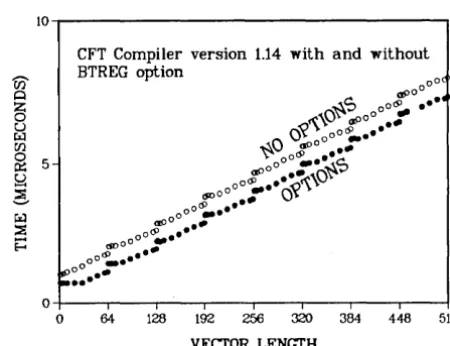
outer loop, its startup time does not significantly distort the results. The time required for the timing function calls (CPUTIME under CTSS, SECOND under COS) was subtracted. Typical MFLOP rates for stride one measured for compiler versions 1.10,1.11,1.13, and 1.14 are presented in Table I for three vector lengths of N = 10. 100.00. Although CFT 1.14 shows a dramatic performance increase for short vectors with optimization options enabled (BTREGS, FULLIFCON, FULLDOREP) the rate for long vectors is lower than for CFT 1.10. Without optimization options, measured rates for CFT versions 1.11 through 1.14 are nearly the same and lower than those for 1.10 for all vector lengths. Figure 2 shows results for a simple vector multiply operation for CFT 1.14 with and without optimization options. The figure demonstrates that the optimizations reduce the startup time of the outer stripmine loop (zero intercept) considerably, while the startup time of each 64-strip (height of each step) remains unchanged.
Table II contains results for element times Telement , 64-strip
startup times Tstarlstrip , and outer stripmine loop startup
times TSlarlout for the simple vector operations listed in
column one. These data were obtained by measuring vector execution times for vector lengths equal to
multiples of 64 (up to 512) and performing a least squares fit to the data pOints according to Eq. (2).
by about 50% between CFT versions 1.10 and 1.11 and a decrease in the startup time of the outer stripmine loop by about a factor of four in introducing optimization options in CFT 1.14. Typical startup times for each 64-strip are 20 cycles with CFT 1.10 and 30 cycles thereafter. For the outer stripmine loop, startup times have been reduced from 110 cycles (with CFT 1.10) to about 25 cycles (with
CFT 1.14 with options). It is noteworthy that the startup
time of the 64 strips has to be added to that of the stripmine loop for short vectors at least once even if the vector length N ~ 64 and several times if N > 64. Thus a decrease in this time improves short as well as long vector performance. The question arises naturally whether we cannot have both short startup times for strips as well as stri pmine loops.
We have examined code produced by the CFT compiler versions 1.10 and 1.14 for many loops. As an example, we present characteristics of the compiled code in Fig. 3 for a frequently encountered vector operation
where all V 's denote distinct vectors, all S 's distinct scalar operands. It can be seen that while CFT 1.10 uses a simple-minded approach to fetch operands as they are needed for the operations, CFT 1.14 prefetches as many vector operands as possible. This approach may work well for the 1 (SAXPY now chains for the first time in Cray-1 history without hand coding), however, it is less efficient for the Cray X-MP with its multiple data paths. The philosophy results in additional non-overlapped startup times for fetches (plus associated non-overlapped A-register loads) and in some cases in delays due to lack of free V-registers. The X-MP has enough memory paths to supply its functional units with two operands on the fly; they do not need more. In addition fetches and operations chain. The most effective way of programming this machine is the ref ore the simpleminded approach used in CFT 1.10. The authors do not see any reason why this approach cannot be combined with the use of Band T registers to reduce startup times for the outer stripmine loops as demonstrated by CFT 1.14 so effectively.
CONCLUSIONS
Between CFT versions 1.10 and 1.11, a significant increase in 64-vector strip startup times has occurred. While CFT version 1.14 has reduced startup times for outer stripmine loops and thereby dramatically increased short vector performance, further improvements are achievable by eliminating the slowdowns introduced in CFT 1.11. This may necessitate different approaches to the scheduling of vector instructions for different computers in the Cray family.
VECTOR LENGTH
Figure 1. Plot of step function represented by Eq. (1).
10,---,
04---~----._--_.--_.----._--_r----._--~
o 64 128 192 256 320 384 448 512
VECTOR LENGTH
Figure 2. Measured execution times for simple multiplication in vector mode as a function of vector length.
CFT 1.10 CFT 1.14
Load Load
Multiply Load
Load Multiply
Multiply Load
Add Load
Load Multiply
Multiply Add
Add Load
[image:23.617.310.533.58.228.2] [image:23.617.310.535.276.449.2]TABLE I
MEASURED RATES FOR SIMPLE VECTOR LOOPS IN MFLOPS
Stride = 1 CFT 1.14 CFT 1.14 CFT 1.13 CFT 1.13 CFT 1.11 CFT 1.10 Options No Options Options No Options No Options No Options
Vector Length
=
10v = v * v 14 9 14 9 8 9
v=v+s* v 25 15 26 16 15 16
v=s* v+s* v 30 20 33 21 22 21
v=v* v+v* v 32 21 33 21 22 21
Vector Length
=
100v=v*v 64 42 58 43 40 46
v=v+s* v 120 80 117 81 81 82
v=s* v+s* v 110 84 110 85 91 92
v=v* v+v* v 102 84 102 84 87 90
Vector Length
=
00v = v * v 72 72 72 72 67 80
v=v+s* v 145 145 145 145 144 160
v=s* v+s* v 124 124 124 124 140 140
v=v* v+v* v 116 116 115 115 131 135
TABLE II
START-UP AND RESULT ELEMENT TIMES FOR SIMPLE VECTOR OPERATIONS
Stride = 1
Times in Nanoseconds
CFT 1.14 (Options) CFT 1.14 (No Options) CFT 1.13 (Options)
Telment Tstartstrip Tstartout Telement Tstartstrip Tstartout Telement Tstartstrtp T startout
v=v+s 9.5 203 177 9.5 203 978 9.5 205 174 v = v * s 9.5 204 186 9.5 202 990 9.5 204 196 v=v+v 9.5 251 177 9.5 251 849 9.5 249 186 v = v * v 9.5 280 293 9.5 279 913 9.5 284 240 v=v+s* v 9.5 264 276 9.5 266 1082 9.5 275 263 v=v* v+s 9.5 288 269 9.5 286 1095 9.5 294 273 v=v* v+v 14.2 304 460 14.2 283 1121 14.2 281 456 v=s*v+s*v 19.0 331 199 19.0 332 1036 19.0 329 207 v=v* v+v* v 19.0 442 224 19.0 444 839 19.0 449 197
CFT 1.13 (No Options) CFT 1.11 CFT 1.10
Telment Tstartstrip Tstartout Telement Tstartstrip Tstartout Telement Tstartstrip Tstartout
NAS KERNEL BENCHMARK RESULTS
David H. Bailey
Informatics General Corp. / NASA Ames Research Center
Moffett Field, California
Abstract
The N AS Kernel Benchmark Program, developed by the NAS (Numerical Ae:(odynamic Simulation) Projects Office to assist in supercomputer performance evaluation, has now been run on a number of currently available sys-tems. This report briefly describes the benchmark pro-gram and lists the performance figures that are now avail-able. Analysis and interpretation of the results are in-cluded.
Introduction
A benchmark test program has been developed for use by the N AS program at the NASA Ames Research Center to aid in the evaluation of supercomputer perfor-mance. This Fortran program consists of seven sections (referred to in this paper as kernels), each of which
per-forms calculations typical of NASA Ames supercomput-ing. It is designed to provide a realistic projection of the supercomputer performance that can be expected on ac-tual user codes.
The N AS Kernel Benchmark Program will not be scribed here in exhaustive detail. A more extensive de-scription of the program, including a listing of the actual Fortran code, may be found in [1]. These seven test ker-nels were chosen from actual user codes currently being run on NASA Ames supercomputers and were included in the benchmark program with only minor changes from these user codes. All of the kernels emphasize the vector performance of a supercomputer - over 99% of the floating point calculations are contained in DO loops that are at least potentially vectorizable, provided the hardware of the computer includes the necessary vector instructions and provided the compiler being used is sufficiently so-phisticated in its vectorization analysis. All floating point computations in the seven kernels must be performed with 64-bit precision (at least 47 mantissa bits).
Substantial care was exercised in the selection of these kernels to insure that none of them had any features that unduly favored any particular supercomputer design. The subroutines selected are all straightforward Fortran code, intelligently written for vector computation but otherwise
to select a variety of calculations and memory operations. Some of the kernels contain vector memory accesses with only unit stride, while others have large strides. (The term stride refers to the memory increment between
suc-cessive words stored or fetched from an array. For a real array indexed by the first dimension in a DO loop, the stride is one. For a real array indexed by the second di-mension, the stride is equal to the first dimension.) Some contain loops with very long vectors (as high as 1000), while others contain loops with shorter vectors (the short-est in a time-intensive loop is 28). A brief description of each kernel is as follows:
1. MXM - Performs an "outer product" matrix mul-tiply.
2. CFFT2D - Performs a two dimensional complex Fast Fourier Transform.
3. CHOLSKY - Performs a vector Cholesky decom-position.
4. BTRIX - Performs a vector block tridiagonal ma-trix solution.
5. GMTRY - Sets up arrays for a vortex method so-lution and performs Gaussian elimination on the resulting array.
6. EMIT - Creates new vortices according to certain boundary conditions.
7. VPENT A - Simultaneously inverts three matrix pentadiagonals in a manner conducive to vector processing.
Results
in-COMPUTER/ NO. TUN- KERNELS COMPo
COMPILER CPUs ING 1 2 3 4 5 6 7 RATE
Cray X-MP /12 1 0 131.0 30.2 36.0 71.4 5.2 74.5 21.5 24.5 CFT 1.13
Cray X-MP /12 1 20 131.0 82.8 51.6 71.6 102.0 107.4 112.5 88.2 CFT 1.13
Cray X-MP/12 1 0 130.7 30.7 35.3 71.6 50.1 82.0 21.6 43.9 CFT 1.14
Cray X-MP /12 1 20 130.8 82.0 50.4 71.5 110.3 97.7 116.4 87.7 CFT 1.14
Cray X-MP /22 1 0 136.5 45.7 47.0 73.8 65.1 81.4 37.1 59.9 CFT 1.14
Cray X-MP /22 1 20 133.7 89.3 60.5 77.2 118.2 97.6 115.5 94.4 CFT 1.14
Cray X-MP /48 1 0 136.0 45.9 59.8 82.3 95.5 84.1 30.5 61.9 CFT 1.14
Cray X-MP/48 1 20 136.0 85.2 66.7 79.6 115.5 103.0 124.1 96.4 CFT 1.14
Cray X-MP /22 2 20 272.0 175.3 112.0 141.2 219.4 193.2 238.6 182.1 CFT 1.14
Cray X-MP /48 4 20 536.8 330.9 205.0 273.3 395.3 396.6 483.9 349.1 CFT 1.14
CDC 205 1 0 128.0 12.7 5.5 10.8 3.2 5.9 10.8 8.9 F200PRI
CDC 205 1 0 116.6 12.5 24.2 8.0 21.3 61.1 9.4 16.1 VAST 1.21
CDC 205 1 20 129.S 49.5 10S.4 14.5 72.1 76.9 52.S 44.7 VAST 1.21
CDC 205 1 50 127.8 57.4 10S.3 135.7 75.0 76.2 67.4 82.9 VAST 1.21
Amdahl 1200 1 0 465.1 11.1 42.2 8S.5 3S.3 214.5 7.3 22.4 VI0LlO
Amdahl 1200 1 20 497.2 106.0 95.6 88.0 127.5 214.9 202.3 139.1 VIOLIO
Amdahl 1200 1 50 500.9 106.5 96.1 91.3 127.4 220.5 202.4 140.8 VIOL 10
Amdahl 1200 1 unlm 499.2 162.1 96.7 124.5 150.9 219.4 232.2 174.7 VIOLIO
ited lines changed out of approximately 1000 total lines). The columns numbered 1 to 7 give the rates on the in-dividual kernels, and the column headed COMPo RATE gives the composite MFLOPS rate. The composite rate is the total floating point operations performed in the seven kernels divided by the total of the seven CPU times.
Notes
Figures for more than 20 lines of tuning on the Cray X-MP computers are not shown because the rates listed for 20-line tuning are close to the maximum attainable level. The uniprocessor Cray X-MP /22 and X-MP /48 rates, especially the untuned figures, are slightly higher than the X-MP /12 rates because the X-MP /12 has slower memory chips and fewer memory banks than the multi-processor models. The figures listed in the box for two CPUs on the Cray MP /22 and for four CPUs on the X-MP / 48 are the result of running the N AS Kernel Bench-mark Program simultaneously on each processor. These runs thus represent the total system throughput that can be expected in a multiprogramming environment. These runs do not represent multitasking, because multitask-ing means modifymultitask-ing a code so that separate parts of the computation run on separate processors, and the individ-ual parts are coordinated.
In
these two cases the entire program was run on each processor without coordination, so they do not qualify as multitasking runs in any sense. However, they do provide a good estimate of the wallclock speedup that could be achieved if true multitask process-ing were invoked. Note that these figures are only 1.93 times and 3.62 times as high as the corresponding unipro-cessor results. Memory bank contention prevents these rates from achieving a full two or four times speedup.No tuned code figures are listed for the CDC 20S with the standard F200 compiler. This is because significant improvement in the performance figures would require uti-lizing the CDC Fortran explicit vector constructs, which are not allowed for this test because they are not standard ANSI Fortran. Using these explicit vector constructs and some other tuning, a composite performance rate of 84.1 MFLOPS was achieved, which is close to the SO-line tun-ing figure listed above for the CDC 20S with the VAST Fortran processor. According to CDC personnel, within a few months a new Fortran processor, based on vectoriza-tion techniques pioneered by Prof. Kuck of the University of illinois, will be available for use on the CDC 20S. This processor will likely yield higher performance figures than the VAST processor figures cited above.
The figures shown for unlimited tuning on the Am-dahl 1200 Vector Processor system are actually based on approximately 400 lines changed. The Amdahl represen-tative who performed this tuning is convinced that some further improvement in the composite rate is possible with additional revision of the code.
incorporated for the final runs. Tuning for the CDC and Amdahl runs was performed by their own benchmark per-sonnel with input from the author.
Analysis
The most striking aspect of the above table of figures is the great variance of the rates on the same kernel. Even on the same computer the rates vary dramatically. This spread indicates that even minor tuning can sharply im-prove execution speeds, and that an effective compiler is a critical part of system performance.
The most common tuning technique employed on the various systems was to change the dimensions of arrays in order to avoid the disadvantageous memory strides that result when arrays are indexed by other than the first dimension. For example, the dimension of one array in kernel seven was changed from (128,128) to (129,128) for both the Amdahl and the Cray tuned code runs. This change alone increased the performance rate of kernel number seven by a factor of 27 on the Amdahl 1200 and by a factor of S on the Cray X-MP /12. The second most commonly applied tuning technique was the insertion of compiler directives to force vectorization of DO loops. Most of the other tuning consisted of code revisions to avoid certain constructs that were not handled well by the system.
The process of tuning the code on the various ma-chines disclosed several weaknesses of the various Fortran compilers. For example, one key DO loop in kernel five calls the complex exponential function. The Cray CFT 1.13 compiler vectorized this loop, but the vector ver-sion of the complex exponential function was merely a loop that iteratively called the scalar complex exponen-tial function. As a result of this fact and the failure of the compiler to vectorize one other key DO loop, the untuned performance rate on this kernel was only S.2 MFLOPS on the Cray X-MP /12. The difficulty with the complex exponential function was overcome in tuning by defining an inline version of the function at the beginning of the subroutine, as follows:
CEXP(Z)
=
EXP(REAL(Z»
*
S
CNPLX(COS(AIMAG(Z»,SIN(AIMAG(Z»)
This change, together with an altered dimension and a compiler directive, increased the performance rate on this kernel by a factor of 20. Both of the above mentioned shortcomings were rectified in the CFT 1.14 compiler.Another feature of both CFT 1.13 and 1.14 discovered in the process of tuning is their failure to vectorize simple complex summation loops:
COMPLEX X(50) , Z
Z = (0., 0.)
DO
100
I=
1,50
Coincidentally, the loop mentioned above with the complex exponential reference also proved troublesome to the Amdahl compiler, although for a different reason. The loop contained the line
ZZ
=
ZI - 1.
I
ZI
where each variable is of type complex. The compiler failed to vectorize this statement, and as a result the per-formance rate on kernel five was significantly reduced. For the minor tuning test this statement was rewritten using the complex constant (1., 0.). The statement was then correctly vectorized by the Amdahl compiler.
Except for the above mentioned details, both the Am-dahl and the Cray compilers display a high level of so-phistication. For instance, the CFT 1.14 compiler now includes a "conditional vectorization" feature. If the com-piler cannot determine at compile time whether or not a recursive dependency exists in a DO loop, then the com-piler generates both a scalar and a vector version of the loop, complete with an execution time test for safe vector-ization. The Amdahl compiler appears to be even more sophisticated than the CFT compilers. It attempts to vectorize not only inner DO loops but also outer loops if conditions permit.
In
addition, if part of a DO loop resists vectorization, the Amdahl compiler vectorizes the rest, whereas the Cray eFT compilers generally vectorize a loop only if all statements within the loop are vector-izable. Another area where the Amdahl compiler seems to outperform the Cray compilers is in the vectorization of IF statements. CFT 1.13 vectorizes some IF state-ments if a certain option is specified, but only CFT 1.14 can vectorize IF... THEN... ELSE constructs. The Amdahl compiler vectorizes both of these constructs and even some IF ... GOTO statements, such as loops that search for the first occurrence of a given value in an array.Conclusions
The three supercomputers tested have achieved high performance figures on the N AS Kernel Benchmark Pro-gram. The highest composite rate, 349.1 MFLOPS, was achieved by the Cray X-MP/48, which is to be expected since this was a four processor run. However, it should again be emphasized that this result is not true multi-tasking - the benchmark program was run simultaneously on each processor, and the results were added. Thus these results should be considered to be a measure of the overall system throughput capacity of the machine rather than the execution speed of a single job. A user could achieve comparable rates on a single job only by making the changes necessary to invoke true multitasking.
Comparing uniprocessor figures, the rates were closer, with all three systems achieving in the neighborhood of 100 MFLOPS on tuned code. Since each of the three systems has claim to the highest rate on at least one of the seven kernels, it is hard to make absolute statements about the relative performances of these systems.
How-The Cray X-MP computers with the new CFT 1.14 compiler achieved impressive untuned performance fig-ures, significantly higher than untuned figures on the other systems (considerably higher even than CFT 1.13). The Amdahl 1200, on the other hand, achieved very high rates on many of the kernels with some tuning, although the overall untuned performance was not spectacular. This is mostly due to the fact that the Amdahl machine is more sensitive to disadvantageous memory strides than is the Cray X-MP system. The CDC 205 is clearly capa-ble of high performance rates (it had the highest rate of the three systems on kernel four), but it seems to require more tuning to achieve these rates. One reason that extra tuning is required is that the CDe Fortran compiler is ap-parently not as advanced as the compilers available on the other systems. This situation may be rectified with the introduction of more· powerful Fortran processors on the CDC /ETA computers. Another factor in the CDC rates is the long startup times for vector operations. As a re-sult, codes with vector lengths less than about 70 usually require revision (such as combining an inner loop and an outer loop into one loop) before the performance reaches its full potential.
The level of tuning that is the most appropriate for comparison depends on the nature of the supercomput-ing application. For a research and development appli-cation, the minor tuning figures may be the most impor-tant. Programmers in such environments usually apply some optimization techniques in their programs, but they seldom have time to perform massive tuning, especially on a code that is being continually revised. On the other hand, the major tuning or unlimited tuning figures might be more appropriate for a production computation appli-cation, where a single code might be used on a daily basis for years, and a large investment in optimization would be worthwhile over the long run.
Using the minor tuning figures (with the best avail-able compiler) as a standard, it appears that the Am-dahl 1200 Vector Processor has the highest uniprocessor performance rate, with about 1.5 times the Cray X-MP uniprocessor rates and about three times the CDC 205 rate. If major tuning is allowed, then the CDC figures are improved to nearly the Cray X-MP level, but the Amdahl figures are still about 1.5 times faster than the X-MP or the 205. If we consider the total system throughput with the minor tuning figures, then the Cray X-MP/48 is clearly the winner with about 2.5 times the throughput of the Amdahl. Similarly, the Cray X-MP /22 would likely achieve about 30 percent higher throughput than the Am-dahl, although this comparison is closer if major tuning is permitted. These results must be considered tentative, since they could change overnight with the introduction of a more powerful version of the Fortran compiler on any of these systems.
Reference