R E S E A R C H
Open Access
A randomized controlled trial of the effect
of supervised progressive cross-continuum
strength training and protein
supplementation in older medical patients:
the STAND-Cph trial
Mette Merete Pedersen
1*, Janne Petersen
1,2,3, Nina Beyer
4,5, Helle Gybel-Juul Larsen
1,5, Pia Søe Jensen
1,6,
Ove Andersen
1,5,7, Thomas Bandholm
1,8,6and on behalf of the STAND-Cph collaborative group
Abstract
Background:During hospitalization, older adults (+ 65 years) are inactive, which puts them at risk of functional decline and loss of independence. Systematic strength training can prevent loss of functional performance and combining strength training with protein supplementation may enhance the response in muscle mass and
strength. However, we lack knowledge about the effect of strength training commenced during hospitalization and continued after discharge in older medical patients. This assessor-blinded, randomized study investigated the effect of a simple, supervised strength training program for the lower extremities, combined with post-training protein supplementation during hospitalization and in the home setting for 4 weeks after discharge, on the effect on change in mobility in older medical patients.
Methods:Older medical patients (≥65 years) admitted acutely from their home to the Emergency Department were randomized to either standard care or supervised progressive strength training and an oral protein supplement during hospitalization and at home 3 days/week for 4 weeks after discharge. The primary outcome was between-group difference in change in mobility from baseline to 4 weeks after discharge assessed by the De Morton Mobility Index, which assesses bed mobility, chair mobility, static and dynamic balance, and walking. Secondary outcomes were 24-h mobility, lower extremity strength, gait speed, grip strength and activities of daily living.
Results:Eighty-five patients were randomized to an intervention group (N= 43) or a control group (N= 42). In the intervention group, 43% were highly compliant with the intervention. Our intention-to-treat analysis revealed no between-group difference in mobility (mean difference in change from baseline to 4 weeks,−4.17 (95% CI−11.09; 2.74; p= 0.24) nor in any of the secondary outcomes. The per-protocol analysis showed that the daily number of steps taken increased significantly more in the intervention group compared to the control group (mean difference in change from baseline to 4 weeks, 1033.4 steps (95% CI 4.1; 2062.7),p= 0.049, adjusted for mobility at baseline and length of stay; 1032.8 steps (95% CI 3.6; 2061.9),p= 0.049, adjusted for mobility at baseline, length of stay, and steps at baseline).
(Continued on next page)
© The Author(s). 2019Open AccessThis article is distributed under the terms of the Creative Commons Attribution 4.0 International License (http://creativecommons.org/licenses/by/4.0/), which permits unrestricted use, distribution, and reproduction in any medium, provided you give appropriate credit to the original author(s) and the source, provide a link to the Creative Commons license, and indicate if changes were made. The Creative Commons Public Domain Dedication waiver (http://creativecommons.org/publicdomain/zero/1.0/) applies to the data made available in this article, unless otherwise stated.
* Correspondence:[email protected]
1Clinical Research Centre, Copenhagen University Hospital Hvidovre, Kettegaard Alle 30, 2650 Hvidovre, Denmark
(Continued from previous page)
Conclusions:Simple supervised strength training for the lower extremities, combined with protein supplementation initiated during hospitalization and continued at home for 4 weeks after discharge was not superior to usual care in the effect on change in mobility at 4 weeks in older medical patients. For the secondary outcome, daily number of steps, high compliance with the intervention resulted in a greater daily number of steps. Less than half of the patients were compliant with the intervention indicating that a simpler intervention might be needed.
Trial registration:ClinicalTrials.gov, NCT01964482. Registered on 14 October 2013. Trial protocol PubMed ID (PMID), 27039381.
Keywords: Older medical patients, Strength training, Cross-continuum, Mobility, Activity
Background
For many older adults, the ability to live independently is ranked a very important health outcome [1], and inde-pendence is considered a prerequisite for control and free-dom of choice in daily life [2]. Therefore, it is unfortunate that for many older adults (+ 65 years) hospitalization is linked with an increased risk of mobility limitations, func-tional decline, and loss of independence [3–5], partly due to preventable events like excessive bed rest or low levels of mobility [6–10]. Nevertheless, older adults spend the majority of their in-hospital time in bed [8,11–15].
The adverse events due to in-hospital inactivity include loss of muscle mass and strength [16–21], especially in the lower extremities [17, 20, 22, 23]. This loss is very rapid and compared to young adults it takes longer for older adults to regain the loss [24], and impairments in muscle strength and power are influential determinants of mobil-ity problems and disabilmobil-ity in older adults [25,26].
It has been reported that functional status at discharge and one month after discharge are associated with long-term outcomes [27, 28]. Thus, it seems imperative to reduce physical inactivity during hospitalization and to focus on regaining functional performance within the first month after discharge, preferably by initiating an exercise program in the hospital and continuing this program in the home setting after discharge [29–31].
Systematic strength training has shown promising results in preventing loss of strength and functional per-formance [32–36] and in improving mobility in frail older adults [34] Also, weight-bearing exercises seem preferable to non-weight-bearing exercises [37] and higher intensities superior to lower intensities [38–41]. However, there is a lack of knowledge on the optimal dose and intensity of strength training and the optimal exercises in different settings for older adults [32, 38, 42], and challenges with compliance have been reported [29, 43, 44]. Moreover, combining strength training with protein supplementation may stimulate muscle protein synthesis and thus increase the effects of the response to exercise on muscle mass and strength as seen in healthy older adults [45–47].
Therefore, in this randomized controlled trial in older medical patients, we determined the effect on mobility
of a simple, low-technology, supervised, high-intensity, strength training program for the lower extremities, combined with post-training protein supplementation initiated during hospitalization and continued in the home setting for 4 weeks after discharge. We hypothe-sized that the intervention was superior to usual care.
Methods
Study design and participants
Procedures
Assessments and randomization
After inclusion, baseline assessments were performed by one of four outcome assessors at the Acute Medical Ad-missions Ward or at an internal medicine ward at the hos-pital. Hereafter, the patients included were randomized to either the intervention group or the control group accord-ing to a computer-generated block randomization list developed by the study coordinator [46]. The patients were reassessed in their own homes within the first week following discharge, 4–5 weeks after discharge (primary endpoint and end of intervention) and 6 months after discharge. The primary investigator or one of the three assistant investigators, who are all trained physiothera-pists, were outcome assessors and performed all base-line and follow-up assessments. All assessments of a patient were performed by the same investigator whenever logistically possible.
Blinding
We ensured that the outcome assessors were blinded to group assignment [46] and the randomization list was unavailable to the outcome assessors at all times. The research assistant handled all communication with phys-iotherapists in charge of supervising the strength train-ing sessions and all logistics in connection with home assessments. Also, all patients were asked not to reveal to the investigators to which group they belonged.
Study groups Control group
Patients assigned to the control group received standard care during hospitalization and following discharge (for further details, please see Pedersen et al. 2016 [48]).
Intervention group
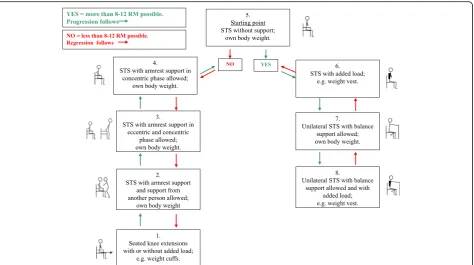
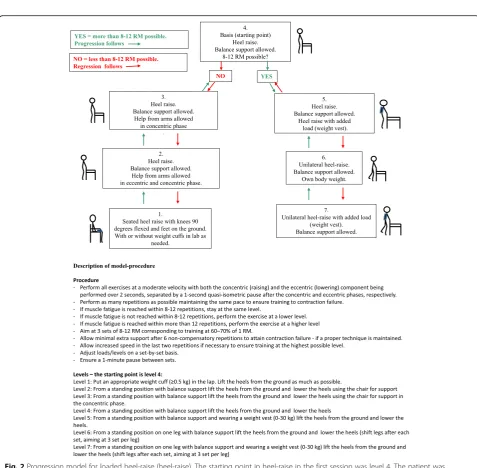
Patients assigned to the intervention group received pro-gressive strength training supervised 1:1 by a skilled physiotherapist on week days during hospitalization and 3 days per week for 4 weeks in their own home after discharge, since recovery of functioning within the first month after discharge has been shown to be important for long-term outcomes [27]. A total of 12 training ses-sions (over a maximum of 5 weeks) were provided after discharge. Every training session consisted of a warm-up program for the lower extremities followed by two pro-gressive strength training exercises, a sit-to-stand exer-cise (STAND) (Fig. 1) followed by a heel raise exercise (heel-raise) (Fig. 2) as outlined in Pedersen et al. 2016 [48]. Both exercises followed predefined models of pro-gression allowing for performance of the exercise from a seated position to performing the exercise unilaterally with extra load (level 1 to level 7/level 8). The STAND progres-sion model was found feasible in a previous study [51].
Both exercises were performed for three sets of 8–12 repe-titions to fatigue in each set (8–12 repetition maximum (RM)) [52]. The progression models shown in Figs.1and2
were applied to every single set of both exercises by the supervising physiotherapist. Each training session lasted approximately 20 min including warm up. Immediately after each training session the patients were asked to con-sume an oral protein supplement (Nutridrink Compact Protein from Nutricia A/S) containing 18 g milk-based protein and 300 kcal.
Standardization of assessments and intervention To ensure standardization of the intervention, the primary investigator performed pre-intervention meetings with all involved outcome assessors and physiotherapists. At meetings for outcome assessors only, the assessors were introduced to and trained in the assessments to ensure standardization. In addition, before conducting an assess-ment the outcome assessors observed one or two sessions conducted by the primary investigator. Further, the pri-mary investigator supervised each assessor for an assess-ment at the hospital and an assessassess-ment in a home setting. At meetings with physiotherapists only, the physiothera-pists were trained in both the warm-up program and the strength training protocol. Should questions arise during the study, the outcome assessors could contact the pri-mary investigator about the assessments and the physio-therapists could contact a senior physiotherapist about the exercise intervention. Also, a geriatrician could be con-tacted in the case of medical concerns.
Outcomes
The outcome assessments were performed on admission (baseline), within the first week after discharge, 4–5 weeks after discharge (primary endpoint), and 6 months after discharge.
Primary outcome measure
The primary outcome was change in the De Morton Mobility Index (DEMMI) score from baseline to 4 weeks after discharge. The DEMMI is a valid and reliable measure of mobility in older adults assessing bed mobil-ity, chair mobilmobil-ity, static and dynamic balance, and walk-ing [53–56]. The DEMMI is scored from 0 to 100 where 100 represents the highest level of mobility [53, 54] and a score below 62 is considered to reflect limited mobility in community-dwelling older adults [57]. In acute older medical patients, the minimal clinically important differ-ence on the DEMMI score is 10 points [53,56].
Secondary outcome measures
1. The 24-h mobility measured by anactivPAL3™ activity monitor (PAL Technologies Ltd., Glasgow, UK). The patient wore theactivPAL3™from inclusion into the study and throughout the entire hospitalization, the first week after discharge, the first week after the 4-week assessment and the first week after the 6-month assessment. TheactivPAL3™ monitors continuously for 7 days and assesses time spent sitting/lying, standing, and walking, and the number of steps taken. During hospitalization, the monitor was replaced after 7 days in the case of hospitalizations extending beyond 7 days. In agreement with an observational study preceding this randomized controlled study [11], and to maximize the number of full days with 24 h of measurements, we considered a day to be from 12:00 a.m. until 12:00 a.m. to avoid half-day mea-surements as the accelerometers were normally at-tached in the morning. Because very few patients are hospitalized for more than 6 days, we only included the first 6 days of hospitalization in the analysis. To avoid skewed days in the analysis, we included only patient-days with more than 20 h of measurements when studying the distributions of sitting/lying,
standing, and walking. The ActivPal3™has been shown valid and reliable in measuring posture and transitions in mobility-limited older adults [58,59] and in measur-ing walkmeasur-ing at speeds between 0.67 m/s and 1.56 m/s [60–62]. The ActivPal3™data will be dichotomized into sedentary (sitting/lying) and upright time (walking/standing) according to our protocol [48] if 15% walk at speeds below 0.67 m/s, since the percentage error in measuring steps is greater for slow walkers than fast walkers [59–63].
2. Isometric knee extension strength (IKE; Nm/kg) in the dominant leg measured by a handheld
dynamometer (Power Track II Commander; JTech Medical, Utah) with the patient seated in a standard chair (height 45 cm), arms crossed over the chest and 90° knee flexion [64,65]. The patient was asked to perform three maximal knee extensions (5 s duration, 1 min apart). The highest value obtained was used as the outcome.
[image:4.595.65.540.87.352.2]rest support for patients who were unable to rise once from the chair with the arms crossed over the chest.
4. Habitual gait speed (HG; m/s) measured on a 4-m course [67,68] from a standing start position (walking aids were allowed). The faster of two walks was used as the outcome. A gait speed below 0.8 m/s is considered to reflect poor mobility [69].
5. Hand-grip strength (HGS; kg) in the dominant hand measured with a handheld dynamometer
(Digi-II; Saehan) with the patient seated in a standard armchair (seat height 45 cm), with the lower
dominant arm placed on the armrest, 90° elbow flexion and neutral wrist position. The highest value of three maximal squeezes of the handle (5 s duration, 1 min apart) was used as the outcome. 6. The Barthel Index 20 (BI) was used as a measure of
activities of daily living (ADL) [70]. The BI is scored between 0 and 20 with higher scores indicating less disability in ADL.
[image:5.595.58.536.73.541.2]Additional variables
We collected descriptive variables and possible con-founders and modifiers: age, sex, education, living status, history of smoking, use of ambulatory devices, use of mu-nicipal help, history of falls during the last year, mobility assessed by the New Mobility Score (NMS) [71,72], am-bulatory capacity assessed by the Cumulated Ambulation Score [73], cognition assessed by the Short Orientation-Memory-Concentration test (OMC) [74] and the Mini Mental State Examination [75], depression assessed by the Geriatric Depression Scale (GDS) [76], health status assessed by the EuroQol instrument [77], nutritional state assessed by the Mini Nutritional Assessment [78], self-reported physical activity [79, 80], pain before and after training assessed by the Verbal Ranking Scale (VRS) [81, 82], medications, history of training before admission, and history of municipal training after discharge. In addition to the protocol [48], from January 2015 patients in the intervention group were asked about their satisfaction with the strength training intervention in 5 questions with corresponding 3–4-level rating scales: (1) How satisfied are you with the training intervention? (“Very satisfied”; “Satisfied”; “Dissatisfied”; “Very dissatisfied”; “Don’t know”); (2) I have benefitted from the strength training sessions (“Strongly agree”; “Agree; “Disagree; “Strongly disagree; “Don’t know); (3) The amount of training was (“Appropriate”; “Too little”; “Too much”;“Don’t know”); (4) I will (“Continue training on my own”;“Continue training with others”;“Stop train-ing”;“I don’t know”); (5) Are you satisfied with the results of the training? (“Very satisfied”;“Satisfied”;“Dissatisfied”; “Very dissatisfied”; “I don’t know”). A research assistant called the participant after completion of the intervention to ask these questions. Also, from the National Patient Registry we obtained data on comorbidities and readmis-sions. The Charlson Comorbidity Index [83] was calcu-lated based on theInternational Classification of Diseases, 10th Edition (ICD-10) [84], and we used registry data on hospital admissions and outpatient visits during the 10 years preceding the admission that was related to inclu-sion in this study.
Exercise diary During each training session the super-vising physiotherapist recorded the exercise level, num-ber of repetitions completed, and the extra load added (in kilograms). Pain before and after each training ses-sion was recorded using the VRS [81]. The amount of protein consumed and reasons for non-participation were also recorded. Good compliance with the interven-tion was defined as compleinterven-tion of 80% of all training ses-sions with a minimum of two sets performed per session and moderate compliance was defined as completion of 67% of all training sessions (8 out of 12 sessions) per-formed with a minimum of two sets per session.
Data management
Trial data management complied with the rules of the Da-nish Data Protection Agency and was performed blinded to group allocation. All data were double-entered in Epi-data Entry 3.1 (EpiEpi-data Associations, Odense, Denmark). Ranges were checked for data values and checked against the case report forms. Data from theactivPAL3™monitors were downloaded using the activPAL™ Professional soft-ware version 7.2.32. All data were exported to SAS Enter-prise Guide 7.1 (SAS Institute Inc., Gary, NC, USA).
Sample size
We estimated our sample size based on unpublished data from a cohort study performed at Hvidovre Hos-pital in older medical patients, showing mean change in the de Morton Mobility Index [56] score of 1.8 from ad-mission to 4 weeks after discharge and standard devi-ation of 12.8. A sample of 54 patients was required to detect a 10-point difference (minimal clinically import-ant difference [56]) in the between-group change in the DEMMI score at the 4-week assessment, given a type I error rate of 5% and power of 80% for a two-sample t
test of a normal mean difference with a two-sided sig-nificance level. According to our protocol, we included patients until both groups contained 25 patients assessed for the primary endpoint (4 weeks).
Statistical analyses
identification number and municipalities were modeled as random variables, group and time were modelled as fixed factors, and the between-group difference in change in the DEMMI score was estimated from the interaction be-tween the time and the group variable. We also analyzed the effect during hospitalization and the effect after the intervention ended, based on the primary analysis model. Similar analyses were performed for all outcomes with all analyses adjusted for baseline DEMMI score to adjust for the large variation in mobility in older medical patients [86]. Also, to account for imbalances in time spent in hos-pital, the effect during hospitalization and the effect from baseline to the end of the intervention adjusted for length of hospital stay were analyzed. In addition, a per-protocol (PP) analysis was performed comparing patients who had fulfilled the compliance criteria (80% of post-discharge sessions completed with a minimum of two sets in each session) with those in the control group who had not dropped out before the 4-week assessment and, thus, would have been able to comply with the intervention if they had been assigned to the intervention group. In the PP analysis, ActivPal data from days 5 and 6 at 6 months were not included in the analysis due to too many missing data. In supplement to the aforementioned analyses, all ITT and PP analyses were conducted with adjustment for baseline values of the outcome of interest. All between-group differences are expressed as the average difference in change from baseline to relevant outcome time with corresponding 95% confidence intervals. All models were investigated for goodness-of-fit (linearity, variance homo-geneity, and normal distribution of residuals) by visual in-spection of residual plots and were remodeled if necessary. We used SAS Enterprise Guide 7.1 (SAS Insti-tute Inc., Gary, NC, USA) for all statistical analyses and considered p values ≤0.05 to be statistically significant. However, for all analyses evaluating potential modifiers and confounders of the intervention,pvalues≤0.01 were used to account for multiple testing.
Results
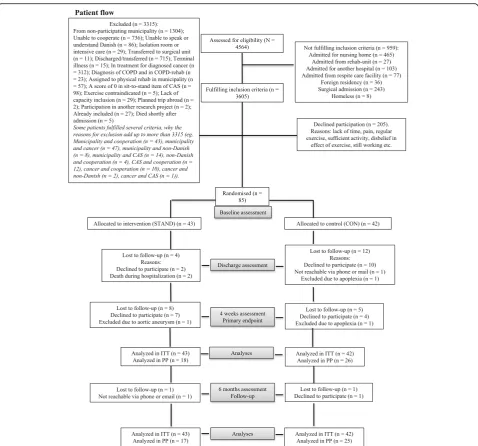
A total of 85 patients were included and randomized to the intervention group (N= 43) or the control group (N= 42). Figure 3 illustrates the flow of patients throughout the study [49]. Between baseline and 4 weeks, twelve patients in the intervention group were lost to follow up (27%). Reasons for declining to participate any further were lack of information about the extent of the study; lack of time/ too many things going on; being in the middle of a divorce; exercise-induced muscle soreness; and chronic leg pain. Seventeen patients in the control group were lost to follow up (40%). Reasons for declining to participate any further were impeding surgery; not wishing to continue; lack of time/too many things going on; lack of information; and not wanting to have anything to do with the hospital.
There were no significant baseline differences in age, sex, or DEMMI score between patients lost to follow up and patients remaining in the study at 4 weeks (all p > 0.31). One patient in each of the two groups was lost to follow up between 4 weeks and 6 months. The ActivPal3™ data was missing for 24 patients during hospitalization (8 pa-tients were lost to follow up, in 2 papa-tients the monitors were not attached due to miscommunication, 1 patient had an allergic reaction to the adhesive padding, 7 patients had monitors lost on the ward, and 6 patients had data for less than 20 h); for 29 patients after discharge (2 patients took the monitor off, 1 patient had an allergic reaction to the adhesive band, 14 patients were lost to follow up, 10 patients did not want to wear the monitor, 1 patient expe-rienced itching under the monitor, and 1 patient lost the monitor); for 41 patients after the 4 week assessment (27 patients were lost to follow up, 2 patients were not able to cooperate, 1 patient was allergic to the adhesive band, 10 patients did not want to wear the monitor, and 1 patient experienced itching under the monitor); and 46 patients after the 6 months assessment (29 patients were lost to follow up, 2 patients were not able to cooperate, 1 patient was allergic to the adhesive band, 12 patients did not want to wear the monitor, 1 patient experienced itching under the monitor, and 2 patients lost the monitors).
Baseline characteristics
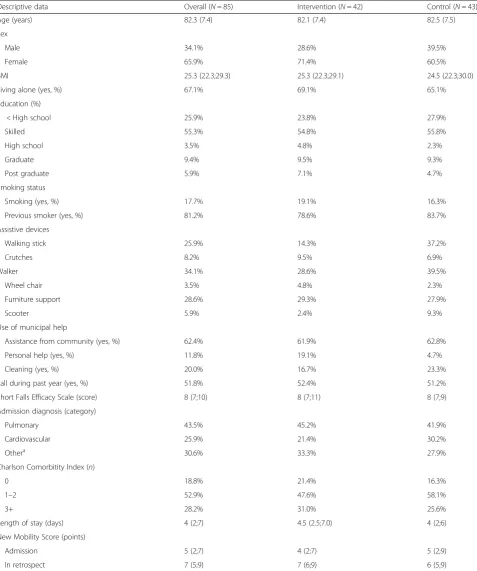
At baseline, no between-group differences appeared to be clinically relevant (no hypothesis testing was under-taken as suggested by the CONSORT group, Table 1). Overall, the patients were 82.3 years of age (SD 7.4), 65.9% were female, 67.1% were living alone, and 54% had an NMS reflecting poor function independency (a score of 0–5) [71]. The majority was admitted to the hospital with pulmonary problems and the median length of stay (LOS) was 4 days.
Outcomes
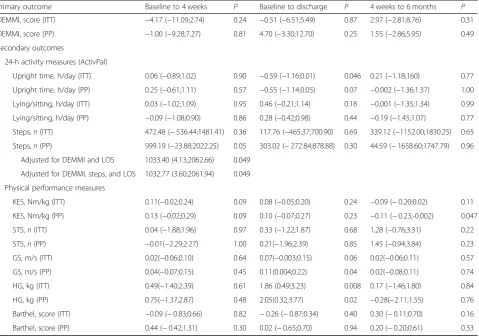
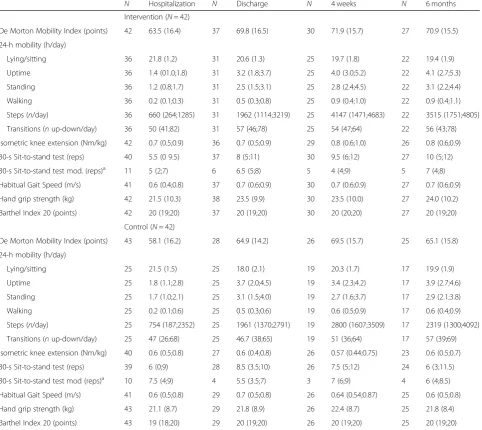
At baseline, the participants had an average DEMMI score of 60.7 (SD 16.4) reflecting limited mobility [57]. The between-group differences for the primary and secondary outcome measures are shown in Table 2, and the values for the primary and secondary outcomes at the four assessment points are shown in Table 3.
Primary outcome
However, there was a significant change in DEMMI score from baseline to 4 weeks in both groups in both the ITT analysis (mean difference from baseline to 4 weeks: intervention, 8.3 points (95% CI 0.6; 16.0), p= 0.04; control, 11.5 points (95% CI 3.5; 19.4), p< 0.01) and in the PP analysis (mean difference from baseline to 4 weeks: intervention, 10.6 points (95% CI 0.6; 20.6), p= 0.04; control, 11.6 points (95% CI 2.9; 20.3),
p< 0.01) (results not shown).
Secondary outcomes
During hospitalization, the participants spent an average of 21.7 h per day sedentary (sitting or lying),
a median of 1.8 h in an upright position (standing or walking) and took a median of 702 steps per day. On admission, their knee extension strength was 0.7 Nm/ kg (IQR 0.5; 0.9), they performed six sit-to-stand transitions in 30 s (IQR 0; 9), their habitual gait speed was 0.6 m/s (IQR 0.4; 0.8), handgrip strength was 28.9 kg in men (IQR 23.1;37.0) and 15.6 kg in women (IQR 13.0;20.2), and they had a Barthel score of 20 (IQR 18; 20) (Table1).
[image:8.595.59.538.85.531.2]Table 1Baseline characteristics
Descriptive data Overall (N= 85) Intervention (N= 42) Control (N= 43)
Age (years) 82.3 (7.4) 82.1 (7.4) 82.5 (7.5)
Sex
Male 34.1% 28.6% 39.5%
Female 65.9% 71.4% 60.5%
BMI 25.3 (22.3;29.3) 25.3 (22.3;29.1) 24.5 (22.3;30.0)
Living alone (yes, %) 67.1% 69.1% 65.1%
Education (%)
< High school 25.9% 23.8% 27.9%
Skilled 55.3% 54.8% 55.8%
High school 3.5% 4.8% 2.3%
Graduate 9.4% 9.5% 9.3%
Post graduate 5.9% 7.1% 4.7%
Smoking status
Smoking (yes, %) 17.7% 19.1% 16.3%
Previous smoker (yes, %) 81.2% 78.6% 83.7%
Assistive devices
Walking stick 25.9% 14.3% 37.2%
Crutches 8.2% 9.5% 6.9%
Walker 34.1% 28.6% 39.5%
Wheel chair 3.5% 4.8% 2.3%
Furniture support 28.6% 29.3% 27.9%
Scooter 5.9% 2.4% 9.3%
Use of municipal help
Assistance from community (yes, %) 62.4% 61.9% 62.8%
Personal help (yes, %) 11.8% 19.1% 4.7%
Cleaning (yes, %) 20.0% 16.7% 23.3%
Fall during past year (yes, %) 51.8% 52.4% 51.2%
Short Falls Efficacy Scale (score) 8 (7;10) 8 (7;11) 8 (7;9)
Admission diagnosis (category)
Pulmonary 43.5% 45.2% 41.9%
Cardiovascular 25.9% 21.4% 30.2%
Othera 30.6% 33.3% 27.9%
Charlson Comorbitity Index (n)
0 18.8% 21.4% 16.3%
1–2 52.9% 47.6% 58.1%
3+ 28.2% 31.0% 25.6%
Length of stay (days) 4 (2;7) 4.5 (2.5;7.0) 4 (2;6)
New Mobility Score (points)
Admission 5 (2;7) 4 (2;7) 5 (2;9)
In retrospect 7 (5;9) 7 (6;9) 6 (5;9)
Variables are presented as mean (SD), median (IQR) or percentages depending on the distribution of the variable.
BMIbody mass index a
hospitalization in both the unadjusted and the adjusted analyses (Table2). The PP analyses showed that between baseline and 4 weeks post discharge, the daily number of steps taken increased significantly more in the interven-tion group (difference in change from baseline to 4 weeks, 1033.40 (95% CI 4.13; 2062.66); p= 0.049 ad-justed for DEMMI score at baseline and length of stay; 1032.77 (95% CI 3.60; 2061.94); p= 0.049 adjusted for DEMMI score at baseline, steps at baseline, and length of stay) compared to the control group and increased more in gait speed and handgrip strength during hospitalization (Table 2). Overall, there was a significant increase in STS from baseline to 4 weeks (mean difference from baseline to 4 weeks, overall: ITT analysis, 2.9 (95% CI 1.3; 4.7), p= 0.001; PP analysis, 3.0 (95% CI 0.6; 5.3),
p= 0.01). Also, there was a significant change within both groups in the ITT analysis (mean difference from baseline to 4 weeks: intervention, 3.1 (95% CI 0.5; 5.6), p= 0.02; control, 2.7 (95% CI 0.3; 5.2),p= 0.03) and in the control group in the PP analysis (mean difference from baseline to
4 weeks: intervention, 3.0 (95% CI−0.8; 6.9),p= 0.12; con-trol, 3.0 (95% CI 0.2; 5.9),p= 0.04). There were no within-group in gait speed, handgrip strength, knee extension strength, or ADL (results not shown).
Compliance and satisfaction with the intervention
[image:10.595.60.540.99.435.2]The majority of the patients started the intervention be-tween 0 and 2 days after admission (78.8%) - range 0–4. Overall, 43% (18/42) of the patients randomized to the intervention group were very compliant with the interven-tion (80% of sessions performed with two sets of eight RM). Of those who remained in the study at 4 weeks, 60% (18/30) were very compliant and 23% (7/30) were moder-ately compliant with the intervention (minimum 8 out 12 (67%) sessions performed with two sets of eight RM). All patients consumed the amount of protein stated in the protocol. Between week 1 and week 4 of the intervention, there was a general increase in the level of exercise per-formed in both the sit-to-stand exercise and the heel-raise exercise. Thus, in the sit-to-stand exercise, 20% more
Table 2Between-group differences in change scores from baseline to discharge, 4 weeks, and 6 months (Δintervention-Δcontrol)
Primary outcome Baseline to 4 weeks P Baseline to discharge P 4 weeks to 6 months P
DEMMI, score (ITT) −4.17 (−11.09;2.74) 0.24 −0.51 (−6.51;5.49) 0.87 2.97 (−2.81;8.76) 0.31
DEMMI, score (PP) −1.00 (−9.28;7.27) 0.81 4.70 (−3.30;12.70) 0.25 1.55 (−2.86;5.95) 0.49
Secondary outcomes
24-h activity measures (ActivPal)
Upright time, h/day (ITT) 0.06 (−0.89;1.02) 0.90 −0.59 (−1.16;0.01) 0.046 0.21 (−1.18;160) 0.77
Upright time, h/day (PP) 0.25 (−0.61;1.11) 0.57 −0.55 (−1.14;0.05) 0.07 −0.002 (−1.36;1.37) 1.00
Lying/sitting, h/day (ITT) 0.03 (−1.02;1.09) 0.95 0.46 (−0.21;1.14) 0.18 −0.001 (−1.35;1.34) 0.99
Lying/sitting, h/day (PP) −0.09 (−1.08;0.90) 0.86 0.28 (−0.42;0.98) 0.44 −0.19 (−1.45;1.07) 0.77
Steps,n(ITT) 472.48 (−536.44;1481.41) 0.36 117.76 (−465.37;700.90) 0.69 339.12 (−1152.00;1830.25) 0.65
Steps,n(PP) 999.19 (−23.88;2022.25) 0.05 303.02 (−272.84;878.88) 0.30 44.59 (−1658.60;1747.79) 0.96
Adjusted for DEMMI and LOS 1033.40 (4.13;2062.66) 0.049
Adjusted for DEMMI, steps, and LOS 1032.77 (3.60;2061.94) 0.049
Physical performance measures
KES, Nm/kg (ITT) 0.11(−0.02;0.24) 0.09 0.08 (−0.05;0.20) 0.24 −0.09 (−0.20;0.02) 0.11
KES, Nm/kg (PP) 0.13 (−0.02;0.29) 0.09 0.10 (−0.07;0.27) 0.23 −0.11 (−0.23;-0.002) 0.047
STS,n(ITT) 0.04 (−1.88;1.96) 0.97 0.33 (−1.22;1.87) 0.68 1.28 (−0.76;3.31) 0.22
STS,n(PP) −0.01(−2.29;2.27) 1.00 0.21(−1.96;2.39) 0.85 1.45 (−0.94;3.84) 0.23
GS, m/s (ITT) 0.02(−0.06;0.10) 0.64 0.07(−0.003;0.15) 0.06 0.02(−0.06;0.11) 0.57
GS, m/s (PP) 0.04(−0.07;0.15) 0.45 0.11(0.004;0.22) 0.04 0.02(−0.08;0.11) 0.74
HG, kg (ITT) 0.49(−1.40;2.39) 0.61 1.86 (0.49;3.23) 0.008 0.17 (−1.46;1.80) 0.84
HG, kg (PP) 0.75(−1.37;2.87) 0.48 2.05(0.32;3.77) 0.02 −0.28(−2.11;1.55) 0.76
Barthel, score (ITT) −0.09 (−0.83;0.66) 0.82 −0.26 (−0.87;0.34) 0.40 0.30 (−0.11;0.70) 0.16
Barthel, score (PP) 0.44 (−0.42;1.31) 0.30 0.02 (−0.65;0.70) 0.94 0.20 (−0.20;0.61) 0.33
Unadjusted values are shown for all comparisons and adjusted values are shown where these differ from the unadjusted analyses. All values are given as mean (95% confidence interval). For the number of imputations at different time points for the primary and secondary outcomes please see Additional file1
patients trained at levels 6–7 in week 4 compared to week 1, and in the heel-raise exercise, 24% more patients trained at levels 5–7 in week 4 compared to week 1. Also, in both exercises those training with a weighted vest (STAND level 6, heel-raise level 5) increased their load by 1.5 kg (p= < 0.01) and 2 kg (p< 0.01), re-spectively. None of the patients reported an increase in pain during the training sessions and no adverse events were reported.
Twenty-five patients from the intervention group were asked about their satisfaction with the intervention. The majority were satisfied or very satisfied (88%) with the
intervention, and two thirds (68%) were satisfied or very satisfied with the results of the intervention. The major-ity (17/25) felt they had benefitted from the strength training sessions and that the amount of training was ap-propriate (20/25). Also, 16/25 said they would continue training either alone or with others.
[image:11.595.58.541.102.532.2]There was no difference between the groups in the number of readmissions between discharge and 4 weeks and between discharge and 6 months. Also, there was no difference between the groups in the number of days hospitalized between discharge and 4 weeks and between discharge and 6 months (results not shown).
Table 3Primary and secondary outcomes at four assessment points (ITT) (non-imputed data)
N Hospitalization N Discharge N 4 weeks N 6 months
Intervention (N= 42)
De Morton Mobility Index (points) 42 63.5 (16.4) 37 69.8 (16.5) 30 71.9 (15.7) 27 70.9 (15.5)
24-h mobility (h/day)
Lying/sitting 36 21.8 (1.2) 31 20.6 (1.3) 25 19.7 (1.8) 22 19.4 (1.9)
Uptime 36 1.4 (01.0;1.8) 31 3.2 (1.8;3.7) 25 4.0 (3.0;5.2) 22 4.1 (2.7;5.3)
Standing 36 1.2 (0.8;1.7) 31 2.5 (1.5;3.1) 25 2.8 (2.4;4.5) 22 3.1 (2.2;4.4)
Walking 36 0.2 (0.1;0.3) 31 0.5 (0.3;0.8) 25 0.9 (0.4;1.0) 22 0.9 (0.4;1.1)
Steps (n/day) 36 660 (264;1285) 31 1962 (1114;3219) 25 4147 (1471;4683) 22 3515 (1751;4805)
Transitions (nup-down/day) 36 50 (41;82) 31 57 (46;78) 25 54 (47;64) 22 56 (43;78)
Isometric knee extension (Nm/kg) 42 0.7 (0.5;0.9) 36 0.7 (0.5;0.9) 29 0.8 (0.6;1.0) 26 0.8 (0.6;0.9)
30-s Sit-to-stand test (reps) 40 5.5 (0 9.5) 37 8 (5;11) 30 9.5 (6;12) 27 10 (5;12)
30-s Sit-to-stand test mod. (reps)a 11 5 (2;7) 6 6.5 (5;8) 5 4 (4;9) 5 7 (4;8)
Habitual Gait Speed (m/s) 41 0.6 (0.4;0.8) 37 0.7 (0.6;0.9) 30 0.7 (0.6;0.9) 27 0.7 (0.6;0.9)
Hand grip strength (kg) 42 21.5 (10.3) 38 23.5 (9.9) 30 23.5 (10.0) 27 24.0 (10.2)
Barthel Index 20 (points) 42 20 (19;20) 37 20 (19;20) 30 20 (20;20) 27 20 (19;20)
Control (N= 42)
De Morton Mobility Index (points) 43 58.1 (16.2) 28 64.9 (14.2) 26 69.5 (15.7) 25 65.1 (15.8)
24-h mobility (h/day)
Lying/sitting 25 21.5 (1.5) 25 18.0 (2.1) 19 20.3 (1.7) 17 19.9 (1.9)
Uptime 25 1.8 (1.1;2.8) 25 3.7 (2.0;4.5) 19 3.4 (2.3;4.2) 17 3.9 (2.7;4.6)
Standing 25 1.7 (1.0;2.1) 25 3.1 (1.5;4.0) 19 2.7 (1.6;3.7) 17 2.9 (2.1;3.8)
Walking 25 0.2 (0.1;0.6) 25 0.5 (0.3;0.6) 19 0.6 (0.5;0.9) 17 0.6 (0.4;0.9)
Steps (n/day) 25 754 (187;2352) 25 1961 (1370;2791) 19 2800 (1607;3509) 17 2319 (1300;4092)
Transitions (nup-down/day) 25 47 (26;68) 25 46.7 (38;65) 19 51 (36;64) 17 57 (39;69)
Isometric knee extension (Nm/kg) 40 0.6 (0.5;0.8) 27 0.6 (0.4;0.8) 26 0.57 (0.44;0.75) 23 0.6 (0.5;0.7)
30-s Sit-to-stand test (reps) 39 6 (0;9) 28 8.5 (3.5;10) 26 7.5 (5;12) 24 6 (3;11.5)
30-s Sit-to-stand test mod (reps)a 10 7.5 (4;9) 4 5.5 (3.5;7) 3 7 (6;9) 4 6 (4;8.5)
Habitual Gait Speed (m/s) 41 0.6 (0.5;0.8) 29 0.7 (0.5;0.8) 26 0.64 (0.54;0.87) 25 0.6 (0.5;0.8)
Hand grip strength (kg) 43 21.1 (8.7) 29 21.8 (8.9) 26 22.4 (8.7) 25 21.8 (8.4)
Barthel Index 20 (points) 43 19 (18;20) 29 20 (19;20) 26 20 (19;20) 25 20 (19;20)
Variables are presented as mean (SD) or median (IQR) depending on the distribution of the variables
ITTintention to treat,repsrepetitions a
Discussion
This randomized controlled trial investigated the efficacy of a simple, supervised, strength training program for the lower extremities, combined with post-training oral pro-tein supplementation, initiated during hospitalization and continued in the home setting for 4 weeks after discharge in older medical patients admitted with acute illness. The main finding was that no effect of the intervention was seen on mobility assessed by the DEMMI score at any of the investigated time points. However, there was a signifi-cant increase in the number of steps taken in the interven-tion group as compared to the control group in our per-protocol analysis. Overall, 43% of the patients were highly compliant with the intervention and there was a general increase in the level of exercise performed in both exer-cises. None of the intervention group patients reported an increase in pain during the exercises and most of them expressed satisfaction with the intervention.
The intervention was not superior to usual care in im-proving mobility (DEMMI) from baseline to 4 weeks. However, both groups improved their mobility and the improvement reached beyond a clinically important dif-ference [56] in the control group in the intention-to-treat analysis and in both groups in the per-protocol analysis. Also, there was no effect on mobility during hospitalization. This is in agreement with previous stud-ies in geriatric patients showing no effect on mobility, assessed by the DEMMI score [87], nor on functional outcomes [88] of an in-hospital, progressive, strength training program. Several reasons for the lack of effect on our primary outcome can be suggested.
Firstly, the intervention had a relatively short duration. It is likely that longer training periods are required to benefit older adults. Studies by Hvid et al. [16, 89] have shown that older adults are more susceptible to periods of inactivity and require more time than younger adults to fully recover. Also, Jadczak et al. recommend inter-ventions with a duration of at least 2.5 months [90]. Ac-cordingly, a systematic review by Valenzuela et al. [36] concludes that progressive resistance training in older nursing home residents is efficient in improving strength and functional performance despite advanced age, chronic diseases, sedentary habits, and functional disabil-ities. However, all interventions investigated by Valen-zuela et al. had a duration of at least 2 months [36]. Equivalently, previous studies have identified an effect on both strength and functional abilities of 10 weeks of supervised, progressive, lower extremity resistive exer-cises using own weight and Therabands in both frail older adults living in a care facility [91] and community-dwelling older adults [92]. Equal to our study, both stud-ies used 3–weekly training sessions, but slightly more extensive programs (4–8 exercises) [91,92]. A systematic review by Borde et al. looking at resistance training in
healthy older adults found that the training period, the intensity, and the total time per repetition under tension are all parameters of significance for the effect on muscle strength with the largest effect sizes seen for the longest periods (50–53 weeks), intensities of 70–79% of 1 RM, and a total time under tension per repetition of 6 s [93]. While the intensity and time under tension rec-ommended by Borde et al. [93] were used in our inter-vention, we were far from the optimal period presented (50–53 weeks). However, it is questionable whether these recommendations can be followed in newly discharged, older medical patients. Admitted with acute illness. Therefore, we chose a minimal treatment approach fo-cusing on the initial 4 weeks after discharge. Despite a much shorter training period of only 4 weeks, we experi-enced a substantial drop out rate (28%) between baseline and 4 weeks and less than half of the remaining partici-pants were very compliant with the intervention (43%), indicating that participation would have been even lower in longer interventions.
Secondly, even though the DEMMI has been shown valid and reliable in measuring mobility in both older medical patients and in community-dwelling older adults [53, 54, 56], and has the ability to measure change in mobility after hospital discharge [56], the patients in that validation sample had much poorer mobility than our participants. Only half of the participants had a baseline DEMMI score below 62, reflecting limited mobility. The functions causing most participants difficulties were re-lated to static and dynamic balance, i.e. tandem stand with closed eyes, walking four steps backwards, and jumping [94]. Obtainment of a significant between-group difference in favor of the intervention between-group would have required that the intervention group partici-pants had learned these three functions, which is highly unlikely based on the provided intervention of sit-to-stand and heel-raise exercises. Thus, for the intervention chosen, the DEMMI score may not have been the best choice of primary outcome. Also, the intervention pro-posed may not be suitable for all patients, and it is worth considering stratifying patients to different interventions according to their mobility difficulties. Accordingly, a re-cent umbrella review [90] investigating the effect of ex-ercise interventions in pre-frail, community-dwelling, older adults found inconclusive results in the effect on mobility of both multi-component exercises and resist-ance exercises and suggested that only personalized ex-ercises are effective in improving mobility.
Previous studies have also reported improvement in func-tional performance measures during hospitalization [95,
96]. However, in accordance with these studies [95,96] the patients in the present study had poor performance at dis-charge - their knee extension strength was at the threshold level for independent ability to perform activities of daily living [97], putting them at increased risk of future mobility limitations [98]. Also, their hand grip strength and walking speed were at levels indicating mobility limitations [69]. These low levels of functional performance at discharge are worthy of concern, since functioning has been linked with future risk of falls, functional decline [99], mobility and ADL disability [68, 100, 101], hospital readmissions [28], and death [67,99,102]. Older adults see mobility related to everyday functioning as vital to their health and as an indi-cator of wellbeing and independence enabling them to par-ticipate in life as they know it and therefore affecting more that the physical aspects of their life [103]. This underlines the importance of trying to counteract further mobility de-cline in connection with hospitalization, to help older adults maintain their independence. Like our study, Tibaek et al. [88] found no effect on mobility or of strength training in addition to standard physiotherapy. Also, Oestergaard et al. [87] found no effect of an in-hospital, chair-based, exercise program on mobility and muscle strength.
During hospitalization the participants took a median of 700 steps daily. This small number of steps during hospitalization has been linked to hospital-associated functional decline [104]. Acknowledging that this was a secondary finding, we observed a significant between-group difference in change in the number of steps taken between baseline and 4 weeks in favor of the intervention group in our per-protocol analysis. At 4 weeks the control group took a median of 2800 steps compared to 4100 in the intervention group (Table3). This difference is prom-ising, since Floegel et al. [105] found that each 1000 add-itional steps in the post-discharge period in older women with heart failure was associated with better physical per-formance. Also, Breen et al. [22] found that reducing the daily number of steps in healthy older adults by 1400/day over a fortnight led to a 4% reduction in leg lean mass, modest increases in inflammation markers, and altered in-sulin sensitivity. Although the present study did not show an effect on either mobility or functional performance measures, the effect on the number of steps taken is promising. Merely focusing on enhancing the number of steps taken during hospitalization and post discharge could be a goal for future studies, thus lowering the re-quirements for acutely ill older adults who might find themselves unable to exercise [29]. In addition, an increase in the number of steps taken during hospitalization is as-sociated with shorter length of stay [106], while a decline is associated with greater risk of death within 2 years after discharge [107]. Accordingly, an association has been
shown between steps per day post discharge and 30-day readmission rate [108]. In addition, Brown and co-authors [109] found that factors like weakness, need for assistance, lack of interest from staff, and structural barriers are rea-sons for inactivity in older medical patients (≥75 years). Thus, based on the findings from the present trial, we have changed our focus from exercise to walking, to in-crease intervention compliance. In an ongoing study, we investigate the effect of an intervention including a phys-ical component (i.e. promoting walking) and a component focusing on overcoming structural barriers [110].
Strengths and limitations
Study strengths included that our intervention was initi-ated at the hospital and continued at home a few days after discharge, as well as choosing a minimally time-consuming treatment approach taking into account its implementation in a busy care-setting. Acutely hospital-ized older adults may prefer exercise to be initiated in the hospital or shortly after discharge. Also, Franco and co-authors found that exercise at home, an improvement in the ability to undertake daily tasks, and not having to use transportation were the three most important attri-butes for engaging in physical activity among community-dwelling older adults with a history of falls or self-reported mobility disability [111]. Thus, the fact that our invention took place in the participants’ own homes shortly after discharge may have enhanced compliance. However, we do not have data to support this hypothesis.
after discharge [43], leading us to believe that 4 weeks might be sufficient in inducing an effect. Protein was chosen as an integrated part of the strength training intervention. Both resistance training and amino acids can stimulate an anabolic response [114] and the two in combination have been shown to enhance the muscular response to exercise in healthy older adults [45–47]. The provided protein supplementation was intended to boost anabolism. However, it is unclear whether it has merely reduced an existing protein deficit since less than half of our participants could be considered to have a normal nutritional state on admission. Nevertheless, since older adults need a greater amount of daily protein than young adults to maintain muscle mass, and older adults with acute or chronic diseases or marked malnutrition, need even more [115], our intention was to fill out a potential protein gap.
A limitation in our study was that a substantial num-ber of participants dropped out between baseline and 4 weeks (27%) - half of these (N= 12) dropped out be-tween the admission and the discharge assessment. However, between baseline and 4 weeks the number of drop outs was smaller in the intervention group than in the control group, indicating that the intervention itself was not the reason for dropping out. This is in line with previous studies reporting equivalent drop-out rates for in-hospital [88] and post-discharge training interven-tions [116]. Furthermore, at baseline there was no sig-nificant difference in the DEMMI score between those who remained in the study and those who dropped out. In the present study, participants in both groups choos-ing to refrain from further participation said they lacked time and felt that the main entrance of their house had turned into a revolving door of health professionals. Also, older medical patients that may benefit from phys-ical rehabilitation during and after hospitalization may have barriers preventing exercise participation. In a study by Brown et al. [29] reporting difficulties in recruiting acutely admitted older medical patients, those declining to participate expressed that they did not feel like exercising or did not believe they could. The reasons for non-participation in the present study were e.g. lack of time, believing oneself to be sufficiently active, or disbelief in the effect of exercise. A large number of patients were excluded from our study or declined to participate, leaving us with a very selective group of older medical patients. However, similar or lower con-sent rates have been reported in previous studies in older medical patients [29,43,117]. This underlines the difficul-ties in recruiting patients in the acute setting and limits the generalizability of the results. In the intervention group, only 43% were very compliant with the interven-tion, which may explain the lack of effect seen in this study. This level of compliance, though, is in line with a
study in acutely admitted geriatric patients [87] and stresses the challenges in maintaining acutely admitted older adults in training interventions. Also, we experi-enced a large amount of missing data in our study, due among other reasons to the high number of drop outs. In addition, several ActivPals were lost during the interven-tion period, which may have affected the results. Further-more, a limitation of our study was that we did not measure the rate of perceived exertion as an indicator of performance intensity. However, in a feasibility study pre-ceding the present study, we found that the subjectively perceived effort, assessed by the BORG score, when per-forming the exercises used in the present study, corre-sponded well with our aim of 8–12 repetitions being equivalent with 60–70% exertion [51]. Thus, perceived exertion was not assessed in the present study.
Conclusions
A simple, low technology, supervised strength training program for the lower extremities, combined with post-training oral protein supplementation initiated during hospitalization and continued in the home setting for 4 weeks after discharge, was not superior to usual care in the effect on change in mobility 4 weeks after discharge in older medical patients admitted with acute illness. For the secondary outcome, the daily number of steps, good compliance with the intervention resulted in a greater daily number of steps.
Supplementary information
Supplementary informationaccompanies this paper athttps://doi.org/10. 1186/s13063-019-3720-x.
Additional file 1.Number of imputations at different time points for the primary and secondary outcomes. The table shows the number of imputations used at each assessment point for the primary and the secondary outcomes for both the intention-to-treat analysis and the per-protocol analysis.
Abbreviations
ADL:Activities of daily living; BI: The Barthel Index 20; CI: Confidence interval; CONSORT: Consolidated Standards of Reporting Trials; COPD: Chronic obstructive pulmonary disease; DEMMI: The De Morton Mobility Index; Heel-raise: Heel raise exercise; HG: Habitual gait speed; HGS: Hand-grip strength; ICD-10: The International Classification of Diseases, 10th Edition;
IQR: Interquartile range; ITT: Intention to treat; LOS: Length of stay; NMS: New Mobility Score; PP: Per protocol; RM: Repetition maximum; SD: Standard deviation; STAND: Sit-to-stand exercise; STS: The 30-s sit-to-stand test; VRS: The Verbal Ranking Scale
Acknowledgements
We thank the municipalities of Copenhagen and Broendby, the Emergency Department and the Department of Physiotherapy at Copenhagen University Hospital, Hvidovre, Denmark, for participating in the study, and all
protein supplements for the study. This study was performed in collaboration with the Optimized Senior Patient Program (Optimed)and Physical Medicine & Rehabilitation Research-Copenhagen (PMR-C) at Copenhagen University Hospital Hvidovre, Hvidovre, Denmark.
Authors’contributions
MMP, TB, JP, OA, and NB designed the study in collaboration with the municipalities of Copenhagen and Broendby. MMP was the primary investigator and project leader and responsible for patient recruitment and data management. HGJL helped in training the included patients. PSJ was responsible for the randomization list. MMP and JP were responsible for analyzing data. MMP wrote the first manuscript draft. Hereafter, all authors revised the manuscript critically for important intellectual content, and all authors approved the final version to be submitted for publication. The STAND-Cph collaborative group (in alphabetical order by name): Ove Andersen, Clinical Research Centre and The Emergency Department, Copenhagen University Hospital, Hvidovre, Denmark and Department of Clinical Medicine, Faculty of Health and Medical Sciences, University of Copenhagen, Copenhagen, Denmark; Thomas Bandholm, Clinical Research Centre, Copenhagen University Hospital Hvidovre, Hvidovre, Denmark and Department of Physiotherapy and Department of Orthopaedic Surgery, Copenhagen University Hospital Hvidovre, Hvidovre, Denmark; Jonathan F Bean, New England Geriatric Research Education and Clinical Center, VA Boston Healthcare System, Boston, MA and Spaulding Rehabilitation Hospital, Boston, MA and Department of Physical Medicine and
Rehabilitation, Harvard Medical School, Boston, MA; Nina Beyer, Department of Physical and Occupational Therapy, Bispebjerg and Frederiksberg Hospital, University of Copenhagen, Denmark, and Department of Clinical Medicine, University of Copenhagen, Denmark; Ann Christine Bodilsen, Clinical Research Centre, Copenhagen University Hospital, Hvidovre, Denmark; Rasmus Brødsgaard, Clinical Research Centre, Copenhagen University Hospital, Hvidovre, Denmark; Jette Christensen, Department of Physical- and Occupational therapy, Copenhagen University Hospital Hvidovre, Hvidovre, Denmark; Line Due
Christensen, Clinical Research Centre, Copenhagen University Hospital, Hvidovre, Denmark; Christina Dahl, Clinical Research Centre, Copenhagen University Hospital, Hvidovre, Denmark; Lars Damkjær, Department of Rehabilitation, Municipality of Copenhagen, Copenhagen, Denmark; Simon Hegnsvad, Department of Rehabilitation, Municipality of Copenhagen, Copenhagen, Denmark; Pia Søe Jensen, Clinical Research Centre, Copenhagen University Hospital, Hvidovre, Denmark and Department of Ortopaedic Surgery, Copenhagen University Hospital, Hvidovre, Denmark; Karen Dalsgaard Jepsen, Department of Rehabilitation, Municipality of Broendby, Broendby, Denmark; Helle Gybel Juul-Larsen, Clinical Research Centre, Copenhagen University Hospital, Hvidovre, Denmark; Louise Lawson-Smith, Clinical Research Centre, Copenhagen University Hospital, Hvidovre, Denmark; Morten Ledertoug, Department of Physiotherapy, Copenhagen University Hospital Hvidovre, Hvidovre, Denmark; Robert-Jan Nienhuis, Department of Physical- and Occupational therapy, Copenhagen University Hospital Hvidovre,
Hvidovre, Denmark; Sanne Stiberg, Department of Physical- and Occupational therapy, Copenhagen University Hospital Hvidovre, Hvidovre, Denmark; Maja Pedersen,
Clinical Research Centre, Copenhagen University Hospital, Hvidovre, Denmark; Mette Merete Pedersen, Clinical Research Centre, Copenhagen University Hospital Hvidovre, Hvidovre, Denmark; Frida Margareta Persson, Department of
Physical- and Occupational therapy, Copenhagen University Hospital Hvi-dovre, HviHvi-dovre, Denmark; Janne Petersen, Clinical Research Centre, Copenhagen University
Hospital, Hvidovre, Denmark and Section of Biostatistics, Department of Pub-lic Health, University of Copenhagen, Denmark; Trine Rehfeld Lind, Depart-ment of Physical- and Occupational therapy, Copenhagen University Hospital Hvidovre, Hvidovre, Denmark; Rikke Friis Knudsen, Department of Physical-and Occupational therapy, Copenhagen University
Hospital Hvidovre, Hvidovre, Denmark; Gitte Salomonsen, Department of Rehabilitation, Municipality of Copenhagen, Copenhagen, Denmark; Bettina Solgaard, Department of Rehabilitation, Municipality of Broendby, Broendby, Denmark; Lisbeth Sommer, Department of Rehabilitation, Municipality of Broendby, Broendby, Denmark; Maria Therese Stage, Department of Physical- and Occupational therapy, Copenhagen University Hospital
Hvidovre, Hvidovre, Denmark; Berit Thorslund, Department of Rehabilitation, Municipality of Copenhagen, Copenhagen, Denmark; Marie West, Depart-ment of Rehabilitation, Municipality of Broendby, Broendby, Denmark; Jade Kavanaugh Wulff, Department of Physical- and Occupational therapy, Copenhagen University Hospital Hvidovre, Hvidovre, Denmark
Funding
This study was funded by the Danish Ministry of Health (grant number 9170); Danish Regions/The Danish Health Confederation; the Lundbeck Foundation (UCSF) (grant numbers FP 07/2012, FP 48/2012 and FP 61/2013); the Research Foundation of Hvidovre Hospital; the Capital Region of Copenhagen; and The Danish Foundation for Research in Physiotherapy.
Availability of data and materials
The datasets generated and/or analyzed during the current study are not publicly available due to regulations set out by the Danish Data Protection Agency regarding data anonymization but are available from the corresponding author on reasonable request.
Ethics approval and consent to participate
All participants gave written informed consent before participation and the study procedures were approved by the Ethics Committee of the Capital Region of Denmark (H-2-2012-115) and by the Danish Data Protection Agency (2007-58-0015).
Consent for publication Not applicable.
Competing interests
The authors declare that they have no competing interests. The funding bodies have had no authority over study design, collection and interpretation of data, or the writing of the manuscript.
Author details
1Clinical Research Centre, Copenhagen University Hospital Hvidovre, Kettegaard Alle 30, 2650 Hvidovre, Denmark.2Section of Biostatistics, Department of Public Health, University of Copenhagen, Øster Farimagsgade 5 Entrance B, 2nd floor, 1014 Copenhagen K, Denmark.3Center for Clinical Research and Prevention, Copenhagen University Hospital, Bispebjerg and Frederiksberg, Bispebjerg Bakke 23, 2400 Copenhagen N, Denmark. 4Department of Physical and Occupational Therapy, Copenhagen University Hospital, Bispebjerg and Frederiksberg, Bispebjerg Bakke 23, 2400 Copenhagen N, Denmark.5Department of Clinical Medicine, Faculty of Health and Medical Sciences, University of Copenhagen, Blegdamsvej 3B, 2200 Copenhagen N, Denmark.6Department of Orthopaedic Surgery, Copenhagen University Hospital, Kettegaard Alle 30, 2650 Hvidovre, Denmark.7The Emergency Department, Copenhagen University Hospital, Kettegaard Alle 30, 2650 Hvidovre, Denmark.8Department of Physical- and Occupational Therapy, Copenhagen University Hospital Hvidovre, Kettegaard Alle 30, 2650 Hvidovre, Denmark.
Received: 24 January 2019 Accepted: 13 September 2019
References
1. Fried TR, Tinetti ME, Iannone L, O’Leary JR, Towle V, Van Ness PH. Health outcome prioritization as a tool for decision making among older persons with multiple chronic conditions. Arch Intern Med. 2011;171:1854–6. 2. Åberg AC, Sidenvall B, Hepworth M, O’Reilly K, Lithell H. On loss of activity
and independence, adaptation improves life satisfaction in old age: a qualitative study of patients’perceptions. Qual Life Res. 2005;14:1111–25. 3. Krumholz HM. Post-hospital syndrome–an acquired, transient condition of
generalized risk. N Engl J Med. 2013;368:100–2.
4. Kortebein P. Rehabilitation for hospital-associated deconditioning. Am J Phys Med Rehabil. 2009;88:66–77.https://doi.org/10.1097/PHM. 0b013e3181838f70.
6. Lafont C, Gérard S, Voisin T, Pahor M, Vellas B. Reducing“iatrogenic disability”in the hospitalized frail elderly. J Nutr Health Aging. 2011;15: 645–60.
7. Admi H, Shadmi E, Baruch H, Zisberg A. From research to reality: minimizing the effects of hospitalization on older adults. Rambam Maimonides Med J. 2015;6:e0017.
8. Brown CJ, Friedkin RJ, Inouye SK. Prevalence and outcomes of low mobility in hospitalized older patients. J Am Geriatr Soc. 2004;52:1263–70. 9. Zisberg A, Shadmi E, Gur-Yaish N, Tonkikh O, Sinoff G. Hospital-associated
functional decline: the role of hospitalization processes beyond individual risk factors. J Am Geriatr Soc. 2015;63:55–62.
10. Sourdet S, Lafont C, Rolland Y, Nourhashemi F, Andrieu S, Vellas B. Preventable iatrogenic disability in elderly patients during hospitalization. J Am Med Dir Assoc. 2015;16:674–81.
11. Pedersen MM, Bodilsen AC, Petersen J, Beyer N, Andersen O, Lawson-Smith L, et al. Twenty-four-hour mobility during acute hospitalization in older medical patients. J Gerontol A Biol Sci Med Sci. 2013 March;68(3):331–7. 12. Villumsen M, Jorgensen MG, Andreasen J, Rathleff MS, Mølgaard CM.
Very low levels of physical activity in older patients during
hospitalization at an acute geriatric ward - a prospective cohort study. J Aging Phys Act. 2015;23:542–9.
13. Callen BL, Mahoney JE, Grieves CB, Wells TJ, Enloe M. Frequency of hallway ambulation by hospitalized older adults on medical units of an academic hospital. Geriatr Nur (Lond). 2004;25:212–7.
14. Fisher SR, Goodwin JS, Protas EJ, Kuo Y-F, Graham JE, Ottenbacher KJ, et al. Ambulatory activity of older adults hospitalized with acute medical illness. J Am Geriatr Soc. 2011;59:91–5.https://doi.org/10.1111/j.1532-5415.2010.03202.x. 15. Cattanach N, Sheedy R, Gill S, Hughes A. Physical activity levels and patients’ expectations of physical activity during acute general medical admission. Intern Med J. 2014;44:501–4.https://doi.org/10.1111/imj.12411. 16. Hvid L, Aagaard P, Justesen L, Bayer ML, Andersen JL, Ørtenblad N, et al.
Effects of aging on muscle mechanical function and muscle fiber morphology during short-term immobilization and subsequent retraining. J Appl Physiol (1985). 2010;109:1628–34 Bethesda Md.
17. Kortebein P, Ferrando A, Lombeida J, Wolfe R, Evans WJ. Effect of 10 days of bed rest on skeletal muscle in healthy older adults. JAMA. 2007;297:1772–4. 18. Kortebein P, Symons TB, Ferrando A, Paddon-Jones D, Ronsen O, Protas E,
et al. Functional impact of 10 days of bed rest in healthy older adults. J Gerontol A Biol Sci Med Sci. 2008;63:1076–81.
19. Coker RH, Hays NP, Williams RH, Wolfe RR, Evans WJ. Bed rest promotes reductions in walking speed, functional parameters, and aerobic fitness in older, healthy adults. J Gerontol A Biol Sci Med Sci. 2014.https://doi.org/10. 1093/gerona/glu123.
20. Drummond MJ, Dickinson JM, Fry CS, Walker DK, Gundermann DM, Reidy PT, et al. Bed rest impairs skeletal muscle amino acid transporter expression, mTORC1 signaling, and protein synthesis in response to essential amino acids in older adults. AJP Endocrinol Metab. 2012;302:E1113–22.https://doi. org/10.1152/ajpendo.00603.2011.
21. Alley DE, Koster A, Mackey D, Cawthon P, Ferrucci L, Simonsick EM, et al. Hospitalization and change in body composition and strength in a population-based cohort of older persons. J Am Geriatr Soc. 2010;58:2085–91.
22. Breen L, Stokes KA, Churchward-Venne TA, Moore DR, Baker SK, Smith K, et al. Two weeks of reduced activity decreases leg lean mass and induces
“anabolic resistance”of myofibrillar protein synthesis in healthy elderly. J Clin Endocrinol Metab. 2013;98:2604–12.
23. LeBlanc AD, Schneider VS, Evans HJ, Pientok C, Rowe R, Spector E. Regional changes in muscle mass following 17 weeks of bed rest. J Appl Physiol (1985). 1992;73:2172–8 Bethesda Md.
24. Suetta C, Hvid LG, Justesen L, Christensen U, Neergaard K, Simonsen L, et al. Effects of aging on human skeletal muscle after immobilization and retraining. J Appl Physiol. 2009;107:1172–80.https://doi.org/10.1152/ japplphysiol.00290.2009.
25. Singh MAF. Exercise comes of age: rationale and recommendations for a geriatric exercise prescription. J Gerontol A Biol Sci Med Sci. 2002;57:M262–82. 26. Bean JF, Leveille SG, Kiely DK, Bandinelli S, Guralnik JM, Ferrucci L. A
comparison of leg power and leg strength within the InCHIANTI study: which influences mobility more? J Gerontol A Biol Sci Med Sci. 2003;58:728–33. 27. Boyd CM, Landefeld CS, Counsell SR, Palmer RM, Fortinsky RH, Kresevic D,
et al. Recovery of activities of daily living in older adults after hospitalization for acute medical illness. J Am Geriatr Soc. 2008;56:2171–9.https://doi.org/ 10.1111/j.1532-5415.2008.02023.x.
28. Hoyer EH, Needham DM, Atanelov L, Knox B, Friedman M, Brotman DJ. Association of impaired functional status at hospital discharge and subsequent rehospitalization. J Hosp Med. 2014;9:277–82. 29. Brown CJ, Peel C, Bamman MM, Allman RM. Exercise program
implementation proves not feasible during acute care hospitalization. J Rehabil Res Dev. 2006;43:939–46.
30. Kosse NM, Dutmer AL, Dasenbrock L, Bauer JM, Lamoth CJC. Effectiveness and feasibility of early physical rehabilitation programs for geriatric hospitalized patients: a systematic review. BMC Geriatr. 2013;13:107. 31. Andreasen J, Lund H, Aadahl M, Sørensen EE. The experience of daily life of
acutely admitted frail elderly patients one week after discharge from the hospital. Int J Qual Stud Health Well-Being. 2015;10:27370.
32. Liu CJ, Latham NK. Progressive resistance strength training for improving physical function in older adults. Cochrane Database Syst Rev. 2009;(3)Art. No.: CD002759.https://doi.org/10.1002/14651858.CD002759.pub2. 33. Koopman R, van Loon LJC. Aging, exercise, and muscle protein metabolism.
J Appl Physiol (1985). 2009;106:2040–8 Bethesda Md.
34. Fiatarone MA, O’Neill EF, Ryan ND, Clements KM, Solares GR, Nelson ME, et al. Exercise training and nutritional supplementation for physical frailty in very elderly people. N Engl J Med. 1994;330:1769–75.
35. Stewart VH, Saunders DH, Greig CA. Responsiveness of muscle size and strength to physical training in very elderly people: a systematic review. Scand J Med Sci Sports. 2014;24:e1–10.
36. Valenzuela T. Efficacy of progressive resistance training interventions in older adults in nursing homes: a systematic review. J Am Med Dir Assoc. 2012;13:418–28.https://doi.org/10.1016/j.jamda.2011.11.001.
37. Olivetti L, Schurr K, Sherrington C, Wallbank G, Pamphlett P, Kwan MM-S, et al. A novel weight-bearing strengthening program during rehabilitation of older people is feasible and improves standing up more than a non-weight-bearing strengthening program: a randomised trial. Aust J Physiother. 2007;53:147–53.https://doi.org/10.1016/S0004-9514(07)70021-1. 38. Steib S, Schoene D, Pfeifer K. Dose-response relationship of resistance
training in older adults. Med Sci Sports Exerc. 2010;42:902–14.https://doi. org/10.1249/MSS.0b013e3181c34465.
39. Raymond MJ, Bramley-Tzerefos RE, Jeffs KJ, Winter A, Holland AE. Systematic review of high-intensity progressive resistance strength training of the lower limb compared with other intensities of strength training in older adults. Arch Phys Med Rehabil. 2013;94:1458–72. https://doi.org/10.1016/j.apmr.2013.02.022.
40. de Vries NM, van Ravensberg CD, Hobbelen JSM, Olde Rikkert MGM, Staal JB, Nijhuis-van der Sanden MWG. Effects of physical exercise therapy on mobility, physical functioning, physical activity and quality of life in community-dwelling older adults with impaired mobility, physical disability and/or multi-morbidity: a meta-analysis. Ageing Res Rev. 2012;11:136–49.
41. Seynnes O, Fiatarone Singh MA, Hue O, Pras P, Legros P, Bernard PL. Physiological and functional responses to low-moderate versus high-intensity progressive resistance training in frail elders. J Gerontol A Biol Sci Med Sci. 2004;59:503–9.
42. De Morton NA, Keating JL, Jeffs K. Exercise for acutely hospitalised older medical patients. Cochrane Database Syst Rev. 2009;1.https://doi.org/10. 1002/14651858.CD005955.pub2.
43. Siebens H, Aronow H, Edwards D, Ghasemi Z. A randomized controlled trial of exercise to improve outcomes of acute hospitalization in older adults. J Am Geriatr Soc. 2000;48:1545–52.
44. Courtney MD, Edwards HE, Chang AM, Parker AW, Finlayson K, Bradbury C, et al. Improved functional ability and independence in activities of daily living for older adults at high risk of hospital readmission: a randomized controlled trial. J Eval Clin Pract. 2012;18:128–34.https://doi.org/10.1111/j. 1365-2753.2010.01547.x.
45. Esmarck B, Andersen JL, Olsen S, Richter EA, Mizuno M, Kjaer M. Timing of post exercise protein intake is important for muscle hypertrophy with resistance training in elderly humans. J Physiol. 2001;535(Pt 1):301–11. 46. Yang Y, Breen L, Burd NA, Hector AJ, Churchward-Venne TA, Josse AR, et al.
Resistance exercise enhances myofibrillar protein synthesis with graded intakes of whey protein in older men. Br J Nutr. 2012;108:1780–8. 47. Cermak NM, Res PT, de Groot LCPGM, Saris WHM, van Loon LJC. Protein
supplementation augments the adaptive response of skeletal muscle to resistance-type exercise training: a meta-analysis. Am J Clin Nutr. 2012;96:1454–64. 48. Pedersen MM, Petersen J, Beyer N, Damkjær L, Bandholm T. Supervised