MAR-APR-2013, VOL-I, ISSUE-V www.srjis.com Page 1269
Effect of Mastery Learning Strategies on Test Anxiety among High School
Students
Vishal Sood
International Centre for Distance Education and Open Learning (ICDEOL), Himachal Pradesh University, Summer Hills, Shimla - 171005
The present investigation was undertaken to study the effect of mastery learning strategies viz. Bloom‟s Learning For Mastery (LFM) and Keller‟s Personalized System of Instruction (PSI) on test anxiety among high school students. For achieving the objectives of this study, a random sample of 105 students studying in 9th class was selected and “Three Groups: Randomized Matched Subject Pretest-Posttest Design” was employed. The sampled students were divided into three homogeneous groups on the basis of their non-verbal intelligence level by administering Raven‟s Standard Progressive Matrices (SPM). The first group and second group were taught through Bloom‟s LFM and Keller‟s PSI respectively and thus, termed as experimental groups. The third group was imparted instruction through conventional method of teaching and named as control group. The data were collected by administering Kumar‟s (undated) Test Anxiety Scale for Children (TASC). The statistical technique of „Analysis of Co-Variance (ANCOVA)‟ was employed to analyze the data. The results revealed that both Bloom‟s LFM and Keller‟s PSI were significantly more effective in reducing test anxiety level of high school students as compared to conventional method of teaching. However, there existed no significant difference in test anxiety between high school students taught through Bloom‟s mastery learning strategy and Keller‟s personalized system of instruction. In the end of paper, implications have been discussed.
Keywords: Mastery Learning Strategies, Bloom‟s Learning For Mastery (LFM), Keller‟s Personalized System of Instruction (PSI), Test Anxiety.
INTRODUCTION:
Since time immemorial, education was considered a purposeful and goal-oriented process to generate and transmit knowledge and experiences to the next generation for speedy development of individual and society as well. The process inscribed as goal-oriented, sets forth some objectives which are to be achieved in a particular span of time. However, it is a pity that at this very particular and crucial juncture, thousands of students at each and every level of education are labeled as „unsatisfactory‟, „poor‟ or „failure‟. There seems no
MAR-APR-2013, VOL-I, ISSUE-V www.srjis.com Page 1270 conformity between desirable educational objectives and academic achievement of the students. Students‟ achievement is hindered and education has proved to be a fallible process. However, there is no denying of the fact that the basic purpose of teaching any subject is to enhance the achievement of the students, not at the superficial level but at concept understanding level. It has been revealed from empirical findings that test anxiety is negatively related to academic achievement meaning thereby, higher the test anxiety, low will be the academic achievement of the students.
Test anxiety is one of the major non-cognitive variables which affect academic achievement. The concept of test anxiety has been in existence for as long as tests have been used to evaluate performance of the individuals. According to Sarason(1959), “we live in a test conscious situation, test giving culture, in which lives of people are in part determined by their test performance”. Individuals with high level of test anxiety become tense, nervous, emotionally apprehensive which hampers their performance. The term „Test Anxiety‟ relates to the anxiety in relation to the quality of performance in a test situation. Test anxiety is a mental state of worry, concern and uncertainty due to encountering of situations of tests, which acts as a constant source of uneasiness for the individual. Test anxiety may be referred to as the tendency to respond with fear in achievement related context and the disposition to engage in activities which are instrumental to the avoidance of achievement tasks. Liebert and Morris(1967) have proposed that test anxiety is bi-dimensional, consisting of the components of worry and emotionality. Worry is any cognitive expression of one‟s concern about own performance and emotionality refers to autonomic reactions to the test situation such as, perspiration and accelerated heartbeat. Wine (1971) has proposed an attentional theory to explain how test anxiety hampers the performance of an individual. She was of the view that attention processes involved in test anxiety are aroused in evaluative settings. Test anxious persons divide their attention between task relevant activities and worry, self-criticism and somatic concerns. With less attention available for task directed efforts, their performance is being hampered. It has been continuously noted that test anxiety affects learning and academic achievement of students. Lynn(1957) and Cox(1964) have reported significant negative correlation between test anxiety and achievement in arithmetic. Hill (1972) in the survey of test anxiety researches conducted by Sarason and Sarason led to the conclusion that test anxiety is significantly related to poor performance marks in the school and grade repetition. Contractor (1981) examined a theoretic model derived from drive theory and trait-state anxiety theory which points out that trait anxiety (A-trait) influences state anxiety(A-state) which in turn affects achievement. However, this finding was significant only for high intelligent individuals. Paulman and Kennelly (1984) demonstrated that under laboratory conditions, high levels of test anxiety are detrimental to performance in evaluative situations. Sharma and Sood (1989) showed that under evaluative conditions, high test anxiety has a debilitating effect on academic performance.
MAR-APR-2013, VOL-I, ISSUE-V www.srjis.com Page 1271 Lawson(1993), Ross(1994), Peklaj and Vodopivec (1999) and McKenzie(1999) clearly indicates that if anxiety level of a student is high, then his achievement will be low.
From the review of the related literature, it was observed that only two studies namely, Koul(1986) and McKenzie(1999) reported that mastery learning strategies are helpful in reducing the test anxiety of the students. Hence, it was decided by the investigator to study the effect of Bloom‟s mastery learning strategy and Keller‟s personalized system of instruction on test anxiety among high school students. If the strategies under study are proved to be effective in reducing test anxiety among the students, then the present study will be of great help to the teachers, students, educational planners and administrators and curriculum constructors in bringing different changes in curriculum, pedagogy and teaching-learning process as a whole.
Keeping this in view, present study was undertaken to investigate the effect of Bloom‟s LFM and Keller‟s PSI on test anxiety among high school students:
To study and compare the effect of Bloom‟s LFM strategy and conventional method of teaching on test anxiety among high school students.
To study and compare the effect of Keller‟s PSI and conventional method of teaching on test anxiety among high school students.
To study and compare the effect of Bloom‟s LFM strategy and Keller‟s PSI on test anxiety among high school students.
Following hypotheses were formulated in the present investigation:
Test anxiety of the students taught through Bloom‟s mastery learning strategy does not differ significantly in comparison to the students taught through conventional method of teaching.
Test anxiety of the students taught through Keller‟s personalized system of instruction does not differ significantly in comparison to the students taught through conventional method of teaching.
Test anxiety of the students taught through Bloom‟s mastery learning strategy does not differ significantly in comparison to the students taught through Keller‟s personalized system of instruction.
RESEARCH METHOD Sampling:
MAR-APR-2013, VOL-I, ISSUE-V www.srjis.com Page 1272 Thus, three groups with 35 students in each group were randomly assigned to three different experimental treatments. The remaining 98 students were weeded out.
R e s e a r c h T o o l s D e v e l o p e d :
F o l l o w i n g r e s e a r c h t o o l s w e r e d e v e l o p e d i n t h e p r e s e n t i n v e s t i ga t i o n :
1 . S t u d y - G u i d e s
For imparting instruction through Keller‟s personalized system of instruction, study-guides were developed on first two chapters of 9th class geometry textbook viz. Basic Geometrical Facts and Some Angle Relations. These two chapters were then divided into eight sub-units for preparation of study-guides. Each study-guide was comprised of five parts namely; introduction, instructional objectives, suggested procedure for achieving instructional objectives, suggested reading material and questions for self-evaluation. The reading material given in study-guides was validated by seeking the views of Mathematics experts, language experts and technical (research) experts. Further, for evaluating the structural accuracy of study-guides, the experts from the field of educational technology were consulted.
2. Formative Tests and their Parallel Forms
For assessing mastery of the students over different sub-units, formative tests and their parallel forms were developed for each small learning unit. The main purpose of these tests was to identify the learning difficulties of those students who were not able to achieve pre-specified mastery criterion of 80/80 and to provide them with remedial instruction on the un-mastered content. The students who were not able to achieve pre-specified mastery criterion were provided remedial instruction and parallel form of formative test of the same sub-unit was re-administered on them to check their mastery. The students could proceed to the next sub-unit only when 80/80 criterion was achieved by them either on formative test or its parallel form. Each formative test and its parallel form were validated in terms of its included content by employing the same procedure as in case of development of study-guides.
Apart from these self-developed research tools, Raven‟s Standard Progressive Matrices (SPM) was employed for subject to subject matching on non-verbal intelligence level (pertinent control variable). In addition to this, for measuring test anxiety level of high school students, test anxiety scale for children (TASC) developed by Kumar (undated) was employed.
Statistical Technique Employed:
After completion of the experiment, for testing the significance of difference among means of test anxiety scores at the time of post-test and to adjust the initial mean differences in the pre-test scores of different treatment groups if any, the statistical technique of „Analysis of Covariance (ANCOVA)‟ was employed. Before starting with actual procedure of analysis of covariance (ANCOVA), the assumptions of normality, randomness, homogeneity, additively, correlation and regression were tested.
METHODOLOGY:
MAR-APR-2013, VOL-I, ISSUE-V www.srjis.com Page 1273 Independent variables: Bloom‟s LFM strategy, Keller‟s PSI and conventional method of teaching.
Dependent variable: Test Anxiety.
Intervening variables: Intelligence level of students, teacher effect and test anxiety level before application of treatment variables.
Description of the Experiment:
The experiment was conducted in following manner for realizing the objectives of present investigation:
Phase –I (Pre-Testing)
During the first phase of experiment, test anxiety scale was administered on the students of three treatment groups. The obtained scores were named as „pre-test scores‟. Phase –II (Experimental Phase)
All three groups were exposed randomly to different experimental treatments for a period of seven weeks. First group was taught with the help of Bloom‟s LFM strategy (Bloom group), second through Keller‟s PSI (Keller group) and third group was taught through conventional method of teaching (Control group). All three groups were taught by the investigator for removing teacher effect (intervening variable).
Phase –III (Post-Testing)
After completion of instruction to all three groups, test anxiety scale was re-administered on all three groups. The obtained scores were named as „post-test scores‟. Results:
After testing all assumptions of analysis of covariance, the investigator further proceeded to test the significance of difference between the adjusted mean scores on test anxiety scale among three treatment groups. The summary of the results of analysis of covariance is given in Table 1.
TABLE 1: Summary of the Results of Analysis of Covariance for Scores on Test Anxiety Scale for Bloom, Keller and Control Group
Sr. No.
Components of Variability
Sum of Squares
Df Variance F-Ratio S.D.y.x.
1 Between Treatments
435.46 2 217.73 43.29**
2 Within Samples of Error
507.67 101 5.03 2.24
3 Total 943.13 103
** Significant at 0.01 level of significance.
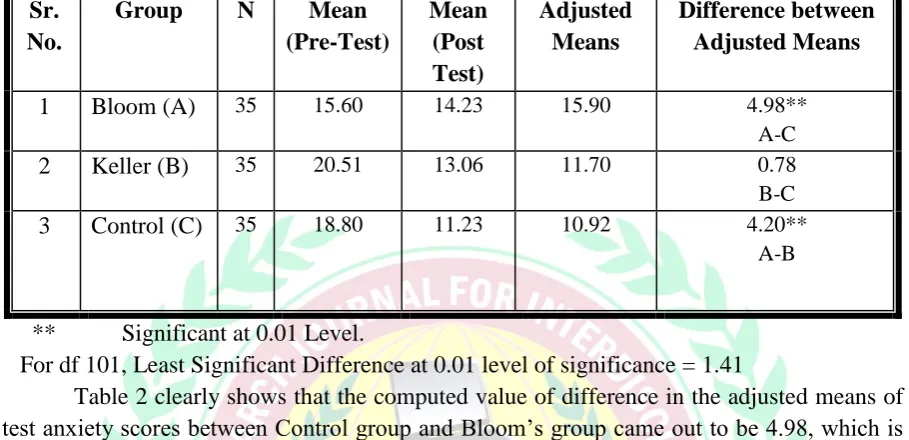
[image:5.595.68.529.257.640.2]pre-MAR-APR-2013, VOL-I, ISSUE-V www.srjis.com Page 1274 test, post-test and adjusted mean scores of students of all three treatment groups on test anxiety scale are given in Table 2.
TABLE 2: Means of Pre-Test, Post-Test and Adjusted Scores on Test Anxiety Scale of Three Groups: Bloom, Keller and Control
** Significant at 0.01 Level.
For df 101, Least Significant Difference at 0.01 level of significance = 1.41
Table 2 clearly shows that the computed value of difference in the adjusted means of test anxiety scores between Control group and Bloom‟s group came out to be 4.98, which is greater than the least significant difference at 0.01 level of significance(1.41), for df 101.
Hence, the hypothesis (Ho) stated as, “test anxiety of the students taught through Bloom‟s mastery learning strategy does not differ significantly in comparison to the students taught through conventional method of teaching” was not accepted. It may be interpreted that the adjusted mean of test anxiety scores of the students taught through conventional method of teaching(15.90) was significantly higher than the group of students taught through Bloom‟s mastery learning strategy(10.92). In other words, it may be concluded that Bloom‟s mastery learning strategy is significantly more effective in reducing the test anxiety of the students as compared to conventional method of teaching.
Similarly, Table 2 shows that the obtained value of difference in adjusted means of test anxiety scores between two groups, one following instruction through conventional method of teaching and the other through Keller‟s personalized system of instruction came out to be 4.20, which is higher than least significant difference(1.41) at 0.01 level of significance, for df 101. Hence, the hypothesis (Ho) stated as, “test anxiety of the students
taught through Keller‟s personalized system of instruction does not differ significantly in comparison to the students taught through conventional method of teaching” was not accepted. It may be interpreted that the adjusted mean of test anxiety scores of the students taught through conventional method of teaching(15.90) was significantly higher than the group of students taught through Keller‟s personalized system of instruction(11.70). In other words, it may be said that Keller‟s personalized system of instruction is significantly more effective in reducing the test anxiety of the students as compared to conventional method of teaching.
The present results of the study are substantiated by the findings of Koul(1986) and McKenzie(1999) who had revealed in their studies that Bloom‟s mastery learning strategy and Keller‟s personalized system of instruction were more effective in reducing test anxiety
Sr. No.
Group N Mean
(Pre-Test)
Mean (Post Test)
Adjusted Means
Difference between Adjusted Means
1 Bloom (A) 35 15.60 14.23 15.90 4.98**
A-C
2 Keller (B) 35 20.51 13.06 11.70 0.78
B-C
3 Control (C) 35 18.80 11.23 10.92 4.20**
MAR-APR-2013, VOL-I, ISSUE-V www.srjis.com Page 1275 of the students than the conventional method of teaching. However, these results are not in agreement with Singh(1983) and Yohon(1997) who were of the opinion that mastery learning strategies have no significant impact on the anxiety level of the students.
Furthermore, Table 2 reveals that the computed value of difference in the adjusted means of test anxiety scores between Bloom‟s group and Keller‟s group came out to be 0.78, which is less than least significant difference(1.06) even at 0.05 level of significance, for df
101. Hence, the hypothesis (Ho) stated as, “the test anxiety of the students taught through Bloom‟s mastery learning strategy does not differ significantly in comparison to the students taught through Keller‟s personalized system of instruction” was accepted. The adjusted mean of test anxiety scores of students who were taught through Keller‟s personalized system of instruction(11.70) is slightly higher than the group of students taught through Bloom‟s mastery learning strategy(10.92), but this difference is not statistically significant. In other words, it may be said that Bloom‟s mastery learning strategy is slightly better than Keller‟s personalized system of instruction in reducing the test anxiety of the students but this difference is not statistically significant. The present result is in agreement with Koul(1986) who had observed that both Bloom‟s mastery learning strategy and Keller‟s personalized system of instruction were equally effective in reducing the test anxiety of the students.
Hence, it may be concluded that both Bloom‟s mastery learning strategy and Keller‟s personalized system of instruction were found to be significant and equally effective in reducing the test anxiety of the students as compared to conventional method of teaching. DISCUSSION:
MAR-APR-2013, VOL-I, ISSUE-V www.srjis.com Page 1276 competition where stress and anxiety are the biggest barriers in enhanced academic performance.
REFERENCES
Bloom, B. S. (1971). Mastery learning. In J. H. Block (Eds.), Mastery learning: Theory and practice. New York: Holt, Rinehart and Winston Inc.
Carroll, J. B. (1963). A model of school learning. Teachers‟ College Record, 64, 723-733. Contractor B. M. (1981). Educational attainment as a function of certain variables. Vidya
Journal of Gujarat University, 24(2), 29-42.
Cox, F. N. (1964). Academic and social adjustments in fifth grade boys. Australian Journal of Education, 5, 184-192.
Garrett, H. E. (1966). Statistics in Psychology and Education. Bombay: Vakils, Feffer and Simons Pvt. Ltd.
Hill, K. T. (1972). Anxiety in the evaluative context. In W. Hartup (Ed.). The young child (Vol. 2). Washington D. C.: National Association for the Education of Young Child. Kapadia, J. J. (1974). Relationship between personality variables and achievement of pupils
on programmed learning material. In Gunvant Shah (Ed.). Studies in programmed learning. Anand, Gujarat: Charotar Educational Society.
Keller, F. S. (1968). Good bye, teacher ……. Journal of Applied Behaviour Analysis, 79-89. Keller, F. S. and Sherman, J. G. (1974). PSI: The Keller plan handbook - Essays on a
personalized system of instruction. Menlo Park, California: W. A. Benjamin Inc. Koul, Lokesh (1986). A study of effects of mastery learning strategies on achievement
motivation and test anxiety of socially disadvantaged groups in Himachal Pradesh. UGC-Project Report, Shimla: Himachal Pradesh University.
Koul, Lokesh (1988). Methodology of Educational Research. New Delhi: Vikas Publishing House Pvt. Ltd.
Kumar, A. (Undated). Manual for Sarason‟s Test Anxiety Scale for Children „TASC‟ (Indian Adaptation). Agra: National Psychological Corporation.
Lawson, Valarie Johnson (1993). Mathematics anxiety, test anxiety, instructional methods and achievement in a developmental mathematics class. Dissertation Abstracts International, 53(10), 3479-A.
Liebert, R. M. and Morris, L. W. (1967). Cognitive, emotional components of test anxiety: A distinction and some initial data. Psychological Reports, 20, 975-978.
Lynn, R. (1957). Temperamental characteristics related to disparity of attainment in reading and arithmetic. The British Journal of Educational Psychology, 29, 213-216.
Mckenzie, Sonia Yalonda (1999). Achievement and affective domains of algebra-I students in traditional or self-paced computer programmes. Dissertation Abstracts International, 60(9), 3297 –A.
Mookerjee, Ratna Singh, L. B. and Sinha, Balanand (1982). Relationship between anxiety and academic achievement. Journal of Institute of Educational Research, 6(1), 10-12. Paulman, R. G. and Kennelly, K. J. (1984). Test anxiety, ineffective test taking: Different