JAN-FEB, 2013, Vol. – I, Issue-IV www.srjis.com Page 1058 IMPORTANCE OF ARTIFICIAL INTELLIGENCE TOOLS
Er. Sanjeev Puri Department of Computers, DAV College Bathinda,Punjab
Received: 22 February 2013
Reviewed & Received: 28 February 2013 Accepted: 28February 2013
This paper,” Importance of Artificial Intelligence Tools” helps us in understanding the
real concept of artificial intelligence and the importance of artificial intelligence tools. It gives
the awareness of how artificial intelligence (AI) plays an important role in our daily life
especially in the case of medicine. This system is working throughout the world as an artificial
brain. In this paper information regarding the tools of AI and it solves the current problems in
the field of medicine. There seems to be many pitfalls in the field of medicine which can’t be
resolved b any other means other than AI. Thus further improvement in the field of AI will be a
boon for the development of scientific technology and to researchers, if done as it has to be.
There seems to be many cons in the current trend which can be easily solved. Thus one of the
applications of computer science being artificial intelligence solves all these problems and helps
in accessing individual patient risk.
Key Words: Artificial intelligence, reasoning, tools, robot, cardiovascular disease, medicine.
INTRODUCTION
Intelligence exhibited by an artificial (non-natural, man-made) entity. It is the branch of
computer science dealing with the reproduction or mimicking of human-level thought in
computers. Intelligence involves mechanisms, and AI research has discovered how to make
Abstract
JAN-FEB, 2013, Vol. – I, Issue-IV www.srjis.com Page 1059 computers carry out some of them and not others. If doing a task requires only mechanisms that
are well understood today, computer programs can give very impressive performances on these
tasks. Such programs should be considered somewhat intelligent. It explains about the
importance of artificial intelligence tools and how it resolves the pitfalls in the field of medicine.
It is related to the similar task of using computers to understand human intelligence.Then
section 2 deals with the existing system which includes the branches of AI, the pros and cons of
AI and the applications of AI. Section 3 deals with the proposed work which gives solutions to
the existing problems especially in case of cardio vascular disease. Section 4 deals with the
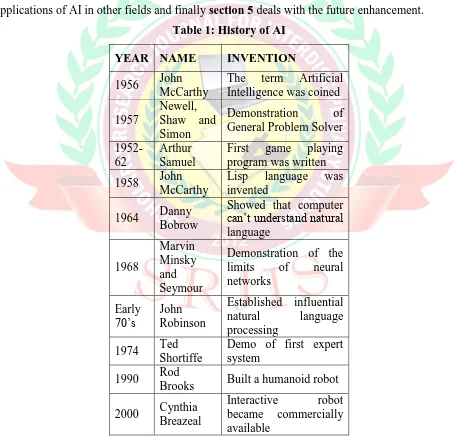
[image:2.612.77.537.235.682.2]applications of AI in other fields and finally section 5 deals with the future enhancement.
Table 1: History of AI
YEAR NAME INVENTION
1956 John McCarthy
The term Artificial Intelligence was coined
1957
Newell, Shaw and Simon
Demonstration of General Problem Solver
1952-62
Arthur Samuel
First game playing program was written
1958 John McCarthy
Lisp language was invented
1964 Danny Bobrow
Showed that computer can’t understand natural language 1968 Marvin Minsky and Seymour
Demonstration of the limits of neural networks
Early 70’s
John Robinson
Established influential natural language processing
1974 Ted Shortiffe
Demo of first expert system
1990 Rod
Brooks Built a humanoid robot
2000 Cynthia Breazeal
JAN-FEB, 2013, Vol. – I, Issue-IV www.srjis.com Page 1060 Research in AI has focussed chiefly on the following components of intelligence: learning,
reasoning, problem-solving, perception, and language-understanding.
Learning: The simplest is learning by trial-and-error.
Reasoning: To reason is to draw inferences appropriate to the situation in hand.
Problem-solving: Problems have the general form: given such-and-such data, find x. A huge
variety of types of problem is addressed in AI. Some examples are: finding winning moves in
board games; identifying people from their photographs.
Perception: In perception the environment is scanned by means of various sense-organs, real or
artificial, and processes internal to the perceiver analyze the scene into objects and their features
and relationships.
Language-understanding: A language is a system of signs having meaning by convention.
II.EXISTING SYSTEM
The existing system helps in understanding how artificial intelligence is useful in our day to day
life. It also tells us about the pros and cons of artificial intelligence.
A. BRANCHES OF AI:
Logical AI: What a program knows about the world in general the facts of the specific
situation in which it must act, and its goals are all represented by sentences of some
mathematical logical language. The program decides what to do by inferring that certain actions
are appropriate for achieving its goals.
Search: AI programs often examine large numbers of possibilities, e.g. moves in a chess game
or inferences by a theorem proving program. Discoveries are continually made about how to do
this more efficiently in various domains.
Pattern recognition: When a program makes observations of some kind, it is often
programmed to compare what it sees with a pattern. For example, a vision program may try to
match a pattern of eyes and a nose in a scene in order to find a face. More complex patterns, e.g.
in a natural language text, in a chess position, or in the history of some event are also studied.
These more complex patterns require quite different methods than do the simple patterns that
have been studied the most.
Representation: Facts about the world have to be represented in some way. Usually languages
JAN-FEB, 2013, Vol. – I, Issue-IV www.srjis.com Page 1061 Inference: From some facts, others can be inferred. Mathematical logical deduction is adequate
for some purposes, but new methods of non-monotonic inference have been added to logic since
the 1970s. The simplest kind of non-monotonic reasoning is default reasoning in which a
conclusion is to be inferred by default, but the conclusion can be withdrawn if there is evidence
to the contrary. For example, when we hear of a bird, we man infer that it can fly, but this
conclusion can be reversed when we hear that it is a penguin. It is the possibility that a
conclusion may have to be withdrawn that constitutes the non-monotonic character of the
reasoning. Ordinary logical reasoning is monotonic in that the set of conclusions that can the
drawn from a set of premises is a monotonic increasing function of the premises.
Common sense knowledge and reasoning: This is the area in which AI is farthest from
human-level, in spite of the fact that it has been an active research area since the 1950s. While there has
been considerable progress, e.g. in developing systems of non-monotonicreasoning and theories
of action.
Learning from experience: Programs do that. The approaches to AI based on connectionism
and neural nets specialize in that. There is also learning of laws expressed in logic. Programs can
only learn what facts or behaviors their formalisms can represent, and unfortunately learning
systems are almost all based on very limited abilities to represent information.
Planning: Planning programs start with general facts about the world (especially facts about the
effects of actions), facts about the particular situation and a statement of a goal. From these, they
generate a strategy for achieving the goal. In the most common cases, the strategy is just a
sequence of actions.
Epistemology: This is a study of the kinds of knowledge that are required for solving problems
in the world.
Ontology: Ontology is the study of the kinds of things that exist. In AI, the programs and
sentences deal with various kinds of objects, and we study what these kinds are and what their
basic properties are.
Heuristics: A heuristic is a way of trying to discover something or an idea imbedded in a
program. The term is used variously in AI. Heuristic functions are used in some approaches to
JAN-FEB, 2013, Vol. – I, Issue-IV www.srjis.com Page 1062 that compare two nodes in a search tree to see if one is better than the other, i.e. constitutes an
advance toward the goal, may be more useful.
Genetic programming: Genetic programming is a technique for getting programs to solve a
task by mating random Lisp programs and selecting fittest in millions of generations.
B.PROS OF ARTIFICIAL INTELLIGENCE:
(1) Finds applications in space exploration. (2) used for mining purposes. (3) The intelligence
of machines can be harnessed for exploring the depths of oceans.(4) used in real world. (5)
Capable of performing critical tasks. (6) We might be able to employ them for dangerous
missions, thus minimizing the risk to human life.
C.CONS OF AI:
(1) robots start replacing human resources in every field. (2) we will have to deal with serious
issues like unemployment in turn leading to mental depression. (3) poverty and crime in the
society crop up. (4) Human beings deprived of their work life may not find any means to
channelize their energies and harness their expertise. (5) replacing human beings with robots in
every field may not be a right decision as many jobs require human touch. (6)One of the major
disadvantages of intelligent machines is that they cannot be human. (7) There won’t be
dedication and devotion in their work.
D: APPLICATIONS OF AI:
HEAVY INDUSTRIES AND SPACE:
Robotics and cybernetics have taken a leap combined with artificially intelligent expert systems.
An entire manufacturing process is now totally automated, controlled and maintained by a
computer system in car manufacture, machine tool production, computer chip production and
almost every high-tech process. They carry out dangerous tasks like handling hazardous
radioactive materials. Robotic pilots carry out complex manoeuvring techniques of unmanned
space crafts sent in space. Japan is the leading country in the world in terms of robotics research
and use.
FINANCE: Banks use intelligent software applications to screen and analyze financial data.
Softwares that can predict trends in the stock market have been created which have been known
JAN-FEB, 2013, Vol. – I, Issue-IV www.srjis.com Page 1063 COMPUTER SCIENCE:
Researchers in quest of artificial intelligence have created spin offs like dynamic programming,
object oriented programming, symbolic programming, intelligent storage management systems
and many more such tools. The primary goal of creating an artificial intelligence still remains a
distant dream but people are getting an idea of the ultimate path which could lead to it.
AVIATION:
Air lines use expert systems in planes to monitor atmospheric conditions and system status. The
plane can be put on auto pilot once a course is set for the destination.
WEATHER FORECAST:
Neural networks are used for predicting weather conditions. Previous data is fed to a
neural network which learns the pattern and uses that knowledge to predict weather patterns.
SWARM INTELLIGENCE:
This is an approach to, as well as application of artificial intelligence similar to a neural network.
Here, programmers study how intelligence emerges in natural systems like swarms of bees even
though on an individual level, a bee just follows simple rules. They study relationships in nature
like the prey-predator relationships that give an insight into how intelligence emerges in a swarm
or collection from simple rules at an individual level. They develop intelligent systems by
creating agent programs that mimic the behavior of these natural systems!
Is artificial Intelligence really possible? Can intelligence like a human mind surpass itself and
create its own image? The depth and the powers of the human mind are just being tapped. Who
knows, it might be possible, only time can tell! Even if such intelligence is created, will it share
our sense of morals and justice, will it share our idiosyncrasies? This will be the next step in the
evolution of intelligence.
PROBLEMS WITH THE CURRENT METHODS:
Artificial intelligence tools can be used to assess individual patient risk in cardiovascular disease.
The pitfalls in the current method are as follows:
1) Inability to capture disease complexity:
The algorithms currently used employ a limited number of variables. This is due to the fact that
traditional statistical approaches tend to select only variables which have a high level of linear
JAN-FEB, 2013, Vol. – I, Issue-IV www.srjis.com Page 1064 a statistical approach, by which only one factor at a time is varied, and the other factors are held
constant. With these techniques, a given set of potential predictors with respect to individual
patients is difficult to interpret.
2) Inability to capture process dynamics:
A major drawback of the probabilistic approach is that prediction tends to behave as a static
process. If a given subject has an absolute risk of 62%, it means that there is a 62% probability
that he/she will suffer from a major cardiovascular event in the following 10 years, and a 38%
probability that he/she will not. The lottery of probability will tell us the truth in the future. In
this situation the subject is in a static position in one out of two mutually excluding possibilities:
event or non event. There is no possibility to make any sort of inference about a specific risk
trend, despite the fact that the same sort of assessment performed 10 years before resulted in an
absolute risk of 34%. In fact, even if after 10 years the algorithm shows that there are more
probabilities that the subject will suffer from an event, the imposition of binary logic does not
allow the mathematical figuring out of a formal and dynamic progression of the risk. The subject
will still remain uncertain and apparently his/her fate will still depend on chance. The use of
fuzzy logic with artificial intelligence, and the consequent use of a "plausibility" rather than a
probability concept, can help overcoming this subtle trap.
3) Wide confidence interval of individual risk assessment:
A major unavoidable pitfall of the translation of group statistics onto an individual level is linked
to the problem of the wide confidence interval of classifications. Within classical statistical
approaches the individual is assimilated into a subgroup of individuals who have, on average, a
given probability of an event.
III.PROPOSED WORK
This paper mainly concentrates in letting people know that for all the problems they suffer in the
field of medicine there is a remedy. Nowadays people suffer a lot with respect to cardiovascular
disease which leads to the drastic increase in the mortality rate. Thus one of the applications of
computer science being artificial intelligence solves all these problems and helps in accessing
individual patient risk. There seems to be many applications of AI but it is the tools in artificial
intelligence makes it possible to overcome the drawbacks and achieve excellence in the field of
JAN-FEB, 2013, Vol. – I, Issue-IV www.srjis.com Page 1065 dynamic programming, object oriented programming, symbolic programming, intelligent storage
management systems and many more such tools. The primary goal of creating an artificial
intelligence still remains a distant dream but people are getting an idea of the ultimate path which
could lead to it. This paper lets us know what are the uses and applications of AI in various
fields and especially in the field of medicine which is briefly discussed in this paper.
IV.APPLICATIONS IN OTHER FIELDS
Automation.
Cybernetics.
Hybrid intelligent system.
Intelligent agent.
Intelligent control.
Automated reasoning.
Data mining.
Behavior-based robotics.
Cognitive robotics.
Developmental robotics.
Knowledge representation
Defence
AI can do the following:
Nowadays artificial intelligence is being used extensively in defense, medical and
research. With the help of artificial intelligence systems doctors are able to diagnose and operate
on a human being without any complications. It’s a modern world and everything is being
interconnected with computer. Thus people can buy anything from any corner of the world.
There are machines which perform human being work like washing dishes, making coffee,
cooking, talking on phone etc. Most of the companies prefer their work to be automated instead
of manual thus minimizing human labor and also errors.
A machine once embedded with AI technology will generate proper report when compared to a
JAN-FEB, 2013, Vol. – I, Issue-IV www.srjis.com Page 1066 system is released with worm it can have a devastating effect on the network.Artificial
intelligence would not need any sleep. This would be an advantage because it would not be
interrupted from its tasks for sleep, as well as other issues that plague biological minds like
restroom breaks.
Unemotional consideration of problems. While an artificial mind could theoretically have
emotions, it would be better for performance if it were programmed for unemotional reasoning.
When people make decisions, sometimes those decisions are based on emotion rather than logic.
This is not always the best way to make decisions.
Easier copying. Once an artificial mind is trained in a task, that mind can then be copied very
easily,.
V. FUTURE ENHANCEMENT
With this development pitfalls in other areas of medicine can be rectified. This discovery can be
kept as a base and more and more improvements can be made which will make the field of AI a
very popular one. It will also lead to more interest of researchers to develop new and innovative
ideas.
VI. CONCLUSION
This paper “Importance of Artificial Intelligence Tools” gives us a solution in improving the
drawbacks in current methods in the field of medicine. With the development in the field of AI
and it being used in various applications more and more research has to be done so that
drawbacks in various fields can be rectified.
REFERENCES
[1] John J.McCarthy, Patrick J. Hayes,” Some Philosophical Problems From The Standpoint
Of Artificial Intelligence”, 1969
[2] Lawrence J. Fogel, Angela Owens, M.J. Walsh, ”Artificial Intelligence Through Simulated
Evolution”, 1965
[3] Patrick Henry Winston,”Artificial Intelligence and
Expert Systems”, 1999
JAN-FEB, 2013, Vol. – I, Issue-IV www.srjis.com Page 1067 [5]Wilson PW, D'Agostino RB, Levy D, Belanger AM, Silbershatz H, Kannel WB: “Prediction of coronary heart disease using risk factor categories”, 1998
[6]Menotti A, Puddu PE, Lanti M: “The estimate of cardiovascular risk. Theory, tools and problems”,2002
[7] www.aaai.org
[8] www.alanturing.net
[9] www.scienceprog.com
[10] www. EzineArticles.com