http://wrap.warwick.ac.uk/
Original citation:Langley, K., Fleet, D. J. and Atherton, T. J. (1991) An instantaneous frequency-based computation of transparent motion. University of Warwick. Department of Computer Science. (Department of Computer Science Research Report). (Unpublished)
Permanent WRAP url:
http://wrap.warwick.ac.uk/60887
Copyright and reuse:
The Warwick Research Archive Portal (WRAP) makes this work by researchers of the University of Warwick available open access under the following conditions. Copyright © and all moral rights to the version of the paper presented here belong to the individual author(s) and/or other copyright owners. To the extent reasonable and practicable the material made available in WRAP has been checked for eligibility before being made available.
Copies of full items can be used for personal research or study, educational, or not-for-profit purposes without prior permission or charge. Provided that the authors, title and full bibliographic details are credited, a hyperlink and/or URL is given for the original metadata page and the content is not changed in any way.
A note on versions:
Research
Report
2A0
An
Instantaneous
Frequency-BasedComputation
of
Transparent Motion
K.
Langley,
D.J.
Fleet,
T.J.
Atherton
RR2OO
We extend the principle of phase-based techniques for measuring optical flow and binocular disparity to multiple motion estimation. Using quadrature filter pairs, we estimate phase
gradients (instantaneous frequency) from independent bandpass channels, which we apply towards the problem of multiple optic flow analysis. Our approach is similar to that of Shizawa
and Mase 123),in which nth-order differential operators are required to
compute
nsimultaneous velocity estimates. The approach presented here is simpler, however, because we require only a set of band-pass filters, the out-puts of which need only be differentiated once.
Thus, the present technique requires only first-order filters. Additionally, this theory is also
applicable to transparency in stereopsis.
Department of Computer Science
University of Warwick
Covenrry Cv4
An
Instantaneous
Frequency-Based
computation of
Tlansparent
Motion
K.
LangleyDepartment of Experimental Psychology,
University College London, London.
U.K.
WC1B68T
D. J.
FleetDepartment of ComPuting Science, Queen's
University
Kingston, Ontario, Canada
K7L
3N6T.
J.Atherton
Department of ComPuter Science,
UniversitY of Warwick,
Coventrv.
U.K. CV4
7ALAbstract
We extend the principle
of
phase-based techniquesfor
measuring opticalflou
and binocular d,isparityto
multiple motion estimation. Using quadrzturefilter
pairs, we estimate phase gradients (instantcneous frequency) from independent bandpass chan'nels, which we apply towards the problem of multiple optic flow annlysis. Our approach is similar
to
that of Shizawa and llfase [23],in
which nth-order differential operutotsare required, to contpute
n
simultaneous uelocity estimates. The apprcach presentedhere
is
simpler, howeuer, because we require onlya
setof
band'pss filters, the out'puts of which need only be differentiated once. Thus, the prtsent technique requirus
only
first-order filters. .ldditionally, this theoryis
also applicable to transparcncy in stereopsis.1
Introduction
Within
motion
analvsis, there are twodistinct
pointsof view.
There are techniquesthat
cletect and track edges over
time (".g
[5]), and thosethat
computeexplicit
measurementsfrom the image intensity
pattern.
Edge-based approaches must t1'pically deal with apertureproblem. For
intensity-based approachesthis only
becomesa
problem wherethe
imageintensity function
is comprised mainlyof
a single one-dimensionalstructure. In
general,Intensity-based approaches can themsleves be subdivided
into
three different groups.Spatio-temporal energy models
[11,3,
1] compute imagevelocity
from the
relativeam-plitudes
of
the outputs of
different band-passfilters.
This
approach,, however, does notperform
well
whenall
of
the power of the signal liesin the
passbandof a
singlefilter.
It
is well-known
in
human vision [2]that
the human visual system performs extremely well under these simple conditions. There are also differential techniquesthat
measure velocityfrom
spatiotemporal derivatives of intensityof
band-passfilter
outputs (e.g. [2a]).
How-ever, these techniques can be sensitive
to
noise, geometric deformations between frames,and photometric variations as they assume conservation
of
image intensity,or its
filtered representation [7].The approach taken here is phase-based [14, 25,
L7,15].
Measurements are based ona representation
of the
signal structure provided by afamily of
quadrature-pair bandpassfilters.
The convolutionof
an imagewith
a linear bandpass operator is given by.R(x,
l)
:
/(x,
l) *
/((x, l)
:
p(x,
f)exp[i{(x,l)]
where
/i(x,
l)
is a complex-values bandpass kernel, and p(x,f)
andd(x, t)
are the amplitudeand
phase componentsof
the
bandpass response. We are assumingthat
the filters
are effectively quadrature pairs and can be expressed as the product of a lowpass envelope and a complex exponential, for example, Gabor filters.Interestingly, differentiation of the above equaticn provides two independent equations
that
canin principle
be applied to solve the aperture problemfrom
theoutput of
a singlefilter
[t8].
It
should be notedthat
similar envelope/phase properties are also obtained fromdifferential
operators.
but
the traditional
representationof
thesefilter
kernels does not payattention to
the bandpass signal. Wefirst
consider the motion constraint equation[l2] appliedto the
bandpass signal. assuming'^#'"
=
0'exp[io(x.
t)]l(p,
+
i,i,p)q
*
Qu*
i6uflu2*
(p' +
ia,p)l=
g
(2)where subscripts refer
to
the direction ofpartial
differentiation rvith respectto
thecoordi-nate frame.
This
gives trvo equations:t^U#9
=
6,ut
*
6ru2t
6t:
o(1)
+brr*L:o
pp
resulting
in
the follorving velocity measurementfor
single motion flow:^
dln r?(x,l)
p,
tie
dt-
=
7r,t
(3)
(4)
[,,]_
L",
l-o.
4,
P,
Psl'[;:]
that
is,
velocity can be measured usinga
general representationof the
bandpass signal.In
[tO] temporal energy derivatives and phase derivatives where deliberately keptindepen-dent because the independence of amplitude derivatives from phase derivatives provides an
account
for
transparency and coherencein
humanvision.
However,in
practice we tendto
relyon
the phasepart
of the
signal because ofstability
[7] considerations. Hence twoindependent bandpass filters are required to compute an unambigous velocity vector
in
the case of single image flow.The recognition
that
the human visual system is capable of separately analysing several independent motions at the same point in the image domain, has prompted some authors[Zl,4] to
investigate the computational rationale behindmultiple
opticalflow analysis.
It
ishoped
that
algorithms suitablefor
measuring multiple image velocitiesin
a
single image neighbourhood will be helpful in a wide variety of circumstances, including the superpositionof
signals, nonlinear transparent phenomena, and several formsof occlusion.
Towardsthis end, several methods have been proposed based on
the
superpositionof two or
moretranslating signals
(e.g.
[21,23,4,
l3]).
This
paper discussesa
variationon this
theme,using
the
previous rvorkof
Shizawaand Mase[zl,
23] asa
starting
point.
It
is
shownthat multiple
motions may be computedwithout
the needto
estimate secondor
higher-order derivatives. The problem
of
computingmultiple motion
is posed insteadin
termsof constraints on local measures
of
instantaneous frequency from different band-passfilter
outputs.
With
a
preliminary implementation wefind
that
this
method produces reliableestimates of two simultaneous motions of superimposed signals.
It
also appears to be robustwith
respectto
multiplicative combinations of translating signals, and differencesin
signal power rvith respectto
transparent surfaces.The occurrence of more bhan one legitinrate image velocity in a single image
neighbour-hood may be caused by one of several common phenomena:
e
specularities or mirror-iike surface reflections like those off a polished floor;r
shadows under diffuselighting
conditionsthat
are seento
move across a stationarysurface;
o
occlusion such as a single occluding boundary or the fragmented occlusion caused bynatural vegetation
or
certain fences;r
translucency,in
rvhichlight
reflected from one surface is passedthrough
another to the camera, such as stained(or dirty)
glass;In just
the
past few years several methodsthat
addressthe
problemof
multiple
ima$evelocities have emerged. For example, some methods compute velocity histograms
in
rela-tively
local regions of the image [tO,if].
Similarly,
Fleet and Jepson[8] showedthat
localphase information can be used
to
computemultiple
estimates of the normal component of2-d velocity.
However, these techniques donot
addressthe
segmentationof the
differentlocal measurements to compute separate 2-d velocity estimates. Langley and Fleet[16] have
argued
that
the independence of phase and energy velocity does provide a basisto
explaintransparent
motionto
simple signalsin
humanvision.
They also notedthat
the
group(energy) velocity of the image signal is
not
constrainedto
pass through theorigin of
thefrequency domain, which
is
oneof the
propertiesof
multiplicativemotion
transparency.Bergen
et
al[4], have derived aniterative method
that
initially
locks onto the oneof
the motions, allowingit
to
be cancelledby
substrating a deformed versionof
one frame fromanother.
The same operations can then be appliedto
the resulting sequence to detect other motionsthat
mightexist.
However, only Shizawa and Mase[?L,23]have attemptedto
ob-tain explicit
constraint equationsfor
the analysisof
multiple flows from image sequences.Their
approach requiresthat
second or higher order derivatives be extractedin
space andtime,
and averaged throughout local aperturesin
orderto
estimate the parametersof
mo-tion.
In
orderto
computen
image velocities simultaneously requiresthe application
ofnth-order differential operators.
By
contrast, the approach presented here recaststhe
multiple-flowmotion
constraintequation
in
termsof a
constrainton
instantaneous frequenciesof the signals. We
viewthis
as an extensionto
phase-based methodsfor
computing image velocity and binoculardisparity,
in
which image velocity and binoculardisparity
are measuredfrom the output
of
band-passfilters
[t+.
ZS, 17.15].
Here weare
specifically concernedwith
the
use ofthe
phase gradient, rvhich providesa
measureof the
instantaneous frequencyof the filter
response as a function of space and
time.
Instantaneous frequency may be computed from thefilter
outputs directiy, rvithoutexplicitly
representing the phase signal.In addition,
wenote
that
the specific formof
band-passfilters is not
crucialto
the approach. Moreover,there
exist
recent results concerning the generalstability of
phase information, aswell
asits potential
instabilities.that
we mayexploit
to
use instantaneous frequencyin
a reliablemanner
[t+,
r].With
the
useof
instantaneous frequency weavoid
the need to esLimate higher-orderderivatives which are t1'pically noise
sensitive.
Furthermore. thereis
a
straightforwardsimplification of this
techniqueto the
two-frame caseof
stereopsis.It
is
rvell known[19]derivative, we should investigate
the possibility of computing multiple
motions withoutsecond derivatives. We
find that the
technique presented here can be appliedto
measure surfaces at multiple disparities under certain conditions, as rvell as multiple image velocities.2
Background
TheorY
With
respectto
motion
transparency, muchof
the groundwork has already been coveredby Shizawa and
Mase[}L,23,22]in
termsof
understandingthe
necessary constraintsthat
are required
to
derive several motionsfrom an
imageintensity
function.
They have also shown the relationship betweentheir
work, andthat
of Bergenet
al[a].The
resultsof
Shizawaand
Mase[21,23,22]
are basedon
the
superpositionof
twotranslating signals.
In
this
case,not only
doesthe motion constraint
equation apply toeach
of the
component signals,but
thereis a
combinedconstraint
that
appliesto
their superposition. For example,let
/(x, l)
be the sum of twotranslating
signals,fi(x,
t)
and.fr(x,
l),
with
velocitiesv1
:
(ur,
u1) andv2
:
(u2,u2). Individually,
the signals satisfythe motion constraint equations:
(t;,
1).Vf(x,f)
-0,
i=I,2,
where
V
:
l*,&,&),Their
superposition/(x,
f)
then satisfies:r((',r',
1).V)
((tr,
1)'V)
f
(x'
t) -
0
,where
(r, 1).v
- l"*,r*,ff].
rvn""
(7) is expanded,the individual
termsbe:
utuzf,,*u,rzfuul(tquz!tr2u1)f"u+
(rr+ uz)f'r*(ut
+
1''2)fs*ltt
- 0'
(8)Using
differential
measurementsof
/(x,
,)
at
four or five points
Shizawaand
Mase [22]describe how
to
compute the individual 2-d velocities.The
fitting
of
three velocity planesthrough the origin of the frequencv domain is a direct extension of this formalism to include
higher-order differential operators'
3
Constraints
on Instantaneous Frequency
It
is well-knownthat
the translation of a 2-d pattern hasall
its
power concentratedon
a planein
the frequency domain [6];that
is, the Fourier transformof (6)
satisfies:/r(k,
r)
=
A1t;01"r.
k+o),
rThis derivation assumes more than the conservation of f1 and f2,
(7), because of the cascaded differentiation,
it
is important that theas a functions of space and time.
(6)
(7)
are found to
(e)
as would be required by (6) alone. In
where
k
andu
are spatial and temporal frequency variables,6(')
is a Dirac delta function,ana 711l) represents the 2-d Fourier transform
of
the 2-dpattern
that
istranslating.
Thevelocity constraint
in (9)
is:ti.k{c.:0.,
( 10)which also follows from
the
Fourier transform of (6)'In these terms, finding a solution to (8) for the two velocities amounts to simultaneously
fitting
two planesto
the power of/(x,
l)
in
the frequency domain. Towardsthis
end, notethat
the Pourier transformof (8)
is given by:;ururklj(k,
@)+
iulu2kli(k, u)
+
i(up2+
uzur)krkzi(k,
u)
+
i(u,
+
ur) kruj(k,
t'r)
+
i(r, +
ur)krui(k, ,r)
+
t,':2i(k,
a)
-
0 .(11)
(14)
If
we factorout
if(k,
t.')from
(12), rve areleft with
the constraint:u1u2k2r*u'rzkzr+(up2*uzut)frr[,
*
(,,
+
u2)kp
* (',
+
u2)k2u*w2
-
0
'
(12)In
effect, (12) constrains the locations of nonzero powerin
the frequency domain(k,
c..') tolie on one
of
two planes.Appendix
A
provides another perspectiveon
the constraints in(i2),
in
orderto
show thesimilarity
of this constraintto that
of Shizawa and Mase.Our approach
to
solvingfor the
two velocities involves finding a solutionto the
coefi-cientsin
(12)that
containthe
components of v1 andv2.
We then compute theindividual
velocities from theseterms.
For convenience, we rewrite (12) directlyin
vectorform
as:a?m:0,
(13)where
m
= (ki,
4,
krkr,
k1..', k2*'.,')T
,
anda
:
(utuz', L:{)2,'t'I1u2l uzut',ur
*
u2, u1*
uz,l)T.
At
least5
measurementsof
instantaneous frequency(ki,
r;)
(at which
there is significant power) are requiredto
solvefor
the five unknorvn elementsof
a.
Given six or more measurementsof
instantaneous frequency lve havean
overconstrained system, and can solve for the eiementsof a
more robustly. We do this b-v minimizing the squared errorbetrveen the model and the instantaneous frequencies;
that
is, we minimizef
(arrn;;2
J
rvith
respectto
a.
Differentiating (14) rvith
respectto
a.
and setting theresult
to
zero produces the linear normal equations:trla: O.
rvhereful=lmrml
J
Equation (15)
constrainsa
to
lie
in
lhe
null
space of.M,
the matrix of outer
products.Ideally,
in
bhe case of two motions,M
has arank of
5,with
a S-dimensional column sPaceand a 1-dimensional null space. The null space is spanned by the eigenvector corresponding
to the
zero eigenvalue. Therefore,to
solvefor
the elements ofa,
we compute the smallesteigenvalueof ,41 (which should bezero for trvo motions), and its corresponding eigenvector.
We
then
scale the eigenvector sothat
its
last
elementis unity,
which producesour
least squares estimate ofa.
An alternative approach based upon the method of the pseudo-inverseis shown
in
Appendix B.From the
elementsof
a,
as describedin
[22], the individual
velocities are found asfollows: Forconvenience,
letthecomputedelementsof abedenoted
o5,i:1,.-.,5.Then,
the trvo u-components of velocity are given
by
solutions to:1
tT;-ui
= ion-l
+"4-ar,
while the two y-components of velocity are given by:
ui:
i'r*
The
correct combinationsof
these rootsto
one anotherto
obtain estimates ofv1
and v2are then determined by
or.
In
particular, notethat their
are only two waysto
combine thedifferent estimates of velocity
in
ther
andy
directions.
Only oneof
these twowill
equalthe third
component of a.4
Computing
Instantaneous
Frequency
In order to compute various measurements of instantaneous frequency, we assume that there
exist a
family
of band-pass filtersthat
areinitially
appliedto
the image sequence, such asthose used by Heeger.
or
Fleet and JepsonItt,
O].If
the tuning of the filters is sufficientlydifferent. we can assume
that
the frequenc,v measurements represent independent degreesof freedom of instantaneous frequency measurements.
Let
1i(x,
l:
h,
*6)
be a complex-valued band-pass kernelwith
peak tuning frequency(ko,
*o),
and let ,B(x.l;
ko, u:o) denote thefilter output output
when applied to the input/(x.
t).
That
is, ,R is the convolution of 1( and/:
,R(x,
l;
ko, uro)=
1((x,
t;
ko, oo)*
/(x'
f)
.
(18)Because the
filter
andits output
are complex-valued, we may express .R(x,f;
k6, cus) as: (16)( 17)
;ai-az.
+where
p
and$
are referredto
asit
amplitude and phase components, which are functionsof space-time.
Instantaneous frequency is defined as the spatiotemporal phase gradient [9, 20] In effect,
the instantan@us frequency provides us
with
a local approximationto
the structure of thefilter
responsein
terms
of
an
amplitude-modulated, sinusoidalsignal.
We measure theinstanlaneous frequency
of
thefilter output
.& using theidentity:
(20)
where .R-
is the
complex conjugateof
.8. It
isa
simplematter to
differentiate thefilter
output.
But
not
all
phase gradients are usefulin
constrainingthe multiple
motionsthat
mayexist
in
the image. First,
it
isimportant that
moreweight
be givento
those frequenciesthat
correspondto
greater amountsof
local energy, givenby
the
amplitudeof
thefilter
output
lr?1. Second,it
is importantthat
the measurementsof
instantaneous frequency beignored
in
regions where the phase of thefilter
output is overly sensitive to small variationsin
spatial position
of
the
scaleof
input.
These are detected usingthe
theoryof
phasesingularities described
by
Jepson andFleet [t+,
O].
They occur
becauseof
interferencebetween energy maxima
in
the power spectrum. Finally, weonly
expectto
be able isolatetransparent motion when there is some parameter (scale, orientation or speed) that can be used
to
distinguishthe
clifferent motions. We requireat
least 5 instantaneous frequenciesfrom
filters that
respondprimarily
to only one of the two motions.5
Preliminary
Implementation
and
Results
We have completed a preliminary implementation of this approach
that
works forl-d
and2-d signals.
In
the former case,l-d
signals provide theopportunity
to display phase gradientsas images.
and
hencean intuitive
graspof the
approach:that
is,
lve are relf ing on the propertiesof the
bandpassfilter to
discriminate the phase velocity of transparent motionfields. The
details are as follows:In
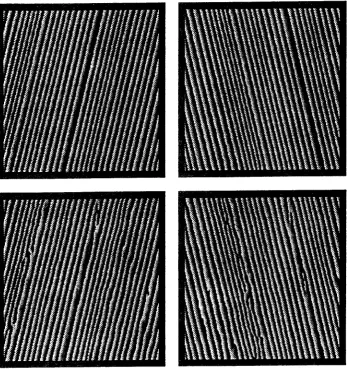
figureI
a two dimensionalpattern
consisting of the summation of trvo one dimensional translating noise sequencesin
time is shown. The noise sequence has beenfiltered with
a quadraturefilter pairs (Gabor
functions) tunedto
thedirection of the motion patterns. The instantaneous frequency is simply the gradient of the
phase function.
Results are shown
for the
translating noise patterns shownin
figures 2a andb.
Theorientation difference between flow fields was 0.49
radians. For
the case of additive noiseFigure
l:
a/
Top
Left
Additiae
Trsnsparencyfor
two 1-d, noise signals.6/
Top
Right
M ultipl i c atiu e tran sp aft n c Y.
flow field was found
to
be -0.005?0 radiansfor
leftward motion, and -0.000797 radians forrightward
motion.
The standard deviation of errorsin
velocity was measuredat
0.02841and 0.02766 radians respectively. We also show the energy response
from the filters
usedin
figure2a.
Noticethat the
energy term is senstitiveto
interferencefrom
the other flowfield, which is
particularly true
when the magnitudeof the
energy responseis
low.
This result provides further evidence for the stability of phase information over energyIt4]in
the context of image analysis. Figure 3 shows phase contours after reducing the contrast of the leftward moving noise pattern of figurela
to
30%by comparison to the rightward pattern.The mean velocity error
for the
stronger signal was foundto
be -0.000697 as opposed to-0.002009 radians,
with
a standard deviation of 0.01617in
contrast to 0.06381 radians.It
isclear, that a reduction in contrast does affect the stability and accuracy of the measurement
process. The
final
examplein l-d
is that of
multiplicative motion transparency(lb
and2b). In
this case rve have obtained the poorest resultswith (this
is not surprising since themultiplication of trvo noise patterns is equivalent to the convolution of the Fourier spectra of
the two signals in the frequency domain, and hence highly unrepresentative of the original'
patterns) a mean error of 0.006944 and 0.000093 radians, and standard deviation of 0'0696
and 0.0891 radians respectively
for
leftward and rightward motion.The final example
in
7 shows the velocity and error fieldin
the case of 2-d motion,with
Figure
2:
a/
Top
Phase contoursfor
two
orientedfilters
for
additiae transparency'Bottom
Phase contoursfor
rnultiplicatiue transparency taken from figure 1Figure
3:
Phase contoursfor
two oriented. filtersfor
additiuetransprency
taken from figurepa with
the
contmstof the
pattern moaingto
the leftat
30%to
that of
the pattem rnouingto
the nght.1l
-o
\,uaf"
'o
Y-\,
Irl
r,ao'\ \ \
|
|tf:
Y1
u''
N
4
,l
{
I
,i l
t
,t [image:14.595.56.429.108.298.2] [image:14.595.59.239.446.633.2]of
uelocity flowsfor
figure 2a and.2b.
Velocityerrors
are giaenFigure
5:
Needle d'iagramin
the tert.tt
M
II
rliagrarn
ol
uelocity flowsfor
figurewith
a contrastratio
of 1:3to
that2a
with
the pattern translatingto
theof the pattern mouing
to
the right. Figure6:
Needle^fifififi{I
If
^^^^^t^
tffifttffiffififi[[fififi
A
AAAAAAAAAAAAA
AAA
n
A AAAnAn AnnAAA
AAA
AAAAAAAAAAAAAAAAn
fiffilfffiiltfififififi^tt^^
[image:15.595.71.439.58.254.2]^^^^^^^^fififf^fififififi
Figure
7: a)
Needle d.iagramfor
uelocity flowsfor
twouith
independent rnotion. b) Er'ror aectors'6
Conclusion
random noise fields of equal contrust
This
paper outlines a new methodfor
computing multiple optical flows usingquadrature-pair
filters and their first-order derivatives. The approach is extendable to severalindepen-dent
velocities by increasing the numberof filters
and modifying our constraint equation.The
basic approach is viewed a variation on the theme discussedin
detail by Shizawa andMase. But
it
offers a substantiallydifferent
persepctive, sinceit
requiresonly
first-orderfilters,
and a mechanism to estimate instantaneous frequency.There are a number of advantages
in
the approachthat
we have chosen.In
particular,our
processing paradigm allows higherorder
(deformation,dilation, rotation)
propertiesof
the optic flow field
to
be
derivedfrom further
differentiationof
the
bandpass signalrepresentation. Additionally,
our preliminary
results indicatethat our
theory can also be appliedto
the case of stereopsis. This direct extension of our technqiue is possible because werestrict
our processing tofirst
order operators, and hence obtain a discrete approximateto
differentiation.
Furthermore,it
is
hopedthat
the multiple
velocity estimates can bemade more robustl."- rvithout requiring second
or
higher order differentiation of the image.Shizawa and Mase[23] also proposed
a theory to
determine themultiplicity of
image flow.We
havenot
approachedthis important
aspect, sincethe
mainpoint
of our
paperis to
highlight
the reductionin
differential orderthat
is possible by phase based analysis.Finaily, although mentioned
in the introduction,
we have not discussed the role of theenergy derivative
in
the contextof multiple
flows. At
present we are unsure about thestability
of this parameterwith
respectto
real image data, and this remains a question forReferences
[l]
Adelson.E.Hand Bergen.J.R.
Spatiotemporal energ,' modelsfor the
perception ofmotion. J.Opt.
Soc.Am.
A,2,2:284-299' 1985'[2]
Adelson.E.H.and Movshon.J.A.
Phenominal coherenceof
moving visual patterns'N ature, 300:523-525, 1982.
[3] Atherton.T.J.
The detection and measurement of visualmotion. Patten
RecognitionLetters, 5,2:157 -163, 1987.
[4]
Bergen.J.R,Burt.P,
Hingorani.R, and Peleg.S.Computing two
motionsfrom
threeframes. Proc. 7rd
ICCV,
Osaka,Japaz' pages 27-32,1990'[5]
Deriche.R and Faugeras.O. Tracking line elements.In
Faugeras.O,editor,
Computervision-ECCV
g0, pages 341-345, Antibes,France, 1989. Springer-Verlag.[6] Fleet.D.J. PhD
thesis, University of Toronto, 1990'[T]
Fleet.D.J and Jepson.A. Stability
of
Phaseinformation.
IEEE
workshopon
VisualMotion,
Princeton., 1991.[g]
Fleet.D.J and Jepson.A.D. The computationof normal
velocity from local phasein-formation. IJCV,
5:77-104, 1990.[9]
Franks.L.Signal
Analysis. Prentice-Hall,Inc,N'J', 1969'[i0]
Girod.B and
I{uo.D.
Direct
Estimationof
DisplacementHistograms.
Proc. Image Understanding and ll'lachine Vision., pages 73-76' 1989'[ll]
Heeger.D.J.A
modelfor
the extractionof
imageflow.
J.Opt.Soc-Am,4:1455-147I,1987.
[12]
Horn.B.Ii.P
and Schunk.B.G. Determiningoptic flow-
Artifcial
Intelligence,lT:185-204, 1981.
[tf]
Jasinschi.R and Rosenfield.A. Sumi.K. The perception of visual motion coherence andtransparency: a statististical model. Technical
report, Univ.
Maryland, 1990.[15] Langley.K.,
Atherton.T.J.,
Wilson.R.G., and M.H.E.Larcombe. Vertical andHoizon'
tal
Disparitiesfrom
Phase.(Ed.)
Faugeras.O, Proc. ECCV,Antibes , Springer-Verlag, 1990.[16] Langley.K and
Fleet.D.J.
Causal velocity mechanisms appliedto
transparent surfaces.Perception, 20:79, 1991.
[12] Langley.K and
Fleet.D.J.
Using group phase to solve the aperture problem. Submittedto
ECCV9-|, 1991.[18] Langley.K, Rogers.B.J, and
Brady.J.M.
The Computationof
Deformation andRota-tion in
stereopsis.BMVCq|,
Uniaersityof
o{ord,
pages 341-346, 1990.[i9]
Marr.D.
Vision. W.H.Freeman&
Co., 1982.[20] Papoulis.A. .Sysf ems
and
Transformswith
Applicationsin
Optics.McGraw-Hill,
NewYork, 1968.
[21] Shizawa.M and Mase.K. Determining multiple optic flow using spatio-temporal filters.
ICPL77, atlantic City,
pages 274-278,1990.[22] Shizawa.M
and
Mase.K.
Principle
of
Superposition:
A
common
Computational Frameworkfor
Analysis
of
Multiple
Motion.
IEEE
workshopon
ttisual
mo-tion, Princeton, N.J.,
199I.[23] Shizawa.M and NIase.K.
A
unified computational theory for motion transparency andmotion
boundaries based on eigenenergy analysis.CVPL|1,
Hawaii, pages 289-294, 1991.[2a] Uras.S, Girosi.F.
Verri.A, and Torre.V.
A
Computational Approachto
Motion
Per-ception. Biological Cybernetics, 60:79-87, 1988.1990-To
showthat our
approach can be viewed as formely equivalentto
that of
Shizawa and Nlase[21, 23], we form two constraint equations based upon instantaneous frequency:A
Tensor
Product
Formulation of
Constraints
ovf v2or
ovlvtor
-0
:0
where
f,l:
[&r;, kz;,u;]Tisa3xn
matrixfori:
l
tonandVl
:
lut,uz',|)r',Yz:lu1,u2,Ifr
and
n
isthe
numberof
independent measurements. The additionof the two
constraintsgives:
QVoxOT
:0
u*:|Vr8%
+vr&Y,l
vec(f,lrv-o)
:
(or
@
or)vec(V-)
where @ denotes the Kronecker product, and vec(V^) refers
to
the 9x1 vector obtained bystacking the elements
of
V-
in
sequence, weobtain a
least squares estimateof
vec(V*)using:
(oSoxor@or).,""(v*)
:
(oor@onr;"ec(V-)
:
s (26)The matrix
(AI
OXOrI
A")
has dimensions 9x9 , and is symmetric andwith
rank 5, inthe
case of trvo unambiguous flow fields while the column vector:(up2*uzut)
ur*uz uruz+uzur
u1*uz u1*u2
"+u,.Lfe7\
vec(V-)
-lu1u2,T,-T=,-,u{)2,
Z ,-T'-
2
','r
\-'t
can be solved
for
using the properties of symmetryto
reduce the eigensystem from 9to
6in
a similar manner to Shizawa and Mase. Thus our approach is directly equivalentto
thatof
Shizawa and N,lase.but
derived entirely fromfirst
orderfilter
kernels.B
An Alternative
Least-squares
Minimization
As
an alternativeto
the eigenvalue problem discussed abovewith
respectto
(13) through(15),
here we show a similar least-squares problem solved using the pseudo-inverseof
thenormal equations.
Werewrite (13) through
(1S)by
breakingm
into the form
(A,12)
rvhere c,,'2 is the last element
of
m'
Then (13) becomeswith:
using the identity:
(21)
(22)
(24)
(25)
(23)
where.,q.:(*?,ti,[,k2,k1.,.,kzr)r,x=(u1u2,
1)f)2,1t'{)2*uzur,u1
*uztq1u2)T'In
this case, the least-squares solution
to
the five elements ofx
minimizes the squared error:D(*te,
+,r|)'?
.J
The corresponding normal equations are then solved by:
(2e)
x
=
(Mr
M\-'i['*
, (30)where the columns of.
i[r
areAi,
and thejlh
element ofw
isu].
In order
to
include the energy weightingon
the instantaneous frequencies we includethe diagonal weight
matrix,
fi
=
diaglFa,..,Enl,
where the diagonal entries represent theenergy response
from
each quadraturefilter
pair usedto
estimate instantaneous frequency.Then