THE .APPLICATION OF REGRESSION TREES TO DETECTING MULTIPLE STRUCTURAL BREAKS IN TIIE
MEAN OF A TIME SERIES
Carmela CAPPELLI, William S. REA and Marco REALE 1
Department of Mathematics and Statistics University of Canterbury
Private Bag 4800 Christchurch, New Zealand
Report Number:
UCDMS2007 /4 JUNE2007The Application of Regression Trees to
Detecting Multiple Structural Breaks in the
Mean of a Time Series
Carmela CAPPELLI, William
S. REA, and Marco REALE
1A non parametric approach is proposed for dating structural breaks whose
number and dates of occurrence are a priori unknown. In particular, the case of
level shifts is considered. For the purpose of locating the breakdates the method
exploits, in the framework of least square regression trees, the contiguity property
introduced by Fisher for grouping a single real variable. The proposed approach
is applied to study the changes in growth rates in Campito Mountain bristlecone
pines, a standard example of a long memory time series.
Key Words: Fisher's algorithm; Least square regression trees; CUSUM; Bai and
Perron procedure.
1 INTRODUCTION
The detection of structural breaks is an important problem in time series
analysis that has attracted the attention of both statisticians and
econome-tricians for more than forty years (for a review see Hansen 2001). In this
1Carmela Cappelli is a Researcher, Department of Statistical Sciences, Universita
di Napoli Federico II, Via L. Rodino n.22, Naples, I-80138. William Rea is a PhD student, Mathematics and Statistics Department, University of Canterbury, Private Bag 4800, Christchurch. Marco Reale is a Senior Lecturer, Mathematics and Statis-tics Department, University of Canterbury, Private Bag 4800, Christchurch. (E-mail:
paper we focus on the problem of detecting multiple breaks occurring at
unknown dates. To this aim, recently, Bai and Perron (1998, 2003) have
pro-posed an estimation procedure that makes use of a dynamic programming
approach that can be traced back to Fisher's method of exact optimization
(Fisher, 1958) for grouping a single real variable into mutually exclusive
and exhaustive subsets having maximum homogeneity, i.e. minimizing the
within-group sum of squares.
Regression trees (RT) are a non-parametric method for fitting piece-wise
constant functions to a data set. The boundaries between the constant
func-tions are steps. These are often regarded as a drawback or weakness if the
variable being modeled is continuous. However, change point analysis is
un-dertaken when it is believed that the underlying data generating process is
discontinuous, or at least changes rapidly between two distinct states, at
the change or break point. In this context it seems natural to interpret the
discontinuities in the RT as the break points in the process. There is a
sub-stantial body of literature dealing with change point detection and location
in time series. However, apart from the papers of Cooper (1998) and
Cap-pelli, Penny, Rea and Reale (2007) the application of RT to this problem
appears to be an overlooked tool.
In this paper we describe the use of RT in the location of structural
(3) presents the results of a simulation study on using RT to find
struc-tural breaks in the mean. Section (
4)
presents an illustrative application tothe changes in the tree-ring index of Campito Mountain, California. Brief
concluding remarks follow in Section
(5).
2 REGRESSION TREES
Hyafil and Rivest (1976) showed that the problem of obtaining an optimal
binary decision tree is NP-complete. Thus, with the exception, of small data
sets, it is computationally impractical to search for an optimal tree. Despite
their sub-optimal results, RT have found wide application owing to their
computational efficiency. This allows them to handle large data sets with
relative ease. Probably the best known regression tree methoclology is the
Classification and Regression Tree ( CART) of Breiman, Friedman, Olshen
and Stone (1984) to which the reader is referred for a detailed description of
RT.
The recently proposed procedure of Bai and Perron (1998, 2003) (BP) is
based on Fisher's (1958) method of exact optimization. While the BP
pro-duces an optimal partition of a time series, it is a computationally expensive
procedure.
volatilities, tree-ring indices, mud-varve sequences, and ice core data are very
long. Sometimes the geophysical series exceed 10,000 data points with annual
resolution. The long compute times and large memory requirements of the
BP makes its use impractical on these types of series. We show that RT
provide a practical alternative for locating structural breaks in the mean of
long time series data. In the context of RT time assumes the role of the
predictor variable when, in fact, it is merely a counter. A common source of
poor predictive performance in RT is that the distribution of the response
variable is not orthogonal or parallel to the predictor variables (see Fig 8.12
of Hastie, Tibshirani and Friedman 2001, for an example). This problem
does not arise in univariate time series. This gives us reason to suspect they
will perform well in the location of structural breaks.
There are several questions to be addressed in applying RT to time series.
These
are:-1. As RT fit piece wise constant functions to data do RT discover or
impose breaks on time series?
2. What is the effect of serial correlations on RT performance in detecting
structural breaks?
3. Given that observations in time series are, in general, non-interchangeable
Consider the time series model:
Yt
=
µ9+
Et, g=
1, ... , G, t=
T9 _ 1+
1, ... , T9 , (1)where G is the number of regimes ( and G -1 the number of breakdates), Yt is
the observed response variable and f.t is the error term at time
t
(we adopt thecommon convention that To= 0 and Ta= T where Tis th~ series length).
This is a pure structural breaks model because all the model coefficients are
subject to change and it has been employed by Bai and Perron (2003) to
detect abrupt structural changes in the mean occurring at unknown dates.
The problem is to estimate the set of breakdates (T1 , ... , T9, .•. , Ta-i) that
define a partition of the series
P(G)
=
{(1, ... , Ti), ... , (T9-1+
1, ... , T9 ), ••• , (Ta-1+
1, ... , T)},... ~,_,;.,;:;,
·~
1<,.·I'-·into homogeneous intervals such that µ9
i=
µ9+1. The BP estimation method. ·is based on the least squares principle: for each G-partition, the
correspond-ing least square estimates of the µ9 's are obtained by minimizing the
within-group sum of squares
G T9
WSSylP(G) =
I: I:
(Yt -µg)2.
(2)
g=l t=T9-1+l
The estimated breakdates
(T'
1 , ... ,T
9 , ••• ,Ta-
1 ) are associated with thepar-titian P*(G) such that P*(G) = argminP(G) WSSvlP(G)· In this approach,
all possible partitions by using the dynamic programming approach proposed
by Fisher,s (1958) to find the least squares partition of T contiguous objects into G groups. His efficient algorithm exploits the additivity of the sum
of squares criterion using a dynamic programming approach (Bellmann and
Dreyfus 1962) that when applied to ordered data points finds the global
min-imum. Despite the computational saving, the method cannot deal with high
values of T and G and the same remark holds for the BP,s procedure, even
with todais computing power.
In the case of time series data Hartigan (1975) provides an excellent
justification in favor of the (faster) binary division algorithm: suppose that
the observed time series consists of G segments within each of which the
values are constant, i.e. model (1) becomes a piecewise constant model with
f.t = 0. The series can be partitioned into G segments where for each segment
the within-group sum of squares is zero. This partitioning can be identified
by a sequential splitting algorithm such as the one in RT.
The binary splitting used by RT does not necessarily provide the optimal
partition, however if the correct number of partitions is identified, because
the observations are ordered by time, misplacements can occur only on the
boundaries. As discussed in Hansen (2001), although structural breaks are
treated as immediate, it is more reasonable to think that they take a period
concern.
Despite the potential suboptimal solutions, RT has the advantage over
global search algorithms as used in BP method in being computationally
fast. The global search algorithm requires O(n2
) steps, whereas RT, at any
tree node requires O(n(h)) steps to identify the best split, where n(h) is the
number of values in node h.
Another distinction between RT and the global search algorithm is in the
selection of the final partition and the consequent set of break dates.
In-deed, partitioning methods such as Fisher's (and BP's) have the drawback
of producing a single partition for a prespecified value of G and, in general,
it is advisable to produce and compare more partitions by varying G. In the
case of RT this is not a concern because the method produces a hierarchical
tree structure associated with the breaks. The selection of the final set of
breakdates can be handled within the framework of tree methods by pruning.
Pruning is the process of retrospectively discarding branches whose
contribu-tion to the reduccontribu-tion of the error is negligible (for details see Breiman et al.
1984, Chap. 3). In this way a nested sequence of partitions and candidate
breakdates is created. In order to select the optimal sequence
correspond-ing to the actual number of break dates and distinct subperiods present in
the data, cross validation (CV), the sequential testing procedure of BP and
selection criteria in regression trees see Su, Wang and Fan 2003). Moreover,
the inspection of the tree structure allows an insight into the partitioning
process. Breakdates can be ordered based on their position in the tree and
the reduction of the error function achieved. For this reason manual pruning
based on subjective choices of the analyst can be preferre1 to an automatic
procedure, see Zhang and Singer (1998, Chap. 4).
Finally, note that if estimation is not the sole concern and one wants to
test for structural breaks or model the observations in the segments, it can be
appropriate to consider restrictions on the possible values of the breakpoints
as suggested by BP. Indeed, extra conditions on the reduction in deviance
and/or on the length of the subperiods are easily handled within the tree
growing recursive partitioning approach of RT.
3 SIMULATION EXPERIMENTS
In this section we present the results of simulation experiments using RT to
detect structural breaks. For comparison purposes we used the estimation
procedure proposed by BP based on the Fisher's method of exact
optimiza-tion.
For the RT method we used tree growing and pruning procedures as
BP method we used the contributed package strucchange (Zeileis, Leisch,
Hornik and Kleiber 2002) in R.
3.1
UNCORRELATED SERIES WITH A SINGLE BREAKA set of simulations were run with series of uncorrelated observations drawn
from standard Normal, geometric and gamma distributed populations with
a single break point at the midpoint of the series giving two equal lengthed
regimes. In most simulations there where 16 regime sizes, 52 to 202
obser-vations in length. Thus in the graphs of the results the axis labeled Regime
Number is non-linear in scale. The break sizes ranged from 0.05 to 2
stan-dard deviations in steps of 0.05 stanstan-dard deviations. 1,000 replications of
each combination of regime length and break size were run. For the
com-parable results from the BP the break sizes ranged from 0.1 to 2 standard
deviations in steps of 0.1 standard deviations. The longest series were
com-posed of 256 data points per regime (regime 16). 100 replications were run
of each parameter combination. The results for the standard normal
simu-lations are presented here, the remainder are available on request from the
authors.
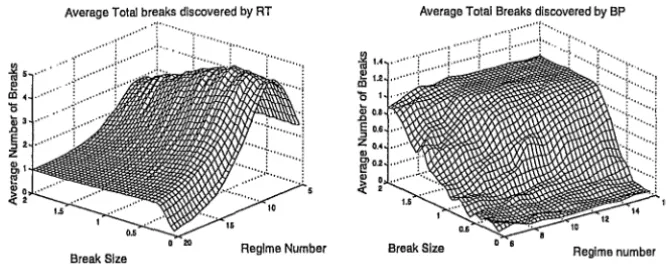
Figure (1) presents the results for the RT and BP for a single break at
Average Total breaks discovered by RT Average Total Breaks discovered by BP
,,,.,
[image:11.600.128.461.146.285.2]J:;
rr ;
r1: ,
...
··· ···
0 1 ...
16
Break Size
Break Size Regime Number Regime number
Figure 1: Left panel: Average total number of breaks found by RT. Right panel: Average total number of breaks found by BP. Simulated series of un-correlated observations with Gaussian noise and a single break. Pruning based on cost complexity using deviance. Break size is measured in terms of standard deviations. Regime number refers to the length of the series, regime 5 is length 52 and the series is 2
x
52 long, regime 20 is length 202 and theseries is 2
x
202 long.reversed in the BP results compared to the RT results. When the series are
short the RT is very prone to over-fitting but that this tendency gradually
disappears by a series length of approximately 700 data points (regime 18 or
19). RT had a tendency to over-fit for smaller breaks and for shorter regimes.
BP tended to under-fit for smaller breaks and for shorter regimes.
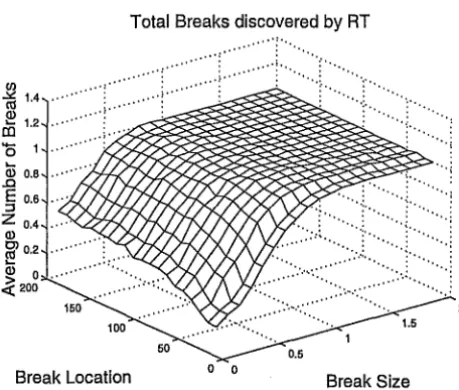
We tested the RT ability to find the location of the break when the break
Total Breaks discovered by RT
en ~ 1.4 ,•'
(I)
[O 1.2
'51
] 0,8 ,,,
~ 0.6
Z 0.4 (I)
g' 0.2
Q) 0 ~200
.... ....
Break Location
··r· ·· ...
,.,···:·, ':···· ...
.... ·· .. : ..
0 0
..
::)"··
...···· ... ! .. ·::.:.:.:.l:::::.
Break Size
2
Figure 2: Average total number of breaks found by RT. Simulated series of
400 uncorrelated observations, Gaussian noise and a single break at different
locations. Pruning with Bayesian Information Criterion.
examined series with 100, 400, and 1600 observations. The BP was not run
for comparison. We present the results for the 400 data point series, the
remainder are available on request from the authors.
The results are presented in Figure (2). The dominant factor in locating a
break is its size rather than its location. Unsurprisingly, it was more difficult
[image:12.600.179.409.143.338.2]3.2
UNCORRELATED SERIES WITH MULTIPLE BREAKSTo investigate the performance of RT for series with multiple breaks we
simulated series with 4 breaks:
(3)
where
µr;
=
the mean of regime ri; i=
1, ... , 5Et
=
!1oise terms drawn from an N(0,1), gamma, or geometric distribution.In all simulations µr;
=
0 for i=
1, 3, 5 and µr4=
-µr2 , The value of µr2started at 2 standard deviations and was decremented to 0.05 in steps of 0.05.
When the BP was used to detect breaks in the series, because the amount of
computation required, the value of µr2 was sometimes decremented to 0.1 in
steps of 0.1.
The resultant series were square waves with an amplitude of break size
with Gaussian ( or other) noise of constant variance imposed on them. We
present the results for the Gaussian noise series. The remainder are available
on request from the authors.
We also examined three tree-pruning methods. The deviance-based cost
complexity, the default method in the R package, the Bayesian Information
infor-mation criteria available we selected the BIO on the basis of Su et al. (2004) and because it is more robust to non-Gaussian error structures than the AIC
(Akaike 1970).
Total breaks discovered by BP
16
Break Size
[image:14.602.128.500.223.364.2]Regime Number Break Size Regime number
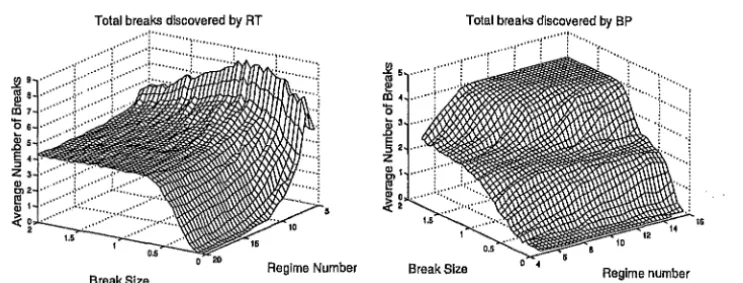
Figure 3: Left panel: Total number of breaks found by RT in the noisy square wave simulations. Deviance based cost-complexity pruning. Right panel: To-tal number of breaks found by BP. The series have four breaks and Gaussian noise.
It is well-known that tree-based procedures over-fit small datasets (Cooper
1998). Thi~ can be seen in the left panel of Figure (3). However, as the series
lengthens the problem of overfitting reduces and is not evident by regime 15
(length of about 1000 data points). This is where the compute times of the
BP begin to become excessive. The BP method underfit for small breaks
particularly for for short series.
Total breaks discovered by RT Total breaks discovered by RT
0.6 20
Break Size Regime Number Break Size Regime number
Figure 4: The average total number of breaks found by RT when using BIG
pruning (left panel) and leave-one-out cross-validation (right panel). The
series have four breaks and Gaussian noise.
aggressive pruning criteria than the usual R-default cost-complexity pruning
introduced by Breiman et al. (1984). The results of BIC and
leave-one-out cross-validation are presented in the left and right panels of Figure ( 4)
respectively.
In time series data observations are usually not interchangeable. Thus the
common 10-fold cross-validation cannot be used. The alternative we
consid-ered was leave-one-out cross-validation. This minimizes the disturbance to
any correlation structure in the data but it is much more computationally
expensive than the BIC, requiring N trees to be constructed where N is the
number of data points. The leave-one-out cross-validation pruning reduced
[image:15.597.129.470.153.294.2]for its robustness to non-Normality, but note that for series with more than
approximately 600 data points the BIC becomes indistinguishable from the
default cost-complexity pruning.
3.3
SERIES WITH CORRELATED DATATo investigate the ability of RT and BP to detect structural breaks in
corre-lated data we analyzed series with AR(l), AR(2), AR(5), and MA(l)
correla-tions. The results for the AR(l) series are presented here and the remainder
are available on request from the authors.
Average Total breaks discovered by RT
AR(1) Parameter Break Size
i ~
~
:0 •
0 "
Cl)
0 •
E
:,
z •
~ Iii •
~
Number of Breaks Discovered by BP
..
..
[image:16.602.127.452.387.531.2]AR(1) Parameter
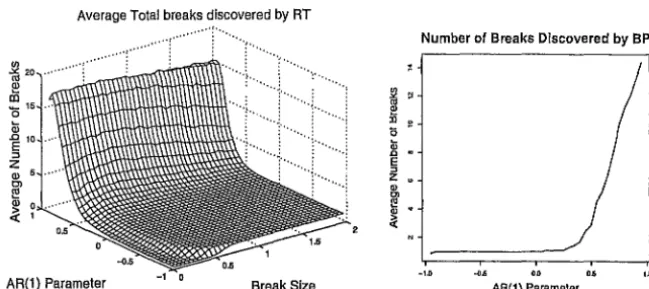
Figure 5: Left panel: Average total number of candidate breaks found by RTs in series with AR(i) correlations and a single break. Default pruning. Right panel: Comparable results from the BP for a break size of two.
The left panel of Figure (5) show the results for the RT. The right panel
the results of the BP for a break size of two standard deviations. All series
were 1024 observations long. It should be noted that the series standard
deviation changes with the magnitude of the AR parameter. The break size
was measured in terms of the input noise series.
Both RT and the BP are robust to negative values of the AR parameter
and to small positive values (less than 0.25). However, neither break
detec-tion method is robust to larger positive values, each finds increasing numbers
of spurious breaks as the AR parameter approaches unity.
We found that the RT had similar robustness to MA correlations except
that they induced far fewer spurious breaks when the MA parameter was
higher than 0.25. In the worst case an average of less than one spurious
break per series was reported.
3.4
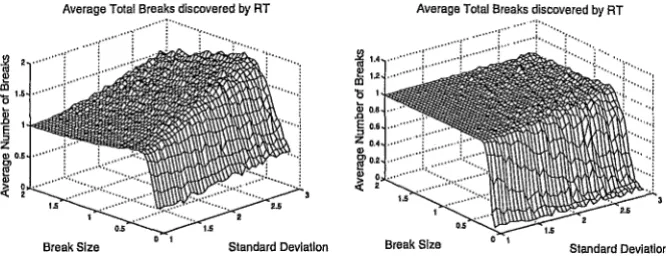
SERIES WITH HETEROSCEDASTICITYWe examined RT robustness to heteroscedasticity by simulating series with
a break at the mid-point and different standard deviations in the two halves.
The first half always had a standard deviation of one. The break size is
stated in standard deviations of the first half. The second half had a standard
deviation ranging from one to 2.95. We examined two lengths of series, 800
and 1800 data points. We did not run BP for comparison due to the excessive
Average Total Breaks discovered by RT
i
2 ... (·""i~u
···r
Break Size
··r ... , ... ,
... .
Standard Deviation Break Size Standard Deviation
Figure 6: Average total number of breaks found by RT in series with
het-eroscedasticity. Left panel - 800 data point series. Right panel - 1800 data
point series. Deviance-based cost-complexity pruning. The series had one
true break.
The results are presented in Figure (6). RT is more robust to
het-eroscedasticity in the longer series than in the shorter series. This is
consis-tent with the other observations presented in this paper that the problem of
over-fitting declines with increasing series length.
4 APPLICATION: CAMPITO MOUNTAIN TREE
RING INDEX
To illustrate the RT method in comparison to the BP method we applied both
methods to the Campito Mountain bristlecone data. The dataset is available
[image:18.597.126.459.146.277.2]/Books/HipelMcLeod/lamarche/ campi to .1 and is also available in the
li-brary of the contributed package tseries in R. These data are regarded as a
standard example of a long memory process (see Doukhan, Oppenheim and
Taqqu 2003). Klemes (1974) argued that the appearance of long memory
in geophysical time series was often a statistical artefact caused by a
non-stationary mean. Despite Klemes' arguments and numerical experiments he
could not demonstrate the correctness of his proposal from data analysis.
The physical cause or causes of long memory is still an open question. We
examine the Campito data with RT and BP to see if a non-stationary mean
can be detected.
We ran the BP on the Campito data twice. The first time with the
mini-mum segment size set to 0.05 times the length of the series or approximately
270 data points. The second time with the minimum segment size set to 0.01
or approximately 54 data points. The second run took almost 243 hours of
CPU time on a SunBlade 1000 with 750Mhz UltraSPARC-III processor and
2Gb of memory. By comparison the RT took 0.16 seconds. This supports
our contention that regression trees are a practical, if sub-optimal, tool for
analyzing long time series.
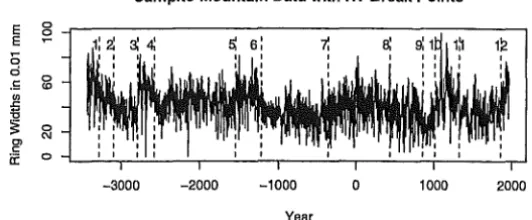
Figure (7) presents the Campito data with the break points marked for
both the regression tree and the BP with the minimum segment size set to
Campito Mountain Data with RT Break Points
E 0 0
E ~
~
0
d
0
.5 co
U)
.c
i5
~ 0
C) (\J
c
ii: 0
-3000 -2000 -1000 0 1000 2000
Year
Campito Mountain Data with BP Break Points
E 0 0
E ~
ci
0 0
.5 co
U)
=
'O
~ 1il
C)
.5
0
[(
-3000 -2000 -1000 0 1000 2000
Year
Figure 7: Regression (RT) and Bai and Perron (BP) break points marked on
the Campito data.
the break points are essentially identical. With a minimum segment size of
0.01 the BP reported 40 break points. We regard 40 breaks to be an excessive
number and do not report them here. They are available on request from the
authors. We attribute the difference in the reported numbers of break points
between the RT and the BP to be due to the penalty terms applied in pruning
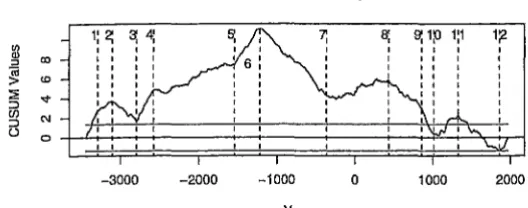
[image:20.600.156.422.166.276.2]CUSUM with RT Breakpoints - Campito Mountain Data
1: 2:
s:
4lII) I
Q) ex, I
~
I(l) I
I
::;; 'St
::,
en N
::, (.)
0
-3000 -2000 -1000 0 1000 2000
Year
CUSUM with BP Breakpoints - Campito Mountain Data
1' I 2:
s:
4' I &,s:
1:0 1:1 1~ 113II)
Q)
<D ::,
iii
> (l)
::;; 'St
::,
en N
::, (.)
0
-3000 -2000 -1000 0 1000 2000
Year
Figure 8: Regression tree (RT) and Bai and Perron (BP) break points marked
on CUSUM graphs for the Campito data.
trees. It is not clear how to select the optimal number of breaks in the BP.
Figure (8) presents both the tree and BP break points on a cumulative
summation (CUSUM) (Brown, Durbin and Evans 1974) graph. The CUSUM
graph in interpreted subjectively by examining the slope of the plot with
regard to the five percent significance lines plotted parallel to the horizonal
[image:21.598.155.425.149.452.2] [image:21.598.160.424.176.280.2]an above average growth rate. Conversely, when the slope is negative the
tree is experiencing below average growth. In these plots there are several
places where the RT breaks appear more physically reasonable than the BP
breaks.
The first is the regime between breaks three and four in RT, which most
closely relate to breaks two and three in the BP. The RT places the break at
the end of a period of above average growth while BP includes a short period
of below average growth. Similarly RT breaks nine through 12 seperate out
the above and below average growth periods. In the corresponding period BP
breaks 11, 12, and 13 generate regimes which mix above and below average
growth rates.
One the other hand, for break point six, the RT places this at the highest
point on the CUSUM plot whereas the BP displaces this slightly to the left.
Examining the break points in Figure (7) the BP break point appears the
more reasonable.
5 CONCLUDING REMARKS
We have proposed a new application of RT by using them as a data driven
nonparametric procedure for detecting multiple structural breaks in the mean
to our three original questions. They are,
1. RT do impose spurious breaks when the series is short but this tendency
disappears as the series becomes longer. This was seen in both single
and multiple break simulations.
2. RT are robust to negative serial correlation and a small amount of
positive correlation, but in this regard they are no worse than the BP.
3. Leave-one-out cross-validation can be used for tree selection but is
com-putationally expensive.
The main advantages of the proposed approach are:
1. simplicity -it can be easily implemented or run with packages contain-ing routines to grow and prune least squares regression trees;
2. feasibility - it can be used to find the least squares partition of an ordered sequence and is particularly suited to long series which are
currently not practical to analyse with the BP;
3. visualization - it results in a nested hierarchy represented by a tree diagram that displays the whole partitioning process and allows the
scientist to interact with the tree and make use of a priori knowledge. Although RT do not necessarily find the global minimum, their results
series are long. In the example data set the breakdates for both the RT and
BP coincide at a number of points. Also, in our example data set some of
the RT break points are more physically reasonable than the optimal break
points of the BP.
The application to the Campito Mountain data shows that Klemes'
con-tention that the Hurst effect is caused by a non-stationary mean is supported
by both the RT and BP. However, the RT is computationally orders of
mag-nitude faster than the BP for this series.
As with any statistical test or modelling procedure, regression trees must
be used with care and discernment. For an experienced time series analyst
who must deal with long series, RT provide a complementary procedure to
the BP when detecting and locating structural breaks in the mean.
Acknowledgements. Carmela Cappelli acknowledges financial support
from Dipartimento di Scienze Statistiche.
References
Akaike, H. (1970), "Information Theory and an Extension of the Maximum
Likelihood Principle," in 2nd International Symposium on Information
Theory, eds. B.N. Petrov and F. Csaki, Budapest: Akademia Kadio,
Bai, J., and Perron, P. (1998), "Estimating and Testing Linear Models with
Multiple Structural Changes," Econometrica, 66, 47-78.
Bai, J., and Perron, P. (2003), "Computation and analysis of multiple
struc-tural change models," Journal of Applied Econometrics, 18, 1-22.
Bellmann, R. E., and Dreyfus, S. E. (1962), Applied Dynamic Programming,
Princeton: Princeton University Press.
Breiman, L., Friedman, J. H., Olshen, R. A., and Stone, C. J. (1984),
Clas-sification and Regression Trees, Monterey (CA): Wadsworth & Brooks.
Brown, R. L., Durbin, J. and Evans, J. M. (1974), "Techniques for Testing
the Constancy of Regression Relationships over time," Journal of the
Royal Statistical Society B, 37, 149 - 163.
Cappelli, C., Penny, R. N., Rea, W. S., and Reale, M. (in press),
"Detect-ing Multiple Mean Breaks at Unknown Points with Regression Trees,"
Mathematics and Computers in Simulation.
Cooper, S.J. (1998), "Multiple Regimes in U.S. Output Fluctuations,"
Jour-nal of Business and Economic Statistics, 16, 92-100.
Doukhan, P., Oppenheim, G., and Taqqu, M. (2003), Theory and
Fisher, W.D. (1958), "On Grouping for Maximum Homogeneity," Journal
of the American Statistical Association, 53, 789-798.
Hansen, B. E. (2001), "The New Econometrics of Structural Change:
Dat-ing Breaks in the U.S. Labor Productivity," Journal of Economic
Per-spectives, 15, 117-128.
Hartigan, J. A. (1975), Clustering Algorithms, New York: John Wiley &
Sons.
Hastie, T., Tibshirani, R., and Friedman, J. (2001), The Elements of
Sta-tistical Learning, New York: Springer Verlag.
Hyafil, L., and Rivest, R. (1976), "Constructing Optimal Binary Decision
Trees is N-P Complete," Information Processing Letters, 5, 15-17.
Klemes, V. (1974), "The Hurst Phenomenon: A Puzzle?" Water Resources
Research, 10, 675-688.
Morgan, J. N., and Sonquist, J. A. (1963), "Problems in the Analysis of
Sur-vey Data and a Proposal," Journal of American Statistical Association,
58, 415-434.
Schwarz, G. (1978), "Estimating the Dimension of a Model," Annals of
Su, X. G., Wang, M., and Fan, J. J. (2004), "Maximum Likelihood
Regres-sion Trees," Journal of Computational and Graphical Statistics, 13,
586-598.
Zeileis, A., Leisch, K., Hornik, K., and Kleiber, C. (2002), "Strucchange:
an R Package for Testing for Structural Breaks in Linear Regression
Models," Journal ofSta#stical Software, 7, 1-38. ·
Zhang, H., and Singer, B. (1998), Recursive Partitioning in the Health