ORIGINAL RESEARCH
PATIENT SAFETY
What Does the Boxed Warning Tell Us? Safe Practice of Using
Ferumoxytol as an MRI Contrast Agent
XC.G. Varallyay,XG.B. Toth,XR. Fu,XJ.P. Netto,XJ. Firkins,XP. Ambady, andXE.A. Neuwelt
ABSTRACT
BACKGROUND AND PURPOSE: Despite the label change and the FDA’s boxed warning added to the Feraheme (ferumoxytol) label in March 2015, radiologists have shown increasing interest in using ferumoxytol as an MR imaging contrast agent as a supplement or alternative to gadolinium. The goals of this study were to provide information regarding ferumoxytol safety as an imaging agent in a single center and to assess how the Feraheme label change may affect this potential, currently off-label indication.
MATERIALS AND METHODS: This retrospective study evaluated the overall frequency of ferumoxytol-related adverse events when used for CNS MR imaging. Patients with various CNS pathologies were enrolled in institutional review board–approved imaging studies. Ferumoxytol was administered as multiple rapid bolus injections. The risk of adverse events was correlated with demographic data/ medical history.
RESULTS:The safety of 671 ferumoxytol-enhanced MR studies in 331 patients was analyzed. No anaphylactic, life-threatening, or fatal (grade 4 or 5) adverse events were recorded. The overall proportion of ferumoxytol-related grade 1–3 adverse events was 10.6% (8.6% occurring within 48 hours), including hypertension (2.38%), nausea (1.64%), diarrhea (1.04%), and headache (1.04%). History of 1 or 2 allergies was associated with an increased risk of adverse events (14.61% versus 7.51% [no history];P⫽.007).
CONCLUSIONS: The frequency of mild ferumoxytol-related adverse events was comparable with literature results, and no serious adverse event was recorded. Although the recommendations in the boxed warning should be followed, serious adverse events appear to be rare, and with proper precautions, ferumoxytol may be a valuable MR imaging agent.
ABBREVIATIONS:AE⫽adverse event; CTCAE⫽Common Terminology Criteria for Adverse Events; HSR⫽hypersensitivity reaction
F
erumoxytol, marketed as Feraheme (AMAG Pharmaceuticals, Waltham, Massachusetts), is an ultra-small iron oxide nano-particle approved to treat iron deficiency anemia in adults with chronic kidney disease.1Because of its superparamagneticprop-erties, ferumoxytol can be used as an MR imaging contrast agent.2 Despite the label change and the FDA’s boxed warning about possible serious hypersensitivity reactions (HSR) added to the Feraheme label in March 2015, radiologists have shown increas-ing interest in usincreas-ing ferumoxytol as an MR imagincreas-ing contrast agent because the long plasma half-life and the lack of early leakage allow imaging of the intravascular space early after injection.3-7 Delayed MR imaging (24 hours after ferumoxytol administra-tion) shows blood-brain barrier defects similar to gadolinium agents, which makes it a potential alternative if gadolinium-based contrast agents are contraindicated.8,9Delayed ferumoxytol im-aging can also take advantage of intracellular uptake of the nano-particles to image inflammation10or assess the lymph nodes for tumor staging.11-14
There are limited safety data of ferumoxytol as an MR imaging contrast agent in the literature. A recent study analyzing 65 cases of children and young adults from institutional review board– approved imaging studies concluded that ferumoxytol was well tolerated as an MR imaging agent.15 Another publication re-Received December 22, 2016; accepted after revision February 17, 2017.
From the Departments of Radiology (C.G.V., J.P.N.), Neurology (C.G.V., G.B.T., J.P.N., J.F., P.A., E.A.N.), Medical Informatics and Clinical Epidemiology (R.F.), and Neurosur-gery (E.A.N.) and School of Public Health (R.F.), Oregon Health & Science University, Portland, Oregon; and Portland Veterans Affairs Medical Center (E.A.N.), Portland, Oregon.
This work was supported by National Institutes of Health grants NS053468, CA199111, and CA137488-15S1, in part with Federal funds from the National Cancer Institute, National Institutes of Health, under Contract No. HHSN261200800001E, and by the Walter S. and Lucienne Driskill Foundation (all to E.A.N).
Paper previously presented at: Annual Meeting of the Radiological Society of North America, November 29 –December 4, 2015; Chicago, Illinois.
Please address correspondence to Edward A. Neuwelt, MD, Oregon Health & Sci-ence University, 3181 SW Sam Jackson Park Rd, L603, Portland, OR 97239; e-mail: [email protected]
Indicates open access to non-subscribers at www.ajnr.org
Indicates article with supplemental on-line tables.
ported a single anaphylactoid reaction in 2000 off-label uses of ferumoxytol for MR imaging,16whereas a recently published sin-gle-center investigation with 217 patients showed no serious ad-verse events (AEs) with the diagnostic use of ferumoxytol.17Our institution has more than 10 years of experience using ferumoxy-tol as an MR imaging contrast agent in the CNS in patients with or without compromised renal function and, as of December 31, 2015, had completed 671 MR imaging studies with ferumoxytol in 8 institutional review board–approved imaging protocols in which AEs were closely monitored. These are the largest single-institution safety data of ferumoxytol used in imaging research protocols. Detailed demographic information was collected, and patients were followed-up for 6 weeks after ferumoxytol admin-istration. The goals of this study were to provide information regarding the safety of ferumoxytol as an MR imaging contrast agent and to assess how the ferumoxytol label change may affect this potential, currently off-label indication.
MATERIALS AND METHODS
Ferumoxytol AdministrationThis retrospective, single-center study analyzed the safety data of 671 ferumoxytol injections in 331 patients between June 2004 and December 2015. The average age of the patients was 51.08 years (SD,⫾16.82 years), and the female-male ratio was 1:1.33. All patients signed informed consent and were enrolled in 1 of the 8 institutional review board–approved ferumoxytol imaging proto-cols (On-line Table 1).
In all cases, ferumoxytol was given during MR imaging by using 1 or multiple IV bolus injections (1:1 or 1:2 diluted feru-moxytol, 3 mL/s flow rate, with 20-mL saline flush at the same flow rate). In most studies, the first 1 mg/kg (or 75 mg) was used for dynamic perfusion imaging, with the remaining dose admin-istered in 1 or 2 subsequent bolus injections. The full 4 –7 mg/kg or 510 mg was never given as a single injection. Subsequent to the label changes and boxed warning, infusion parameters were mod-ified in all protocols, asFig 1indicates. Patients were evaluated for AEs after each ferumoxytol injection. Blood pressure, pulse, and ox-ygen saturation were recorded before and after each injection. Pa-tients were observed for at least 30 minutes after the completion of ferumoxytol administration. A research nurse or physician was al-ways present during ferumoxytol administration, the postcontrast MR imaging acquisition, and the following observation period.
Recording Adverse Events
Data on AEs were recorded according to Common Terminology Criteria for Adverse Events v3.0 or v4.0 (CTCAE),18,19including the description of the toxicity event, toxicity category, toxicity grade, time of occurrence after ferumoxytol injection, and toxic-ity attribute. Attribute describes the likelihood that the AE was caused by ferumoxytol based on clinical judgment and has 5 cat-egories: 1, unrelated; 2, unlikely; 3, possible; 4, probably; and 5, definite. We only included AEs that occurred within 6 weeks (42 days) of each ferumoxytol injection. Patients were contacted by phone by a research nurse or completed a clinic visit 6 weeks after administration of ferumoxytol to assess for any AEs. Patient char-acteristics such as age, race, sex, existence of allergies, steroid use, pathology, and administered ferumoxytol dose were also
re-corded. On-line Table 2 shows the potential AEs with ferumoxy-tol classified to CTCAE and FDA categories. Note that CTCAE grade 3 (severe) AEs may or may not be serious based on FDA classification.18-20Serious AEs are associated with specific out-comes (eg, life-threatening or hospitalization). In contrast, a “se-vere nosebleed” may not qualify as being categorized as serious.
Statistical Methods
Descriptive statistics were used to summarize patient demograph-ics and clinical characteristdemograph-ics. AEs with an attribute of 3, 4, or 5 were characterized, including at least 1 AE in an infusion, early AE (occurring within 48 hours of ferumoxytol administration), and AE by event type by using proportions. Association between at least 1 AE in an infusion and patient characteristics was assessed by using a logistic generalized estimating equation model while taking into account the correlation of multiple infusions within a patient. The statistical package SAS 9.4 (SAS Institute, Cary, North Carolina) was used.
RESULTS
Among the 671 ferumoxytol infusions, grade 1, 2, or 3 AEs oc-curred in 71 infusions (10.6%) recorded within 6 weeks. Most AEs occurred within 48 hours after ferumoxytol infusion (in 58 cases [8.6% of the infusions]). There were no life-threatening or fatal (grade 4 or 5) AEs. The most frequent mild and moderate AEs were hypertension (2.38%), nausea (1.64%), diarrhea (1.04%), and headache (1.04%) (Fig 2). Only 2 grade 3 AEs were recorded (0.30%). One patient had a rapid rash on his trunk, both upper extremities, and thighs after the imaging. He received IV dexa-methasone, and after several hours of observation, all symptoms disappeared with no further treatment needed. Another patient, who developed red sclera with burning/tingling sensation after an otherwise uneventful ferumoxytol MR imaging, returned for a
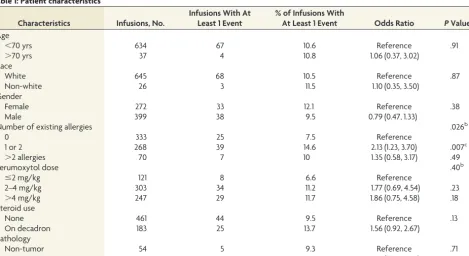
[image:2.594.300.533.48.218.2]second study visit 6 months later. Immediately after the initial 1 mg/kg ferumoxytol administration, he reported severe nausea and moderate degree of shortness of breath along with lower back pain. The patient was removed from the scanner, and no further ferumoxytol was given. He was treated with albuterol and diphen-hydramine, and the symptoms completely subsided after 2 hours. In the logistic generalized estimating equation model, patients with 1 or 2 pre-existing allergies were more likely to have at least 1 AE after ferumoxytol infusion compared with patients without any pre-existing allergy (14.6% versus 7.5%;P⫽.007). No other patient characteristics showed significant association with the oc-currence of AE (Table 1).
DISCUSSION
Contrast materials are frequently used in imaging and provide valuable information, often changing the course of treatment. Contrast agents are known to be generally safe, with minimal risk of HSR.21Our results showed that overall ferumoxytol-related AE occurred in 10.6% of infusions, most of them occurring within 48 hours (8.6%), in concordance with 10%–14.6% of AE published in the literature based on 3 randomized trials for iron replacement.22-24 Based on our data, the frequency of AE with Feraheme is equivalent to ionic iodinated contrast media, approximately 15 times higher than gadolinium MR contrast agents, and 4 times higher than non-ionic iodinated contrast agents,25,26which is summarized inTable 2. Severe reactions, based on literature data, occur 6 –7 times more of-ten with ferumoxytol compared with gadolinium or currently used nonionic iodinated agents.
At our institution, we have not recorded any serious AEs with ferumoxytol. However, we acknowledge that our sample size may not be adequate to record this rare event. It is worth mentioning that our patient population may differ from populations reported in prior studies because most of our patients had brain tumors; it has been shown that patients with tumor can be anergic27-29and are often on corticosteroids, which may cause immunosuppres-sion and, in theory, help prevent HSR.30Our results, however, did
[image:3.594.52.286.222.384.2]FIG 2. Frequency of AEs potentially related to ferumoxytol. Events that occurred in at least 2 cases are displayed. Note that multiple AEs (symptoms, abnormal lab values) may be associated with a single in-jection according to the CTCAE recording guidelines.
Table 1: Patient characteristics
Characteristics Infusions, No.
Infusions With At Least 1 Event
% of Infusions With
At Least 1 Event Odds Ratio PValuea
Age
⬍70 yrs 634 67 10.6 Reference .91
⬎70 yrs 37 4 10.8 1.06 (0.37, 3.02)
Race
White 645 68 10.5 Reference .87
Non-white 26 3 11.5 1.10 (0.35, 3.50)
Gender
Female 272 33 12.1 Reference .38
Male 399 38 9.5 0.79 (0.47, 1.33)
Number of existing allergies .026b
0 333 25 7.5 Reference
1 or 2 268 39 14.6 2.13 (1.23, 3.70) .007c
⬎2 allergies 70 7 10 1.35 (0.58, 3.17) .49
Ferumoxytol dose .40b
ⱕ2 mg/kg 121 8 6.6 Reference
2–4 mg/kg 303 34 11.2 1.77 (0.69, 4.54) .23
⬎4 mg/kg 247 29 11.7 1.86 (0.75, 4.58) .18
Steroid use
None 461 44 9.5 Reference .13
On decadron 183 25 13.7 1.56 (0.92, 2.67)
Pathology
Non-tumor 54 5 9.3 Reference .71
Tumor 617 66 10.7 1.20 (0.47, 3.04)
aPvalues are obtained from the logistic generalized estimating equation model. b
OverallPvalue for the number of existing allergies or ferumoxytol dose.
[image:3.594.301.533.349.426.2]cStatistically significant.
Table 2: Frequency of adverse events using various contrast media from the literature and our data
Contrast Media
Adverse Events
Severe Adverse Events
Gadolinium25 0.8% 0.03%
Iodinated (ionic)26 12.66% 0.22%
Iodinated (nonionic)26 3.13% 0.04%
Ferumoxytol (Feraheme label) 3.7% 0.2%
[image:3.594.62.532.450.706.2]not show any risk reduction in patients with long-term cortico-steroid use, nor in those with tumor pathology. The benefit of premedication before IV iron products remains controversial in the literature and is generally not advised.31
Although the 2 grade 3 reactions were possibly HSR-related, most of the AEs recorded in this study are likely unrelated to HSR. Hypertension, recorded most frequently after ferumoxytol injec-tion, may be anxiety-related, which normalized without interven-tion by the time the patient left the MR imaging suite. No feru-moxytol-related blood pressure drop has been detected. Our study found a significant association between 1 or 2 existing aller-gies and the frequency of mild AEs. The exact mechanism of iron HSR is still unclear. Bioactive, labile iron, which is present in all IV iron products, may be an important causative factor. Comple-ment activation-related pseudoallergy, triggered by iron nano-particles, is probably a more frequent mechanism in acute reactions to current IV formulations than is an immunologic IgE-mediated response.32
The boxed warning of Feraheme is intended to mitigate the risk and potential morbidity of HSR, thus enhancing patient safety. Recommendations are to observe patients up to 30 min-utes after injection and monitor heart rate and blood pressure at baseline and after (each) ferumoxytol administration, which was re-emphasized in this warning and which we strictly adhere to in our imaging protocols. Rapid bolus injection (previously up to 30 mg/s) was eliminated from the package insert, and infusion of the diluted ferumoxytol over 15 minutes became the recommenda-tion. Although there are currently no data using ferumoxytol to support that slow infusion is indeed safer than bolus injection, slow infusion is recommended with other iron products32and it also allows observation of the patient during ferumoxytol admin-istration and termination of the infusion if HSR occurs.
For MR imaging, to best comply with FDA recommendations, rapid bolus should be avoided. Our imaging protocols have elim-inated rapid injection, and only the first 1 mg/kg is given as a bolus to gain clinically valuable dynamic imaging data. The lack of con-trast agent leakage has been demonstrated as a benefit compared with low molecular weight agents, though the latter ones may be corrected with mathematical algorithms.33For most imaging ap-plications, such as high-resolution steady-state blood volume mapping, steady-state angiography, and visualization of delayed ferumoxytol enhancement/inflammation, no bolus injection is necessary; therefore, high flow rate injection may be com-pletely avoided.
The new prescribing information as of March 2015 provides additional information regarding the potential for more severe HSR in elderly patients with multiple or serious comorbidities and increased risk of HSR to Feraheme in patients with a history of multiple drug allergies. This information may be useful when considering risk and benefit.
A detailed analysis and guideline have been published by an international group to minimize the risk and severity of IV iron supplement–related AEs. There is emphasis on observation, prompt recognition of symptoms, and severity-related interven-tions by well-trained medical and nursing staff.32On-line Table 3 summarizes our recommendations in managing hypersensitivity related to IV iron, when used as an MR contrast agent.
Contrast agent safety is a relevant clinical issue. HSR is just one of the contrast agent–related AEs; in gadolinium-based agents, the incidence of nephrogenic systemic fibrosis has been mini-mized since the guidelines and boxed warning. Given the emerg-ing safety record of macrocyclic contrast agents in patients with renal failure, remaining contraindications are rare and limited essentially to a history of rare severe allergic reaction to gado-linium-based agents. Gadolinium deposition in the nervous system is a recent finding, which occurs even in patients with normal renal function, and its clinical impact is still un-known.34Although no serious AE with ferumoxytol was ob-served in 671 administrations at our institution, it is important to understand the potential risks and be prepared in case a severe reaction occurs. Having trained staff and appropriate medications available would be considered good medical prac-tice in any facility using any imaging contrast agent.
The limitations of ferumoxytol imaging include potential iron overload in patients with iron metabolism disorders. The maxi-mum administered dose (510 mg) is equivalent with 2 units of blood, which is unlikely to cause acute or chronic toxicity in pa-tients with normal iron metabolism.15Ferumoxytol is taken up by the liver, spleen, and bone marrow, which may cause signal change on the MR imaging for months. In the CNS, contrast enhancement may be detectable a few days after administration. Adding another contrast agent (ie, if used in addition to gadolin-ium-based contrast agents) may increase the costs, in addition to MR imaging time, if additional imaging is used. Our research protocols included up to 3 consecutive days of scanning, and MR imaging times were long: between 60 –90 minutes on days when contrast agent was given and 30 – 45 minutes to image late feru-moxytol enhancement. In clinical practice, however, more fo-cused imaging is applied to answer the clinical question. High-resolution blood volume maps may be obtained with only an additional 5 minute scan time.5Steady-state angiography requires only a few minutes of scan time, whereas late enhancement/im-aging inflammation/lymph node imenhancement/im-aging requires a separate MR imaging scanning session, which is likely the length of a noncon-trast MR imaging study. Multiphase connoncon-trast administration was used to test the optimal doses for various applications, but in clinical use, a single infusion of the most appropriate dose is suf-ficient. Applications, such as visualizing the micro- and macro-vasculature and visualizing inflammation, hold promise, but fu-ture trials have to prove their impact on improving clinical diagnosis and clinical management.
Limitations of this study include the variable patient charac-teristics and ferumoxytol doses. Although our sample size of 671 was the highest reported in a single center, this number is still too low to evaluate the frequency of rare, but serious HSR.
CONCLUSIONS
recommen-dations in the boxed warning should be followed to further im-prove the safety of imaging with ferumoxytol.
Disclosures: Rongwei Fu—UNRELATED:Grants/Grants Pending: Oregon Health & Science University*. Jenny Firkins—RELATED:Grants/Grants Pending: Driskill Foun-dation grant and R01*;UNRELATED:Employment: Driskill Foundation grant and R01. Edward Neuwelt—RELATED:Grants/Grants Pending: National Institutes of Health, Driskill Foundation,Comments: This work was supported in part by National Insti-tutes of Health grants NS053468, CA199111, and CA137488 –15S1, in part with Federal funds from the National Cancer Institute, National Institutes of Health, under Con-tract No. HHSN261200800001E, and by the Walter S. and Lucienne Driskill Founda-tion, all to E.A.N.;UNRELATED:Grants/Grants Pending: AMAG Pharmaceuticals, Comments: Dr. Neuwelt’s studies involving ferumoxytol were entirely funded by National Institutes of Health research grants and the Driskill Foundation, with the ferumoxytol ultra-small superparamagnetic iron oxide nanoparticles donated by AMAG Pharmaceuticals. Oregon Health & Science University has received a small sponsored research agreement from AMAG Pharmaceuticals to partially fund clini-cal trials of MRI with ferumoxytol. None of the authors has financial interest in this agent or in its developer AMAG Pharmaceuticals.* Money paid to the institution.
REFERENCES
1. Lu M, Cohen MH, Rieves D, et al.FDA report: ferumoxytol for intravenous iron therapy in adult patients with chronic kidney dis-ease.Am J Hematol2010;85:315–19CrossRef Medline
2. Bashir MR, Bhatti L, Marin D, et al.Emerging applications for feru-moxytol as a contrast agent in MRI.J Magn Reson Imaging2015;41: 884 –98CrossRef Medline
3. Hope MD, Hope TA, Zhu C, et al.Vascular imaging with ferumoxy-tol as a contrast agent.AJR Am J Roentgenol2015;205:W366 –73
CrossRef Medline
4. Nayak AB, Luhar A, Hanudel M, et al.High-resolution, whole-body vascular imaging with ferumoxytol as an alternative to gadolinium agents in a pediatric chronic kidney disease cohort.Pediatr Nephrol
2015;30:515–21CrossRef Medline
5. Varallyay CG, Nesbit E, Fu R, et al.High-resolution steady-state cerebral blood volume maps in patients with central nervous sys-tem neoplasms using ferumoxytol, a superparamagnetic iron oxide nanoparticle.J Cereb Blood Flow Metab 2013;33:780 – 86CrossRef Medline
6. Christen T, Ni W, Qiu D, et al.High-resolution cerebral blood vol-ume imaging in humans using the blood pool contrast agent feru-moxytol.Magn Reson Med2013;70:705–10CrossRef Medline
7. Finn JP, Nguyen KL, Han F, et al.Cardiovascular MRI with feru-moxytol.Clin Radiol2016;71:796 – 806CrossRef Medline
8. Neuwelt EA, Hamilton BE, Varallyay CG, et al.Ultrasmall superpara-magnetic iron oxides (USPIOs): a future alternative superpara-magnetic reso-nance (MR) contrast agent for patients at risk for nephrogenic sys-temic fibrosis (NSF)?Kidney Int2009;75:465–74CrossRef Medline
9. Neuwelt EA, Va´rallyay CG, Manninger S, et al.The potential of feru-moxytol nanoparticle magnetic resonance imaging, perfusion, and angiography in central nervous system malignancy: a pilot study. Neurosurgery2007;60:601–11; discussion 611–12CrossRef Medline
10. Storey P, Arbini AA.Bone marrow uptake of ferumoxytol: a prelim-inary study in healthy human subjects.J Magn Reson Imaging2014; 39:1401–10CrossRef Medline
11. Guthrie PJ, Thomas JV, Peker D, et al.Perivesical unicentric Castle-man disease initially suspected to be metastatic prostate cancer. Urol Ann2016;8:245– 48CrossRef Medline
12. Liu L, Tseng L, Ye Q, et al.A new method for preparing mesenchy-mal stem cells and labeling with ferumoxytol for cell tracking by MRI.Sci Rep2016;6:26271CrossRef Medline
13. Pouw JJ, Grootendorst MR, Bezooijen R, et al.Pre-operative sentinel lymph node localization in breast cancer with superparamagnetic iron oxide MRI: the SentiMAG Multicentre Trial imaging subpro-tocol.Br J Radiol2015;88:20150634CrossRef Medline
14. Wang YX.Current status of superparamagnetic iron oxide contrast agents for liver magnetic resonance imaging.World J Gastroenterol
2015;21:13400 – 02CrossRef Medline
15. Muehe AM, Feng D, von Eyben R, et al.Safety report of ferumoxytol
for magnetic resonance imaging in children and young adults. In-vest Radiol2016;51:221–27CrossRef Medline
16. Vasanawala SS, Nguyen KL, Hope MD, et al.Safety and technique of ferumoxytol administration for MRI.Magn Reson Med2016;75: 2107–11CrossRef Medline
17. Nguyen KL, Yoshida T, Han F, et al.MRI with ferumoxytol: a single center experience of safety across the age spectrum.J Magn Res Im-aging2017;45:804 –12CrossRef Medline
18. Common Terminology Criteria for Adverse Events v3.0 (CTCAE). Pub-lished August 9, 2006. https://ctep.cancer.gov/protocolDevelopment/ electronic_applications/docs/ctcaev3.pdf. Accessed April 3, 2017 19. Common Terminology Criteria for Adverse Events (CTCAE) Version
4.0.Published 2010. https://ctep.cancer.gov/protocolDevelopment/ electronic_applications/ctc.htm. Accessed April 3, 2017
20. What is a serious adverse event? U.S. Food and Drug Administration. https://www.fda.gov/safety/medwatch/howtoreport/ucm053087. htm. Accessed May 4, 2017
21. Brockow K, Sa´nchez-Borges M.Hypersensitivity to contrast media and dyes. Immunol Allergy Clin North Am 2014;34:547– 64, viii
CrossRef Medline
22. Vadhan-Raj S, Strauss W, Ford D, et al.Efficacy and safety of IV ferumoxytol for adults with iron deficiency anemia previously un-responsive to or unable to tolerate oral iron.Am J Hematol2014;89: 7–12CrossRef Medline
23. Macdougall IC, Strauss WE, McLaughlin J, et al.A randomized com-parison of ferumoxytol and iron sucrose for treating iron defi-ciency anemia in patients with CKD.Clin J Am Soc Nephrol2014;9: 705–12CrossRef Medline
24. Hetzel D, Strauss W, Bernard K, et al.A phase III, randomized, open-label trial of ferumoxytol compared with iron sucrose for the treat-ment of iron deficiency anemia in patients with a history of unsat-isfactory oral iron therapy.Am J Hematol2014;89:646 –50CrossRef Medline
25. Bleicher AG, Kanal E.Assessment of adverse reaction rates to a newly approved MRI contrast agent: review of 23,553 administra-tions of gadobenate dimeglumine.AJR Am J Roentgenol2008;191: W307–11CrossRef Medline
26. Katayama H, Yamaguchi K, Kozuka T, et al.Adverse reactions to ionic and nonionic contrast media. A report from the Japanese Committee on the Safety of Contrast Media.Radiology1990;175: 621–28CrossRef Medline
27. Evans C, Dalgleish AG, Kumar D.Review article: immune suppres-sion and colorectal cancer.Aliment Pharmacol Ther2006;24:1163–77
CrossRef Medline
28. Kawakami Y, Yaguchi T, Sumimoto H, et al.Cancer-induced immu-nosuppressive cascades and their reversal by molecular-targeted therapy.Ann N Y Acad Sci2013;1284:80 – 86CrossRef Medline
29. Pumhirun P, Wasuwat P.Anergy testing in patients with head and neck cancer.Asian Pac J Allergy Immunol2003;21:189 –92Medline
30. Braaten K, Holcombe RF, Kim SS.Premedication with IV steroids effectively prevented anaphylactic reactions following ferumoxytol given as IV push in hematology and oncology patients.Am J Hema-tol2015;90:E207CrossRef Medline
31. Bircher AJ, Auerbach M.Hypersensitivity from intravenous iron products. Immunol Allergy Clin North Am 2014;34:707–23, x-xi
CrossRef Medline
32. Rampton D, Folkersen J, Fishbane S, et al.Hypersensitivity reactions to intravenous iron: guidance for risk minimization and manage-ment.Haematologica2014;99:1671–76CrossRef Medline
33. Gahramanov S, Muldoon LL, Varallyay CG, et al. Pseudoprogres-sion of glioblastoma after chemo- and radiation therapy: diag-nosis by using dynamic susceptibility-weighted contrast-en-hanced perfusion MR imaging with ferumoxytol versus gadoteridol and correlation with survival.Radiology2013;266: 842–52CrossRef Medline
gad-olinium-based contrast material. Radiology 2014;270:834 – 41
CrossRef Medline
35. Gahramanov S, Raslan AM, Muldoon LL, et al.Potential for differ-entiation of pseudoprogression from true tumor progression with dynamic susceptibility-weighted contrast-enhanced magnetic res-onance imaging using ferumoxytol vs. gadoteridol: a pilot study.Int J Radiat Incol Biol Phys2011;79:514 –23CrossRef Medline
36. Hamilton BE, Nesbit GM, Dosa E, et al.Comparative analysis of ferumoxytol and gadoteridol enhancement using T1- and T2-weighted MRI in neuroimaging.AJR Am J Roentgenol2011;197: 981– 88CrossRef Medline
37. Nasseri M, Gahramanov S, Netto JP, et al.Evaluation of pseudo-progression in patients with glioblastoma multiforme using dynamic magnetic resonance imaging with ferumoxytol calls RANO criteria into question. Neuro Oncol 2014;16:1146 –54
CrossRef Medline
38. Do´sa E, Tuladhar S, Muldoon LL, et al.MRI using ferumoxytol im-proves the visualization of central nervous system vascular malfor-mations.Stroke2011;42:1581– 88CrossRef Medline
39. Do´sa E, Guillaume DJ, Haluska M, et al.Magnetic resonance
imag-ing of intracranial tumors: intra-patient comparison of gadoteridol and ferumoxytol.Neuro Oncol2011;13:251– 60CrossRef Medline
40. Farrell BT, Hamilton BE, Do´sa E, et al.Using iron oxide nanopar-ticles to diagnose CNS inflammatory diseases and PCNSL. Neurol-ogy2013;81:256 – 63CrossRef Medline
41. Hamilton BE, Woltjer RL, Prola-Netto J, et al. Ferumoxytol-en-hanced MRI differentiation of meningioma from dural metastases: a pilot study with immunohistochemical observations.J Neuroon-col2016;129:301– 09CrossRef Medline
42. Thompson EM, Guillaume DJ, Do´sa E, et al.Dual contrast perfusion MRI in a single imaging session for assessment of pediatric brain tumors.J Neurooncol2012;109:105–14CrossRef Medline
43. UpToDate: Evidence-Based Clinical Decision Support System. Waltham, Massachusetts: Wolters Kluwer; 1992 [updated in 2016]. https://www.uptodate.com. Accessed April 3, 2017