
ISSN Online: 2162-576X ISSN Print: 2162-5751
DOI: 10.4236/jqis.2018.81001 Mar. 7, 2018 1 Journal of Quantum Information Science
Empirical Analysis of a Quantum Classifier
Implemented on IBM’s 5Q Quantum Computer
Wei Hu
Department of Computer Science, Houghton College, Houghton, USA
Abstract
The development of artificial intelligence today is marked with increased computational power, new algorithms, and big data. One such milestone im-pressive achievement in this area is Google’s AlphaGo. However, this ad-vancement is beginning to face increasing challenges and the major bottleneck of AI today is the lack of adequate computing power in the processing of big data. Quantum computing offers a new and viable solution to deal with these challenges. A recent work designed a quantum classifier that runs on IBM’s five qubit quantum computer and tested its performance on the Iris data set as well as a circles data set. As quantum machine learning is still an emerging discipline, it may be enlightening to conduct an empirical analysis of this quantum classifier on some artificial datasets to help learn its unique features and potentials. Our work on the quantum classifier can be summarized in three parts. The first is to run its original version as a binary classifier on some artificial datasets using visualization to reveal the quantum nature of this al-gorithm, and the second is to analyze the swap operation utilized in its origi-nal circuit due to the hardware constraint and investigate its impact on the performance of the classifier. The last part is to extend the original circuit for binary classification to a circuit for multiclass classification and test its per-formance. Our findings shed new light on how this quantum classifier works.
Keywords
Quantum Computation, Quantum Machine Learning, Quantum Circuit
1. Introduction
Quantum computation is a new computing approach based on the laws of quantum mechanics, which is a very hot topic at the frontiers of computing world today. By carefully exploiting the unique features of quantum states, How to cite this paper: Hu, W. (2018)
Empirical Analysis of a Quantum Classifier Implemented on IBM’s 5Q Quantum Computer. Journal of Quantum Informa-tion Science, 8, 1-11.
https://doi.org/10.4236/jqis.2018.81001
Received: December 26, 2017 Accepted: March 4, 2018 Published: March 7, 2018
Copyright © 2018 by author and Scientific Research Publishing Inc. This work is licensed under the Creative Commons Attribution International License (CC BY 4.0).
DOI: 10.4236/jqis.2018.81001 2 Journal of Quantum Information Science quantum computers can efficiently solve some problems that are believed to be hard for classical computers.
There are two well-known quantum algorithms that demonstrate the advan-tage of quantum computation over classical approach. Shor’s algorithm for finding the prime factors of a number runs in polynomial time while any classic-al similar classic-algorithms run in exponenticlassic-al times. Grover devised a quantum classic- algo-rithm for the problem of unstructured search which achieves a quadratic speed up over the classical algorithms. Not available in classical computing, superposi-tion, entanglement and interference of quantum states employed in quantum computing are generally considered as resources for this speed up. Furthermore, quantum computers can perform simulations of another quantum system such as protein folding that is beyond the capability of any classical computers.
IBM recently released the Quantum Experience to allow users to access a five qubit quantum processor, with services including circuit design, simulation, testing and actual computation on a physical device [1]. It offers researchers great opportunities to test their quantum theories and algorithms on actual quantum hardware. In today’s data rich society, the growth rate of data generat-ed by different devices goes up way faster than that of the computer processors’ speed. As such quantum computation provides a new computing paradigm to process the enormous data and information we are facing today.
It is true that a quantum computer using quantum laws can process many quantum states simultaneously via quantum parallelism, say it can compute
( )
f x through evaluating the function for multiple values of x simultaneously. But when we need to measure the results of the computation, we can only get one result and sometimes this result is even nondeterministic. Therefore, to get a classical result, we have to run a quantum algorithm multiple times in some cas-es. In this sense, to produce the same classical result, an algorithm that requires less number of runs the better. In particularly, for a quantum classifier, we are not only interested in the classification accuracy, but also less number of runs (or shots in IBM’s term) of the algorithm.
DOI: 10.4236/jqis.2018.81001 3 Journal of Quantum Information Science The work in [2] was to design a quantum circuit for a distance based binary classifier runnable on IBM’s 5Q quantum computer. The quantum advantage of this classifier is the ability to compute the distance of the test data point to all the training data points simultaneously. In contrast, a major drawback of classical distance based classifier is that it can be computationally expensive. Other quantum machine learning algorithms can be seen in [3]-[13].
This classifier was tested on iris dataset and a circles data set. The numerical results were summarized in two tables [2]. We thought it might shed more light on the nature of this quantum classifier if some visualization of its working can be seen. More specifically how the distance of the data points influences the pre-diction probabilities caused by the stochastic nature of quantum computing. The second thought is how the swap operation in the circuit (Figure 1) has a toll on the prediction accuracy as this operation is necessary in quantum circuit design to meet certain hardware constraints. Our final thought is how to extend the quantum binary classifier to a multiclass classifier, a further step to illustrate the potential of quantum machine learning. The purposes of our study entail the use of IBM’s quantum simulator instead of its real quantum device as we need to use more than five qubits.
2. A Quantum Classifier
This paper reports our empirical analysis of a quantum classifier implemented on IBM’s 5Q computer. We will briefly present the distance based quantum clas-sifier created in [2]. Quantum computing requires the data be encoded in quan-tum states for storage, transformation, and processing. In the context of the analysis of classical data, one method is to encode the coordinates of a classical data point as amplitudes of the quantum state, adopted by [2]. Another straight forward encoding method is to encode one classical bit of information into a qubit. The advantage of amplitude encoding is its compactness to represent real numbers.
Let N =2n and
(
0, 1 , 1)
N N
X = x x x − ∈R is a unit vector. A dataset of size
M can be denoted by
{
(
0 0) (
1 1) (
2 2) (
1 1)
}
, , , , , , , M , M
D= X y X y X y X − y − , where
m N
X ∈R represents a data point and ym represents its class label. For a binary classification, ym∈
{ }
0,1 . The amplitude encoding of X is 10
N
X i xi i
ψ −
=
=
∑
. Thefirst step of the quantum classifier is, through some quantum operations (see the quantum circuit in Figure 1), to transform the dataset D together with a test point as:
(
)
1 0 1 10 1 m
M m
m X X
D m y
Z
ψ
ψ
− =
=
∑
+ (1)where X is a test point, Xm are training points, m is an index for the data point m
X , and Z1 is a normalization constant to make the whole quantum state of length one. After applying the Hadamard gate to the data qubit that contains X and m
DOI: 10.4236/jqis.2018.81001 4 Journal of Quantum Information Science
Figure 1. An implementation of the quantum circuit from [2] in IBM’s quantum com-poser. The first two H gates prepare the ancilla qubit q[0] and index qubit m q[1] in su-perposition. The cU3 gate entangles a test data point with the ancilla qubit q[0]. The ccX gate entangles the first training data point with q[0] and q[1]. The ccU3 gate adds the second training data point to the circuit. Lastly the swap operation is used to add the class label to the circuit through a cnot gate due to the star topology of IBM’s 5Q quantum processor.
(
)
1 1 0 1 10 m 1 m
M
X
m
m X X X
D m y
Z
ψ
+ψ
−− =
=
∑
+ (2)here ψX X± m =ψX ±ψXm . The key observation is
2 2 0 0 2 2 1 1 1 m m m m
y X X y X
Z
∑
= + = −Z∑
= X −where Z2 is another normalization constant, which implies that the closer the test point X to the training point Xm, the larger the amplitudes in front of
m
y and therefore the more likely to be observed at the last step of measure-ments. In another word, the probability of measuring the class qubit m
y in state 0 is:
(
)
20 0
2 2
2
1 1
0 m 1 m
m m
y y
P y X
Z
X X X
Z = =
= =
∑
+ = −∑
− (3)
By exploiting superposition, entanglement, and interference, this algorithm is able to evaluate the distance of the test point to all the training points at once. And more importantly, through clever mathematical manipulation, the proba-bility of the test point belonging to class 0 or 1 can be determined at the end of the quantum circuit. However, when measuring the ancilla qubit (the qubit con-taining 0 and 1 in Equations (1) and (2)), we may see 1 instead of 0 .
Therefore the final tally of the counts for P(0) or P(1) has to exclude the results of seeing 1 in the ancilla qubit, which is way different from classical machine
learning algorithms.
da-DOI: 10.4236/jqis.2018.81001 5 Journal of Quantum Information Science ta point, q[2] is data, and q[3] is for class label. q[4] is an temporary qubit that we use to build the ccU3 gate. Note that a swap operation is used at the end of this circuit to satisfy the star topology employed in IBM’s 5Q quantum chip, see Figure 1.
A typical quantum circuit is composed of initial states, followed by several un-itary operators, and terminated by a few measurements according to the task of the algorithm. During execution of the algorithm, the super positioned quantum states have to maintain their coherent superposition. As a result, the length of a quantum circuit depends directly on the amount of time that these quantum states can remain coherent [14].
3. Results
The quantum classifier in [2] uses amplitude encoding technique, so the classical data points that we will use in our experiments are all of the form
(
x x1, 2)
=(
sin , cosθ
θ
)
, to make the notation easier to follow we simply use θ torepresent a point. Say, we can use π
4
θ= to represent the point of
(
sin , cosθ
θ
)
1 1
,
2 2
= . Since the classifier is distance based, we like to investigate
experimentally how the distance of the data points affect its performance. The classifier is run several times with 1000 or 8192 shots, where 8192 is the maximal number of shots allowed on Quantum Experience. We use IBM’s quantum si-mulator in this work rather than the real 5Q quantum computer because part of our goal is to extend the binary classifier in [2] to a multiclass classifier that uses more than five qubits. We summarize our findings in the following three subsec-tions.
3.1. Experiments on a Binary Classifier
Our first task is to test the binary classifier in [2], we set the two training data points to be {0, θ} and label point 0 as class 0 and point θ as class 1. Then select the evenly spaced points in the interval [0, θ] as the test points. θ can take values like π, or π/4. Since this is a binary classifier, P(0) + P(1) = 1. Our first experi-ment indicates that P(0) and P(1) can take values in the full range of [0, 1], see Figure 2, where θ = π. As the test point moves from the training point 0 (class label 0) to another training point π (class label 1), P(0) changes from 1 to 0 gradually. Similarly, P(1) changes from 0 to 1. The angular distance of the two training points 0 and π is π.
DOI: 10.4236/jqis.2018.81001 6 Journal of Quantum Information Science
Figure 2. Curves of P(0) and P(1) for 400 test points in [0, π] and two training points 0 and π with 8192 shots. The values of P(0) and P(1) can takes values from the full range of [0, 1]. The angular distance of 0 and π is π.
Figure 3. Curves of P(0) and P(1) for 100 test points in [0, π/4] and two training points 0 and π/4 with 8192 shots. The angular distance of the two training points is π/4 which is smaller than that in Figure 2, so the values of P(0) and P(1) cannot take the fall range of [0, 1] but within the range of [0.46, 0.54] approximately.
As the test point moves from 0 (class label 0) to π/4 (class label 1), P(0) changes from about 0.54 to about 0.56 gradually. Similarly, P(1) changes from 0.46 to 0.56. When the test point gets into the middle of the interval [0, π/4], the classification problem becomes harder for a distance based classifier. Note that
P(0) and P(1) do not take values near 1 and 0 as the distances between 0 and π/4 is smaller than that of 0 and π, compared with Figure 2.
[image:6.595.53.540.282.488.2]DOI: 10.4236/jqis.2018.81001 7 Journal of Quantum Information Science quantum computing caused by the genuinely probabilistic properties of quantum states.
3.2. Experiments on a Binary Classifier with or without Swap
Operation
[image:7.595.61.538.249.461.2]The IBM 5Q consists of five superconducting transmon qubits patterned on a silicon substrate. The qubits are labeled Q0, Q1, Q2, Q3, and Q4. For the IBM 5Q system, only 4 different types of CNOT gates are available: every CNOT must have Q2 as the target qubit and Q0, Q1, Q3, or Q4 as the control qubit, see Fig-ure 5. The SWAP gate is routinely used to deal the hardware constraint that the CNOT gate cannot be applied to two arbitrary qubits.
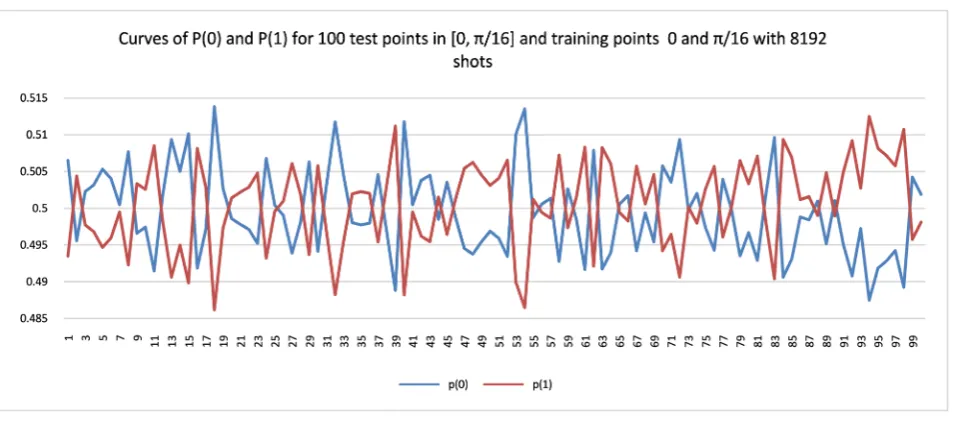
Figure 4. Curves of P(0) and P(1) for 100 test points in [0, π/16] and two training points 0 and π/16 with 8192 shots. This time the angular distance between the two training points is π/16, much smaller than π. As a result, the values of P(0) and P(1) are oscillat-ing near 0.5, far away from 1 and 0.
Figure 5. A schematic demonstration of the five qubits in IBM’s 5Q chip, an image taken from
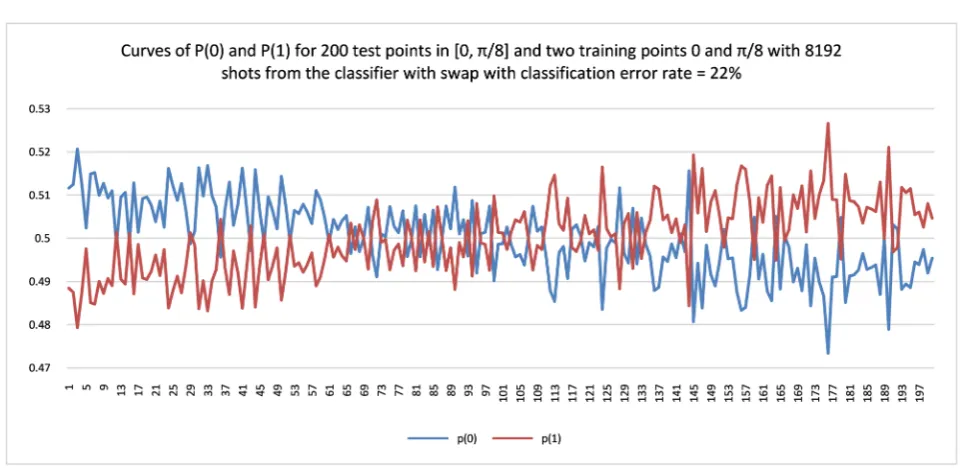
[image:7.595.125.475.514.691.2]DOI: 10.4236/jqis.2018.81001 8 Journal of Quantum Information Science To test the effects of the swap operation as shown in Figure 1, we create another circuit where the SWAP gate and CNOT gate in the original circuit are replaced by a Toffoli gate so they are logically equivalent but the latter involves no swap. We run 10 experiments for these two classifiers, each of which is made of 8192 shots for 200 test points and two training points, see Figure 6. From these experiments, the average error rate of the circuit with the swap is 20.55% and the one without swap is 22.05%. Our results imply no significant difference in the classification accuracy, given the stochastic nature of these two classifiers. We intentionally choose two close training points 0 and π/8 to make it hard for the distance based classifiers to differentiate them. To further elucidate the ob-served results, we select one experiment for each classifier from the 10 experi-ments and plot the whole curves of P(0) and P(1) over all the 200 test points, see Figure 7 and Figure 8. They show what the curves of P(0) and P(1) look like when the classification error rate is around 20%.
3.3. Experiments on a Multiclass Classifier
To make a multiclass classifier, four classes to be exact in this study, we use two qubits for index and two qubits for classes following the circuit patterns shown in Figure 1. In the following experiment, we set the four training data points to be {0, π/2, π, 3π/2} with class labels 0, 1, 2, and 3 respectively and then select the evenly spaced points in the interval [0, 2π] as the test points. Since we have four classes, P(0) + P(1) + P(2) + P(3) = 1. The idea is to create the test points so they can move from 0 to 2π, as a result these four probabilities can display their four peaks in turn as shown in Figure 9.
4. Conclusions
[image:8.595.56.539.493.682.2]Quantum machine learning, though in its initial stage, has demonstrated its
DOI: 10.4236/jqis.2018.81001 9 Journal of Quantum Information Science
[image:9.595.56.538.328.547.2]Figure 7. One selected experiment for the classifier with swap from the 10 experiments reported in Figure 6.
Figure 8. One selected experiment for the classifier without swap from the 10 experiments reported in Figure 6.
DOI: 10.4236/jqis.2018.81001 10 Journal of Quantum Information Science
Figure 9. Curves of P(0) and P(1) for 200 test points in [0, 2π] and four training points 0, π/2, π, 3π/2 with class labels 0, 1, 2, and 3 respectively, with 1000 shots from the multiclass classifier created in this study.
differentiate the training points. The values of P(0) and P(1) are very close to 0.5 and oscillating about 0.5. Because of the stochastic nature of quantum algo-rithms, this phenomena makes prediction more difficult than the corresponding classical algorithms.
The second is to see if the swap operation that is commonly utilized in quan-tum circuit design to meet the hardware constraints may have an impact on the performance of this classifier. A typical circuit of a quantum machine learning algorithm employs superposition, entailment, and interference of qubits. Be-cause of this, any swap of two qubits in the circuit may influence the final out-come of the algorithm. Our experiments suggest that the swap operation does not make a difference in the cases that we have tested.
Our final goal is to extend the binary classifier in [2] to a multiclass classifier to further demonstrate the capability of this classifier. The four-class classifier that we create in this work shows its ability to distinguish the four different training points with four peaks of the curves of P(0), P(1), P(2), and P(3) occur-ring at the right test points.
It is known that some quantum machine learning algorithms can outperform their classical counterparts, but the full scope of their potential needs to be fur-ther investigated. Our work adds new knowledge to this field by helping learn the working of this quantum classifier, fulfilling part of the big goal of under-standing the value of quantum computing to machine learning and AI.
References
[1] IBM. Quantum Experience. www.research.ibm.com/quantum
[2] Schuld, M., Fingerhuth, M. and Petruccione, F. (2017) Implementing a Dis-tance-Based Classifier with a Quantum Interference Circuit. A Letters Journal of Exploring the Frontiers of Physics, 119, Article ID: 60002.
DOI: 10.4236/jqis.2018.81001 11 Journal of Quantum Information Science
on a Quantum Computer. Physical Review A, 94, Article ID: 022342.
https://doi.org/10.1103/PhysRevA.94.022342
[4] Schuld, M., Sinayskiy, I. and Petruccione, F. (2015) Simulating a Perceptron on a Quantum Computer. Physics Letters A, 379, 660-663.
https://doi.org/10.1016/j.physleta.2014.11.061
[5] Schuld, M., Sinayskiy, I. and Petruccione, F. (2014) Quantum Computing for Pat-tern Classification. Pacific Rim International Conference on Artificial Intelligence, Gold Coast, 1-5 December 2014, 208-220.
[6] Schuld, M., Sinayskiy, I. and Petruccione, F. (2014) The Quest for a Quantum Neural Network. Quantum Information Processing, 13, 2567-2586.
https://doi.org/10.1007/s11128-014-0809-8
[7] Schuld, M., Sinayskiy, I. and Petruccione, F. (2014) Quantum Walks on Graphs Representing the Firing Patterns of a Quantum Neural Network. Physical Review A, 89, Article ID: 032333. https://doi.org/10.1103/PhysRevA.89.032333
[8] Cai, X.-D., Wu, D., Su, Z.-E., Chen, M.-C., Wang, X.-L., Li, L., Liu, N.-L., Lu, C.-Y. and Pan, J.-W. (2015) Entanglement-Based Machine Learning on a Quantum Computer. Physical Review Letters, 114, Article ID: 110504.
https://doi.org/10.1103/PhysRevLett.114.110504
[9] Biamonte, J., Wittek, P., Pancotti, N., Rebentrost, P., Wiebe, N. and Lloyd, S. (2017) Quantum Machine Learning. Nature, 549, 195-202.
https://doi.org/10.1038/nature23474
[10] Dunjko, V., Taylor, J.M. and Briegel, H.J. (2016) Quantum-Enhanced Machine Learning. Physical Review Letters, 117, Article ID: 130501.
https://doi.org/10.1103/PhysRevLett.117.130501
[11] Alsina, D. and Latorre, J.I. (2016) Experimental Test of Mermin Inequalities on a Five-Qubit Quantum Computer. Physical Review A, 94, Article ID: 012314.
https://doi.org/10.1103/PhysRevA.94.012314
[12] Berta, M., Wehner, S. and Wilde, M.M. (2016) Entropic Uncertainty and Measure-ment Reversibility. New Journal of Physics, 18, Article ID: 073004.
https://doi.org/10.1088/1367-2630/18/7/073004
[13] Hu, W. (2018) Empirical Analysis of Decision Making of an AI Agent on IBM’s 5Q Quantum Computer. Natural Science, 10, 45-58.
https://doi.org/10.4236/ns.2018.101004
[14] Nielsen, M.A. and Chuang, I.L. (2010) Quantum Computation and Quantum In-formation. Cambridge University Press, Cambridge.
![Figure 1. An implementation of the quantum circuit from perposition. The cU3 gate entangles a test data point with the ancilla qubit q[0]](https://thumb-us.123doks.com/thumbv2/123dok_us/9955454.496891/4.595.210.540.63.209/figure-implementation-quantum-circuit-perposition-entangles-point-ancilla.webp)
![Figure 2. Curves of P(0) and P(1) for 400 test points in [0, π] and two training points 0 and π with 8192 shots](https://thumb-us.123doks.com/thumbv2/123dok_us/9955454.496891/6.595.53.540.282.488/figure-curves-p-test-points-training-points-shots.webp)
![Figure 6. Classification error rate from 10 experiments for two classifiers with and without swap operation, each of which is made of 200 test points in [0, π/8] and two training points 0 and π/8 with 8192 shots](https://thumb-us.123doks.com/thumbv2/123dok_us/9955454.496891/8.595.56.539.493.682/figure-classification-experiments-classifiers-operation-points-training-points.webp)
![Figure 9. Curves of P(0) and P(1) for 200 test points in [0, 2π] and four training points 0, π/2, π, 3π/2 with class labels 0, 1, 2, and 3 respectively, with 1000 shots from the multiclass classifier created in this study](https://thumb-us.123doks.com/thumbv2/123dok_us/9955454.496891/10.595.54.544.60.263/figure-curves-training-labels-respectively-multiclass-classifier-created.webp)
