ISSN Online: 2380-4335 ISSN Print: 2380-4327
DOI: 10.4236/jhepgc.2018.41014 Jan. 31, 2018 152 Journal of High Energy Physics, Gravitation and Cosmology
Dynamo Speed Control and Tectonics—Modeling
Earth as a Shunt Wound DC Machine
Greg Poole
Industrial Tests, Inc., Pilot Hill, CA, USA
Abstract
The Sun’s slow periodic flux transfer to the Earth, the low frequency of Schu-mann Resonance, and the fixed DC voltage of the capacitor direct us toward direct current (DC) machines for electrical modeling purposes. The Earth ex-hibits dual characteristics of a motor generator set by motoring the mechani-cal Earth around its axis, while at the same time generating energy for its spher-ical capacitor. It follows that electrspher-ical and mechanspher-ical output of the Earth are powered by the magnitude of the flux transfer events, the constant DC voltage supply and any potential nuclear contribution within the core. Like an induc-tion furnace, powerful magnetic flux from the Sun partially melts the outer iron core of the Earth and magnetizes the inner solid iron core. The solid in-ner magnetic core acts as a rotating armature similar to a DC machine. All electrical machines experience no load and full load power loss while in oper-ation. Speed control of large rotating DC machines is well understood and has been applied in industry for over a century. Speed can be changed either by varying the field resistance and/or the armature resistance. The characteristic of a constant speed DC machine is such that a change in field resistance will cause a compensatory change in armature resistance to maintain velocity. In the case of the earth, a decrease in armature resistance results in an increase in volume of the iron core, which may result in greater seismic and volcanic ac-tivity. Climate change may be the direct result of changes in soil and sea water resistance, which we lump together as field resistance.
Keywords
Climate Change, Seismic Activity, Shunt Wound DC Machine, Speed Control, Tectonics, Volcano
1. Introduction
As concerned inhabitants of our small planet, it is the sworn duty of scientists How to cite this paper: Poole, G. (2018)
Dynamo Speed Control and Tectonics— Modeling Earth as a Shunt Wound DC Machine. Journal of High Energy Physics, Gravitation and Cosmology, 4, 152-165. https://doi.org/10.4236/jhepgc.2018.41014
Received: November 30, 2017 Accepted: January 28, 2018 Published: January 31, 2018
Copyright © 2018 by author and Scientific Research Publishing Inc. This work is licensed under the Creative Commons Attribution International License (CC BY 4.0).
DOI: 10.4236/jhepgc.2018.41014 153 Journal of High Energy Physics, Gravitation and Cosmology and engineers to uphold the highest integrity of workmanship, and provide ac-curate information to better understand the world around us and the world it-self. It is the latter, which has focused our problem-solving skills; to address how the Earth is electrically wired, and how it mechanically operates from electro-magnetic force. Environmental issues are a secondary yet important considera-tion as well. Theoretical concepts push the boundaries of physics beyond what is known, and attempt to rationalize what is not known; occasionally this is suc-cessful using methods from other scientific disciplines. It is hoped that the cu-rious thoughts of one lead to the contemplation of many, and science and nature are duly served. Much has been written about global warming and climate change, and it is not the purpose of this paper to challenge convention, repeat known science, raise undue alarm or create ideological controversy. The manuscript’s goal is to formally communicate a possible electrical explanation on planetary operation, and how it may be the driving force behind tectonic plate movement. As such, the paper may indirectly infer an additive explanation for earthquakes, volcanism and climate change. These issues are of course of great interest to ge-ologists and geophysicists, but not the thrust of this manuscript, nor the exper-tise of the author. Instead it is electromagnetism, the electrical engineer’s magic wand, which is how one asks peers to view the theoretician’s presentation. By in-troducing simple yet formal electrical machine circuits into the dynamo theory, it may prove beneficial to other scientists in solving what may be one of man-kind’s biggest challenges. For we know that there are two constants that cannot change; the size of the Earth and its speed. The goal of the work is to further the understanding of planetary tectonics primarily through speed and, secondarily, through temperature control of the Earth using proven electrical engineering tech-niques for large rotating apparatus.
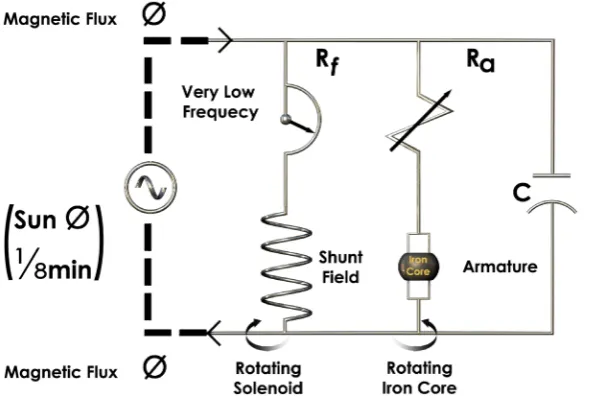
The Earth dynamo has been turning for several billion years and the action of rotation infinitely repeatable. Therefore, once understood, it can be electrically modelled with a high degree of certainty (Figure 1). Through diligent thought experiments, intuitive engineering reasoning and a bit of magical pixie dust, the first functional electrical wiring diagram of the planet Earth is shown below.
2. Plate Tectonic Movement
DOI: 10.4236/jhepgc.2018.41014 154 Journal of High Energy Physics, Gravitation and Cosmology
Figure 1. Electrical wiring diagram of earth.
been joined together at one point in the past in a super continent called Pangea [2].
Tectonics describes the processes of building mountains, growth of cratons, and the ways in which the plates that constitute the Earth’s outer shell interact with each other. Tectonics also provides an understanding of earthquake and volcanic events that directly affect much of mankind. Continental drift showed that earthquakes, volcanoes, and other active geological events aligned along dis-tinct belts around the world and, up to now it has been thought that the unifying theory of geology is plate tectonics. The mechanical force behind plate tectonics is heat convection in the mantle. Hot volcanic material near the Earth’s core ris-es, and colder mantle rock moves downward. The convective heat creates tec-tonics by pushing and spreading apart plates at middle ocean ridges, and at the same time raising and lowering at subduction zones. “It’s kind of like a pot boil-ing on a stove” says Nicholas van der Elst, a seismologist at Columbia Universi-ty’s Lamont-Doherty Earth Observatory [3].
Scientists continue to analyze and study the mechanisms that move plates. Much work has been completed and documented to address the mechanics of the boiling pot, but what needs further investigation is the electrical stove that is heating the pot and to inquire what hypothetical factors might inadvertently turn up the electrical stove and cause the pot to boil over. The smart frog is al-ways curious of its surroundings and likes to know how things work.
3. Calculating Earth’s Current
DOI: 10.4236/jhepgc.2018.41014 155 Journal of High Energy Physics, Gravitation and Cosmology
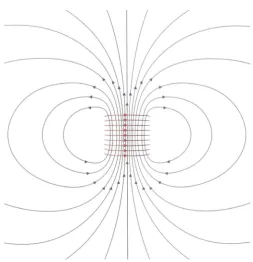
Figure 2. Earth modeled as a solenoid.
0
B=kµ nI
where µ=kµ0 and k = 15 is the average relative permeability of the mantle and liquid iron core combined, which includes the magnifying effect of the core.
For a solenoid of length L = 1.276 E3 meters with N = 9.8 turns, the turn den-sity is n = N/L = 7.68 turns/m. If the current of the solenoid is I = 1.73 E8 A, and the relative permeability of the core is k = 15, then the magnetic field at the cen-ter of the solenoid is 25 gausses. By increasing the average permeability from what was reported in my previous paper, the model more closely matches the reported 25 Gauss at the center of the Earth [5].
4. Earth as a Shunt Wound DC Machine
DOI: 10.4236/jhepgc.2018.41014 156 Journal of High Energy Physics, Gravitation and Cosmology running torque. A shunt DC motor has a feedback mechanism that controls its speed (Figure 3). As the armature rotates in a magnetic field, it induces electrical current. This back EMF is generated in a reverse direction; thus, the armature limits its current draw. The current through the armature is decreased and the speed of the motor is self-regulating for most normal operating conditions. A DC shunt wound motor can maintain a constant speed, regardless of the load on the motor. Typical applications for DC shunt motors include fans, compressors, lathes and grinders. In a shunt motor, current is proportional to torque, thus in-creased torque allows the motor to increase its speed and compensate for the slowdown due to loading. Thus, a DC shunt motor can self-regulate speed and is referred to as a constant speed motor.
In Figure 4, the rotating solenoid coil, or crust, is depicted as the field
[image:5.595.249.497.294.461.2]winding, and the solid inner and liquid outer iron cores as the armature winding. The variable internal resistance of the liquid iron core is represented as
Figure 3. Speed response of DC shunt motor (Image adapted from electrical4u.com).
[image:5.595.228.523.507.708.2]DOI: 10.4236/jhepgc.2018.41014 157 Journal of High Energy Physics, Gravitation and Cosmology ra. We use a variable resistance for ra with the understanding that the volume of
the liquid iron core sphere can increase or decrease in size. Just as in cross sec-tional area resistance, ra is lowered with increasing volume and raised with a
de-creasing volume. The planets soil and water resistance are shown as an adjusta-ble rheostat that mankind, to some degree, will knowingly or unknowingly raise or lower. For example, we know that deforestation and/or desertification leads to dry soil which increase field resistance Rf and moist humid soil such as that
found in the rain forest decreases Rf. This is of course a simplistic rationale for
the choice of a variable rheostat, but sufficient for rudimentary understanding of the principles of electrical impedance and its relationship to controlling a fix speed machine like the planet Earth. Figure 5 is the mechanical equivalent of the electrical schematic shown in Figure 4.
We know that the speed of a shunt motor is given by:
a a a
v i r
N kφ − =
where, φ is the flux per pole and is proportional to the field current If. The
vol-tage applied across the armature is va. The mechanical load present on the shaft
is defined by the armature current Ia. Speed N can be varied by va and If. Given a
fixed supply voltage and the Earth connected as a shunt, va can be theoretically
varied by changing ra resistance connected in series with the armature. The more
likely scenario in the case of the Earth is that If of course is varied by controlling
external field resistance Rf connected with the field circuit. Thus, for a shunt
motor we have essentially three methods [6] for controlling speed: 1) Varying the voltage,
[image:6.595.289.458.478.709.2]2) Varying armature resistance, 3) Varying field resistance.
DOI: 10.4236/jhepgc.2018.41014 158 Journal of High Energy Physics, Gravitation and Cosmology The speed of the motor can be controlled by controlling the current through the stator or rotor, when the DC power supply voltage is the same. Speed of the shunt DC motor also decreases when the motor is operated at lower voltage than its rated voltage. This causes higher losses and the motor will become overbur-dened and overheat. The current through the stator and rotor branches can be controlled by varying their resistance. The resistance can be increased or de-creased in the shunt winding and armature branch by placing a rheostat in se-ries. Typically, the rheostat for controlling current in the armature branch is quite large as the armature handles much higher current than the field winding. Motor designers generally prefer using a current controlling rheostat in the field winding to reduce cost and size. Varying the shunt field current can change the speed of a motor by 10% - 20%. As resistance in the shunt field increases, the current through the shunt winding decreases, the speed of the rotor decreases, thus yielding lower back EMF to maintain the equivalent increase in armature current. Conversely, by increasing the current through the shunt winding, the speed of the motor can be increased.
In the case of a constant speed machine, both the armature resistance and the field resistance are simultaneously operating to maintain constant speed at a set point. Since the Earth operates at a constant speed of 465 m/s, it is postulated that the field resistance Rf is the controlling variable or rheostat is changed by
the changes to the surface resistance of the planet. Principally these are soil re-sistance and sea water rere-sistance. Any changes that impact Rf are then met with a
compensatory change of Ra to keep the earthly machine running at constant speed. It is believed that the inner core expands and contracts to meet the resis-tance requirements of Ra.
As an aside note, shunt wound DC motors do have an inherent design flaw in that a loss of field or infinite impedance, such as an open circuit, can lead to motor run away condition in which the speed increases instantly to infinity and the machine ultimately mechanically blows apart due to centrifugal forces. It might make a tantalizing theory to explain supernovas; or the ancient Greeks who wit-nessed the planet Phaeton exploding in our solar system.
5. Full Load Losses of the Dynamo Earth
Electrical machine full load losses can be categorized into four major compo-nents. These include winding losses, iron core losses, eddy current losses and mechanical losses [7].
5.1. Hysteresis Losses
DOI: 10.4236/jhepgc.2018.41014 159 Journal of High Energy Physics, Gravitation and Cosmology 30% to full load losses for a typical machine.
5.2. Iron Core Losses
As the armature core is made up of liquid iron, and rotates in a magnetic field, a small current gets induced in the core itself. Due to this current, eddy current loss and hysteresis loss occur in the armature iron core. Hysteresis loss is due to the reversal of magnetization of the armature core. When the core passes under one pair of poles, it undergoes one complete cycle of magnetic reversal. The loss depends upon the volume and grade of the iron, frequency of magnetic reversals and value of flux density. Hysteresis loss is given by, Steinmetz formula:
1.6 max h
W =ηB fV (watts) where, η = Steinmetz hysteresis constant and V = vo-lume of the core in m3.
5.3. Eddy Current Losses
When the armature core rotates in the magnetic field, an emf is induced in the core, per Faraday’s law of electromagnetic induction. Though this induced emf is small, it causes an eddy current to flow in the body due to the resistance of the iron core.
5.4. Mechanical Losses
Mechanical losses consist of the losses due to friction in space and atmospheric resistance. Material friction loss between the rotating solid inner core and oppo-site rotating liquid inner core and mantle may be significant. Air friction loss of rotating shunt field also contributes to these. These losses are about 10% to 20% of full load losses in a typical electrical machine.
6. Calculating Shunt Field I2R Loss
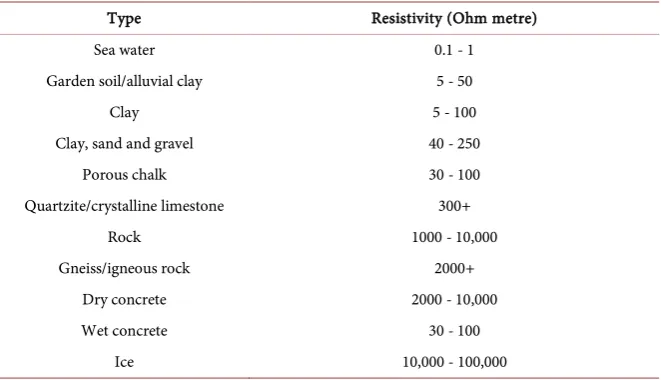
The resistance of the circumference of the Earth is not a practical measurement to make due to its length of 40,075 km. We note that sea water, which makes up 71% of the surface of the globe, has very low impedance, on average 0.1 ohms/meter. Land makes up 29% of the surface of the Earth. Current will take the path of least resistance, so we conclude that current will follow rivers, lakes, underground aquifers and moisture laden soil as it crosses through continental land masses. Table 1 shows conventional resistivity values measured using stan-dard Earth ground resistance measurements. These values are for relative com-parison as an ohm meter represents a standard measurement of one cubic meter of material.
DOI: 10.4236/jhepgc.2018.41014 160 Journal of High Energy Physics, Gravitation and Cosmology
Table 1. Materials and resistivity (adapted from electrical safety slideshow by A. Singla, associate professor of Chitkara University).
Type Resistivity (Ohm metre)
Sea water 0.1 - 1
Garden soil/alluvial clay 5 - 50
Clay 5 - 100
Clay, sand and gravel 40 - 250
Porous chalk 30 - 100
Quartzite/crystalline limestone 300+
Rock 1000 - 10,000
Gneiss/igneous rock 2000+
Dry concrete 2000 - 10,000
Wet concrete 30 - 100
Ice 10,000 - 100,000
which may partially explain why ice ages are extremely slow to melt. To main-tain energy balance between the inner Earth and the outer surface, less current is drawn through the shunt field and more current is passed through the armature. The overall heat loss in both circuits stays the same, but during an ice age the amperage through the ice is reduced.
The longest ever distance measurement to test Earth’s resistivity was per-formed in 1908 near the Animas River in Colorado. Electrical Engineer F. Creigh-ton measured resistance over a 25-mile stretch between a power house and a substation. The total resistance, including both station grounds, the earth be-tween the two points and the line wire, was 55 ohms. The resistance of the power house earthing electrode plus the main body of the Earth was about 30 ohms, or slightly over 1 ohm per mile. A second and third long distance earth ground re-sistance test was performed by Creighton with similar test results [9]. Using 1 ohm per mile, the total resistance of the circumference of the globe is estimated to be 25,000 ohms. Given the very low frequency of the flux transfer events of one every eight minutes, and the commutation or Schumann Resonance of 7.83 Hz, which is also approaching direct current (DC), it is believed that current “fringe effect” would be negligible. In theory, this would significantly reduce the resis-tivity as more cross-sectional area is made available and parallel paths for cur-rent provided. The table is useful for commercial building Earth resistance test-ing, where test rods are a few meters apart, but becomes less meaningful when the distances between test rods are hundreds or thousands of kilometers. As such the table for standard Earth ground testing, even though much more con-servative, is set aside, and the field data collected in 1908 by F. Creighton is fa-vored for use in I2R loss calculation of the shunt field.
DOI: 10.4236/jhepgc.2018.41014 161 Journal of High Energy Physics, Gravitation and Cosmology Watts Loss = I2 × R,
Watts Loss = (1.73 E8 A) 2 × 25,000 ohms, Watts Loss = 7.48 × 10²⁰ Watts,
Total Watts Loss = Watts × N Turns × 0.5 (Spheroid Length Adjusting Fac-tor),
Total Watts Loss = 2.4 × 1023 × 10 Turns × 0.5, Total Watts Loss = 3.75 × 10²¹,
Converting to Joules, 1 Watt = 1 Joule/sec, Watts Loss = 3.75 E21 Joule/sec.
Figure 6 shows the Ocean Heat Content published by the National Centers for Environmental Information (NOAA) for a point of comparison, and consid-eration of the potential contribution of full load losses of the electrical dynamo earth. It is estimated that the I2R losses are 20% - 30% of the total full load losses. Using the percentage losses as a basis for estimating the full load losses, includ-ing field and armature windinclud-ing losses, iron core, mechanical and stray losses, could approach 1 × 10²² Joules or more. As such the electrical full load losses may be a more significant contributor to ocean heat content than previously con-sidered; if considered at all.
7. Temperature Warming, Volcanic and Seismic Activity
[image:10.595.211.537.500.707.2]Bill McGuire, a distinguished geologist charts how changing climate may trigger wild weather in his book, Waking the Giant: How A Changing Climate Triggers Earthquakes, Volcanos and Tsunamis [10]. The book explains that the Earth is a dynamic planet of shifting tectonic plates that is responsive to change, especially when there is a dramatic climate transition. The theory of electromagnetism and tectonics as described in this paper supports these finding by correlating changes in field resistance to I2R losses that people experience as climate change. This in
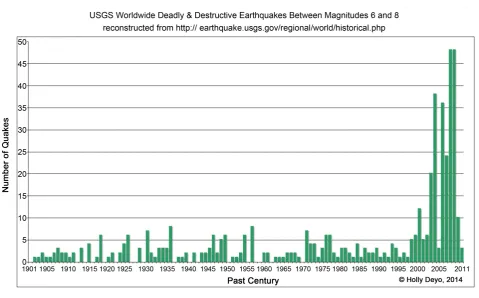
DOI: 10.4236/jhepgc.2018.41014 162 Journal of High Energy Physics, Gravitation and Cosmology turns leads to a change in armature resistance, which increases pressure and al-lows the crust beneath to rise toward the mantle’s surface. The resulting tossing and churning above and beneath the ocean lead to volcanic activity, seismic shocks, and other calamities including tsunamis. Many experts contend that tempera-ture rises expected this century are in line with those at the end of the ice age and climate change due to human activities could bring about catastrophic seis-mic and volcanic events. Figure 7 is a USGS chart of earthquakes that support this argument.
8. Speed and Temperature Regulation through Volcanism
Volcanic eruptions help renew the soil, and soils around active volcanoes are some of the richest on Earth. Hydrothermal processes associated with volcanism produce rich ore deposits. Iron ore deposits have low resistance which allows the flow of electrical current, which is highly dependent on temperature and water content. As magma and ore rich ash is dispersed in the atmosphere and then widely deposited, the electrical resistivity of the surface of the Earth will natural-ly decrease. A change or lowering in field resistance, Rf, will then be
compen-sated by an increase in armature resistance, ra, which will call for a decrease in
[image:11.595.59.539.416.714.2]volume of the inner core and volcanic activity will subside. The Garden of Eden is thus restored to its steady state condition using an ancient electrical feedback loop dating to the Earth’s comparatively miniscule magnetic origin and the Earth’s mechanical actuators that were once allegorically thought of as Devine
DOI: 10.4236/jhepgc.2018.41014 163 Journal of High Energy Physics, Gravitation and Cosmology acts of volcanic fire and ice. Speed regulation is thus closely maintained at 465 m/s and temperature of the surface of the planet is rather crudely regulated as well. Making measurements of the Earth’s electrical resistivity by placing elec-trodes into the ground will allow tracking of the surface resistance and perhaps methods developed for tracking the expansion and contraction of the iron core.
9. Conclusions
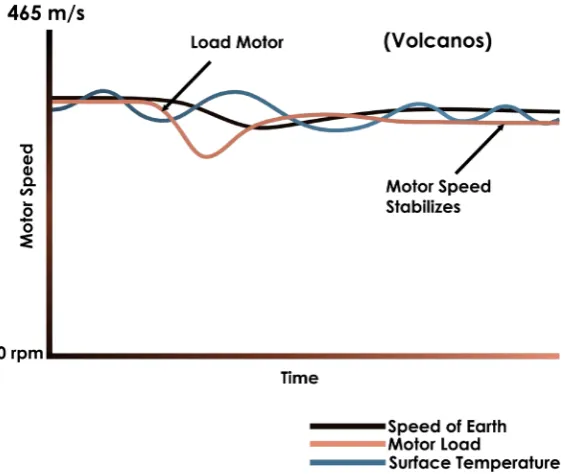
A simple shunt wound DC machine has been proposed as an improved electrical model of the Earth. This electromagnetic analogy provides an intuitive picture of how the Earth regulates speed and uses the Earth armature and shunt resistance to maintain constant speed. The model clearly demonstrates how changes in armature resistance can result in a volumetric change in iron core size, which may be the driving force that directly impacts tectonic plate shifts. The Earth is an electrical machine; it has no intelligence. Its ability to self-regulate speed is not due to an onboard microprocessor; neither does it have power electronics to regulate its temperature for our personal comfort. What electro/mechanical ac-tions it takes (volcanoes, earthquakes, seismic events, temperature, etc.) are ul-timately a function of its electromagnetic coupling with the Sun, which has a magnetic field many thousand times the Earth. Simply speaking the Earth is a slave to the master Sun, in terms of motor control theory. Since the Earth evolved over time to become a constant speed shunt wound machine, it does have inhe-rent design capability to self-regulate speed over a spectrum of changing load conditions. Climate change therefore is a function of the Earth’s normal and sta-ble fluctuating load conditions, and the response time required to self-regulate speed. Below is a speed response curve (Figure 8) for what might be considered normal volcanic or seismic activity of the Earth. As the inner core heats and ex-pands the motor load increases, which attempts to slow the Earth. Since the Earth self regulates, it adjusts to increase speed to maintain 465 m/s. Tempera-ture of the Earth rises with increased loading and later cools as volcanic ash is distributed around the globe.
DOI: 10.4236/jhepgc.2018.41014 164 Journal of High Energy Physics, Gravitation and Cosmology
Figure 8. Normal speed & temperature response of the earth.
and the soil. It may be important for regulating speed and controlling the tem-perature of the Earth. Melting of the ice caps will predictably increase shunt field resistance as fresh water dilutes the salinity of the ocean. Further study and resis-tivity testing of soil and sea water is required to draw any concrete conclusions and make recommendations. Resistance testing of ice core samples similar to CO2
data collection, along with accurate historical data regarding volcanic, seismic and temperature data might be used to add or subtract evidence to global warming arguments. Certainly, a computer design model of the Earth as a shunt wound DC machine with all the losses identified and calculated is of paramount impor-tance to scientists who have a stake in geophysics and environmental research. Based on USGS’ seismic evidence, accumulated from studies of the recent histo-ry of our planet, and simple electrical modelling of the Earth as a constant speed shunt wound DC machine, this electrical engineer has cause for concern. Human activity may be increasing the size of the iron core, which is tantamount to wak-ing the sleepwak-ing giant beneath our feet.
Acknowledgements
Author wishes to acknowledge Ask Scientific for the artwork and formatting as-sistance. Heartfelt thanks to JHEPGC and their editorial staff for giving me the opportunity to publish my papers.
References
[1] Mole, H. (1709) Thesaurus Geographicus. Publisher Churchill, A.J. and Childe, T., London.
DOI: 10.4236/jhepgc.2018.41014 165 Journal of High Energy Physics, Gravitation and Cosmology [3] Oskin, B. and Contributing Writer (2016) What Is Plate Tectonics? Live Science. [4] Poole, G. (2017) Theory of Electromagnetism and Gravity. Journal of High Energy
Physics, Gravitation and Cosmology, 3, 663-692. https://doi.org/10.4236/jhepgc.2017.34051
[5] Buffett, B. (2010) Tidal Dissipation and the Strength of the Earths Internal Magnetic Field. Nature, 468, 952-954. https://doi.org/10.1038/nature09643
[6] Camara PE, J.A. (2017) Power Reference for Manual for the Electrical and Com-puter PE Exam. 2nd Edition, Professional Publications Inc., Belmont.
[7] Sidhdhapura, K.R. and Raval, D.B. (2015) DC Machines and Transformers. Vikas Publishing House, New Delhi.
[8] Cascio, R.L. and Helfrich, W.J. (1987) Ground Resistance Testing in the Mining Industry. Mine Safety and Health Administration, Arlington.
[9] Creighton, E.E.F. (1908) Measurement of Lightning, Aluminum Lightning Arres-tors, Earth Resistance, Cement Resistance, and Kindred Tests. Transactions of the American Institute of Electrical Engineers, 52, 772.