A study of nurses’ job satisfaction: The relationship
to professional commitment and friendship networks
Li-Se Yang1, Hsieh-Hua Yang2*, Hsiu-Tzu Chen3, Mei-Fang Chang1, Yu-Fen Chiu1, Ya-Wen Chou1, Yen-Chi Cheng1
1Department of Nursing, En Chu Kong Hospital, New Taipei City, Chinese Taipei;
2Department of Health Care Administration, Oriental Institute of Technology, New Taipei City, Chinese Taipei; *Corresponding Author: [email protected]
3Nursing Home of Huaining Internal Medicine Clinic, Taoyuan, Chinese Taipei
Received 30 August 2012; revised 1 October 2012; accepted 14 October 2012
ABSTRACT
We suggest that employees’ job satisfaction has relationship to friendship network other than professional commitment, and argue that fri- endship network in the same ward and across wards will have different effects on employees’ job satisfaction. A cross-sectional survey de- sign utilizing questionnaires was selected to fulfill the research objectives. All of the 405 nurses in the En Chou Kong Hospital were sur- veyed. Three hundred and three nurses com- pleted the questionnaire representing a re- sponse rate of 74.8%. The instruments included friendship network nomination, professional commitment scale, and nurses’ job satisfaction scale (NJSS). The regression model of job sat- isfaction was constructed, using friendship network variables in the ward and across wards and professional commitment as independent variables. R square for each model is 0.22 - 0.36 for the four dimensions of job satisfaction. Pro- fessional commitment is the robust predictor. The efficiency of friendship network in the ward is a good predictor, while it is negative related to satisfaction of work load. Further, the indegree in the ward is negative related to work load. Im- plication was discussed.
Keywords:Job Satisfaction; Professional Commitment; Friendship Network
1. INTRODUCTION
Employees who have friends at work are more likely to be engaged in their jobs. A review or research sug- gests that workplace friendship is positively related to employees’ job satisfaction, performance, team cohesion,
and organizational commitment; it is negatively associ- ated with employees’ turnover intentions and negative emotions [1-4]. Job satisfaction is perhaps the most widely studied work orientation over the last four dec- ades of organizational research. It is obviously complex because of a multitude of variables associated with it [5]. A literature review [6-7] revealed that the absence of a robust causal model incorporating organizational, pro- fessional and personal variables is undermining the de- velopment of interventions to improve nurse retention. It is suggested that friendship at work may make up the puzzling absence.
In the review [6], organizational commitment, cohe- sion of the ward nursing team were identified as the strong predictors of job satisfaction, and professional commitment, communication with supervisor/peers were moderate correlated with job satisfaction. Since it had been proposed that professional commitment might es- calate in importance as a compensation for the loss of organizational commitment [8]. It is argued that job sat- isfaction has relationship to professional commitment and friendship network.
should be considered in predicting job satisfaction. The cohesiveness of the ward nursing team was men- tioned as a strong predictor of job satisfaction [6]. The basic element of cohesive team is friendship network. Literature documents that individuals will have benefits through their social networks. [13] found the issues in interpersonal relationships were frequently cited causes that made nurses consider leaving their jobs. [14] found social support might reduce personnel turnover in hospi- tals. Greater social support and pay can reduce turnover by their positive impact on job satisfaction [15]. In Tai- wan, [16] showed that interpersonal relationship was the highest factor of job satisfaction. And, the research in a Norwegian population of nurses found that interaction, followed by pay and autonomy were the most important job factors [17]. In organizational settings, [18] convinc- ingly argued, the social relations of the workplace may make a key contribution to employees’ job satisfaction, productivity, and well-being. Friendship network can be used as a measurement of social relations, but not ever a direct measurement was applied to evaluate this variable.
Nurses bring to their job more than just the profes- sional abilities they have accumulated through years of education and experience. They also bring the assets they can procure through their social network. The research- ers identified two main approaches in which social net- works can enhance individual and organizational per- formance. First, social networks can facilitate access to information, resources, and opportunities [19-24]. Sec- ond, networks can help actors to coordinate critical task interdependencies and to overcome the dilemmas of co- operation and collective action [25-29].
The traditional view of social capital stresses the posi- tive effects of “network closure” in promoting a norma- tive environment that facilitates trust and cooperation between actors [22,30]. Structural hole theory proposes an alternative view of the relationship between network structure and the benefits of social capital [23,24]. The structural hole theory argues that the benefits from social capital stem from the brokerage opportunities created by disperse ties [23,24]. Although structural hole theory is mainly concerned with the sources of competitive ad- vantage, [24] also sees the autonomy of players as cru- cial asset to promote effective coordination in organiza- tions.
Workplaces often have features that may facilitate friendship making. As nurses work in the ward nursing team, the workplace friendship in the working ward can help to facilitate coordination, cooperation, interdepend- encies and promote the job satisfaction. They can also meet others of other wards and make cross-ward friend- ships. Cross-ward friendships can provide extensive contact in multiple departments with access to informa- tion, resources, and opportunities. Obviously, there is
difference between the friendship in working ward and across wards.
We test the hypotheses through a social network lens by examining friendship network of nurses in a hospital in Taiwan. The objectives of this research are illustrating the friendship network in the same ward and across wards, and constructing the model of job satisfaction.
2. METHOD
A cross-sectional survey design utilizing question-naires was selected to fulfill the research objectives. All of the 405 nurses in the En Chou Kong Hospital were surveyed. Three hundred and three nurses completed the questionnaire representing a response rate of 74.8%. The instruments included social network nomination, profes- sional commitment scale, and nurses’ job satisfaction scale (NJSS).
Social network nomination was applied to derive the participants’ friendship networks. The participants were asked to nominate up to 18 persons either in the same ward or across wards separately.
Professional commitment scale is a 6-point Likert type scale (1 = strongly disagree, 6 = strongly agree) with 3 items. These 3 items are “Being a professional nurse is great helpful to my self-image”, “I am proud of being a professional nurse”, and “I am enthusiastic about nursing care”. The Cronbach’s alpha was 0.83.
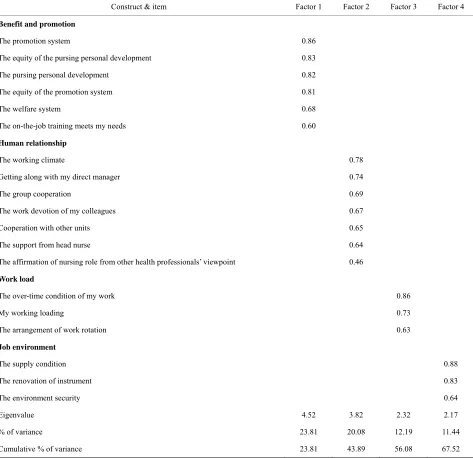
The NJSS was adopted from [31]. It was applied to measure job satisfaction in 4 domains of job environment, human relationship, feedback, and benefit and promotion. The questions were scored on a 6-point Likert scale ranging from 1 point (very dissatisfied) to 6 points (very satisfied). The measurement has strong internal consis- tency with all multiple-item constructs achieving Cron- bach’s alpha ranged between 0.89 and 0.98, exceeding the 0.7 threshold commonly suggested for exploratory re- search [32]. The construct validity is shown as Table 1.
Prior to data collection, approval to conduct the study was obtained from the Medical Center and the partici- pants signed an agreement.
Excel was applied to data coding and processing. UCINET 6 for window [33] was used to calculate the social network variables. The nomination number is de-fined as outdegree and the number of nominated as inde-gree. Efficiency is effective size divided by observed size [23]. The equations is shown as below. The Statistical Package for the Social Sciences (SPSS) software was used to describe the data and construct the regression model.
Effective size 1 iq jq
j q
p m q i j
Table 1. Convergent/discriminant validity of NJSS.
Construct & item Factor 1 Factor 2 Factor 3 Factor 4
Benefit and promotion
The promotion system 0.86
The equity of the pursing personal development 0.83
The pursing personal development 0.82
The equity of the promotion system 0.81
The welfare system 0.68
The on-the-job training meets my needs 0.60
Human relationship
The working climate 0.78
Getting along with my direct manager 0.74
The group cooperation 0.69
The work devotion of my colleagues 0.67
Cooperation with other units 0.65
The support from head nurse 0.64
The affirmation of nursing role from other health professionals’ viewpoint 0.46
Work load
The over-time condition of my work 0.86
My working loading 0.73
The arrangement of work rotation 0.63
Job environment
The supply condition 0.88
The renovation of instrument 0.83
The environment security 0.64
Eigenvalue 4.52 3.82 2.32 2.17
% of variance 23.81 20.08 12.19 11.44
Cumulative % of variance 23.81 43.89 56.08 67.52
Efficiency = effective size/observed size
3. RESULT
The participants came from 17 wards in a hospital. As
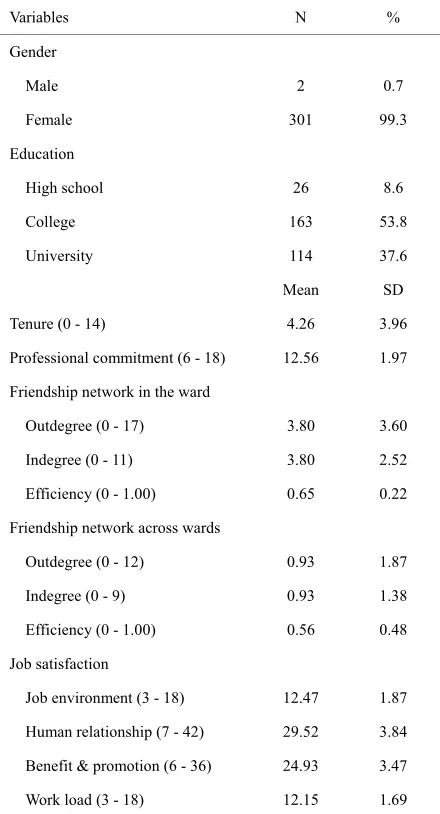
Table 2, there are 301 females and 2 males. Since the
percentage of males is 0.7, the gender difference is not included in regression model. Over half of the partici-pants are graduated from college, one third of them are from university, and the others are from high schools. The mean tenure in present ward is 4.26 years, and the longest tenure is 14 years. The mean score of profes-sional commitment is 12.56.
Three social network variables, outdegree, indegree,
and efficiency, were calculated. Outdegree is the nomi-nation number for each participant. Indegree is the num-ber nominated by others for each participant. Efficiency represents the effective size divided by observed size. In the same ward, the mean scores of outdegree, indegree, and efficiency are 3.80, 3.80, and 0.65. Across different wards, the mean scores of outdegree, indegree, and effi-ciency are 0.93, 0.93, and 0.56. And the mean scores of job satisfaction for all dimensions were moderate.
Table 2. Description of participants.
Variables N %
Gender
Male 2 0.7
Female 301 99.3
Education
High school 26 8.6
College 163 53.8
University 114 37.6
Mean SD
Tenure (0 - 14) 4.26 3.96
Professional commitment (6 - 18) 12.56 1.97
Friendship network in the ward
Outdegree (0 - 17) 3.80 3.60
Indegree (0 - 11) 3.80 2.52
Efficiency (0 - 1.00) 0.65 0.22
Friendship network across wards
Outdegree (0 - 12) 0.93 1.87
Indegree (0 - 9) 0.93 1.38
Efficiency (0 - 1.00) 0.56 0.48
Job satisfaction
Job environment (3 - 18) 12.47 1.87
Human relationship (7 - 42) 29.52 3.84
Benefit & promotion (6 - 36) 24.93 3.47
Work load (3 - 18) 12.15 1.69
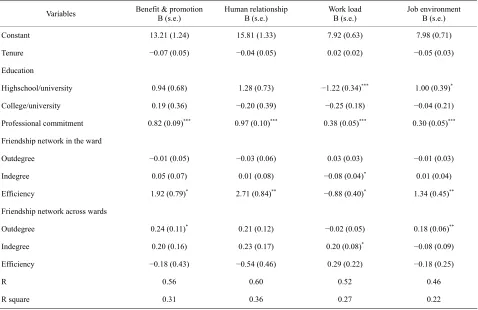
variables. As Table 3, the results showed that R square
for each model is 0.22 - 0.36. For the four dimensions of job satisfaction, professional commitment is the robust predictor. The efficiency of friendship network in the ward is a good predictor for all the four dimensions, while it is negative related to work load. Further, the indegree in the ward is negative related to work load. For friendship network across wards, outdegree is a good predictor for job environment, and benefit & promotion, and indegree is positive related to work load.
4. DISCUSSION
In this article the friendship networks in the working ward and across wards were examined. The results have several implications for the current debate on the rela-tionship between social networks and social capital. And it would be acknowledged some limitations that
recom-mend caution at the time of extracting conclusions, and suggest the importance of future research on the topic.
4.1. Theoretical Implications
Our research raises several theoretical and practical issues for the analysis of how friendship networks can enhance the nurses’ job satisfaction. By analyzing the theoretical underpinnings of the network closure and structural hole theories of social capital, it is partially relieved for which the tension between two alternative views of the relationship between social structures and benefits purportedly created by those structures. The current debate suggests that networks rich in structural holes may provide the information necessary to find about new opportunities, but they may hinder the emer-gence and the enforcement of the norms that can secure cooperative behavior. Network closure is thus viewed as essential to obtain the support and the cooperation nec-essary to take advantage of the opportunities accessible to individuals through their ties. Yet, our results suggest that social context should be considered in interpreting this debate.
In the working ward, efficiency is positively related to job satisfaction in three dimensions, benefit & promotion, human relationship, job environment. The nurse who has higher efficiency demonstrates her friendship network is rich in structural hoes and may take the advantage of the opportunities to obtain support to get her job done. And her job satisfaction will be promoted. This result sup-ports the structural hole theory. Indegree refers to the number of other nurses to which a given nurse is directly connected. The higher indegree represents the nominated person has more friends in the working ward. Seers [34] defined team-member exchange as the relationship qual-ity between an individual and her team members. The empirical evidence demonstrates that individuals who experience high-quality team-member exchange rela-tionships are more likely to contribute by assisting one another and to share information, ideas, and feedback within work teams [34,35]. In a working ward, the nurse who has good relationship quality with others takes more time and energy to accomplish these contributions, and it will increase work load and reduce job satisfaction. This result indicates that network closure has negative effect on satisfaction of work load.
Table 3. Regression model of job satisfaction.
Variables Benefit & promotion B (s.e.) Human relationship B (s.e.) Work load B (s.e.) Job environment B (s.e.)
Constant 13.21 (1.24) 15.81 (1.33) 7.92 (0.63) 7.98 (0.71)
Tenure −0.07 (0.05) −0.04 (0.05) 0.02 (0.02) −0.05 (0.03)
Education
Highschool/university 0.94 (0.68) 1.28 (0.73) −1.22 (0.34)*** 1.00 (0.39)*
College/university 0.19 (0.36) −0.20 (0.39) −0.25 (0.18) −0.04 (0.21)
Professional commitment 0.82 (0.09)*** 0.97 (0.10)*** 0.38 (0.05)*** 0.30 (0.05)***
Friendship network in the ward
Outdegree −0.01 (0.05) −0.03 (0.06) 0.03 (0.03) −0.01 (0.03)
Indegree 0.05 (0.07) 0.01 (0.08) −0.08 (0.04)* 0.01 (0.04)
Efficiency 1.92 (0.79)* 2.71 (0.84)** −0.88 (0.40)* 1.34 (0.45)**
Friendship network across wards
Outdegree 0.24 (0.11)* 0.21 (0.12) −0.02 (0.05) 0.18 (0.06)**
Indegree 0.20 (0.16) 0.23 (0.17) 0.20 (0.08)* −0.08 (0.09)
Efficiency −0.18 (0.43) −0.54 (0.46) 0.29 (0.22) −0.18 (0.25)
R 0.56 0.60 0.52 0.46
R square 0.31 0.36 0.27 0.22
one’s social networks and increase the opportunities to compare with other wards colleague. The social com-parison theory [36] posited that there is a drive within individuals to look to outside images in order to evaluate their own opinions and ability. The nurses learn about their own attitudes by comparing themselves with other nurses across wards. Since the nurses work in the same hospital, they have reasonable similar job environment. The similarity will promote the satisfaction about job environment.
4.2. Managerial Implications
In this study, the friendship networks in the ward and across wards are different in structure. The outdegree in the same ward is higher than across wards. Apparently, the nurses have more friends in the working ward then out of the working ward. And the item “work load” was negatively correlated with indegree in the ward and posi-tively correlated with indegree across ward. Obviously, the work burden came from the same ward but not from the other ward. The friendship network in a ward should be considered in the arrangement of working shift.
Professional commitment is a robust predictor of job satisfaction. The importance of employees’ commitment has been widely advocated [37-40]. Commitment may
provide an important source of occupational meaning. Professional commitment had an incremental effect on a professional’s intention to leave the organization in one study [39]. Enhancing professional commitment in nurs-ing has the potential to produce benefits for both the in-dividual and their organization [41,42]. Further, the pro-fessional commitment is shaped during the socialization process. The development of a profession involves more than developing a distinct body of knowledge. It involves the realization that professionals are part of a moral community with social links not only to their clients and colleagues in the profession but also to other groups. The legitimacy of nursing’s professional contribution must be acknowledged by other groups, including physicians and administrators or managers of health care facilities.
The participants connect with their friends of the same value across divisions. And the attitude, belief, and value similarity lead to attraction and interaction [44]. The op-portunity for interaction with the friends in ward and across wards would reinforce the professional commit-ment.
4.3. Limitations and Future Research
Although this study expands our knowledge of friend- ship network related to job satisfaction among nurses, it has limitations. First, as the data reported in this paper was obtained from all the nurses working in a single district hospital, it is rather difficult to make general- izations. The result might have differed if the population came from different hospital. Further, the task was relatively heterogeneous across these 17 departments. It is suggested that further research is needed to differen- tiate the effect of divisions.
The findings remind us the friendship may have negative effect. [45] indicated that the entrepreneurs did benefit from the support and resources provided by their cohesive networks, but the obligations that resulted from those benefits, and the entrepreneurs’ difficulties to extricate themselves from those obligations, curtailed their subsequent ability to pursue new opportunities. The social capital embodies in their cohesive networks then became a liability that hindered, rather than helped, their subsequent performance. The research of the “dark side” of friendship network is needed.
5. CONCLUSIONS
Nursing is a healthcare profession. They work in a large variety of specialties and as part of a team. The interaction with team member is needed at their work. Interpersonal relationships play a pivotal role in effective team functioning because they facilitate behaviors that maximize the individual potential for team efficiency and effectiveness [46]. The friendship network of nurse is a key factor of job satisfaction.
However, the role of friendship network play different roles in working ward and across wards. In working ward, network efficiency is helpful for job satisfaction. And network closure across wards is helpful for job satisfaction. The findings of this study provide evidence for the importance of considering context when examin- ing the debate between network closure and structural hole.
Social networks research focuses on patterns of social relations among a set of actors to explain social phe-nomena [47]. The utilization of social networks can ex-plain how the interaction of an individual within broader social network of actors affects how perceptions of ex-change relationships develop. We apply this logic and
tested that social network will affect employees’ percep-tions of job satisfaction.
REFERENCES
[1] Berman, E.M., West, J.P. and Richter, M.N. (2002) Workplace relations: Friendship patterns and cones- quences (according to managers). Public Administration Reviews, 62, 217-230. doi:10.1111/0033-3352.00172
[2] Morrison, R. (2004) Information relationships in the workplace: Association with job satisfaction, organiza- tional commitment and turnover intentions. New Zealand Journal of Psychology, 33, 114-128.
[3] Riordan, C.M. and Griffeth, R.W. (1995) The opportunity for friendship in the workplace: An underexplored con- struct. Journal of Business and Psychology, 10, 141-154.
doi:10.1007/BF02249575
[4] Winstead, B.A., Derlega, V.J., Montgomery, M.J. and Pilkington, C. (1995) The quality of friendships at work and job satisfaction. Journal of Social and Personal Re- lationships, 12, 199-215.doi:10.1177/0265407595122003
[5] Johnston, C.L. (1997) Changing care patterns and re- gistered nurse job satisfaction. Holistic Nursing Practice,
11, 69-77.
[6] Lu, H., While, A.E. and Barriball, K.L. (2005) Job satis- faction among nurses: A literature review. International Journal of Nursing Studies, 42, 211-227.
doi:10.1016/j.ijnurstu.2004.09.003
[7] Lu, H., Barriball, K.L., Zhang, X. and While, A.E. (2011) Job satisfaction among hospital nurses revisited: A sys- tematic review. International Journal of Nursing Studies,
49, 1017-1038. doi:10.1016/j.ijnurstu.2011.11.009
[8] Irving, G.P., Coleman, D.F. and Cooper, C.L. (1997) Fur- ther assessments of a three-component model of organ- izational commitment: Generalizability and differences across occupations. Journal of Applied Psychology, 82,
444-452.doi:10.1037/0021-9010.82.3.444
[9] Fang, Y. (2001) Turnover propensity and its causes among Singapore nurses: An empirical study. Interna- tional Journal of Human Resource Management, 12, 859-
871.doi:10.1080/09585190110047875
[10] Lu, K.-Y., Lin, P.-L. Wu, C.-M., Hsieh, Y.-L. and Chang, Y.-Y. (2002) The relationship among turnover intentions, professional commitment, and job satisfaction of hospital nurses. Journal of Professional Nursing, 18, 214-219.
doi:10.1053/jpnu.2002.127573
[11] Harrison, D.A., Newman, D.A. and Roth, P.L. (2006). How important are job attitudes? Meta-analytic compare- sons of integrative behavioral outcomes and time se- quences. Academy of Management Journal, 49, 305-325.
doi:10.5465/AMJ.2006.20786077
[12] Ahmadi, K.S., Speedling, E.J. and Kuhn-Weissman, G. (1987) The newly hired hospital staff nurse’s profession- alism, satisfaction and alienation. Internal Journal of Nursing Studies, 24, 107-121.
doi:10.1016/0020-7489(87)90053-8
among Japanese nurses: An exploratory comparative de- sign. International Journal of Nursing Studies, 46, 957- 967.doi:10.1016/j.ijnurstu.2007.10.013
[14] Bjorvell, H. and Brodin, B. (1992) Hospital staff mem- bers are satisfied with their jobs. Scandinavia Journal of Caring Sciences, 6, 9-16.
[15] Price, J.L. (2001) Reflections on the determinants of voluntary turnover. International Journal of Manpower,
22, 600-624.doi:10.1108/EUM0000000006233
[16] Chang, F.M., Lin, C.J., Kuo, H.W., Teng, Y.K. and Lee, J.N. (1995) Appraisal and satisfaction among staff nurses in the health stations of Taiwan province. China Journal of Public Health, 14, 78-87.
[17] Bjork, I.T., Samdal, G.B. Hansen, B.S., Torstad, S. and Hamilton, G.A. (2007) Job satisfaction in a Norwegian population of nurses: A questionnaire survey. Interna- tional Journal of Nursing Studies, 44, 747-757.
doi:10.1016/j.ijnurstu.2006.01.002
[18] Hodson, R. (1997) Group relations at work: Solidarity, conflict and relations with management. Work and Occu- pations, 24, 426-452.
doi:10.1177/0730888497024004003
[19] Granovetter, M. (1974) Getting a job: A study of contacts and careers. University of Chicago Press, Chicago. [20] Lin, N., Ensel, W. and Vaughn, J. (1981) Social resources
and strength of ties: Structural factors in occupational status attainment. American Sociological Review, 46, 393-
405. doi:10.2307/2095260
[21] Flap, H.D. and de Graaf, N.D. (1986) Social capital and attained occupational status. Netherlands Journal of So- ciology, 22, 145-161.
[22] Coleman, J.S. (1990) Foundations of social theory. Har-vard University Press, Cambridge.
[23] Burt, R.S. (1992) Structural holes: The structure of com- petition. Harvard University Press, Cambridge.
[24] Burt, R.S. (1997) The contingent value of social capital.
Administrative Science Quarterly, 42, 339-364.
doi:10.2307/2393923
[25] Pfeffer, J. and Salancik, G.R. (1978) The external control of organizations: A resource dependence perspective. Harper & Row, New York.
[26] Kotter, J.P. (1982) What effective general managers really do. Harvard Business Review, 60, 156-167.
[27] Gulati, R. (1995) Social structure and alliance formation patterns: A longitudinal analysis. Administrative Science Quarterly, 40, 619-652.doi:10.2307/2393756
[28] Walker, G., Kogut, B. and Shan, W.J. (1997) Social capi- tal, structural holes and the formation of an industry net- work. Organization Science, 8, 109.
doi:10.1287/orsc.8.2.109
[29] Gulati, R. and Gargiulo, M. (1999) Where do interior- ganizational networks come from? American Journal of Sociology, 104, 1439-1493.doi:10.1086/210179
[30] Coleman, J.S. (1988) Social capital in the creation of human capital. American Journal of Sociology, 94, S95-
S120.doi:10.1086/228943
[31] Lin, C.J., Wang, H.C., Li, T.C. and Huang, L.C. (2007)
Reliability and validity of nurses’ job satisfaction scale and nurses’ professional commitment. Mid-Taiwan Jour- nal of Medicine, 12, 65-75.
[32] Nunnally, J.C. (1978) Psychometric Theory. McGraw- Hill, New York.
[33] Borgatti, S.P., Everett, M.G. and Freeman, L.C. (2002) UCINET 6 for Windows: Software for social network analysis. Analytic Technologies, Harvard.
[34] Seers, A. (1989) Team-member exchange quality: A new construct for role-making research. Organizational Be- havior and Human Decision Processes, 43, 118-135.
doi:10.1016/0749-5978(89)90060-5
[35] Seers, A., Petty, M.M. and Cashman, J.F. (1995) Team- member exchange under team and traditional manage- ment. Group and Organization Management, 20, 18-38.
doi:10.1177/1059601195201003
[36] Festinger, L. (1954) A theory of social comparison proc- esses. Human Relations, 7, 117-140.
doi:10.1177/001872675400700202
[37] Aryee, S. and Tan, K. (1992) Antecedents and outcomes of career commitment. Journal of Vocational Behavior,
40, 288-305. doi:10.1016/0001-8791(92)90052-2
[38] Bedeian, A.G. and Kemery, E.R. (1991) Career com- mitment and expected utility of present job as predictors of turnover intention and turnover behavior. Journal of Vocational Behavior, 39, 331-343.
doi:10.1016/0001-8791(91)90042-K
[39] Blau, G. and Lunz, M. (1998) Testing the incremental effect of professional commitment on intent to leave one’s profession beyond the effects of external, personal, and work-related variables. Journal of Vocational Behav- ior, 52, 260-269.doi:10.1006/jvbe.1997.1601
[40] Chang, E. (1999) Career commitment as a complex mod- erator of organizational commitment and turnover inten- tion. Human Relations, 52, 1257-1278.
doi:10.1023/A:1016908430206
[41] Cohen, A. (1998) An examination of the relationship between work commitment and work outcomes among hospital nurses. Scandinavia Journal of Management, 14,
1-17. doi:10.1016/S0956-5221(97)00033-X
[42] Cohen, A. (1999) Relationships among five forms com- mitment: An empirical assessment. Journal of Organiza- tional Behavior, 20, 285-308.
doi:10.1002/(SICI)1099-1379(199905)20:3<285::AID-JO B887>3.0.CO;2-R
[43] McPherson, M., Smith-Lovin, L. and Cook, J.M. (2001) Birds of a feather: Homophily in social networks. Annual Review of Sociology, 27, 415-444.
doi:10.1146/annurev.soc.27.1.415
[44] Huston, T.L. and Levinger, G. (1978) Interpersonal attrac- tion and relationships. Annual Review of Psychology, 29,
115-156.doi:10.1146/annurev.ps.29.020178.000555
[45] Portes, A. and Sensenbrenner, J. (1993) Embeddedness and immigration: Notes on the social determinants of economic action. American Journal of Sociology, 98,
1320-1350.doi:10.1086/230191
formation. Academy of Management Review, 29, 297-317.
doi:10.5465/AMR.2003.9416356
[47] Wasserman, S. and Faust, K. (1994) Social network