http://www.scirp.org/journal/jcc ISSN Online: 2327-5227 ISSN Print: 2327-5219
DOI: 10.4236/jcc.2018.61007 Dec. 29, 2017 65 Journal of Computer and Communications
Passive Localization Using Time Difference of
Arrival and Frequency Difference of Arrival
Xiansheng Guo
1,2, Yan Zhang
3, Botao Zeng
11Department of EE, University of Electronic Science and Technology of China, Chengdu, China 2Wuhu Overseas Students Pioneer Park, Wuhu, China
3Chengdu University, Chengdu, China
Abstract
In order to improve the accuracy and engineering feasibility of four-Satellite localization system, the frequency difference measurement is introduced to the four-Satellite TDOA (Time Difference of Arrival) localization algorithm. The TDOA/FDOA (Frequency Difference of Arrival) localization algorithm is used to optimize the GDOP (geometric dilution of precision) of four-Satellite localization. The simulation results show that the absolute position measure-ment accuracy has little influence on TDOA/FDOA localization accuracy as compared with TDOA localization. Under the same conditions, TDOA/FDOA localization has better accuracy and its GDOP shows more uniform distribu-tion in diamond configuradistribu-tion case. The localizadistribu-tion accuracy of four-Satellite TDOA/FDOA is better than the localization accuracy of four-Satellite TDOA.
Keywords
Four-Satellite Localization, TDOA (Time Difference of Arrival), FDOA (Frequency Difference of Arrival),
GDOP (Geometric Dilution of Precision), Passive Localization
1. Introduction
With the development of space technology, high precision passive localization based on small satellite platform plays an important role in civil and military fields and has broad application prospects [1]. The development trend of space electronic reconnaissance technology is to increase the measurement informa-tion of target and adopt joint posiinforma-tioning method to improve posiinforma-tioning accu-racy and increase reconnaissance range [2]. In recent years, the two-satellite TDOA/FDOA localization method has been developed both in domestic and How to cite this paper: Guo, X.S., Zhang,
Y. and Zeng, B.T. (2018) Passive Localiza-tion Using Time Difference of Arrival and Frequency Difference of Arrival. Journal of Computer and Communications, 6, 65-73. https://doi.org/10.4236/jcc.2018.61007
DOI: 10.4236/jcc.2018.61007 66 Journal of Computer and Communications
global position fields, which lays a foundation for the research of TDOA/FDOA localization system [3] [4] [5]. There are also literatures of multi-statellite TDOA/FDOA localization method [6] [7] [8] [9] [10], However, they seldom considered the four-satellite TDOA/FDOA joint localization problem. In this paper, the localization performance of the four-satellite TDOA/FDOA localiza-tion method is studied. Compared with the TDOA localizalocaliza-tion system, the ad-vantages of the diamond configuration and accuracy of the absolute position measurement are emphasized.
2. Principle of Four-Satellite TDOA
Suppose that the model of the three-dimensional TDOA localization system (as
shown in Figure 1) consists of 1 main satellite and three subsatellites. S0 is the
main satellite, S S S1, 2, 3 are the subsatellites. Their coordinates are denoted as
( , , ) i i i i
S x y z , where i=0,1, 2, 3. p( , , )x y z is the location of the target radiation
source to be estimated.
According to the position of each satellite, the distance differences between the main satellite and the other three subsatellites satisfy the following equations:
0
2 2 2
0 0 0 0
2 2 2
( ) ( ) ( )
( ) ( ) ( )
i i
i i i i
r r r
r x x y y z z
r x x y y z z ∆ = −
= − + − + −
= − + − + −
(1)
where ri is the radial distance between the satellite i and the target where
0,1, 2, 3
i= . Equations (2) can be obtained with simplification and
rearrange-ment of Equation (1):
0 0 0 0
(x −x xi) +(y −y yi) +(z −z zi) = ∆ +r ri ki (2)
where 2 2 2 2 2 2 2
0 0 0
1
( ) ( )
2
i i i i i
k = ∆ +r x +y +z − x +y +z . The matrix
[image:2.595.231.521.516.706.2]representa-tion of Equarepresenta-tion (2) can be given by
DOI: 10.4236/jcc.2018.61007 67 Journal of Computer and Communications =
Ax f (3)
where
0 1 0 1 0 1
0 2 0 2 0 2
0 3 0 3 0 3
, , , , , ,
x x y y z z
x x y y z z
x x y y z z
− − − = − − − − − − A ,
[
x y z, ,]
T=
x , and f = ∆ +
[
r r0 1 k r r1, 0∆ +2 k r r2, 0∆ +3 k3]
T.Ideally for satellites location, rank
( )
A =3, Equation (4) can be obtained byusing pseudo inverse to solve Equation (3):
T 1 T
( )−
=
x A A A f (4)
The accuracy analysis of four-satellite TDOA localization algorithm is as fol-lows.
Differentiating ∆ri:
0 0 0
0 0 0 0 0
d( ) ( )d ( )d ( )d d d d d d d
i ix x iy y iz z
ix i iy i iz i x oy z
r c c x c c y c c z
c x c y c z c x c y c z
∆ = − + − + −
− − − + + + (5)
where i, i, i
ix iy iz
i i i
x x y y z z
c c c
r r r
− − −
= = = .
Let
1 0 1 0 1 0
2 0 2 0 2 0
3 0 3 0 3 0
, ,
, ,
, ,
x x y y z z
x x y y z z
x x y y z z
c c c c c c c c c c c c c c c c c c
− − −
= − − −
− − −
C , dX =
[
d , d , dx y z]
T,[
1 2 3]
dY = ∆d r, d∆r, d∆r T , dSi =
[
d , d , dxi yi zi]
T,0 0 0
0 0 0 0
0 0 0
, , , , , , x y z x y z x y z
c c c c c c c c c
= U ,
1 1 1
1 0 0 0
0 0 0
x y z
c c c
=
U , 2 2 2 2
0 0 0
0 0 0
x y z
c c c
=
U , 3
3 3 3
0 0 0
0 0 0
x y z
c c c
= U .
We can obtain
0 0 1 1 2 2 3 3
d d d d d d
⋅ = − + + +
C X Y U S U S U S U S (6)
Let B=(C CT )−1CT. Since the main satellite has an error in measuring the
ar-rival time of the radiation source signal, and the error exists in each time
differ-ence measurement. The measurement errors of each ∆ri are related. we
as-sumed that the mean of the measurement error is 0 after the systematic calibra-tion. Moreover, each element of satellite position error is uncorrelated and each satellite position is uncorrelated. The covariance matrix of the target radiation source localization error can be obtained as follows.
{
T}
T Tˆ 0 0 0 0
d
T T T T T T
1 1 1 1 2 2 2 2 3 3 3 3
ˆ ˆ
E d d E d d + E d d
E d d E d d E d d
= =
+ + +
X
P X X B Y Y U S S U
DOI: 10.4236/jcc.2018.61007 68 Journal of Computer and Communications
where
1 1 2 1 3 1 2 2 2 3 1 3 2 3 3
2
12 12
T 2
12 23
2
13 23
E d
r r r r r
r r r r r
r r r r r
d
σ η σ σ η σ σ
η σ σ σ η σ σ
η σ σ η σ σ σ
∆ ∆ ∆ ∆ ∆
∆ ∆ ∆ ∆ ∆
∆ ∆ ∆ ∆ ∆
=
Y Y , σ∆2ri is the variance
of the measurement error of the distance between the satellite i and the main
satellite. ηij is the correlation coefficient between ∆ri and ∆rj. We assume
that the variance of satellite position error on each component is the same, that
is 2 2 2
i i i
x y z
σ =σ =σ . We can obtain the covariance matrix of the satellite position
error as Equation (8).
[
] [
]
(
)
T 2 2 2
E d d E d , d , d d , d , d diag , ,
i i i
T
i i xi yi zi xi yi zi σ σ σx y z
= =
S S (8)
The covariance matrix of the target radiation source position error is as Eq-uation (9).
[
] [
]
(
)
T 2 2 2
E d d X X =d , d , dx y zT d , d , dx y z T=diag σ σ σx, y, z (9)
According to the definition of the GDOP, the GDOP of TDOA localization in three dimensional space can be calculated as Equation (10).
(
T)
GDOP= trace E d d X X (10)
3. Principle of Four-Satellite TDOA/FDOA
On the basis of the four-satellite TDOA localization algorithm, the four-satellite TDOA/FDOA localization algorithm adds frequency difference information.
The coordinate of the target is recorded as p
(
x y z, ,)
. The coordinate of themain satellite is recorded as S0
(
x y z0, 0, 0)
. The speed of the main satellite isrecorded as v0
(
vx0,vy0,vz0)
. The coordinate of the subsatellites is recorded as(
, ,)
i x y zi i i
S . The speed of the subsatellite is recorded as vi
(
vxi,vyi,vzi)
, where1, 2, 3
i= . According to the time difference and frequency difference of the
target radiation source arriving at the main satellite and subsatellites, we can ob-tain that
(
) (
) (
)
(
) (
) (
)
2 2 2
0 0 0
2 2 2
c
i i
i i i
f tdoa x x y y z z x x y y z z
= ⋅ = − + − + −
− − + − + − (11)
(
)
(
)
(
)
(
) (
) (
)
(
)
(
)
(
)
(
) (
) (
)
0 0 0 0 0 0
2 2 2
0 0 0
2 2 2
c
+
i i i
x y z
i j
x i y i z i
i i i
v x x v y y v z z
fdoa f
f x x y y z z
v x x v y y v z z
x x y y z z
− + − + −
= ⋅ =
− + − + −
− + − −
−
− + − + −
(12)
where i=1, 2, 3, 4, 5, 6j= . And tdoai is the time difference of arrival, fdoai
is the frequency difference of arrival, f is the radiation frequency of radiation
source, c is the light speed. By solving the least square solution of the equation,
DOI: 10.4236/jcc.2018.61007 69 Journal of Computer and Communications
Using first order linear approximation expansion for tdoai, fdoai,
(
x y z, ,)
,(
x y zi, i, i)
and vi(
vxi,vyi,vzi)
, we can obtain the Equation (13).[
]
[
]
3[
]
31 2
0 0
, /
d , d , d d , d , d d , d , d
T
T T
T
i i i i i xi yi zi
i i
c f
x y z x y z v v v
= =
= +
∑
+∑
TDOA FDOA
B B B (13)
where
[
1, 2, 3]
T
tdoa tdoa tdoa =
TDOA , FDOA=
[
fdoa fdoa1, 2,fdoa3]
T,1 1 1
2 2 2
3 3 3
4 4 4
5 5 5
6 6 6
/ / / / / / / / / / / / / / / / / /
f x f y f z
f x f y f z
f x f y f z
f x f y f z
f x f y f z
f x f y f z
∂ ∂ ∂ ∂ ∂ ∂ ∂ ∂ ∂ ∂ ∂ ∂ ∂ ∂ ∂ ∂ ∂ ∂ = ∂ ∂ ∂ ∂ ∂ ∂ ∂ ∂ ∂ ∂ ∂ ∂ ∂ ∂ ∂ ∂ ∂ ∂ B ,
1 1 1
2 2 2
3 3 3
1
4 4 4
5 5 5
6 6 6
/ / / / / / / / / / / / / / / / / /
i i i
i i i
i i i
i
i i i
i i i
i i i
f x f y f z
f x f y f z
f x f y f z
f x f y f z
f x f y f z
f x f y f z
∂ ∂ ∂ ∂ ∂ ∂ ∂ ∂ ∂ ∂ ∂ ∂ ∂ ∂ ∂ ∂ ∂ ∂ = ∂ ∂ ∂ ∂ ∂ ∂ ∂ ∂ ∂ ∂ ∂ ∂ ∂ ∂ ∂ ∂ ∂ ∂ B
Take the upper equation as
[
]
[
]
3[
]
1 0 3
2 0
d , d , d , / d , d , d
d , d , d
T
T T
i i i i i
T i xi yi zi i
x y z c f x y z
v v v
= = = − −
∑
∑
B TDOA FDOA B
B
(14)
Divide the measurement accuracy of the subsatellite position into measure-ment accuracy of absolute position and measuremeasure-ment accuracy of relative posi-tion. That is
[
] [
]
' ' '0 0 0
d , d , dxi yi zi T = d , d , dx y z T+ d , d , d xi yi ziT
The right ' ' '
d , d , dxi yi zi T
is the measurement accuracy of relative position
be-tween main satellite and subsatellites.
[
d , d , d0 0 0]
T
x y z is the measurement
accu-racy of absolute position of main satellite. We can obtain the Equation (15).
[
]
[
]
3[
]
1 0 0 0
0
3 3
' ' '
1 2
1 0
d , d , d , / d , d , d
d , d , d d , d , d T
T T
i i
T T
i i i i i xi yi zi
i i
x y y c f x y y
x y z v v v
= = = = − − −
∑
∑
∑
B TDOA FDOA B
B B
(15)
Let 1 3 1
0
i i=
=
∑
K B , K2=B11 , K3=B12 , K4=B13 , K5=B20 , K6=B21,
7= 22
K B , K8=B23. And we assume that the measurement accuracy of
posi-tion, the measurement accuracy of speed, the measurement accuracy of TDOA, the measurement accuracy of FDOA are uncorrelated. We can obtain Equation (16) by matrix operation.
[
] [
]
( )
T 8( )
T2 1 1 1 T 1
1
E d , d , d T d , d , d
i i i i
x y z x y z
c − − − −
=
= B M B +
∑
B K E K B(16)
where M is the correlation matrix of measurement accuracy between TDOA
and FDOA. Ei is the correlation matrix of the measurement accuracy of
DOI: 10.4236/jcc.2018.61007 70 Journal of Computer and Communications
The positioning accuracy can be expressed by the measuring accuracy of 3 orthogonal directions as Equation (17)
2 2 2
x y z
GDOP=
σ
+σ
+σ
(17)From the above analysis results, we can see that the positioning accuracy is
calculated by M and Ei.
We assume that the mean of the TDOA signal and the FDOA signal mea-surement accuracy is 0, and they are uncorrelated. We can obtain that
2 2
3 2 3
diag t , f
f
σ
σ
=
M I I
where I3 is a 3 3× unit matrix,σt is the measurement accuracy of time
difference, σf is the measurement accuracy of frequency difference.
The absolute position measurement accuracy component d , d , dx0 y0 z0 are
considered to be independent of the random variables. Therefore, the correlation matrix of four-satellite absolute position measurement accuracy is
2
1 3
3 as
σ =
E I
where σas is the measurement accuracy of absolute position.
Comprehensively considering the measurement accuracy of relative position and the ranging accuracy, the correlation matrix of relative position measure-ment accuracy can be represented as
2 2 2 2
2
diag , , 2 2
bs d bs d
i d
σ σ σ σ σ
− −
=
E
where i=2, 3, 4, and σbs is the measurement accuracy of relative position,
d
σ is the ranging accuracy.
The correlation matrix of speed measurement accuracy can be represented as
2 3
j=σv
E I where σv is measurement accuracy of speed.
4. Simulation Results
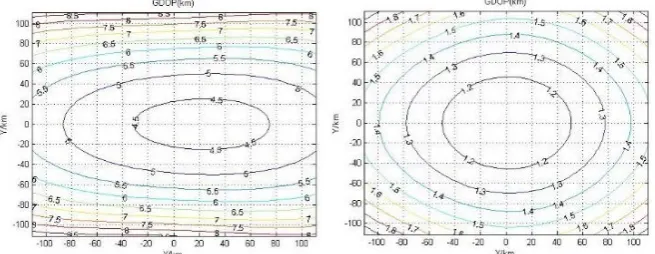
We assume that the satellite orbit altitude is 200 km and the length of baseline is 60 km. The Y configuration, T configuration and diamond configuration are adopted respectively. The measurement accuracy of time difference is 50 ns. The measurement accuracy of frequency difference is 10 Hz. The measurement ac-curacy of speed is 1 m/s. The absolute position measurement acac-curacy is 150 m. The relative position measurement accuracy is 50 m. The GDOP distributions of TDOA localization and TDOA/FDOA localization are obtained by simulation, as shown in Figures 2-4.
DOI: 10.4236/jcc.2018.61007 71 Journal of Computer and Communications
Figure 2. Y configuration, the GDOP distributions of TDOA localization (left) and TDOA/FDOA localization (right).
Figure 3. T configuration, the GDOP distributions of TDOA localization (left) and TDOA/FDOA localization (right).
Figure 4. Diamond configuration, the GDOP distributions of TDOA localization (left) and TDOA/FDOA localization (right).
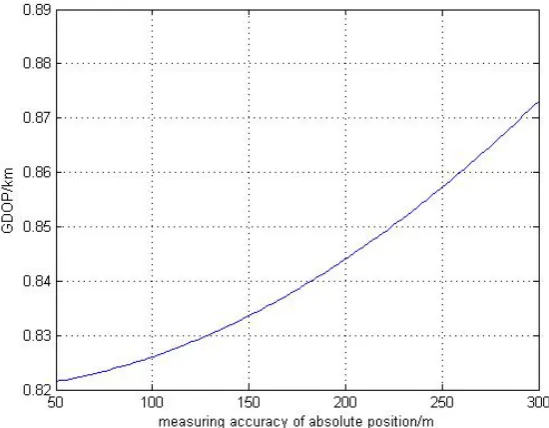
Let measurement accuracy of absolute position in continuous 0 - 300 m and continuous value. Select the Y configuration, and the remaining parameters re-main unchanged. Taking a point on the 100 km circumference of the subastral point, the relationship of TDOA localization accuracy and TDOA/FDOA locali-zation accuracy with the absolute position measurement accuracy are obtained respectively, as shown in Figure 5 and Figure 6.
[image:7.595.210.539.67.201.2] [image:7.595.217.539.251.379.2] [image:7.595.211.539.429.556.2]DOI: 10.4236/jcc.2018.61007 72 Journal of Computer and Communications
[image:8.595.236.512.74.293.2]Figure 5. Relationship of TDOA localization accuracy with the absolute position mea-surement accuracy.
Figure 6. Relationship of TDOA/FDOA localization accuracy with the absolute position measurement accuracy.
accuracy. But the localization accuracy of TDOA is greatly affected by absolute position measurement accuracy. The localization accuracy of TDOA/FDOA is affected by absolute position measurement accuracy very little. Compared with TDOA localization, the effect is almost negligible.
5. Conclusion
[image:8.595.236.511.342.556.2]re-DOI: 10.4236/jcc.2018.61007 73 Journal of Computer and Communications
spectively. Through simulation analysis, some useful conclusions can be drawn as follows.
With the same parameters, TDOA/FDOA localization algorithm shows better accuracy than TDOA localization algorithm.
When using the diamond configuration, as compared with the TDOA locali-zation algorithm, the TDOA/FDOA localilocali-zation algorithm not only has better localization accuracy, but also improves the GDOP distribution uniformity. It solves the problem of uneven distribution of diamond configuration and in-creases the engineering feasibility.
As compared with the TDOA localization, the absolute position measurement accuracy of satellite has almost no effect on the localization accuracy of TDOA/ FDOA, which reduces the localization error caused by unavoidable absolute po-sition measuring factors.
Acknowledgements
This work is supported by the National Natural Science Foundation of China un-der Grant (No. 61201277, No. 61371184, No. 61671137, No. 61771114) and the Fundamental Research Funds for the Central Universities (No. ZYGX2016J028).
References
[1] Hu, L.Z. (2004) The Summarization of Passive Locating Technique. Electronic Warfare.
[2] Wu, J. (2009) Current Status and Development of Foreign Space Reconnaissance Systems. Telecommunication Engineering, 49, 108-114.
[3] Chang, X.Y., Xie, B., Zhang, X.M. and Lan, D. (2013) Target Location Accuracy Analysis of Dual-satellites Location System Using TDOA and FDOA. Spacecraft Engineering, 22, 35-42.
[4] Guo, F.C. and Fan, Y. (2006) Analysis of Dual Satellites Geo Location Method Us-ing TDOA and FDOA. Aerospace Eletronic Warfare, 22, 20-23.
[5] Zhang, Y., Sheng, W.D. and Guo, F.C. (2007) Low Orbit Dual-Satellites Passive Lo-cation Algorithm and Its Precision Analysis. Journal of Chinese Inertial Technolo-gy, 15, 188-192.
[6] Liu, D.J. (2012) Study of Joint Passive Location Using Time Difference of Arrival and Frequency Difference of Arrival Measurements. Xidian University.
[7] Ulman, R.J. and Gerantiotis, E. (2001) Motion Detection Using TDOA and FDOA Measurements. IEEE Transactions on Aerospace & Electronic Systems, 37, 759-764. https://doi.org/10.1109/7.937490
[8] Pan, Q.G., Yan, M. and Liao, G.S. (2005) Joint Passive Location Using TDOA and FDOA in Multi Stations. Radar Science and Technology, 3, 332-335.
[9] Yin, J.R., Cheng, F.D. and Li, S. (2008) Joint Passive Locating Using TDOA and Doppler Shift Based on Multi-Stations. Modern Radar, 30, 61-64.