Contribution to Enterprise Intelligent Systems
Architecture: Assumptions, Expectations and a Proposal
Abdessamad Mouzoune
QSM Laboratory-CEDOC/EMI, Mohammed V University, Rabat, Morocco Email: [email protected]
Received June 29, 2012; revised August 20, 2012; accepted August 27, 2012
ABSTRACT
Currently, enterprise intelligent systems are built without expressed assumptions likely to enable harmonizing the field and correctly attributing the intelligence label to enterprise systems within the way they are built. In the present paper we propose three base assumptions for an enterprise intelligent system architecture as related to 1) Cognitive Enterprise, 2) Embodied Cognition and 3) Agent Paradigm. The aim is to open up possibility to deal with intelligence at the early stages of enterprise architecture and related disciplines such as system engineering and software development. In addi-tion, we suggest possible expectations from Enterprise Intelligent Systems Architecture and propose an architectural frame based on the cognitive architecture CogAff. Compared with similar works, we noted differences in the fact that our work takes into consideration the cognitive aspect of the firm and the general aspect of intelligence.
Keywords: Enterprise Intelligent Systems Architecture; Cognitive Enterprise; Embodied Cognition; Agent Paradigm; CogAff
1. Introduction
The concept of Intelligence in Enterprise Systems comes after early investigations have tended to focus on En- terprise Resource Planning, Enterprise Knowledge Man-agement, Customer Relationship Management and alike.
Enterprise systems are large-scale application software packages that support business processes and the flow of information as well as reporting and data analytics in firms as organizations. However, being enterprise-wide packages application software is not sufficient for sys- tems to be considered enterprise systems. This is the case of data warehousing and business intelligence systems when they do not directly support execution of business processes. Supporting business processes is, indeed, among the required criteria for a system to be labeled enterprise system.
When it comes to intelligence, additional criteria are required for an enterprise system to be labeled intelligent system but currently, there is a lack of precise conditions for such a label. In this direction, it is not surprising that a workshop to be hold in 2013 on intelligent enterprise systems states in its web portal that “currently, enterprise systems are not intelligent” [1].
Considering that the enterprise dimensions as well as the intelligence dimension of a system are both to be taken into account at the conceptual level, the aim of this paper is multifold:
To build founding assumptions to design enterprise systems that can be categorized as intelligent;
To establish what are expectations from an enterprise intelligent system architecture;
To present an architecture proposal to design enter- prise intelligent system.
The rest of this paper is structured as follows: Section 2: Base Assumptions;
Section 3: Expectations and a Proposal; Section 4: Discussion an Future Work; Section 5: Conclusion.
2. Base Assumptions
2.1. Context
Within the context of Enterprise Intelligent Systems, two sides of the architecture and design issues are to be taken into consideration:
For the first side, the enterprise is to be viewed as a system of processes that can be engineered both indi- vidually and holistically [2].
The four underlying disciplines for engineering sys- tems are [3]:
Systems architecture/systems engineering and product (software) development;
Operations research and systems analysis; Engineering management;
The engineering systems field includes the study of enterprises, and all of the four underlying disciplines are involved in designing, developing and sustaining enter-prises.
In addition to system engineering, Enterprise architec- ture is related to other different disciplines (Management consulting, information systems, software engineering) each of them uses different architecting frameworks and techniques: BPM, Zachman, TOGAF, UML, SOAML, SysML, MODAF and others.
For the second side, enterprise systems are to meet the new development trend to intellectualize technology, product, equipment, such as intelligent computer, intelli- gent database, intelligent management, intelligent con-trol, intelligent network, intelligent engineering and alike [4].
While intelligence is among the most studied topics in various disciplines such as psychology, philosophy, sci-ence and computer scisci-ence, yet, there is no consensus about its definition at the point that some researchers argued it has lost its scientific utility (Jensen (1998, 1999) cited in [5]).
Nonetheless, we can note and retain for the purpose of the current work, the classical behavioral/biologists de- finition of intelligence: “Intelligence is the ability to a- dapt to new conditions and to successfully cope with life situations” [6].
2.2. Cognitive Enterprise
In 1978, Argyris and Schon suggest that an organization is, at its root, a cognitive enterprise that learns and de- velops knowledge [7].
For firms, the existence of enterprise as a business firm as well as its boundaries within the market and its organization are subject of number of theories of the firm [8,9].
Taking the notions of knowledge and cognition in a wide sense, including perception, interpretation and evalu- ation, while considering cognition and emotion as linked, Nooteboom criticized existing theories of the firm stating that they do not offer an adequate treatment of learning and innovation. In his alternative cognitive theory, he argued that a central task of organizations is to find ways to combining the two levels of organizational learning that are learning for exploitation and exploratory learning [10].
The cognitive aspect of the enterprise has always been at the centre of other approaches in particular behavioral and knowledge based theories.
Knowledge-based theories of the firm consider know- ledge as the most strategically significant resource of a firm that is carried through multiple entities. Information technologies is of great importance in the knowledge- based view of the firm in that information systems can be
used to synthesize, enhance, and expedite large-scale intra- and inter-firm knowledge management [11].
Nelson and Winter define a firm’s knowledge (or ca-pability) as the “input-output combinations achievable with all possible mixes and levels of activities known to the firm” [12]. The search for solutions being necessarily uncertain, more efficient orderings utilize knowledge to direct this search process within directional and heuristic approaches [11].
The behavioral approach emphasis on explaining how decisions are taken within the firm, and goes well beyond neo-classical economics. Simon’s work in the 1950s con- cerning behavior in situations of uncertainty argued that people possess limited cognitive ability and so can exer-cise only “bounded rationality” [13] when making deci-sions in complex, uncertain situations.
Behavior in organizations is often cognitive and cal-culative and not only at the level of strategic decision making. Indeed, assuming that cognition is situated and thinking and interpreting depend on the actor’s position within the hierarchy, then different organizational ar-rangements might affect capability development in pro- foundly different ways. Hence, it is essential to consider cognitive and more automatic search processes jointly, as well as the role of hierarchy [14].
In general, including small business [15], three levels of decision-making take place in a business for it to oper- ate at its full potential:
Strategic decisions deal with the big picture of the business, with external focus and future oriented to create the forward thrust in the business.
Tactical decisions involve the establishment of key initiatives to achieve the overall strategy. This layer cre-ates a strong connection between long-term vision and day-to-day activities as a domain of mission statements.
Operational decisions determine how activities actual- ly get done. They are made in “real time” and are con-cerned with quick adjustments to achieve a desired out-come.
2.3. Embodied Cognition
Contemporary theories of intelligence can be classified within the three following classes [16]:
Theories that are closely tied to the measurement of intelligence (CHC theory and the PASS model); Theories that have been created to respond to what is
Theories underlying on latest research on cognition and neuroscience (The Multiple Mechanisms Ap-proach and the Parietofrontal Integration, Minimal Cognitive Architecture, and Dual-Process theories). Within psychology or philosophy, the concept of cog- nition is closely related to abstract concepts such as mind and intelligence. We consider cognition to refer to the mental functions, mental processes and states of intelli-gent entities.
Cognitive scientists and artificial intelligence resear- chers who study embodied cognition and the embodied mind argue that all aspects of cognition are shaped by aspects of the body. Robotics researchers argued that true artificial intelligence can only be achieved by machines that have sensory and motor skills and are connected to the world through a body [17].
While artificial intelligence research has achieved a significant amount of success by using “embodied” ap- proaches as researchers discovered that abstract, disem-bodied reasoning was highly inefficient and could not achieve human-levels of competence on many simple tasks. In any case, debates about whether cognition is embodied or disembodied, have outlived their usefulness even though critical vision keeps going such as [18] about disembodying cognition and not disembodied cog-nition.
According to Margaret Wilson [19], the “Six Views of Embodied Cognition” are:
Cognition is situated; Cognition is time-pressured;
We off-load cognitive work onto the environment; The environment is part of the cognitive system; Cognition is for action;
Off-line cognition is body based.
It is useful to mention in this section that artificial in-telligence as a branch of computer science allowed the development of numerous computational paradigms and algorithms such as supervised and unsupervised machine learning, artificial neural networks, genetic algorithms and evolutionary computation.
2.4. Agent Paradigm
Architecture implies an approach that attempts to model not only behavior, but also structural properties of the modeled system.
Cognitive architectures form a subset of general agent architectures and can be symbolic (e.g. SOAR, EPIC, ICARUS, NARS, SNePS), emergent (e.g. IBCA, Cortron-ics, NuPIC, NOMAD), or hybrid (e.g. ACT-R, CLARION, LIDA, DUAL, 4CAPS) [20].
Architectures differ strongly in how well psychologi-cal constraints are represented and enforced. Another difference is whether the architecture is centralized or decentralized. Some are under active scientific
develop-ment to incorporate additional constraints. Others are popular and useful, but constraints are not well-repre- sented [21].
Hence, while the importance of cognitive architecture is a blueprint for intelligent agents, researchers have dif-ferent objectives, presuppositions and conceptual frame- works, which can lead to confused terminology, argu-mentation at cross purposes [22].
The fragmentation of artificial intelligence has taken energy away from efforts on general intelligent systems even though it has led to progress within each of its sub-fields. Newell believed that agent architectures should incorporate strong theoretical assumptions about the na- ture of the mind [23]. He proposed Soar as a candidate for his unified theory of cognition [24].
In 2002, Sloman, Aaron, and Matthias Scheutz intro- duced a framework for comparing agent architectures [22]: The general CogAff architecture is based on su-perimposing 1) the distinction between perceptual, cen-tral and action components, and 2) a distinction between types of components which evolve at different stages and provide increasingly abstract and flexible processing me- chanisms. The reactive components generate goal seek-ing reactive behavior, whereas the middle layer compo-nents enable decision making, planning, and deliberative behavior. The modules of the third layer support moni-toring, evaluation and control of the internal process in other layers and levels.
Regarding the other area of interest of our work, the concepts of the agent paradigm can improve the model- ing of the business processes in order to increase control on information system [25].
In [26], authors argue that agent orientation may be considered as a powerful paradigm for organization mo- deling and the reference architecture for Management Information Systems, that if properly applied, would lead to firm’s overall performance improvement.
Different usages of agent paradigm are proposed for enterprise modeling frameworks such as [27], but none of them is known to be part of an enterprise architecture framework in a holistic approach at the enterprise level.
2.5. Setting the Assumptions
The agent paradigm considers a computing device as an “externally active entity capable to perceive its outer en- vironment, and acting in it” and is generally associated to multi-agent structures with emergent behavior [28].
This is indeed the common use of the agent paradigm in enterprise modeling by decomposing the enterprise into significant components. In this paper, we’re looking forward to use the agent paradigm at the enterprise level.
constitutes a way of viewing reality for the community that shares them, especially in an intellectual discipline” [29].
Hence, the first step in our endeavor is to set assump- tions underlying the use of agent paradigm at the enter-prise level within enterenter-prise architecture and related dis-ciplines as discussed in the introduction. The background of each of the following assumptions is given in what preceded within the current section. Consequently, we will just summarize here the extracted assumptions while keeping their original terms:
“An organization is a cognitive enterprise”: Consider- ing the firm from the cognitive perspective while cog-nition is taken in its general meaning as here above discussed forms the first assumption;
“All aspects of cognition are shaped by aspects of the body”: Cognitive activities as extracted under the first assumption are to be materialized by the system under the assumption of embodied cognition;
“Agent architectures should incorporate strong theo- retical assumptions about the nature of the mind”: The architecture to support the two preceding assump- tions should have the human mind as reference for an artificial intelligence while avoiding inherent con-straints to its development.
3. Expectations and Proposal
3.1. Expectations
Based on what preceded, especially the three base assump- tions as discussed here above, we can anticipate what we can expect from an Enterprise Intelligent System Archi-tecture (EISA) as follows:
EISA should follow a holistic approach at the enter- prise level while allowing modular design;
EISA should lead to a system that can adapt to new conditions and successfully cope with uncertainty of its changing environment;
EISA should enhance organizational learning similar approaches aiming development of capabilities within the firm;
EISA should deal with subjectivity and emotions to support decision making in complex, uncertain situa- tions at different level of the organizational hierarchy. Ideally, the intelligent system should be considered as a part of different work teams;
EISA should lead to a system that learns from its en-vironment and develop its own knowledge abilities; EISA should take advantage from advanced progress
in artificial intelligence algorithms and technologies; EISA should allow studying and exploring the whole
environment be it internal or external environment, as part of the cognitive system;
EISA should consider perception and action as in- herently involved in cognitive activity;
EISA should allow the system to function under pres- sure of real-time interaction with the environment while tolerating incompleteness and poor reliability of information;
EISA should adopt agent paradigm (perception, rea- soning, action) at the enterprise level while enabling IT alignment at all hierarchical levels.
3.2. Proposal
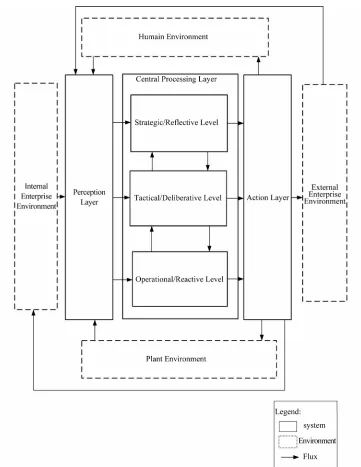
Within an agent paradigm perspective, an intelligent sys-tem is decomposable into three subsyssys-tems correspond- ing to perception layer, central processing or reasoning layer (i.e. mapping perception to action) and action layer.
In addition, we propose to maintain this decomposition within the three common layers of enterprise architecture, namely: Business layer, Application layer and Infras- tructure.
We also suggest mapping organizational hierarchy levels (i.e. strategic, tactical and operational levels) to a three layered cognitive architecture with reflective, deli- berative and reactive levels.
Finally, we sustain the necessity to take into account the whole enterprise system environment in the form of coherent clusters to ease its analysis.
In a previous paper [30], we retained CogAff archi- tecture as the main candidate to stand such a proposal for the design of e-maintenance system as an intelligent sys-tem. The proposed frame labeled E-Cogaff is depicted in Figure 1 and the rest of this section gives details of the frame with illustrative indications from the e-mainte- nance case.
3.2.1. Perception Layer
The role of the perception horizontal layer is responsi-ble of providing central processing layer with knowledge and information based on data received from different Environment sources. Here, data are to be processed in a hierarchical manner and categorized into different levels of abstraction allowing the central layer to assess the situa-tion of its environment and to make appropriate decisions. The most direct intelligent system abilities that are candidates to be classified within the perception hori- zontal layer are:
Data acquisition and pprocessing to detect and re-move discrepancies such as outliers and missing data; Data reconciliation;
Data fusion that will help the planning layer assess the situation of the external environment and to make appropriate decisions;
Database management system.
Figure 1. E-CogAff frame.
3.2.2. Central Processing Layer data quality is of a major concern within the perception
subsystem. The central processing horizontal layer is composed with
three hierarchical levels corresponding to strategic, tacti-cal and operational levels of both internal capabilities of the system and different activities of the business proc-esses:
Accuracy, completeness, currency, consistency and re-liability are some of the common dimensions to deal with data quality assessment within information systems. In fact, data quality dimensions characterize properties that are inherent to data. Such dimensions concern data val-ues as well as logical schema or data format to satisfy specific set of semantic rules. Source reliability that is the credibility of a source organization with respect to provided data quality values depends on the cooperative context in which data are exchanged. Finally, security issues are generally to be tackled within this layer.
3.2.2.1. Strategic/Reflective Level
obser-vation over an extended time period develop a strategy to deal with such situations. Furthermore, this level coordi-nates other modules so as to make the whole system per-formance more robust and coherent assessing credibility of each module’s behavior by monitoring their internal states.
In addition to monitoring, evaluating and control abili-ties regarding both internal behavior and business activi-ties performances , this level is also responsible of assis-tance in a cooperative manner for strategic managers. In the case of e-maintenance, its responsibility field covers maintenance contribution in an Executive Management Information System as well as interactive search for ap-propriate strategic goals and plans to maintenance activi-ties within changing internal and external enterprise en-vironment. Such ability is of great help for maintenance managers dealing with uncertainty-especially within a risk based management approach enabling a linkage of e-maintenance to the strategic goals of an organization. In such a case, artificial intelligence paradigms in this layer are to address issues concerning some kind of sub-jective and uncertain aspects of strategic management. Probabilistic methods as well as possibilistic ones such as fuzzy logic based algorithms are among solutions to deal with a certain level of such aspects.
3.2.2.2. Tactical/Deliberative Level
Proactive behavior is achieved in the system in its de- liberative layer, which is responsible for governing the system’s actions in normal and abnormal circumstances.
The choice of the appropriate artificial intelligence paradigm is very crucial to the high performance and real-time requirements of this layer to be endowed with appropriate abilities of planning, reasoning, learning and problem solving: Expert systems, case-based reasoning systems, neural networks are among solutions for such a requirement with different strengths and weaknesses to be taken into account in a given context.
In the case of e-maintenance, such artificial intelli- gence requirements are to address different issues includ- ing exceptional processing regarding time or resources required by certain maintenance policies: reliability cen-tered maintenance, opportunistic maintenance, health/ care management, knowledge management and asset life cycle management. In general, in addition to the supervi-sion of the system in coordination with the reflective layer, this layer is also responsible of interactive decision support towards tactical managers.
3.2.2.3. Operational/Reactive Level
The reactive layer provides direct responses to events that occur in the environment.
In the case of e-maintenance, inspection-condition ba- sed maintenance is the major element of this layer. Many
artificial intelligence paradigms can coexist in this layer with appropriate mechanism for collaborative problem- solving concept. This layer is also to support human teams in their daily activities providing them with the right information at the right time and the right place, asking for required data and alerting in case of errors or lack of provided data among other interactive functional-ities.
3.2.3. Action Layer
The action layer concretizes plans that are decided in the central layer within a hierarchically organized manner.
In the case of e-maintenance, among responsibilities of this layer are Maintenance Planning and scheduling, dif-ferent presentation tasks towards human Environment, updating adequate internal and external Environment and eventually acting on the plant Environment.
3.2.4. Environment
The intelligent system is intended to act on its perceived environment in a way to achieve its goals and thereby enterprise common goals. We decompose such an environ- ment into four categories as follows:
3.2.4.1. Human Environment
This includes all human agents that are to interact with the system. Be it management, executive or functional and technical staff or human experts, contractor’s team members, constructor’s after-sale responsible and so on. Some interactive activities are listed within the three lev-els of the central layer. Interactivity can be understood as simple information exchange as well as the way the sys-tem enables supporting individual team members in completion of their own tasks or the team as a whole.
3.2.4.2. Plant Environment
This environment includes mainly: 1) Sensors regarding physical assets condition (e.g. vibration and oil analysis) as well as operational conditions (e.g. temperature and voltage), and 2) Actuators in case of integrated control (e.g. emergency shutdown) or self-maintainable assets.
3.2.4.3. Enterprise Environment
In the enterprise environment, a distinction is made be- tween internal and external environment to allow useful differentiation in the system perception regarding those environments. External environment needs more pru-dence such as evaluation of the credibility of a source organization.
In the case of e-maintenance, the main departments in daily direct relation with maintenance are typically: Hu- man resources (availability, skills, training, salaries...), Production (operational plan...), MRO Inventory and Pur- chasing (maintenance repair operations requirements), Finances (costs…).
Regardless to their geographical position or the level of their intelligence, internal systems in the case of maintenance include Management and Executive Infor- mation Systems, Asset Management Systems, Enterprise Resource Planning and CMMS.
External environment include every system not owned by the enterprise offering services to the enterprise sys- tem or cooperating occasionally or permanently to achi- eve predefined goals.
Following systems are examples in the case of e- maintenance: Inter enterprise databases such as relia- bility databases of a common industrial sector, external knowledge and experts systems, external catalogues and machines manufacturer’s services. This includes the case of exchange of reliability data for and from maintenance system especially when redesign is needed.
4. Discussion and Future Work
Following a constructive approach, we identified three base assumptions and we could anticipate ten possible expectations for an EISA.
The expressed expectations are very comparable to needs and principles expressed in other works especially [31] and [32]. Nevertheless, among fundamental differ-ences we underline our call to the use of agent paradigm at the enterprise level within either enterprise architecture or related disciplines. This holistic and modular use of agent paradigm makes also the great difference between the E-CogAff proposal and the model proposed in [33].
Moreover, in [31], the author listed seven principles of lean enterprise thinking for achieving sustainable enter- prise transformation but without clear indication to the intelligence as approached in our study.
In [32], authors listed four basic rules for designing intelligent systems for decision-support in management. While we note that these rules are all taken into account within our work, we also note that those basic rules don’t indicate clear concern with the entire human environment other that management stuff neither clear concern with the support of the organizational learning.
In [33], authors propose a practical generic solution framework with an intelligent systems layer that is more oriented business intelligence rather than general intelli-gence as we’re trying to achieve in our work.
Ideally, we expect E-CogAff frame can be easily inte-grated to an enterprise architecture framework to bridge business view and application view so that intelligence aspect of the designed enterprise system can be studied in
earlier stages of the design. Indeed, cognitive capabilities of each business capability or process can form compo-nents of different horizontal layers (perception, central processing and action) while the tree layers would allow alignment at different hierarchical levels of the organiza-tion. When all components are to be intelligent, the case can be viewed as a multi-agent system case.
The three base assumptions will be made in use to ex-plore the architectural utility attributed to the proposed frame within our project of e-maintenance as an intel- ligent system as introduced in [30]. This project will al-low more quantitative analysis and comparison with other methods.
5. Conclusions
In this work, we proposed base assumptions that are to open up possibility to deal with intelligence while building enterprise systems and this, at the early stages of enterprise architecture and related disciplines such as system engineering and software development.
Those assumptions are maintained at their basic level and expressed in their original terms as inherited from their respective research areas:
An organization is a cognitive enterprise;
All aspects of cognition are shaped by aspects of the body;
Agent architectures should incorporate strong theo- retical assumptions about the nature of the mind. While extracting those assumptions, we walked through theoretical founding backgrounds. The base assumptions are limited in number to three fundamental and comple-mentary assumptions so that they can serve to a coher-ent endeavor of building coher-enterprise intelligcoher-ent systems. To facilitate such endeavor, we also expressed possible expectations from enterprise intelligent system archi-tecture and proposed a frame that is based on the cog-nitive architecture CogAff.
Comparing the expressed expectations and E-CogAff proposal with similar works, we noted differences in the fact that our work takes into consideration the cog- nitive aspect of the firm and the general aspect of intel-ligence.
As far as we know, our work is the first tentative to express theoretical founding assumptions for an “en- terprise intelligent system architecture”. Hopefully, other initiatives can follow aiming to harmonize the way to deal with intelligence while building enterprise systems within related disciplines
REFERENCES
[2] D. H. Liles, M. E. Johnson, L. Meade and D. R. Under- down, “Enterprise Engineering: A Discipline?” Society for Enterprise Engineering Conference Proceedings, Vol. 6, 1995, pp. 45-47.
[3] D. J. Nightingale and D. H. Rhodes, “Enterprise Systems Architecting: Emerging Art and Science within Engi- neering Systems,” Proceedings of the ESD External Sympo-sium Session VI, MIT, Cambridge, 31 March 2004. http://esd.mit.edu/symposium/pdfs/papers/nightingale.pdf [4] Z. Shi, “Foundations of Intelligence Science,” Interna- tional Journal of Intelligence Science, Vol. 1, No. 1, 2011, pp. 8-16. doi:10.4236/ijis.2011.11002
[5] M. Anderson, “Marrying Intelligence and Cognition,” In: R. J. Sternberg and J. E. Pretz, Eds., Cognition and Intel-ligence, Cambridge University Press, New York, 2005, pp. 268-287.
[6] V. G. Ivancevic and T. T. Ivancevic, “Computational Mind: A Complex Dynamics Perspective,” Studies in Computa- tional Intelligence, Vol. 60, 2007, p. 70.
doi:10.1007/978-3-540-71561-0
[7] A. Lam, “Organizational Innovation,” 2012. http://mpra.ub.uni-muenchen.de/11539
[8] J. Dobson, “Theory of the Firm,” Economics and Philoso- phy, Vol. 10, No. 1, 2008, pp. 73-89.
doi:10.1017/S0266267100001723
[9] P. Walker, “The Past and Present of the Theory of the Firm,” SSRN eLibrary, 2012.
[10] B. Nooteboom, “A Cognitive Theory of the Firm,” Work- shop on Theories of the Firm, Paris, November 2002, 23 p. http://esnie.org/pdf/ws_2002/Nooteboom.pdf
[11] J. A. Nickerson and T. R. Zenger, “A Knowledge-Based Theory of the Firm—The Problem-Solving Perspective,” Organization Science, Vol. 15, No. 6, 2004, pp. 617-632. doi:10.1287/orsc.1040.0093
[12] R. R. Nelson and S. G. Winter, “An Evolutionary Theory of Economic Change,” Harvard University Press, Cam- bridge, 1982.
[13] B. D. Jones, “Bounded Rationality,” Annual Review of Po- litical Science, Vol. 2, No. 1, 1999, pp. 297-321.
doi:10.1146/annurev.polisci.2.1.297
[14] G. Gavetti, “Cognition and Hierarchy: Rethinking the Microfoundations of Capabilities’ Development,” Orga- nization Science, Vol. 16, No. 6, 2005, pp. 599-617. doi:10.1287/orsc.1050.0140
[15] M. Gerber, “The E-myth Revisited,” HarperCollins, 1995. http://www.smallbusinesshq.com.au/factsheet/20305-tips-o n-strategic-tactical-and-operational-decision-making.htm [16] J. C. Kaufman, S. B. Kaufman and J. A. Plucker, “Con-
temporary Theories of Intelligence,” In: D. Reisberg, Ed., Oxford Handbook of Cognitive Psychology, Oxford Uni-versity Press, Oxford, 2013.
http://scottbarrykaufman.com/wp-content/uploads/2011/0 6/Kaufman-Kaufman-Plucker-in-press.pdf
[17] N. Streitz and P. Nixon, “The Disappearing Computer,” Communications of the ACM, Vol. 48, No. 3, 2005, pp. 32-35. doi:10.1145/1047671.1047700
[18] A. Chatterjee, “Disembodying Cognition,” Language and Cognition, Vol. 2, No. 1, 2010, p. 79.
[19] M. Wilson, “Six Views of Embodied Cognition,” Psycho- nomic Bulletin & Review, Vol. 9, No. 4, 2002, pp. 625- 636. doi:10.3758/BF03196322
[20] W. Duch, R. J. Oentaryo and M. Pasquier, “Cognitive Ar-chitectures: Where Do We Go from Here?” In: P. Wang, B. Goertzel and S. Franklin, Eds., Frontiers in Artificial Intelligence and Applications, Artificial General Intelli-gence 2008—Proceedings of the First AGI Conference. Vol. 171, 2008, pp. 122-136.
[21] D. Kieras, “A Survey of Cognitive Architectures,” 2005. http://www.cs.cmu.edu/~bej/CognitiveModelingForUIDe sign/2b_Architecture_Survey.pdf
[22] A. Sloman and M. Scheutz, “A Framework for Compar- ing Agent Architectures,” Proceedings of the UK Work-shop on Computational Intelligence, Birmingham, Sep-tember 2002.
[23] P. Langley, “Cognitive Architectures and General Intelli-gent Systems,” AI Magazine, Vol. 27, No. 2, 2006, pp. 33- 44.
[24] A. Newell, “Unified Theories of Cognition,” Harvard Univer- sity Press, Cambridge, 1994.
[25] C. Morley, D. Berthier and M. Maurice, “Contribution of the Agent Paradigm to Master Information Systems,” Pro- ceedings of the 10th Conference of the AIM (Association In-formation and Management), Toulouse, 21-23 September 2005.
[26] J. Jakieła and B. Pomianek, “Agent Orientation as a Toolbox for Organizational Modeling and Performance Improvement,” International Book Series—Information Science & Computing, No. 13 Supplement to the Interna- tional Journal—Information Technologies & Knowledge, Vol. 3, Bulgaria, 2009, p. 113.
[27] O. Lamouchi, A. Ramdane-Cherif and N. Lévy, “Enter- prise Architecture Modeling Using Agent Paradigm,” ISTA, Vol. 48, 2004, pp. 213-219.
[28] J. Kelemen, “The Agent Paradigm,” Computing and In-formatics, Vol. 22, No. 6, 2004, pp. 513-520.
[29] “The American Heritage Dictionary of the English Lan-guage,” 4th Edition, Houghton Mifflin Company, Boston, 2000.
[30] A. Mouzoune, “Towards an Intelligence Based Concep- tual Framework for E-Maintenance,” 2012.
[31] D. Nightingale, “Principles of Enterprise Systems,” 2nd International Symposium on Engineering Systems, MIT, Cambridge, 15-17 June 2009.
[32] G. Setlak and S. Pieczonka, “Design Concept of Intelli- gent Management Systems,” International Book Series— Information Science & Computing, No. 13 Supplement to the International Journal—Information Technologies & Knowledge, Vol. 3, Bulgaria, 2009, p. 142.