Project
The graduation project done at
Rayka Design Studio
has pleased me. Therefore I would like to
thank them for their attention, time and effort. I truly hope that this report will make a useful
contribution to
Rayka Design Studio
as a whole. Hopefully without deriving anyone, I would
like to thank some people.
First of all my graduation mentor from the University of Twente; ING
T.G.M. Krone
. Your
help and support helped me throughout the whole project. The useful feedback that I have
obtained helped me to re-think and improve certain aspects which I hadn’t foreseen earlier.
Thank you for your effort.
Secondly I would like to thank my guide at Rayka Design Studio;
Caner Özer.
The meetings we
had and the explanations you’ve given to me helped me to understand the principle of
de-sign engineering even better. My time at Istanbul won’t be forgotten and the knowledge that I
have obtained there will stay with me for the rest of my life. You trusted me into starting and
finishing a full project which grew my self-confidence majorly. I hope that my input into this
project hasn’t disappointed you in any form and the result of the project satisfied you. Thank
you.
As a reader I wish you the best of pleasure while reading my graduation paper. If there ought
to be any questions please do not hesitate to contact me by mailing me on the following
adress: [email protected] .
Name:
Gökhan Sönmez
Date:
17. March 2014
A surplus of plastic bag use leads to more plastic waste around us. Supermarkets offer their
customers plastic bags to help them carry their groceries. However, it is said that the
custom-ers take more plastic bags than necessary which eventually end up in the trash bin or outside.
This only leads to more pollution and higher costs for both the markets and the government.
Therefore one of the largest market-chains in Turkey decided to put the first step amongst
its competitors to help build a cleaner future environment. They approached Rayka Design
which is located in Rumelihisari, Istanbul. Rayka is known to provide eco-friendly solutions
to problems as these.
What the market wanted was a solution for this overly-excessive use of plastic bags. The issue
was that it was too easy for a customer to pick many bags at once, even though if he were to
use only one. To limit their customers in their habits from doing this they requested Rayka to
provide them with a dispenser for these plastic bags. The dispenser should be able to dispense
a single bag and at the same time dissuade the user to take out several bags at once.
Rayka accepted this request from the market-chain and started the dispenser project. The
goal of this project is to propose a concept of a dispenser which fulfills these requirements.
If the concept is later deemed succesful in accomplishing its task, then an agreement will be
made to set them up for production.
This project is about the creation of a plastic bag dispenser. The goal is to create an
eco-friendlier future by reducing the waste and costs due to the overly excessive use of plastic
bags. Customers tend to take more of these bags in the markets than really is needed and are
then left with a surplus of these bags. These eventually end up in either the bin or outside in
the environment.
This goal has been tried to achieve by creating a fully mechanical dispenser which allows the
user to take out a single plastic whilst at the same time discouraging the user to take out a
sec-ond one. The dispenser will be presented to a large retailer in Turkey and, if succesful, taken
to production.
To create this dispenser an analysis has been done on the retailer, its background and
sur-roundings. After that a look has been taken into the market of comparative products to come
up with strong positive aspects to include in the new dispenser. The analysis has been
con-cluded with a design brief. The requirements in this design brief are then used to start
gener-ating ideas.
The idea generation ends with three concepts, from which one has been chosen to be further
developed. After making the concept choice the concept has been optimized and further
de-tailled. This chapter ends with a complete dispenser.
After that a prototype of the dispenser will be realized to see if and how it works. Eventual
issues that come up during the try-out will be stated and solved before moving on to the mass
product.
In the chapter of mass-product the new (improved) parts will be defined. After that the reader
will shortly be enlightened on the materials that have been chosen to manufacture the
com-ponents from and also how these parts can be produced or whether they will be bought. The
chapter will be closed with an explanation of the way in which the components are assembled
together.
As last the paper will be closed with a short evaluation. The whole project will be reflected
upon and the resulting dispenser will be criticized.
Besides this paper there is also an appendix which contains some data regarding dimenions.
In the text the reader will be referred to the specific parts of the appendix.
Index
[1] Analysis
1.1 - Background information
1.2 - Underlying market chains
1.3 - (Upcoming) competition
1.4 - The different brands
1.5 - Target brand
1.6 - Target group of users
1.7 - Physical representation
1.8 - Stakeholders
1.9 - Comparative products
1.10 - The design brief
1.11 - Conclusion - The product meaning
[2.1] Concept creation
2.1.1 - Idea generation
2.1.2 - In-depth views
2.1.3 - Further development choice
2.1.4 - Proof of concept
[2.2] Concept development
2.2.1 - Optimization
2.2.2 - Detailling
2.2.3 - Final model
[3] Protoype
3.1 - Evolving the proof-of-principle model
3.2 - Preparing the prototype
3.3 - Realization and prototype try-out
3.4 - Resulting adaptions
[4] Mass product
4.1 - Product components
4.2 - Material & manufacturing
4.3 - Assembling
Evaluation:
Ending the paper
Analysis
Introduction
In this chapter an analysis will be done on Migros T.A.S.; a top retailer in Turkey that owns
some of the largest supermarket chains. It will start off with some background information
about their history, then some info will be given about the underlying market-chains that
they possess and their present competition. After that, the target group, the stakeholders and
the main ergonomic aspects will be defined. As last a market research will be done to see how
some of the competing products look like. The data sources can be found in Appendix E. The
chapter will end in a design brief.
Background information
Eventually Migros T.A.S. ends up serving its customers with their Migros, 5M, Sok, Tansas, Macro Center and Kangu-rum (virtual) markets. They are able to respond to different expectations and needs by their customers by maintaining the exclusivity and distinctiveness of their shops, which each serve a different target group. By offering many choices Migros has created a way to stay closely in touch with them. With all these changes that took place over the past few years Migros T.A.S. managed to take 12th place amongst 50 companies that grew the fastest between 2001-2006. This allowed them to enter the list of the top 250 retailers around the world created by Deloitte in 2008. Migros T.A.S. man-aged to take the 236th place.
Their Virtual Market, Kangurum, later changed its name to Migros Sanal Market (Migros Virtual Market). Besides that, in June 2011, Migros sold their discount chain Sok to Ülker group.
A recent research of Ortakalan.com.tr (see appendix E) shows the amount of supermarkets for each brand in Turkey at the 1st of January, 2013. Looking at the markets that are part of Migros T.A.S. it can be seen that Sok, which is al-ready sold, is the leader with an amount of 1222 shops, fol-lowed by Migros with 622 shops and Tansas with 218 shops. Another research shows the top 10 brands that opened the most markets in 1 year, from the first of January 2012 until the first of January 2013. As can be seen; Migros takes the 4th place with 93 markets, and Tansas takes the 6th spot with 34 markets.
At this moment Migros T.A.S. serves her customers with 715 Migros, 202 Tansas, 23 Macro Center and 20 5M shops in 69 regions in Turkey, and 36 Ramstores outside of Turkey, Migros, founded in 1925 in Zürich, is Switzerland’s largest
retailing company, supermarket chain and also co-founder of its Turkish chain “Migros Türk Ticaret A.S.” in 1954. The basic reason for establishment was due to the grow-ing population of Istanbul, increasgrow-ing cost of livgrow-ing and the large wage-gap between the city center and its surround-ings. With the help and under the control of its municipality Migros introduced a mobile food-service in the same year in which small sales-trucks circulated through the outer suburbs of Istanbul. In the light of providing these lower working-class people with food and supplies; Migros tried to deliver products at a favorable price and quality for them and soon after turned out to become a success. They were also the one to introduce today’s modern retail elements, such as hygienic packaging, labeling and applying shelf-life to products.
After various additions and improvements, such as meat processing, Migros began to develop its status as a provider of qualitative, sanitary and economically priced products throughout the years. Ending up with 34 stores in the cities of Izmir and Istanbul by the year of 1989; they had been given the identity of being an “Honest Trader” by its con-sumers. Following the increasingly changing demands and expectations of Turkish customers they started to expand their merchandising business even more by 1990. That is when a new concept of MM- and MMM-Migros stores arose. The difference between the stores can be found in the product assortment; with the extra M indicating a larger product spectrum. They have also been largely responsible for introducing the part-time working concept, staff-train-ing programs, credit-card use and automated cash registers.
In 1995 Migros created the first discount-brand “Sok” in turkey, and one year later opened “Ramstore” in the capital city of Azerbaijan; Baku. They started building shopping centers in 1997, with the first two being Migros shopping center, Istanbul, and Ramstore shopping center in Moscow. With this rapid growth Migros reached a total of 325 stores in 7 regions by the end of 1999. They introduced the self-checkout service in their hypermarket in Ankara, which turned out to be a success. After that the Ramstores got expanded into two more countries; Russia and Kazakhstan.
By this time another concept was created that went by the name of “Bakkalim”; literally meaning my store. In a short period of time they opened this Bakkalim in roughly 700 points. Whilst still growing, they decided to merge in Tan-sas, another retail chain, in 2005. Together with this merge they grew up to an astounding total of 722 stores.
The underlying market-chains
Migros hasn’t been the only fast-growing market chain. Another table from ortakalan shows the top 10 brands that opened the most stores in the past year. This table can be used as an indicator for their pace of growth. The top spot is taken by A101; a discount market chain that made its entrance with 121 stores in March 2008. They opened 396 stores in total from 2012 to 2013. After A101 comes BIM, another discount market chain which made its appearance in 1995 with 21 stores. They opened 381 stores, which is rather similar to A101. BIM is followed up by DiaSa. DiaSa too is a discount chain which is now being owned by the same group that Sok was sold to: Ülker Group. With a big difference between the top two stores, DiaSa has opened a total of 109 stores in those 12 months. The 4th place is taken by Migros, with an amount of 93 newly opened shops between 2012 and 2013.
The main competition for Migros consists of 4 other brands which take a higher position on the list of store-counts. With only BIM and Migros being listed in the top 250 global retailers report from Deloitte(2011) which state the retail revenues, the top 5 store-owners consist of BIM, A101, Sok, DiaSa and Migros. What draws attention is the fact that these 4 other markets chains are all discount brands, unlike Migros. Another fact to be kept in mind is that Migros has been existing for a rough 60 years, whereas the other dis-count marks have all recently entered this sector, but have relatively grown dramatically. Migros might have to think about a way to secure its future existence with all these new market chains coming up.
The different brands
So, as has been stated earlier, Migros T.A.S. owns 5 stores at this very moment. Those include Tansas, Migros, 5M, Ram-store and Macro Center. With each of these Ram-stores Migros tries to keep in touch with different types of target groups by making each store fulfill a specific role. In this way they can attend to the unique expectations and wishes of their customers.
Macro Center
-The first shop to start off with is Macro center. It aims to serve the higher working-class of the customers. This is being accomplished by offering relatively exclusive varieties of products. The larger part of these products is imported, thus foreign, resulting in higher average prices for the same type of products. Obviously this attracts customers that are more given to luxurious tastes, resulting in Macro’s status as serving the more wealthy consumers.
The picture above (A.1) shows the entrance of a Macro Center in Istanbul. As can be clearly noticed, it has a certain style that creates a familiar atmosphere. The use of wood and this type of window makes the customer feel welcome and safe, for he might get the impression of walking into a house rather than an unknown building.
Image A.1 - The entrance of a Macro Center
Images A.2 and A.3 give inside views of Macro center. What can be noticed at first is again the use of wood. The pillars of the building are covered by black glass and wood. Another aspect that catches attention is the use of chrome. This has been done to protect units, such as the pillars, from getting damaged by shopping carts. However, the two blocks on the left, hanging above the cash registers, also seem to have some chrome accents on them. On the right image the con-cept of black furniture arises. The box in the middle and the boxes on the right are all black. Together with the previously stated characteristics they create a chique overall style. The last aspect that draws attention is the largely spaced place-ment of units. The customers are given more than enough room to walk through the market.
5M
-Secondly a look has been taken inside the 5M Migros markets. The 5M markets are the largest ones, offering the widest product spectrum in the whole Migros series. These markets are mostly referred to as hypermarkets. Their prod-ucts range from basic food, fruits and vegetables, to house-products, textile and electronics. Their goal is to deliver as many products as possible for an economic price and therefore their services are meant to reach the largest range of customers possible. Their slogan confirms the previously made statement; “Cok aliyoruz, ucuz satiyoruz!”, which literally means: “We buy a lot, and sell it cheaply!” . Image A.3 - Another inside view of a Macro Center
Image A.5 - Inside a 5M market
Image A.6 - The checkout section of a 5M market
The difference with Macro market can immediately be seen in these pictures. The entrance to the market is overwhelm-ing the customer; it’s filled with labels, flags and ban-ners. The products are all placed densely together and the amounts in which they are sold are larger. The store has its typical use of the color orange, and the sale-signs are of the standard black-on-white concept covered by a red attention-drawing line. Besides that, the shopping carts are simple metal baskets on 4 wheels, which is pretty standard too. The only aspect that really shows itself is the “Jet Kasa” system, which can be seen on the bottom picture A.6. The custom-ers are allowed to check-out by themselves by scanning and paying using a checkout machine.
Tansas
-The third store from Migros T.A.S. is Tansas. This discount market-chain comes in three formats; Tansas Mini, Midi and Maxi. As the names already indicate they represent the size of the store. Tansas is known to be that regular supermarket that tries to offer high quality for a low price. Although Tansas serves its customers with 202 shops spread over 3 store formats, it’s the mini-format that takes the ma-jor part. In 2009 Tansas seemed to have 146 mini, 97 midi and 59 maxi stores which result in a total of 302 stores.
Image A.7 - The checkout area of a Tansas market
Image A.8 - An inside view of the regular Tansas markets
Image A.9 - Another inside view of a Tansas market
The sale-signs are simple papers put in red plastic frames that are attached to a small metal standard.
However, the last image, A.9, does show that Tansas cares about its diabetic customers for they do offer special low-sugar products – “Diabetik Ürünler”. It might be a small extra service that they offer, but for its customers it may mean something special.
Migros
-Migros is the first and their truly original store that led to Migros T.A.S. success. As stated earlier the Migros markets come in 3 formats. There is the M, MM and MMM format with each increase in M indicating a larger store with a broader product range. The Migros store-concept is already explained above at the 5M section, therefore this part will focus on the smaller stores.
Image A.10 - The entrance of a 5M market
Image A.11 - The entrance of a 5M market
Image A.12 - The entrance of a 5M market
Image A.13 - The entrance of a 5M market
Whereas the 5M stores were mainly focused upon providing cheap goods in large amounts, the smaller 3M,2M and M stores are more aimed at quality and their customers. While the stores aren’t as big as the 5M ones they still manage to offer a decent amount of products.
The aspect that draws the most attention is the frequent use of the color orange which can be seen on all of the images. Even the entrances to the stores are covered with big orange letters. This is a strong characteristic of the Migros markets.
On the top left image, A.10, the checkout-section can be seen where Migros offers their customers a regular check-out register, or a self-checkcheck-out machine. The point of using these self-checkouts is to avoid long queues at the registers.
On the top A.12 picture it can be seen that Migros offers its customers an iPad. This happens to be something new in Turkey as the package already indicates: “Türkiye’de ilk defa!”, which literally means: “First time in Turkey!”.
Ramstore
Image A.17 - Checkout-section of a Ramstore market Image A.14 - A Ramstore shopping centre in Macedonia
Image A.15 - Valentines theme applied inside a Ramstore
Image A.16 - An inside view of a Ramstore market
These pictures give an idea of how Ramstore looks like. Image A.14 shows the entrance to a ramstore-mall in Macedonia. It has its own parking lot next to the build-ing to support its many customers. The second and third images, A.15 & A.16, show that Ramstore applies themes to its shops. This may be a good way to distinguish itself from other stores.
Target brand
The product that will be designed in this project will be aimed at the regular Migros stores from Migros T.A.S. The main reason for this is the fact that the Migros series are responsible for the major part of the stores that Migros T.A.S. owns. The regular Migros stores are the most widely spread over Turkey and therefore would exert the largest influence on the environment when a new concept would be introduced.
The main competitors from Migros, outside Migros T.A.S.’ property, are as shown earlier in the table from ortakalan mainly discount brands. When designing a product for these discount market-chains there are two important things to be kept in mind. Firstly, the amount of stores they own is immense compared to Migros, and secondly, their main goal is to deliver their goods as cheap as possible. Therefore it is understandable that these companies are less likely to invest the same amount of money, as Migros, into introducing a new concept. Hence, they will have to buy much more units to be able to fill all of their stores and therefore the price of this upcoming product will have to be relatively low.
If the price of this product has to be low, this already limits the opportunities for the designer to add (several) in-novative features to the design. The product-to-be would eventually end up looking not much different than what is being used today as a plastic bag dispenser, which is a roller of plastic bags on a thin metal standard in its most simple form. Therefore this (probable) small change in design would not be worth the investment costs. Besides this, the new product will be associated with the company that designs it, in this case being Rayka Design, therefore bringing forth another reason not to take the risk of creating a product that is likely to fail.
Choosing Migros, which is not a discount market-chain, leaves out more opportunities for the designer to create a new, innovative and unique design that combines different requirements and wishes into one. Migros, known for its history to be a true trend-setting leader in the supermarket industry, might therefore be very-well the best choice.
The target group can consist of any person that is able to do the shopping. These persons include grown-up males or females, couples, or couples with children. This means that the age of this group varies from roughly 4 to 70 years; implying that there is a major gap between the youngest and the oldest person in this target group. The ages at both ends of this range can be called extremes. Including both of these ages lead to totally different, specific, product-requirements. Four year old children are small, active and curious. They love to run, jump and play all day long, in contrary to seventy year old seniors. Those people are larger, slower and less flexible in using and understanding technology. All of this has to be kept in mind while designing a product. In this analysis the main characteristics of this target group will be brought forth. Therefore the target group will first be split into three parts; children, matures and seniors. Each of these groups will be analyzed to come up with specific
- Children (4-10)
For children most design-aspects will regard safety. They are small, active and are constantly playing with each other. They are careless and do not pay attention at what’s happen-ing around them. Children run around, and might collide with anything around them, hang onto them, pull on them, knock them over or sit on them thinking that it’s all just a game. Therefore it is important to create a safe product that does not have any sharp edges or points sticking out that might harm these children. Also known for their curiosity, it might be wise to avoid provocative and challenging colors and features in the product. Besides that, the product should be stable enough and able to take a hit without falling over or breaking.
However, what can be used as a solution to all these poten-tial dangers is their limited height. These children aren’t that long and placing the essential parts of the product a bit above their average height already makes it harder for them to reach for it.
- Adults (16-55)
The main target group to be focused on are the adults. They will be the ones making the most use of the dispenser. Therefore this product is to be aimed mainly at this group. The dimensions of the new dispenser will rely on the aver-age human-body measurements; in this way the vast major-ity of this group can be provided a comfortable product that is also ergonomic in use.
People in this category are likely workers, therefore having little time to do the groceries or not willing to invest much time into it. Therefore it is important that the dispenser should not require much effort to be used. This should also be the case when the user has a basket or a baby in one hand and has only got the other hand free to use. The dispenser should allow 1-handed usage.
When people are in a hurry; another point to be kept in mind is the rough and careless usage of such a dispenser. It is important that the design allows room for such usage. The product should therefore be firm and especially stable.
Another important aspect is the functionality of the product in such a situation. Not only should it withstand rough and harsh usage, but it should also keep its functionality at that time. If the dispenser gives a plastic bag when pulled gently on an arm, it should not suddenly give two when pulling harshly on the arm!
- Seniors (60-70)
The last category of users is the seniors. Being an extreme target group, just like the children, they will also bring forth rather specific requirements to the design. These however will be based especially on product complexity. It shouldn’t be forgotten that these people aren’t grown up with technol-ogy like most people are nowadays. They take a longer time to fully understand certain situations and are less coura-geous, and therefore less willing to take action at those moments.
This is the main reason why the design should guide the user to its usage without raising any doubt. It should be inviting the user to take a certain action which will lead to a successful outcome. It should be considered to add any form of instruction is the design is believed to be complex.
Besides the indirect influence of the design, also the physical aspect is to be taken into account. Older people aren’t as strong as younger ones, so it is of importance that the design does not require much force to function.
Main stakeholders
It’s important to know which stakeholders play a key-role in getting the eventual design to the customer. Each stake-holder plays its own role in the process and there are differ-ent and specific requiremdiffer-ents and wishes for each of them. From the start until the end the following stakeholders are found; the designer (company), the producer, the consumer, the transporter and the client.
- The designer (company)
The company that created the design has to deliver a good product that representative. The created product will be associated with its company and therefore either strengthen or damage their image. The designing company also holds responsibility for any product-failure, or any accident(s) that it may cause in the future. As last, the designer needs to make enough profit to be able to win back the investments in labour, production and patenting.
- The producer
The producer of the components, not necessarily the as-sembler, has to deliver the parts that the product consists of. Besides the profit that they need to make, also they will have to think about their image. They need to produce the parts in time and favorably without any mistakes. If the producer does its job well they might be chosen as a producer for another product by the same designing company. To be able to do his job well a producer will therefore require a clear overview and description of the parts that they have to manufacture.
- The transporter
This stakeholder is interested in the size of the product, and in the way it can be packaged. The transporter will have to fill a truck with these products and is looking for the easiest, fastest and therefore cheapest way in which this can be real-ized. If a transporter can load a truck with a small amount of products at a time, it would mean he has to make more trips. This means it will take more time to transport it and therefore the transporter will earn more.
- The consumer
This user is the eventual user of the product. Only safety and product functionality matter for these users. They require a product that functions well, is safe and easy to use and fulfills its task. Their experience with this product will greatly influence their opinion about the client that offers these products; in this case a supermarket.
- The client
The client is the most important stakeholder. They are the ones who will have to invest money in this product. To be able to do this, the client needs a crystal-clear explanation as how this new product is going to solve the client’s problem. If the designer can convince the client of the success of this product the client will be able to ‘safely’ make their invest-ments. Product-marketing plays a huge role in this part of the whole process.
Physical representation
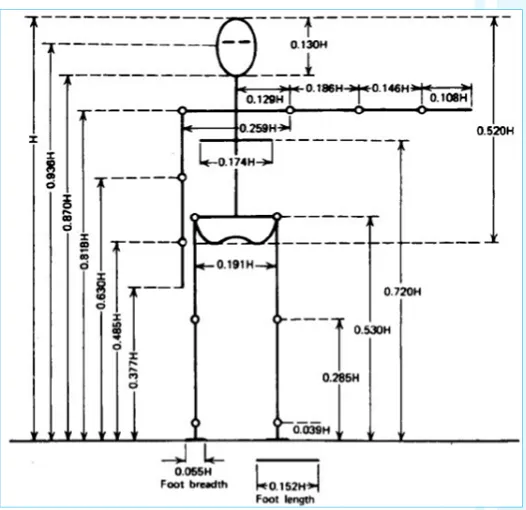
An important aspect to take into consideration while designing this product is to keep focusing on the primary users. In terms of creating an ergonomic product one has to consider what lengths, heights and other sizes are optimal to use. Therefore a more detailed look has to be taken into av-erage human-body sizes. These avav-erages consist of different values for most countries due to, for example, the various cultural habits of people. Since this product will be targeted at the Turkish market it is necessary to look for the values that represent the Turkish population at its best.
The total target group includes people ranging from chil-dren to seniors. Finding one average for this whole group will be a difficult task due to the large difference in heights and sizes. Therefore an ideal model of a person will have to be created by taking the average of the several provided averages.
Table A.1, which can be found on the next page, is a table representing the average values of height, weight and BMI by sex and age group. The table is split into three main columns whereas the first one represents the average heights in centimeters. The average of all 4 mean values for the dif-ferent age groups are calculated for both males and females. Now the average of these two values will be taken to end up with one final height.
Average height for males, aged 18-59, is 174.1 cm. Average height for females, aged 18-59, is 158.9 cm. Therefore the average height of a person, so regardless of sex, is found to be ; ( 174.1 + 158.9 ) / 2 = 166.5 cm.
The mean height of the total target group is now being rep-resented by a single value. By introducing a different model the lengths of different body-parts, as a fraction of the total body-height, can be calculated. In this way the ideal heights can be calculated that should allow the majority of the users to interact comfortably with the product. So the focus lies on serving the majority of the target group with a functional product, instead of paying special attention to the extreme (sub) target groups; in this case the seniors.
This model will be used later in the concept detailing phase where the final concept measurements will be defined. Also this model can be found on the next page.
Table A.1 - Representing the mean values of height, weight and BMI by sex and age group of the turkish population (B. K. Özer, 2007)
[image:15.595.36.563.237.747.2]Comparative products
At the moment there are many products on the market that function in the same, or a similar way as the plastic bag dis-penser. By means of a simple mechanism the product offers the user a single unit of its content. The mechanism’s func-tionality mostly depends on a product’s shape combined with a direct user-related force. These products include, but aren’t limited to; (wet) tissue boxes, napkin dispensers, foil rolls. Please see the note in Appendix E before reading on.
First a look will be taken at existing products in each cat-egory mentioned above. After that the working principle of each of these products will be explained shortly and also how that (possibly) contributed to the product’s success. Eventually, various product requirements will be tried to form out of this information.
Tissue boxes
This product is a small mobile tissue box. As it can be seen from the picture the roll can be attached to user’s belt and carried along during the day. It has a little lid that can be opened to pull out one tissue. Due to its size it cannot hold many tissues at once, and therefore will need to be replen-ished every now and then. The shell is just empty from the inside and there is no structure in the way the tissues are placed inside the box. The box opening is faced downwards!
In this image a simple cylindric box can be seen that has a roll containing bags inside. The bags are structured in such
a way that they can be pulled out from the center of the roll. When one bag is pulled out of the roll the user will need to hold the roll to be able to separate bag and roll from another. This is a simple and compact product, yet requires some effort to use.
This box contains a pile of bags which are folded in such a way that each bag has its grips placed on top of them. In this way, when a bag gets pulled out the next bag can eas-ily be taken out too because its yellow grips already offer themselves to the user. This can be regarded as a very simple and cheap solution. However, the size of the box indicates that it can contain a very limited amount of these bags, the product requires much effort to be replenished in the same structural way it was before and also limits the user in his choice for replenishment-bags.
Napkin dispensers
These standard napkin boxes are being widely used in espe-cially restaurants. The functionality of this product depends on a simple principle; it contains a pile of napkins that are being pushed outside by means of (a) simple spring(s). The one the user will always be able to take out a napkin, even when the amount of napkins in the box is minimal. Image A.18 - An example of a small tissue box.
Image A.19 - An example of a cylindrical box of bags
Image A.20 - A box containing single plastic bags
These dispensers can mostly be found in public restrooms. This concept functions due to the way the napkins are placed and structured into each other. When one piece is pulled out it opens up the following piece. Unlike the previ-ous napkin box, this product isn’t supported by a spring. It only works by means of gravity; by opening the shell on the bottom-side the need for a spring is completely unnecessary. Due to its relatively large reservoir frequent replenishment is not needed.
This is a simple, yet effective, concept. The user is being asked to take out his napkin by separating it from the rest with his fingers. This might be a bit frustrating for the user to do and therefore at the same time makes room to take out two or more units at once. A strong positive about this product is that its functionality doesn’t depend on the size of
Foil rolls
Foil rolls aren’t the same type of products as the dispensers mentioned earlier, however, they do function in a similar way. It can be stated that the only difference is the fact that with this product allows the user to cut his own desired unit sizes, whereas the previous dispensers have a reservoir that’s filled with pre-cut units. This might be a good and strong aspect to add to the dispenser that will be designed in this project as a unique selling point.
The user is asked to pull out the desired length of foil and cut it off afterwards by using the metal teeth.
This product is almost the same as the previous one, how-ever this one eliminates one risk that the other one has; the chance of miss-cutting the foil. It has a button that slides from one way to the other where it cuts the foil with a knife.
This is a disposable plastic-bag product. It has a roll with bags in a box with an edge of metal teeth on the outside. This product is a small and cheap variant of the previ-Image A.22 - A typical tissue dispenser used in public areas.
Image A.23 - Another commonly used napkin holder in cafes.
Image A.24 - A dispenser containing 3 rolls.
Image A.25 - The user can cut the desired size of the foil.
Plastic bag dispensers
This green box is a plastic bag dispenser. It contains plastic bags on a thin bar that can be taken out. As the product already states the user needs to pinch in a bag and pull it downwards through the split before it should be taken out. The product is small in size, limited in capacity and bag size. The product itself looks simple and cheap to make. The concept however seems to be pretty unique.
This product looks a lot like the baby-wipe boxes. It has an opening in the middle through which the plastic bags can be pulled out. As one unit is being pulled out another one comes out partially. The next user can easily take out a new unit as this process repeats itself until there are no more bags left. The product is small, easy to use and pretty self-explanatory.
This metal frame product is used in many markets around the world. The reason for it to become successful is its ease of use. The user can pull a bag open and fill the bag. The bags are stuck to each other somewhere around the top-section which allows the user to easily open up the bag. The arms of the product hold the bag in place while the user puts his recently-purchased goods inside the bag. So actu-ally the product serves as a second user which holds the bag for the primary user.
Plastic bag rollers
In this picture a simple roll can be seen with a shell around it. The bags are pulled through an opening and can be ripped off by using the shape of the hole. The user is free to pull out the amount of bags that is desired. A negative point about this concept might be the risk of the bags falling in-side the shell. The next user would then have to put his hand inside to find the bag where the previous user left off. Image A.27 - A plastic bag dispenser with instructions.
Image A.28 - A simple box containing folded plastic bags.
Image A.30 - A bag dispenser where bags can be ripped off.
This roller consists of an open block where a roll with bags can be placed. At the bottom it offers a V shaped part where the user can separate the desired amount of bags from the rest of the roll. The user will however have to hold the roll to stop it from rotating to be able to rip off the bags.
This product consists of 2 main parts; the bar where the roll can be placed onto, and the long thin piece of plate where the wrapping-paper is pulled through. Due to the distance between the roll and the metal plate the risk of miss-cutting the paper is decreased and therefore is almost guaranteed to succeed in most cases. The plate has a small cutting edge on the bottom-side which can be used to cut off the paper as the user pleases.
The wide frame offers to hold a thick roll so it can be re-placed once in a relatively long time.
When the analysis of the comparative products is summa-rized the positive and negative design aspects, listed below, can be found. The positive aspects should be considered to be realized into the new dispenser and the negative aspects should be avoided as much as possible.
Strong & positive aspects;
- Direct the dispensed bags towards the user (vision). - Allow one-handed use of the product.
- Allow the replenishment of bags.
- After usage product should be ready for another user. - Provide two-sided usage (mutual reservoir, 2 dispensers). - Indicate the remaining bags in the reservoir.
- Allow for quick recovery/maintenance when product fails. - Support universality - support the use of different bag sizes.
- UNIQUE; allow the user to cut his own desired bag-size. - Using metal teeth to easen bag seperation.
- Keep the product out of children’s reach (use height). - Allow the bags to be cut apart, or ripped apart - two ways. - Avoid product complexity; the principle of offering a bag should be kept simple!
- The product should be highly durable - will be subject to high amounts of repetition.
- Using the colour white suggests hygiene. - Use shape to indicate the desired user-actions.
Weak & negative aspects;
- Avoid the need for frequent replenishment. - Avoid the need for any dissassemblement when replenishing.
- Limit the amount of actions that the user needs to take for the product to function.
- Limit the risk of a product failure. - Limit the severity of a product failure.
- Avoid the need for bag seperation (bags are thin, might be frustrating when they’re stacked into one big pile)
- Discourage or limit the user from dispensing multiple units.
- AVOID dangerously sharp/cutting edges.
- Avoid the use of elastical components over large ranges. - Limit the need for long instructions - the product should be self-explanatory!
- AVOID the possibility for the user to reach the inner mechanics.
- Avoid the use of weak and susceptible components. Soft and tender use of the product is NOT guaranteed. Image A.31 - A simple dispenser for a different type of bag.
Here below is a list representing the full design brief for the new dispenser that is to be created. The product-to-be-created must;
- dispense plastic bags
- be usable single-handedly
- require, mostly, 3 actions to function
- be replenishable within a minute
- avoid the need for any dissassemblement when replenishing
- offer a reservoir to hold several rolls/stacks of bags
- not be larger than 50x50 cm
- in some way discourage or limit the user to take out more than one unit
- offer an object to help seperate a bag from the rest
- not pose threat of any possible harm to the user (sharp edges on the outside etc.)
- stay out of children’s reach
- have its mechanical parts protected/covered
- be stabile and not fall over
- withstand rough and frequent usage (durability)
- allow for simple recovery/maintenance when product fails
- allow the user to see it when there are no bags left
- offer a clear using-time advantage over the current method
- Should require just little force to function properly
- a small component failure should not lead to complete loss of product functionality
The small list below represents the wishes to the new dis-penser. These can be realized, but are not seen as obligatory. The product-to-be-created may;
- open up the bags while dispensing them
- fully limit the user to dispensing a single bag only
- avoid the use of elastical components
- direct the user into right way it’s meant to be used
Conclusion - The product meaning
So after a complete analysis it is now clear what can be expected and what has to be created to eventually solve the problem; a mechanism that allows a potential user to take out one plastic bag preferably by using a single hand. The product will have to be easy to understand, simple in usage, and provide a clear benefit over the current method.
End-user
For the final user the product itself should not be too complex, but rather easy to understand. The user should be directed in the way it is meant to be used and woulnd’t therefore have to encounter any difficulties. As a result, the user should be quickly offered one plastic bag, and at the same time in some way limited to take a second.
Market employee
From the perspective of a market employee it’s imporant that the dispenser should in some way offer a reservoir that allows for quick replenishment of the rolls that are placed inside.
Another important aspect is that it doesn’t require much ef-fort for an employee to switch an empty roll with a new one. This will have to be done several times a day and is therefore deemed to be a considerable requirement.
Market owner
From the view of the market-owner the desired requirements are more financially and business related. The first point is the safety of the product. One can imagine the disastrous consequences for the supermarket if the new product were to injure a (young) user. Not only would the situation harm their image as a consumer-friendly market, but also bring up the possibility of a lawsuit against them.
Secondly, the investments need to be earned back. The product is expected to function well even after a certain period of usage. Therefore it is deemed important that the product itself is durable; it should not require much mainte-nance or a replacement due to component failure. This will be a difficult aspect to work on regarding the fact that the product is, probably, to be used several thousand times a week and will therefore have a rather limited lifecycle.
Thirdly, the product has to function near flawlessly since it will be associated with the markets name, image and cus-tomer service. Being a trend-setter in a certain area can leap that business ahead of its competitors, assuming the product succeeds in fulfulling its role. It’s a risky concept, because the rewards can be great, but the losses can be greater. In the contrary case, where the product does not fulfill its require-ments, as stated that it would, then not only the investments are lost, but also the service-quality of the market will be affected in a negative way. This could lead to unsatisfied customers, and therefore to lost sales.
As last, the product has to show its advantage over the cur-rent method. There is no reason at all for a marketing-de-partment to invest in a new concept if it’s unclear what the new product has to offer. Therefore it is deemed necessary to have at least one unique selling point, and clear advantages over current methods onn the other design points.
Concept
.1 Creation
Introduction
The goal of this concept generation phase is to come up with ideas that serve as (partial)
design-solutions for the problem stated in the previous chapter. Each idea in this chapter will
be worked out in a rather structural way to solve its sub-problems and so eventually to come
up with a functional solution. The first series of sketches will lead to a concept that works
for plastic bags which are stacked in a pile, the second and third series lead to a concept that
works with a roll of plastic bags. The main focus while developing these concepts will lie upon
dispensing single units.
The first concept star
ts off with a
general problem; splitting one plastic
bag from the rest generally takes up
too much effort from the user.
Therefor this basic thought has been
chosen as a starting point for the
first concept.
Concept 1
Generating
Concept 1
Generating
The idea is to pr
ess a pile of plastic
bags against an half-open platfor
m.
The next step is to cr
eate a
mecha-nism that seperates one of these bags
from the rest of the pile. The
finger-lick-and-stroke method that is often
being used by people needs to be imi
Alternative to the dualsided “tooth”;
> One-directional wheel
Dual-sided tooth concept;
Rough surface ;
> causes friction
The one-directional wheel is an
easier solution because it does
not need to flip, like the “tooth”
does, to switch sides. The wheel
will simply provide friction in
the first half of the motion by
not rotating at all, and will then
roll back to its original position
over the pile of bags in the
sec-ond half of the motion. See the
images on the left for it.
The two images below show the
frame where the wheel is
con-nected to and how this frame
is placed inside the shell itself.
The two connection-units on the
right picture guide the frame in
its motion.
The user will be asked to hold
the bar and pull it towards
______________________________________ Concept 1 _____________________________________
Spring
Bar to grab
The picture on the left
shows how the upper
shell can be connected to
the lower shell. The
up-per part can be opened
again by pressing the
grey button inwards.
This way the plastic bags
can be replenished.
While generating the second concept
the main focus lay upon finding a link
between roll-rotations and single-unit
dispensions. The problems that have
been encountered and their respective
solutions can be found here.
Concept 2
Since it was difficult to find a
mechanical solution without it
becoming too complex it is now
decided to look at alter-nate
possibilites, such as the (par
______________________________________ Concept 2 _____________________________________
The two pictures on the
left represent the final
sec-ond concept. In contrary
to the previous concept
mechanics; this one works
in the opposite way. The
mechanic will unlock when
a user pulls a bag
down-wards onto the red
plat-form, and only allowing
the roll to rotate when a
downforce is being exerted
onto it. However, when the
user does this the broad
hook at the edge of the
platform will hook into the
opening between two bags.
This forces the user to rip
it off. As a result, a single
bag is dispensed.
Generating
Concept 3
As for number three the
intention is to create a
dispenser that defines
the length of “one plastic
bag” in different ways.
The first pair of sketches
is a unique idea where
the users themselves are
expected to cut their
desired bag-lengths. This
would redefine the whole
concept of dispensing a
“single unit” because the
users are able to create
their own definition of a
single unit.
However, the question
is how much
complex-ity it will bring into
a dispenser that is to
serve a simple goal...
After some thinking
it has been decided to
give up on this system.
A new idea to use gears to create a movement that matches with the
length of one bag proved itself more successful. The result is a linear
movement that is turned into a rotation. Adding two single-directional
wheels to the concept allowed for the single-unit dispension of the bags.
The idea on the top right is to reset the rotation
2.1.2 -- In-depth views
Now it’s known how and for which main reasons each idea evolved into its present concept form. For each of these concepts it will now be explained how they work and in which way they are thought to fulfill their goals. This will be done step by step with the first step being an explanation of its working principle, the second step will be the composition of a list stating the pros & cons while the third and last step will result in a speculation of the concept’s success potential. This will be done by going down the design brief and checking how well the concept suffices each one of the requirements in it. Eventually the outcome of this small analysis will be used in picking a concept for further development.
- Concept 1 - - Working principle
The first concept is in fact just a box holding a pile of bags that are stacked together. It consists of a platform with a spring attached to it. This spring causes the platform to push against the plastic bags. On the other side is a long wheel. In this way the plastic bags push against the wheel constantly ensuring continious con-tact between the two (an alternative to this could be to attach a spring to the wheel itself). The wheel rotates single directionally and is locked onto a small frame-work. What the user is asked to do is to grab and pull onto this framework from the outside. This will cause the wheel inside the product to slide over the plastic bags that are pressed against it.
In this first part of the motion the wheel will not rotate but block. The friction between wheel and bag that results from this action causes one bag to get seperated from the rest. The main functionality of the product depends on this friction. Therefore it is deemed impor-tant to pick the right material for the wheel; a material that has no chances of slipping over the bags’ surface.
In the second half of the motion a spring makes sure that the framework is restored to its original position. Here the wheel will rotate so that the other bags under it will not be disarranged. The user can now pull out the loose bag which hangs out of the dispenser. The dispenser is now ready for re-usage.
- Strong & weak aspects
A strong point aspect of this concept is that it actually dispenses a plastic bag rather fast and easy. With a single pull the user is offered a plastic bag which he can take out. Another strong point is the ease of refilling the bags. To open the dispenser the user needs to push two small knobs inside. This will unlock the upper shell of the dispenser so it can open by rotating it outwards. As last, another strong feature is its compactness. The dispenser is in fact a small rectangle with a height that needn’t be much larger than the height of the pile of bags inside of it. It just requires some extra room for the wheel to fit inside.
A weak aspect of this concept is its reliability. The wheel needs to be thoroughly thought out in order for it to function as intended. For example, if the wheel
were not to freely rotate on the way back, it would disrupt the other bags and they would get stuck inside the dispenser which could lead to product failure. The open upper shell should allow for a quick manual fix, however this will take time and is not the way the dispenser is meant to function. The chance of failure is therefore rather high.
Another point is the fact that a spring is needed to pull the framework back to its origin. This spring will be stretched over a pretty long distance many times a day. The question is how long it will last before it loses its sternness?
- Success potential
This concept fulfills most of the requirements stated in the design brief, at the end of the analysis phase. However, it lacks a few features, such as a reservoir and durability. This means that the product will in fact become a small compact box that contains a limited amount of bags. It also means that its lifecycle is rather limited (due to the usage of the long spring).
This, however, does not mean that this concept has no chances of becoming successful. The shell can be larger than the measurements it was initally given. In this way more plastic bags can be put into it leading to a lesser need for replenishment. An alternative could always be to add an external reservoir.
As limited durability concerns; this is due to the use of one component, which is the long spring inside. The question here is if it’s really necessary to use one. The answer to that question is easy, it is necessary. The framework will even-tually need to be taken back to its original position. The movement has to be a linear translation which therefore leaves out many other possibilities. The question is now how disastrous the consequences are if the spring loses some of its stifness over time. The consequences are not disastrous, because the concept can still pull a bag out of the dispenser. Whether the bag is being pulled outwards for half its size, as it is intended to do, or a few inches less, it doesn’t matter as long as the user is still able to get a decent grip on the bag.
In short, the concept is an easy and quick to use dispenser. It is usable single-handedly and dispenses one plastic bag at a time with just a single action. It can be attached to a back-ground and easily be opened up for replenishment. Reliabil-ity might still be an issue though, because the chances for failure can be rated as medium.
Concept 2
-- Working principle
secondary hand. When a plastic bag is ripped off from a roll of bags one hand is generally used to hold the roll itself, while the other hand is used to pull the bag in the opposite direction so that it seperates. This corresponds exactly with the function of the U-segment.
What can not yet be seen on the renders of concept 2 is a short spring. This spring is supposed to pull the blocking-arm back in between the teeth. It needn’t be long and neither a stiff one. This is where the functionality of this concept depends on, because this spring ensures that conti-nous downforce needs to be exerted on the platform, which on its turn assures that the U-segment hooks into the open-ing between 2 bags. In this way only can be guaranteed that the dispenser limits (and discourages?) the user to take out a second bag at the same time. If the user were to pull onto the bags without pushing the platform downwards it would mean that the mechanism would not unlock and therefore the roll will not rotate along.
- Strong & weak aspects
The strongest point of this concept is its reliability. It has little chances of failing in functionality. The idea is simple; pull a down downwards to unlock the mechanism so the roll can rotate and give out a bag. Another strong point, like concept 1, is its compactness. The platform doesn’t need to be as long as shown and could be shortened to a certain minimum. Besides that, it can be easily seen when the roll is empty and needs to be replaced.
The weakest aspect is the strong contact that is made be-tween the blocking arm and the teeth of the rotational com-ponent. A user is asked to pull on the plastic bags, which forces the cog-like component to rotate. However, because of the blocking arm it isn’t able to start rotating. At this moment there is a frictional force between the two; the arm and the teeth. This is when the user also pushes the platform downwards, causing the block arm to move up. Due to the initial tension/friction between the two parts it is hard to say whether this will cause a problem.
This is a point that will need some attention later on. The area of contact between the two should be changed in some way. This will result in lesser required force to lift the block-ing part and less chances of it gettblock-ing stuck.
Another small point that needs consideration is the bearer of the rolls. This tube needs to make sure that the bag rolls fit onto it firmly so that they wont slip during usage of the product. At the same time though they shouldn’t get stuck
- Succes potential
This concept actually fulfills every requirement in the design brief. It is simple to use, it is fast and also usable with one hand. It dispenses a single bag and actually limits the user in taking a second. However, unlike concept one, this concept requires the user to take three actions. The first action is to hold the bags and pull them upwards out of the U-segment, the second action is pull them downwards together with the platform and the third and last action is to rip off a bag when the U-segment hooks in the opening between this and the next bag. The good thing about this is the lower chances of product-failure that it brings. When the majority of the required actions has to come from the user this means that the product has less ways in which it can fail. This on its turn leads to increased product reliability which is well worth the extra actions that need to be taken.
For this concept also, to be successful, a solution will have to be found for the strained contactpoint. This problem heavily affects the product’s sustainability and can therefore decreases its lifecycle. The solution needn’t be a complex one; a simple change of geometry would suffice.
Besides that, the roll-bearing tube was said to be point of attention. Also this can be simply solved by changing the geometry of the bearer. Whereas it should still stay in the form of a cylinder adding a few features could already make a great difference. One can imagine the effect of a few ridges on the surface, from top to bottom, which are put all the way around it. A roll of bags can then be easily slided onto it, however the contact between the ridges on the bearer and the inside of the roll will create enough friction to avoid slipping.
As a conclusion this concept has also got a few points that need strong attention, however they are not to be seen as problems but just aspects that need some extra thinking. The concept is clear and simple in usage, fast and guarantees to dispense a single bag at a time. Its reliability is a strong positive that could give this concept an edge over its equiva-lents; concepts 1 & 3.
- Concept 3 -
- Working principle
This final concept also work with plastic bag rolls. The roll is put on top of the product, as can be seen on the renders of concept 3. The bags are (party) pulled out and tightened in between both wheels. There is an initial length to which the bags must be inserted in between the wheels. The idea is to match the line of contact between both wheels with the middle-line of the bags. The user is asked to pull onto the handle which causes to wheels to rotate for a specific amount of turns. These turns should match with the length of a plastic bag. That means after each pull on the handle one plastic bag will be dispensed. When a bag hangs out of the dispenser the user can easily seperate it from the other bags by using the metal part component around the opening of the dispenser.
will not rotate. Now the dispenser reached its original state again and has a plastic bag hanging out of it. The user is expected to rip off this bag from the rest and the dispenser is now ready for another usage.
- Strong & weak aspects
Some positive aspects of this concept are its simplicity regarding comprehension of the design and usage. When the user sees a handle it is made quite obvious what is being expected from him/her. The user pulls on a handle and a plastic bad appears. Only two actions are needed to reach their goal from which both are self-explanatory.
Another strong point is its mechanical reliability. The lengths of the bags are all the same, so every pull on the handle will deliver exactly one bag. This is determined be-forehand and applies to each rotation of the wheels.
This concept has also got some negative aspects. First of all, for rolling mechanism to work an initial action is required from the market employees. When a new roll is placed the employee will have to prepare the mechanism by pulling the first bag of the roll through both wheels. This doesn’t cost much effort, however doing this several times a day can generate some frustration and costs some time. Secondly, the users will most probably know what to do when they see a handle, but will they also know what to do when the bag comes out? The intention is to use the metal component to rip one bag off so that the rest of the bags won’t have to endure any strain. This is because the danger of slipping is also present in this concept. If the user doesn’t use the metal clip and therefore pulls onto all the bags together, uninten-tionally, the wheels may not be able to hold the bags in their position and the initial set-up may get disturbed. This would result in bags that don’t come out one by one. The mecha-nism would still dispense ‘x’ centimeter (length of 1 bag) worth of bags but the start and ending point would change. For example, a user is not allowed to see relative large part of bag sticking out of the dispenser because this might con-fuse him and cause a conflict in his thoughts whether to pull on the handle or not. The user won’t know if a bag is already “dispensed” and therefore he needs to pull it out, or that a bag still needs to be dispensed.
- Success potential
Unlike the other two concepts this one has lower chances of becoming a success. The concept lacks on a few points and will require some more development compared to the other two. The success potential of this concept is therefore deemed to be somewhat lower.
On the renders of concept 3 it could be seen that the top of the dispenser was left open so the roll of bags could be seen. This can be seen as a positive, but also as a negative. The good side about it is the fact that it is easily estimable when the roll will be out of bags and about when it will need re-placement. It’s always good for a market employee to know this as to keep it in consideration while planning ahead. Not to mention the ease of roll replacement that comes with it. Since the roll is already on the outside some time can be saved in this way. On the other hand, leaving the top side open allows room for user interference. The user should not touch, take out or play with this roll at all since it could lead to loss of functionality. Therefore it might be wise to close it off with a lid. However, this again leads to more required effort when the dispenser would need to be restored.
Another point that can withstand the success potential is the lack of user limitation. A user could be inclined to take out more than one bag if this were rather easy. In this case the use of a handle in the dispenser can prompt the user to pull on it again. This could be repeated until the user reaches his desired amount of bags and which he would then rip off and walk off with. This doesn’t mean that the other two concepts fully block out this possibility, but they at least limit the user in a more effective way.
A third point is its durability. The use of gear wheels and teeth in a dispenser which is used high frequently can cause them to wear out rather early in its lifecycle. An option would be to use strong iron alloyed wheels, though these can be pricey. Besides the gear wheels there is also a spring that pulls the handle back up every time. It is important that this spring pulls the handle component up to its original po-sition because the rotations of the single-directional wheels depend on it. If the teeth on the handle component would for example go up halfway, the wheels would not finish the required rotations and only half a bag would be dispensed. To round it all up, this concept might be a bit too complex to serve as a platic bag dispenser. It has lots of components, is very mechanism dependent and therefore has a high risk of failing often, which is an important factor to minimalize in this project.
2.1.3 -- Further development choice
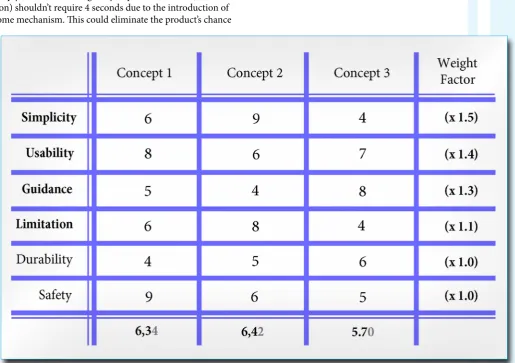
As already stated one of these three concepts will be chosen to develop into a final product. Each concept will be given a score on a scale from 1 to 10. This score will be an average of several subscores that cover some main design aspects. These subscores are determined as a result of the concept analysis that has been done in the previous part. The design aspects where the concepts will be criticized on can be divided into two types; product-specific and general design aspects.
It should not be forgotten that this project is about creating a product that is going to replace a fairly simple, short and quick task. The key to success lays in keeping it that way. It is that what makes this such a difficult task to realize. When something that is already simple is tried to make easier the designs are ought to get more complex. Therefore it is deemed important to keep focusing on what is truly impor-tant and to make sure the product reflects that.
In this case that leads to the following product-specific design aspects:
- Simplicity: How complex is this concept (going to be)? How will this increase its chances of failure?
- Usability: Is the goal worth the invested effort? Which of the concepts requires the least effort to get the biggest results?
- Limitation: How strong is its ability to limit the user in tak-ing more bags than truly is needed?