I
DESIGNING SECURE ENTERPRISE
ARCHITECTURES
III
MASTER THESIS SANDER VAN DEN BOSCH
DESIGNING SECURE ENTERPRISE ARCHITECTURESEnschede, 2 May 2014
Author
Sander van den Bosch
Programme: MSc Business Information Technology
Institute: University of Twente
Faculty of Electrical Engineering, Mathematics and Computer Science Enschede, the Netherlands
Student number: s0175358
E-mail: [email protected]
Date: 2 May 2014
Graduation Committee
dr. ir. Marten van Sinderen
Department Services, Cybersecurity and Safety
E-mail [email protected]
dr. Maria-Eugenia Iacob
Department Industrial Engineering and Business Information Systems
E-mail [email protected]
ir. Sander van Wijk
Department Deloitte Consulting B.V., Enterprise Architecture
V
PREFACE
This master thesis describes the research to conclude my master study ‘Business & IT’ at the University of Twente. It also means the end of my time as a student, which I enjoyed very much and in which I developed myself in both a personal as well as a professional way.
The research has been established in cooperation with Deloitte Consulting in the Netherlands. Specifically I worked together with the experts of the service line Enterprise Architecture, who helped me very much in discussing the interesting subject, as well as in making the translation from theory to practice.
First, I would like to thank my university supervisors Marten van Sinderen and Maria Iacob for their support. They gave me guidance, room for developing ideas and shared their experiences and views on this research.
Furthermore, I would like to thank Deloitte Consulting for providing me the opportunity doing my research in cooperation with them. I would really like to thank Sander van Wijk for his supervision, enthusiasm and critical view on the research when needed. Also I would like to thank Eric Onderdelinden for the inspiring discussions about the subject and bringing me into contact with several experts within the enterprise architecture discipline. Next to that, I would like to thank the experts I interviewed during the validation of this research: Lourens Bordewijk, Rob Faber, Aaldert Hofman, Sorin Iacob, Paul Samwel, and Jan Joris Vereijken. Their interesting views on the subject significantly improved the quality of the research. Also special thanks to Jacco Roest, the discussions we had significantly boosted the quality of this thesis.
Finally I would like thank my family and girlfriend Suzanne, who supported me in writing this thesis as well as during my years of studying. Last but not least, thanks to the many friends who made my time in Enschede a time I’ll never forget.
I hope you really enjoy reading this thesis and, in case if you have any questions, please feel free to contact me.
VII
MANAGEMENT SUMMARY
Although acceptance is increasing of the notion that security should be considered throughout the entire design cycle of enterprise architecture, both disciplines are still separated to a large extent. Moreover, no systematic approach exists to integrate the two.
In this thesis, an approach for designing secure enterprise architectures is proposed. Both security and enterprise architecture discipline could potentially benefit from this approach. From a security perspective, the likelihood that security requirements will be addressed throughout the enterprise could be increased. From an enterprise architecture perspective, the intended benefits are expected to be realized by providing a holistic view on the organisation where security is adequately addressed. This is demanded, because the impact of security on the organisation is still growing.
The approach to designing secure enterprise architectures as developed in this thesis consists of three elements: a framework, a method, and a modelling language.
- The framework structures the architecture viewpoints. Zachman is often used for enterprise architecture in this regard, where for security purposes SABSA is frequently employed. This thesis describes how these two frameworks are related. Although the two frameworks have an identical structure, it is still valuable to use these frameworks side by side, as they complement each other regarding their content.
- The method provides a step-wise prescriptive approach for developing an architecture. This thesis describes how the TOGAF Architecture Development Method and the SABSA Lifecycle can be integrated. The SABSA Lifecycle enriches the ADM with relevant security aspects per development phase.
- The modelling language defines the concepts for describing an architecture. Since security concepts are currently not covered in ArchiMate, a security extension is proposed. The extension provides the various concepts needed to include security in the architecture specification, specifically: vulnerability, threat, risk, security mechanism, and security policy.
Experts from the enterprise architecture and security discipline were interviewed to validate the proposed approach. Overall, the approach is considered to be both usable and useful, since it includes the correct ingredients and they are well integrated. Also, the appropriate constructs are deemed to be included in the modelling language to support security modelling in enterprise architecture.
In summary, results of the research include:
- A description of the relation between the Zachman and the SABSA framework
- An integration of the TOGAF ADM and the SABSA Lifecycle
- An identification of constructs for modelling security in enterprise architecture and an ArchiMate extension based on these constructs
IX
TABLE OF CONTENTS
Preface ...V
Management Summary ...VII
1 Research Introduction ... 1
2 Background ... 2
2.1 Enterprise Architecture ... 2
2.2 Security ... 3
2.3 Secure Enterprise Architecture ... 3
3 Research Design ... 5
3.1 Problem Statement ... 5
3.2 Research Objectives ... 6
3.3 Research Questions ... 6
3.4 Research Methodology ... 7
4 Literature Review ... 9
4.1 Approach ... 9
4.2 Enterprise Security Architecture ... 11
4.3 Analysis ... 14
4.4 Model ... 17
4.5 Design ... 21
4.6 Hyperconnectivity and Interoperability ... 23
4.7 Conclusion ... 23
5 Solution Design ... 25
5.1 Line of Reasoning ... 25
5.2 Framework ... 26
5.3 Method ... 29
5.4 Modelling Language ... 40
5.5 An Integrated Approach ... 54
6 Demonstration ... 55
6.1 ArchiSurance Case ... 55
6.2 Application of Solution Design ... 55
6.3 Demonstration Conclusion ... 67
7 Validation ... 68
X
7.2 Research Rigor ... 69
7.3 Research Relevance... 70
7.4 Validation Conclusions ... 72
8 Conclusion ... 75
8.1 Research Questions ... 75
8.2 Contributions ... 77
8.3 Limitations and Suggestions for Further Research ... 79
9 Bibliography ... 80
List of Figures ... 82
List of Tables ... 84
Appendix A – Literature Review Short List ... 85
Appendix B – Security Related Concepts in ArchiMate ... 87
Cha
p
te
r:
Rese
a
rch
In
tro
d
u
cti
o
n
1
1
RESEARCH INTRODUCTION
The subject of this research is the integration of the enterprise architecture and security disciplines: two research fields which are still too separated, but have more in common than you would say at first sight. When executed together properly, these fields are able to reinforce each other (Kreizman & Robertson, 2006). Although the enterprise architecture has evolved into a mature discipline, still not much attention has been paid to integrate non-functional aspects in general, and in particular to integrate security (Shariati, Bahmani, & Shams, 2011).
Enterprise Architecture is the discipline that focuses on organizing logic for business processes and IT infrastructure, reflecting the integration and standardization requirements of the firm’s operating model. The purpose of enterprise architecture is to optimize the often fragmented legacy of processes across the enterprise into an integrated environment that is responsive to change and supportive of the delivery of the organisations strategy (The Open Group, 2011b). Within the enterprise architecture discipline, over the last years several frameworks, methods and modelling languages have been defined to achieve this goal (Iacob, Jonkers, Quartel, Franken, & Berg, 2012).
Security aims at ensuring that risks and controls are in balance (Anderson, 2003). In order to achieve this a holistic approach to security is needed encompassing the complete organisation (Ekstedt & Sommestad, 2009; Lang & Schreiner, 2008). ‘Secure by design’ is an important credo within this discipline, stating that artefacts should be designed from the ground up to be secure. The underlying hypothesis is that once the design has been produced, security problems can seldom be fixed by adding new functionalities, and generally the solution lies in redesign, which can be both costly and time-consuming.
Cha
p
te
r:
B
a
ck
g
rou
n
d
2
2
BACKGROUND
In this chapter high-level background information on the research is provided. It starts with an elaboration on enterprise architecture in section 2.1, followed by security in section 2.2, and considers the various concepts that are related to an integration between the two. One of these concepts is a definition of secure enterprise architectures, which is discussed in section 2.3.
2.1 ENTERPRISE ARCHITECTURE
Within this research, the definition of enterprise architecture provided by Engelsman, Quartel, Jonkers, and van Sinderen (2011) is used:
“a design or a description that makes clear the relationships between products, processes, organisation, information services and technological infrastructure; it is based on a vision and on certain assumptions, principles and preferences; consists of models and underlying principles; provides frameworks and guidelines for the design and realisation of products, processes, organisation, information services, and technological infrastructure.”
Enterprise architecture examines more than just the technological architecture, or just the business architecture, or even the two side by side. It investigates the phenomena that emerge when the two interact (Engelsman et al., 2011; Innerhofer-Oberperfler & Breu, 2006).
The term enterprise in enterprise architecture covers all kinds of business organisations, including public or private sector organisations and an entire business or corporation. Also a business unit as part of a whole and a conglomerate of several organisations is included. The enterprise can be both national and international oriented.
In general, a distinction between four layers of architecture is made: business, information / data, application, technological / infrastructure, as outlined in Figure 1. The processes and activities in the business make use of information or data, which need to be collected, organized and distributed, using applications, which run on technology or infrastructure such as a computer system. Sometimes, the information/data and application layer are integrated into one layer, often called the information systems layer.
Figure 1: Four common layers in Enterprise Architecture
Business
Information / data
Application
Cha
p
te
r:
B
a
ck
g
rou
n
d
3 2.2 SECURITY
The definition for information security within the context of this thesis is the definition of Anderson (2003):
“A well-informed sense of assurance that information risks and controls are in balance.”
Security refers to minimizing the risk of exposure of assets and resources to vulnerabilities and threats of various kinds. This applies to any vulnerable and valuable asset, e.g. a person, community or organisation. Within the context of security, a distinction is made between physical security, IT security and information security. The physical security refers to the measures taken to deny unauthorized access to facilities, equipment and resources. IT security is mainly aimed at protecting applications and technical measures. Information security is concerned with the protection of information, both analogue and digital. Cybersecurity is information security as applied to computers and computer networks. Within the context of this thesis, the focus is on information security, so digital as well as analogous information are in scope.
Three fundamental qualities of information are vulnerable to risk, namely confidentiality, integrity and availability. Confidentially aims at ensuring that information is accessible only to those authorized to have access. Integrity safeguards the accuracy and completeness of information and processing methods. The availability aspect ensures that authorized users have access to information and associated assets when required (Johansson & Johnson, 2005; Kim & Leem, 2004).
On the other hand are the costs and effort incurred in minimizing the risk. There is a need to balance these costs with the business needs and regulatory compliance. The concept of balance also includes the notion of cost effectiveness (Anderson, 2003).
2.3 SECURE ENTERPRISE ARCHITECTURE
A lot of concepts are related to ‘secure enterprise architecture’. An overview of these concepts is provided, and it is described to what extent they will or will not be incorporated within this thesis. A distinction is made between ESA (enterprise security architecture), TSA (technical security architecture), and SEA (secure enterprise architecture). These are the terms discussed in literature most often.
A. Enterprise Security Architecture (ESA)
Cha
p
te
r:
B
a
ck
g
rou
n
d
4 Sometimes an author refers to the term ‘enterprise information security architecture’ instead of ‘enterprise security architecture’. Within this thesis they are treated as synonyms.
The ESA is concerned with the security architecture throughout the organisation.
B. Technical Security Architecture (TSA)
The technical security architecture typically defines standards for protection settings that can be implemented as a technical mechanism to minimize information risks. In contrast to the enterprise security architecture the prime focus is on technical elements.
A technical security architecture focuses on the mapping between the control architecture and the protection processes on a technical level.
C. Secure Enterprise Architecture (SEA)
A secure enterprise architecture encompasses the enterprise architecture as well as the security risks and measurements on all levels of enterprise architecture: business, information, application and technology architecture. By combining the enterprise architecture and security, it is possible to provide an integrated description of an organisation’s structure, processes and underlying IT landscape (Innerhofer-Oberperfler & Breu, 2006).
A secure enterprise architecture describes the security risks and measures in relation to the business, information, application and technology architecture.
Cha
p
te
r:
Rese
a
rch
De
sign
5
3
RESEARCH DESIGN
This chapter describes the research design. The problem statement is outlined in section 3.1. In order to solve the problem, the research objectives are derived and discussed in section 3.2. In section 3.3 the research questions are provided, and the final section 3.4 describes the research methodology.
3.1 PROBLEM STATEMENT
Both practice and literature state that the fields of security and enterprise architecture are still too separated (Oda, Fu, & Zhu, 2009). In theory, the role of security experts is in the profile and planning phase by performing a risk assessment and developing principles, procedures, policies and measurements accordingly. Based on this risk analysis, the enterprise architect’s expertise is to implement these principles, procedures, policies and measurements in a target architecture. However in practice, the synergistic benefits between these fields have not been captured yet.
Although several attempts have been made to integrate these worlds, still no comprehensive approach exists. Integrating and improving the relationship of enterprise architecture and security is mainly relevant because of two reasons:
- From a security point of view: According to (Kreizman & Robertson, 2006), “security architecture work is performed outside of the EA group in most organisations. Combining work efforts of EA staff and security architects improve the probability that security requirements will be addressed throughout the enterprise.”
- From an enterprise architecture point of view: Security becomes an integrated part of the enterprise, while its impact is still growing. For the enterprise architecture, claiming to provide a holistic view, security is an essential aspect. The growing impact of security on the organisation is illustrated by the rise of the cost of data security breaches over the past five years, as shown in Figure 2. The impact on the organisation of not having security and EA aligned and integrated becomes bigger. The number between the brackets indicates the amount of data breaches per capita in the corresponding year (Ponemon Research Institute, 2013).
Figure 2: The average per capita cost of data breach over five years in Germany (Ponemon Research Institute, 2013)
€112
€132 €138
€146 €151
€-€20 €40 €60 €80 €100 €120 €140 €160
Cha
p
te
r:
Rese
a
rch
De
sign
6 Currently, no comprehensive approach exists for developing enterprise architecture with integrated security. In order to realize the above mentioned benefits, an integrated approach of enterprise architecture and security is needed. The development of this approach will be the main objective of this research.
3.2 RESEARCH OBJECTIVES
The main objective of this research is to develop an integrated approach of enterprise architecture and security. From literature it is derived, as identified later in chapter 4, that a comprehensive approach consists of three ingredients: a framework, a method and a modelling language. The research focuses on an integration between these elements separately, and on how these elements relate to each other to provide a comprehensive approach.
As identified in the literature review in chapter 4, the language-aspect of security is not very well defined in the literature yet. A focus on this aspect is needed in order to make the integration between enterprise architecture and security possible.
To conclude, the research objectives are to:
- Provide a description on how an integrated approach of security and enterprise architecture would look like, by:
o Providing an integration of each of the ingredients separately;
o Closing the missing gap of not having a graphical security modelling language;
o Providing a description of the full approach.
- Validate this approach in the field by means of a case study.
3.3 RESEARCH QUESTIONS
The research questions are derived from the research objectives. Two main research questions are central in the research conducted. The first research question focuses on designing the integrated approach of security and enterprise architecture, including the validation of this approach. The second research question focuses on the integration of security in the graphical modelling language of enterprise architecture. The research questions and their sub questions are outlined below.
1. “What is a validated, comprehensive and integrated approach for designing secure enterprise architecture?”
1.1.What is the current state of the Enterprise Architecture and Security discipline and their relation?
1.2.Which elements are needed to provide a comprehensive approach, and what are their requirements?
1.3.What does an integration of these elements look like?
Cha
p
te
r:
Rese
a
rch
De
sign
7 2. “How can an enterprise architecture language be extended to incorporate security
aspects?”
2.1.What elements are needed to specify a modelling language?
2.2.Which security concepts need to be merged into the enterprise architecture language?
2.3.How can the language be validated?
3.4 RESEARCH METHODOLOGY
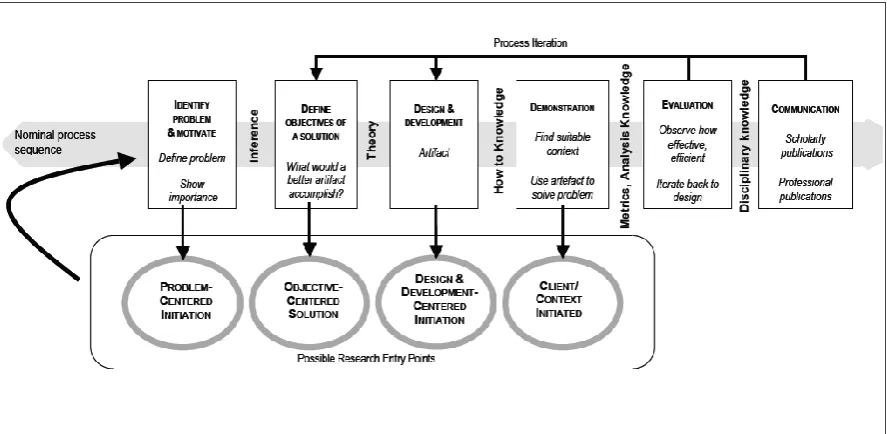
[image:17.595.75.519.277.494.2]Since the question is a design problem, design science is conducted. One of the research methodologies for this type of research is the design science research methodology as proposed by Peffers, Tuunanen, Rothenberger, and Chatterjee (2007). A graphical representation of the approach is shown in Figure 3.
Figure 3: Design Science Research Methodology (DSRM) process model (Peffers et al., 2007)
An overview of the process steps, related research questions, and the corresponding sections is provided in Table 1.
A. Identify problem & Motivate
Define the specific research problem and justify the value of a solution. In section 3.1, the research problem is defined, and is further explored in the literature review in chapter 4.
B. Define objectives of a solution
Cha
p
te
r:
Rese
a
rch
De
sign
8
C. Design & Development
Create the artefact. The outcome of this phase is an approach for designing secure enterprise architectures. The approach consists of an integrated framework, method and a modelling language. The underlying design choices are explained in chapter 5.
D. Demonstration
Demonstrate the use of the artefact to solve one or more instances of the problem. The artefact will be demonstrated by applying the proposed integrated approach to a case. This demonstration is provided in chapter 6.
E. Evaluation
Observe and measure how well the artefact supports a solution to the problem. The evaluation is aimed at comparing objectives of the solution to the actual results derived in the design & development and evaluation phase. During this phase several experts in the field were interviewed. The outcomes of the interviews is discussed in chapter 7.
F. Communication
Communicate the problem and its importance, the artefact, its utility and novelty, the rigor of its design, and its effectiveness to researchers and other relevant audiences. The communication of the problem, its importance and the solution is done in this report.
Table 1: Relation between process, research questions and thesis outline
Process step Relates to research question(s)
Discussed in section / chapter
Outcome
Identify problem & motivate
1.1 3, 4 Problem outline,
research motivation
Define objectives of a solution
1.1 3, 4 Research objectives
Design & development
1.2, 1.3,
2.1, 2.2
5 Approach for designing
secure enterprise architectures
Demonstration 1.4 6 A case where the
approach is demonstrated
Evaluation 1.5,
2.3
7 An evaluation of the
approach and its demonstration
Cha p te r: L ite ra tu re R eview 9
4
LITERATURE REVIEW
For this literature review, 27 publications from both enterprise architecture and security discipline are used. These papers were derived from a structured literature research, as explained in section 4.1. The literature is discussed in sections 4.2 till 4.6, and a conclusion is provided in section 4.7.
4.1 APPROACH
The aim of this literature review is to identify the state-of-the-art in the enterprise architecture and security disciplines and their relations. In order to do so, the EA-related security concepts as well as the security-related EA concepts are identified. With this approach, a view from both enterprise architecture and security discipline is provided. Within this view a distinction is made between analysis techniques, modelling techniques and design methods. The differentiation in analysis, model and design is also used by Gregor (2006), where they differentiate between I. Analysis, II. Explanation, III. Prediction, IV. Explanation and Prediction and V. Design and Action, in order to identify the state of research fields.
The approach is based on the systematic literature review approach as described by Webster and Watson (2002). According to them, two reasons for conducting a structured review exist. First, authors could deal with a mature topic where an accumulated body of research exists that needs analysis and synthesis. In this case, they would conduct a thorough literature review and then propose a conceptual model that synthesizes and extends existing research. Second, authors could tackle an emerging issue that would benefit from exposure to potential theoretical foundations. Here, the review of current literature on the emerging topic would, of necessity, be shorter. The author's contribution would arise from the fresh theoretical foundations proposed in developing a conceptual model. This research focuses on the latter type and by adopting a replicable scientific and transparent process, fresh theoretical foundations can be proposed.
Two types of literature review exist: author-centric and concept-centric. An author-centric approach would compare authors, based on the concepts they describe and the review then essentially presents a summary of the articles. The concept-centric approach compares the concepts, where authors and their statements on the same concept are compared. The concept-centric approach is used in this literature review, so concepts determine the organizing framework of the synthesis.
The search process for literature has been divided in four steps and three deliverables, as shown in Figure 4. A blue colour indicates a step in the process, where a green colour indicates a deliverable.
Figure 4: Literature review search process
Cha
p
te
r:
L
ite
ra
tu
re R
eview
10
4.1.1 LONG LIST
In the first step of the search for literature, Scopus and Google Scholar are used. An exploratory search is conducted in order to identify the keywords. The used search terms are ‘enterprise architecture’ and ‘information security’. During the inspection of the results, it already appeared that the two fields have some overlap in the concept “enterprise (information) security architecture”.
As described in the approach of the literature review, the identification of analysis techniques, modelling techniques and design methods is the main goal of the literature review. Therefore the respective terms “analysis”, “model” and “design” are added to the term “enterprise security architecture”. Furthermore, a search on these terms is repeated, but ‘security’ is left out of the quotes, in order to extend the view to security related papers.
The used search queries and the outcomes of the searches are depicted in Table 2.
Table 2: Search queries used in literature review
Search query # Results in
Scopus
# Results in Google Scholar
"enterprise security architecture" 22 468 (50)
"enterprise security architecture" analysis 6 379 (50)
"enterprise security architecture" model 9 379 (50)
"enterprise security architecture" design 4 395 (50)
"enterprise architecture" information security 89 ~ 13.200 (50)
"enterprise architecture" information assurance 16 4.820 (50)
"enterprise architecture" security analysis 49 ~ 12.100 (50)
"enterprise architecture" security model 68 ~ 13.200 (50)
"enterprise architecture" security design 33 ~ 13.100 (50)
Cha
p
te
r:
L
ite
ra
tu
re R
eview
11 Subsequently, the results of Scopus and Scholar are standardized in order to filter out the duplicates. After this filtering step, 360 unique publications remain in the long list.
4.1.2 MIDDLE LIST
The long list is used as input to create the middle list. A filter on the long list is needed to make sure only time is invested in the relevant literature in order to create a short list. A first cut is made based on three criteria. First, and foremost, is that the article is likely to contribute to answering the research questions. Second, it is important that the articles deals with the research fields of enterprise architecture and/or security, because those are the investigated research fields. Third, as some articles are superseded, it is important to take the most recent version of the papers into account.
The amount of citations is left out of the selection criteria, because recent developments within this research area might be missed when this criterion is applied.
Concluding, the long list is filtered to the middle list by applying the following criteria:
- R1: The article is likely to contribute to answering the literature review research questions.
- R2: The article is primarily dealing with Enterprise Architecture and/or Security. - R3: The article has not been superseded.
These criteria are applied to the long list based on the title, the year of publication and the journal of publication. The relevancy for answering the research questions (R1) and research discipline (R2) is based on the title of the publication and the journal in which it is published. The year of publication is also taken into account to decide whether or not the article is likely to contribute to answering the research questions, since a more recent article will provide more information on recent developments in the disciplines. The year of publication is also used to determine whether or not the article has been superseded. After this filtering step, 96 publications remain in the middle list.
4.1.3 SHORT LIST
In order to create the short list, the publications from the middle list are retrieved and the abstract is considered. In order to select the relevant papers, requirements R1 and R2 are used again. Articles primarily focusing at enterprise architecture, as well as articles which did not mention the word ‘security’ or related concepts are left out of the scope.
After this selection, 27 articles remain in scope. A list of these articles is included in Appendix A – Literature Review Short List.
4.2 ENTERPRISE SECURITY ARCHITECTURE
Cha
p
te
r:
L
ite
ra
tu
re R
eview
12
4.2.1 ENTERPRISE SECURITY ARCHITECTURE FRAMEWORK
Several enterprise security architectures are currently accepted by the industry, these include:
- Gartner EISA
- Zachman framework
- SABSA framework & methodology
Three viewpoints are often included in the frameworks: business, information systems and technology. The business architecture models the organisation’s business processes, roles, responsibilities and structure. It reflects the “business of security” and how information security interrelates with the way the organisation functions. The information systems architecture includes data, integration and application models used to operate the organisation. The technology layer encompasses the organisation’s IT infrastructure, consisting of hardware, software and security requirements derived from the information architecture. None of the layers function in isolation or independently of other layers. Rather, the correlation across all three layers is the crux (Montelibano & Moore, 2012; Oda et al., 2009; Shariati et al., 2011).
The Gartner EISA framework, introduced in 2006, was the first attempt of introducing an enterprise security architecture by considering the compatibility of EISA with EA program and insisting on the collaboration of these two. This framework focuses on a description of the structure, but does not include a specific methodology for implementation (Shariati et al., 2011).
The Zachman framework is a layered architecture, consisting of six horizontal layers: contextual, conceptual, logical, physical, component, and functioning enterprise layer. Across these six horizontal layers, six vertical columns are placed, representing six essential aspects of the viewpoints: what, how, where, who, when, and why.
The Zachman framework does not specifically address security aspects. Nevertheless, due to the fact that Zachman is a comprehensive framework that is used within lots of businesses, it is adapted to include security nowadays. One of the advantages in this case is the use of an automated tool that provides consistent perspective of the enterprise architecture. Key players are able to add or remove parts of the model as business and technology change. However, an automated process cannot determine information security needs and requirements on its own; the tool is meant to manage complex information provided by key players (Burkett, 2012; Heaney et al., 2002; Oda et al., 2009).
SABSA is the most outstanding attempt of a holistic EISA. It has an identical structure compared to the Zachman framework, but differs in the sixth horizontal layer. Within SABSA, the sixth horizontal layer aims at security service management. The service management layer is for example concerned with the assurance of operation continuity and management of the environment.
Cha
p
te
r:
L
ite
ra
tu
re R
eview
13 method for carrying out requirement engineering. The SABSA Matrix is included in Figure 5 (Burkett, 2012; Shariati et al., 2011; John Sherwood, Clark, & Lynas, 2005).
Figure 5: SABSA Matrix (John Sherwood et al., 2005)
To summarise, Gartner’s EISA framework tries to integrate security and EA, however it is not as detailed as, e.g. the Zachman framework or SABSA. Zachman is more specified, but does not explicitly address security aspects. SABSA focuses on security, however it does not include EA elements.
4.2.2 ENTERPRISE SECURITY ARCHITECTURE METHOD
Specific methods for designing enterprise security architecture have been developed. In this literature review, two methods were identified: the RISE methodology, and the SABSA Lifecycle.
Cha
p
te
r:
L
ite
ra
tu
re R
eview
14 Also, the SABSA approach includes a method, which is called the SABSA lifecycle. It consists of four parts: strategy & planning, design, implement and manage & measure. The first phase sets the goal and vision of the architecture. The design phase embraces the design of the logical, physical, component and service management architectures. The third activity is ‘Implement’, followed by ‘Manage and Measure’ (J Sherwood, Clark, & Lynas, 2009).
4.3 ANALYSIS
In order to manage and improve something, it is necessary to be able to analyse the current state of affairs. This analysis is at the core of making rational decisions about information systems and enterprise architecture. In order to perform an analysis, information about the involved systems and their organisational context is required for a good understanding of their data quality. It is for instance reasonable to believe that a firewall has a positive influence on the probability that a system or network of systems is more secure. The availability of the firewall is thus one factor that has an effect on the security and should therefore be recorded in a scenario model. The person that carries out the analysis and builds the model should therefore have an understanding of the context, what information to gather and also ensure that this information is collected and modelled accordingly (Buschle, Ullberg, Franke, Lagerstrӧm, & Sommestad, 2011; Johansson & Johnson, 2005).
Analysis can be divided in qualitative and quantitative analysis, and each type of analysis has its advantages and disadvantages associated. Quantitative analysis aims at a statically reliable and generalizable result, based on observations. Qualitative analysis aims at a complete and detailed description, with no attempt to assign frequencies to the features which were identified. Both types of analysis can be found in the literature on the topic of enterprise security architecture. Some analysis models are specifically designed for this type of architectures, others are more generalized, but use the subject of security or cyber security to provide an example or validation to the audience.
Most frameworks are based on standards like ISO 27000 series, or NIST (NIST, 2012). A common denominator for all these guides and standards is that they can all be considered as theoretical frameworks for how to achieve security. None of these works are ensuring “complete” security. A common problem with standards like ISO 27000 series or NIST, is that it is not clear how all the different promoted features and mechanisms are related to each other and if some are more important than others. For example, firewalls have a positive effect on the level of security, but are firewalls more or less important than a security awareness program? Is it taken into account that an awareness program might increase the chance that a firewall is correctly configured? The strength and structure of the causal relations are typically not addressed in the standards and guides (Ekstedt & Sommestad, 2009).
4.3.1 QUANTITATIVE ANALYSIS
Cha
p
te
r:
L
ite
ra
tu
re R
eview
15
A. Assessment with Architecture Theory Diagram
Johansson and Johnson (2005) propose a single quantitative estimate of the level of Enterprise Information Security in a company by providing a list of 1365 questions from standards: ISO/IEC, NIST, ISF and OCTAVE. The questions are clustered by dimension Scope (technical, organisational, environmental), Purpose (preventive, detective, responsive) and Time (planning, operational, controlling). Answering (a selection of) the questions provides a result on a scale which indicates the level of Enterprise Information Security in the researched company. In a validation attempt of the method, the enterprise CISO confirmed that the result from this survey did correspond well to their common feeling of the possible Enterprise Information Security level (Johansson & Johnson, 2005).
B. Attack and Defence trees
Attack trees are a graphical notation evolved from fault trees, where the main goal of an attacker is depicted as the root of a tree. The steps to reach the goal are broken down into sub-goals (nodes) of the attack through “AND” and “OR” relationships, which represent mandatory or optional steps respectively. These trees can be used to answer questions about the current security status and facilitate comparison with previous measurements, but does not answer the question how to improve security. A natural extension of the attack trees are the defence trees, where countermeasures are also included (Ekstedt & Sommestad, 2009). An example of an attack and defence tree is included in Figure 6.
Figure 6: The defence tree concept (Ekstedt & Sommestad, 2009)
Cha
p
te
r:
L
ite
ra
tu
re R
eview
16
Figure 7: A general-purpose decision-tree diagram example for the Security Meter model (Sahinoglu, 2005)
The decision tree frameworks as discussed here are aimed at measuring security, but do not include enterprise architecture aspects yet. The drawback of attack and defence trees is that they can grow extensively if several goals and sub goals are of interest. Therefore, Bayesian networks have been proposed.
C. Bayesian Networks and extended influence diagrams
A Bayesian network is a probabilistic graphical model that represents a set of variables and their dependencies. Influence diagrams are an enhancement of Bayesian networks and a powerful modelling approach. These are used to depict and analyse complex causal interplay between properties. As illustrated in the example diagram in Figure 8, extended influence diagrams can be used to represent defence trees. A utility node can be used to represent the consequence of successful attacks and steps required for their success can be decomposed in a number of sub steps. Attack steps will assume the state “Success” or “Failure”, each with a certain probability, influenced by the countermeasures. Based on the scenario chosen the states of the countermeasures will differ represented by decision nodes that influence the state of countermeasures (Ekstedt & Sommestad, 2009).
Cha
p
te
r:
L
ite
ra
tu
re R
eview
17 In the example outlined in Figure 8, the cost of a security breach is 1000. This is indicated by the utility node of attack goal 1; when this goal is successfully reached this result in a loss of 1000. The goal can be decomposed in attack steps with different chances of success and corresponding failure. The chance of successfully executing the attack steps depends on the countermeasures taken. In this example, countermeasure 1 can have two different states (state 1 and state 2) indicating, for example, a weak and a strong firewall (P5 and P6). The state of the countermeasure has an effect on the successfulness of reaching the attack goal through the various attack steps, resulting in the various chances of success (P1 – P4)
One important feature of the Bayesian formalism is the possibility to learn from previous data and create powerful statistical models for accurate assessments (e.g. on cyber security). Since influence diagrams include decision and utility nodes, predicted losses from successful attacks can be included in the models.
4.3.2 QUALITATIVE ANALYSIS
Kim (2011) proposes a reference model for IT compliance, based on best practices which are mainly described in BS7799, ISO27000 and ISO13335 standards. A best practice mentioned in the paper is for example ‘Mission critical systems and record management systems should be located in an environmentally friendly area. Access to computer hardware, wiring, displays and network should be controlled by rules of least privilege. Systems which monitor and audit a physical access to computer hardware, wiring, displays and networks should be implemented’. The corresponding mitigating controls then include Environment control, Power protection, Water damage controls, HVAC, Smart cards, Fire prevention and suppression and Physical access controls. The best practices can be found in some parts of BS7799 and ISO27000.
By using this reference model for IT compliance, one can improve quality of internal auditing plans and is able to analyse the current state of affairs for information security within the company. Furthermore, the model can be used to manage an auditing project or train auditors to improve the auditors’ capability.
4.4 MODEL
The current approach to protect distributed systems in large organisations is based on a security policy document. This document balances the functional business requirements of the application, the security requirements, legal and regulatory aspects and other factors like costs. This approach raises several issues however, for example policy correctness and consistency, even for quite simple client/server applications. It is the question how to ensure that the high level policy is correctly mapped to a high number of access control rules and configurations of security systems. This approach is error prone, causes high maintenance costs and requires a lot of resources. Furthermore, the challenge in security is not in the elements as encryption or access control, but in the protection of the system as a whole (Buschle, Holm, Sommestad, Ekstedt, & Shahzad, 2012; Lang & Schreiner, 2008).
Cha
p
te
r:
L
ite
ra
tu
re R
eview
18 little purpose in a complex world. This is also demanded by regulatory and legal requirements, which require a higher level of security, including the proof that the system is sufficiently protected. A model transforms part of the real world, e.g. an organisation, into model conditions (Ekstedt & Sommestad, 2009; Hensel & Lemke-Rust, 2010; Lang & Schreiner, 2008).
Currently, information security is modelled in one of the two approaches. Frequently, the security aspects of a system are designed and analysed separately from the rest of the architecture, and are therefore not well integrated, leading to a potential of new vulnerabilities. Alternatively, the security aspects are designed implicitly in the architecture, so that they cannot be extracted. This leads to a lack of analysability of the security aspects. Thus there is a need for practical guidance on how enterprise engineers not qualified as security engineers can include security aspects on the holistic approach of architectures (Heaney et al., 2002; Hensel & Lemke-Rust, 2010; Lang & Schreiner, 2008; Shin & Gomaa, 2007).
A major difficulty of implementing security policies is in the fact that these policies are expressed at a high level of abstraction, that is organisation-, business-, or information-centric, but often not IT-centric or expressed in IT-terms. Furthermore, compliance monitoring is hard, how can an organisation demonstrate that it complies with regulations? Doing this manually is too slow, costly and error-prone. These two difficulties are even harder to tackle within distributed IT environments which get reconfigured regularly.
Benefits of model driven security include a regulation of information flows and resource access between the various systems of an organisation and its users; it helps aligning business security requirements and policy-driven technical security enforcement. Furthermore, the cost/effort savings can be significant because multiple rules can be generated and maintained automatically while also providing a link to the business enterprise architecture, which ensures that the needs of the business are reflected (Lang & Schreiner, 2008).
In order to do so, several approaches exist: Heaney et al. (2002) propose the use of security patterns, Buschle et al. (2012) provides a tool for automatic enterprise architecture modelling with a running example on cyber security.
A. Using patterns
Heaney et al. (2002) also mentions the importance of linking the IT element of information security to the enterprise business needs, because the purpose of enterprise architecture is to insure that IT effectively supports the needs of the business.
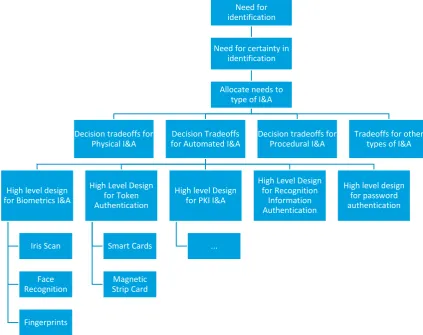
It is important to address all levels of conceptualization, both on system level but also on enterprise level, and to address all levels of composition, from a system of systems to the smallest unit. This can be achieved by using patterns. Patterns have been successfully used in systems and software communities to capture and share knowledge about well-known and successful solutions to common technical problems. By providing an integrated system of patterns and their detailed representations, the level of security can be improved and understood by enterprise engineers not qualified as security engineers.
Cha p te r: L ite ra tu re R eview 19 Business Model, to system model, technology model and the detailed representations. Accordingly, characteristics can be defined per level and solution. For example for the solution option ‘Biometrics’, the costs are moderate to high per user and there are high costs per entry point, but it provides a solution when tokens or passwords are not acceptable and the entry point is physically insecure (Heaney et al., 2002).
Figure 9: Identification & Authentication Pattern Tree (Heaney et al., 2002)
B. Automatic generation
Another approach for designing an enterprise security architecture is by generating it automatically. In a study conducted by Buschle et al. (2012), a tool is proposed to automatically instantiate elements in enterprise architecture models based on results from network scans. This approach mainly focuses on the application and technology layer of the organisation.
The information needed to construct the architecture is gathered through the application of a vulnerability scanner that evaluates the structure of an enterprise.
For this purpose, a vulnerability scanner is needed. Examples of this tool include NeXpose, Nessus, and OpenVAS. In the research conducted by Buschle et al. (2012) NeXpose is used, which is an active vulnerability scanner capable of both authenticated and unauthenticated scans. Active means that it queries remote hosts for data and it does this by providing user accounts to hosts (authenticated) or without (unauthenticated). Authenticated scans are typically less disturbing to normal operations and provide a higher degree of accuracy, but
Need for identification Need for certainty in
identification Allocate needs to
type of I&A Decision tradeoffs for
Physical I&A
Decision Tradeoffs for Automated I&A
High level design for Biometrics I&A
Iris Scan Face Recognition Fingerprints
High Level Design for Token Authentication
Smart Cards Magnetic Strip Card
High level Design for PKI I&A
...
High Level Design for Recognition
Information Authentication
High level design for password authentication Decision tradeoffs for
Procedural I&A
Cha
p
te
r:
L
ite
ra
tu
re R
eview
20 credentials are not always available. The result of the scan is a network architecture including all devices communicating over TCP or UDP, e.g. firewalls and printers, and their operating systems or firmware and any services that are running. If the scanner is given credentials, all applications and versions, and user / administration accounts are also included. It is able to detect both software flaws and configuration errors from the security point of view. It scans for approximately 53.000 vulnerabilities.
This tool proves to be extremely useful for automatic generation of the infrastructure and application layer of the enterprise architecture. In a case study, it took less than an hour to create the EA model for a network of 20 physical computers and 28 virtual machines (Buschle et al., 2012).
Other tools for modelling an enterprise security architecture are mentioned in section 4.2.1.
C. Modelling language
Known graphical modelling languages in security discipline are Rei, UMLsec, and SI* (Ekstedt & Sommestad, 2009). Rei is a policy modelling language. It allows for specifying different types of policies in terms of rights, obligations, dispensations, and prohibitions (Kagal, Finin, & Joshi, 2003).
UMLsec is an extension to UML and has a focus on security requirements for systems engineering. It allows for integrating security related information in UML specifications, by enabling software developers with a background in security to make use of security engineering knowledge and capsulate in a widely used design notation (Jürjens, 2002).
SI* is a security requirements engineering modelling language, which encompasses constructs for actors, roles, goals and their dependencies. It is an agent-oriented methodology, which supports the modelling of the social context in which the system-to-be will operate, and is therefore especially useful in requirements-engineering (Massacci, Mylopoulos, & Zannone, 2010).
Other current modelling languages that have been tailored for security, like UMLsec, secure UML and Misuse cases, provide good support for detailed modelling of concerns such as access control, and formal validation of security design. However, they lack a holistic scope and do not represent the broad spectrum of security. Also, alignment with other system topics of interest such as maintainability, performance, functionality, and business alignment is lacking. This requires an enterprise wide architecture viewpoint (Ekstedt & Sommestad, 2009).
A well-known modelling language in the enterprise architecture discipline is ArchiMate (M.E. Iacob, 2012). This language is becoming widely accepted as the de-facto standard for the specification of enterprise architecture models and views. Three layers are distinguished: the business layer, the application layer, and the infrastructure layer. In addition, the language considers structural, behavioural, and informational aspects within each layer.
Cha
p
te
r:
L
ite
ra
tu
re R
eview
21
4.5 DESIGN
Designing information security from a purely technical perspective is believed to have a high tendency of failure. Both literature and the industry agree upon having a more holistic approach is vital in order to secure the enterprise and its assets. Similar to how a building architect designs security into a building, an enterprise security architecture has to assimilate security elements throughout the layers of an organisation and has to align these with the current enterprise architecture (Burkett, 2012; Montelibano & Moore, 2012; Park, Ahmad, & Ruighaver, 2010).
Today, the security department is often seen as the business prevention department, keeping the business from innovation and creating value. This is in contrast to what most security architects aim for: security as a business enabler. Information security should enable a business to take the risks it is prepared to take on, by designing and deploying countermeasures that allow for sensible business risk (Liu, Sullivan, & Ormaner, 2001; Peterson, 2007).
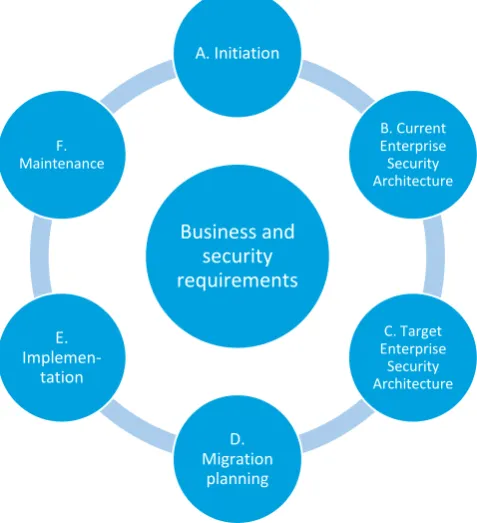
[image:31.595.129.368.485.747.2]All approaches to designing enterprise security architectures apply the pattern as outlined in Figure 10. Important in this process is the continuous loop, where most process models aim for. Defining and updating the enterprise security architecture within the organisation is a continuous process, because the environment is constantly changing. Kim and Leem (2004) argue for an environment analysis prior to the development of AS-IS and TO-BE architectures, identifying both business and technical environment. The business environment focuses both on external and internal environment, including threat of entry, and powerful suppliers; and buyers, management planning, financing, and research. They include this environment analysis in order to identify the competitive environment of the business and the technical trends, which have an impact on the risk analysis in the TO-BE architecture (Kim & Leem, 2004; Liu et al., 2001).
Figure 10: Enterprise Security Architecture design process, adapted from Liu et al. (2001)
Business and security requirements
A. Initiation
B. Current Enterprise Security Architecture
C. Target Enterprise
Security Architecture
D. Migration
planning E.
Implemen-tation
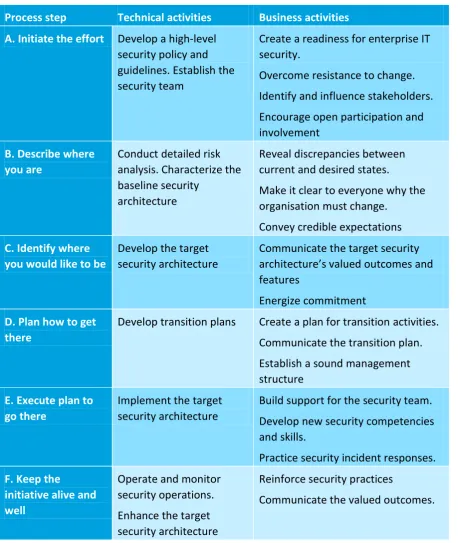
Cha p te r: L ite ra tu re R eview 22 Liu et al. (2001) divide the activities for each step of the process in technical and business concerns. These concerns are summed up in Table 3. For each process step in Figure 10, the table indicates which technical and business activities one should consider.
[image:32.595.73.532.210.754.2]This overview balances the technical and business concerns, where the involvement of the business is primarily required for the preparation of implementation in the business. Current approaches require more involvement of the business in weighing up risks and countermeasures (Burkett, 2012; Liu et al., 2001).
Table 3: Activities in six-step process to develop Enterprise Security Architecture, as outlined in Figure 10. (Liu et al., 2001)
Process step Technical activities Business activities
A. Initiate the effort Develop a high-level security policy and guidelines. Establish the security team
Create a readiness for enterprise IT security.
Overcome resistance to change.
Identify and influence stakeholders.
Encourage open participation and involvement
B. Describe where you are
Conduct detailed risk analysis. Characterize the baseline security
architecture
Reveal discrepancies between current and desired states.
Make it clear to everyone why the organisation must change.
Convey credible expectations
C. Identify where you would like to be
Develop the target security architecture
Communicate the target security architecture’s valued outcomes and features
Energize commitment
D. Plan how to get there
Develop transition plans Create a plan for transition activities.
Communicate the transition plan.
Establish a sound management structure
E. Execute plan to go there
Implement the target security architecture
Build support for the security team.
Develop new security competencies and skills.
Practice security incident responses.
F. Keep the
initiative alive and well
Operate and monitor security operations.
Enhance the target security architecture
Reinforce security practices
Cha
p
te
r:
L
ite
ra
tu
re R
eview
23 Other tools for designing an enterprise security architecture are mentioned in section 4.2.1.
4.6 HYPERCONNECTIVITY AND INTEROPERABILITY
The emergence of internetworked systems has given corporations and government agencies the opportunity to share information in unprecedented fashion, recognized by Haigh (1995) already. However, there are significant security implications in this trend. An enterprise must not only protect the confidentiality, integrity and availability of its own information, but also of the virtual organisation to which it belongs. The sharing is not only geographically across a single enterprise, but it can also be distributed across several enterprises. This raises several complex research questions on privacy, information security and trust (Pulkkinen, Naumenko, & Luostarinen, 2007).
Consequently, security is inherently suffering from a weakest-link syndrome (Ekstedt & Sommestad, 2009). Enterprise Architecture is proposed as a means for comprehensive and coordinated planning and management of corporate ICT and the security infrastructure. Pulkkinen et al. (2007) conducted a study which provides an example of security architecture planning based on enterprise architecture, which aligns the development of technological solutions with business goals. By choosing for an enterprise architecture approach, the planning of business and ICT developments is combined.
Shariati et al. (2011) conducted a review on Enterprise Information Security Architectures from an interoperability perspective. Three interoperability aspects were included: technical, organisational and semantic interoperability. The result was that the role of information security in interoperability was often neglected. It seems that much practical research should be done so that the two incompatible quality attributes of security and interoperability could be implemented along with each other. A summary of the results is included in Figure 11.
Figure 11: The comparison of prominent EISA frameworks from interoperability perspective (Shariati et al., 2011)
4.7 CONCLUSION
The goal of the literature review was to identify the state of the combined research field of enterprise architecture and security and the relation between these concepts. This goal is reached by discussing the various subjects in the preceding sections.
Cha
p
te
r:
L
ite
ra
tu
re R
eview
24 Analysis can be done both quantitative and qualitative, where each of these has its advantages and disadvantages. Both of these approaches discuss security in terms of attacks and countermeasures related to the various aspects of an enterprise architecture. Once the enterprise architecture components and their relations are determined, a risk analysis can be conducted and countermeasures can be put in place.
In order to achieve this application, a comprehensive secure enterprise architecture approach is needed. Within the enterprise architecture discipline, three ingredients are identified; a framework, a method, and a language (Iacob, Jonkers, et al., 2012). These ingredients correspond to the core components of any information system design theory, as described by Gregor and Jones (2007): principles of form and function, principles of implementation, and constructs.
A framework for the subdivision of an architecture in different domains, sometimes including the relationships between these domains.
A method, or a way of working, which is in most cases a step-wise prescriptive method for developing architectural descriptions.
A (modelling) language, defining the concepts for describing an architecture, including a (preferably graphical) representation of these concepts.
Cha
p
te
r:
S
o
lu
tio
n
D
e
sign
25
5
SOLUTION DESIGN
The solution design consists of three components: framework, method and modelling language. The concepts are described and investigated in section 5.2, 5.3, and 5.4 respectively. The solution design is then discussed in section 5.5.
5.1 LINE OF REASONING
According to Iacob, Jonkers, et al. (2012), a comprehensive approach for enterprise architecture consists of three essential ingredients: a framework, a method, and a modelling language. Moreover, it should become clear in the approach how these three concepts relate to each other. The concepts are described in further detail below.
A framework provides the various existing viewpoints on an architecture, and subdivides the architecture in different domains, sometimes complemented with the relationships between these domains. In enterprise architecture, examples include the Zachman Framework, NIST Enterprise Architecture, and Federal Enterprise Architecture Framework.
A method provides a step-wise prescriptive approach for developing the architecture, from scratch or from existing models. In the enterprise architecture field, the TOGAF ADM approach is well-known for example. But also the Federal Enterprise Architecture covers a development method.
The final ingredient of a comprehensive approach is a language, which defines the concepts for describing an architecture. This can be both in natural language or graphically, where the latter one is preferred. Examples include UML and ArchiMate.
The relation between these ingredients is depicted in Figure 12.
Figure 12: Ingredients of an Enterprise Architecture approach (Iacob, Jonkers, et al., 2012)
A comprehensive approach, where security and enterprise architecture are integrated, would also consist of a framework, method and modelling language. Furthermore, for each of these ingredients, it should be described how they relate to the ingredient of the other discipline, and also how they relate to the full approach.
Framework
(viewpoints)
Method
Language
Cha
p
te
r:
S
o
lu
tio
n
D
e
sign
26 The literature review conducted and described in chapter 4 provides insight in the current state of affairs. A framework often used in security discipline is SABSA, which has the same structure as the Zachman framework. As a method, one could use the ESA development cycle (Liu et al., 2001), which describes the common steps in order to create an enterprise security architecture. A suitable graphical security modelling language is not discovered in the extensive literature review. Some languages support parts of security though, but none of them covers the broad topic of security. Therefore, a definition of a language or a language extension that allows modelling security, and describe its relation to ArchiMate is demanded. An elaboration on the choice of the framework, method and language is provided in the following sections. An overview is depicted in Figure 13.
Enterprise Architecture Security
Framework Zachman SABSA
Method TOGAF Security implementation
approach / SABSA Lifecycle
Language ArchiMate To be defined
Figure 13: Essential ingredients of an integrated approach for EA and Security
5.2 FRAMEWORK
As discussed in chapter 4, several architecture frameworks exists. In order to accomplish the formulation of the framework, an integration of Zachman and SABSA is chosen.
The most important reason for using the Zachman framework is because of its wide acceptance in the enterprise architecture discipline, both in research and industry. It is relatively old, but still relevant, used and well-known. Furthermore, it is comprehensive in the sense that it provides several views. Currently, security is not explicitly addressed in the Zachman framework. (van Gansewinkel & Hofman, 2012).
The most important reason for using SABSA is because it is an open standard, comprising a number of security artefacts. It is also well-known and the de facto standard for security frameworks.
The Zachman framework is discussed first, then the SABSA framework will be elaborated, followed by a description of the relation between these two frameworks.
5.2.1 EA: ZACHMAN FRAMEWORK
Cha
p
te
r:
S
o
lu
tio
n
D
e
sign
[image:37.595.77.525.71.429.2]27
Figure 14: The Zachman framework for Enterprise Architecture (version 2003)
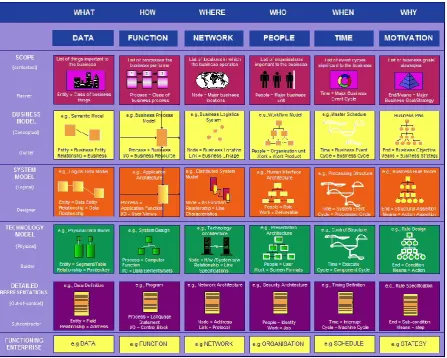
The framework contains six rows, each providing a different viewpoint; and six columns, where the focus is on the same fundamental questions. The rows will be discussed first, followed by an elaboration on the columns.
The rows represent different viewpoints, but do not imply a hierarchical structure. An upper row does not necessarily have a more comprehensive understanding than a lower perspective. Each row represents a distinct, unique viewpoint. Still, each viewpoint should take the requirements of the other viewpoints into account and the constraints that these viewpoints impose. The constraints are additive, so the requirements of the higher viewpoint do affect the constraints of the lower rows, while the opposite is not necessarily true.
- Planner’s Viewpoint (Contextual) – In this viewpoint, the “ballpark view” is defined. It starts with some concepts, which are specifications for the “ballpark” in which they intend to manufacture. It contains for example specifications for the product that it will fly so high, so fast, so far, and for which purpose it is constructed.
Cha
p
te
r:
S
o
lu
tio
n
D
e
sign
28
- Designer’s Viewpoint (Logical) – The designer translates the work breakdown structure into physical products. Within this view, the detailed requirements are created.
- Builder’s Viewpoint (Physical) – The builder must redraw the plans of the designer to represent de builder’s perspective, including all technical details and constraints of supporting technology.
- Subcontractor Viewpoint (Detailed representations) – The subcontractors build the pieces from the detailed representations.
- Actual System (Functioning enterprise) – Finally, the functioning enterprise is built. The Zachman Framework also contains six columns, focussing on six fundamental questions: What, How, Where, Who, When and Why. Each of these viewpoints provides an unique answer to the question (Zachman, 1987, 2008).
5.2.2 SECURITY: SABSA FRAMEWORK
[image:38.595.75.519.383.683.2]The SABSA Model follows the work done by Zachman closely, although it has been adapted to security. Each layer represents the view of a different player in the process of specifying, designing, constructing and using ‘the building’ (J Sherwood et al., 2009). The SABSA matrix is outlined in Figure 15.