PRODUCT COSTING USING ACTIVITYABASED COSTING
A CASE STUDY
A thesis
submitted in partial fulfilment of the requirements for the Degree
of Master of Commerce in the
University of Canterbury
by
C. W. Cattermole
Chapter
PRODUCT COSTING USING ACTIVllY-BASED COSTING
A CASE STUDY
1. Introduction.
2. The Traditional Product Costing Model and extensions of that model.
3. Product Costing and Activities: A general discussion of the Activity-Based-Costing Model.
4. The Principles of the Activity-Based Costing Model. An algebraic Abstraction in Relation to Product Mix Determination.
· 5. How is Activity-Based Costing Different from Other Product Costing Models?
6. The Use of Case Studies as a Research Tool.
7. The Case Study Company - Fisher and Paykel Ltd. A discussion of the company, its facility and the role of product costing.
8. The Case Study Method Applied.
9. Problems and Pitfalls of an Activity-Based Costing Implementation.
10. Results of the ABC Analysis. Presentation of the results of product costing using ABC.
ABSTRACT
As manufacturing enterprises have become less labour-paced the process of recovering overheads by allocation on the basis of direct labour costs has been challenged.
It has been claimed by proponents of Activity-based Costing (ABC) that it is possible to identify the real cost of production by careful identification of 'cost-drivers'.
This thesis examines the conceptual relations between ABC and traditional product costing models.
It -:>n-:>h1coc tho ARr mnrlol tn rlotl'.'rminl'.' \Mhl'.'th"'r it nrnrl11rl'.'c:: rl'.'C::I iltc:: rliffl'.'rl'.'nt frnn,
tlL u11u17o.J1'-"~ I L l l V 1 .. ._.. ... • • • - - - • .,.._.. _ . . . _ . ' - " - ' • • • • • • • - • . , , , . _ . . . _ , , _ , . . . , , _ . . . . , . . . , . _ _ ..., ,.._. .... ...,, ... ..., ...,,1 1 , _ 1._. 0 1 " ' • • - • • •
allocation-based models.
Thesis Introduction
CHAPTER 1
THESIS INTRODUCTION
TABLE OF CONTENTS
Page 1
Table of Contents ... 1
List of Tables and Diagrams ... 2
I. Introduction ... 3
Section 1 ... 4
II. The Study of Product Costing ... 4
A. Background ... 4
B. Evidence of Problems With Costing Systems ... 7
Section 2 ... 8
Ill. Activity Based Costing The Solution to Product Costing Problems? ... 8
IV. The Case Study Company, Fisher and Paykel Ltd ... 10
Section 3 ... 1 0 V. Major Thesis Objective ... 10
VI. Possible Solutions to be lnvestigated ... 13
A. Product Costing Methods ... 13
VII. Thesis Methods ... 13
A. The Case Study ... 13
B. The Case For a Case Study Thesis ... 14
Page 2
Table 1
Table 2
Figure 1
Thesis Introduction
LIST OF TABLES AND DIAGRAMS
Product Costs at Schrader Bellows ... 7
Financial Statistics:
Schrader Bellows Automation Group ... 8
I. Introduction
CHAPTER 1
THESIS INTRODUCTION
In recent years, product costing has become a topical accounting subject.1 As managers of companies struggle to manage diverse product lines in the face of rising competition, it has become very important for them to have detailed knowledge of their product costs so that they can make effective strategic decisions.2 However, many are using product costing systems designed decades ago in a time of narrow product ranges and labour-paced factories. Therefore, their decisions in areas such as product mix-selection and product pricing may well be inappropriate and could, at worst, lead to company failure. As a result of these problems, product costing systems are coming under increasingly detailed scrutiny by both academics and practitioners.
This thesis will examine one of the most important of the new product costing models, Activity-based Costing (ABC). The thesis will explore the ABC model and attempt to draw some conclusions about its validity by examining a case study where the model was used.
Section 1 of this chapter will give a brief background to product costing models. Section 2 will describe ABC and the case study. Section 3 will present the goals and methods of the thesis.
1. Cooper R. and R.S. Kaplan, "How Cost Accounting Distorts Product costs", Management
Accounting, April 1988; Cotton W.1 "Transaction Based ("Event Driven") Product Costing for
the Factory of the 1990s", Accountants lournal, April 1990; Dugdale D., "Costing Systems in Transition", Management Accounting, Jan 1990; Johnson H.T. and R.S. Kaplan, Relevance
Lost, Harvard Business School Press, Boston 1987
2. " ... it is only today, when the principle of competition has attained its full growth and has
become a matter of life and death, that the commercial organization of manufactories is felt to have become a matter' of prime urgency". These words, by Alexander Hamilton Church "The Proper Distribution of Expense Burden", The Engineering Magazine, New York, 1908, p.
Page 4 Thesis Introduction
SECTION 1
II. The Study of Product Costing
A. Background
Traditional product costing systems are of two types: variable costing and absorption costing. The former system, also called marginal costing, uses only those costs which change. directly in response to short term fluctuations in production volume. The most common examples of variable costs are direct materials and direct labour. Overhead costs,
on
the other hand, are considered by this model to be fixed. Decisions relating to products are obviously influenced by highly visible changes in variable costs. The influence of overhead costs, which are excluded from this model and which may have considerable effect on products, is less visible.The absorption costing model allocates overheads to products using a volume~
related allocation base such as direct labour hours. It can, therefore, incorporate overhead costs into product related decisions. However, as the allocation base can be quite arbitrary and averages all overheads over all products, this costing model is a fairly crude means of determining a product's cost. This inaccuracy is made worse when overheads are a large percentage of a firm's total costs.
As early as the 1900s, engineers such as Alexander Hamilton Church were trying to determine accurate product costs by tracing costs to those products which caused them. Church argued that the simple burden rates of the absorption costing model did not trace costs with a sufficient degree of accuracy for use in important tasks such as identification of inefficiencies in the production processes.3 However, Church was thwarted by the size of the task of manually processing the necessary
Thesis Introduction Page 5
information for his more detailed costing model. Today, with computers, this task is considerably easier.
By the 1920s, the demands of external financial reporting meant that auditability became the key issue influencing product costs and the pressure for accurate cost tracing was lost. The traditional absorption costing model was used because it was simple and easy to audit. It was able to value total inventory for income reporting purposes and so long as the total value of inventory was correct, it was unimportant whether individual products were accurately costed.4
Problems arose only when managers began to use these same product costs for· decision-making. The averaging effect of simple percentage burden rates based on a single volume-related allocation base has the effect of overcosting high volume products and undercosting low volume products. This means that managers, using product cost information to decide upon product mixes, are likely to drop profitable long run products in favour of unprofitable short run products.
The absorption costing system is still in use today despite the fact that the manufacturing environment is considerably different. Labour is as low as 3o/o-So/o5 of total manufacturing costs and, in modern factories, has tended to· have the characteristics of a fixed cost. This is because workers act in a supervisory role, operating a number of machines, each making a different component. To continue to use labour as an allocation basis distorts product costs.6
4. Johnson and Kaplan, 1987.
5. Hunt R., L. Garrett and C.M. Merz, "Direct Labour Cost Not Always Relevant at H-P",
Management Accounting, Feb 1985, p. 60.
6. Cooper R. and R.S.Kaplan, "How Cost Accounting Systematically Distorts Product Costs" in
Accounting & Management, Field Study Perspectives, W.J. Bruns Jr and R.S. Kaplan (Eds.),
Page 6 Thesis Introduction
As a result of competitive pressures and a growing realisation that the traditional absorption costing model is unable to handle production complexity, new costing models are emerging to improve the relevance and accuracy of cost accounting techniques. In particular, there is a growing awareness that costings based on volume measures are no longer accurate enough to use for decisions involving product costs. The trend is towards tracing costs directly to products rather than just allocating them.
·The basic cause of overheads is the consumption of resources to manage diversity. Strategic cost analyses use the idea that" ... people cannot manage costs, they can only manage activities that cause costs ... 117• Therefore, if costs can be associated with these activities, they can be more accurately calculated and effectively controlled. Activity Based Costing (ABC) endeavours to calculate product costs by tracing resource costs to individual products according to that product's consumption of each resource. The amount consumed is proportional to the product's consumption of activities associated with the resource.
An illustration of the distortions inherent in absorption costing models can be seen in the case of Schrader Bellows. This company was a manufacturer of compressed air equipment. The management carried out a strategic cost analysis using ABC (albeit in a modified form) which showed that products which the traditional product costing system said were profitable, with gross margin percentages between 26o/o and 46%, were in fact making losses as high as 258o/o. See table 1 for a comparison of the costs of some of Schrader Bellows' products.
7. Johnson H.T., "Organizational Design versus Strategic Information Procedures for Managing
Corporate Overhead Cost: Weyerhaeuser Company, 1972-1986" in Accounting &
Thesis Introduction Page 7
Table 1
PRODUCT COSTS AT SCHRADER BEUOWS8
Existing Cost System Transaction Based System Percentage of Change Sales Onit Sale Unit Gross GM
%
Unit Sale Unit Gross GM % Unit Unit Gross Product Volume Cost Price Margin Cost Price Margin Cost Margin1 43,562 7.85 13.36 5.51 41% 7.17 13.36 6.19 46% -8.7% 12.3%
2 500 8.74 12.50 3.76 30% 15.45 12.50 (2.95) -24% 76.8% -178.5% 3 53 12.15 23.04 10.89 47% 82.49 23.04 (59.45) -258% 578.9% -645.9% 4 2,079 13.63 18.54 4.91 26% 24.51 18.54 (5.97) -32% 79.8% -221.6% 5 5,670 12.40 20.35 7.95 39% 19.99 20.35 0.36 2% 61.2% -95.5% 6 11,169 8.04 13.53 5.49 41% 7.96 13.53 5.57 41% -1.0% 1.5% 7 423 8.47 12.21 3.74 31% 6.93 12.21 5.28 43% -18.2% 41.2%
B. Evidence of Problems With Costing Systems
Evidence that a costing system is becoming inaccurate can come from many
sources.9 However, there are two major factors which illuminate the problem.
Firstly, managers do not trust the costing system. They are aware that
distortions are occurring and either override the cost accounting system by
altering the product mix or use their own ad hoe costing systems to support
their decisions. In a survey of US manufacturers, evidence was found that
managers used their accounting systems to report financial results but used
company engineers to provide cost information for decision making. This was
because the cost accounting system could not be trusted to provide accurate
information.10
Secondly, companies may have steady or increasing sales yet profits are
declining., This is evidence that products are costing more than the accounting
systems are predicting. See table 2.
8, Cooper R, and R,S, Kaplan, "How Cost Accounting Distorts Product Costs", Management Accounting, April 19 24.
9. Cooper R,, "You Need a New Costing System When ... ",Harvard Business Review, Jan-Feb 1989.
Page 8 Thesis Introduction
Table 2
FINANCIAL STATISTICS: SCHRADER ~;LLOWS AUTOMATION GROUP 1979-1983
($million)
1983 1982 1981 1980 1979 Sales 99.7 102.s 123.2 123.1 120.2 Operating Income 6.0 4.7 12.0 16.9 19.5
Identified Assets 92.8 87.5 96.1 97.4 97.2
Capital Expenditure 4.0 4.7 5.0 5.8 5.0
SECTION 2
Ill. Activity Based Costing: The Solution to Product Costing Problems?
ABC is being developed by Harvard Business School academics Robih Cooper and Robert S.- Kaplan and Stanford University's H. Thomas Johnson. It endeavours t6
more accurately capture the cost of a product in terms of its consumption of company resources. it is a ''user-pays'' costing modei which works by focusing on the complexity of products rather than volume factors such as direct labour hours or machine hours. All overhead resources of the company can be captured by the process, including previously excluded areas such as administration and marketing costs.
Figure 1
PRODUCT COST SYSTEMS - A SUMMARY12
SUPPORT [ ACTIVITIES
FIRM INFRASTRUCTURE
HUMAN RI SOURCE MAN GEMENT
MARGIN TECH NI lLOGY DEVEL PM ENT
I ROCUREMENT
MARGIN
INBOUND OPERATIONS OUTBOUND MARKETING SERVICE
LOGISTICS LOGISTICS & SALES MARGIN
PRIMARY ACTIVITIES
11. Cooper R., Schrader Bellows: A Strategic Cost Analysis, Harvard Business School Case 9-186-272, Exhibit 2, p. 9.
12. Kaplan R.S., "Regaining Relevance", in Capettini R. and D.K. Clancy Eds., Cost Accounting, Robotics and the New
Thesis Introduction Page 9
A long run view is taken which means that all costs can be assumed to be variable.
That this view is valid is evidenced by the fact that so called fixed costs are the
fastest growing of all costs in a modern factory.13 Also, managers have to take a
long run view when making product decisions as most product lives exceed the
length of a reporting period. The size of a particular overhead resource is assumed
to vary according to some activity which acts as a cost driver. For example, the
cost of an accounting department could vary according to the number of invoices
processed rather than the amount of direct labour hours worked on the production
line it supports. A set up department's cost would vary according to the number of
set-ups i.e. production runs. These activities are normally transactions of some
kind14.
In the first stage of the ABC process, costs are traced, through the use of first stage
cost drivers, from production resources to cost pools based on activities relating to
those resources. In the second stage, costs are traced from the cost pools to
products using second stage cost drivers. This costing system differs from
traditional models where, in the first stage, costs are allocated from service
departments to production departments. In the second stage costs are traced from
the production departments to products using only volume based cost drivers.
Most of the information to do with ABC has been derived from case studies
emanating from the Harvard Business Schoo11s. Most of these case studies are of
13. Kaplan R.S., "Regaining Relevance", Capettini R. and Clancy D .K., Eds., Cost Accounting, Robotics, and t
Manufacturing Environment, pp. 7.10 - 7.15.
14. Miller J.G. and T.E. Vollmann, "The Hidden Factory", Harvard Business Review, Sept-Oct 1985, found that th
three main types of transactions:
1. Logistic transactions: those required to order and track movement of goods.
2. Balancing transactions: those necessary to ensure goods and services necessary for production mate
demand.
3. Quality transactions: those necessary to ensure product quality matches market requirements.
15. Examples are "John Deere Component Works", Case 187-107, "Schrader Bellows", Case 186-272 and "Sieme
Page 10 Thesis Introduction
American or European Companies and the time is ripe for a case study of a New Zealand company.
IV. The Case Study Company, Fisher and Paykel Ltd.
Fisher and Paykel, a large New Zealand whiteware manufacturer, has three manufacturing divisions, the Laundry Division, the Refrigeration Division and the Range Division. The Refrigeration Division, on which the case study is based, has a fully automated factory using both imported and home-grown plant and is the equal
of any factory in the world. It uses flexible manufacturing systems and has a fully computerised production line.
Each division has its own support departments such as engineering and stores. All divisions use Just-in-Time
01T)1
6 systems and have minimal work-in-progress (WIP) inventories. Their raw materials inventories are also held to the minimum possible amount consistent with their low power over overseas suppliers and the vagaries of shipping services. All production is demand-pull based on JiT though balanced to ensure efficient use of production facilities.SECTION 3
V. ·Major Thesis Objective
The goal of the thesis is to analyse the ABC model to assess whether it is the best a.vailable method of costing products for strategic product decisions. The thesis will compare ABC with the absorption costing model to determine whether it gives better results.
16. See Schonberger R.J., Japanese Manufacturing Techniques Nine Lessons in Simplicity, The Free Press, New York,
Thesis Introduction Page 11
This thesis is a response to the perception that conventional management accounting measures are so inaccurate that they cause dysfunctional dedsion making. Its focus will be on the production mix decision i.e. which product mix will maximise the profits of the firm. This decision is normally based on the profitability of individual products as determined by the management accounting system.
The thesis will also investigate some of the implementation issues and try to gain insights into the model. In order to achieve its main purpose the thesis will try to answer four questions:
1. Does ABC exist as a distinct costing model or is it merely a more complex allocation system using techniques similar to traditional absorption costing systems?
2. How valid is ABC as a method of costing products for the purpose of determining product mixes in a high technology manufacturing environment?
3. Does ABC produce more useful accounting information than
conventional product costing techniques in areas such as inventory valuation for income determination and performance evaluation? Do managers perceive the profitability of individual products as being different from the signals put out by the cost accounting system and does ABC quantify this perception?
Page 12 Thesis Introduction
Question 1 will be answered by comparing ABC to the traditional method on a deductive basis identifying the differences between the two costing models. From this analysis, the relative strengths of each model can be determined.
Question 2 requires that the internal consistency of ABC be investigated in order to determine the model's validity and usefulness for purposes other than decision-making.
Question 3 focuses on the usefulness of ABC. In order to test how useful ABC is, company managers will be surveyed to find out:
1. 'vVhether managers accept the accuracy of the product costs generated by ABC.
2. Whether managers would use product costs generated by ABC for decision-making.
3. Whether the results align with managers' perception of which products are profitable and which are not.
4. Whether the benefits obtained from the new costing system outweigh the costs and difficulty of obtaining them.
lt:i effect, the usefulness of ABC will be measured by testing ABC predictions of loss-making products against predictions made by managers independently from the existing product costing system.
Thesis Introduction Page 13
VI. Possible Solutions
to
be InvestigatedA. Product Costing Methods
There are currently four major methods of product costing in use. They are:
1. Traditional Method based on direct labour hour allocations.
2. Modified Traditional Method based on alternative allocation bases
such as machine hours or material dollars.
3. Modified Traditional Method using multiple allocation bases.
4. Activity Based Costing.
The last three methods have been suggested as solutions to the distortions caused by the traditionai modei. The thesis wiii discuss the effectiveness of each of these methods at overcoming the distortions.
VII. Thesis Methods
A. The Case Study
A strategic costing analysis using ABC was carried out on the Refrigeration Division of Fisher and Paykel Ltd. The results of that analysis are compared in the thesis with the traditional absorption costing model currently used by the division. The main reason why the company offered this opportunity is that they are concerned about overhead growth and consider that ABC might help them with this problem.
Page 14 Thesis Introduction
In the second phase, the production resource department managers were interviewed to identify activities carried out in their areas and the cost drivers associated with each activity. Each cost driver was quantified.
Calculations occurred in the third stage. Cost pools were determined and from these transaction costs were calculated. Component costs were calculated from the transaction costs and entered into the company's Material Requirements Planning (MRP) system. This system was 11
rolled up" to produce product costs.
In the fourth and final stage, the differences between the ABC product costs and the existing product costs were analysed.
B. The Case For a Case Study Thesis
The thesis involves a case study because there is a clearly perceived need amongst management accountants for more empirical research and the thesis is a response to that perception.17
Management accounting systems are presumed to provide information to enable decision-makers to control their organisation and direct it towards achievement of its goals. However, as organisations grow more complex and decentralised, managing them becomes more difficult. As management accounting only exists because of, and within these complex entities, it is difficult to USE:! laboratory . methods to research into its structures and theories. Within any organisation there is a complicated interaction of people, systems, products and processes and it is only here that management accounting phenomena can be observed18. Therefore a field study provides a more suitable method of gaining an insight into the
17. . Bruns W.J. Jr. and R.S. Kaplan R.S., Field Studies in Management Accounting, Harvard Business School Press, Boston,
1987.
Thesis Introduction Page 15
processes which go into the design, implementation and control of management
accounting systems.
Most existing management accounting thought has developed around stable
organisations with long production runs and often assume a single product or a two
or three product mix. With product proliferation, shorter product lives, increased
competition and the rapid growth in technology, this traditional approach to
management accounting research is misleading, if not fundamentally flawed. By
carrying out research in an actual environment where the forces which act on
internal information flows are better able to be observed, it is hoped that an insight
can be obtained into the underlying factors affecting a part· of the management
accounting system: namely manufacturing product mix decisions.
Case studies also offer benefits in hypothesis building. Even though they tend to be
situation specific, they provide an opportunity for identifying possible underlying
principles which may be hypothesized and tested.
VIII. Conclusion and Overview
Few companies in New Zealand have implemented ABC.19 It is important to
replicate the results of overseas cases in a New Zealand company to see whether
the same sorts of problems apply. This case study will attempt to draw conclusions
on this issue. Because ABC is such a new model, it has yet to prove itself. The
ultimate proof of the effectiveness of a costing model is enhanced profitability
through more effective decision-making. However, because the model is still
19. The only two I know of are Tait Electronics and Comalco Aluminium. As Comalco's profits will be more stro
Page 16 Thesis Introduction
relatively new, conclusions on this basis are unable to be reached. Accordingly, the thesis will endeavour to assess deductively the model.
The thesis has 10 chapters plus this introduction chapter. In Chapter 2 the traditional costing model and the extensions which have been used to overcome its weakness are examined and the-precursors of ABC are discussed. The ABC model, its definitions and· characteristics are examined in Chapter 3. The chapter also covers implementation issues and the benefits and limitation of the ABC model. Chapter 4 consists of an abstraction of the ABC model. The goal of the chapter is to determine the assumptions on which the model relies, the variables of which it is constructed and their inter-relationships.
Chapter 5 covers the key differences between the traditional absorption costing model and ABC. This is a key chapter because it addresses the question, "Is ABC just the normal absorption costing model with more allocation bases?".
Chapter 6 addresses the issues which arise from the use of case studies as a research tool. Case studies have less rigour than other research methods and this chapter addresses this and other related issues.
Traditional Product Costing Model Page 17
CHAPTER 2
TRADITIONAL PRODUCT COSTING MODEL
TABLE OF CONTENTS
Table of Contents ... 17
Table of Figures and Tables ... 18.
I. Introduction ... 19
Section 1 ... 20
11. Why are Costs Needed? ... 20
Ill. F·unctions of a Cost System ... 21
Section 2 ... 23
IV. Traditional Product Costing Models ... 23
A. Variable Costing ... 23
B. Absorption Costing ... 24
V. Factors Indicative of Distortions in the Costing System ... 26
VI. Reasons for Distortions ... 29
VII. Suggrsted Solutions to Improve the Accuracy of Product Costs ... 32
A. More Appropriate Allocation Bases ... 32
B. Multiple Allocation Bases ... 33
Section 3 ... 35
VIII. Historical Developments Underlying Activity-Based Costing ... 35
Page 18
Table 1
Figure 1
Traditional Product Costing Model
TABLE OF FIGURES AND TABLES
Product cost calculation ... 25
CHAPTER 2
THE TRADITIONAL PRODUCT COSTING MODEL
I. Introduction
Product costs have many uses, most of them relating to decision-making. Even the reports generated for external reporting are ultimately for the purpose of shareholder and debenture holder decision-making. Determining an accurate or appropriate product cost has been one of the more difficult tasks facing management accountants.1
Traditional product costing systems use direct costs plus some, often arbitrary, allocation of fixed costs. In the earlier part of this century when companies were relatively uncomplicated, these simple costing models were satisfactory. In the modern manufacturing environment, companies and the products they make are no longer simple and consequently, the traditional model is failing to produce accurate product costs. The major cause of this distortion is failure of the allocation bases to reflect the complexity and diversity of the production process.
Various solutions are being proposed to solve this problem including· more appropriate allocation bases and the use of multiple allocation bases. However, these seem to be less successful than hoped. A new costing model called Activity Base Costing (ABC) is emerging as a solution to the product cost distortion problem. This model will be discussed in detail in Chapter 3 while this chapter concentrates on the traditional model and its derivatives.
Chapter 2 is in three sections. In section 1 the general role of product costing is examined. The traditional product costing models and solutions to their failure is
Page 20 Traditional Product Costing Model
discussed in Section 2. Finally, in section 3, the background and history of Activity Based Costing is briefly discussed.
SECTION 1
II. Why are Costs Needed1
The need for cost information was noted even in Biblical times:
For which of you, intending to build a tower, sitteth not down first, and counteth the cost, whether he have sufficient to finish it.
2
Implicit in this quotation is the role of decision-making. Knowledge of costs is required when weighing alternatives for both short term (tactical) decisions and long term (strategic) decisions.
Costs have traditionally been perceived to attach to a product.3 These product costs are "inventoried11
until expensed as part of the revenue generating process. This means that the inventoried costs may be inappropriate for decision-making by
managers.
2. Luke 14 v 28. Used by Horn C.A., "How Victorian Industrial Advances Brought Cost
Accounting to the Fore", Management Accounting, Jan 1974.
3. Paton W.A. and A.C. Littleton in their monograph, "An Introduction to Corporate Accounting
Traditional Product Costing Model Page 21 ·
111. Functions of a Cost System
There are four major functions of a cost system:4' 5
1. To allocate costs for periodic financial statements. 2. Facilitate the control of manufacturing processes. 3. Compute product costs.
4. Support special studies.
Johnson and Kaplan believe that an over emphasis on the first role has led to" ... the irrelevance of today's cost systems for managerial decisions.116 The fourth function is hard to predict in advance so it is difficult to clearly identify what data it requires from a cost system. Management accounting requires product costs suitable for
the second and third roles,
The quality of a costing system is determined by the degree to which it enhances decision-making within a firm. Sandwell and Molyneux believe that
"[t]he'. key to designing ... improved costing systems .. . is to understand the
unde'rlying business, and the way it conducts its operations, and then to build the
costing system around those structures".
7Frank et al consider that "[t]he ultimate goal [is] to develop a cost system useful for product mix and pricing decisions".8 They believe that this could be achieved by focusing on the factors driving production costs before considering how these costs were to be attached to products.
4. Johnson and Kaplan 1987, p. 228
5. Kaplan 1988.
6. Johnson H.T. and R.S. Kaplan, p. 228.
7. Sandwell R. and N. Molyneux, "Will Accountants be Just in Time?", Accountancy, Sept 1989,
p. 70.
8. Frank G.B., S.A. Fisher and A.R. Wilkie, "Linking Cost to Price and Profit", Management
Page 22 Traditional Product Costing Model
Kaplan believes that more than one cost system is required to avoid the over-emphasis on inventory valuation for financial reporting which results when a single system is used.9 Product costs determined for this purpose are inappropriate for operational control of firms.10 By setting up a separate system for operational control purposes, a firm can optimise its product costing system for decision-making. It can increase the frequency of its reports, allow more accurately for cost behaviour patterns and eliminate unnecessary and distorting allocations. In addition it can incorporate non-financial measurements of activities. Howell and Soucy agree with Kaplan, suggesting that
" ... two primary systems will be developed: one for cost control at the source on a
real time basis, and the second for product cost determination and managerial
decision making, with a longer term orientation. "
11A good product cost system must meet five criteria:12
1. Extensive allocations of support department costs will be necessary to give a reasonable approximation of the long-run variable costs of products.
2. As product decisions have long term consequences, all costs should be considered variable. This requires investigation of how costs behave in the long term in relation to both production volume and activities.
3. "All company resources support production and sales" so all costs should be traced to products. The only possible exclusions would be research and development costs and the expenses of unus..ed capacity. The difficulty with the latter is that it may be hard to
9. Kaplan R.S., "One Cost System isn't Enough", Harvard Business Review, January-February
1988.
10. Kaplan 1988, p. 62.
11. Howell R.A. and S.R. Soucy "Cost Accounting in the New Manufacturing Environment" in
Factory 2000+ Management Accounting's Changing Role, NM, New Jersey, 1988.
Traditional Product Costing Model Page 23
identify. Even if it can be correctly identified, treating surplus capacity as a period cost instead of a product cost is inconsistent with the notion that all costs are driven by activities, which are driven by products.
4. Because product costing information is used for making strategic decisions it is unnecessary to change it more than once a year unless significant changes have been made to the production process.13 5. Inclusion of the cost of transactions enhances the ability of product
designers to understand the production resource costs which a new product demands. This means they can design more cost effective products.
SECTION 2
IV. Traditional Product Costing Models
There are two traditional product costing models, variable (or direct) costing and
"
absorption costing. An extension of the latter is full costing.
A. Variable Costing
Variable costing is defined as:
A method of assigning only variable manufacturing costs to the units
produced or other output. Fixed costs are excluded from the unit costs under
this method and are classified as period costs as incurred.
Also called
marginal costing ...
1413. Comalco Ltd., who are currently in their second year of an ABC product costing system, are
recalculating their costs annually. Mr. Tim Boyle, the accountant in the company responsible for product costing, reports that the company finds annual recalculation satisfactory for the company's purposes. They are excited about the quality of the information that the product costing system is producing.
Page 24 Traditional Product Costing Model
Variable costing has always been favoured by academics for decision-making.15
Variable costs are the only costs which change in the short term so are considered by supporters of this model to be the only costs which are relevant for decisions,
especially those relating to pricing. The economist's marginal pricing model states that the profit maximising price occurs when marginal cost equals marginal revenue. However, a study in the USA showed that, in practice, of the two models absorption costing is used more widely and is used extensively for pricing
decisions.16
B. Absorption Costing
Absorption costing has been defined as:
A product costing method which assigns all necessary manufacturing costs,
direct and indirect, to the units produced1 7
Robb considers that full costing is the same as absorption costing but others believe that, especially when setting prices, full costing includes allocations of selling and administration expenses.18 Normally, however, selling and administration expenses are treated as a period expense.
When using the absorption costing model, a product's cost is the sum of the direct costs such as direct materials, direct labour and variable factory overhead plus
15. Cooper and Kaplan, 1988, p. 22.
16. Govindarajan V. and R.N. Anthony, "How Firms Use Cost Data in Price Decisions",
Management Accounting, July 1983. The results of this study are supported by a recent study by M. Joye and P. Blayney, Accounting Research Centre of Sydney University [Accountancy Week, Business Review Weekly, July 13, 1990, p. 91]. They found that 70% of Australian manufacturers used product costs to set prices yet these costs are based on arbitrary allocations.
17. Robb 1986, p. 9
18. Horngren C.T. and G. Foster, Cost Accounting, A Managerial Emphasis, 6th Ed., Prentice-Hall
Traditional Product Costing Model Page 25
allocations of fixed overhead. It is the allocation process which causes problems ·
with this costing model.
In order to determine the amount of fixed overhead which is allocated to products,
an allocation or burden rate .is calculated. The first step is to determine what fixed
overhead should be allocated. Normally it is only fixed factory overhead unless full
costing is used when selling and administration costs are included.
The next step is to determine an activity base which is normally some suitable
factor related to production volume. The most commonly used base is direct
labour hours. It is preferable that there be a strong cause and effect link between
the allocation base and the fixed overhead
but this is not necessary for the model
tobe used.
By dividing the total fixed overhead by the base, a burden rate can bedetermined as the following example shows.
Total Annual Fixed Overhead $13,800,000
Total Annual Direct Labour Hours 400,000
Burden Rate ., $34.50 per Direct Labour Hour
Once a burden rate has been determined, a product's cost can be calculated by
multiplying the amount of the activity the product generates by the burden rate and
adding the result to the product's variable costs.
Product A Direct Materials
Table 1
PRODUCT COST CALCULATION
Direct Labour Hours 4.5 hrs@ $15 per hour Variable Overhead
Fixed Overhead Allocation
Total Product Cost
$250.00
$67.50 $55.00 $155.25
Page 26 Traditional Product Costing Model
The selection of the activity base is the key to accuracy of this costing model. Horngren and Foster suggest four criteria as guidance for selecting the activity base for allocation decisions.19 They are:
Cause and effect Benefits received
Fairness or equity · Ability to bear
there is a relationship between the base and the cost. those products receiving greatest benefit get the largest allocation.
Relates mainly to price setting.
the most profitable products receive the highest allocation.
The use of a single plant-wide burden rate is perfectly acceptable where there is a single product and stralghtfor\AJard processes. However; as soon as another product line is added and/or production processes become more sophisticated, then the accuracy of the product costs declines.
V. Factors Indicative of Distortions in the Costing System.
Cooper has identified several factors which may cause a company to suspect that the product costing system is untrustworthy.20 These may be re-classified under four headings: market factors, · production factors, accounting factors, and management factors.
1. Market Factors
*·
*
The company has what it believes to be a high margin niche all to itself which implies that competitors know it is really not a high margin niche.
Competitors prices seem unrealistically low.
Traditional Product Costing Model Page 27
*
*
*
*
*
Competition has intensified.
The firm's marketing strategy has changed. This factor is especially important if the change is from high volume standardized products to low volume customized products.
Customers don't seem to mind price increases. This implies that they perceive a higher value for products than the company's pricing suggests.
The results of bids are hard to explain. Bids the company thinks it would lose, it wins and vice versa. This occurs because the cost information on which the bids are based is faulty.
The environment has become deregulated.
2. Production Factors
*
*
*
*
*
*
Production managers want to drop seemingly profitable products. Conversely there may be a reluctance to drop products shown by the costing system to be making a loss.21 This factor occurs because production managers know which are the costly products by the amount of effort (activity) required to make them.
Automation has.increased and technology has improved.
There have been changes in products' use of support functions e.g. more detailed inspection is required.
The manufacturing process has been simplified.
Products have been unbundled i.e. products which have been sold as a set are separated and sold individually.
Vendor bids are lower than expected i.e. lower than the calculated cost of producing the same component internally.
21. Frank G.B., S.A. Fisher and A.R. Wilkie, "Linking Cost to Price and Profit", Management
Page 28 Traditional Product Costing Model
3. Accounting Factors
*
Profit margins are hard to explain. A product's contribution margin might be low yet the production managers know it is being made more efficiently than others. This is evidence that a volume based allocation system is over-burdening the product with overhead.*
*
*
*
Hard-to-make products show big margins. This is illogical as more effort should equal more cost.
Departments have their own ad hoe costing systems. This is evidence that user managers don't believe in the formal system. The accounting department spends a lot of time on special projects. This indicates that there is insufficient information coming from the existing system.
Reported costs change as accounting standards change.
4. Management Factors
*
If the company's strategy has changed, this has an impact on individual manager's personal goals. The cost system may be inadequate to support senior management when they change their strategy and want to reward different subordinate behaviour.Traditional Product Costing Model Page 29
Flexible, automated machinery which could be used for high volume parts is used instead on customized parts.22
Deteriorating profitability while revenue is rising is cause for suspecting the product costing system.23 This is often a result of overheads increasing (especially in the area of service departments) at a faster rate than other costs. In one case, service department costs had risen 117% in six years while factory overhead had risen only 36o/o.24
VI. Reasons for Distortions
Some of the reasons which have been put forward as causes of distortions in product costs are as follows:25,26,27
1. Short run products require more support from production resource departments such as scheduling, engineering, computing and purchasing. These products also require more frequent start-up and shut-down periods than long run products. This means that they not only require more set ups, causing extra set up costs but incur additional costs through inefficiencies during these start up and shut down periods.
2. When plant wide allocation rates are used, all overheads are averaged across all products. Because volume based allocation bases are used, the higher volume products get a share of the. costs caused by the short run, less efficient products. This makes long run products appear to be less profitable.
22. English L., "Management Accounting: Time for Change", Australian Accountant, Aug 1988, pp. 75-76.
23. Schrader Bellows Case HBS Case Series 9-186-272. 24. Romano 1989 p. 65
25. Cooper and Kaplan 1988. 26. Kaplan 1987.
Page 30 Traditional Product Costing Model
3. All costs should be included in product costs. Traditionally, distribution and administration costs have been treated as period costs and are therefore excluded from the product cost calculation. The costs of a product consist of the cost of all of the activities necessary both to produce it and to get it into the customer's hands. Short run products require as much or more selling and administration costs as long run products.
4. Because the long-run products are carrying too much overhead, focused competitors are likely to show lower costs. They will be able to sell at a lower price and squeeze the company out of that market niche.
5. Traditional product costing systems assume that indirect costs are fixed yet in reality they are the fastest growing of all costs in manufactured products.28 This fact is obscured by the short time frame used
by
the traditional process (typically one month).6. Volume based allocation methods do not account for product diversity. This makes it difficult to see how resource department costs are varying and why. 7. Distortions are systematic i.e. short run products are under-costed, long-run
products are over-costed.29
One of the major causes of distortions is the use of volume allocation bases for allocation of fixed overhead. Traditionally direct labour has been used to allocate indirect costs to products. As automation has increased so labour has become a much smaller part of product costs. Hewlett-Packard found that labour h~s fallen to between
3o/o
andSo/o
of product costs. 30 At Harley Davidson, where direct labour had fallen to 1Oo/o
of product costs, the management considered that direct labour was the 11log-jam11
which conflicted with the other areas of "continuous
28. Miller and Vollman 1985, pp. 142-143.
29. Johnson 1988, p. 29
30. Hunt R., L. Garrett and M. Merz, "Direct Labour Cost Not Always Relevant at H-P",
Traditional Product Costing Model Page 31
improvement and excellence" in the factory. "It was the prime element of control and the foundation of accounting systems throughout the factory".31 But as labour dollars fell, less overhead was absorbed giving the impression that performance was deteriorating. This conflicted with other signals which showed considerable improvement in performance. For example, scrap rates were falling, inventory costs were improving and throughput was rising, all indicating improved performance. The solution adopted by both Hewlett-Packard and Harley Davidson was to combine direct labour with overhead. There are two major reasons for making this move. Firstly, direct labour is such a small percentage of total costs, that it is not worth the extra cost of monitoring it more accurately.32 Secondly, labour is becoming more indirect than direct, as a result of automation. Automated machines need only to be supervised so one worker may be able to supervise several machines, all working on different components at the same time. This makes it difficult to trace his labour to any specific component or product.
However in labour-paced plants, volume measures are still the drivers of overhead costs. A study by Foster and Gupta of 37 different manufacturing facilities of a large multinational electronics firm found that direct labour was a good predictor of total overhead despite being only
6%
of total manufacturing costs.33 They found a similar high relationship with another volume measure, direct material dollars. The authors conclude that this is because the plants are not highly automated which suggests that volume cost drivers are appropriate in labour-paced firms while inappropriate in machine-paced firms. To illustrate the difference between machine and labour paced plants, consider the difference between a clothing factory where most activities are labour intensive and a computer-manufacturing plant where all31. Turk 1990, p. 29.
Page 32 Traditional Product Costing Model
production activities are carried out by robots. The clothing factory is labour-paced while the computer plant is machine-paced.
VII. Suggested Solutions
to
Improve the Accuracy of Product CostsWhen the product costing system becomes untrustworthy, there are three main options a company may take to make improvements. They are:
1. Change to a more appropriate allocation base
2. Change to multiple allocation bases 3. Adopt Activity based costing
A. More Appropriate Allocation Bases
This is the easiest ~esponse and on a cost benefit basis may be the best option. It is especially appropriate when firms become more automated and labour becomes a smaller proportion of total costs. As automation increases and workers become supervisors of several different machines rather than working just one, their costs become indirect rather than direct. It is the machines which are driving the costs
)
so the use of machine hours to allocate costs increases the accuracy of product costs.
Using machine hours as an allocation base has several advantages. Firstly, the rate may be more meaningful to managers. When labour is a very low percentage of total costs it is not uncommon for burden rates to be as high as 900o/o. Using machine hours reduces these rates to something more reasonable.34
The second advantage is that diverse use of machinery by products is accurately reflected in product costs. This means that a product spending an hour on each of
34. Turney P.B.B., "Ten Myths About Implementing an Activity-Based System", lournal of Cost
Traditional Product Costing Model Page 33
four different machines will carry more costs from one spending a hour on just one machine.
However, there is a disadvantage to using machine hours. Machine hours will not accurately capture those costs which are unrelated to machinery. Costs incurred in design, engineering and supervision may not be related to machine hours so these costs wou Id be averaged over all products rather than to those products which caused them.
Another allocation base beginning to find favour is material dollars. It has the benefit over machine hours that data on material costs is already captured by the accounting system. On the other hand, special procedures would have to be adopted to gather machine hour data thus making this option more costly.
The disadvantage of using material dollars is even more pronounced than that of machine hours. Material dollars bears no relationship to costs such as supervision, machinery maintenance, quality control and so on. Accordingly, significant distortiogs would be introduced if material dollars was used to allocate these costs.
On the other hand, material costs have some influence on procurement, storage and transportation costs. These costs would be allocated with some degree of accuracy.
B. Multiple Allocation Bases
In order to better capture the complexity of production processes, companies could segment their overhead into pools relating to different bases.35 Some costs such as supervision would be related to direct labour so could be allocated by direct labour
35. Cooper R. and R.S. Kaplan, "How Cost Accounting Distorts Product Costs", Management
Page 34 Traditional Product Costing Model
hours. Some would be related to the receipt, checking, storage and issue of materials so could be allocated by material dollars. The balance such as depreciation, power and maintenance is related to machinery so could be allocated using machine hours. This process of the simultaneous use of multiple allocation bases enables more detailed cost allocations to take place.
Some companies are even determining allocation rates for individual machines which will lead to an even higher level of accuracy in cost allocations. This is made possible by the use of computers to capture machine time accurately.36
Some companies are reported as getting an improvement in product costs by using different allocation rates for different plants or different departments within a olant.
• ' I
Separate rates may also be developed for other cost pools besides plant, department or individual machine cost pools. To give some idea of the use of these different methods figure 1 shows the results of a 1987 study for the NM.37
Multiple plant overhead rate
Individual Plant overhead rate
Departmental overhead rate
overhead rates for individual machines
overhead rates for cost pools other than the above
Figure 1
TYPES OF OVERHEAD RATES
Percentage of Respondents
20!
61
*
Percentages sum to more than 100% because many respondents use more than one type of overhead rate.36. Schwarzbach H.R. and R.G. Vangermeersch, "Why We Should Account for the 4th Cost of
Manufacturing", Management Accounting, July 1983.
Traditional Product Costing Model Page 35
However, these solutions to the. problem of product cost distortions still ·use volume-related allocation bases. If overhead costs are not being driven by volume factors but are instead driven by the diversity and complexity of products, then the resulting product costs will still be inaccurate. A more appropriate method of tracing costs is necessary
The solution is to use the transactions derived from the complexity of the production process and the diversity of the product lines to trace costs to products. This costing model is called Activity-Based Costing (ABC) and will be discussed in detail in the next chapter. ABC uses the activities that a product demands to trace the costs to that product. The use of this cause and effect chain increases the accuracy of product costs. While it is a new product costing method, some of its basic concepts have been in use for some time.
SECTION 3
VIII. Historical Developments Underlying Activity-Based Costing
Activity-Based Costing is a general term which covers the product costing process which fulfils the need for strategic product cost information. Its most well known advocates are two Harvard academics Robin Cooper and Robert S. Kaplan but the ideas underlying it relate back to the early 1970's.
Earlier investigation into the role of activities in decision making was carried out by George Staubus. George Staubus who, in 1971, wrote "Activity Costing and Input-Output Accounting"38 looked at the relationship between inputs, production
Page 36 Traditional Product Costing Model
activities and the outputs of the production process. He acknowledged the difficulty of defining what is meant by an activity but considered that:
"
... the general idea is to keep an account for each function, operation task, or
process about which management may need information for managing the entity.
Each activity must have an intended output, or objective, which may or may not
be divisible into units.
Each activity must also have inputs - means of
accomplishing objectives. Inputs are measured at their cost - the sacrifices of
alternative service potentials involved in applying the commodity or service to this
activity. Output may be
ex~ressedin non-monetary units but must also be
measured in monetary units."
9In particular, the method Staubus advocated for calculating activity accounting is similar to that proposed by Cooper and Kaplan.40 Where he differs from the later ABC model is in the requirement to compare inputs and outputs in order to measure economic efficiency. While this is a worthwhile goal, at its present level of development ABC is more appropriate for determining standards for strategic decision making, rather than performance measurement.
Murray Wells was another early researcher into activity costing, although without covering specific product costing processes.41 Wells believed that product costs were not relevant to 'decision-making because overhead · allocations are unnecessary.
Wells was interested in integrating financial and management accounting. He suggested that for internal decision making and control, activities be aggregated against the responsible manager and that " ... all costs and revenues are classified according to activities".42 He sought to avoid allocation problems by using current cash equivalents to value assets. From his model, product costs could be
39. Staubus, 1988, p. 23.
40. Staubus, 1988, p. 25.
41. Wells, 1976.
Traditional Product Costing Model Page 37
determined by summing the value of the activities to which asset values are attached.
Activity costing relates to
J.
Maurice Clark's different costs for different purposes43 idea by focusing on the various roles of product costing. A subset of activity costs relevant to a particular decision could be extracted from the full set of activity costs of a product to determine an appropriate cost for that decision. 11Product costs are readily ascertainable once the activities arising from a particular decision are identified and the period in which they took place is known".44 For example, incremental costs may be important to an increase in production whereas total costs may be relevant to a quotation decision. Wells, however, seems to be more concerned with a 11
macro11
view of activities, Eg the activity of selling or the activity of
production rather than with a detailed consideration of the individual activities which go into making a product.
Another early writer who was influential in developing the ideas underlying ABC was Shiljinglaw who introduced the idea that costs can be avoidable. He called this the concept of Attributable Costs.45 It is the " ... long-run counterpart of average variable costs ... [and] ... represents an attempt to bring the long-run marginal costs concept into a practical context and make it operational11
•46 The attributable cost
concept is based on the idea that a cost will be avoided if a product or function (this could be interpreted as activity) is discontinued without changing the supporting organisation structure.47 In his later writing he said:
43.
J.
Maurice Clark, Studies in the Economics of Overhead Costs, University of Chicago Press, 1923, pp 67-69, pp 175-203.44. Wells, 1976, p. 34.
45. Shillinglaw G., "The Concept of Attributable Cost", lournal of Accounting Research, Vol.1 No. 1, Spring 1963.
Page 38 Traditional Product Costing Model
The planning mechanism focuses on individual activities and groups of activities
because management's resource-allocation decision are keyea to the activities
that resources are or might be committed to. An
activityis an action or set of
actions requiring the use of resources in an effort to achieve an objective ...
By
controlling the activity structure, management is able to control the flows of
resources. (author's emphasis)
This is not always obvious. Some decisions seem to focus on organization units,
as in decisions to open new branch offices... On closer anafysis, however, it
becomes clear that the decision focus is not the organization unit itself but the
activities it encompasses or the means of carrying them out... The managerial
question is how best
to
carry out this activit)'J or whether it is worth carrying out
at all.
48None of these early writers went beyond these broad concepts and attempted to develop a form of the ABC model which could be put into operation and tested for its validity. The major work in this area has been done by Robin Cooper49, Robert Kaplan50 and H. Thomas Johnson.51. Chapter 3 is based on the work of these three academics.
IX. Conclusions
Absorption costing is the most widely used of traditional product costing systems. However, its reliance of volume-based allocation systems has caused it to give distorted results. Evidence of these distortions is shown by actions such as the elimination of long run products and an excessive concentration on short run "customized" products. Managers spend excessive time endeavouring to reduce direct labour, where that is the allocation base, in order to reduce apparent product costs.
Traditional methods to overcome these distortions involve either changing the allocation base or using multiple bases. These will not work because the bases are
48. Shillinglaw, 1982, pp 5-6. 49. Cooper 1987, 1988-1989.
Traditional Product Costing Model Page 39
still a function of production volume. These changes fail to capture the real driver of costs, product diversity and the complexity of the production process. Activity-based costing is suggested as an improvement on traditional costing systems because it makes use of all cost drivers including those that are not volume related.
General Discussion on the ABC Model Page 41
CHAPTER 3
PRODUCT COSTING AND ACTIVITIES
A GENERAL DISCUSSION OF THE ACTIVITY-BASED COSTING MODEL
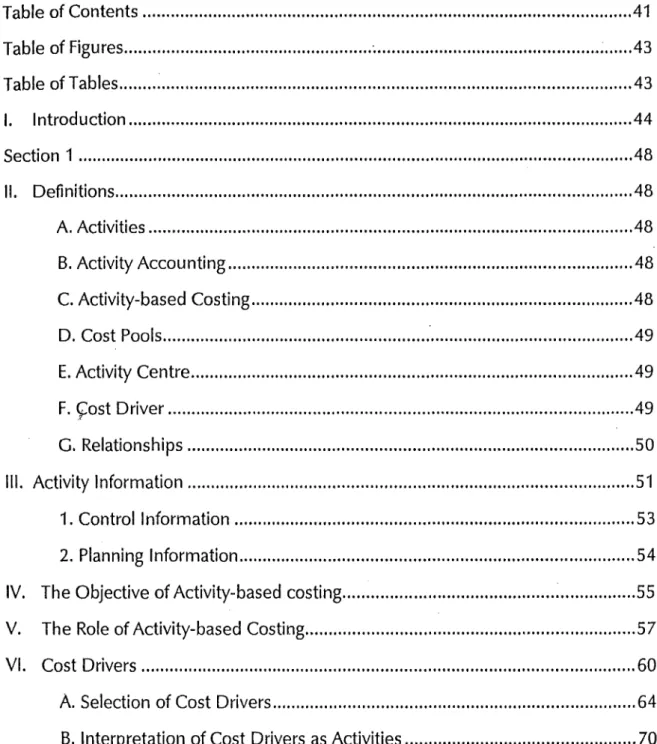
TABLE OF CONTENTS
Table of Contents ... 41
Table of Figures ... ~ ... 43
Table of Tables ... 43
I. Introduction ... 44
Section 1 ... 48
II. Definitions ... 48
A. Activities ... 48
B. Activity Accounting ... 48
C. Activity-based Costing ... 48
D. Cost Pools ... .' ... 49
E. Activity Centre ... 49
F. <;ost Driver ... 49
G. Relationships ... 50
Ill. Activity Information ... 51
1. Control Information ... 53
2. Planning Information ... 54
IV. The Objective of Activity-based costing ... 55
V. The Role of Activity-based Costing ... 57
VI. Cost Drivers ... 60
A. Selection of Cost Drivers ... 64
Page 42 General Discussion on the ABC Model
Section 2 ... 70
VII. Implementing Activity Accounting Systems ... 70
A. General Factors to Consider ... 70
B. Planning Phase ... 71
C. Interview Phase ... 73 D. Calculations ... 7 4
E. Approval and lmplementation ... 75
VIII. Long Term Product Costs Using the Two Stage Costing Process ... 75
A. Stage One
···~···75B. Stage Two ... 78
Section 3 ... 79
IX. Limitations of Activitv-based costin!! ... ,,,,,,,,,, ... 79 , u
X. Benefits ... 81
General Discussion on the ABC Model Page. 43
Figure 1
Figure 2
Figure 3
Figure 4
Table 1
Table 2
Table 3
Table 4
Table 5
Table 6
Table 7
TABLE OF FIGURES
The Activity-Based Costing Relationship ... 50
Activity-Based Information for Managing Profitability ... 52
Events Theory-Based Management Accounting System ... 56
Product Profit/Volume Profile ... 58
TABLE OF TABLES
Level of Satisfaction with Product Cost lnformation ... 59
Relative Importance of Transaction Types ... 64
Calculation of Ratios With Alterations to Volume Cost Driver ... 68
Calculation of Initial Ratios With Batch Sizes Reversed ... 69
Pairwise Correlation With Total Manufacturing Overheads ... 74
Pairwise Correlation With Headcount.. ... 7 4
CHAPTER 3
PRODUCT COSTING AND ACTIVITIES
A GENERAL DISCUSSION ON THE ACTIVITY-BASED COSTING MODEL
I. Introduction
In order to survive, the long term goal of any firm must be to be profitable. While short term losses can be sustained, if a firm is not profitable in the long term then it will go out of business. In modern factories it is becoming clear that survival involves more than just ensuring that costs are less than revenues. New management methods which focus on . standards of customer value mean that flexibility and quality in the production process is just as important as costs.1 From this quality and flexibility comes an ability to meet customer needs which ultimately enhances the firm's profitability.
Management accounting must be able to t~ll managers whether products are delivering value to customers. More than that, managers must know whether " ... their decisions will deliver value to the customer in excess of the cost of delivering that value".2 Each activity which a company carries out to deliver products to its customers adds costs to those products. In doing so, the activity either increases the value of the product to the customer or decreases its profitability.
"Ideally, the way to achieve profitability is to manage activities".3,4 Each activity consumes production resources and by efficiently managing activities, maximum benefit can be obtained from these resources. Pryor calls this intervention insight.5
1. Johnson 1988, p. 23. 2. ibid, p. 24.
3. Ibid.
4. Ostrenga