V
ALUE
N
ETWORKS AND
B
USINESS
M
ODELS
:
V
ALUE
N
ETWORKS AND
B
USINESS
M
ODELS
:
FORMULATING AND DEMONSTRATING A METHODOLOGY FOR THE DEVELOPMENT OF VALUE NETWORKS AND ALIGNMENT OF BUSINESS MODELS BASED ON DESIGN SCIENCE RESEARCH METHODOLOGY
Author: Maher Dara (student ID: s1080318; [email protected]) University: University of Twente, School of Management and Governance Study: MSc. in Business Administration, Innovation & Entrepreneurship Supervisors: Ir. Björn Kijl (1st supervisor)
Dr. Kasia Zalewska-Kurek (2nd supervisor)
Commissioning organization: BiZZdesign BV
Address: Capitool 15
7521 PL Enschede The Netherlands
Supervisor: Dr. Dick Quartel
M
ANAGEMENTS
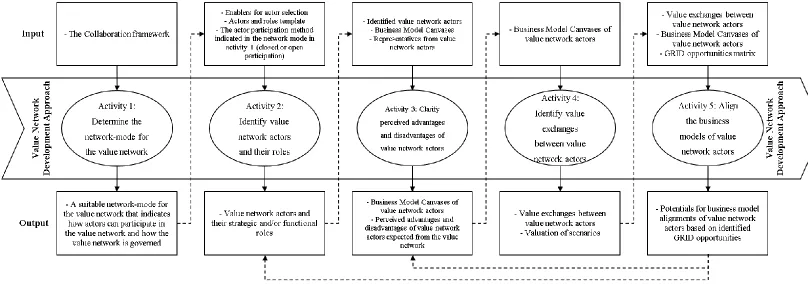
UMMARYIn this study the Business Model Canvas and value networks are prominent subjects that are integrat-ed to formulate a practice orientintegrat-ed methodology for the development of value networks and alignment of business models. Accordingly the main research question of this study is: How can the Business Model Canvas support a methodology for the development of value networks? This research question is answered by formulating the Value Network Development Approach which consists of five activi-ties that guide practitioners in the development of value networks and the alignment of the business models of value network actors. Table 1 contains the five activities of the Value Network Develop-ment Approach and the application templates for each activity.
Table 1: The Value Network Development Approach
Activity Description Suggested application frameworks
Activity 1: Determine the network-mode for the value network
A network-mode that suits the purpose of the value net-work has to be determined. The netnet-work-mode clarifies the ways in which actors could participate in the value net-work. In addition the network-mode clarifies how the value network is governed. This activity also clarifies the pur-pose of the value network.
The collaboration framework
Activity 2: Identify value network actors and their roles
The purpose of activity two is to identify the participants of the value network and determine their roles. This activity is dependent on the previous activity. Specifically actor iden-tification is based on the collaboration form that is selected in the first activity in the collaboration framework. Strate-gic and/or functional roles of value network actors should also be determined in order to produce a clear picture of the positions and importance of actors.
The actor selection and roles template
Activity 3: Clarify perceived advantages and disadvantages of value network actors
The purpose of this activity is to identify the perceived values that actors intend to capture from the value network. The Business Model Canvas is suggested as a basis from which actors will be able to identify relevant perceived advantages and disadvantages that they expect to retrieve from the value network.
The Business Model Canvas
A template to summarize the perceived advantages and disadvantages of value network actors
Activity 4: Identify value exchanges between value net-work actors
In this activity the individual Business Model Canvases of value network actors are used to clarify the exchanges between actors and evaluate the economic potentials of the value network.
A translation from the Business Model Canvas-es of value network actors to value exchang-es between actors
Activity 5: Align the business models of value network actors
The goal of this activity is to align the business models of value network actors with each other by identifying oppor-tunities to gain, reconfigure, integrate, and/or dismiss re-sources amongst the business models of value network actors. The exchanges between value network actors that have been identified in activity 4 are used to perform this activity.
In addition to the main research question three questions are answered in this study. The first sub-question – How are business models and value networks defined and related? – clarifies that the pur-pose of business models is considered to be capturing the business logic of organizations while value networks concentrate on a group of organizations who are related to one another and aim to achieve a common goal. Some business models mainly concentrate on the business logic of a single firm; other business models incorporate value network actors in the business logic of the firm. Yet other business models concentrate equally on all value network actors. Therefore business models clarify the busi-ness logic of organizations from different perspectives ranging from firm-centered to network-centered.
For the second sub-question – What methodologies exist for the development of value networks? – two methods – the Network Value Analysis of Peppard and Rylander (2006) and the Value Network Development model of Al-Debei et al. (2013) – are considered to be concrete business practice ori-ented methods for the development of value networks.
Finally, the third sub-question – How can representations of a value network and related business models be demonstrated and evaluated? – is answered by including application templates in each of the five activities of the Value Network Development Approach. Templates provide brief overviews of the results that are produced by the Value Network Development Approach.
A
CKNOWLEDGEMENTSIn June 2012 I started my master thesis for Business Administration at BiZZdesign. While BiZZde-sign was interested to conduct a research for the company’s Business Model Management value prop-osition, as a graduate student, I was interested in a master thesis about the business model concept. During courses at the university I gained some interesting basic background knowledge about busi-ness models, therefore I was excited to investigate the subject in a practical setting during my master thesis. After several thorough discussions BiZZdesign, my internal supervisors at the university, and I agreed on this design oriented research.
During the thesis I stumbled across many challenges and difficulties. For example, formulating the Value Network Development Approach required lots of creativity and out of the box thinking. Anoth-er challenge was to undAnoth-erstand and apply the case study; a large and complex research project in the field of crisis and disaster management. Eventually I experienced the master thesis as a tremendous professional and personal learning experience.
I would like to thank my university supervisors Björn Kijl and Kasia Zalewska-Kurek for their sup-port, motivation and constructive feedback. Björn and Kasia, you always provided your timely and clarifying feedback and yet respected my choices and decisions. I also would like to thank my exter-nal supervisor Dick Quartel for his involvement and care. We had many useful discussions during the past couple of months. Dick, I appreciate your positive and understanding attitude. During the times that I was stuck in my progress you motivated me to keep on going. Your advice helped me well. Furthermore, I would like to thank Henry Franken for his support, feedback and confidence, Remco Blom for his contributions to my thesis, and all BiZZdesign staff who helped me to conduct my the-sis. Also many thanks for my colleague students at BiZZdesign for their companionship, discussions and the fun we had at the office. Special thanks to all the respondents that participated in workshops and interviews and provided their useful insights for the case study. Finally, I would like to thank my girlfriend Suzan, for her unconditional support and care during my entire master study and especially during this thesis. Without you I would not have been able to achieve the things that I have.
I hope this report will inspire you for the business model concept, value networks, and design oriented research.
T
ABLE OF CONTENTSManagement Summary ... I Acknowledgements ... III List of figures ... V List of tables ... VI
1 Introduction and research questions ... 1
1.1 Research objective and questions ... 2
1.2 Academic and practical relevance of the study ... 3
1.3 Research approach ... 4
2 Literature review ... 6
2.1 Business models ... 6
2.1.1 Firm centered business models ... 14
2.1.2 The Business Model Canvas ... 14
2.1.3 Network centered business models ... 16
2.1.4 The E3-value business model ontology ... 16
2.1.5 Business Model Alignment ... 17
2.2 Value networks ... 18
2.2.1 The Network Value Analysis approach ... 19
2.2.2 The Value Network Development model... 20
3 A Value Network Development Approach ... 22
3.1 Activity 1: Determine the network-mode for the value network ... 26
3.2 Activity 2: Identify value network actors and their roles ... 28
3.3 Activity 3: Clarify perceived advantages and disadvantages of value network actors ... 29
3.4 Activity 4: Identify value exchanges between value network actors ... 32
3.5 Activity 5: Align the business models of value network actors ... 36
4 Research method ... 41
5 The TOKO case study ... 43
5.1 Application of Activity 1: Determine the network-mode for the value network ... 44
5.2 Application of Activity 2: Identify value network actors and their roles ... 48
5.3 Application of Activity 3: Clarify perceived advantages and disadvantages of value network actors ... 51
5.4 Application of Activity 4: Identify value exchanges between value network actors ... 53
5.5 Application of Activity 5: Align the business models of value network actors ... 57
6 Evaluation ... 60
7 Conclusion and discussion ... 64
7.1 Practical implications ... 65
7.2 Limitations and future research ... 66
8 References ... 67
L
IST OF FIGURESFigure 1: Application of the Design Science Research Methodology ... 4
Figure 2: V4 Business Model Structure ... 7
Figure 3: Classification of business model papers according V4 ... 11
Figure 4: Occurrences of business model components that correspond with V4 sub-dimensions ... 12
Figure 5: Increasing consideration of the value-network dimension ... 12
Figure 6: Business Model perspectives ... 13
Figure 7: The Business Model Canvas (Osterwalder and Pigneur, 2010) ... 16
Figure 8: Simplified illustration of an E3-value business model ... 17
Figure 9: Alignment of business layers (Al-Debei and Avison, 2010) ... 18
Figure 10: Network Value Analysis methodology... 19
Figure 11: The process of theory synthesis and development ... 22
Figure 12: Dependencies between activities of the Value Network Development Approach ... 24
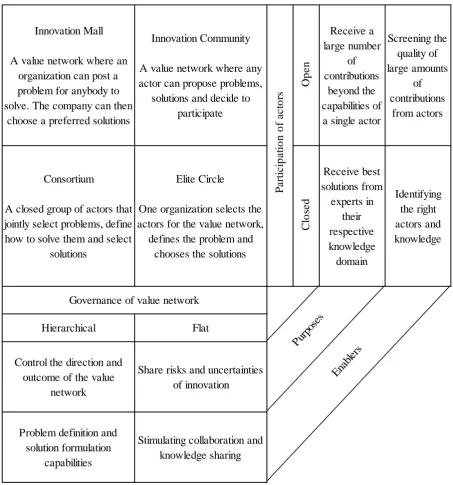
Figure 13: The collaboration framework (Pisano and Verganti, 2008) ... 28
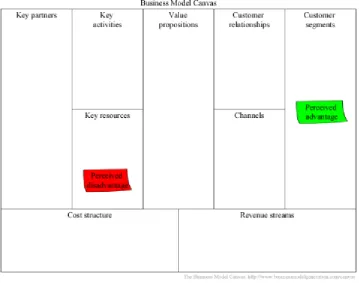
Figure 14: Identification of perceived advantages and disadvantages identification in the Business Model Canvas ... 31
Figure 15: Deriving value exchange from the Business Model Canvases of value network actors ... 34
Figure 16: Annual total profits of value network actors in current and future scenarios ... 36
Figure 17: GRID opportunities across Business Model Canvas building blocks of value network actors ... 38
Figure 18: GRID opportunities matrix ... 40
Figure 19: The collaboration framework of TOKO ... 47
Figure 20: Perceived advantages and disadvantages of value network actors of the TOKO case ... 52
Figure 21: Value exchanges between actors of the TOKO-platform ... 54
Figure 22: Accumulated profits of current and TOKO scenarios (profits * 100,000) ... 56
Figure 23: Number of customers and accumulated profits for the TOKO scenario (profits * 100) ... 56
Figure 24: Application of GRID opportunities matrix for the TOKO case ... 58
Figure 25: GRID opportunities for the Training Services Provider and Research Organization ... 59
Figure 26: Research Organization Business Model Canvas ... 71
Figure 27: Training Services Provider Business Model Canvas ... 72
Figure 28: Training Scenarios Writer Business Model Canvas ... 72
Figure 29: Training Organizer Business Model Canvas ... 72
L
IST OF TABLESTable 1: The Value Network Development Approach ... I
Table 2: Coverage of V4 dimensions by other papers ... 7
Table 3: Classification of business model papers according V4 ... 8
Table 4: The pillars, building blocks and key questions of the Business Model Canvas ... 15
Table 5: A brief description of the Value Network Development Approach ... 23
Table 6: Solution objectives ... 26
Table 7: Enabling factors for actor selection (Pisano and Verganti, 2008) ... 29
Table 8: Actor and roles template ... 29
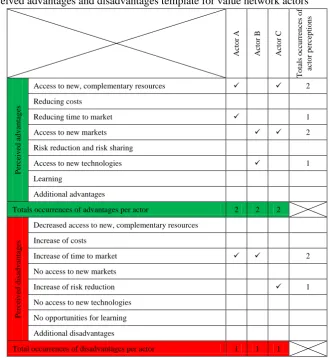
Table 9: Perceived advantages and disadvantages template for value network actors ... 32
Table 10: Economic feasibility of scenarios ... 35
Table 11: Definition of GRID ... 37
Table 12: Motivation of GRID opportunities ... 40
Table 13: Case study questions and corresponding Value Network Development Approach activities ... 42
Table 14: Work packages and deliverables for the TOKO-project ... 43
Table 15: Summary of data sources ... 44
Table 16: Actor selection for the TOKO-project and TOKO-platform ... 49
Table 17: Actor roles within the TOKO-project and TOKO-platform ... 51
Table 18: Assumptions of metrics for economic valuation of scenarios ... 53
Table 19: Estimated profits for TOKO actors ... 55
1
I
NTRODUCTION AND RESEARCH QUESTIONSThe goal of this study is to formulate a methodology for the development of value networks and the alignment of business models of value network actors. During the past decade business models have received increasing attention from researchers and practitioners. Several reasons have been mentioned which may have caused this increased attention such as among others the growing usage and devel-opment of the internet, growth in emerging markets and expanding industries and organizations (Zott et al., 2011). However, research about business models has progressed mainly in isolated silos result-ing in different literature streams related to 1) e-business and information technology usage; (2) issues related to strategy, such as value creation and competitive advantage; and (3) innovation and technol-ogy management (Zott et al., 2011). Business model research incorporate findings from different the-ories such as strategic management, innovation management, network-analysis, and the Resources Base View (Al-Debei and Avison, 2010; Zott et al., 2011). As a result, different interpretations of business models exist and the business model concept is still fuzzy and vague (Al-Debei and Avison, 2010; Zott et al., 2011).
Despite the infancy of business model research in general, the usefulness of the business model con-cept is indicate as helping to design, innovate and manage businesses as concon-ceptual models and tool (Fielt, 2011). Business models are necessary for all organizations because they provide a method to manage choices and enable, for instance, the design of information systems of an organization (Al-Debei and Avison, 2010). Furthermore, the business model defines the mechanisms behind revenues, costs and profits of the organization (Teece, 2010). Business models fulfill an important role by sup-porting businesses though different contributions such as providing input for decision making, design-ing the business, allowdesign-ing businesses to innovate, explaindesign-ing the interest of stakeholders, and defindesign-ing the organization’s logic for value creation, delivery and capture. The business model is defined as “a description of the way an organization or a network of organizations aims to make money and create customer value” (Kijl et al., 2010, 2005). Similarly, Al-Debei and Avison (2010) define the business model as “the ways in which an organization along with its stakeholders create value for each party involved” (p. 365).
The Business Model Canvas of Osterwalder and Pigneur (2010) is considered as a popular and well known representation of a business model (Andersson et al., 2006; Gordijn et al., 2005; Jiménez et al., 2005; Loss and Crave, 2011; Meertens et al., 2012). It is a holistic and easy applicable tool to devel-op, analyze and innovate business models of new and existing businesses. The Business Model Can-vas is based on earlier work of Osterwalder (Osterwalder and Pigneur, 2003, 2002; Osterwalder, 2004; Osterwalder et al., 2005, 2004, 2002).
ers. Loss and Crave (2011) argue that the Business Model Canvas is mainly applicable for single or-ganizations and it assumes a linear value chain for the production, delivery and capture of value.
This research is sponsored by BiZZdesign BV which is founded in Enschede, the Netherlands in 2000. BiZZdesign is a consultancy, software and training company. Within a decade from the compa-ny’s inception, revenue has grown to approximately €8 million, business activities have been extend-ed into Canada, Mexico, Germany, Belgium, France and the UK, and the number of employees has grown to 85 in 2012. Today, the head quarter of BiZZdesign is still located in Enschede, The Nether-lands. BiZZdesign is committed to the use of best practice methods and models to guarantee a thor-ough foundation for the offered services and to prevent vendor lock-inn from the perspective of cus-tomers. The company embraces open standard such as TOGAF1 and ArchiMate2 and participates in the development of such standards. BiZZdesign also values the importance of R&D which is repre-sented through the company’s R&D investment of approximately 40% of its yearly revenue. BiZZde-sign furthermore collaborates extensively with other organizations such as universities, a variety of companies, and non-profit knowledge institutes.
BiZZdesign offers Enterprise Architecture, Business Process Management, and Business Model Man-agement software tools, consultancy and trainings to medium and large size profit and non-profit or-ganizations in the Netherlands and abroad. Most customers – such as financial service providers, in-surance companies, and governmental tax authorities – rely heavily on extensive information man-agement for their activities. The services of BiZZdesign enable organizations to clarify, analyze, and improve their business activities in order to anticipate organizational change and initiate performance improvements.
Business Model Management services of BiZZdesign consist of training courses, consultancy and software tools. These services are based on the Business Model Canvas of Osterwalder and Pigneur (2010). Training services consist of practical business courses of one till eight days in which practi-tioners are taught how to use the Business Model Canvas. Consultancy services are performed by helping clients to apply the Business Model Canvas for various purposes such as developing new business ideas and aligning existing products and services. Finally BiZZdesign supports the applica-tion of the Business Model Canvas through a software tool. It is important to use software tools for the design and visualization of business models because such models tend to become complex very rapidly (Gordijn et al., 2005). Therefore business models should be developed with the help of com-puter aided methods and tools.
1.1
R
ESEARCH OBJECTIVE AND QUESTIONSThe research objective is to support the business model management proposition of BiZZdesign (fur-ther referred to as the commissioning organization) such that value networks could be developed through a practice oriented approach based on well-established concepts and theories.
Central research question
1. How can the Business Model Canvas support a methodology for the development of value net-works?
1
The Open Group Architecture Framework (TOGAF®) is a global standard for Enterprise Architecture.
2
architec-Sub-questions
1.1. How are business models and value networks defined and related? 1.2. What methodologies exist for the development of value networks?
1.3. How can representations of a value network and related business models be demonstrated and evaluated?
1.2
A
CADEMIC AND PRACTICAL RELEVANCE OF THE STUDYAs indicated earlier different interpretations of the business model exist and the business model con-cept is still fuzzy and vague. This study is relevant because it contributes to the clarification of the business model concept. Although efforts have been made by scholars to conceptualize the business model concept, research contribution to the development of a rigorous conceptual model is still val-ued (Pateli and Giaglis, 2004). Defining the business model and its notation may clarify the business model’s components and enhance the development of computer-based modeling tools for practical use. It is important to use software tools for the design and visualization of business models because such models tend to become complex very rapidly (Gordijn et al., 2005). The graphical representation of business models is valuable since it is suitable to communicate key information and acquire in-depth understandings (Pateli and Giaglis, 2004). Therefore business models should be developed with the help of computer aided methods and tools. Accordingly the results of this study are intended to be used by the commissioning organization for the development of supportive software tools. Since business models have been applied within different contexts for different purposes, the investigation of business models in an IT intensive business environment is valuable because not many similar research has been conducted yet (Al-Debei and Avison, 2010). Therefore the application of a single case study of an IT intensive research project contributes to the academic relevance of this study. This study is also relevant for the theoretical development of business models since it also aims at to inte-grate different business model concepts. Specifically the E3-value of Gordijn and Akkermans (2001) and the Business Model Ontology of Osterwalder et al. (2005) are proposed as suitable ontologies to be integrated due to their mutual complementarities (Gordijn et al., 2005).
Technology development forces companies to collaborate to produce a viable product or service, ini-tiating the emergence of complex value networks (Palo and Tähtinen, 2011). Therefore the purpose of this study – to formulate a methodology for the development of value networks – is valuable because it describes the value creation method of a business network and exemplifies the role of involved ac-tors within the network. Business models should be viable to all acac-tors instead of one single firm (Pa-lo and Tähtinen, 2011). Explicitly defining the business models of value network actors is necessary to allow value network actors to manage their organizations in line with the business model logic within the value network (Al-Debei and Avison, 2010). The methodology that is formulated in this study might assist single companies in mastering the collective competencies for the development of new technology-based value offerings within a business net (Palo and Tähtinen, 2011). Furthermore, the practical relevance of the research will be the development of methods, trainings, and computer-aided business modeling tools of commissioning organization based on the results of this study. Hence, the commissioning organization’s Business Model Management proposition will be supple-mented by the formulated methodology of this study.
M ain research question
Activity 6: Communication Activity 5: Evaluation Activity 1: Problem identification
and motivation
Activity 2: Define objectives for solution
Activity 3: Design and development
The design artifact is demonstrated by means of a single case study
Evaluation is performed through a semi-structured interview with a business model practitioner and the researcher's own reflections
This research will be made available through the publication website of the University of Twente, and if possible, it will be submitted to a relevant conference in order to communicate the results towards the academic community
The problem identification and motivation of this research is included in the introduction and literature review sections of this report
The solution objectives are formulated through discussions between the researcher and the commissioning organization
The design and development of the artifact is performed by means of synthesis of theory and iterations with the commissioning organization
Activity 4: Demonstration
DS RM activities
Contribution to research questions
Sub-question 1
Sub-question 2
Sub-question 3
[image:12.595.51.485.449.736.2]Thesis chapter
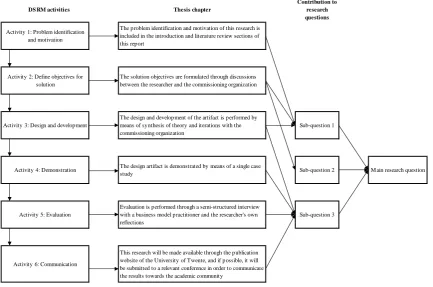
Figure 1: Application of the Design Science Research Methodology
value networks form the basis for the proposed methodology for the development of value networks which is presented in chapter 3. The single case study research method is motivated in chapter 4. Sub-sequently, the Value Network Development approach is demonstrated through a single case study of a Dutch national research project in chapter 5. The validity of the Value Network Development Ap-proach for the development of value networks is then evaluated in chapter 6. Finally, the report ends with a conclusion and discussion of the study in chapter 7.
1.3
R
ESEARCH APPROACHThe first activity of the DSRM is problem identification and motivation. The result of this activity is to define the research problem and rationalize the value of the solution. The problem definition will be used to develop an ‘artifact’ – which may be designs such as methods, models, and constructs (Peffers et al., 2007) – that provides a solution. Motivating the value of the solution encourages the researcher to achieve a solution and explains the reasoning of the researcher’s perception of the prob-lem. The problem identification and motivation of this study is included in the introduction and litera-ture review chapters (chapters 1 and 2 respectively) of this report.
Second, solution objectives have to be formulated which need to be met by the design artifact. Solu-tion objectives indicate the features of the design artifact. Objectives can be quantitative, such as measures of the better performance of the desired solution compared to current ones or qualitative such as the description of how the design artifact will support the solution of the addressed problem definition. The solution objectives of this study are presented in chapter 3.
The third activity is related to creating the artifact such as a model or method of which the research contribution is embedded in the design. The design and development of the artifact is performed by means of synthesis of theory and discussions with the commissioning organization. The results of activity three – the Value Network Development Approach – is presented in chapter 3.
Activity four refers to the demonstration of the methodology of this study for the development of value networks. Demonstrating the use of the methodology can be achieved through different methods such as experiments, case study, and workshops. In this study the design artifact (e.g. the Value Net-work Development Approach) will be demonstrated by means of a single case study that is motivated in chapter 4 and presented in chapter 5.
Evaluation (activity five) concerns observing how well the design artifact supports a solution for the problem. In order to do so the solution objectives from the second activity of the DSRM will be com-pared to the results of the demonstration. Evaluation can be performed by comparison of the design artifact’s functionality with the objectives of the solution, satisfaction surveys, interviews, simulations and any other appropriate empirical prove. For this study evaluation is performed through a semi-structured interview with a business model practitioner and own reflections of the researcher in chap-ter 6.
2
L
ITERATURE REVIEWThe literature review is conducted in order to formulate the objectives for a solution as part of the Design Science Research Methodology and gain relevant knowledge regarding the business model concept and value network. The literature review is conducted as following. First, thirty four business model papers have been examined in order to classify firm-centered and network-centered perspec-tives of business models. Second, two business modeling methods are discussed. Finally, two Value Network Development methodologies are discussed.
Papers for the literature review are identified through a structured search method. First, four electronic data bases have been selected (Google Scholar, EBSCO Information Services, SCOPUS, and Web of Knowledge). These particular databases have been selected due to their extensive coverage of busi-ness literature, as indicated by the library services of the University of Twente. Second, an initial set of papers was found through searching by key words and variations of key words such as business models, business logic, value network development, and value chains. Hereafter, each paper is studied and forth and back references are examined. To prevent the exclusion of key paper, forth and back reference is also considered for business models review papers of the following authors Alberts (2011); Al-Debei and Avison (2010); Burkhart et al. (2011); Pateli and Giaglis (2004); Vermolen (2010); and Zott et al. (2011). To retain a deeper understanding of value networks relevant theory is included in the literature review. According to Zott et al. (2011) the examination of indirectly related subjects to business models provides a solid basis for the business model concept. For the selection of papers a sampling process is iterated (Light et al., 1984) until no new relevant papers were found.
2.1
B
USINESS MODELSBusiness model papers have been examined by studying their definitions and concepts of business models in order to answer the first research question; How are business models and value networks defined and related? In order to examine the relation between business models and value networks business models descriptions and definitions of each paper are examined to determine whether the respective business model is mainly suitable for an application to the single firm, value networks, or a single firm within a value network.
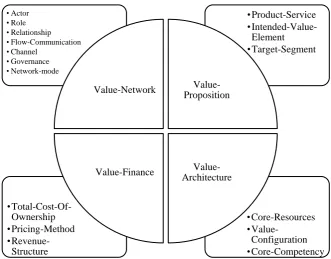
Figure 2: V4 Business Model Structure •Core-Resources •Value-Configuration •Core-Competency •Total-Cost-Of-Ownership •Pricing-Method •Revenue-Structure •Product-Service •Intended-Value-Element •Target-Segment • Actor • Role • Relationship • Flow-Communication • Channel • Governance • Network-mode
Value-Network
Value-Proposition
Value-Architecture Value-Finance
[image:15.595.131.463.106.365.2]The validity of V4 is indicated through the coverage of its dimensions by other business model papers (Table 2) and its empirical demonstration by Al-Debei et al. (2010); Joha and Janssen (2012); Pana-giotopoulos et al. (2012); and Serrano et al. (2010).
Table 2: Coverage of V4 dimensions by other papers
V4 business model framework dimensions Authors Value-proposition Value-network Value-architecture Value-finance (Al-Debei and Avison, 2010) Corresponding dimen-sions of other business model conceptualizations
Strategic
choices Value network Create value
Capture value
(Shafer et al., 2005) Product pillar Customer interface pillar Infrastructure management pillar Financial aspects pillar (Osterwalder et al., 2005)
Service domain Organization domain Technology domain Finance domain (Bouwman et al., 2008)
Table 3: Classification of business model papers according V4
Authors BM description
V4 Business Model Ontological Structure (Al-Debei and Avison, 2010)
Applic ati on of B usiness Model * Additi onal c on cept s** Vale- propo-sition Value-network Value- archi-tecture Value- fi-nance Product -service Inte nded -v al ue -e le m ent Ta rge t-segme n t
Actor Role Rel
ationship Flow -com muni cat ion Channe l Governa nce Network -mode Core -re so urc es Value -conf iguration Core -com p et en cy Tot
al Costs of
Ow ner ship Prici ng -m et hod Reve nue -stru ct u re (Sinfield at al., 2012)
At a conceptual level, a business model in-cludes all aspects of a company's approach to developing a profitable offering and delivering it to its target customers
N
(Tsvet-kova and Gus-tafsson, 2012)
Helps to analyze how value is created C
(Palo and Tähtinen, 2011)
The way a strategic business net creates value C
(Zott et al., 2011)
How firms do business and how value is
creat-ed and capturcreat-ed C
(Mason and Spring, 2011)
An objective representation of the reality of
the firm and its markets N
(Kijl and Nieu-wenhuis, 2011)
The way an organization or a network of or-ganizations aim to make money and create customer value
C
(Casades us-Masanell and Ri-cart, 2010)
A firms realized strategy S
(Kijl and Nieu-wenhuis, 2011)
The way an organization operates to ensure its sustainability (Demil and Lecocq,
2010)(Demil & Lecocq, 2010)
N
(McGrat
h, 2010) No explicit definition S
(Yunus et al., 2010)
No explicit definition N
ugh, 2010) (Itami and Ni-shino, 2010)
The business model consists of business
sys-tem a profit model which is N
(Arana and Cas-tellano, 2010)
A simplified representation of a company’s
business logic N
(Chen et al., 2010)
Series of planned activities, or business
pro-cesses, with a focus on market profitability C
(Ne-nonen and Stor-backa, 2010)
Depicts the managerial opportunities for a
focal firm to influence value co-creation C
(Björk-dahl, 2009)
The logic and the activities that create and appropriate economic value, and the link be-tween them
S
(Ka-moun, 2008)
The blueprint of the way a business creates and captures value from new services, prod-ucts, or innovations and interact with provid-ers, customprovid-ers, and partners
C
(Johnson et al., 2008)
Explains how to create and deliver value S
(Bouwm an et al., 2008)
A blueprint for a service to be delivered, de-scribing the service definition and the intended value for the target group, the sources of reve-nue, and providing an architecture for the service delivery, including a description of the resources required, and the organizational and financial arrangements between the involved business actors, including a description of their roles and the division of costs and revenues over the business actors
C
(Rajala and Wester-lund, 2007)
Ways of creating value for customers and to show how a business turns market opportuni-ties into profit through the agency of sets of actors, activities and collaboration
N
(Chesbro ugh, 2007)
Defines a series of activities, from procuring raw materials to satisfying the final consumer, which will yield a new product or service in such a way that there is net value created throughout the various activities, and captures value from a portion of those activities for the firm developing and operating it
are addressed to create sustainable competitive advantage in defined markets
(Tik-kanen et al., 2005)
The sum of material, objectively existing structures and processes as well as intangible, cognitive meaning structures at the level of a business organization
N
(Voelpel et al., 2005)
The particular business concept (or way of doing business) as reflected by the business’s core value proposition(s) for customers; its configured value network to provide that val-ue, consisting of own strategic capabilities as well as other (e.g. outsourced/allianced) value networks; and its continued sustainability to reinvent itself and satisfy the multiple objec-tives of its various stakeholders
N
(Shafer et al., 2005)
A representation of a firm’s underlying core logic and strategic choices for creating and capturing value within a value network
N
(Heland-er and Rissanen, 2005)
Describes the operating model of the
organiza-tion S
(Oster-walder et al., 2005)
A conceptual tool that contains a set of ele-ments and their relationships and allows ex-pressing the business logic of a specific firm. A description of the value a company offers to one or several segments of customers and of the architecture of the firm and its network of partners for creating, marketing, and delivering this value and relationship capital, to generate profitable and sustainable revenue streams
N
(Komu-lainen et al., 2004)
No explicit definition C
(Pateli and Giaglis, 2004)
The logic of doing business of a firm and the linkages and configurations of a broad spec-trum of organizational activities
N
(Hedman and Kalling, 2003)
Integrates firm-internal aspects that transform factors to resources, through activities, in a structure, to products and offerings, to market
S
(Chesbro ugh and Rosen-bloom, 2002)
How a firm makes money N
(Gordijn and Ak-kermans, 2001)
Highlights a network of actors and how they
Business model papers that could
be classified entirely within V4,
21 Business model
papers that could be classified partly
within V4, 13
Figure 3: Classification of business model papers according V4
(Alt and Zim mer-mann, 2001)
Allows focusing and measuring Information
Systems activities and results N
(Ma-hadevan, 2000)
A business model is a unique blend of three streams - the value stream for the business partners and the buyers, the revenue stream, and the logistical stream - that are critical to the business
N
*The business model is indicated to be suitable for: a single firm (S); collaborating organizations, multiple firms or a value networks (C); or a single firm within a value network (N). **Business model components which did not fit within the V4 Business Model structure.
Based on the analysis of business model papers, the distinction is made between firm-centered and network-centered business models. The difference between the two perspectives is that the former refers to the application of business models to a single firm, while the latter perspective approaches the business model of a network of firms.
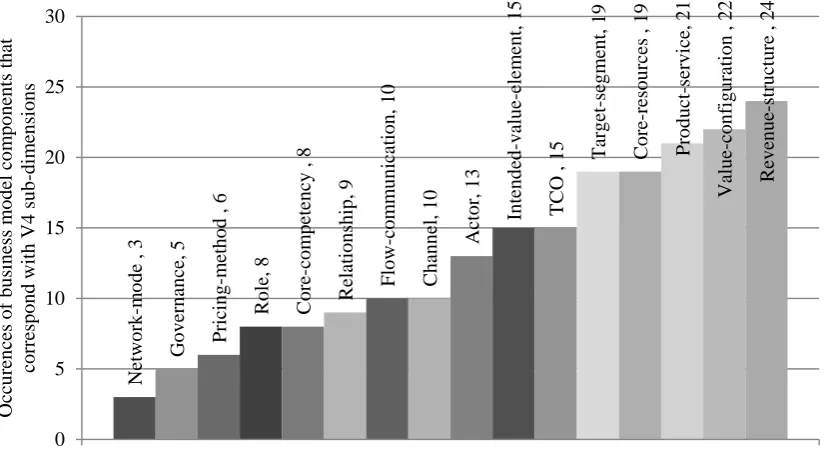
Netwo rk -m od e , 3 Go ver nance, 5 Pr ic ing -m et ho d , 6 Role, 8 Core -com petency , 8 Re la ti on sh ip, 9 Flow -com m un ic at ion , 10 Chann el , 10 Actor , 13 In te nd ed -va lue -el em ent, 15 TCO
, 15 Targ
et -segm ent, 19 Core -reso urces , 19 Pr od uct -ser vice, 21 Value -con fig urat ion , 2 2 Re ven ue -structu re , 24 0 5 10 15 20 25 30 Occu ren ces of bu siness m od el co m po nen ts that cor resp ond with V4 su b -dim ension s
The sixteen sub-dimensions of V4
Figure 4: Occurrences of business model components that correspond with V4 sub-dimensions
2 6
1 2
4 7 2 7 1 17 7 2 0 2 4 6 8 10 12 14 16 18
2000 2001 2002 2003 2004 2005 2007 2008 2009 2010 2011 2012
Occu ren ces of bu siness m od el com po nen ts relat ed t o the value -netwo rk dim ension of V4
[image:20.595.95.510.114.342.2]Publication years of business model papers
Figure 5: Increasing consideration of the value-network dimension
Firm-centered perspective
21%
Network-centered perspective
30% Between firm and
network 49%
Figure 6: Business Model perspectives
Moreover as indicated by several authors, business models are applied in different contexts (Al-Debei and Avison, 2010; Burkhart et al., 2011; Fielt, 2011; Gordijn et al., 2005; Pateli and Giaglis, 2004). They are used to understand businesses at different levels such as individual organizations, organiza-tional parts, and business networks. Even at the individual level business models are applied to rein-vent ones abilities, and career (Clark et al., 2012), and to investigate “the set of activities, organizing, and strategic resources individuals employ to create and capture value while pursuing their interests and motivations” (Svejenova et al., 2010, p. 408).
2.1.1
F
IRM CENTERED BUSINESS MODELSAn example of a firm-centered business model is indicated through the following business model definition: “A business model describes the rationale of how [an organization] creates, delivers, and captures value” (Osterwalder and Pigneur, 2010, p. 14). In other words, the business model reasons from the perspective of a single firm, even though it might (and often does) consider inter-firm rela-tions and the importance of partnerships and suppliers. Nonetheless, essentially the business model elaborates the core logic of doing business for a specific company (Pateli and Giaglis, 2004; Shafer et al., 2005). Other examples of firm centered business model definitions are “how [a company] makes money” (Chesbrough and Rosenbloom, 2002, p. 533) and “a simplified representation of [a compa-nies] business logic” (Arana and Castellano, 2010, p. 105).
At the core of firm-centered business models lies the individual firm and its products or services. The business model then describes the core logic for the firm to create, deliver and capture value. There-fore firm-centered business models approach the value proposition as “the ways in which an organiza-tion along with its providers and partners (business actors) create value for its customers” (Al-Debei and Avison, 2010, p. 365).
2.1.2
T
HEB
USINESSM
ODELC
ANVASAs explained earlier in section 1 the Business Model Canvas is used by the commissioning organiza-tion for the Business Model Management value proposiorganiza-tion because the Business Model Canvas is well known and popular among practitioners. As a result the Business Model Canvas is prominent for the purpose of this study. The Business Model Canvas is based on the business model ontology which is developed by Osterwalder (2004) during his PhD research and has become the most known repre-sentation of a business model (Andersson et al., 2006; Gordijn et al., 2005; Jiménez et al., 2005; Loss and Crave, 2011; Meertens et al., 2012). It is a holistic and easy applicable tool to develop, analyze and innovate business models of new and existing businesses. The Business Model Canvas is based on earlier works of Osterwalder (Osterwalder and Pigneur, 2003, 2002; Osterwalder, 2004; Osterwal-der et al., 2005, 2004, 2002).
Table 4: The pillars, building blocks and key questions of the Business Model Canvas
Pillar Building block Key questions
Product (What business the company is in, the products and the value propo-sitions offered to the market)
Value Propositions
What value do we deliver to the customer? Which one of our customer’s problems are we helping to solve? Which customer needs are we satisfying? What bundles of products and services are we offering to each Customer Segment?
Customer Interface (Who the compa-ny's target customers are, how it deliv-ers them products and services, and how it builds a strong relationships with them)
Customer Segments For whom are we creating value? Who are our most important customers?
Channels
Through which Channels do our Customer Segments want to be reached? How are we reaching them now? How are our Channels integrated? Which ones work best? Which ones are most cost-efficient? How are we inte-grating them with customer routines?
Customer Relation-ships
What type of relationship does each of our Customer Segments expect us to establish and maintain with them? Which ones have we established? How costly are they? How are they integrated with the rest of our business model?
Infrastructure Management (How the company efficiently performs infra-structural or logistical issues, with whom, and as what kind of network enterprise)
Key Resources
What Key Resources do our Value Proposi-tions require? Our Distribution Channels? Customer Relationships? Revenue Streams?
Key Activities
What Key Activities do our Value Propositions require? Our Distribution Channels? Customer Relationships? Revenue streams?
Key Partnerships
Who are our Key Partners? Who are our key providers? Which Key Resources are we ac-quiring from partners? Which Key Activities do partners perform?
Financial Aspects (What is the revenue model, the cost structure and the busi-ness model’s sustainability)
Revenue Streams
For what value are our customers really willing to pay? For what do they currently pay? How are they currently paying? How would they prefer to pay? How much does each Revenue Stream contribute to overall revenues?
Cost Structure
Figure 7: The Business Model Canvas (Osterwalder and Pigneur, 2010)
Infrastructure Management (Pillar) Product (Pillar) Customer Interface (Pillar)
Key Partners
Key Activities
Value Proposition
Customer Relation-ships
Customer Segments
Key Resources Channels
Cost Structure Revenue Streams
Financial Aspects (Pillar)
2.1.3
N
ETWORK CENTERED BUSINESS MODELSIn contrast to the firm-centered Business Model Canvas, other business model definitions adapt a network-centered perspective by reasoning that a group of businesses and their value capturing and exchanging activities combined form the business model instead of a single firm. An example of a network-centered business model definition is found in the E3-value business model ontology (further referred to as E3-value) of which the purpose is “to help define how economic value is created and exchanged within a [network of actors]” (Gordijn and Akkermans, 2001, p. 11). In contrast to the Business Model Canvas E3-value emphasizes the interactions between businesses, instead of focusing on a single enterprise (Gordijn et al., 2005). Network-centered business models acknowledge that companies do not operate on their own; however they have many relations with other businesses (Komulainen et al., 2004) and therefore require “a higher involvement by other stakeholders, i.e. cus-tomers, providers, partners, in a company’s business model and deeper consideration of their business processes and benefits” (Tsvetkova and Gustafsson, 2012, p. 247).
The focus of centered business models is not only the individual firm. Instead, network-centered business models clarify the value exchanges between a group of collaborating organizations and key activities performed by organizations to create, deliver and capture value for an end custom-er. Therefore, network-centered business models refer to “the ways in which an organization along with its stakeholders create value for each party involved” (Al-Debei and Avison, 2010, p. 365).
2.1.4
T
HEE3-
VALUE BUSINESS MODEL ONTOLOGYFigure 8: Simplified illustration of an E3-value business model
between actors. E3-value is suitable to model and evaluate the economic viability of a business mod-el, through an assessment of incoming and outgoing values of involved actor. In addition, the evalua-tion of different scenarios through profit sheets clarifies how all actors could gain from the value net-work. Although Pateli and Giaglis (2004) indicate that the difficulty of expressing value flows in monetary terms is a major shortfall of E3-value, Gordijn and Akkermans (2001) argue that the articu-lation of the economic potential of a business model is required by business analysts and that the “in-dustry lacks effective techniques to express and analyze the value viewpoint” (p. 11). In this study the economic analysis techniques based on the principle of value exchanges is appreciated because it is considered to be viable for the clarification of the economic potential of a value network. A simplified representation of E3-value is illustrated in Figure 8 in which profits for the each actor could be calcu-lated by subtracting the totals of value out from the totals of value in of the respective actor.
2.1.5
B
USINESSM
ODELA
LIGNMENTRecently, in the Journal of Long Range Planning a special issue on business models was published (Long Range Planning, Volume 43, Issues 2–3, Pages 143-462, April–June 2010) which contains nineteen papers that examine business models from an academic point of view, highlighting the theo-retical and conceptual foundations and empirical applications of the concept. A brief review of these papers reveals that business model alignment is considered in different perspectives.
Figure 9: Alignment of business layers (Al-Debei and Avison, 2010)
While business model alignment is highlighted from an internal perspective – concerning the align-ment of the organization according newly developed business models or the alignalign-ment of strategy with business processes – others approach business model alignment from an external perspective. Accordingly Smith et al. (2010) argue that organizations analyze the external environment and strate-gize their course of action accordingly, consequently business models needs to be aligned with the external environment. In a similar vein Svejenova et al. (2010) note that business Models need to be aligned with changes in venture needs, stakeholder priorities, and the external environment. Business model realignment is required due to environmental changes (Wirtz et al., 2010).
From the strategic management perspective designing and aligning business models is considered to be a dynamic capability (Teece, 2007). Dynamic capabilities are organizational routines – such as strategic decision making, product development, and alliancing – by which firms gain, reconfigure, integrate, and dismiss their resources (Eisenhardt and Martin, 2000). According to Eisenhardt and Martin (2000) dynamic capabilities routines have been researched extensively in related literature streams. For example, gaining resources can be achieved through knowledge creation routines such as Research and Development and alliancing and acquisition routines “whereby managers and others build new thinking within the firm” (Eisenhardt and Martin, 2000, p. 1108). The reconfiguration of resources can be achieved through replication and brokering routines in order to copy, transfer, and recombine the resources. Resource allocations enable the distribution of scares resources within an organization. Resource reconfigurations are also achieved through coevolving which is about recon-necting “webs of collaborations among various parts of the firm to generate new and synergistic re-source combinations among businesses” (Eisenhardt and Martin, 2000, p. 1107). Rere-source integra-tions could be achieved by product development and strategic decision making routines. Both routines integrate personal skills, expertise, and backgrounds of organizational actors. Finally dismissing re-sources could be achieved by routines that enable abandoning rere-sources that do not longer provide competitive advantage. Ultimately the goal of dynamic capabilities regarding business model align-ment is therefore to gain, reconfigure, integrate and dismiss resources of value network actors amongst each other and align their business models accordingly – altering their resources base to ini-tiate new value adding activities and achieve competitive advantage.
2.2
V
ALUE NETWORKScapa-Step 1
• Defining network objectives
Step 2
• Identifying and defining network participants
Step 3
• Identifying value dimensions of the network participants
Step 4
• Difing value linkages
Step 5
• Analyse and shape
Figure 10: Network Value Analysis methodology
zations within the value network (Helander and Rissanen, 2005; Peppard and Rylander, 2006). In the following sections two value network development methodologies are described to answer the second research question; What methodologies exist for the development of value networks? For the purpose of this study value network development methodologies are examined in order to determine their us-age combined with business models. The respective value network development methodologies have been selected based on their expected suitability for an application in practical settings. For instance, Allee (2009) also discusses value network analysis. She defines value networks as “any purposeful group of people or organizations creating social and economic good through complex dynamic ex-changes of tangible and intangible value” (p. 3). While her approach enables the analysis of value creating roles and relations and the utilization and conversion of tangible and intangible assets, for the purpose of this study Allee's value network analysis techniques are considered less suitable due to the emphasis on value conversion, in contrast to the business oriented emphasis on value exchange for the purpose of this study. Furthermore, other research on value networks is considered to be less suitable for this study due to their theory testing (such the paper of De Reuver and Bouwman (2012) where hypotheses are developed and tested to determine governance mechanisms of value network) and theory developing (such as the paper of Möller and Rajala (2007) that classifies types of value net-works to structure the theoretical field) natures. Therefore, to my best knowledge the hereafter de-scribed two methodologies for value network analysis of Peppard and Rylander (2006) and Al-Debei et al. (2013) are the most up-to date and practice oriented papers on value network development available. These two papers are found through searching the electronic databases that are used for this study (Google Scholar, EBSCO Information Services, SCOPUS, and Web of Knowledge).
2.2.1
T
HEN
ETWORKV
ALUEA
NALYSIS APPROACHPeppard and Rylander (2006) describe the value network as an interconnected network of organiza-tions that form a value creating systems in which providers, partners and customers work together to co-produce value. The authors suggest the Network Value Analysis methodology of which the aim is to indicate where value lies in the network and how it is created. Network Value Analysis consists of five steps (Figure 10) and is meant to clarify implications for value network development. Through the application of Network Value Analysis the following questions supposed to be answered (Peppard and Rylander, 2006, p. 134):
What roles (or groups of players) are benefiting most in the configuration? What are the key resources they need to have?
The purpose of the first step is to define the network and its boundaries from the perspective of the network focal. The network focal is the organization whose business model is dependent upon the network. Step two requires the identification of the organizations that could influence the value which is delivered through the value network to the customer. Step three involves clarifying the perceived values that participants may acquire when participating to the network such as access to new, com-plementary resources; reducing costs; reducing time to market; access to new markets; risk reduction and risk sharing; access to new technologies; and learning (Oksanen et al., 2010). According to Pep-pard and Rylander (2006) investigating perceived advantages and disadvantages of actors regarding their participation in the value network is important because “perceived value is a key driver of be-havior… it is the perceived values that steer what people and firms are willing to do and not do” (Peppard and Rylander, 2006, p. 135). The investigation of positive and negative effects of the value network perceived by participants is in particular advantageous for opportunity networks which are emerging networks of which “no one knows what they will look like in the future” (Peppard and Rylander, 2006, p. 135).
Opportunity networks are classified as emerging business nets that are managed through an informal leadership style and self-coordination and where collaboration is based on trust and norms (Möller and Rajala, 2007). Furthermore Möller and Rajala (2007) state that emerging business nets have a low level of determination – which is the extend that value activities of the business net and the resources of the participant to carry them out are clarified (Möller and Rajala, 2007). The fourth step involves the identification of influences such linkages between network members and concern what flows in the network. Finally in step five the value network is analyzed and shaped. Peppard and Rylander (2006) indicate that the behavior of the network should also be examined, for instance by describing different types of networks, network participants and their roles and future scenarios which may be contingent upon external factors such as market, regulation and technology (Kijl et al., 2005).
2.2.2
T
HEV
ALUEN
ETWORKD
EVELOPMENT MODELAl-Debei et al. (2013) describe the value network in the context of mobile operators. They state that different parties who need to collaborate to develop mobile data services form the value network in-stead of a single telecom operator. These parties often have different strategic objectives and therefore need to be aligned when a value network is developed. They aim of the value network is to collective-ly create value for the customer and the involved stakeholders. Based on previous works (Al-Debei and Fitzgerald, 2010a, 2010b) Al-Debei et al. (2013) propose a value network-model which contains seven design constructs that support the development of a value network. The design constructs are network-mode, actor, role, relationship, flow communication, channel, and governance. Value net-work development and design constructs enable the development of complex, collaborative and inter-connected value networks that foster innovation in changing and competitive environments (Al-Debei et al., 2013). Through the development and analysis of value networks design constructs the following questions are supposed to be answered:
How do actors need to collaborate within the value network?
Who are the primary actors within the value network and what roles do they fulfill? What misalignments may occur between objectives of actors?
The network-mode refers to the understanding of the way in which the value network is established and expanded. The network-mode can be open or closed. An open network-mode refers to the possi-bility of participation of any actor to the vale network while a closed network-mode refers to the par-ticipation of only a selected number of actors. The choice for a network-mode is dependent upon the purpose of the value network. For instance an open network fosters innovation within the value net-work because it allows new actors to propose ideas and knowledge. In contrast a closed netnet-work- network-mode is easier to manage and less expensive and time consuming in terms of actor screening and alignment of different objectives of actors. Determining the network-mode requires the consideration of the purpose of the value network and evaluating the trade-offs between open and closed network-modes.
Governance defines the actors who manage, control, and/or directs the value network. At the industry level governance involves the influences of regulations and legal institutions and their power and control over the characteristics of the value network. Value networks themselves can be governed hierarchically or in a flattened mode. The hierarchical governance mode involves one or few actors who dominate the power in the value network. A flattened governance mode implies that all value network actors share costs, risks, knowledge, capabilities, etc. more equally. Al-Debei et al. (2013) adapted the network-mode and governance form design constructs from Pisano and Verganti (2008) who formulate and discuss four collaboration modes that might be adapted by cooperating organiza-tions.
Actors refer to the involved parties that realize the value network. Identifying value network actors is based on the previous step, especially the determined network-mode. In a closed network-mode spe-cific actors need to be identified who need to collaborate to deliver the product or service of the value network. In an open network-mode the potential contributions of an extensive set of actors have to be screened in order to determine the delivered value of the network.
Each value network actor fulfills functional or strategic roles which indicate the importance of differ-ent actors within the value network. Functional roles are fulfilled by actors that contribute to the value network through their knowledge, experience, and specialties. Such roles are considered from an op-erational point of view. Strategic roles are fulfilled by actors who contribute directly to a key objec-tive or function of the value network. Al-Debei et al. (2013) identify eight strategic roles for mobile telecom operators – Resources allocation; Efficiency; Risk mitigation; Effectiveness; Time-to-market; Agility; Intelligence and Creativity; and Enlarging customer base.
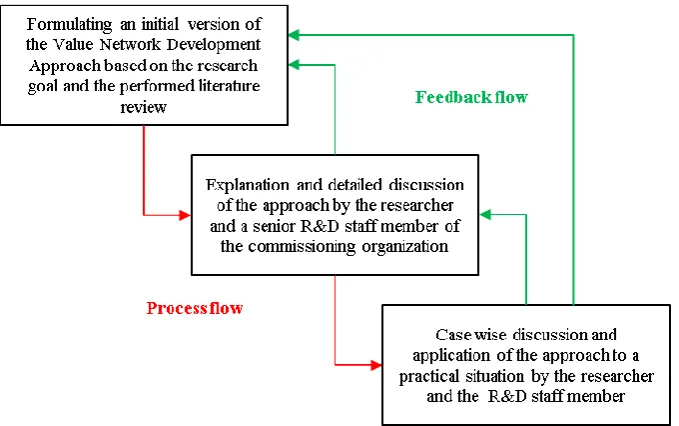
Figure 11: The process of theory synthesis and development
3
A
V
ALUEN
ETWORKD
EVELOPMENTA
PPROACHFor this study a methodology is formulated for the development of value networks and alignment business models. The Value Network Development Approach is proposed which consists of five ac-tivities. By formulating the detailed activities of the Value Network Development Approach the third sub-question (How can representations of a value network and related business models be demon-strated and evaluated?) and main question (How can the Business Model Canvas support a methodol-ogy for the development of value networks?) of this study are answered. The Value Network Devel-opment Approach is formulated through a synthesis of the theoretical insights gained by the research-er and discussions with the commissioning organization. The ovresearch-erall process of the theory synthesis and the development of the approach consist of three iteration steps (Figure 11).
As indicated in Figure 11, first based on the goal of this study and the knowledge that is gained through the literature review in chapter 2, the researcher formulated an initial version of the Value Network Development Approach. Accordingly, the literature review enabled the researcher to consid-er key dimensions and constructs of value networks and business models for the formulation of the Value Network Development Approach.
Second, the formulated approach is explained by the researcher to a senior R&D consultant of the commissioning organization to initiate discussions regarding the approach and retrieve feedback from the R&D consultant. During this step the presented approach was discussed in detail by the researcher and the R&D consultant.
The synthesis and development cycle was repeated until the current Value Network Development Approach was produced. The five activities of the Value Network Development Approach, their de-scriptions and used theories are summarized in Table 5. Detailed dede-scriptions all five activities are provided in chapter 3.1 – 3.5. Subsequently the application of each activity is demonstrated by means of a single case study in chapter 5. Finally all activities are evaluated in chapter 6.
Table 5: A brief description of the Value Network Development Approach
Activity Description Authors of used
method or theory
Activity 1: Determine the network-mode for the value network
A network-mode that suits the purpose of the value network has to be determined. The network-mode clarifies the ways in which actors could participate in the value network. In addition the network-mode clarifies how the value network is governed. This activity also clarifies the purpose of the value network.
(Al-Debei et al., 2013; Pisano and Verganti, 2008)
Activity 2: Identify value network actors and their roles
The purpose of activity two is to identify the participants of the value network and their roles. This activity is dependent on the outcomes of the previous activity. Specifically actor identifica-tion is based on the collaboraidentifica-tion form that is selected in the first activity from the collaboration framework. Strategic and/or functional roles of value network actors should also be deter-mined in order to produce a clear picture of the positions and importance of actors.
(Al-Debei et al., 2013; Pisano and Verganti, 2008)
Activity 3: Clarify perceived advantages and disadvantages of value network actors
The purpose of this step is to identify the perceived values that actors intend to capture from the value network. In this study the Business Model Canvas is suggested as a basis from which actors will be able to identify relevant perceived advantages and disadvantages that they expect to retrieve from the value net-work as clarified in the previous activities. The Business Model Canvas is used because it is (a) required by the commissioning organization and (b) because it is a simply applicable and un-derstandable business model representation.
(Osterwalder and Pigneur, 2010; Peppard and Rylander, 2006)
Activity 4: Identify value exchanges be-tween value network actors
In this activity the individual Business Model Canvases of value network actors (from activity 3) are used to clarify the exchang-es and economic potentials of actors.
(Gordijn and Ak-kermans, 2001; Osterwalder and Pigneur, 2010)
Activity 5: Align the business models of value network actors
The goal of this activity is to align the business models of value network actors with each other by identifying opportunities to gain, reconfigure, integrate, and/or dismiss resources amongst value network actors. The exchanges between value network actors that have been identified in activity 4 are used to perform this activity.
(Eisenhardt and Martin, 2000; Os-terwalder and Pigneur, 2010)