Proceedings of the 57th Annual Meeting of the Association for Computational Linguistics, pages 6314–6322 6314
Large-Scale Multi-Label Text Classification on EU Legislation
Ilias Chalkidis Manos Fergadiotis Prodromos Malakasiotis Ion Androutsopoulos
Department of Informatics, Athens University of Economics and Business, Greece [ihalk,fergadiotis,rulller,ion]@aueb.gr
Abstract
We consider Large-Scale Multi-Label Text Classification (LMTC) in the legal domain. We release a new dataset of 57k legislative documents from EUR-LEX, annotated with ∼4.3kEUROVOClabels, which is suitable for
LMTC, few- and zero-shot learning. Exper-imenting with several neural classifiers, we show that BIGRUs with label-wise attention perform better than other current state of the art methods. Domain-specific WORD2VEC
and context-sensitive ELMO embeddings fur-ther improve performance. We also find that considering only particular zones of the docu-ments is sufficient. This allows us to bypass
BERT’s maximum text length limit and fine-tuneBERT, obtaining the best results in all but zero-shot learning cases.
1 Introduction
Large-scale multi-label text classification (LMTC) is the task of assigning to each document all the relevant labels from a large set, typically contain-ing thousands of labels (classes). Applications include building web directories (Partalas et al.,
2015), labeling scientific publications with con-cepts from ontologies (Tsatsaronis et al., 2015), assigning diagnostic and procedure labels to med-ical records (Mullenbach et al., 2018; Rios and Kavuluru,2018). We focus on legal text process-ing, an emerging NLP field with many applica-tions (e.g., legal judgment (Nallapati and Man-ning,2008;Aletras et al.,2016), contract element extraction (Chalkidis et al., 2017), obligation ex-traction (Chalkidis et al.,2018)), but limited pub-licly available resources.
Our first contribution is a new publicly avail-able legal LMTC dataset, dubbed EURLEX57K,
containing 57k English EU legislative documents from the EUR-LEX portal, tagged with ∼4.3k la-bels (concepts) from the European Vocabulary
(EUROVOC).1 EUROVOC contains approx. 7k la-bels, but most of them are rarely used, hence they are under-represented (or absent) inEURLEX57K, making the dataset also appropriate for few- and zero-shot learning. EURLEX57K can be viewed
as an improved version of the dataset released by
Mencia and F¨urnkranzand(2007), which has been widely used inLMTCresearch, but is less than half
the size ofEURLEX57K(19.6k documents, 4kEU
-ROVOClabels) and more than ten years old. As a second contribution, we experiment with several neural classifiers onEURLEX57K,
includ-ing the Label-Wise Attention Network of Mullen-bach et al.(2018), calledCNN-LWANhere, which was reported to achieve state of the art perfor-mance in LMTC on medical records. We show that a simplerBIGRUwith self-attention (Xu et al.,
2015) outperforms CNN-LWAN by a wide
mar-gin on EURLEX57K. However, by replacing the
CNNencoder ofCNN-LWANwith aBIGRU, we ob-tain even better results onEURLEX57K. Domain-specific WORD2VEC (Mikolov et al., 2013) and context-sensitiveELMOembeddings (Peters et al.,
2018) yield further improvements. We thus estab-lish strong baselines forEURLEX57K.
As a third contribution, we investigate which zones of the documents are more informative on
EURLEX57K, showing that considering only the title and recitals of each document leads to almost the same performance as considering the full doc-ument. This allows us to bypass BERT’s (Devlin et al.,2018) maximum text length limit and fine-tune BERT, obtaining the best results for all but zero-shot learning labels. To our knowledge, this is the first application of BERT to an LMTC task,
which provides further evidence of the superiority of pretrained language models with task-specific
1See https://eur-lex.europa.eu/ for EUR
fine-tuning, and establishes an even stronger base-line forEURLEX57KandLMTCin general.
2 Related Work
You et al. (2018) explored RNN-based methods with self-attention on five LMTC datasets that had also been considered by Liu et al. (2017), namelyRCV1 (Lewis et al.,2004), Amazon-13K, (McAuley and Leskovec, 2013), Wiki-30K and Wiki-500K (Zubiaga,2012), as well as the previ-ousEUR-LEXdataset (Mencia and F¨urnkranzand,
2007), reporting that attention-based RNNs pro-duced the best results overall (4 out of 5 datasets).
Mullenbach et al.(2018) investigated the use of label-wise attention inLMTCfor medical code pre-diction on the MIMIC-II and MIMIC-III datasets
(Johnson et al., 2017). Their best method, Con-volutional Attention for Multi-Label Classifica-tion, called CNN-LWAN here, employs one
atten-tion head per label and was shown to outperform weak baselines, namely logistic regression, plain
BIGRUs,CNNs with a single convolution layer. Rios and Kavuluru (2018) consider few- and zero-shot learning on the MIMIC datasets. They propose Zero-shot Attentive CNN, called ZERO -CNN-LWANhere, a method similar toCNN-LWAN, which also exploits label descriptors. Although
ZERO-CNN-LWANdid not outperformCNN-LWAN
overall on MIMIC-II and MIMIC-III, it had much improved results in few-shot and zero-shot learn-ing, among other variations ofZERO-CNN-LWAN
that exploit the hierarchical relations of the labels with graph convolutions.
We note that the label-wise attention methods of
Mullenbach et al. (2018) andRios and Kavuluru
(2018) were not compared to strong generic text classification baselines, such as attention-based
RNNs (You et al.,2018) or Hierarchical Attention Network (HAN) (Yang et al.,2016), which we in-vestigate below.
3 The New Dataset
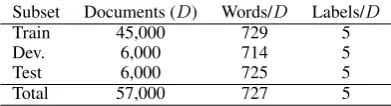
As already noted, EURLEX57K contains 57k leg-islative documents fromEUR-LEX2 with an
aver-age length of 727 words (Table 1).3 Each doc-ument contains four major zones: the header, which includes the title and name of the legal body
2Our dataset is available at http://nlp.cs. aueb.gr/software_and_datasets/EURLEX57K, with permission of reuse under European Union c,
https://eur-lex.europa.eu, 1998–2019.
3See AppendixAfor more statistics.
Subset Documents (D) Words/D Labels/D
[image:2.595.318.514.61.114.2]Train 45,000 729 5 Dev. 6,000 714 5 Test 6,000 725 5 Total 57,000 727 5
Table 1: Statistics of theEUR-LEXdataset.
enforcing the legal act; therecitals, which are legal background references; themain body, usually or-ganized in articles; and theattachments(e.g., ap-pendices, annexes).
Some of the LMTCmethods we consider need to be fed with documents split into smaller units. These are often sentences, but in our experiments they are sections, thus we preprocessed the raw text, respectively. We treat the header, the recitals zone, each article of the main body, and the attach-ments as separate sections.
All the documents of the dataset have been an-notated by the Publications Office of EU4 with multiple concepts from EUROVOC. While EU
-ROVOCincludes approx. 7k concepts (labels), only 4,271 (59.31%) are present inEURLEX57K, from which only 2,049 (47.97%) have been assigned to more than 10 documents. Similar distributions were reported byRios and Kavuluru(2018) for the
MIMIC datasets. We splitEURLEX57K into train-ing (45k documents), development (6k), and test subsets (6k). We also divide the 4,271 labels into
frequent(746 labels), few-shot(3,362), and zero-shot (163), depending on whether they were as-signed to more than 50, fewer than 50 but at least one, or no training documents, respectively.
4 Methods
Exact Match, Logistic Regression: A first naive baseline, Exact Match, assigns only labels whose descriptors can be found verbatim in the document. A second one uses Logistic Regression with feature vectors containing TF-IDF scores of n-grams (n= 1,2, . . . ,5).
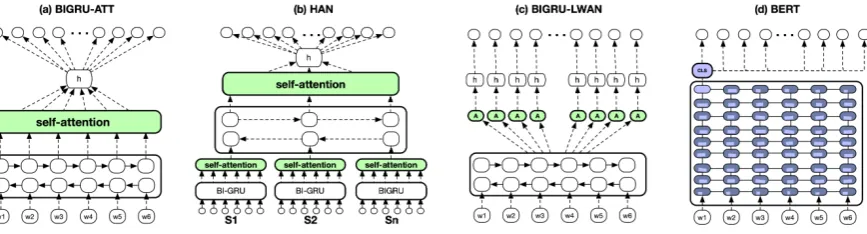
BIGRU-ATT: The first neural method is aBIGRU
with self-attention (Xu et al., 2015). Each doc-ument is represented as the sequence of its word embeddings, which go through a stack ofBIGRUs (Figure1a). A document embedding (h) is com-puted as the sum of the resulting context-aware embeddings (h=P
iaihi), weighted by the
self-attention scores (ai), and goes through a dense
Figure 1: Illustration of (a)BIGRU-ATT, (b)HAN, (c)BIGRU-LWAN, and (d)BERT.
layer of L = 4,271 output units with sigmoids, producingLprobabilities, one per label.
HAN: The Hierarchical Attention Network (Yang et al., 2016) is a strong baseline for text classification. We use a slightly modified version, where aBIGRUwith self-attention reads the words of each section, as in BIGRU-ATT but separately per section, producing section embeddings. A second-level BIGRU with self-attention reads the section embeddings, producing a single document embedding (h) that goes through a similar output layer as inBIGRU-ATT(Figure1b).
CNN-LWAN, BIGRU-LWAN: In the original Label-Wise Attention Network (LWAN) of Mul-lenbach et al.(2018), calledCNN-LWANhere, the word embeddings of each document are first con-verted to a sequence of vectorshi by a CNN
en-coder. A modified version ofCNN-LWANthat we developed, calledBIGRU-LWAN, replaces theCNN
encoder with a BIGRU (Figure 1c), which
con-verts the word embeddings into context-sensitive embeddings hi, much as in BIGRU-ATT.
Un-like BIGRU-ATT, however, both CNN-LWAN and
BIGRU-LWAN useL independent attention heads, one per label, generatingLdocument embeddings (h(l) = P
ial,ihi, l = 1, . . . , L) from the
se-quence of vectorshi produced by theCNN orBI -GRU encoder, respectively. Each document em-bedding (h(l)) is specialized to predict the corre-sponding label and goes through a separate dense layer (Ldense layers in total) with a sigmoid, to produce the probability of the corresponding label.
ZERO-CNN-LWAN, ZERO-BIGRU-LWAN: Rios and Kavuluru (2018) designed a model similar to CNN-LWAN, called ZACNN in their work and
ZERO-CNN-LWAN here, to deal with rare labels.
In ZERO-CNN-LWAN, the attention scores (al,i)
and the label probabilities are produced by com-paring the hi vectors that the CNN encoder
pro-duces and the label-specific document embeddings (h(l)), respectively, to label embeddings. Each la-bel embedding is the centroid of the pretrained word embeddings of the label’s descriptor; con-sultRios and Kavuluru(2018) for further details. By contrast,CNN-LWANandBIGRU-LWANdo not consider the descriptors of the labels. We also experiment with a variant of ZERO-CNN-LWAN
that we developed, dubbed ZERO-BIGRU-LWAN, where theCNNencoder is replaced by aBIGRU.
BERT: BERT (Devlin et al.,2018) is a language model based on Transformers (Vaswani et al.,
2017) pretrained on large corpora. For a new tar-get task, a task-specific layer is added on top of
BERT. The extra layer is trained jointly withBERT
by fine-tuning on task-specific data. We add a dense layer on top of BERT, with sigmoids, that produces a probability per label. Unfortunately,
BERTcan currently process texts up to 512 word-pieces, which is too small for the documents of
EURLEX57K. Hence,BERTcan only be applied to
truncated versions of our documents (see below).
5 Experiments
Evaluation measures: Common LMTC
ALLLABELS FREQUENT FEW ZERO RP@5 nDCG@5 Micro-F1 RP@5 nDCG@5 RP@5 nDCG@5 RP@5 nDCG@5 Exact Match 0.097 0.099 0.120 0.219 0.201 0.111 0.074 0.194 0.186 Logistic Regression 0.710 0.741 0.539 0.767 0.781 0.508 0.470 0.011 0.011
BIGRU-ATT 0.758 0.789 0.689 0.799 0.813 0.631 0.580 0.040 0.027
HAN 0.746 0.778 0.680 0.789 0.805 0.597 0.544 0.051 0.034
CNN-LWAN 0.716 0.746 0.642 0.761 0.772 0.613 0.557 0.036 0.023
BIGRU-LWAN 0.766 0.796 0.698 0.805 0.819 0.662 0.618 0.029 0.019
ZERO-CNN-LWAN 0.684 0.717 0.618 0.730 0.745 0.495 0.454 0.321 0.264
ZERO-BIGRU-LWAN 0.718 0.752 0.652 0.764 0.780 0.561 0.510 0.438 0.345
BIGRU-LWAN(L2V) 0.775 0.804 0.711 0.815 0.828 0.656 0.612 0.034 0.024
BIGRU-LWAN(L2V) * 0.770 0.796 0.709 0.811 0.825 0.641 0.600 0.047 0.030
BIGRU-LWAN(ELMO) * 0.781 0.811 0.719 0.821 0.835 0.668 0.619 0.044 0.028
[image:4.595.74.523.61.215.2]BERT-BASE* 0.796 0.823 0.732 0.835 0.846 0.686 0.636 0.028 0.023
Table 2: Results onEURLEX57Kfor all, frequent, few-shot, zero-shot labels. Starred methods use the first 512 document tokens; all other methods use full documents. Unless otherwise stated,GLOVEembeddings are used.
K is a parameter. This measure is the same as P@Kif there are at leastKgold labels, otherwise Kis reduced to the number of gold labels.
1 2 3 4 5 6 7 8 9 10
0.2 0.3 0.4 0.5 0.6 0.7 0.8 0.9 1
K top predictions
BIGRU-LWAN(ELMO)
BIGRU-LWAN(L2V)
[image:4.595.75.291.310.506.2]BERT-BASE
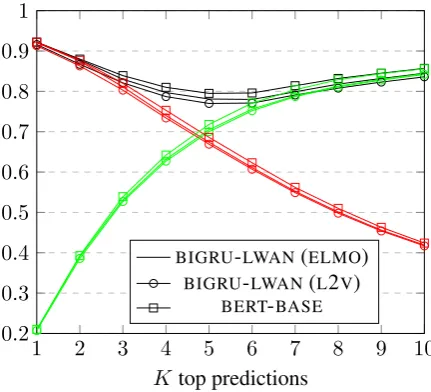
Figure 2: R@K (green lines), P@K (red), RP@K (black) of the best methods (BIGRU-LWAN (L2V),
BIGRU-LWAN(ELMO),BERT-BASE), forK= 1to10.
Figure2 showsRP@K for the three best sys-tems, macro-averaged over test documents. Un-like P@K, RP@K does not decline sharply as K increases, because it replaces K by the num-ber of gold labels, when the latter is lower than K. ForK = 1, RP@K is equivalent to P@K, as confirmed by Fig.2. For large values ofKthat almost always exceed the number of gold labels, RP@Kasymptotically approachesR@K, as also confirmed by Fig.2.5In our dataset, there are 5.07 labels per document, henceK = 5is reasonable.6
5
See AppendixCfor a more detailed discussion on the evaluation measures.
6Evaluating at other values ofKlead to similar
conclu-sions (see Fig.2and AppendixD).
Setup: Hyper-parameters are tuned using the
HYPEROPT library selecting the values with the
best loss on development data.7 For the best hyper-parameter values, we perform five runs and report mean scores on test data. For statistical sig-nificance tests, we take the run of each method with the best performance on development data, and perform two-tailed approximate randomiza-tion tests (Dror et al., 2018) on test data.8 Un-less otherwise stated, we used 200-D pretrained
GLOVEembeddings (Pennington et al.,2014).
Full documents: The first five horizontal zones of Table2 report results for full documents. The naive baselines are weak, as expected. Interest-ingly, for all, frequent, and even few-shot labels, the genericBIGRU-ATTperforms better thanCNN
-LWAN, which was designed forLMTC. HAN also performs better than CNN-LWAN for all and fre-quent labels. However, replacing theCNNencoder ofCNN-LWANwith aBIGRU(BIGRU-LWAN) leads to the best results, indicating that the main weak-ness ofCNN-LWANis its vanillaCNNencoder.
The zero-shot versions of CNN-LWAN and
BIGRU-LWAN outperform all other methods on zero-shot labels (Table2), in line with the findings ofRios and Kavuluru(2018), because they exploit label descriptors, but more importantly because they have a component that uses prior knowledge as is (i.e., label embeddings are frozen). Exact Match also performs better on zero-shot labels, for the same reason (i.e., the prior knowledge is
7We implemented all neural methods in
KERAS(https: //keras.io/). Code available athttps://github. com/iliaschalkidis/lmtc-eurlex57k.git. See AppendixBfor details on hyper-parameter tuning.
8We perform 10k iterations, randomly swapping in each
intact). BIGRU-LWAN, however, is still the best method in few-shot learning. All the differences between the best (bold) and other methods in Ta-ble2are statistically significant (p <0.01).
Table 3 shows that using WORD2VEC em-beddings trained on legal texts (L2V) (Chalkidis and Kampas,2018) orELMOembeddings (Peters et al., 2018) trained on generic texts further im-prove the performance ofBIGRU-LWAN.
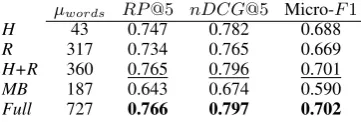
Document zones: Table4compares the perfor-mance ofBIGRU-LWANon the development set for
different combinations of document zones (Sec-tion3):header(H),recitals(R),main body(MB), full text. Surprisingly H+R leads to almost the same results as full documents,9 indicating that
H+Rprovides most of the information needed to assignEUROVOClabels.
RP@5 nDCG@5 Micro-F1
GLOVE 0.766 0.796 0.698
L2V 0.775 0.804 0.711
GLOVE+ELMO 0.777 0.808 0.714
[image:5.595.91.272.400.461.2]L2V+ELMO 0.781 0.811 0.719
Table 3:BIGRU-LWANwithGLOVE,L2V,ELMO.
µwords RP@5 nDCG@5 Micro-F1
H 43 0.747 0.782 0.688 R 317 0.734 0.765 0.669 H+R 360 0.765 0.796 0.701 MB 187 0.643 0.674 0.590 Full 727 0.766 0.797 0.702
Table 4: BIGRU-LWANwith different document zones. First 512 tokens: Given that H+R contains enough information and is shorter than 500 tokens in 83% of our dataset’s documents, we also ap-plyBERTto the first 512 tokens of each document (truncated to BERT’s max. length), comparing to
BIGRU-LWAN also operating on the first 512
to-kens. Table2(bottom zone) shows thatBERT out-performs all other methods, even though it consid-ers only the first 512 tokens. It fails, however, in zero-shot learning, since it does not have a com-ponent that exploits prior knowledge as is (i.e., all the components are fine-tuned on training data).
6 Limitations and Future Work
One major limitation of the investigated methods is that they are unsuitable forExtremeMulti-Label Text Classification where there are hundreds of thousands of labels (Liu et al.,2017;Zhang et al.,
9The approximate randomization tests detected no
statis-tically significant difference in this case (p= 0.20).
2018;Wydmuch et al., 2018), as opposed to the
LMTC setting of our work where the labels are in the order of thousands. We leave the investi-gation of methods for extremely large label sets for future work. Moreover,RNN(andGRU) based methods have high computational cost, especially for long documents. We plan to investigate more computationally efficient methods, e.g., dilated
CNNs (Kalchbrenner et al.,2017) and Transform-ers (Vaswani et al., 2017; Dai et al., 2019). We also plan to experiment with hierarchical flavors of BERT to surpass its length limitations. Fur-thermore, experimenting with more datasets e.g.,
RCV1, Amazon-13K, Wiki-30K, MIMIC-III will allow us to confirm our conclusions in different domains. Finally, we plan to investigate General-ized Zero-Shot Learning (Liu et al.,2018).
Acknowledgements
This work was partly supported by the Research Center of the Athens University of Economics and Business.
References
Nikolaos Aletras et al. 2016. Predicting judicial de-cisions of the European Court of Human Rights: a Natural Language Processing perspective. PeerJ Computer Science, 2:e93.
Ilias Chalkidis, Ion Androutsopoulos, and Achilleas Michos. 2017. Extracting Contract Elements. In
Proceedings of the 16th Edition of the International Conference on Articial Intelligence and Law, pages 19–28, London, UK.
Ilias Chalkidis, Ion Androutsopoulos, and Achilleas Michos. 2018. Obligation and Prohibition Extrac-tion Using Hierarchical RNNs. In Proceedings of the 56th Annual Meeting of the Association for Com-putational Linguistics (Volume 2: Short Papers), pages 254–259, Melbourne, Australia.
Ilias Chalkidis and Dimitrios Kampas. 2018. Deep learning in law: early adaptation and legal word em-beddings trained on large corpora. Artificial Intelli-gence and Law.
Zihang Dai, Zhilin Yang, Yiming Yang, Jaime G. Carbonell, Quoc V. Le, and Ruslan Salakhutdi-nov. 2019. Transformer-XL: Attentive Language Models Beyond a Fixed-Length Context. CoRR, abs/1901.02860.
Computational Linguistics: Human Language Tech-nologies, Minneapolis, MN, USA.
Rotem Dror, Gili Baumer, Segev Shlomov, and Roi Re-ichart. 2018. The Hitchhiker’s Guide to Testing Sta-tistical Significance in Natural Language Process-ing. InProceedings of the 56th Annual Meeting of the Association for Computational Linguistics (Vol-ume 1: Long Papers), pages 1383–1392, Melbourne, Australia.
Alistair EW Johnson, David J. Stone, Leo A. Celi, and Tom J. Pollard. 2017. MIMIC-III, a freely accessi-ble critical care database.Nature.
Nal Kalchbrenner, Lasse Espeholt, Karen Simonyan, A¨aron van den Oord, Alex Graves, and Koray Kavukcuoglu. 2017. Neural Machine Translation in Linear Time. InProceedings of the Conference on Empirical Methods in Natural Language Processing (EMNLP), Copenhagen, Denmark.
David D. Lewis, Yiming Yang, Tony G. Rose, and Fan Li. 2004. RCV1: A New Benchmark Collection for Text Categorization Research.J. Mach. Learn. Res., 5:361–397.
Jingzhou Liu, Wei-Cheng Chang, Yuexin Wu, and Yiming Yang. 2017. Deep Learning for Extreme Multi-label Text Classification. In Proceedings of the 40th International ACM SIGIR Conference on Research and Development in Information Re-trieval, SIGIR ’17, pages 115–124, New York, NY, USA.
Shichen Liu, Mingsheng Long, Jianmin Wang, and Michael I Jordan. 2018. Generalized Zero-Shot Learning with Deep Calibration Network. In Ad-vances in Neural Information Processing Systems 31, pages 2005–2015. Curran Associates, Inc.
Christopher D. Manning, Prabhakar Raghavan, and Hinrich Schtze. 2009. Introduction to Information Retrieval. Cambridge University Press.
Julian McAuley and Jure Leskovec. 2013. Hidden Factors and Hidden Topics: Understanding Rating Dimensions with Review Text. In Proceedings of the 7th ACM Conference on Recommender Systems, RecSys ’13, pages 165–172, New York, NY, USA.
Eneldo Loza Mencia and Johannes F¨urnkranzand. 2007. An Evaluation of Efficient Multilabel Classi-fication Algorithms for Large-Scale Problems in the Legal Domain. In Proceedings of the LWA 2007, pages 126–132, Halle, Germany.
Tomas Mikolov, Kai Chen, Greg Corrado, and Jeffrey Dean. 2013. Efficient Estimation of Word Repre-sentations in Vector Space. In Proceedings of the International Conference on Learning Representa-tions (ICLR), Scottsdale, AZ.
James Mullenbach, Sarah Wiegreffe, Jon Duke, Jimeng Sun, and Jacob Eisenstein. 2018. Explainable Pre-diction of Medical Codes from Clinical Text. In
Proceedings of the 2018 Conference of the North American Chapter of the Association for Computa-tional Linguistics: Human Language Technologies, Volume 1 (Long Papers), pages 1101–1111, New Orleans, Louisiana. Association for Computational Linguistics.
Ramesh Nallapati and Christopher D. Manning. 2008. Legal Docket Classification: Where Machine Learn-ing Stumbles. InProceedings of the Conference on Empirical Methods in Natural Language Processing (EMNLP), pages 438–446, Honolulu, Hawaii. Asso-ciation for Computational Linguistics.
Ioannis Partalas, Aris Kosmopoulos, Nicolas Baskiotis, Thierry Arti`eres, Georgios Paliouras, ´Eric Gaussier, Ion Androutsopoulos, Massih-Reza Amini, and Patrick Gallinari. 2015. LSHTC: A Bench-mark for Large-Scale Text Classification. CoRR, abs/1503.08581.
Jeffrey Pennington, Richard Socher, and Christo-pher D. Manning. 2014. GloVe: Global Vectors for Word Representation. In Proceedings of the 2014 Conference on Empirical Methods in Natural Language Processing (EMNLP), pages 1532–1543, Doha, Qatar. Association for Computational Lin-guistics.
Matthew E. Peters, Mark Neumann, Mohit Iyyer, Matt Gardner, Christopher Clark, Kenton Lee, and Luke Zettlemoyer. 2018. Deep contextualized word rep-resentations. In Proceedings of the 2018 Confer-ence of the North American Chapter of the Associ-ation for ComputAssoci-ational Linguistics: Human Lan-guage Technologies, Volume 1 (Long Papers), New Orleans, Louisiana, USA. Association for Computa-tional Linguistics.
Anthony Rios and Ramakanth Kavuluru. 2018. Few-Shot and Zero-Few-Shot Multi-Label Learning for Struc-tured Label Spaces. In Proceedings of the Confer-ence on Empirical Methods in Natural Language Processing (EMNLP), pages 3132–3142, Brussels, Belgium. Association for Computational Linguis-tics.
George Tsatsaronis, Georgios Balikas, Prodromos Malakasiotis, Ioannis Partalas, Matthias Zschunke, Michael R. Alvers, Dirk Weissenborn, Anastasia Krithara, Sergios Petridis, Dimitris Polychronopou-los, Yannis Almirantis, John PavlopouPolychronopou-los, Nico-las Baskiotis, Patrick Gallinari, Thierry Arti`eres, Axel-Cyrille Ngonga Ngomo, Norman Heino, ´Eric Gaussier, Liliana Barrio-Alvers, Michael Schroeder, Ion Androutsopoulos, and Georgios Paliouras. 2015. An overview of the BIOASQ large-scale biomedical semantic indexing and question answering competi-tion.BMC Bioinformatics, 16(138).
Marek Wydmuch, Kalina Jasinska, Mikhail Kuznetsov, R´obert Busa-Fekete, and Krzysztof Dembczynski. 2018. A no-regret generalization of hierarchical softmax to extreme multi-label classification. In
Proceedings of the 32nd International Conference on Neural Information Processing Systems, pages 6355–6366. Curran Associates, Inc.
Kelvin Xu, Jimmy Ba, Ryan Kiros, Kyunghyun Cho, Aaron Courville, Ruslan Salakhudinov, Rich Zemel, and Yoshua Bengio. 2015. Show, Attend and Tell: Neural Image Caption Generation with Visual At-tention. In Proceedings of the 32nd International Conference on Machine Learning, volume 37 of
Proceedings of Machine Learning Research, pages 2048–2057, Lille, France. PMLR.
Zichao Yang, Diyi Yang, Chris Dyer, Xiaodong He, Alex Smola, and Eduard Hovy. 2016. Hierarchi-cal Attention Networks for Document Classification. InProceedings of the 2016 Conference of the North American Chapter of the Association for Computa-tional Linguistics: Human Language Technologies, pages 1480–1489, San Diego, California. Associa-tion for ComputaAssocia-tional Linguistics.
Ronghui You, Suyang Dai, Zihan Zhang, Hiroshi Mamitsuka, and Shanfeng Zhu. 2018. Atten-tionXML: Extreme Multi-Label Text Classification with Multi-Label Attention Based Recurrent Neural Networks.CoRR, abs/1811.01727.
Wenjie Zhang, Junchi Yan, Xiangfeng Wang, and Hongyuan Zha. 2018. Deep Extreme Multi-label Learning. In Proceedings of the 2018 ACM on International Conference on Multimedia Retrieval, ICMR ’18, pages 100–107, New York, NY, USA.
Arkaitz Zubiaga. 2012. Enhancing Navigation on Wikipedia with Social Tags.CoRR, abs/1202.5469.
Appendix
A EURLEX57Kstatistics
Figure 3 shows the distribution of labels across
EURLEX57Kdocuments. From the 7k labels fewer than 50% appear in more than 10 documents. Such an aggressive Zipfian distribution has also been noted in medical code predictions (Rios and Kavu-luru,2018), where such thesauri are used to clas-sify documents, demonstrating the practical im-portance of few-shot and zero-shot learning.
B Hyper-paramater tuning
[image:7.595.307.519.62.209.2]Table5shows the best hyper-parameters returned by HYPEROPT. Concerning BERT, we set the dropout rate and learning rate to 0.1 and 5e-5, re-spectively, as suggested by Devlin et al. (2018), while batch size was set to 8 due toGPUmemory limitations. Finally, we noticed that the model did
Figure 3: Distribution of EUROVOC concepts across
EURLEX57Kdocuments
not converge in the fourth epoch, as suggested by
Devlin et al.(2018). Thus we used early-stopping with no patience and trained the model for eight to nine epochs on average among the five runs.
C Evaluation Measures
The macro-averaged versions ofR@KandP@K are defined as follows:
R@K = 1 T
T X
t=1 St(K)
Rt
(1)
P@K = 1 T
T X
t=1 St(K)
K (2)
whereT is the total number of test documents,K is the number of labels to be selected per doc-ument, St(K) is the number of correct labels
among those ranked as top K for the t-th docu-ment, andRtis the number of gold labels for each
document. Although these measures are widely used in LMTC, we question their appropriateness for the following reasons:
1. R@K leads to excessive penalization when documents have more than K gold labels. For example, evaluating atK = 1for a single doc-ument with 5 gold labels returnsR@1 = 0.20, if the system managed to return a correct label. The system is penalized, even though it was not allowed to return more than one label.
2. P@Kdoes the same for documents with fewer thanK gold labels. For example, evaluating at K = 5for a single document with a single gold label returnsP@1 = 0.20.
[image:7.595.365.524.378.446.2]la-Hyper parameters BIGRU-ATT HAN CNN-LWAN BIGRU-LWAN ZACNN* ZAGRU* BERT-BASE+
Nl∈[1,2] 1 (1,1) 1 1 1 1 12
HU∈[200,300,400] 300 (300,300) 200 300 200 100 768
Dd∈[0.1,0.2, . . . ,0.5] 0.2 0.3 0.1 0.4 0.1 0.1 0.1
Dwe∈[0.00,0.01,0.02] 0.02 0.02 0.01 0.00 0.00 0.00 0.00
[image:8.595.74.530.200.358.2]BS∈[8,12,16] 12 16 12 16 16 16 8
Table 5: Best hyper parameters for neural methods. Nl: number of layers,HU: hidden units size,Dd: dropout rate across dimensions,Dwe: dropout rate of word embeddings,BS: batch size. * Hidden units size is fixed to word embedding dimensionality, +Nl,HUare fixed from the pre-trained model. Dropout rate fixed as suggested by Devlin et al. (2018).
OVERALL FREQUENT FEW ZERO
@1 @5 @10 @1 @5 @10 @1 @5 @10 @1 @5 @10 Exact Match 0.131 0.084 0.080 0.194 0.166 0.141 0.037 0.037 0.036 0.178 0.042 0.022 Logistic Regression 0.861 0.613 0.378 0.864 0.604 0.368 0.458 0.169 0.094 0.011 0.002 0.002
BIGRU-ATT 0.899 0.654 0.407 0.893 0.627 0.382 0.551 0.212 0.121 0.015 0.008 0.007
HAN 0.894 0.643 0.401 0.889 0.620 0.378 0.510 0.199 0.114 0.020 0.011 0.008
CNN-LWAN 0.853 0.617 0.395 0.849 0.596 0.374 0.521 0.204 0.117 0.011 0.007 0.007
BIGRU-LWAN 0.907 0.661 0.414 0.900 0.631 0.387 0.599 0.222 0.124 0.011 0.006 0.006
ZERO-CNN-LWAN 0.842 0.589 0.371 0.837 0.572 0.355 0.447 0.164 0.094 0.202 0.069 0.040
ZERO-BIGRU-LWAN 0.874 0.619 0.386 0.867 0.599 0.367 0.488 0.184 0.107 0.247 0.093 0.057
BIGRU-LWAN(L2V) 0.913 0.669 0.417 0.905 0.639 0.390 0.593 0.219 0.122 0.013 0.007 0.008
BIGRU-LWAN(L2V) * 0.915 0.664 0.413 0.905 0.637 0.387 0.586 0.214 0.120 0.013 0.010 0.010
BIGRU-LWAN(ELMO) * 0.921 0.674 0.419 0.912 0.644 0.391 0.595 0.226 0.127 0.011 0.009 0.007
BERT-BASE* 0.922 0.687 0.424 0.914 0.656 0.394 0.611 0.229 0.129 0.019 0.006 0.007
Table 6: P@1, P@5 and P@10 results on EURLEX57Kfor all, frequent, few-shot, zero-shot labels. Starred methods use the first 512 document tokens; all other methods use full documents. Unless otherwise stated,GLOVE
embeddings are used.
bels largely diverges from K. This is clearly illustrated in Figure2of the main article.
4. Because of these drawbacks, both measures do not correctly single out the best methods.
Based on the above arguments, we believe that R-Precision@K (RP@K) andnDCG@Klead to a more informative and fair evaluation. Both mea-sures adjust to the number of gold labels per doc-ument, without over- or under-estimating perfor-mance when documents have few or many gold labels. The macro-averaged versions of the two measures are defined as follows:
RP@K = 1 T
T X
t=1
St(K)
min (K, Rt)
(3)
nDCG@K = 1 T
T X
t=1
K X
k=1
2St(k)−1 log (1 +k) (4)
Again,T is the total number of test documents,K is the number of labels to be selected, St(K) is
the number of correct labels among those ranked as topKfor thet-th document, andRtis the
num-ber of gold labels for each document. In the main article we report results forK = 5. The reason is
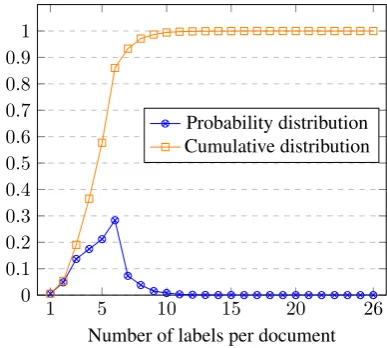
that the majority of the documents ofEURLEX57K
(57.7%) have at most 5 labels. The detailed distri-butions can be seen in Figure4.
1 5 10 15 20 26
0 0.1 0.2 0.3 0.4 0.5 0.6 0.7 0.8 0.9 1
Number of labels per document Probability distribution Cumulative distribution
Figure 4: Distribution of number of labels per docu-ment inEURLEX57K.
D Experimental Results
[image:8.595.319.513.473.647.2]OVERALL FREQUENT FEW ZERO
@1 @5 @10 @1 @5 @10 @1 @5 @10 @1 @5 @10 Exact Match 0.026 0.087 0.168 0.045 0.207 0.344 0.022 0.111 0.214 0.161 0.194 0.206 Logistic Regression 0.195 0.641 0.764 0.234 0.719 0.845 0.313 0.507 0.560 0.011 0.011 0.022
BIGRU-ATT 0.204 0.685 0.824 0.242 0.749 0.880 0.382 0.629 0.703 0.015 0.040 0.062
HAN 0.203 0.675 0.811 0.241 0.740 0.871 0.355 0.596 0.673 0.018 0.051 0.079
CNN-LWAN 0.193 0.647 0.800 0.229 0.713 0.862 0.360 0.612 0.681 0.011 0.036 0.061
BIGRU-LWAN 0.205 0.692 0.836 0.243 0.755 0.891 0.420 0.661 0.725 0.011 0.029 0.060
ZERO-CNN-LWAN 0.189 0.617 0.752 0.223 0.683 0.820 0.300 0.494 0.556 0.189 0.321 0.376
ZERO-BIGRU-LWAN 0.197 0.648 0.782 0.232 0.716 0.847 0.335 0.560 0.635 0.231 0.438 0.531
BIGRU-LWAN(L2V) 0.207 0.700 0.842 0.246 0.764 0.898 0.414 0.655 0.716 0.012 0.034 0.066
BIGRU-LWAN(L2V) * 0.207 0.696 0.835 0.245 0.760 0.891 0.409 0.640 0.707 0.013 0.047 0.084
BIGRU-LWAN(ELMO) * 0.208 0.705 0.844 0.249 0.770 0.900 0.410 0.667 0.732 0.011 0.044 0.061
[image:9.595.75.523.310.468.2]BERT-BASE* 0.209 0.719 0.855 0.250 0.784 0.908 0.428 0.684 0.752 0.018 0.028 0.068
Table 7: R@1, R@5 andR@10results on EURLEX57K for all, frequent, few-shot, zero-shot labels. Starred methods use the first 512 document tokens; all other methods use full documents. Unless otherwise stated,GLOVE
embeddings are used.
OVERALL FREQUENT FEW ZERO
@1 @5 @10 @1 @5 @10 @1 @5 @10 @1 @5 @10 Exact Match 0.131 0.097 0.168 0.194 0.219 0.344 0.037 0.111 0.214 0.178 0.194 0.206 Logistic Regression 0.861 0.710 0.765 0.864 0.767 0.846 0.458 0.508 0.560 0.011 0.011 0.022
BIGRU-ATT 0.899 0.758 0.824 0.893 0.799 0.880 0.551 0.631 0.703 0.015 0.040 0.062
HAN 0.894 0.746 0.811 0.889 0.789 0.872 0.510 0.597 0.673 0.020 0.051 0.079
CNN-LWAN 0.853 0.716 0.801 0.849 0.761 0.862 0.521 0.613 0.681 0.011 0.036 0.061
BIGRU-LWAN 0.907 0.766 0.836 0.900 0.805 0.891 0.599 0.662 0.725 0.011 0.029 0.060
ZERO-CNN-LWAN 0.842 0.684 0.753 0.837 0.730 0.820 0.447 0.495 0.556 0.202 0.321 0.376
ZERO-BIGRU-LWAN 0.874 0.718 0.782 0.867 0.764 0.847 0.488 0.561 0.635 0.247 0.438 0.531
BIGRU-LWAN(L2V) 0.913 0.775 0.842 0.905 0.815 0.898 0.593 0.657 0.716 0.013 0.034 0.066
BIGRU-LWAN(L2V) * 0.915 0.770 0.836 0.905 0.811 0.891 0.586 0.641 0.707 0.013 0.047 0.084
BIGRU-LWAN(ELMO) * 0.921 0.781 0.845 0.912 0.821 0.901 0.595 0.668 0.732 0.011 0.044 0.061
BERT-BASE* 0.922 0.796 0.856 0.914 0.835 0.908 0.611 0.686 0.752 0.019 0.028 0.068
Table 8: RP@1,RP@5andRP@10results onEURLEX57Kfor all, frequent, few-shot, zero-shot labels. Starred methods use the first 512 document tokens; all other methods use full documents. Unless otherwise stated,GLOVE
embeddings are used.
OVERALL FREQUENT FEW ZERO
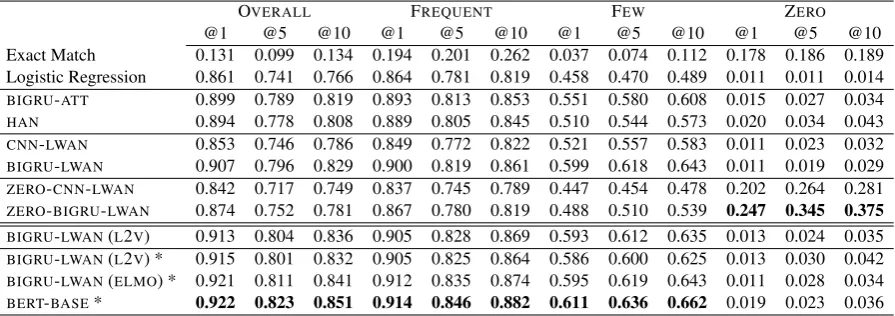
@1 @5 @10 @1 @5 @10 @1 @5 @10 @1 @5 @10 Exact Match 0.131 0.099 0.134 0.194 0.201 0.262 0.037 0.074 0.112 0.178 0.186 0.189 Logistic Regression 0.861 0.741 0.766 0.864 0.781 0.819 0.458 0.470 0.489 0.011 0.011 0.014
BIGRU-ATT 0.899 0.789 0.819 0.893 0.813 0.853 0.551 0.580 0.608 0.015 0.027 0.034
HAN 0.894 0.778 0.808 0.889 0.805 0.845 0.510 0.544 0.573 0.020 0.034 0.043
CNN-LWAN 0.853 0.746 0.786 0.849 0.772 0.822 0.521 0.557 0.583 0.011 0.023 0.032
BIGRU-LWAN 0.907 0.796 0.829 0.900 0.819 0.861 0.599 0.618 0.643 0.011 0.019 0.029
ZERO-CNN-LWAN 0.842 0.717 0.749 0.837 0.745 0.789 0.447 0.454 0.478 0.202 0.264 0.281
ZERO-BIGRU-LWAN 0.874 0.752 0.781 0.867 0.780 0.819 0.488 0.510 0.539 0.247 0.345 0.375
BIGRU-LWAN(L2V) 0.913 0.804 0.836 0.905 0.828 0.869 0.593 0.612 0.635 0.013 0.024 0.035
BIGRU-LWAN(L2V) * 0.915 0.801 0.832 0.905 0.825 0.864 0.586 0.600 0.625 0.013 0.030 0.042
BIGRU-LWAN(ELMO) * 0.921 0.811 0.841 0.912 0.835 0.874 0.595 0.619 0.643 0.011 0.028 0.034
BERT-BASE* 0.922 0.823 0.851 0.914 0.846 0.882 0.611 0.636 0.662 0.019 0.023 0.036
[image:9.595.76.524.547.705.2]