DOI: 10.4236/mme.2017.74010 Nov. 28, 2017 144 Modern Mechanical Engineering
Sankar Ramaiyan, Rathinasuriyan Chandran, Senthil Kumar Velukkudi Santhanam
Department of Mechanical Engineering, Anna University, Chennai, India
Abstract
Friction stir processing (FSP) is an important microstructural alteration process used recently in the engineering field. Grains alteration and hence the mechanical properties of the possessed zone are controlled by the tempera-ture, heating and cooling rate. In this work, AZ31B magnesium samples were friction stir processed in three different cooling conditions like air, water and cryogenic (liquid nitrogen) cooling. 1000 rpm and 60 mm/min were kept constant as tool rotation speed and traverse speed respectively in all the three mediums. The consequence of these conditions on thermal fields, axial force, resulting grain structure and mechanical properties was studied. It is found that the cryogenic treated friction stir processed samples exhibit fine grain structures and hence offer better mechanical properties than the air and water cooled processed samples.
Keywords
Friction Stir Processing, AZ31B Magnesium Alloy, Cryogenic Coolant, Liquid Nitrogen and Mechanical Properties, Axial Force,
Submerged Friction Stir Processing
1. Introduction
Friction stir Processing (FSP) is developed and introduced to the global scenario in 1999 [1]. FSP basically involves the same concept as Friction Stir Welding (FSW) which is a solid state processing technique for microstructural modification and improvement of mechanical properties [2] [3]. In FSP, a non-consumable rotating tool with a shoulder and a pin is embedded in the work piece and tra-versed along the desired path for localized microstructural variation for specific
How to cite this paper: Ramaiyan, S., Chandran, R. and Santhanam, S.K.V. (2017) Effect of Cooling Conditions on Mechanical and Microstructural Beha-viours of Friction Stir Processed AZ31B Mg Alloy. Modern Mechanical Engineering, 7, 144-160.
https://doi.org/10.4236/mme.2017.74010
Received: August 30, 2017 Accepted: November 25, 2017 Published: November 28, 2017
Copyright © 2017 by authors and Scientific Research Publishing Inc. This work is licensed under the Creative Commons Attribution International License (CC BY 4.0).
DOI: 10.4236/mme.2017.74010 145 Modern Mechanical Engineering property improvement in the handled zone, arising from deep plastic deforma-tion, blending and thermal presentation of the metal cooling in manufacturing processes which is known to improve a tool life and surface finish [4] [5]. Mag-nesium and its alloys are the lightest essential materials as they less in weight by 40% compare to aluminum alloy and 78% to steel. Mg alloys are known for ex-cellent specific strength, exex-cellent sound damping capabilities, useful cast-ability, good machinability, excellent formability, valuable electromagnetic interference shielding, and recyclability, having applications in aerospace, automobile and ship building industries. They have better corrosion resistant than aluminum al-loys [6] [7]. There are some advantages associated with cooling which are related mostly to microstructure enhancements; that FSP has been improved as superior to AZ31B magnesium alloy. Darras et al.[8] have investigated the mechanical properties and microstructure behavior of FSP under water medium, and con-cluded that this is an effective technique which modifies the grain size and en-hances the tensile properties of AZ91 magnesium alloy. Prakash et al. [9] have conducted the experiment on FSP to applied liquid nitrogen coolant on the processed sample for investigation of temperature, torque and grain size im-provements and comparing with FSPed air medium samples. The results shows decrease in the ultimate tensile strength, impact strength as also increase in the percentage of elongation at cryogenic temperature achieved by cryogenic pre cooling [10].
Friction Stir processing of AZ31B Mg alloy during cryogenic cooled samples achieved finer and a better homogeneous grain size than the FSPed air Samples. Recently very few researchers have used liquid nitrogen coolant on FSW/FSP samples, few study of thermal history, mechanical properties and microstructure analysis at cryogenic coolant (liquid nitrogen), considered as suitable technique for application to aerospace and automotive which are run at low temperature place [11] [12]. The present study investigates the hot-rolled AZ31B magnesium alloys was subjected to FSP in air, water and cryogenic coolant respectively. A result of the thermal histories of the two FSPed zones was made. Investigation of the effect of cooling conditions on the microstructure, mechanical properties and axial load was also made.
2. Material and Experiment Methods
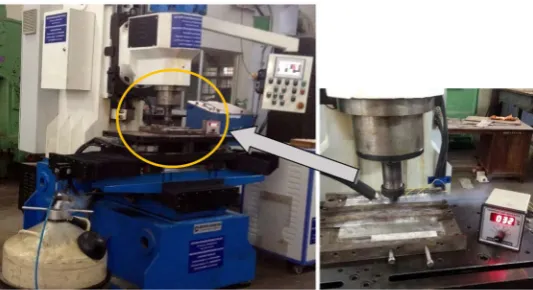
FSP was conducted using a 3 axis servo control friction stir welding machine. A special fixture was designed and built to hold the samples. Table 1 list the chemical composition of AZ31B Mg alloy.
[image:2.595.205.543.690.733.2]The tool used in this work has a scrolled shoulder with a diameter of 24 mm, and a three stepped square pin total height of 5.8 mm, slightly shorter than the
Table 1. Chemical composition of magnesium alloy AZ31B.
DOI: 10.4236/mme.2017.74010 146 Modern Mechanical Engineering vironment. The complete experimental set-up and a closer look at the fixture and the FSP tool are shown in Figure 1.
Thermocouples (T1) and (T2) were used for measuring the temperatures at two different locations within the sample during friction stir processing. The mechanical properties and microstructural investigations were done in the mid-dle of FSP samples. Four zones have been identified on the basis of microstruc-ture characterization. These were base material (BM) heat affected zone (HAZ) thermo-mechanical affected zone (TMAZ) and stir zone (SZ). Pouring cryogenic coolant on the processed samples resulted in the achievement of pre cooling. Cryogenic cooling has several advantages applied to changes in the enrichment life of the tool, surface finish and the mechanical properties. The area where it is to be cooled and reached to the target value of 10˚C till then Cryogenic (liquid nitrogen) coolant is poured. This temperature drop ensured FSP starting tem-perature would be seen at around 0˚C by the state of the process. The setup temperature during the pre-cooling phase was maintained by the thermo-couples.
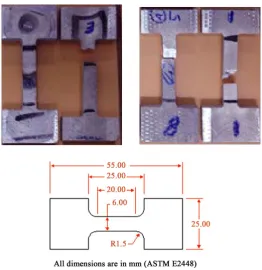
[image:3.595.240.507.560.705.2]The tensile test was conducted by an INSTRON universal testing machine having a capacity of 50 kN. A standard tensile test specimen 20 mm in length and a width of 6 mm was cut using wire-cut EDM through the ASTM standard E 2448. The tensile specimen used for conducting experiments and the dimension of the specimen used are presented in Figure 2.
DOI: 10.4236/mme.2017.74010 147 Modern Mechanical Engineering
Figure 2. Tensile samples geometry used in this paper.
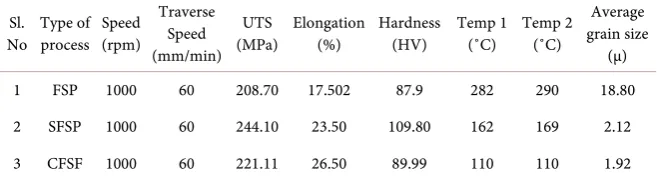
The experimental results obtained are presented in Table 2. The parameters, namely, % elongation and UTS were measured by using a computer interface.
3. Results and Discussion
3.1. Temperature Measurements
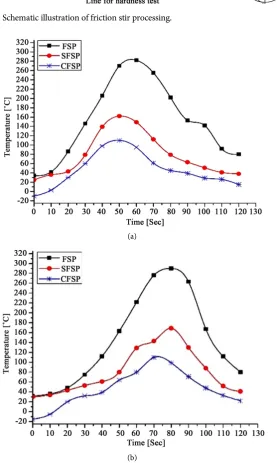
Figure 3 shows the experimental setup of two different locations of the two thermocouples (T1) and (T2). Figure 4(a) and Figure 4(b) provides a compari-son of the temperatures recorded through the in FSP in air, submerged FSP and cryogenic FSP samples at a constant rotational and traverse speed. The graph shows the significant difference between the peak temperatures of the three samples.
DOI: 10.4236/mme.2017.74010 148 Modern Mechanical Engineering
Figure 3. Schematic illustration of friction stir processing.
(a)
(b)
[image:5.595.240.518.230.694.2]DOI: 10.4236/mme.2017.74010 149 Modern Mechanical Engineering Table 2. Microstructure and strength properties of processed under different temperature conditions.
Sl.
No Type of process Speed (rpm)
Traverse Speed (mm/min)
UTS
(MPa) Elongation (%) Hardness (HV) Temp 1 (˚C) Temp 2 (˚C)
Average grain size
(µ) 1 FSP 1000 60 208.70 17.502 87.9 282 290 18.80 2 SFSP 1000 60 244.10 23.50 109.80 162 169 2.12 3 CFSF 1000 60 221.11 26.50 89.99 110 110 1.92
ties [14] [15] [16]. Mishra et al. [17] have observed three significant explana-tions. The first, peak temperature was recorded at the near to SZ and the tem-perature decreased with increasing distance from the stirred zone. Second, the increase temperature at the edge of the stirred zone from the bottom surface of the plate to the top surface. Third, a maximum temperature of 475˚C seen close to the corner between the edge of the stirred zone and the top surface. When submerging in water and cryogenic condition the results demonstrate dramatic changes in the thermal variations in the adapted material. Both reduce the dura-tion for the adapted material above a certain temperature along with the reduc-tion of maximum temperature needed. In the heat treatment, during FSP, both factors are considered as tough aspects. The results show attainment of the low-est peak temperature and time consumed above a certain temperature in cryo-genic cooling condition.
These results are due to the heat absorption capacity of water, which produces good cooling rate [18]. Upadhyay et al. [19] examined the effect of thermal boundaries on friction stir welding. The cooling rate was higher found to be submerged samples compared to those welded in air. Moreover, SFSW samples achieved a grain size smaller than that in air welded samples. Hofmann and Vacchio et al.[20] used submerging as a technique to increase the cooling rate of the sample and decrease the time it is exposed to high temperature.
Thermal conductivity of the material has a permanent impact on the thermal fields of the processed material. High thermal conductivity leads to non-uniform thermal fields along the FSP path temperature showing increase along the path
[21].
3.2. Tensile Strength
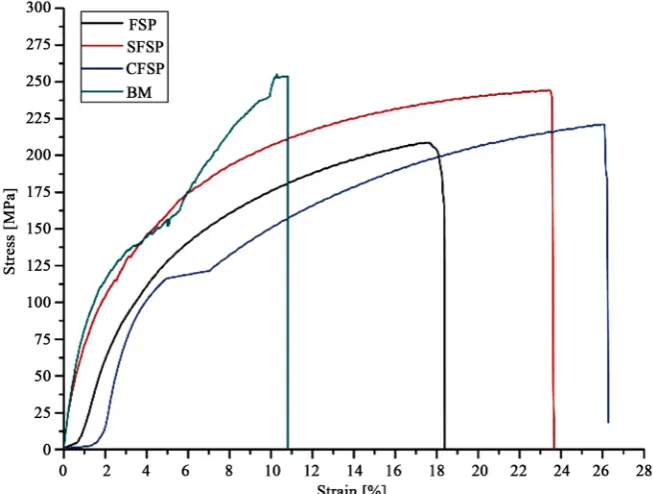
DOI: 10.4236/mme.2017.74010 150 Modern Mechanical Engineering Figure 5. Mechanical properties of BM, FSP, SFSP and CFSP of Stress strain graph.
by FSP leads to unusual Hall-Petch effect. Darras et al. [8] also proved the achievement of a decreasing ultimate tensile strength in the SFSP sample of AZ31B Mg alloy compared to the unprocessed material.
They attributed this to the drastic texture variation during FSP. Figure 6 ex-poses the effects of the strength, hardness and elongation of the test results of three various processed conditions. From the Figure 6 shows the total range of tensile strength, hardness and elongation % of the FSP specimen are 191 MPa, 87 HV and 18.3%, respectively. As for SFSP, those properties increase to 244 MPa, 109 HV and 23.50%. The CFSP properties slightly decrease in tensile strength 221 MPa, 90 HV and increase 26.50% of percentage elongation. The results show SFSP softening the material resulting in small strength and more ductility with implication of better formability at submerged and cryogenic con-ditions. The highest percentage of elongation were achieved at minimum peak temperature of the samples. This concept could be understood by comparing
Figure 4(a) and Figure 4(b).
DOI: 10.4236/mme.2017.74010 151 Modern Mechanical Engineering Figure 6. Tensile strength, elongation % and Hardness of various FSPed condition.
3.3. Macrostructure
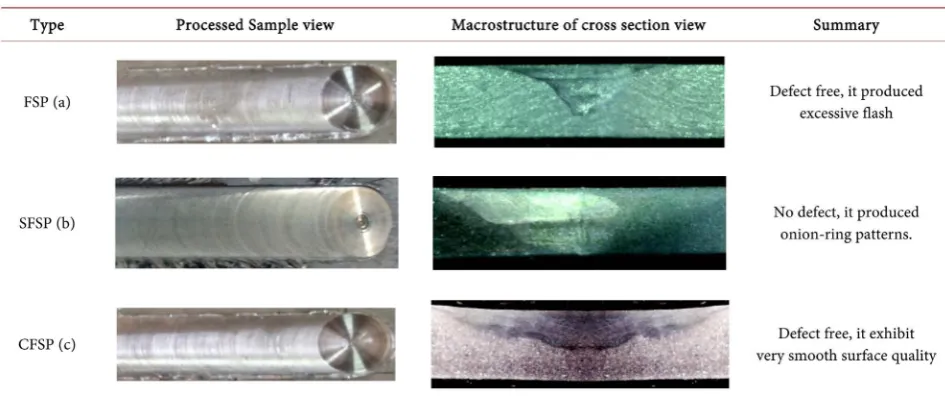
Figure 7 shows the top surface and cross-section appearance of FSP in air, SFSP and CFSP AZ31B magnesium alloys. The figure, shows the processed zone hav-ing good formability and excellent appearance without macro defects such as galling, void and excessive flash. However, in comparison with Figures 7(a)-(c), the FSP specimen is seen creating excessive flash, especially on the retreating side (RS), while the surface of the CFSP AZ31B specimen exhibits very smooth compare to other samples. Ammouri et al.[10] have reported the achievement of the very good surface finish than FSP samples by CFSP samples.
3.4. Micro Hardness
DOI: 10.4236/mme.2017.74010 152 Modern Mechanical Engineering Figure 7. Surface view and traverse cross-section of the FSP, SFSP and CFSP condition.
Figure 8. Micro-hardness curve across the processed zone of FSP, SFSP and CFSP.
of base metal, grain refinement plays an important role in material strengthen-ing, secondly the small particles of intermetallic compounds are also a benefit to hardness improvement [25].
3.5. Microstructure
DOI: 10.4236/mme.2017.74010 153 Modern Mechanical Engineering
(a)
[image:10.595.210.539.65.602.2](b)
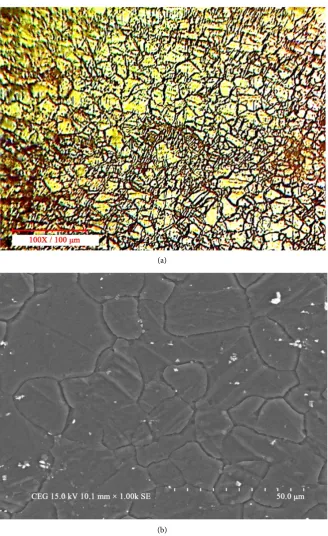
Figure 9. (a) Optical micrographs and (b) SEM images of Received Material.
DOI: 10.4236/mme.2017.74010 154 Modern Mechanical Engineering
DOI: 10.4236/mme.2017.74010 155 Modern Mechanical Engineering
[image:12.595.244.505.67.698.2](ii)
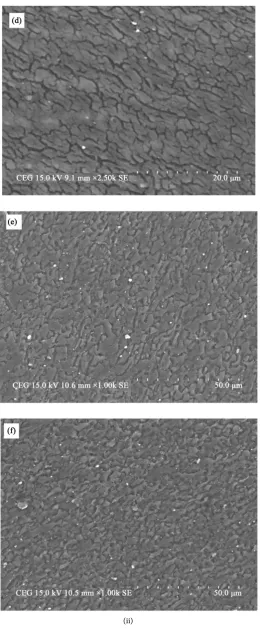
DOI: 10.4236/mme.2017.74010 156 Modern Mechanical Engineering The effect of various temperatures on the resulting microstructure is shown in
Figure 10(d) and Figure 10(f). The average grain sizes attained were 18.8 µm, 2.12 µm and 1.92 µm for FSP in air, submerged in water and cryogenic coolant respectively. The achievement of a larger grain refinement under cryogenic con-dition was palpable. The resulting grain size was affected by temperature. The grain size is smaller when the temperature is lower. It is proved to be related to thermal conditions. As discussed in Section 1, the thermal fields are higher sen-sitive to submerging conditions. They affect not only the peak temperature, but also the time the material spent above a certain temperature. Lower peak tem-perature and less time spent above a certain temtem-perature lead to smaller grain growth and as a result smaller grain size [26] [27]. In a previous study [8], FSP of magnesium alloy AZ31 was conducted in air and submerged in hot and cold water. The peak temperature and time above a reference temperature showed a considerably decrease compared to the sample processed in air.
The sample submerged in cold water achieved the smallest average grain size of 13.3 µm compared to 15.9 µm and 18.9 µm in FSP samples done in hot water and air, respectively. However, the sample processed in hot water achieved the highest ultimate tensile strength and elongation compared to the other two sam-ples. In another study on cryogenic friction stir processing, Ammouri et al. [10]
studied the effects of cryogenic temperature on the microstructure analysis. AZ31B Mg alloy was used in this study where it was FSP in air and FSP in cryo-genic coolant (liquid nitrogen). The result indicates the achievement of finer and a homogeneous microstructure when the cryogenic samples are compared to room temperature.
The received microstructure exhibit a combination of large and small grains while the structure of the processed samples show that the majority of grains have almost the same grain size. The finer and more homogenous grain struc-ture produced by FSP is expected to improve the ductility and formability of the material at elevated temperatures and improve its superplastic behavior.
3.6. Axial Force
DOI: 10.4236/mme.2017.74010 157 Modern Mechanical Engineering Figure 11. Axial forces of FSP, SFSP and CFSP recorded at constant feed rate 60 mm/min and 1000 rpm.
axial force were observed, the maximum tool plunged force were 3800 N, 6100 N and 5600 N for in air, water and cryogenic conditions, consequently. This figure shows, the axial force of the friction stir processed specimens fabricated using cooling is higher than that of the friction stir processed specimen fabricated in air. Moreover, the friction stir processed specimen fabricated using the cooling method of underwater have the highest axial force among other conditions.
The logical conclusion that, by a drop in temperature due to a rise in cooling rate, the FSP axial force increases, whose amount depends on the extent of fall in temperature. This can be attributed to the decrease in material flow when tem-perature drops. Softening of material leading to a decrease in axial force as a re-sult of the temperature rise during FSP is a fact that gained general acceptance. This account for the stagnant grain development of dynamically recrystallized grains, which would explain the development of very fine grains at the processed NZ under cooling conditions which, in turn, were due to the flow of adequate softened material. This may be the reason for the higher elongation and hard-ness of the processed samples under cooling conditions compared to in FSP.
suffi-DOI: 10.4236/mme.2017.74010 158 Modern Mechanical Engineering In this study, Temperature effect and mechanical properties on friction stir processing of AZ31B Mg alloy is investigated by FSP in air, under water and un-der liquid nitrogen. The following conclusions are arrived.
Significant grain refinement and porosity reduction are obtained from the Friction Stir Processed specimens.
Achieving more grain refinement from controlling the thermal boundaries of the process through submerged friction stir processing. It is observed that the specimens were reached at 162˚C temperature during SFSP.
Thermal fields of the processed material are highly affected by CFSP. The temperature arrived for the both conditions is measured to be 110˚C.
FSP improves the elongation of 17.50% for AZ31B Mg alloy. But SFSP is 23.50% and CFSP is 26.50%, which are better than FSP.
Substantial development in the hardness and elongation of the processed material is attained by the grain refinement. The average grain sizes attained were 18.8 µm, 2.12 µm and 1.92 µm for FSP in air, submerged in water and cryogenic conditions respectively. Under cryogenic conditions more grain refinement is achieved.
Axial force has been involved in the development of defects, microstructure and hardness of Nugget zone and consequently tensile strength of FSP of AZ31B magnesium alloy with various processed conditions.
References
[1] Mishra, R.S. and Mahoney, M.W. (2001) Friction Stir Processing: A New Grain Re-finement Technique to Achieve High Strain Rate Superplasticity in Commercial Alloys. Materials Science Forum. Trans Tech Publications, Switzerland, 357-359, 507-514. https://doi.org/10.4028/www.scientific.net/MSF.357-359.507
[2] Senthil Kumar, V.S., Lokesh, R., Rathinasuriyan, C. and Shankar, R. (2015) Multi Response Optimization of Submerged Friction Stir Welding Process Parameters Using TOPSIS Approach. IMECE2015-50353:V02BT02A032.
[3] Cui, G.R., Ni, D.R., Ma, Z.Y. and Li, S.X. (2014) Effects of Friction Stir Processing Parameters and In Situ Passes on Microstructure and Tensile Properties of Al-Si-Mg Casting. Metallurgical and Materials Transactions A, 45, 5318-5331.
https://doi.org/10.1007/s11661-014-2494-8
Ther-DOI: 10.4236/mme.2017.74010 159 Modern Mechanical Engineering
mo-Mechanical and Metallurgical Aspects in Friction Stir Processing of AZ31 Mg Alloy A Numerical and Experimental Investigation. Journal of Materials Processing Technology, 213, 279-290. https://doi.org/10.1016/j.jmatprotec.2012.09.015
[5] Padmanaban, G. and Balasubramanian, V. (2009) Selection of FSW Tool Pin Profile, Shoulder Diameter and Material for Joining AZ31B Magnesium Alloy an Experimental Approach. Materials and Design, 30, 2647-2656.
https://doi.org/10.1016/j.matdes.2008.10.021
[6] Chai, F., Zhang, D.T. and Li, Y.Y. (2015) Microstructures and Tensile Properties of Submerged Friction Stir Processed AZ91 Magnesium Alloy. Journal of Magnesium and Alloys, 3, 203-209.
[7] Cao, G.H., Zhang, D.T., Zhang, W. and Qiu, C. (2015) Microstructure Evolution and Mechanical Properties of Mg-Nd-Y Alloy in Different Friction Stir Processing Conditions. Journal of Alloys and Compounds, 636, 12-19.
https://doi.org/10.1016/j.jallcom.2015.02.081
[8] Darras, B. and Kishta, E. (2013) Submerged Friction Stir Processing of AZ31 Mag-nesium Alloy. Materials and Design, 47, 133-137.
https://doi.org/10.1016/j.matdes.2012.12.026
[9] Surya Prakash Rao, G. and Balunaik, B. (2015) Effect of Liquid Nitrogen on Friction Stir Welded Joint of Magnesium Alloy Az31b. International Journal of Applied En-gineering and Technology, 5, 40-44.
[10] Ammouri, A.H., Kridli, G.T., Ayoub, G. and Hamade, R.F. (2014) Investigating the Effect of Cryogenic Precooling on the Friction Stir Processing of AZ31. Proceedings of the World Congress on Engineering, WCE 2014, 2-4 July 2014, London.
[11] Nomu, V., Devaraju, A. and Shiva Chander, M. (2016) Influence of Liquid Nitrogen Cooling On Microstructure And Mechanical Properties of Friction Stir Welded (FSW) Dissimilar Aa5083-Aa6061 Aluminum Alloy Joints. International Journal of Research in Engineering and Technology, 5, 388-391.
[12] Aruridevarajua, K.V. (2016) Influence of Cryogenic Cooling (Liquid Nitrogen) on Microstructure and Mechanical Properties of Friction Stir Welded 2014-T6 Alumi-num alloy. Materials Today, Proceedings.
[13] Rodrigues, D.M., Loureiro, A., Leitao, C., Leal, R.M., Chaparroa, B.M. and Vilaça, P. (2009) Influence of Friction Stir Welding Parameters on the Microstructural and Mechanical Properties of AA 6016-T4 Thin Welds. Materials and Design, 30, 1913-1921. https://doi.org/10.1016/j.matdes.2008.09.016
[14] Darras, B. (2013) Kishta Submerged Friction Stir Processing of AZ31 Magnesium Alloy. Material and Design, 47, 133-137.
https://doi.org/10.1016/j.matdes.2012.12.026
[15] Rathinasuriyan, C. and Senthil Kumar, V.S. (2016) Modelling and Optimization of Submerged Friction Stir Welding Parameters for AA6061-T6 Alloy Using RSM.
Kovove Mater, 54, 297-304.
[16] Schmidt, H. and Hattel, J. (2005) A Local Model for the Thermomechanical Condi-tions in Friction Stir Welding. Modelling and Simulation in Materials Science and Engineering, 13, 77-93.https://doi.org/10.1088/0965-0393/13/1/006
[17] Colegrove, P., Shercliff, H. and Zettler, R. (2017) A Model for Predicting the Heat Generation and Temperature in Friction Stir Welding from the Material Properties.
Science and Technology of Welding & Joining, 12, 284-297. https://doi.org/10.1179/174329307X197539
DOI: 10.4236/mme.2017.74010 160 Modern Mechanical Engineering Manufacturing, 1969-1974.
[23] Hung, F., Shih, C., Chen, L. and Lui, T. (2007) Microstructures and High Tempera-ture Mechanical Properties of Friction Stirred AZ31-Mg Alloy. Journal of Alloys and Compounds, 428, 106-114.https://doi.org/10.1016/j.jallcom.2006.03.066
[24] Chai, F., Zhang, D. and Li, Y. (2014) Effect of Thermal History on Microstructures and Mechanical Properties of AZ31 Magnesium Alloy Prepared by Friction Stir Processing. Journal of Materials Science, 7, 1573-1589.
[25] Padmanaban, G. and Balasubramanian, V. (2009) An Experimental Investigation on Friction Stir Welding of AZ31B Magnesium Alloy. International Journal of Ad-vanced Manufacturing Tech, 49, 111-121.
[26] Xie, G.M. (2011) Effect of Rotation Rate on Microstructures and Mechanical Prop-erties of FSW Mg-Zn-Y-Zr Alloy Joints. Journal of Materials Science & Technology, 27, 1157-1164.https://doi.org/10.1016/S1005-0302(12)60012-7
[27] Zhang, Z. and Zhang, H.W. (2009) Numerical Studies on Controlling of Process Parameters in Friction Stir Welding. Journal of Materials Processing Technology, 209, 241-270.https://doi.org/10.1016/j.jmatprotec.2008.01.044
[28] Sutton, M., Yang, B., Reynolds, A. and Taylor, R. (2002) Microstructural Studies of Friction Stir Welds in 2024-T3 Aluminum. Materials, Science, Engineering, 323, 160-166.
[29] Razal Rose, A., Manisekar, K. and Balasubramanian, V. (2011) Effect of Axial Force on Microstructure and Tensile Properties of Friction Stir Welded AZ61A Magne-sium Alloy. Transactions of Nonferrous Metals Society of China, 21, 974-984. https://doi.org/10.1016/S1003-6326(11)60809-1