215
Continuous Annotation Quality Control, Support for Hierarchically
Structured Label Sets and Long-Segment Annotation with W
AT-S
L2.0
Christina Lohr,?Johannes Kiesel,◦ Stephanie Luther,?Johannes Hellrich,?
Benno Stein,◦Udo Hahn?
?Jena University Language & Information Engineering Lab (JULIE Lab), Friedrich-Schiller-Universit¨at Jena, Jena, Germany,<firstname.lastname>@uni-jena.de
◦Faculty of Media,
Bauhaus-Universit¨at Weimar, Weimar, Germany,<firstname.lastname>@uni-weimar.de
Abstract
Today’s widely used annotation tools were designed for annotating typically short tex-tual mentions of entities or relations, making their interface cumbersome to use for long(er) stretches of text, e.g, sentences running over several lines in a document. They also lack systematic support for hierarchically struc-tured labels, i.e., one label being conceptually more general than another (e.g.,anamnesisin relation to family anamnesis). Moreover, as a more fundamental shortcoming of today’s tools, they provide no continuous quality con-trol mechanisms for the annotation process, an essential feature to intrinsically support iterative cycles in the development of annota-tion guidelines. We alleviated these problems by developing WAT-SL2.0, an open-source web-based annotation tool for long-segment labeling, hierarchically structured label sets and built-ins for quality control.
1 Introduction
In the course of large-scale annotation campaigns on medical full-text corpora, we encountered several shortcomings of the current generation of annotation tools.Labeling long-spanning text seg-ments (e.g., entire sentences or even paragraphs) is a major issue here that is only insufficiently supported by general purpose open-source anno-tation tools (M¨uller and Strube, 2006; Stenetorp et al., 2012; Bontcheva et al., 2013; Rak et al.,
2014;Yimam et al.,2014) which typically aim at annotating (much) shorter text spans for entities and relations. This is especially troublesome given the increasing availability of full texts and even books as input for annotation projects.
With annotation schemes becoming more and more conceptually structured, we also faced
prob-lems with the lack of systematic support for
hierarchically structured tag labels where one label is semantically more general than another (e.g., the general taganamnesisin relation to more specific ones likefamily anamnesis).
Finally, and this point addresses a more general design desideratum, we encountered a substantial lack of continuousquality controlmechanisms in the majority of annotation tools (the WASA tool (AlGhamdi and Diab, 2018) is one of the rare exceptions and shares several design goals with WAT-SL 2.0). This shortcoming requires an-notation project managers to reach for external tools for statistical evaluation. As a consequence, shifting back and forth between annotation and evaluation environments slows down the overall progress of the entire annotation project and ham-pers iterative refinement of annotation guidelines. Yet, a close technical coupling of such test-development cycles withinoneintegrated platform is a particularly fruitful strategy in complex anno-tation campaigns.
As a remedy for these problems, we here present WAT-SL 2.0, an open sourceweb-based
annotation tool for segment labeling, hierarchi-cally structured label sets and built-ins for quality control that is available under the MIT License.1It provides a live view on each annotator’s progress on assigned documents and document sets and features Krippendorff’s α (Krippendorff, 1970) for agreement statistics. WAT-SL 2.0 is based on WAT-SL, the Web Annotation Tool for Segment Labeling (Kiesel et al.,2017).
WAT-SL 2.0 was successfully employed in an on-going annotation project comprising
guide (re)definition
tool configuration
staff instruction
annotation work agreement
[image:2.595.72.292.60.256.2]computation discussion
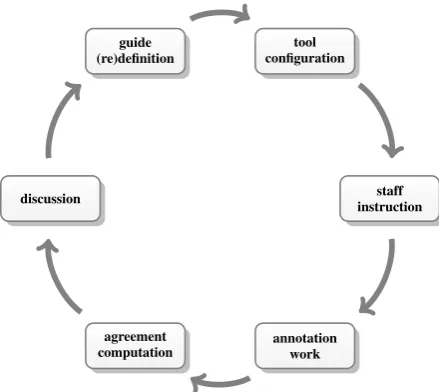
Figure 1: Enhanced annotation life cycle model (based onPustejovsky and Stubbs(2012)’s four-step model).
mately 1K German clinical reports (Lohr et al.,
2018;Hahn et al., 2018). The segment labeling subtask (see Section 4) of this project could not have been accomplished without WAT-SL 2.0’s novel features and its new interface functionality.
Annotating large corpora typically requires multiple iterations to refine annotation guidelines and train annotators. This can be illustrated by the enhanced annotation life cycle model in Figure1. Given a data collection, first an annotation guide has to be (re-)defined. Next annotation tools are configured to support the proper application of these guidelines and annotation staff is trained on them. After that the main annotation process is started and its outcome is evaluated. Finally, the overall process should be discussed by the annotation team and future iterations can be run with changed annotation guidelines and retraining, thus reflecting the experience from earlier cycles.
2 Basic Design of the Annotation Tool
WAT-SL 2.0’s basic design follows WAT-SL 1.0 in providing a highly customizable and extensible interface for the annotation of full texts. It is implemented with a JAVA back-end and a Web-based front-end making it highly compatible with different environments and easy to customize. Plain text files are used as input, each line containing one segment for labeling. Results as well as logging information (e.g., time stamps) are stored in key-value files. These easy to process formats made WAT-SL1.0 already well-suited for large-scale annotation projects and were further extended by us as described in Section3.3.
The user interface provides annotators not only with a single document view for on-going anno-tation, but also with an overview page showing their upcoming and finalized tasks, as well as their progress so far—annotators in our clinical anno-tation project (see Section 4) found this feature particularly favorable to increase their motivation. Last but not least, WAT-SL2.0 provides two novel administrative views (see next section) showing the progress of all annotators, as well as their agreement on specific documents.
3 Novel Features of the Annotation Tool
WAT-SL 2.0 has more advanced features—both for supporting the annotation process, as well as for servicing quality control concerns—than WAT-SL, its predecessor described byKiesel et al.
(2017), and many other tools widely used in the annotation community, BRAT (Stenetorp et al.,
2012), in particular. Its features support both annotators and project managers to allow for faster and easier annotation and monitoring.
3.1 Advanced Annotation Functionality
WAT-SL2.0 was extended with several features to allow for the large-scale annotation of documents with longer text passages using a large number of different labels.
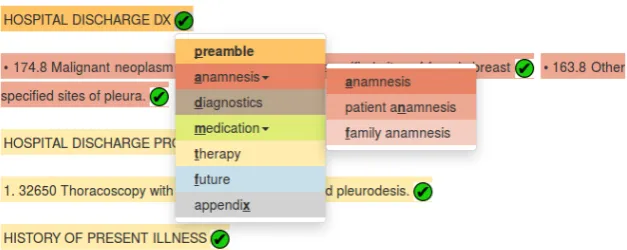
We added support for hierarchically structured label sets for conceptually more adequate model-ing of complex domains, such as clinical activities. Figure 2 shows the drop-down menu used to either directly select a label without sublabels (e.g., preamble) or a label with sublabels, such as the selected anamnesis tag. Selecting a label with sublabels prompts another drop-down menu to appear providing access to all the sublabels of the selected superlabel (e.g., selecting the super-labelanamnesis yields access to its conceptually more specialized sublabelspatient anamnesisand
family anamnesis).
Figure 2: Sublabels ofanamnesistag in a secondary drop-down menu shown when the user clicks on the superlabel anamnesis; the bold and underlined letters display the shortcuts of the labels.
Following annotator feedback during early it-erations of our annotation project, we also in-troduced keyboard shortcuts for each label, thus increasing both annotation speed and convenience of use. The shortcut key for each label is defined as part of WAT-SL 2.0’s configuration file. The annotation drop-down menu provides both a mouse-based option to perform annotations, as well as typographic indicators for the relevant shortcuts as part of individual label names. To further support keyboard-based operation, we also introduced another shortcut (bound to the tabulator key) to select the next segment for annotation. We found these shortcuts to speed up the entire annotation process considerably, especially when labels change infrequently in long stretches of text (see Section4for details).
3.2 Annotation Monitoring & Quality Control
We also added advanced features for continuous progress monitoring and quality control. A single administrative interface (see Figure3(a)) provides annotator-specific progress reports, i.e., task and segment completion, as well as time spent on each task, and an option to take the role of any single annotator. The latter feature allows inspection and correction (logging provided for correct at-tribution) of individual segment annotations. We also provide a task-specific progress report for each annotator (see Figure3(b)) to support more fine-grained monitoring.
Finally, we added continuous quality monitor-ing as a task-oriented, yet annotator-agnostic view. As shown in Figure 4, this feature provides data on the progress of each annotation task and inter-annotator agreement values of the tasks completed by all annotators. Krippendorff’sα(Krippendorff,
1970) is the metric of choice in WAT-SL 2.0 for measuring the chance-corrected overlap in
anno-tation decisions. Following Artstein and Poesio
(2008), we prefer it over a range of alternative measures, like Cohen’s κ (Cohen, 1960), which are overly sensitive to individual annotators’ deci-sions when modeling chance agreement.
Based on such kind of statistical evidence, continuous quality monitoring allows annotation project managers to assess the difficulty of tasks, allowing for a swift refinement of annotation guidelines. This feature was implemented by calculating coincidence matrices for each task with DKPROAGREEMENT(Meyer et al.,2014).
3.3 Export format
WAT-SL 2.0 also provides extended export func-tions to increase interoperability. In addition to WAT-SL 1.0’s key-value export format, we also provide CSV files well-suited as input for machine learning tools. Furthermore, we provide an export option compatible with the widely used BRAT tool, i.e., ANN files similar to the format used in the BioNLP Shared Task.2This increased interop-erability was vital for our multi-level annotation project described in the next section.
4 Clinical Annotation Project
We employed WAT-SL 2.0 in a large-scale anno-tation project aiming at the creation of a reference corpus of German clinical language (Hahn et al.,
2018). We annotated approximately 1K clinical documents with around 170K text segments (Lohr et al.,2018). This project covers multiple linguis-tic layers in addition to text segments, such as named entities (e.g., medications, diseases, etc.) and their relations (e.g., drug-drug interactions, temporal relations between clinical episodes, etc.).
2http://2011.bionlp-st.org/home/
(a) (b)
Figure 3: Project manager’s view of progress tracking—(a) by annotator and (b) by task for a single annotator. Columns show the progress in relation to tasks and segments, the time spent and a button to log in as individual annotator (for corrections).
Figure 4: Progress monitoring by tasks and display of Inter-Annotator-Agreement. Columns show the progress in tasks, segments and Krippendorff’sα.
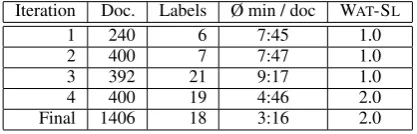
Section annotations were performed by up to eight medical students supervised by two anno-tation managers with a computer science back-ground and further advised by clinical doctors. We iteratively developed and refined guidelines for annotating segments in accordance with existing clinical requirements and standards (see Table1). We experimented with up to 21 different labels during early exploratory iterations, but finally decided on 18 labels (including 7 hierarchical sublabels) for the final annotation round.
The first three iterations were run with the original version of WAT-SL. However, based on consistent feedback from our annotators, a desire for continuous quality control and faster
Iteration Doc. Labels Ø min / doc WAT-SL
1 240 6 7:45 1.0
2 400 7 7:47 1.0
3 392 21 9:17 1.0
4 400 19 4:46 2.0
Final 1406 18 3:16 2.0
Table 1: Details for each annotation iteration. The total number of documents is inflated due to multiple anno-tations (by eight annotators) for agreement calculation.
iterations became obvious. Hence, we decided to implement WAT-SL 2.0. Our interface improve-ments contributed—probably together with a gen-eral training effect—to halving average annotation times per document from approximately 9 minutes to less than 4 minutes. Overall, our improvements clearly increased the general usability of WAT-SL and were vital for the success of our project by increasing annotation quality (effectiveness) and speed (efficiency).
5 Conclusions
We here presented WAT-SL 2.0, a Web-based tool for annotating long texts with (hierarchical) segment labels and built-in facilities for quality measurement. It provides annotators with individ-ual progress overviews, label shortcuts and hierar-chically structured label sets which help increase motivation, quality and speed for task completion. Alternative annotation tools (e.g., BRAT ( Stene-torp et al., 2012) as a main representative) are mostly ill-suited for applying a large amount of labels to text segments, as they use mouse-based selection of arbitrary text spans (more suited for short-spanning entities and relations) and are thus prone to miss-clicks or lack support for both hierarchical and larger numbers of labels to select. WAT-SL 2.0’s unique elaborated monitoring device includes means for in-depth logging, anno-tation complexity analysis and continuous quality control. These features allow project managers to make more informed decisions when updating annotation guidelines or evaluating annotators.
[image:4.595.77.286.640.707.2]Acknowledgements
This work was partially supported by the Deutsche Forschungsgemeinschaft (DFG) under grants HA 2097/8-1 within the STAKI2B2project (Semantic Text Analysis for Quality-controlled Extraction of Clinical Phenotype Information within the Framework of Healthcare Integrated Biobanking) and the German Federal Ministry of Education and Research (BMBF) within the SMITH project under grant 01ZZ1803G.
References
Fahad AlGhamdi and Mona T. Diab. 2018. WASA: a Web application for sequence annotation. In LREC 2018 — Proceedings of the 11th International Conference on Language Resources and Evaluation. Miyazaki, Japan, May 7-12, 2018, pages 1073– 1077, Paris. European Language Resources Associ-ation (ELRA).
Ron Artstein and Massimo Poesio. 2008. Inter-coder agreement for computational linguistics. Computa-tional Linguistics, 34(4):555–596.
Kalina Bontcheva, Hamish Cunningham, Ian Roberts, Angus Roberts, Valentin Tablan, Niraj Aswani, and Genevieve Gorrell. 2013. GATE TEAMWARE: a Web-based collaborative text annotation framework. Language Resources and Evaluation, 47(4):1007– 1029.
Jacob Cohen. 1960. A coefficient of agreement for nominal scales. Educational and Psychological Measurement, 20(1):37–46.
Udo Hahn, Franz Matthies, Christina Lohr, and Markus L¨offler. 2018. 3000PA: towards a national reference corpus of German clinical language. In MIE 2018 — Proceedings of the 29th Conference on Medical Informatics in Europe. Building Continents of Knowledge in Oceans of Data: The Future of Co-Created eHealth. Gothenburg, Sweden, 24-26 April 2018, number 247 in Studies in Health Technology and Informatics, pages 26–30, Amsterdam, Berlin, Washington, D.C. IOS Press.
Johannes Kiesel, Henning Wachsmuth, Khalid Al-Khatib, and Benno Stein. 2017. WAT-SL: a customizable Web annotation tool for segment la-beling. In EACL 2017 — Proceedings of the 15th Conference of the European Chapter of the Association for Computational Linguistics: Soft-ware Demonstrations. Valencia, Spain, April 5-6, 2017, pages 13–16, Stroudsburg/PA. Association for Computational Linguistics (ACL).
Klaus Krippendorff. 1970. Estimating the reliabil-ity, systematic error and random error of interval data. Educational and Psychological Measurement, 30(1):61–70.
Christina Lohr, Stephanie Luther, Franz Matthies, Luise Modersohn, Danny Ammon, Kutaiba Saleh, Andreas Henkel, Michael Kiehntopf, and Udo Hahn. 2018. CDA-compliant section annotation of German-language discharge summaries: guideline development, annotation campaign, section classi-fication. In AMIA 2018 — Proceedings of the 2018 Annual Symposium of the American Medical Informatics Association. Data, Technology, and Innovation for Better Health. San Francisco, Cali-fornia, USA, November 3-7, 2018, pages 770–779.
Christian M. Meyer, Margot Mieskes, Christian Stab, and Iryna Gurevych. 2014. DKPRO AGREEMENT: an open-source JAVA library for measuring inter-rater agreement. InCOLING 2014 — Proceedings of the 25th International Conference on Computa-tional Linguistics: System Demonstrations. Dublin, Ireland, August 25-26, 2014, pages 105–109. Inter-national Committee on Computational Linguistics (ICCL).
Christoph M¨uller and Michael Strube. 2006. Multi-level annotation of linguistic data with MMAX2. In Sabine Braun, Kurt Kohn, and Joybrato Mukherjee, editors, Corpus Technology and Language Peda-gogy. New Resources, New Tools, New Methods, number 3 in english corpus linguistics, pages 197– 214. Peter Lang, Frankfurt a.M., Germany.
James D. Pustejovsky and Amber Stubbs. 2012. Natural Language Annotation for Machine Learn-ing. A Guide to Corpus-Building for Applications. O’Reilly Media, Sebastopol/CA.
Rafal Rak, Jacob Carter, Andrew D. Rowley, Riza Theresa Batista-Navarro, and Sophia Anani-adou. 2014. Interoperability and customisation of annotation schemata in ARGO. In LREC 2014 — Proceedings of the 9th International Conference on Language Resources and Evaluation. Reykjavik, Iceland, May 26-31, 2014, pages 3837–3842. Euro-pean Language Resources Association (ELRA).
Pontus Stenetorp, Sampo Pyysalo, Goran Topi´c, Tomoko Ohta, Sophia Ananiadou, and Jun’ichi Tsu-jii. 2012. BRAT: a Web-based tool for NLP-assisted text annotation. In EACL 2012 — Proceedings of the 13th Conference of the European Chapter of the Association for Computational Linguistics: Demonstrations. Avignon, France, April 25-26, 2012, pages 102–107, Stroudsburg/PA. Association for Computational Linguistics (ACL).