http://www.scirp.org/journal/jss ISSN Online: 2327-5960
ISSN Print: 2327-5952
DOI: 10.4236/jss.2017.510012 Oct. 13, 2017 128 Open Journal of Social Sciences
A Chinese Product Feature Extraction Method
Based on KNN Algorithm
Biao Ma, Haiyan Chen
The Glorious Sun School of Business and Management, Donghua University, Shanghai, China
Abstract
The product feature set of online reviews obtained by the current product feature extraction methods has a low coverage rate of review information. In order to solve this problem, this paper proposes a method of product feature extraction based on KNN algorithm. We establish the classification system of product feature set firstly. Then we extract part of product features as training set manually, and according to similarity between words and the classification system, the product features of all reviews are quickly classified and extracted. At last, the PMI algorithm is used to filter and supplement it to improve the correct rate and the review information coverage rate of product feature set. Through the examples of online clothing reviews data in the Taobao platform, we prove that this method can effectively improve the review information coverage rate of product feature set.
Keywords
Product Features, KNN Algorithm, Review Information Coverage Rate, Online Reviews
1. Introduction
With the rapid development of the Internet economy, the amount of data on the network review is growing. The huge amount of comment data makes it neces-sary for consumers to spend a lot of time to find interesting contents. Comment mining is an important tool for dealing with massive reviews [1]. And product feature extraction is the core part of Reviews’ mining. For taking advantage of the full information of comment features for further analysis, artificial extraction of product features is accurately and completely from reviews, but it will take a lot of time and efforts. Therefore, this paper first manually extracts part of the product features and then uses the KNN algorithm to extract all product feature How to cite this paper: Ma, B. and Chen,
H.Y. (2017) A Chinese Product Feature Extraction Method Based on KNN Algo-rithm. Open Journal of Social Sciences, 5, 128-138.
https://doi.org/10.4236/jss.2017.510012
DOI: 10.4236/jss.2017.510012 129 Open Journal of Social Sciences from reviews. This method can obtain higher product feature information at less time and labor cost.
Now the methods of product feature extraction are mainly divided into two categories: manual definition and automatic extraction. Song X. L., Wang S. G. and Li H. X. used supervised learning method to extract product features. Firstly, the text pattern defined manually constitute a collection of seeds, and then the product name and product characteristics are extracted by Bootstrap-ping algorithm [2]; Yao T. F., Nie Q. Y., Li J. C., Li L. L., Lou D.C., Chen K. et al. used ontology knowledge to establish the field of automotive product features set [3]; Titov, Ivan, McDonald and Ryan proposed a multi-granularity LDA model that avoids the problem that the topic meaning in the LDA model cannot be de-termined and applied it to the subject’s emotional digest generation system [4]; Liu, J., Wu, G. and Yao, J. proposed the extraction of opinion examples and es-tablished relevant domain knowledge to complete the simultaneous extraction of feature items and emotion words [5]; Hu M and Liu B. firstly proposed the asso-ciation rule classification method-Apriori algorithm to extract the candidate set of product features, and then extracts the product features in English reviews [6]; Li S., Ye Q., Li Y. J. and Rob L. referred to Hu et al. research and proposed product feature extraction method of Chinese text review based on Apriori algo-rithm according to the Chinese language characteristics [7] [8]. To reduce the information noise generated by Li et al. method, Wang Y., Zhang Q. and Yang X. J. put forward a FP increasing algorithm which is much higher than Apriori algorithm. He considered the semantic relation between product and attribute to filter the candidate product feature set and then improved the accuracy rate [9]. The above methods did an improvement in the accuracy and recall rate, but these methods didn’t consider that the extracted product features cover the rate of comment information. This paper proposes a method of product feature ex-traction based on KNN algorithm, which can effectively improve the product feature set’s coverage rate of review information based on ensuring correct rate.
2. Proposed Method
This paper proposes a method of product feature extraction based on KNN algo-rithm, which can effectively improve the product feature set’s coverage rate of review information. Firstly, we extract part of product features as training set manually, and according to similarity between words and the classification sys-tem, the product features of all reviews are quickly classified and extracted. Fi-nally, the PMI algorithm is used to filter candidate product feature set and get the final product features.
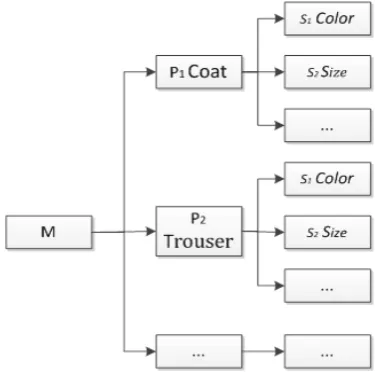
DOI: 10.4236/jss.2017.510012 130 Open Journal of Social Sciences also establish the characteristic system for other aspects (such as logistics, service and so on) and the process is same. The product characteristic classification sys-tem divides into two levels syssys-tem. The first level is the product classification P. A product category can be an indicator, and multiple product classes can be merged into one indicator according to the specific business scenarios. The second level is the product’s indexes of manufacturer’s definition S, S { ,= s s1 2,…, }sn , where n represents the number of indicators. We assume that the user’s descrip-tions of the product features are within the scope of the vendor’s description. If the customers’ comments about the product characteristics are not within the scope of the firm’s defined indexes when the training set is set up by using the KNN method, the second-level indexes will be supplemented accordingly. Take coat and trouser as an example, according to the manufacturer’s definition in-dexes including color, size and so on, so we can get the characteristic classifica-tion system of this product, as shown in Figure 1.
[image:3.595.278.466.521.707.2]2.2. Extracting Product Feature Sets Based on KNN Algorithm After establishing the classification system of product features, the product fea-ture set is extracted by using the KNN algorithm. The central idea of the KNN algorithm is that if the majority of the k most adjacent samples of one sample in the feature space belong to a particular category, this sample also belongs to this class. First, we classify part of the candidate feature sets manually according to the classification system, and classify the unclassified candidate feature sets by computing the similarity between the unclassified candidate product features and the already classified features. The feature set of the product is characterized by the noun. After the noun is extracted, the training set and the test set are es-tablished according to the product characteristic classification system M. We use the synonym forest of Harbin University of engineering to calculate the similar-ity between words and class and extract product features. The specific process is as follows:
DOI: 10.4236/jss.2017.510012 131 Open Journal of Social Sciences The first step: word segment and POS tagging
We firstly use the Chinese Institute of Computing Technology Institute Chi-nese segmentation tool ICTCLAS for word segmentation and POS tagging of the original review corpus before feature extraction to build the set related with noun including{/an, /ng, /n, /nr, /ns, /nt, /nz, /vn}. This paper selects set N_0 of the nouns and gerunds {/n, /vn} for the subsequent experimental verification and then filter the stop words to get the candidate feature set I0.
The second step: manually labeling training set and test set respectively We randomly select some items from the candidate feature set
{
}
0 1, 2, , m
I = word word … word (M is the number of words in the candidate
fea-ture set) as training set I1=
{
word word1, 2,…,worda}
(a is the number ofwords in the training set), i.e. I1∈I0andi<m. According to the classification
system of product characteristics established by 2.1, I1 can be classified
ma-nually, so we can obtain:
(
)
(
)
(
)
1
1 11 1 1 2
1 1
P { , , , , , , , , ,
, , , }
j i
n
m i i im m
n n m
s word word s word word word
s word word
= … … … …
… …
where wordimj denotes the 𝑚𝑚𝑗𝑗-th word of the i-th index and mi denotes the number of words contained in the i-th index. Example 1: Selected training set
1 sam
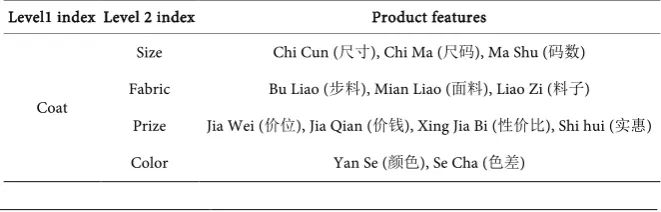
I − = {Chi Cun (尺寸), Bu Liao (布料), Yan Se (颜色), Jia Wei (价位), Hao Ma (号码), Mian Liao (面料), Shi Hui (实惠), Jia Qian (价钱), Liao Zi (料子), Se
Cha (色差), Xing Jia Bi (性价比)}. According to the previously established
product characteristics classification system P, Isam−1 can be classified manually
as shown in Table 1.
We also randomly select some items from the initial candidate feature set I0
as test set I2=
{
worda+1,worda+2,…,worda b+}
(b is the number of words in thetest set), i.e. I2∈I0anda+ <b m. According to the classification system of
product characteristics established by 2.1, I2 can be classified manually.
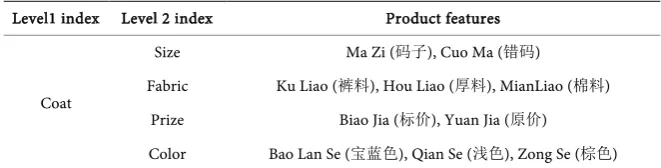
Exam-ple 1: Selected test set Isam−2 = {Cuo Ma (错码), Bao Lan Se (宝蓝色), Ku Liao
(裤料), Biao Jia (标价), Zong Se (棕色), Ma Zi (码子), Yuan Jia (原价), Qian Se
(浅色), Mian Liao (面料), Hou Liao (厚料)}. According to the previously
estab-lished product characteristics classification system P, Isam−2) can be classified
manually as shown in Table 2.
[image:4.595.208.539.633.739.2]The Third step: Using the synonyms of Harbin Institute of Technology to classify words
Table 1. Manually classification results of training set in Example 1.
Level1 index Level 2 index Product features
Coat
Size Chi Cun (尺寸), Chi Ma (尺码), Ma Shu (码数) Fabric Bu Liao (步料), Mian Liao (面料), Liao Zi (料子)
Prize Jia Wei (价位), Jia Qian (价钱), Xing Jia Bi (性价比), Shi hui (实惠)
DOI: 10.4236/jss.2017.510012 132 Open Journal of Social Sciences Table 2. Manually classification results of test set in Example 1.
Level1 index Level 2 index Product features
Coat
Size Ma Zi (码子), Cuo Ma (错码)
Fabric Ku Liao (裤料), Hou Liao (厚料), MianLiao (棉料)
Prize Biao Jia (标价), Yuan Jia (原价)
Color Bao Lan Se (宝蓝色), Qian Se (浅色), Zong Se (棕色)
After setting up training sets I1, we calculate the similarity d between the
words wordt in the test set I2 and the words wordimj in the training set I1.
The calculation of similarity is as follows:
Sim( , )
j j
im t im t
d = word word
where wordimj∈I1, wordt∈I2, dim tj indicates the similarity between wordimj and wordimj, Sim (a, b) indicates the similarity between word a and word b. If the maximum similarity between the word wordt and all the words in the training set is greater than the corresponding threshold value f, i.e.
max(dim tj)> f , the words wordt belongs to the product feature words and the index i of the word wordt is same with the index of the word wordimj in the training set that have the maximum similarity with the word 𝑤𝑤𝑤𝑤𝑤𝑤𝑤𝑤𝑡𝑡. If the maximum similarity between the word wordt and all the words in the training set is lower than the corresponding threshold value f, i.e. max(dim tj)< f ,the
word wordt does not belong to the product feature words. The method is used to judge whether each word in the test set belongs to the product feature set. If it belongs to the product feature word, this method can be classified directly. Then we can get the initial product feature set I3.
In this paper, we use the similarity calculation method based on synonym word forest proposed in [10] to calculate the similarity between words. The si-milarity of words is expressed by Sim, and is calculated as follows:
1) If the two items are not on the same tree
Sim(A, B)=0.1
2) If the two items are on the same tree a) If the two items are on the second branch
(
)
1Sim A, B 0.65 cos
180
n k n
n
π − +
= × ×
b) If the two items are on the third branch
(
)
1Sim A, B 0.8 cos
180
n k n
n
π − +
= × ×
c) If the two items are on the fourth branch
(
)
1Sim A, B 0.9 cos
180
n k n
n
π − +
= × ×
DOI: 10.4236/jss.2017.510012 133 Open Journal of Social Sciences
(
)
1Sim A, B 0.96 cos
180
n k n
n
π − +
= × ×
where n is the total number of nodes in the branch layer, and k is the distance between the two branches.
Through the above method, the test set I2 uses the training set I1 to
classi-fy. By modifying the training set, we classify the candidate feature sets I0 and
then generate the initial product feature set I3. In example 1, the classification
results by using the synonyms of Harbin Institute of Technology are consistent with those in the second step.
2.3. Filtering I3 by the PMI Algorithm
The 2.2 Section used the KNN algorithm to extract and classify the features ac-cording to the similarity between words. Though the above method can quickly extract product information, the similarity of some words and words in the training set is very high and these words do not belong to product features. In the Example 1, the similarity between the word “chi cun” and the word “shen cai” is 0.99999, which exceeds the threshold of 0.9999, so the word “shen ti” be-long to level 2 indicator “size”. In fact, the word “shen ti” does not bebe-long to lev-el 2 indicator “size”. So to improve the accuracy of product features, this paper uses PMI algorithm to filter I3.
Popescu, AnaMaria, Etzioni and Oren are based on the following hypothesis: the more frequent co-occurrence of two words, the higher the correlation be-tween them, so Popescu proposed a point mutual information PMI method to extract product features [11]. Wang et al use the PMI algorithm based on Web search engine to filter product features. PMI values are calculated as follows.
(
)
(
)
(
) (
) (
)
3
3 2
3 PMI level 1 indicator, level 2 indicator,
level 1 indicator and and level 2 indicator
level 1 indicator level 2 indicator
I
hit I
log
hit hit hit I
= “ ” “ ” “
“
”
“ “
” ” ”
where hit (x) is the number of pages returned by the search engine using the “x” as keywords, and Hit (x and y) is the number of pages returned at the same time using “x” and “y” as keywords.
The subject of this paper is the product features in the review; we first consid-er the covariance of the two words based on a large numbconsid-er of comment sets. This paper calculates co-occurrence degree between the second indicators and the initial feature set I3, in which hit (x) is the number of comments returned
DOI: 10.4236/jss.2017.510012 134 Open Journal of Social Sciences This paper computes the co-occurrence degree -PMI values between level 1 indictors, level 2 indictors and the initial feature set I3 to filter the initial
product feature set I3 based on Web search engine, and sorts PMI value. We
set the corresponding threshold to filter the initial product feature set I3, and
get the final product feature set I4.
2.4. Research Process The specific process is as follows:
1) Establishing the product characteristic classification system M based on manufacturer defined product metrics.
2) The extraction of product feature sets based on KNN algorithm mainly in-cludes the following steps:
a) Use word segmentation tool for segment comments and part of speech tag-ging;
b) Filter the stop words and punctuation marks, extract the noun and gerund in the comment and get the candidate feature set I0;
c) Establish and classify training set I1 manually according to product
fea-ture classification system and I0;
d) Build the test set I2, and manually classify I2;
e) Use the KNN classification algorithm, calculate the distance between words by the synonyms forest and classify I2 by setting the threshold;
f) Classify the candidate product feature set I0 using KNN algorithm after
getting the highest accuracy of the test set I2 by constantly modifying the
training set.
3) Filtering the product feature sets of each classification based on PMI algo-rithm
Compute the co-occurrence degree -PMI values between level 1 indictors, lev-el 2 indictors and the initial feature set I3 using the PMI algorithm based on
Web search engine and sorts PMI value. We set the corresponding threshold by to filter the initial product feature set I3, and get the final product feature set
4
I .
3. Experimental Results and Performance Assessment
3.1. Data Set
This paper uses the python web crawler from Tian Mao website
(https://www.tmall.com) to crawl review information of one clothing brand from December 2016 to February 2017. The review information includes the us-er’s Name, date of comment, comment content. After establishing the product characteristic classification system M, we select part of the candidate feature set
0
I as I1. We manually classify the training set I1 according M. The training
DOI: 10.4236/jss.2017.510012 135 Open Journal of Social Sciences Table 3. The lexical information contained in the training set and the test set.
Set The number of words
the training set 365
the test set 365
the initial candidate feature set 1219
Table 4. Artificially classified information of the training set.
Level1
index Level 2 index Artificially classified product features
The number of Artificially
classified product features
The coat and trousers
of a certain brand of clothing
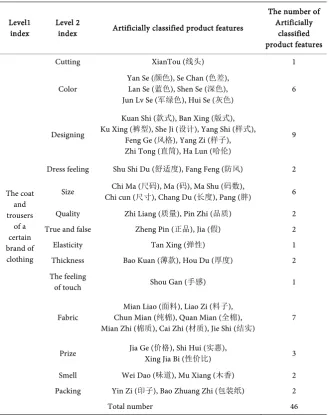
Cutting XianTou (线头) 1
Color
Yan Se (颜色), Se Chan (色差), Lan Se (蓝色), Shen Se (深色),
Jun Lv Se (军绿色), Hui Se (灰色) 6
Designing
Kuan Shi (款式), Ban Xing (版式),
Ku Xing (裤型), She Ji (设计), Yang Shi (样式), Feng Ge (风格), Yang Zi (样子),
Zhi Tong (直筒), Ha Lun (哈伦)
9
Dress feeling Shu Shi Du (舒适度), Fang Feng (防风) 2
Size Chi cun (Chi Ma (尺寸尺码), Chang Du (), Ma (码), Ma Shu (长度), Pang (码数), 胖) 6
Quality Zhi Liang (质量), Pin Zhi (品质) 2 True and false Zheng Pin (正品), Jia (假) 2 Elasticity Tan Xing (弹性) 1 Thickness Bao Kuan (薄款), Hou Du (厚度) 2 The feeling
of touch Shou Gan (手感) 1
Fabric Mian Liao (
面料), Liao Zi (料子),
Chun Mian (纯棉), Quan Mian (全棉), Mian Zhi (棉质), Cai Zhi (材质), Jie Shi (结实)
7
Prize Jia Ge (Xing Jia Bi (价格), Shi Hui (性价比实惠) ), 3
Smell Wei Dao (味道), Mu Xiang (木香) 2 Packing Yin Zi (印子), Bao Zhuang Zhi (包装纸) 2
Total number 46
3.2. Performance Evaluation
The goal of this paper is to improve the ratio of the coverage information in the reviews, so the performance evaluation indexes selected in this paper are infor-mation coverage rate C and accuracy rate Z.
Each comment information coverage Ci is calculated as:
i
X C
Y
[image:8.595.211.541.184.600.2]DOI: 10.4236/jss.2017.510012 136 Open Journal of Social Sciences where X represents the number of feature words extracted from each comment and Y indicates the number of candidate feature words I0 contained in each
comment.
The weight of each comment Ai is the ratio of the number of words in each comment to all words of the total comments and n is the number of reviews.
The total coverage rate C can be expressed as:
1
( )
n
i i
i
C A P
=
=
∑
×The accuracy rate Z is calculated as follows:
A Z
A B
= +
where A is the number of the correct product feature of identification, and B is the number of the wrong product feature of identification [1] [8] [9] [10].
3.3. Experimental Results
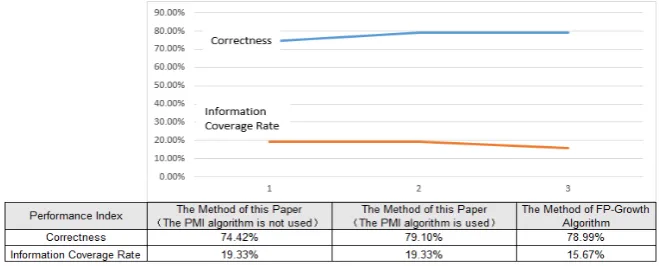
Taking the comment data of the 3.1 Section as the research object, the FP-Growth algorithm proposed in [10] is used as the contrast object. We com-pare the difference of the accurate rate and information coverage ratio between the proposed method and the FP-Growth algorithm. According to the indexes of performance evaluation in the 3.2 Section, we calculate the performance indica-tors of the two methods as shown in Figure 2. We can see in the Figure 2 that the method proposed in this paper has improved the accuracy and information coverage indicators compared with the FP-Growth method.
[image:9.595.208.538.572.705.2]As can be seen from the Figure 2, the information coverage by the proposed method and the method is no more than 20%. We analyze the reason why the information coverage rate is relatively low is that: 1) in the real comment, the customers are involved in the dimensions such as: services, purchase in addition to the description of the product itself; 2) the part of speech (POS) selected product features is adjectives besides nouns and gerund. For example, this dress is very cheap. Although the word “cheap” is adjective, but it is a description of the price of the product. It belongs to the product feature. This paper further
DOI: 10.4236/jss.2017.510012 137 Open Journal of Social Sciences analyzes the reasons for the differences in the product feature extraction process as follows:
1) Due to the imperfection of the word segmentation tools, the result of the word segmentation is biased;
2) With the rapid development of the Internet, a lot of new words have been produced in a short time, and the synonyms lexicon proposed by HIT may not update the thesaurus in time.
3) Because of the complexity of the Chinese language, the same language in different contexts may have different meanings, and the method of calculating the similarity of words also needs to be further improved.
4. Conclusion
Product feature extraction is an important research area in mining reviews. In this paper, a method based on KNN product feature is proposed from the point of view of improving information coverage. Experiments based on real com-ments show that this method is effective and can improve information coverage in some degree. The focus of the following work is to analyze the sensitivity of the ratio of training set to the sample set. Under the premise of guaranteeing the correct rate and extracting the product characteristic information coverage rate, the workload of manual participation in the training set is minimized.
References
[1] Ma, B.Z. and Yan, Z.J. (2014) Product Features Extraction of Online Reviews Based on LDA Model. Computer Integrated Manufacturing Systems, 20, 96-103.
[2] Song, X.L., Wang, S.G. and Li, H.X. (2010) Research on Comment Target Recogni-tion for Specific Domain Products. Journal of Chinese Information Processing, 24, 89-94.
[3] Yao, T.F., Nie, Q.Y., Li, J.C., Li, L.L., Lou, D.C., Chen, K., et al. (2006) An Opinion Mining System of Chinese Automobile Review. The 25th Anniversary Academic Conference of Chinese Information Society of China, Beijing, 19-22 November 2006, 268-289.
[4] Titov, Ivan, McDonald and Ryan (2008) A Joint Model of Text and Aspect Ratings for Sentiment Summarization. PROC. ACL-08: HLT, 308-316.
[5] Liu, J., Wu, G. and Yao, J. (2006) Opinion Searching in Multi-Product Reviews.
IEEE International Conference on Computer and Information Technology. Seoul, Korea, 20-22 September 2006, 25-25. https://doi.org/10.1109/CIT.2006.132
[6] Hu, M. and Liu, B.(2004) Mining and Summarizing Customer Reviews. Tenth ACM SIGKDD International Conference on Knowledge Discovery and Data Mining,
Seattle, Washington DC, 22-25 August 2004, 168-177.
https://doi.org/10.1145/1014052.1014073
[7] Li, S., Ye, Q., Li, Y.J. and Rob, L. (2009) Research on Product Feature Mining Me-thods for Chinese Online Customer Reviews. Journal of Management Sciences in China, 12, 142-152. https://doi.org/10.1016/S1001-0742(08)62242-1
DOI: 10.4236/jss.2017.510012 138 Open Journal of Social Sciences [9] Wang, Y., Zhang, Q. and Yang, X.J. (2013) Research on the Method of Extracting
Features from Chinese Product Reviews on the Internet. New Technology of Li-brary and Information Service, 12, 70-73.
[10] Tian, J.L. and Zhao, W. (2010) Words Similarity Algorithm Based on Tongyici Cili-nin Semantic Web Adaptive LearCili-ning System. Journal of Jilin University ( Informa-tion Science EdiInforma-tion), 28, 602-608.