Situation entity types:
automatic classification of clause-level aspect
Annemarie Friedrich1 Alexis Palmer2 Manfred Pinkal1 1Department of Computational Linguistics, Saarland University, Germany
2Leibniz ScienceCampus, Dept. of Computational Linguistics, Heidelberg University, Germany
{afried,pinkal}@coli.uni-saarland.de [email protected]
Abstract
This paper describes the first robust ap-proach to automatically labeling clauses with their situation entity type (Smith, 2003), capturing aspectual phenomena at the clause level which are relevant for interpreting both semantics at the clause level and discourse structure. Previous work on this task used a small data set from a limited domain, and relied mainly on words as features, an approach which is impractical in larger settings. We pro-vide a new corpus of texts from 13 genres (40,000 clauses) annotated with situation entity types. We show that our sequence labeling approach using distributional in-formation in the form of Brown clusters, as well as syntactic-semantic features tar-geted to the task, is robust across genres, reaching accuracies of up to 76%.
1 Introduction
Clauses in text have different aspectual properties, and thus contribute to the discourse in different ways. Distinctions that have been made in the linguistic and semantic theory literature include the classification of states, events and processes (Vendler, 1957; Bach, 1986), and whether clauses introduce particular eventualities or report regular-ities generalizing either over events or members of a kind (Krifka et al., 1995). Such aspectual distinctions are relevant to natural language pro-cessing tasks requiring text understanding such as information extraction (Van Durme, 2010) or tem-poral processing (Costa and Branco, 2012).
In this paper, we are concerned with automat-ically identifying the type of a situation entity (SE), which we assume to be expressed by a clause. Specifically, we present a system for au-tomatically labeling clauses using the inventory of
STATE:The colonel owns the farm.
EVENT:John won the race.
REPORT: “...”,said Obama.
GENERICSENTENCE: Generalizations over
kinds.The lion has a bushy tail.
GENERALIZINGSENTENCE:
Generalizations over events (habituals).
Mary often fed the cat last year.
QUESTION:Who wants to come?
IMPERATIVE:Hand me the pen!
Figure 1: SE types, adapted from Smith (2003).
SE types shown in Figure 1 (Smith, 2003, 2005; Palmer et al., 2007). The original motivation for the above inventory of SE types is the observation that differentmodes of discourse, a classification of linguistic properties of text at the passage level, have different distributions of SE types. For ex-ample, EVENTs and STATEs are predominant in
narrativepassages, while GENERIC SENTENCEs
occur frequently ininformationpassages.
A previous approach to automatically labeling SE types (Palmer et al., 2007) – referred to here as UT07 – captures interesting insights, but is trained and evaluated on a relatively small amount of text (about 4300 clauses), mainly from one rather spe-cialized subsection of the Brown corpus. The data shows a highly skewed distribution of SE types and was annotated in an intuitive fashion with only moderate agreement. In addition, the UT07 sys-tem relies mostly on part-of-speech tags and words as features. The latter are impractical when deal-ing with larger data sets and capture most of the corpus vocabulary, overfitting the model to the data set. Despite this overfitting, the system’s ac-curacy is only around 53%.
We address these shortcomings, developing a robust system that delivers high performance com-pared to the human upper bound across a range of genres. Our approach uses features which increase
robustness: Brown clusters and syntactic-semantic features. Our models for labeling texts with the aspectual properties of clauses in the form of SE types reach accuracies of up to 76%.
In an oracle experiment, Palmer et al. (2007) show that including the gold labels of the previ-ous clauses as features into their maximum en-tropy model is beneficial. We implement the first true sequence labeling model for SE types, us-ing conditional random fields to find the globally-best sequence of labels for the clauses in a docu-ment. Performance increases by around 2% abso-lute compared to predicting labels for clauses sep-arately; much of this effect stems from the fact that GENERICSENTENCEs often occur together.
Moving well beyond the single-domain setting, our models are trained and evaluated on a multi-genre corpus of approximately 40,000 clauses from MASC (Ide et al., 2008) and Wikipedia which have been annotated with substantial agree-ment. We train and test our models both within genres and across genres, highlighting differences between genres and creating models that are ro-bust across genres. Both the corpus and the code for an SE type labeler are freely available.1 These
form the basis for future research on SE types and related aspectual phenomena and will enable the inclusion of SE type information as a preprocess-ing step into various NLP tasks.
2 Linguistic background
The inventory of SE types proposed by Smith (2003) consists of three high-level categories, each with two subtypes.Eventualitiescomprise EVENT
and STATE, categories for clauses representing
ac-tual happenings, states of the world, or attributes of entities or situations. General Stativesinclude GENERIC SENTENCE and GENERALIZING SEN -TENCEand reflect regularities in the world or
gen-eral information predicated over classes or kinds. Finally,Abstract Entities(Figure 2) have the sub-types FACT and PROPOSITION. Although
Ab-stract Entities are part of the label inventory for UT07, we treat them in a separate identification step, for reasons discussed in Section 7. The in-ventory was expanded by Palmer et al. (2007) to include three additional types: REPORT, QUES -TIONand IMPERATIVE. The latter two categories
were added to accommodate exhaustive
annota-1Corpora, annotation manual and code available at www.coli.uni-saarland.de/projects/sitent
FACT: Objects of knowledge.
I know that Mary refused the offer.
PROPOSITION: Objects of belief.
I believe that Mary refused the offer.
Figure 2:Abstract EntitySE types.
tion of text; REPORTis a subtype of event for
at-tributions of quoted speech.
Two parts of a clause provide important in-formation for determining the SE type (Friedrich and Palmer, 2014b): a clause’s main verb and its main referent. The latter is loosely defined as the main entity that the segment is about; in English this is usually the subject. For example, main referents of GENERICSENTENCEs are kinds
or classes as in “Elephants are huge”, while the main referents ofEventualitiesand GENERALIZ -INGSENTENCEs are particular individuals (“John
is short”). For English, the main verb is the non-auxiliary verb ranked highest in the depen-dency parse (e.g. “kiss” in “John has kissed Joe”). STATEs and EVENTs differ in thefundamental
lex-ical aspectual class(Siegel and McKeown, 2000) of their main verbs (e.g. dynamicin “She filled the glass with water” vs. stative in “Water fills the glass”). While fundamental lexical aspectual class is a word-sense level attribute of the clause’s main verb, habituality is a property of the entire clause which is helpful to determine the clause’s SE type. For example, EVENTand GENERALIZ -INGSENTENCEdiffer in habituality (e.g.episodic
in “John cycled to work yesterday” vs. habitualin “John cycles to work”).
Like habituality, SE types are a categorization at the clause level. Properties of the clause such as modals, negation, or the perfect influence the SE type: for instance, “John might win” is treated as a STATE as it describes a possible state of the
world rather than an EVENT. Such coercions
hap-pen only for clauses which, without the trigger for aspectual shift, would be EVENTs; other SEs
re-tain their type even under coercions such as nega-tion, e.g., “Elephants are not small” is a GENERIC
SENTENCE. SE types aim to capture how clauses
behave in discourse, and the types STATE and
EVENT are aspectual rather than ontological
3 Related work
SE types model aspect at the clause level; thus they are most closely related to other works performing automatic classification for various aspect-related phenomena of the verb or the clause. For exam-ple, Vendler classes (Vendler, 1957) ascribe four categories as lexical properties of verbs, distin-guishing states from three types of events (ac-complishment, achievement, and activity), differ-ing accorddiffer-ing to temporal and aspectual proper-ties (e.g. telicity and punctuality). The work of Siegel and McKeown (2000) is a major inspiration in computational work on modeling these linguis-tic phenomena, introducing the use of linguislinguis-tic indicators (see Section 5.1). Hermes et al. (2015) model Vendler classes computationally on a verb-type level for 95 different German verbs, combin-ing distributional vectors with supervised classifi-cation. Zarcone and Lenci (2008) investigate both supervised and unsupervised classification frame-works for occurrences of 28 Italian verbs, and Friedrich and Palmer (2014a) predict lexical as-pectual class for English verbs in context.
The only previous approach to automatic clas-sification of SE types comes from Palmer et al. (2007). This system (UT07) uses word and POS tag features as well as a number of lexical features adopted from theoretical work on aspectual classi-fication. The model is described in Section 6.1.
Another related body of work has to do with determining event class as a precursor to tempo-ral relation classification. The inventory of event classes, described in detail in the TimeML anno-tation guidelines (Saur´ı et al., 2006), combines semantic (REPORTING, PERCEPTION), aspectual
(ASPECTUAL, STATE, OCCURRENCE), and
inten-sional (I ACTION,I STATE) properties of events.
Finally, there are close connections to systems which predict genericity of noun phrases (Reiter and Frank, 2010; Friedrich and Pinkal, 2015a), and habituality of clauses (Mathew and Katz, 2009; Friedrich and Pinkal, 2015b).
4 Data sets
The experiments presented in this paper make use of two data sets labeled with SE types.
Brown data. This data set consists of 20 texts from thepopular loresection of the Brown corpus (Francis and Kuˇcera, 1979), manually segmented into 4391 clauses and marked by two annotators in
[image:3.595.331.503.62.100.2]corpus tokens SEs Fleiss’κ MASC 357078 30333 0.69 Wikipedia 148040 10607 0.66
Table 1: SE-labeled corpora:sizeandagreement.
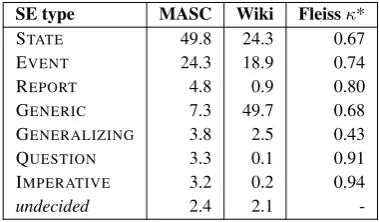
SE type MASC Wiki Fleissκ*
STATE 49.8 24.3 0.67
EVENT 24.3 18.9 0.74
REPORT 4.8 0.9 0.80
GENERIC 7.3 49.7 0.68
GENERALIZING 3.8 2.5 0.43
QUESTION 3.3 0.1 0.91
IMPERATIVE 3.2 0.2 0.94
undecided 2.4 2.1
-Table 2: Distribution of SE types in gold stan-dard (%). *Krippendorff’s diagnostics.
an intuitive way withκ=0.52 (Cohen, 1960). Fi-nal labels were created via adjudication. The texts are essays and personal stories with topics ranging from maritime stories to marriage advice.
MASC and Wikipedia. Our main data set con-sists of documents from MASC (Ide et al., 2010) and Wikipedia. The MASC data covers 12 of the written genres (see Table 11). Texts are split into clauses using SPADE (Soricut and Marcu, 2003) with some heuristic post-processing, and the clauses are labeled by three annotators inde-pendently. Annotators, all student assistants with basic linguistic training, were given an extensive annotation manual. Table 1 reports agreement over types in terms of Fleiss’κ(Fleiss, 1971). As we do not force annotators to assign a label to each clause, we computeκusing all pairings of labels where both annotators assigned an SE type. The gold standard is constructed via majority voting.
Table 2 shows the distribution of SE types. The largest proportion of segments in MASC are STATEs, while the largest proportion in Wikipedia
are GENERIC SENTENCEs. The Wikipedia data
was collected to supplement MASC, which con-tains few generics and no data from an encyclo-pedic genre. Within MASC, the various genres’ distributions of SE types differ as well, and agree-ment scores also vary: some genres contain many instances of easily classifiable SE types, while oth-ers (e.g., essays or journal) are more difficult to annotate (more details in Section 6.6).
[image:3.595.321.511.132.243.2]hu-group explanation examples mv features describing the SE’s main
verb& its arguments tense, lemma, lemma of object, auxiliary, WordNet sense and hypernymsense, progressive, POS, perfect, particle, voice, linguistic indicators
mr features describing themain refer-ent, i.e., the NP denoting the main verb’s subject
lemma, determiner type, noun type, number, WordNet sense and super-sense, dependency relations linked to this token, person, countability, bare plural
cl features describing entireclausethat
[image:4.595.74.534.62.156.2]invokes the SE presence of adverbs / prepositional clauses, conditional, modal, whethersubject before verb, negated, verbs embedding the clause
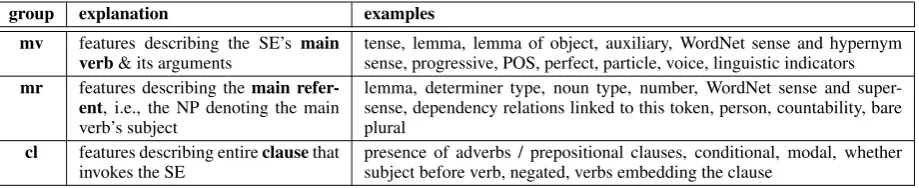
Table 3: Overview of feature setB. The full and detailed list is available (together with the implementa-tion) athttp://www.coli.uni-saarland.de/projects/sitent.
mans had most difficulties with. For each cate-gory, one computes κ for an artificial set-up in which all categories except one are collapsed into an artificial OTHER category. A high value
indi-cates that annotators can distinguish this SE type well from others. GENERALIZING SENTENCEs
are most difficult to agree upon. For all frequently occurring types as well as QUESTIONs and IM -PERATIVEs, agreement is substantial.
Agreement on QUESTIONand IMPERATIVEs is
not perfect even for humans, as identifying them requires recognizing cases in reported speech, which is not a trivial task (e.g., Brunner, 2013). To illustrate another difficult case, consider the ex-ample “You must never confuse faith”, which was marked as both IMPERATIVEand GENERIC SEN -TENCE, by different annotators.
5 Method
This section describes the feature sets and classifi-cation methods used in our approach, which mod-els SE type labeling as a supervised sequence la-beling task.
5.1 Feature sets
Our feature sets are designed to work well on large data sets, across genres and domains. Features are grouped into two sets:Aconsists of standard NLP features including POS tags and Brown clusters. Set Btargets SE labeling, focusing on syntactic-semantic properties of the main verb and main ref-erent, as well as properties of the clause which in-dicate its aspectual nature. Texts are pre-processed with Stanford CoreNLP (Manning et al., 2014), including tokenization, POS tagging (Toutanova et al., 2003) and dependency parsing (Klein and Manning, 2002) using the UIMA-based DKPro framework (Ferrucci and Lally, 2004; Eckart de Castilho and Gurevych, 2014).
A-pos: part-of-speech tags. These features count how often each POS tag occurs in a clause.
A-bc: Brown cluster features. UT07 relies mostly on words and word/POS tag pairs. These simple features work well on the small Brown data set, but the approach quickly becomes impracti-cal with increasing corpus size. We instead turn to distributional information in the form of Brown clusters (Brown et al., 1992), which can be learned from raw text and represent word classes in a hi-erarchical way. Originally developed in the con-text ofn-gram language modeling, they aim to as-sign words to classes such that the average mutual information of the words in the clusters is maxi-mized. We use existing, freely-available clusters trained on news data by Turian et al. (2010) using the implementation by Liang (2005).2 Clusterings
with 320 and 1000 Brown clusters work best for our task. We use one feature per cluster, counting how often a word in the clause was assigned to this cluster (0 for most clusters).
B-mv: main verb. Using dependency parses, we extract the verb ranked highest in the clause’s parse as the main verb, and extract the set of fea-tures listed in Table 3 for that token. Feafea-tures based on WordNet (Fellbaum, 1998) use the most frequent sense of the lemma. Tense and voice information is extracted from sequences of POS tags using a set of rules (Loaiciga et al., 2014). Linguistic indicators (Siegel and McKeown, 2000) are features collected per verb type over a large parsed background corpus, encoding how often a verb type occurred with each linguistic marker, e.g., in past tense or with an in-PP. We use val-ues collected from Gigaword (Graff et al., 2003); these are freely available at our project web site (Friedrich and Palmer, 2014a).
B-mr: main referent. We extract the gram-matical subject of the main verb (i.e., nsubj or
nsubjpass) as the clause’s main referent. While the main verb must occur within the clause, the
main referent may be a token either within or out-side the clause. In the latter case, it still functions as the clause’s main referent, as in most cases it can be considered an implicit argument within the clause. Table 3 lists the features extracted for the main referent.
B-cl: clause. These features (see also Table 3) describe properties at the clause level, capturing both grammatical phenomena such as word order and lexical phenomena including presence of par-ticular adverbials or prepositional phrases, as well as semantic information such as modality. If the clause’s main verb is embedded in accomp rela-tion, we also use features describing the respective governing verb.
5.2 Classification / sequence labeling model
Our core modeling assumption is to view a doc-ument as a sequence of SE type labels, each as-sociated with a clause; this motivates the choice of using a conditional random field (CRF, Lafferty et al. (2001)) for label prediction. The conditional probability of label sequence~ygiven an observa-tion sequence~xis given by:
P(~y|~x) =Z(1~x)exp(Xn j=1
m X
i=1
λifi(yj−1, yj, ~x, j)),
with Z(~x) being a normalization constant (see also Klinger and Tomanek (2007)).λi, the weights
of the feature functions, are learned via L-BGFS (Wright and Nocedal, 1999).
We create a linear chain CRF using the CRF++ toolkit3 with default parameters,
apply-ing two forms of feature functions: fi(yj, xj)and
fi(yj−1, yj). The former consists of indicator
functions for combinations of SE type labels and each of the features listed above. The latter type of feature function (also called “bigram” features in CRF++ terminology) gets instantiated as indicator functions for each combination of labels, thereby enabling the model to take sequence information into account. When using only the former type of feature function, our classifier is equivalent to a maximum entropy (MaxEnt) model.
Side remark: pipeline approach. Feature setB
is inspired by previous work on two subtasks of assigning an SE type to a clause (see Section 3): (a) identifying the genericity of a noun phrase in its clausal context, and (b) identifying whether a clause is episodic, habitual or static. This
informa-3https://code.google.com/p/crfpp
tion can in turn be used to determine a clause’s SE type label in a rule-based way, e.g., GENERALIZ -ING SENTENCEs are habitual clauses with a
non-generic main referent. As our corpus is also anno-tated with this information, we also trained sepa-rate models for these subtasks and assigned the SE type label accordingly. However, such a pipeline approach is not competitive with the model trained directly on SE types (see Section 6.3).
6 Experiments
Here we present our experiments on SE type clas-sification, beginning with a (near) replication of the UT07 system, and moving on to evaluate our new approach from multiple perspectives.
6.1 Replication and extension of UT07
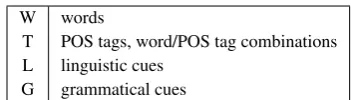
As a first step, we implement a system similar to UT07, which relies on the features summarized in Table 4. For W and T features, we set a frequency threshold of 7 occurrences. Feature set L com-prises sets of predicates assumed to correlate with particular SE types, and whether or not the clause contains a modal or finite verb. Set G includes all verbs of the clause and their POS-tags. UT07 additionally uses CCG supertags and grammatical function information. The UT07 system approx-imates a sequence labeling model by adding the predicted labels of previous clauses as lookback
(LB) features. To parallel their experiments, we train both MaxEnt and CRF models, as explained in Section 5.2. Results on the Brown data, with the same training/test split, appear in Table 5. Unlike the LB model, our CRF predicts the label sequence jointly and outperforms UT07 on the Brown data by up to 7% accuracy. We assume that the per-formance boost in the MaxEnt setting is at least partially due to having better parses.
In sum, on the small Brown data set, a CRF ap-proach successfully leverages sequence informa-tion, and a simple set of features works well. Pre-liminary experiments applying our new features on Brown data yield no improvements, suggesting that word-based features overfit this domain.
W words
T POS tags, word/POS tag combinations L linguistic cues
[image:5.595.327.503.693.743.2]G grammatical cues
Palmer et al. (2007) our implementation
features MaxEnt LB MaxEnt CRF
W 45.4 46.6 48.8 47.0
WT 49.9 52.4 52.9 53.7
WTL 48.9 50.5 51.6 55.8
[image:6.595.78.288.61.131.2]WTLG 50.6 53.1 55.8 60.0
Table 5: Accuracy on Brown. Test set majority class (STATE) is 35.3%. LB = results for best
look-back settings in MaxEnt. 787 test instances.
6.2 Experimental settings
We develop our models using 10-fold cross val-idation (CV) on 80% (counted in terms of the number of SEs) of the MASC and Wikipedia data (a total of 32,855 annotated SEs), keeping the re-maining 20% as a held-out test set. Development and test sets each contain distinct sets of docu-ments; the documents of each MASC genre and of Wikipedia are distributed over the folds. We re-port results in terms of macro-average precision, macro-average recall, macro-average F1-measure (harmonic mean of macro-average precision and macro-average recall), and accuracy. We apply McNemar’s test (McNemar, 1947) withp <0.01 to test significance of differences in accuracy. In the following tables, we mark numerically-close scores with the same symbols if they are found to be significantly different.
Upper bound: human performance. Labeling clauses with their SE types is a non-trivial task even for humans, as there are many borderline cases (see Sections 4 and 8). We compute an upper bound for system performance by iterating over all clauses: for each pair of human annotators, two entries are added to a co-occurrence matrix (simi-lar to a confusion matrix), with each label serving once as “gold standard” and once as the “predic-tion.” From this matrix, we can compute scores in the same manner as for system predictions. Preci-sion and recall scores are symmetric in this case, and accuracy corresponds to observed agreement.
6.3 Impact of feature sets
We now compare various configurations of our CRF-based SE type labeler, experimenting with the feature sets as described in Section 5.1. Ta-ble 6 shows the results for 10-fold CV on the dev portion of the MASC+Wiki corpus.
Each feature set on its own outperforms the majority class baseline. Of the individual fea-ture groups, bc andmv have the highest
predic-feature set P R F acc.
maj. class (STATE) 6.4 14.3 8.8 45.0
A 70.1 61.4 65.4 ∗†72.1
pos 49.3 40.3 44.3 58.7
bc 67.5 55.8 61.1 ∗70.6
B 69.5 62.7 66.9 ?‡72.8
mr 36.4 26.8 30.9 51.7
mv 62.3 52.4 56.9 ?70.8
cl 53.3 41.2 46.6 52.8
A+B 74.1 68.6 71.2 ‡†76.4
[image:6.595.309.527.62.198.2]upper bound (humans) 78.6 78.6 78.6 79.6
Table 6: Impact of different feature sets.
Wiki+MASC dev set, CRF, 10-fold CV.
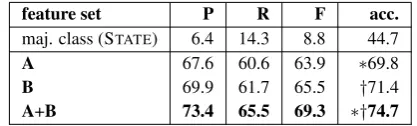
feature set P R F acc.
maj. class (STATE) 6.4 14.3 8.8 44.7
A 67.6 60.6 63.9 ∗69.8
B 69.9 61.7 65.5 †71.4
A+B 73.4 65.5 69.3 ∗†74.7
Table 7: Results on MASC+Wikiheld-out test set
(7937 test instances).
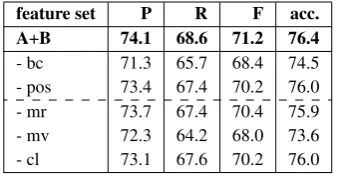
tive power; both capture lexical information of the main verb. Using sets A and B individually re-sults in similar scores; their combination increases accuracy on the dev set by an absolute 3.6-4.3%. WithinAandB, each subgroup contributes to the increase in performance (not shown in table).
Finally, having developed exclusively on the dev set, we run the system on the held-out test set, training on the entire dev set. Results (in Table 7) show the same tendencies as for the dev set: each feature set contributes to the final score, and the syntactic-semantic features targeted at classifying SE types (i.e.B) are helpful.
[image:6.595.311.520.244.307.2]tran-feature set P R F acc.
A+B 74.1 68.6 71.2 76.4
[image:7.595.331.503.59.167.2]- bc 71.3 65.7 68.4 74.5 - pos 73.4 67.4 70.2 76.0 - mr 73.7 67.4 70.4 75.9 - mv 72.3 64.2 68.0 73.6 - cl 73.1 67.6 70.2 76.0
Table 8: Impact of feature groups: ablation
Wiki+MASC dev set, CRF, 10-fold CV. All accu-racies for ablation settings are significantly differ-ent from A+B.
sitions (Klinger and Friedrich, 2009). In addition, CRFs are known to be able to deal with a large number of potentially dependent features.
Side remark: pipeline approach. We here use the subset of SEs labeled as EVENT, STATE,
GENERIC SENTENCE or GENERALIZING SEN -TENCE because noun phrase genericity and
habit-uality is not labeled for IMPERATIVE and QUES -TION, and REPORTis identified lexically based on
the main verb rather than these semantic features. Models for subtasks of SE type identification, i.e., (a) genericity of noun phrases and (b) habitual-ity reach accuracies of (a) 86.8% and (b) 83.6% (on the relevant subset). Applying the labels out-put by these two systems as (the only) features in a rule-based way using a J48 decision tree (Wit-ten et al., 1999) results in an accuracy of 75.5%, which is lower than 77.2%, the accuracy of the CRF which directly models SE types (when using only the above four types).
6.4 Impact of amount of training data
Next we test how much training data is required to get stable results for SE type classification. Fig-ure 3 shows accuracy and F1 for 10-fold CV us-ingA+B, with training data downsampled to dif-ferent extents in each run by randomly removing documents. Up to the setting which uses about 60% of the training data, performance increases steadily. Afterwards, the curves start to level off. We conclude that robust models can be learned from our corpus. Adding training data, especially in-domain data, will, as always, be beneficial.
6.5 Impact of sequence labeling approach
Palmer et al. (2007) suggest that SE types of nearby clauses are a useful source of information. We further test this hypothesis by comparing our sequence labeling model (CRF) to two additional
0 20 40 60 80 100
40
50
60
70
80
● ● ● ●●
● ●
● ● ●
● ● ● ● ●
●
0 20 40 60 80 100
40
50
60
70
80
●
[image:7.595.97.266.62.150.2]Accuracy F1 % training data
Figure 3:Learning curvefor MASC+Wiki dev.
[image:7.595.311.520.504.655.2]models: (1) a MaxEnt model, which labels clauses in isolation, and (2) a MaxEnt model including the correct label of the preceding clause (seq-oracle), simulating an upper bound for the impact of se-quence information on our system.
Table 9 shows the results. Scores for GENER -ALIZINGSENTENCEare the lowest as this class is
very infrequent in the data set. The most strik-ing improvement of the two sequence labelstrik-ing settings over MaxEnt concerns the identification of GENERIC SENTENCEs. These often “cluster”
in texts (Friedrich and Pinkal, 2015b) and hence their identification profits from using sequence in-formation. The results for seq-oracle show that the sequence information is useful for STATE,
GENERIC and GENERALIZING SENTENCEs, but
that no further improvement is to be expected from this method for the other SE types. We conclude that the CRF model is to be preferred over the MaxEnt model; in almost all of our experiments it performs significantly better or equally well.
SE type MaxEnt CRF seq-oracle
STATE 79.1 80.6 81.7
EVENT 77.5 78.6 78.3
REPORT 78.2 78.9 78.3
GENERIC 61.3 68.3 73.5
GENERALIZING 25.0 29.4 38.1
IMPERATIVE 72.3 75.3 74.7
QUESTION 84.4 84.4 83.8
macro-avg P 71.5 74.1 75.5
macro-avg R 66.1 68.6 70.4
macro-avg F1 68.7 71.2 73.9
accuracy ∗74.1 ∗†76.4 †77.9
Table 9: Impact of sequence information: (F1
by SE type): CRF, Masc+Wiki, 10-fold CV.
6.6 Impact of genre
10-SE type genre-CV 10-fold CV humans
STATE 78.2 80.6 82.8
EVENT 77.0 78.6 80.5
REPORT 76.8 78.9 81.5
GENERIC 44.8 68.3 75.1
GENERALIZING 27.4 29.4 45.8
IMPERATIVE 70.8 75.3 93.6
QUESTION 81.8 84.4 90.7
macro-avg F1 66.6 71.2 78.6
[image:8.595.317.516.62.267.2]accuracy ∗71.8 ∗76.4 79.6
Table 10: Impact of in-genre training data. F1-score by SE type, CRF, MASC+Wiki dev.
fold CV setting as explained in section 6.2, and a
genre-CV setting, simulating the case where no in-genre training data is available, treating each genre as one cross validation fold. As expected, in the latter setting, both overall accuracy and macro-average F1 are lower compared to the case when in-genre training data is available. Nevertheless, our model is able to capture the nature of SE types across genres: the prediction of STATE, EVENT,
REPORT and QUESTION is relatively stable even
in the case of not having in-genre training data. An EVENTseems to be easily identifiable
regard-less of the genre. GENERICSENTENCEis a
prob-lematic case; in the genre-CV setting, its F1-score drops by 23.5%. The main reason for this is that the distribution of SE types in Wikipedia differs completely from the other genres (see section 4). Precision for GENERIC SENTENCE is at 70.5%
in the genre-CV setting, but recall is only 32.8% (compared to 70.1% and 66.6% in the 10-fold CV setting). Genericity seems to work differently in the various genres: most generics in Wikipedia clearly refer to kinds (e.g., lions or plants), while many generics in essays or letters are instances of more abstract concepts or genericyou.
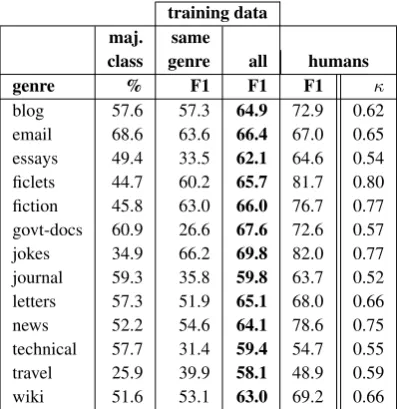
Results by genre. Next, we drill down in the evaluation of our system by separately inspect-ing results for individual genres. Table 11 shows that performance differs greatly depending on the genre. In some genres, the nature of SE types seems clearer to our annotators than in others, and this is reflected in the system’s performance. The majority class is GENERIC SENTENCE in wiki,
and STATEin all other genres. In the ‘same genre’
setting, 10-fold CV was performed within each genre. Adding out-of-genre training data improves macro-average F1 especially for genres with low scores in the ‘same genre’ setting. This boost is
training data maj. same
class genre all humans
genre % F1 F1 F1 κ
blog 57.6 57.3 64.9 72.9 0.62 email 68.6 63.6 66.4 67.0 0.65 essays 49.4 33.5 62.1 64.6 0.54 ficlets 44.7 60.2 65.7 81.7 0.80 fiction 45.8 63.0 66.0 76.7 0.77 govt-docs 60.9 26.6 67.6 72.6 0.57 jokes 34.9 66.2 69.8 82.0 0.77 journal 59.3 35.8 59.8 63.7 0.52 letters 57.3 51.9 65.1 68.0 0.66 news 52.2 54.6 64.1 78.6 0.75 technical 57.7 31.4 59.4 54.7 0.55 travel 25.9 39.9 58.1 48.9 0.59 wiki 51.6 53.1 63.0 69.2 0.66
Table 11:Macro-avg. F1 by genre, CRF, 10-fold CV. Majority class given in % of clauses.
due to adding training data for types that are infre-quent in that genre. Accuracy (not shown in table) improves significantly for blog, essays, govt-docs, jokes, and journal, and does not change for the re-maining genres. We conclude that it is extremely beneficial to use our full corpus for training, as ro-bustness of the system is increased, especially for SE types occurring infrequently in some genres.
7 Identification of Abstract Entities
Our system notably does not address one of Smith’s main SE categories:Abstract Entities, in-troduced in Section 2. These SEs are expressed as clausal arguments of certain predicates such as (canonically) knoworbelieve. Note that the Ab-stract Entitysubtypes FACTand PROPOSITIONdo
not imply that a clause’s propositional content is true or likely from an objective point of view, they rather indicate that the clause’s content is intro-duced to the discourse as an object of knowledge or belief, respectively. Following Smith (2003), we use PROPOSITION in a different sense than
the usual meaning of “proposition” in semantics -naturally situation entities of any type may have propositional content. Smith’s use of the term (and thus ours too) contrasts PROPOSITIONwith
FACT - our PROPOSITIONs are simply sentences
presented as a belief (or with uncertain evidential status) of the writer or speaker. This use of “propo-sition” also occurs in linguistic work by Peterson (1997) on factive vs. propositional predicates.
[image:8.595.73.295.64.192.2]were asked to give one label out of the SE types included in our classification task, and to mark the clause with one of the Abstract Entity sub-types in addition if applicable. Analysis of the data shows that our annotators frequently for-got to mark clauses as Abstract Entities, which makes it difficult to model these categories cor-rectly. As a first step toward resolving this issue, we implement a filter which automatically identi-fiesAbstract Entitiesby looking for clausal com-plements of certain predicates. The list of pred-icates is compiled using WordNet synonyms of
know, think, and believe, as well as predicates extracted from FactBank (Sauri and Pustejovsky, 2009) and TruthTeller (Lotan et al., 2013). Many of the clauses automatically identified asAbstract Entities are cases that annotators missed during annotation. We thus performed a post-hoc evalua-tion, presenting these clauses in context to annota-tors and asking whether the clause is anAbstract Entity. The so-estimated precision of our filter is 85.8% (averaged over 3 annotators). Agreement for this annotation task is κ = 0.54, with an ob-served agreement of 88.7%. Our filter finds 80% of the clauses labeled asAbstract Entityby at least one annotator in the gold standard; this is approx-imatelyits recall.
8 Conclusion
We have presented a system for automatically la-beling clauses with their SE type which is mostly robust to changes in genre and which reaches ac-curacies of up to 76%, comparing favorably to the human upper bound of 80%. The system benefits from capturing contexual effects by using a linear chain CRF with label bigram features. In addition, the distributional and targeted syntactic-semantic features we introduce enable SE type prediction for large and diverse data sets. Our publicly avail-able system can readily be applied to any written English text, making it easy to explore the utility of SE types for other NLP tasks.
Discussion. Our annotation scheme and guide-lines for SE types (Friedrich and Palmer, 2014b) follow established traditions in linguistics and se-mantic theory. When applying these to a large number of natural texts, though, we came across a number of borderline cases where it is not easy to select just one SE type label. As we have re-ported before (Friedrich et al., 2015), the most dif-ficult case is the identification of GENERIC SEN
-TENCEs, which are defined as making a statement
about a kind or class. We find that making this task becomes particularly difficult for argumenta-tive essays (Becker et al., to appear).
Future work. A next major step in our research agenda is to integrate SE type information into various applications, including argument mining, temporal reasoning, and summarization. Together with the mode of progression through the text, e.g., temporal or spatial, SE type distribution is a key factor for a reader or listener’s intuitive recog-nition of the discourse mode of a text passage. Therefore the automatic labeling of clauses with their SE type is a prerequisite for automatically identifying a passage’s discourse mode, which in turn has promising applications in many areas of NLP, as the mode of a text passage has implica-tions for the linguistic phenomena to be found in the passage. Examples include temporal process-ing of text (Smith, 2008), summarization, or ma-chine translation (for work on genres see van der Wees et al., 2015). Here we focus on the automatic identification of SE types, leaving the identifica-tion of discourse modes to future work.
The present work, using the SE type inventory introduced by Smith (2003), is also the basis for research on more fine-grained aspectual type in-ventories. Among others, we plan to create sub-types of the STATE label, which currently
sub-sumes clauses stativized by negation, modals, lex-ical information or other aspectual operators. Dis-tinguishing these is relevant for temporal relation processing or veridicality recognition.
Acknowledgments
References
Emmon Bach. 1986. The algebra of events. Lin-guistics and philosophy9(1):5–16.
Maria Becker, Alexis Palmer, and Anette Frank. to appear. Argumentative texts and clause types. In Proceedings of the 3rd Workshop on Argu-ment Mining, ACL 2016.
Peter F Brown, Peter V Desouza, Robert L Mercer, Vincent J Della Pietra, and Jenifer C Lai. 1992. Class-based n-gram models of natural language.
Computational Linguistics18(4):467–479. Annelen Brunner. 2013. Automatic recognition of
speech, thought, and writing representation in german narrative texts. Literary and linguistic computing28(4):563–575.
Jacob Cohen. 1960. A coefficient of agreement for nominal scales. Educational and Psychological Measurement20(1):37–46.
Francisco Costa and Ant´onio Branco. 2012. As-pectual type and temporal relation classifica-tion. In Proceedings of the 13th Conference of the European Chapter of the Association for Computational Linguistics (EACL).
Richard Eckart de Castilho and Iryna Gurevych. 2014. A broad-coverage collection of portable NLP components for building shareable analy-sis pipelines. In Proceedings of the Workshop on Open Infrastructures and Analysis Frame-works for HLT. Dublin, Ireland.
Christiane Fellbaum. 1998. WordNet. Wiley On-line Library.
David Ferrucci and Adam Lally. 2004. UIMA: an architectural approach to unstructured informa-tion processing in the corporate research envi-ronment. Natural Language Engineering 10(3-4):327–348.
Joseph L Fleiss. 1971. Measuring nominal scale agreement among many raters. Psychological bulletin76(5):378.
W. Nelson Francis and Henry Kuˇcera. 1979. A Standard Corpus of Present-Day Edited Amer-ican English, for use with Digital Computers. Brown University.
Annemarie Friedrich and Alexis Palmer. 2014a. Automatic prediction of aspectual class of verbs in context. In Proceedings of the 52nd Annual Meeting of the Association for Computational Linguistics (ACL). Baltimore, USA.
Annemarie Friedrich and Alexis Palmer. 2014b. Situation entity annotation. In Proceedings of the Linguistic Annotation Workshop VIII. Annemarie Friedrich, Alexis Palmer,
Melissa Peate Srensen, and Manfred Pinkal. 2015. Annotating genericity: a survey, a scheme, and a corpus. In Proceedings of the 9th Linguistic Annotation Workshop (LAW IX). Denver, Colorado, US.
Annemarie Friedrich and Manfred Pinkal. 2015a. Automatic recognition of habituals: a three-way classification of clausal aspect. InProceedings of Conference on Empirical Methods in Natural Language Processing (EMNLP). Lisbon, Portu-gal.
Annemarie Friedrich and Manfred Pinkal. 2015b. Discourse-sensitive Automatic Identification of Generic Expressions. In Proceedings of the 53rd Annual Meeting of the Association for Computational Linguistics (ACL). Beijing, China.
David Graff, Junbo Kong, Ke Chen, and Kazuaki Maeda. 2003. English gigaword. Linguistic Data Consortium, Philadelphia.
J¨urgen Hermes, Michael Richter, and Claes Neuefind. 2015. Automatic induction of Ger-man aspectual verb classes in a distributional framework. InProceedings of the International Conference of the German Society for Compu-tational Linguistics and Language Technology (GSCL).
Nancy Ide, Collin Baker, Christiane Fellbaum, and Charles Fillmore. 2008. MASC: The manually annotated sub-corpus of American English . Nancy Ide, Christiane Fellbaum, Collin Baker, and
Rebecca Passonneau. 2010. The manually an-notated sub-corpus: A community resource for and by the people. InProceedings of the ACL 2010 conference short papers.
Dan Klein and Christopher D Manning. 2002. Fast exact inference with a factored model for nat-ural language parsing. In Advances in Neural Information Processing Systems.
Roman Klinger and Katrin Tomanek. 2007. Clas-sical probabilistic models and conditional ran-dom fields. TU Dortmund Algorithm Engineer-ing Report.
Manfred Krifka, Francis Jeffrey Pelletier, Gre-gory N. Carlson, Alice ter Meulen, Godehard Link, and Gennaro Chierchia. 1995. Generic-ity: An Introduction. The Generic Bookpages 1–124.
Klaus Krippendorff. 1980. Content analysis: An introduction to its methodology. Sage.
John D. Lafferty, Andrew McCallum, and Fer-nando C. N. Pereira. 2001. Conditional Ran-dom Fields: Probabilistic Models for Segment-ing and LabelSegment-ing Sequence Data. In Proceed-ings of the Eighteenth International Conference on Machine Learning (ICML).
Percy Liang. 2005. Semi-supervised learning for natural language. Ph.D. thesis, University of California Berkeley.
Sharid Loaiciga, Thomas Meyer, and Andrei Popescu-Belis. 2014. English-French Verb Phrase Alignment in Europarl for Tense Trans-lation Modeling. In The Ninth Language Re-sources and Evaluation Conference (LREC). Amnon Lotan, Asher Stern, and Ido Dagan. 2013.
TruthTeller: Annotating Predicate Truth. In
Proceedings of NAACL 2013.
Christopher D. Manning, Mihai Surdeanu, John Bauer, Jenny Finkel, Steven J. Bethard, and David McClosky. 2014. The Stanford CoreNLP Natural Language Processing Toolkit. In As-sociation for Computational Linguistics (ACL) System Demonstrations.
Thomas A. Mathew and Graham E. Katz. 2009. Supervised categorization for habitual versus episodic sentences. InSixth Midwest Computa-tional Lingustics Colloquium. Indiana Univer-sity, Bloomington, Indiana.
Quinn McNemar. 1947. Note on the sampling er-ror of the difference between correlated propor-tions or percentages.Psychometrika12(2):153– 157.
Alexis Palmer, Elias Ponvert, Jason Baldridge, and Carlota Smith. 2007. A sequencing model for situation entity classification. InProceedings of the 45th Annual Meeting of the Association for Computational Linguistics.
Philip L Peterson. 1997. On representing event reference. InFact Proposition Event, Springer, pages 65–90.
Nils Reiter and Anette Frank. 2010. Identify-ing Generic Noun Phrases. In Proceedings of the 48th Annual Meeting of the Association for Computational Linguistics. Uppsala, Sweden. Roser Saur´ı, Jessica Littman, Bob Knippen, Rober
Gaizauskas, Andrea Setzer, and James Puste-jovsky. 2006. TimeML Annotation Guidelines, Version 1.2.1. Technical report.
Roser Sauri and James Pustejovsky. 2009. Fact-bank 1.0 ldc2009t23. Web Download. Philadel-phia: Linguistic Data Consortium.
Eric V Siegel and Kathleen R McKeown. 2000. Learning methods to combine linguistic indica-tors: Improving aspectual classification and re-vealing linguistic insights. Computational Lin-guistics26(4):595–628.
Carlota S Smith. 2003. Modes of discourse: The local structure of texts, volume 103. Cambridge University Press.
Carlota S Smith. 2005. Aspectual entities and tense in discourse. In Aspectual inquiries, Springer, pages 223–237.
Carlota S Smith. 2008. Time with and without tense. In Time and modality, Springer, pages 227–249.
Radu Soricut and Daniel Marcu. 2003. Sentence level discourse parsing using syntactic and lex-ical information. In Proceedings of the 2003 Conference of the North American Chapter of the Association for Computational Linguistics on Human Language Technology.
Kristina Toutanova, Dan Klein, Christopher D Manning, and Yoram Singer. 2003. Feature-rich part-of-speech tagging with a cyclic depen-dency network. In Proceedings of the 2003 Conference of the North American Chapter of the Association for Computational Linguistics on Human Language Technology.
Joseph Turian, Lev Ratinov, and Yoshua Bengio. 2010. Word representations: a simple and gen-eral method for semi-supervised learning. In
Proceedings of the 48th Annual Meeting of the Association for Computational Linguistics. Marlies van der Wees, Arianna Bisazza, Wouter
in a Domain? Analyzing Genre and Topic dif-ferences in Statistical Machine Translation. In
Proceedings of the 53rd Meeting of the Associ-ation for ComputAssoci-ational Linguistics (ACL). Benjamin D Van Durme. 2010.Extracting implicit
knowledge from text. Ph.D. thesis, University of Rochester.
Zeno Vendler. 1957. Verbs and times. The philo-sophical reviewpages 143–160.
Ian H Witten, Eibe Frank, Len Trigg, Mark Hall, Geoffrey Holmes, and Sally Jo Cunningham. 1999. Weka: Practical machine learning tools and techniques with java implementations . Stephen Wright and Jorge Nocedal. 1999.
Numer-ical optimization. Springer Science35:67–68. Alessandra Zarcone and Alessandro Lenci. 2008.