Munich Personal RePEc Archive
Regional environmental efficiency in
waste generation
Halkos, George and Petrou, Kleoniki Natalia
Department of Economics, University of Thessaly
September 2017
Online at
https://mpra.ub.uni-muenchen.de/81237/
Regional environmental efficiency in waste generation
George Halkos and Kleoniki Natalia Petrou
Laboratory of Operations Research,
Department of Economics, University of Thessaly
Abstract
This paper employs Data Envelopment Analysis (DEA) to consider waste generation at a regional level in the European Union (EU). By doing so both good and bad outputs are taken into account and different frameworks are designed. Five parameters (waste generation, employment rate, capital formation, GDP and population density) are used for 172 EU regions and for the years 2009, 2011 and 2013. In doing so four frameworks have been designed with different inputs and outputs each time. The results show the more efficient EU regions according to each framework, but it should be noted that results from different frameworks should not be compared to each other. Overall results suggest that the highest performers are regions in Belgium, Italy, Portugal and the UK. Finally the efficiency results from DEA were reviewed against the treatment options employed in the relevant regions. Our findings show that although a country might be efficient according to DEA and by taking many factors into consideration, it is not necessary that regions within a country use sustainable waste treatment options as it is essential to account for trade and shipment of waste between regions and countries as well.
Keywords: Environmental efficiency; waste generation; EU regions; DEA.
1. Introduction
Waste disposals have been increasing over the past few years, hence their management
has proved to be a rather challenging issue of the 21st century and a lot of research is being
conducted in this field (Halkos and Petrou, 2016). Waste arisings and composition of waste
differs not only across countries, but also by region according but not limited to the following
factors (Eunomia, 2015): socioeconomic status, consumption habits, season, whether or not
households have gardens and presence (or not) of tourists. These factors have been analyzed
in various ways but most methods used in economic efficiency analysis are mainly
quantitative, although qualitative approaches (such as brainstorming, SWOT analysis, the
Delphi method) can be used too, usually to support quantitative findings attained through
(Soukopová, 2011):
a) Either single-criterion techniques: integrating several indicators into one (e.g. multiple
input-to-output ratios into a single efficiency score in the case of DEA)
b) Or multi-criteria analysis: keeping individual criteria separate to obtain a wider angle for
assessment, often including non-economic perspectives.
Our paper deals with waste generation at a regional level in the European Union and
employs Data Envelopment Analysis (DEA). By doing so both good and bad outputs are
taken into account and different frameworks are designed. Data Envelopment Analysis
(DEA) is a non-parametric approach that is used to measure the efficiency of certain Decision
Making Units (DMUs) by employing linear programming techniques (Boussofiane et al.,
1991). Then DEA assigns each DMU into an efficient frontier and produces an optimization
model which in turn produces lower values for the inputs and higher values for the outputs
(Lozano et al., 2009). DEA compares each DMU with all other and shows the ones that are
operating inefficiently compared to the others by identifying best practice scenarios (Sherman
above this one; therefore if there is a point where less input is consumed or more output is
produced then the DMU is considered inefficient (Lozano et al., 2009). The DEA frontier can
act as the production frontier, but it must be noted that DEA is a method for performance
evaluation and benchmarking against best-practice (Cook et al., 2014). DEA models treat bad
outputs in various ways. Specifically, undesirable outputs are treated as inputs for processing
(Berg et al., 1992; Hailu and Veeman, 2001), although this does not reflect the actual
production process (Seiford and Zhu, 2002); data for undesirable outputs are transformed and
those are used in evaluating environmental efficiency (Seiford and Zhu, 2002; Hua et al.,
2007); The disposability of the production technology is considered, which is suggested by
Fare et al. (1989; 1993; 2004; 2005) and further developed through other researchers too
(Tyteca, 1996; Zhou et al., 2008; Tone, 2001; Tone, 2004; Halkos and Tseremes, 2007).
In DEA the DMUs that are efficient are defined by a rating of 1 (or 100%) and these
ratings then form the efficiency frontier including the rest (not so efficient) DMUs; this rating
provides a realistic and practical value of what a certain DMU has achieved and what can be
further achieved by the other DMUs (Dostalova, 2014). Thus DEA disregards the ideal of
efficiency according to the economic theory and focuses mostly on real and so far-from-ideal
DMUs (Jablonský & Dlouhý, 2000). With time, extensions and additions have been done to
DEA modeling techniques. One of those that shows a good potential is Network DEA which
accounts for the relative efficiency of a system, by taking into account its whole structure
thus providing more informative and useful results (Kao, 2014).
2. Background
Some recent studies have employed DEA to evaluate the efficiency of waste management
(Bosch et al., 2000; Worthington and Dollery, 2001; Moore et al., 2005; Marques and Simões,
and Chen, 2012;). Further modifications are being made to DEA so that it can better capture
the full complexity of the process, for instance Rogge and De Jaeger (2012; 2013) suggested
a way to differentiate performance efficiency by the main municipal solid waste components.
Some regulating bodies and governments are using DEA also in their waste management
policies, such as Spain and Australia (Simões et al., 2010).
Most waste-related studies which employ DEA simply focus on waste or pollution as an
undesirable output within the standard DEA framework (Scheel, 2001; Seiford and Zhu,
2002). DEA has been also applied to measure the environmental performance at both micro
and macro levels (Kortelainen and Kuosmanen, 2005; frameworks by Sarkis, 1999; Zaim,
2004; chemical and pharmaceutical firms in Sueyoshi and Goto, 2014):
• investment into waste treatment technologies (Sarkis & Weinrach, 2001),
• waste prevention vs. ecological treatment and recycling (Sarkis & Cordeiro, 2001),
• carbon dioxide emissions on a national level (Ramanathan, 2002, 2005; Kumar,2006; Wang et al., 2012).
In this paper regional EU data (NUTS level 2) was used for 172 regions from 17 countries
and for the years 2009, 2011 and 2013.1 According to the 1961 Brussels Conference on
Regional Economies, NUTS 2 regional classification2 is the most common framework used
by Member States to apply their regional policies and therefore is the most appropriate level
for analysing regional environmental problems (Eurostat, 2007). The parameters used, are
counted as presented below:
Regional waste arisings: waste generated (thousand tonnes)
Regional employment rate: thousand number of people
Regional gross fixed capital formation: current prices (million €)
1 Regions (in parentheses) examined by country are Austria (7), Belgium (11), Bulgaria (6), Czech Republic (9),
Estonia (1), Germany (36), Hungary (6), Italy (21), Latvia (1), Lithuania (1), Luxembourg (1), Malta (1), Netherlands (12), Poland (16), Portugal (7), Slovakia (4), UK (33).
Regional GDP (as proxy of economic development) 3: current prices (million €)
Regional population density: persons per km2
2.1 Overall issues regarding missing variables in the current analysis
An issue that arose in the current analysis was that some data were missing in the
regional statistics for DEA. This created some problems in analysing and contrasting data
among different countries/regions.
In order to be able to handle missing data, it is vital to know why they are missing; there
are three general ‘missingness mechanisms’ (Gelman and Hill, 2007; IDRE, 2016):
Missing completely at random (MCAR): neither the unobserved values of the variable
with missing nor the other variables in the dataset predict whether a value will be missing.
Missing at random (MAR): other variables (but not the variable with missing itself) in the
dataset can be used to predict missingness.
Missing not at random (MNAR): the unobserved value of the variable with missing
predicts missingness.
As far as this DEA analysis is concerned, the following assumptions had to be made to
replace some missing values in the regional data:
1. Data on waste arising for the UK were missing for 2013 and as waste is the most
important parameter in question for this project, it was assumed that waste arisings
remained the same between 2011 and 2013.
2. Data on population density were missing for Leipzig and Thüringen for 2009, so 2011
data were used.
3. Also data for population density were missing for Nord-Est and Zuid-Nederland for all
the examined years. To resolve this for Nord-Est the sum of Emilia-Romagna,
3For the determinants of the environment and development relationship see among others Halkos (1992, 2003,
Venezia Giulia and Trentino-Alto Adige e Veneto was used as Nord-Est consists of these
regions. For Zuid-Nederland the relevant country’s average was used.
3. DEA modeling results – Regional level (17 EU countries, 172 regions)
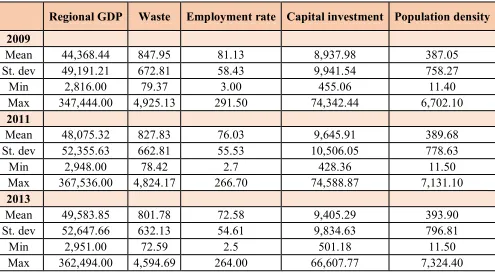
Table 1 presents the descriptive statistics of the inputs and outputs used in the different
[image:7.595.73.568.259.533.2]DEA model formulations and for all the years in question for the 172 regions.
Table 1: Descriptive statistics for all years and regions
Regional GDP Waste Employment rate Capital investment Population density
2009
Mean 44,368.44 847.95 81.13 8,937.98 387.05
St. dev 49,191.21 672.81 58.43 9,941.54 758.27
Min 2,816.00 79.37 3.00 455.06 11.40
Max 347,444.00 4,925.13 291.50 74,342.44 6,702.10
2011
Mean 48,075.32 827.83 76.03 9,645.91 389.68
St. dev 52,355.63 662.81 55.53 10,506.05 778.63
Min 2,948.00 78.42 2.7 428.36 11.50
Max 367,536.00 4,824.17 266.70 74,588.87 7,131.10
2013
Mean 49,583.85 801.78 72.58 9,405.29 393.90
St. dev 52,647.66 632.13 54.61 9,834.63 796.81
Min 2,951.00 72.59 2.5 501.18 11.50
Max 362,494.00 4,594.69 264.00 66,607.77 7,324.40
3.1 Presentation of four environmental production frameworks on regional analysis
The present analysis builds on the work by Halkos and Papageorgiou (2014, 2015)
and furthers it by using more inputs and outputs and more recent EU data. The frameworks
that have been designed are also based on their analysis with new additions in the inputs
taken into account. More specifically in terms of methodology, first one of the pollutants in
question, MSW generation is modelled as a regular output by applying the transformation
introduced by Seiford and Zhu (2002, 2005). This is done in the first framework (M1). Then
the main goal is its minimisation, which is performed in M2 and M3 each time with slightly
different inputs. In Framework M4 the idea of eco-efficiency is used as introduced by
Kuosmanen and Kortelainen (2005) and Kortelainen (2008). For all the regions in the DEA
analysis a radial model was used, which is output oriented and with variable returns to scale.
3.2 Results of the DEA regional level study
Under the M1 framework the highest performers over the years 2009-2013 are: Région de
Bruxelles-Capitale (Belgium), Yuzhen tsentralen (Bulgaria), Düsseldorf (Germany), Valle
d'Aosta (Italy), Liguria (Italy), Lombardia (Italy), Nord-Est (Italy), Lazio (Italy), Sicilia (Italy),
Luxembourg (Luxembourg), Algarve (Portugal), Greater Manchester (UK), Surrey, East and
West Sussex (UK); whereas the areas with the lowest performers are: Flevoland (Netherlands),
North Eastern Scotland (UK), Severozápad (Bulgaria), Zeeland (Netherlands), Trier (Germany),
Jihozápad (Czech Republic), Strední Cechy (Czech Republic), Eesti (Estonia), Highlands and
Islands (UK), Moravskoslezsko (Czech Republic), Prague (Czech Republic).
When using framework M2 and by treating the bad output as input, the highest
performers are: Bremen (Germany), Greater Manchester (UK), Luxembourg (Luxembourg),
Région de Bruxelles-Capitale (Belgium), Düsseldorf (Germany), Valle d'Aosta (Italy),
Lombardia (Italy), Nord-Est (Italy), Lazio (Italy), Surrey, East and West Sussex (UK). The
lowest performers are: Yugoiztochen (Bulgaria), Strední Cechy (Czech Republic), Severozápad
(Czech Republic), Highlands and Islands (UK), Dél-Dunántúl (Hungary), Zeeland (Netherlands),
North Eastern Scotland (UK), Észak-Alföld (Hungary), Yugozapadna i yuzhna tsentralna
(Bulgaria) and Flevoland (Netherlands).
Framework M3 is similar to M2 but with the addition of an extra parameter, population
density. In this one the highest performers are: Region de Bruxelles-Capitale (Belgium),
Severozapaden (Bulgaria), Düsseldorf (Germany), Valle d'Aosta/Vallée d'Aoste (Italy),
Luxembourg (Luxembourg), Zuid-Nederland (Nerherlands), Região Autónoma dos Açores
(Portugal), Surrey, East and West Sussex and Highlands and Islands (both UK). Under this
framework the worse performers are: Flevoland (Netherlands), Severozápad (Czech Republic),
Strední Cechy (Czech Republic), Zeeland (Netherlands), Moravskoslezsko (Czech Republic),
Yugoiztochen (Bulgaria), Dél-Dunántúl (Hungary), Észak-Alföld (Hungary), Podkarpackie
(Poland), Nyugat-Dunántúl (Hungary) and Praha (Czech Republic).
From framework M4, the highest performers are: Lombardia (Italy), Valle d'Aosta (Italy),
Nord-Est (Italy), whereas the lowest ones are: Severozapaden (Bulgaria), Severen tsentralen
(Bulgaria), Severoiztochen (Bulgaria), Yugoiztochen (Bulgaria), Yuzhen tsentralen (Bulgaria),
Dél-Dunántúl (Hungary), Malta (Malta), Észak-Magyarország (Hungary), Algarve (Portugal),
Opolskie (Poland).
As it is evident from this analysis, different frameworks return different results, namely
the results from M1 are much different to M2, M3 and M4 which show a kind of similar picture
overall. This difference can be explained by the fact that in M1 the bad output (waste generation)
is actually considered as output, whereas in the other three frameworks it is considered as a
normal input. Table 2 shows the average scores of each region for all the years divided by the
framework option.4
The results of each framework cannot be compared to each other though as different
assumptions are taken into account under each modelling framework. According to EEA (European
Environment Agency, 2015) and other researchers, there are fluctuations in waste generation not only
among the countries but also among regions within a country, which is due to the fact that there are
separate waste management strategies among the regions themselves as well. This study’s results are
in agreement with this idea, as it was shown that certain regions from one country can be at the top
environmental performers whereas other regions from the same one can be among the lowest ones.
4 The Table presenting in detail the results of M1, M2, M3 and M4 frameworks for all regions for years 2009,
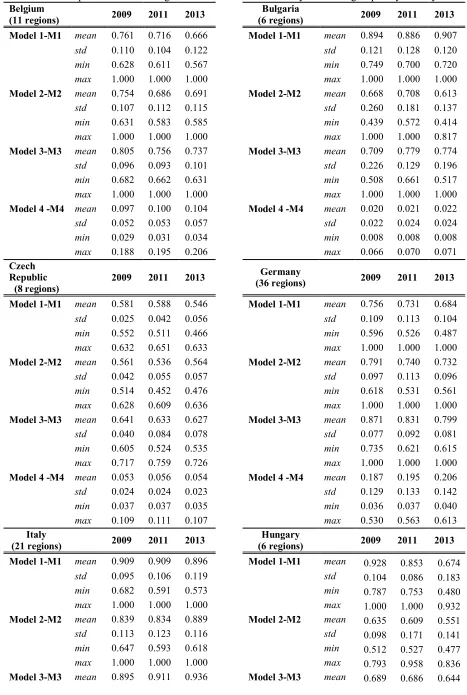
Furthermore table 3 presents the descriptive statistics per country of the different
environmental frameworks over the examined period. The results show that on average terms
the environmental efficiency scores regarding waste arising on a regional level are higher in
framework M1 compared to the environmental efficiency scores from M2, M3 and M4.
Overall the results obtained (on average terms) from M1 suggest that Belgium has higher
[image:10.595.72.531.256.758.2]environmental efficient regions followed by the regions in Italy, Portugal and the UK.
Table 2: Average scores of each region for all the years divided by framework
M1 M2 M3 M4
Region Average Average Average Average
Région de Bruxelles-Capitale / Brussels Hoofdstedelijk Gewest 1.000 1.000 1.000 0.193
Prov. Antwerpen 0.694 0.723 0.775 0.196
Prov. Limburg (BE) 0.636 0.622 0.672 0.065
Prov. Oost-Vlaanderen 0.620 0.627 0.679 0.125
Prov. Vlaams-Brabant 0.729 0.729 0.806 0.110
Prov. West-Vlaanderen 0.602 0.604 0.658 0.105
Prov. Brabant Wallon 0.709 0.715 0.769 0.078
Prov. Hainaut 0.749 0.721 0.772 0.081
Prov. Liège 0.712 0.703 0.763 0.075
Prov. Luxembourg (BE) 0.722 0.687 0.779 0.032
Prov. Namur 0.682 0.682 0.754 0.044
Severozapaden 0.935 0.887 1.000 0.008
Severen tsentralen 0.991 0.887 0.948 0.009
Severoiztochen 0.872 0.587 0.656 0.012
Yugoiztochen 0.848 0.479 0.577 0.014
Yugozapadna i yuzhna tsentralna Bulgaria 0.729 0.533 0.658 0.069
Yuzhen tsentralen 1.000 0.606 0.687 0.016
Praha 0.570 0.605 0.634 0.109
Strední Cechy 0.550 0.488 0.563 0.047
Jihozápad 0.547 0.545 0.711 0.044
Severozápad 0.528 0.503 0.563 0.036
Severovýchod 0.638 0.620 0.722 0.051
Jihovýchod 0.576 0.562 0.666 0.064
Strední Morava 0.600 0.569 0.636 0.041
Moravskoslezsko 0.564 0.540 0.576 0.043
Stuttgart 0.740 0.771 0.822 0.454
Karlsruhe 0.752 0.794 0.833 0.279
Freiburg 0.676 0.727 0.810 0.191
Tübingen 0.630 0.698 0.772 0.173
Oberbayern 0.687 0.705 0.926 0.569
Niederbayern 0.694 0.748 0.896 0.104
Oberpfalz 0.637 0.701 0.829 0.099
Oberfranken 0.744 0.747 0.871 0.088
Unterfranken 0.752 0.787 0.916 0.119
Schwaben 0.643 0.688 0.782 0.162
Berlin 0.832 0.857 0.857 0.297
Brandenburg 0.664 0.689 0.862 0.160
Bremen 0.927 0.965 0.965 0.077
Hamburg 0.734 0.792 0.812 0.267
Darmstadt 0.864 0.902 0.925 0.462
Gießen 0.703 0.719 0.789 0.083
Kassel 0.720 0.744 0.862 0.103
Mecklenburg-Vorpommern 0.617 0.641 0.827 0.101
Braunschweig 0.661 0.686 0.767 0.149
Hannover 0.808 0.810 0.887 0.188
Lüneburg 0.633 0.627 0.767 0.108
Weser-Ems 0.629 0.649 0.753 0.199
Düsseldorf 1.000 1.000 1.000 0.510
Köln 0.889 0.900 0.932 0.426
Münster 0.788 0.795 0.839 0.207
Detmold 0.801 0.849 0.892 0.181
Arnsberg 0.895 0.905 0.944 0.297
Koblenz 0.706 0.716 0.815 0.116
Trier 0.538 0.570 0.662 0.037
Rheinhessen-Pfalz 0.697 0.705 0.758 0.175
Saarland 0.836 0.839 0.882 0.087
Dresden 0.579 0.640 0.695 0.109
Chemnitz 0.668 0.725 0.775 0.094
Leipzig 0.642 0.715 0.753 0.072
Thüringen 0.649 0.676 0.801 0.138
Eesti 0.553 0.547 0.873 0.046
Piemonte 0.778 0.795 0.936 0.345
Valle d'Aosta/Vallée d'Aoste 1.000 1.000 1.000 1.000
Liguria 1.000 0.884 0.933 0.130
Lombardia 1.000 1.000 1.000 0.958
Nord-Est 1.000 1.000 1.000 1.000
Provincia Autonoma di Bolzano/Bozen 0.616 0.629 0.763 0.055
Veneto 0.844 0.867 0.904 0.406
Friuli-Venezia Giulia 0.803 0.772 0.851 0.097
Emilia-Romagna 0.953 0.887 1.000 0.393
Toscana 0.988 0.941 1.000 0.297
Umbria 0.875 0.811 0.883 0.061
Marche 0.897 0.849 0.917 0.111
Lazio 1.000 1.000 1.000 0.513
Abruzzo 0.744 0.653 0.720 0.087
Molise 0.932 0.894 0.943 0.054
Campania 0.995 0.923 0.931 0.282
Puglia 0.922 0.828 0.869 0.196
Calabria 0.889 0.696 0.750 0.091
Sicilia 1.000 0.919 0.955 0.246
Sardegna 0.892 0.767 0.954 0.093
Latvija 0.674 0.562 0.889 0.057
Lietuva 0.962 0.702 0.979 0.086
Luxembourg 1.000 0.989 1.000 0.116
Közép-Magyarország 0.887 0.863 0.892 0.133
Nyugat-Dunántúl 0.784 0.551 0.626 0.027
Dél-Dunántúl 0.800 0.515 0.606 0.018
Észak-Magyarország 0.824 0.585 0.650 0.020
Észak-Alföld 0.845 0.528 0.610 0.026
Dél-Alföld 0.771 0.549 0.654 0.024
Malta 0.767 0.824 0.824 0.020
Groningen 0.868 0.922 0.961 0.082
Friesland (NL) 0.679 0.647 0.687 0.049
Drenthe 0.732 0.702 0.735 0.037
Overijssel 0.658 0.702 0.718 0.099
Gelderland 0.691 0.640 0.675 0.180
Flevoland 0.466 0.539 0.555 0.042
Utrecht 0.694 0.766 0.777 0.157
Noord-Holland 0.850 0.906 0.907 0.350
Zuid-Holland 0.741 0.766 0.767 0.380
Zeeland 0.532 0.525 0.569 0.031
Zuid-Nederland 0.745 0.808 1.000 0.360
Limburg (NL) 0.682 0.713 0.726 0.097
Wien 0.713 0.734 0.739 0.221
Kärnten 0.657 0.686 0.900 0.047
Steiermark 0.626 0.663 0.844 0.108
Oberösterreich 0.665 0.701 0.845 0.144
Salzburg 0.625 0.669 0.832 0.062
Tirol 0.583 0.615 0.819 0.075
Vorarlberg 0.693 0.894 0.909 0.087
Lódzkie 0.739 0.589 0.688 0.062
Mazowieckie 0.831 0.740 0.890 0.219
Malopolskie 0.800 0.663 0.713 0.078
Slaskie 0.932 0.688 0.713 0.129
Lubelskie 0.665 0.600 0.740 0.040
Podkarpackie 0.581 0.546 0.623 0.039
Swietokrzyskie 0.636 0.700 0.781 0.028
Podlaskie 0.634 +0.592 0.770 0.023
Wielkopolskie 0.838 0.694 0.851 0.096
Zachodniopomorskie 0.758 0.612 0.741 0.038
Lubuskie 0.673 0.624 0.724 0.022
Dolnoslaskie 0.791 0.649 0.761 0.085
Opolskie 0.687 0.687 0.753 0.022
Kujawsko-Pomorskie 0.736 0.601 0.706 0.045
Norte 0.888 0.706 0.818 0.138
Algarve 1.000 0.761 0.843 0.020
Centro (PT) 0.863 0.761 0.932 0.091
Área Metropolitana de Lisboa 0.969 0.926 0.932 0.181
Alentejo 0.729 0.623 0.976 0.031
Região Autónoma dos Açores (PT) 0.932 0.946 1.000 0.026
Região Autónoma da Madeira (PT) 0.927 0.9F08 0.908 0.038
Bratislavský kraj 0.603 0.599 0.670 0.054
Západné Slovensko 0.765 0.693 0.798 0.062
Stredné Slovensko 0.686 0.647 0.801 0.038
Východné Slovensko 0.705 0.676 0.796 0.039
Tees Valley and Durham 0.765 0.712 0.714 0.067
Northumberland and Tyne and Wear 0.798 0.772 0.798 0.090
Cumbria 0.803 0.828 0.983 0.034
Greater Manchester 1.000 0.986 0.986 0.186
Lancashire 0.937 0.910 0.917 0.091
East Yorkshire and Northern Lincolnshire 0.872 0.855 0.864 0.060
North Yorkshire 0.844 0.832 0.981 0.059
South Yorkshire 0.797 0.797 0.797 0.078
West Yorkshire 0.947 0.943 0.943 0.156
Derbyshire and Nottinghamshire 0.848 0.812 0.813 0.138
Leicestershire, Rutland and Northamptonshire 0.819 0.816 0.827 0.123
Lincolnshire 0.650 0.642 0.746 0.043
Herefordshire, Worcestershire and Warwickshire 0.790 0.786 0.826 0.092
Shropshire and Staffordshire 0.877 0.850 0.881 0.097
West Midlands 0.960 0.922 0.922 0.180
East Anglia 0.678 0.694 0.807 0.181
Bedfordshire and Hertfordshire 0.886 0.902 0.916 0.147
Essex 0.897 0.890 0.893 0.116
Berkshire, Buckinghamshire and Oxfordshire 0.839 0.885 0.915 0.253
Surrey, East and West Sussex 1.000 1.000 1.000 0.234
Hampshire and Isle of Wight 0.716 0.762 0.771 0.159
Kent 0.874 0.856 0.865 0.115
Gloucestershire, Wiltshire and Bristol/Bath area 0.817 0.840 0.910 0.200
Dorset and Somerset 0.837 0.835 0.885 0.086
Cornwall and Isles of Scilly 0.706 0.705 0.735 0.031
Devon 0.787 0.778 0.851 0.073
West Wales and The Valleys 0.853 0.752 0.893 0.100
East Wales 0.791 0.779 0.891 0.078
Eastern Scotland 0.778 0.732 0.917 0.153
South Western Scotland 0.757 0.687 0.822 0.159
North Eastern Scotland 0.479 0.526 0.691 0.057
Highlands and Islands 0.555 0.512 1.000 0.032
Table 3: Descriptive statistics of regions’ environmental efficiency estimates grouped by country Belgium
(11 regions) 2009 2011 2013 (6 regions) Bulgaria 2009 2011 2013
Model 1-M1 mean 0.761 0.716 0.666 Model 1-M1 mean 0.894 0.886 0.907
std 0.110 0.104 0.122 std 0.121 0.128 0.120
min 0.628 0.611 0.567 min 0.749 0.700 0.720
max 1.000 1.000 1.000 max 1.000 1.000 1.000
Model 2-M2 mean 0.754 0.686 0.691 Model 2-M2 mean 0.668 0.708 0.613
std 0.107 0.112 0.115 std 0.260 0.181 0.137
min 0.631 0.583 0.585 min 0.439 0.572 0.414
max 1.000 1.000 1.000 max 1.000 1.000 0.817
Model 3-M3 mean 0.805 0.756 0.737 Model 3-M3 mean 0.709 0.779 0.774
std 0.096 0.093 0.101 std 0.226 0.129 0.196
min 0.682 0.662 0.631 min 0.508 0.661 0.517
max 1.000 1.000 1.000 max 1.000 1.000 1.000
Model 4 -M4 mean 0.097 0.100 0.104 Model 4 -M4 mean 0.020 0.021 0.022
std 0.052 0.053 0.057 std 0.022 0.024 0.024
min 0.029 0.031 0.034 min 0.008 0.008 0.008
max 0.188 0.195 0.206 max 0.066 0.070 0.071 Czech
Republic
(8 regions) 2009 2011 2013
Germany
(36 regions) 2009 2011 2013
Model 1-M1 mean 0.581 0.588 0.546 Model 1-M1 mean 0.756 0.731 0.684
std 0.025 0.042 0.056 std 0.109 0.113 0.104
min 0.552 0.511 0.466 min 0.596 0.526 0.487
max 0.632 0.651 0.633 max 1.000 1.000 1.000
Model 2-M2 mean 0.561 0.536 0.564 Model 2-M2 mean 0.791 0.740 0.732
std 0.042 0.055 0.057 std 0.097 0.113 0.096
min 0.514 0.452 0.476 min 0.618 0.531 0.561
max 0.628 0.609 0.636 max 1.000 1.000 1.000
Model 3-M3 mean 0.641 0.633 0.627 Model 3-M3 mean 0.871 0.831 0.799
std 0.040 0.084 0.078 std 0.077 0.092 0.081
min 0.605 0.524 0.535 min 0.735 0.621 0.615
max 0.717 0.759 0.726 max 1.000 1.000 1.000
Model 4 -M4 mean 0.053 0.056 0.054 Model 4 -M4 mean 0.187 0.195 0.206
std 0.024 0.024 0.023 std 0.129 0.133 0.142
min 0.037 0.037 0.035 min 0.036 0.037 0.040
max 0.109 0.111 0.107 max 0.530 0.563 0.613 Italy
(21 regions) 2009 2011 2013 (6 regions) Hungary 2009 2011 2013
Model 1-M1 mean 0.909 0.909 0.896 Model 1-M1 mean 0.928 0.853 0.674
std 0.095 0.106 0.119 std 0.104 0.086 0.183
min 0.682 0.591 0.573 min 0.787 0.753 0.480 max 1.000 1.000 1.000 max 1.000 1.000 0.932
Model 2-M2 mean 0.839 0.834 0.889 Model 2-M2 mean 0.635 0.609 0.551
std 0.113 0.123 0.116 std 0.098 0.171 0.141 min 0.647 0.593 0.618 min 0.512 0.527 0.477
std 0.094 0.082 0.092 std 0.094 0.146 0.116 min 0.692 0.732 0.696 min 0.562 0.596 0.548
max 1.000 1.000 1.000 max 0.828 0.980 0.868
Model 4 -M4 mean 0.309 0.307 0.305 Model 4 -M4 mean 0.041 0.041 0.042
std 0.314 0.315 0.315 std 0.045 0.045 0.045
min 0.034 0.038 0.038 min 0.018 0.017 0.018 max 1.000 1.000 1.000 max 0.133 0.132 0.135 Netherlands
(12 regions) 2009 2011 2013 (7 regions) Austria 2009 2011 2013
Model 1-M1 mean 0.665 0.714 0.705 Model 1-M1 mean 0.689 0.667 0.599
std 0.095 0.145 0.110 std 0.048 0.055 0.050
min 0.478 0.437 0.484 min 0.630 0.583 0.535
max 0.827 1.000 0.896 max 0.755 0.727 0.695
Model 2-M2 mean 0.695 0.713 0.751 Model 2-M2 mean 0.748 0.701 0.677
std 0.116 0.154 0.110 std 0.116 0.115 0.048
min 0.504 0.490 0.575 min 0.641 0.592 0.614
max 0.865 1.000 0.933 max 0.994 0.938 0.751
Model 3-M3 mean 0.753 0.738 0.778 Model 3-M3 mean 0.887 0.855 0.782
std 0.134 0.165 0.125 std 0.090 0.062 0.029
min 0.585 0.490 0.590 min 0.749 0.738 0.732
max 1.000 1.000 1.000 max 1.000 0.938 0.820
Model 4 -M4 mean 0.155 0.154 0.157 Model 4 -M4 mean 0.105 0.105 0.110
std 0.135 0.131 0.135 std 0.059 0.059 0.062
min 0.030 0.031 0.031 min 0.046 0.047 0.049
max 0.389 0.371 0.380 max 0.218 0.218 0.229 Poland
(16 regions) 2009 2011 2013 (7 regions) Portugal 2009 2011 2013
Model 1-M1 mean 0.753 0.730 0.710 Model 1-M1 mean 0.869 0.920 0.915
std 0.105 0.122 0.082 std 0.094 0.110 0.092
min 0.619 0.532 0.560 min 0.739 0.690 0.760
max 1.000 0.908 0.890 max 1.000 1.000 1.000
Model 2-M2 mean 0.675 0.589 0.641 Model 2-M2 mean 0.747 0.799 0.867
std 0.077 0.098 0.071 std 0.145 0.156 0.109
min 0.468 0.435 0.525 min 0.612 0.544 0.714
max 0.788 0.785 0.768 max 1.000 1.000 1.000
Model 3-M3 mean 0.749 0.726 0.757 Model 3-M3 mean 0.840 0.929 0.978
std 0.080 0.096 0.084 std 0.098 0.075 0.059
min 0.544 0.560 0.606 min 0.717 0.810 0.844
max 0.840 0.949 0.909 max 1.000 1.000 1.000
Model 4 -M4 mean 0.057 0.065 0.068 Model 4 -M4 mean 0.076 0.074 0.076
std 0.046 0.053 0.056 std 0.068 0.063 0.060
min 0.020 0.022 0.023 min 0.021 0.020 0.020
max 0.192 0.225 0.241 max 0.191 0.180 0.173 Slovakia
(4 regions) 2009 2011 2013 (33 regions) UK 2009 2011 2013
Model 1-M1 mean 0.683 0.657 0.729 Model 1-M1 mean 0.838 0.829 0.754
std 0.075 0.086 0.166 std 0.109 0.136 0.138
max 0.764 0.762 0.843 max 1.000 1.000 1.000
Model 2-M2 mean 0.674 0.575 0.713 Model 2-M2 mean 0.831 0.790 0.764
std 0.061 0.048 0.144 std 0.116 0.136 0.133
min 0.614 0.535 0.502 min 0.537 0.403 0.361
max 0.759 0.634 0.820 max 1.000 1.000 1.000
Model 3-M3 mean 0.763 0.715 0.821 Model 3-M3 mean 0.885 0.870 0.839
std 0.073 0.067 0.196 std 0.096 0.110 0.101
min 0.685 0.618 0.530 min 0.628 0.510 0.565
max 0.862 0.769 0.953 max 1.000 1.000 1.000
Model 4 -M4 mean 0.046 0.048 0.051 Model 4 -M4 mean 0.107 0.112 0.125
std 0.011 0.012 0.012 std 0.054 0.057 0.064
min 0.036 0.038 0.040 min 0.029 0.030 0.034
max 0.059 0.062 0.065 max 0.229 0.249 0.280 4. Discussion
The efficiency scores obtained through DEA have been reviewed against the
treatment options that have been employed in each region and which for this analysis are
divided in landfill, incineration, material recycling and composting. Data for the treatment
options have been obtained from Eurostat as well. First of all it is worth mentioning that
overall in the EU a decrease in the use of landfill and an increase in the use of more
[image:16.595.99.499.504.715.2]sustainable treatment options has been noticed over the period 1995-2015.
The aim of the comparison in this analysis was to investigate whether regions with the
use of more sustainable treatment options are the ones that are the highest performers
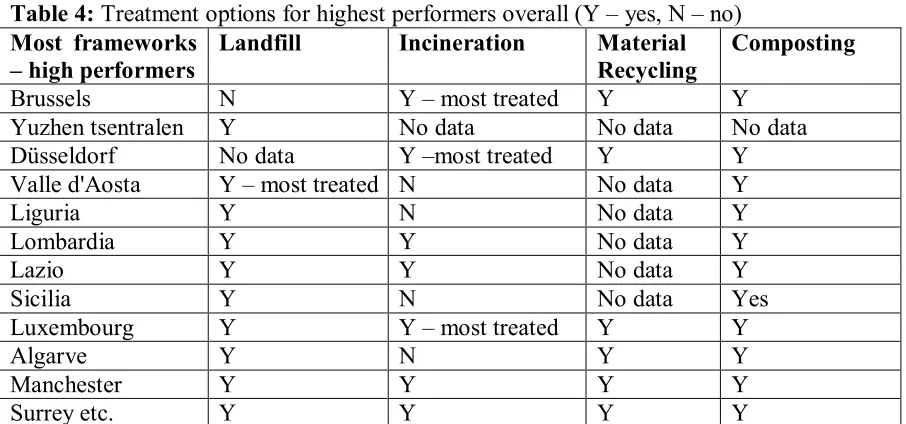
regarding efficiency based on the DEA analysis. Table 4 presents the treatment options that
have been used for the highest performing regions, whereas table 5 presents those options for
[image:17.595.67.520.224.436.2]the lowest performers.5
Table 4: Treatment options for highest performers overall (Y – yes, N – no) Most frameworks
– high performers Landfill Incineration Material Recycling Composting
Brussels N Y – most treated Y Y
Yuzhen tsentralen Y No data No data No data
Düsseldorf No data Y –most treated Y Y
Valle d'Aosta Y – most treated N No data Y
Liguria Y N No data Y
Lombardia Y Y No data Y
Lazio Y Y No data Y
Sicilia Y N No data Yes
Luxembourg Y Y – most treated Y Y
Algarve Y N Y Y
Manchester Y Y Y Y
Surrey etc. Y Y Y Y
Table 5: Treatment options for lowest performers overall (Y – yes, N – no) Most frameworks –
lowest performers Landfill Incineration Material Recycling Composting
Severozápaden Y No data No data No data
Zeeland Y Y – most treated Y Y
Flevoland Y Y – most treated Y y
Strední Cechy No data No data No data No data
Dél-Dunántúl Y – most treated N Y Y
North Eastern Scotland Y – most treated N Y Y
Észak-Alföld Y – most treated N Y Y
It was noticed that higher performing regions generally employ all four treatment
options and for some landfill is still in extensive use for the majority of the waste treated. In
Brussels and Luxembourg metropolitan regions incineration is mostly used instead. On the
5 For the implementation of environmental management systems standards see Evangelinos and Halkos (2002)
[image:17.595.71.520.465.609.2]other hand for the lowest performing regions generally landfill is used mostly in those ones
with a small mix of other more sustainable options and with the exceptions of Flevoland and
Zeeland, both regions of the Netherlands, which use mostly incineration.
These results are not unexpected because we need to account for the transport of waste
between regions within a country and also the general trade of waste between countries.
Regulation (EC) No 1013/2006 of the European Parliament and of the Council of 14 June 2006
on shipments of waste aims at managing all the procedures around controlling waste shipments
and to improve environmental protection in whole (Municipal Waste Europe, 2017). In those
regards the principles of self-sufficiency, proximity of waste for disposal and prior informed
consent need to be considered (Municipal Waste Europe, 2017). The growth in exports of waste
in the EU can be attributed to a number of factors, mainly the recycling targets set in the waste
directives, disparities in recycling infrastructure between EU Member States, increasing prices for
secondary materials and increasing demand for materials, especially in Asian countries (European
Environment Agency, 2012).
This means that despite the fact that a region uses mostly landfill for example, it can also
be very efficient in DEA while taking many parameters into account (population density, GDP,
labor, investment). This is due to the fact that it is possible that waste produced in that area is
actually treated elsewhere. The Eurostat data for the treatment options refer only to a certain
region and cannot reflect waste movement in that sense, therefore it is not possible to match these
waste treated with the efficiency scores of DEA on the regional level. This would make more
5. Conclusions
As it has been mentioned before waste arisings have been increasing over the years and
therefore their management and treatment have raised a lot of attention. This paper deals with the
efficiency of 172 EU regions for the years 2009, 2011 and 2013 by employing DEA analysis and
by using five parameters, namely waste generation, employment rate, capital formation, GDP and
population density for the relevant regions. In doing so four frameworks have been designed with
different inputs and outputs each time. The results present the more efficient EU regions
according to each framework, but it should be noted that results from different frameworks
should not be compared to each other.
Overall results show that the highest performers are regions in Belgium, Italy, Portugal and
the UK. Finally the efficiency results from DEA were reviewed against the treatment options
employed in the relevant regions. This review proved that although high performers generally
employ a mix of all treatment options, landfill is still in extensive use in those regions. This can
be attributed to the fact that although waste is produced in that region, it is actually treated
elsewhere. Therefore although a country might be efficient according to DEA and by taking many
factors into consideration, it is not necessary that this region uses sustainable waste treatment
References
Benito, B., Bastida, F. and García, J. A. (2010) The determinants of efficiency in municipal governments. Applied Economics, 42(4), 515–528.
Berg, S.A., Forsund, F.R. and Jansen, E.S. (1992) Malmquist indices of productivity growth during the deregulation of Norwegian banking 1980–1989. Scandinavian Journal of Economics, 94(0), 211–228.
Bosch, N., Pedraja, F. and Suárez‐Pandiello, J. (2000) Measuring the efficiency of Spanish municipal refuse collection services. Local Government Studies, 26(3), 71–90.
Boussofiane, A., Dyson, R.G. and Thanassoulis, E. (1991) Applied data envelopment analysis. European Journal of Operational Research, 52, 1–15.
Chen, H.-W., Chang, N.-B., Chen, J.-C. and Tsai, S.-J. (2010) Environmental performance evaluation of large-scale municipal solid waste incinerators using data envelopment analysis. Waste Management, 30, 1371–1381.
Chen, Y., Chen, C., (2012) The privatization effect of MSW incineration services by using data envelopment analysis. Waste Management, 32, 595–602.
Cook, W.D., Tone, K. and Zhu, J. (2014) Data envelopment analysis: Prior to choosing a model. Omega 44, 1–4.
De Jaeger, S., Eyckmans, J., Rogge, N. and Van Puyenbroeck, T. (2011) Wasteful waste reducing policies? The impact of waste reduction policy instruments on collection and processing costs of municipal solid waste. Waste Management, 31, 1429–1440.
Dostalova, K. (2014) Efficiency Evaluation of Municipal Solid Waste Management in the Czech Republic using DEA Method. Master Thesis, Masaryk University, Faculty of Economics and Administration, Brno.
European Environment Agency (2012) Movements of waste across the EU's internal and external borders. EEA Report, No 7/2012.
European Environment Agency (2015) Cross-country comparisons: Waste — municipal solid waste generation and management. European Environment Agency, SOER 2015. Available at: https://www.eea.europa.eu/soer-2015/countries-comparison/waste Eurostat (2016) Top 3 types of treatment and the top 3 export and import countries for the top
10 notified non-hazardous waste according to the European LoW classification in 2013. Available at: http://ec.europa.eu/eurostat/statistics-explained/index.php/Waste_shipment_ statistics_ based_on_the_European_list_of_waste_codes
Eurostat (2017) Municipal waste treatment by type of treatment. Available at: http://ec.europa.eu/ eurostat/statistics-explained/index.php/Municipal_waste_statistics Eunomia (2015) Economic Analysis of Options for Managing Biodegradable Municipal
Waste, Final Report to the European Commission. Available at: http://ec.europa.eu/environment/waste/ compost/pdf/econanalysis_finalreport.pdf
Evangelinos K.I. and Halkos G.E. (2002). Implementation of environmental management systems standards: important factors in corporate decision making. Journal of Environmental Assessment Policy and Management, 4(3), 311-328.
Fare, R., Grosskopf, S., Lovell, C.A.K. and Yaiswarng, S. (1993) Deviation of shadow prices for undesirable outputs: a distance function approach. The Review of Economics and Statistics, 75(2), 374–380.
Fare, R., Grosskopf, S. and Hernandez-Sancho, F. (2004) Environmental performance: an index number approach. Resource and Energy Economics, 26(4), 343–352.
Fare, R., Grosskopf, S., Noh, D.W. and Weber, W. (2005) Characteristics of a polluting technology: theory and practice. Journal of Econometrics, 126(2), 469–492.
Gelman, A and Hill, J. (2007) Data Analysis using Regression and Multilevel/Hierarchical Models, Chapter 25 Cambridge University Press.
Hailu, A. and Veeman, T. (2001) Non-parametric productivity analysis with undesirable outputs: an application to Canadian pulp and paper industry. American Journal of Agricultural Economics, 83(3), 605–616.
Halkos G.E. (1992). Economic perspectives of the acid rain problem in Europe. University of York.
Halkos G.E. (2003). Environmental Kuznets Curve for sulfur: evidence using GMM estimation and random coefficient panel data models. Environment and Development Economics, 8(4), 581-601.
Halkos G.E. (2011). Environment and economic development: determinants of an EKC hypothesis, MPRA Paper 33262, University Library of Munich, Germany.
Halkos G.E. (2013). Exploring the economy - environment relationship in the case of sulphur emissions. Journal of Environmental Planning and Management, 56(2), 159-177.
Halkos G.E. and Evangelinos K.I. (2002). Determinants of environmental management systems standards implementation: evidence from Greek industry. Business Strategy and the Environment, 11(6), 360-375.
Halkos, G.E. and Papageorgiou, G. (2014) Spatial environmental efficiency indicators in regional waste generation: A nonparametric approach. DEOS Working Papers 1401, Athens, University of Economics and Business.
Halkos, G.E. and Papageorgiou, G. (2015) Spatial environmental efficiency indicators in regional waste generation: A nonparametric approach. Journal of Environmental Planning and Management, 59(1), 62-78.
Halkos, G.E. and Petrou K.N. (2016) Moving Towards a Circular Economy: Rethinking Waste Management Practices. Journal of Economic and Social Thought, 3(2): 220-240. Halkos G.E. and Tseremes N. (2007). International competitiveness in the ICT industry:
Evaluating the performance of the top 50 companies. Global Economic Review, 36(2), 167-182.
Halkos G.E. and Tsionas E.G. (2001). Environmental Kuznets curves: Bayesian evidence from switching regime models. Energy Economics, 23(2), 191-210.
Hua, Z., Bian, Y, and Liang, L. (2007) Eco-efficiency analysis of paper mills along the Huai River: an extended DEA approach. Omega. 35(5), 578–587.
IDRE (2016) Missing Data Techniques with SAS. Available at: http://stats.idre.ucla.edu/wp-content/uploads/2016/09/Missing-Data-Techniques_UCLA_Stata.pdf
Kao, C. (2014) Network data envelopment analysis: A review. European Journal of Operational Research, 239, 1–16.
Kortelainen, M. and Kuosmanen, T. (2007) Eco-efficiency analysis of consumer durables using absolute shadow prices. Journal of Productivity Analysis, 28, 57–69.
Kortelainen, M. 2008. Dynamic environmental performance analysis: a Malmquist index approach. Ecological Economics, 64, 701-715.
Kumar, S. (2006) Environmentally sensitive productivity growth: A global analysis using Malmquist–Luenberger index. Ecological Economics, 56(2), 280–293.
Kuosmanen, T., Kortelainen, M. (2005) Measuring eco-efficiency of production with data envelopment analysis. Journal of Industrial Ecology, 9, 59-72.
Lozano, S., Iribarren, D., Moreira, M.T. and Feijoo, G. (2009) The link between operational efficiency and environmental impacts: A joint application of Life Cycle Assessment and Data Envelopment Analysis. Science of the Total Environment, 407, 1744-1754.
Marques, R.C. and Simões, P. (2009) Incentive regulation and performance measurement of the Portuguese solid waste management services. Waste Management and Research, 27, 188–196.
Moore, A., Nolan, J. and Segal, G. F. (2005) Putting out the trash measuring municipal service efficiency in US cities. Urban Affairs Review, 41(2), 237–259.
Municipal Waste Europe (2017) Summary of the current EU legislation. Available at: https://www.municipalwasteeurope.eu/summary-current-eu-waste-legislation
Ramanathan, R. (2002) Combining indicators of energy consumption and CO 2 emissions: A crosscountry comparison. International Journal of Global Energy Issues, 17(3), 214–227. Ramanathan, R. (2005) An analysis of energy consumption and carbon dioxide emissions in
countries of the Middle East and North Africa. Energy, 30(15), 2831–2842.
Rogge, N. and De Jaeger, S. (2012) Evaluating the efficiency of municipalities in collecting and processing municipal solid waste: A shared input DEA-model. Waste Management,
32, 1968–1978.
Rogge, N. and De Jaeger, S. (2013) Measuring and explaining the cost efficiency of municipal solid waste collection and processing services. Omega, 41(4), 653–664.
Sarkis, J. (1999) Methodological framework for evaluating environmentally conscious manufacturing programs. Computers & Industrial Engineering, 36(4), 793–810.
Sarkis, J. and Cordeiro, J. J. (2001) An empirical evaluation of environmental efficiencies and firm performance: pollution prevention versus end-of-pipe practice. European Journal of Operational Research, 135(1), 102–113.
Sarkis, J. and Weinrach, J. (2001) Using data envelopment analysis to evaluate environmentally conscious waste treatment technology. Journal of Cleaner Production, 9(5), 417–427.
Scheel, H. (2001) Undesirable outputs in efficiency valuations. European Journal of Operational Research, 132(2), 400–410.
Seiford, L.M., Zhu, J. (2002) Modeling undesirable factors in efficiency evaluation.
Seiford, L.M., Zhu, J. (2005) A response to comments on modeling undesirable factors in efficiency evaluation. European Journal of Operational Research, 161, 579-581.
Sherman, H.D. and Zhu, J. (2006) Chapter 2: Data Envelopment Analysis explained. In:
Service Productivity Management, Improving Service Performance using Data Envelopment Analysis (DEA), Springer.
Simões, P., De Witte, K. and Marques, R.C. (2010) Regulatory structures and operational environment in the Portuguese waste sector. Waste Management, 30, 1130–1137.
Sueyoshi, T. and Goto, M. (2014) DEA radial measurement for environmental assessment: A comparative study between Japanese chemical and pharmaceutical firms. Applied Energy, 115, 502–513.
Soukopová, J. (2011) Metody ekonomické analýzy a jejich využití pro hodnocení výdajů na ochranu životního prostředí. In Soukopová, J. (Ed.), Výdaje obcí na ochranu životního prostředí a jejich efektivnost, Brno, Czech Republic: Littera, 103-142.
Tone, K. (2001) A slacks-based measure of efficiency in data envelopment analysis.
European Journal of Operational Research, 130(3), 498–509.
Tone, K. (2004) Dealing with undesirable outputs in DEA: a Slacks-Based Measure (SBM) approach. Presentation at NAPWIII. Toronto.
Tyteca, D. (1996) On the measurement of the environmental performance of firms: a literature review and productive efficiency perspective. Journal of Environmental Management, 46(3), 281–308.
Wang, Q., Zhou, P. and Zhou, D. (2012) Efficiency measurement with carbon dioxide emissions: The case of China. Applied Energy, 90(1), 161–166.
Worthington, A. C. and Dollery, B. E. (2001) Measuring efficiency in local government: An analysis of New South Wales municipalities' domestic waste management function.
Policy Studies Journal, 29(2), 232–249.
Zaim, O. (2004) Measuring environmental performance of state manufacturing through changes in pollution intensities: A DEA framework. Ecological Economics, 48(1), 37–47. Zhou, P., Ang, B.W. and Poh, K.L. (2008) Measuring environmental performance under