CFO: Conditional Focused Neural Question Answering
with Large-scale Knowledge Bases
Zihang Dai∗ Carnegie Mellon University
Lei Li∗ Toutiao.com
Wei Xu Baidu Research
Abstract
How can we enable computers to automat-ically answer questions like “Who created the character Harry Potter”? Carefully built knowledge bases provide rich sources of facts. However, it remains a chal-lenge to answer factoid questions raised in natural language due to numerous ex-pressions of one question. In particular, we focus on the most common questions — ones that can be answered with a sin-gle fact in the knowledge base. We pro-pose CFO, aConditionalFocused neural-network-based approach to answering fac-toid questions with knowledge bases. Our approach first zooms in a question to find more probable candidate subject men-tions, and infers the final answers with a unified conditional probabilistic frame-work. Powered by deep recurrent neural networks and neural embeddings, our pro-posed CFO achieves an accuracy of 75.7% on a dataset of 108k questions – the largest public one to date. It outperforms the cur-rent state of the art by an absolute margin of 11.8%.
1 Introduction
Community-driven question answering (QA) web-sites such as Quora, Yahoo-Answers, and An-swers.com are accumulating millions of users and hundreds of millions of questions. A large portion of the questions are about facts or trivia. It has been a long pursuit to enable machines to answer such questions automatically.
In recent years, several efforts have been made on utilizing open-domain knowledge bases to answer factoid questions. A knowledge
∗Part of the work was done while at Baidu.
base (KB) consists of structured representation of facts in the form of subject-relation-object triples. Lately, several large-scale general-purpose KBs have been constructed, including YAGO (Suchanek et al., 2007), Freebase (Bol-lacker et al., 2008), NELL (Carlson et al., 2010), and DBpedia (Lehmann et al., 2014). Typically, structured queries with predefined semantics (e.g. SPARQL) can be issued to retrieve specified facts from such KBs. Thus, answering factoid questions will be straightforward once they are converted into the corresponding structured form. However, due to complexity of language, converting natural language questions to structure forms remains an open challenge.
Among all sorts of questions, there is one cat-egory that only requires a single fact (triple) in KB as the supporting evidence. As a typical ex-ample, the question “Who created the charac-ter Harry Potcharac-ter” can be answered with the sin-gle fact (HarryPotter, CharacterCreatedBy, J.K.Rowling). In this work, we refer to such questions as single-fact questions. Previously, it has been observed thatsingle-fact questions con-stitute the majority of factoid questions in commu-nity QA sites (Fader et al., 2013). Despite the sim-plicity, automatically answering such questions re-mains far from solved — the latest best result on a dataset of 108k single-fact questions is only 63.9% in terms of accuracy (Bordes et al., 2015).
To find the answer to a single-fact question, it suffices to identify the subject entity and relation (implicitly) mentioned by the question, and then forms a corresponding structured query. The prob-lem can be formulated into a probabilistic form. Given a single-fact questionq, finding the subject-relation pairs,ˆ rˆfrom the KBKwhich maximizes the conditional probabilityp(s, r|q), i.e.
ˆ
s,rˆ= arg max
s,r∈K p(s, r|q) (1)
Based on the formulation (1), the central problem is to estimate the conditional distributionp(s, r|q). It is very challenging because of a) the vast amount of facts — a large-scale KB such as Free-base contains billions of triples, b) the huge vari-ety of language — there are multiple aliases for an entity, and numerous ways to compose a question,
c) the severe sparsity of supervision — most com-binations of s, r, q are not expressed in training data. Faced with these challenges, existing meth-ods have exploited to incorporate prior knowledge into semantic parsers, to design models and rep-resentations with better generalization property, to utilize large-margin ranking objective to estimate the model parameters, and to prune the search space during inference. Noticeably, models based on neural networks and distributed representations have largely contributed to the recent progress (see section 2).
In this paper, we propose CFO, a novel method to answer single-fact questions with large-scale knowledge bases. The contributions of this paper are,
• we employ a fully probabilistic treatment of the problem with a novel conditional param-eterization using neural networks,
• we propose the focused pruning method to re-duce the search space during inference, and
• we investigate two variations to improve the generalization of representations for millions of entities under highly sparse supervision.
In experiments, CFO achieves 75.7% in terms of top-1 accuracy on the largest dataset to date, out-performing the current best record by an absolute margin of 11.8%.
2 Related Work
The research of KB supported QA has evolved from earlier domain-specific QA (Zelle and Mooney, 1996; Tang and Mooney, 2001; Liang et al., 2013) to open-domain QA based on large-scale KBs. An important line of research has been trying to tackle the problem by semantic parsing, which directly parses natural language questions into structured queries (Liang et al., 2011; Cai and Yates, 2013; Kwiatkowski et al., 2013; Yao and Van Durme, 2014). Recent progresses in-clude designing KB specific logical representation and parsing grammar (Berant et al., 2013), using distant supervision (Berant et al., 2013), utilizing
paraphrase information (Fader et al., 2013; Be-rant and Liang, 2014), requiring little question-answer pairs (Reddy et al., 2014), and exploit-ing ideas from agenda-based parsexploit-ing (Berant and Liang, 2015).
In contrast, another line of research tackles the problem by deep learning powered similarity matching. The core idea is to learn semantic repre-sentations of both the question and the knowledge from observed data, such that the correct support-ing evidence will be the nearest neighbor of the question in the learned vector space. Thus, a main difference among several approaches lies in the neural networks proposed to represent questions and KB elements. While (Bordes et al., 2014b; Bordes et al., 2014a; Bordes et al., 2015; Yang et al., 2014) use relatively shallow embedding mod-els to represent the question and knowledge, (Yih et al., 2014; Yih et al., 2015) employ a convolu-tional neural network (CNN) to produce the repre-sentation. In the latter case, both the question and the relation are treated as a sequence of letter-tri-gram patterns, and fed into two parameter shared CNNs to get their embeddings. What’s more, in-stead of measuring the similarity between a ques-tion and an evidence triple with a single model as in (Bordes et al., 2015), (Yih et al., 2014; Yih et al., 2015) adopt a multi-stage approach. In each stage, one element of the triple is compared with the question to produce a partial similarity score by a dedicated model. Then, these partial scores are combined to generate the overall measurement.
Our proposed method is closely related to the second line of research, since neural models are employed to learn semantic representations. As in (Bordes et al., 2015; Yih et al., 2014), we focus onsingle-fact questions. However, we propose to use recurrent neural networks (RNN) to produce the question representation. More importantly, our method follows a probabilistic formulation, and our parameterization relies on factors other than similarity measurement.
syn-thetic QA task (Weston et al., 2016). In addition, (Hermann et al., 2015) seeks to answer Cloze style questions based on news articles.
3 Overview
In this section, we formally formulate the problem ofsingle-fact question answeringwith knowledge bases. A knowledge baseK contains three com-ponents: a set of entities E, a set of relationsR, and a set of factsF = {hs, r, oi} ⊆ E × R × E, where s, o ∈ E are the subject and object enti-ties, andr∈ Ris a binary relation. E(r),E(s)are the vector representations of a relation and an en-tity, respectively.s→rindicates that there exists some entityosuch thaths, r, oi ∈ F. For single-fact questions, a common assumption is that the answer entity o and some triple hsi, rk, oi ∈ F
reside in the given knowledge base. The goal of our model is to find such subjectsiand relationrk
mentioned or implied in the question. Once found, a structured query (e.g. in SPARQL) can be con-structed to retrieve the result entity.
3.1 Conditional Factoid Factorization
Given a questionq, the joint conditional probabil-ity of subject-relation pairs p(s, r|q) can be used to retrieve the answer using the exact inference defined by Eq. (1). However, since there can be millions of entities and thousands of relations in a knowledge base, it is less effective to model
p(s, r|q) directly. Instead, we propose a condi-tional factoid factorization,
p(s, r|q) =p(r|q)·p(s|q, r) (2)
and utilize two neural networks to parameter-ize each component,p(r|q)andp(s|q, r), respec-tively. Hence, our proposed method contains two phases: inferring the implied relationr from the questionq, and inferring the mentioned subject en-titysgiven the relationrand the questionq.
There is an alternative factorizationp(s, r|q) =
p(s|q)·p(r|s, q). However, it is rather challenging to estimatep(s|q)directly due to the vast amount of entities (> 106) in a KB. In comparison, our proposed factorization takes advantage of the rel-atively limited number of relations (on the order of thousands). What’s more, by exploiting addi-tional information from the candidate relation r, it’s more feasible to model p(s|q, r) than p(s|q), leading to more robust estimation.
A key difference from prior multi-step approach is that our method do not assume any indepen-dence between the target subject and relation given a question, as does in the prior method (Yih et al., 2014). It proves effective in our experiments.
3.2 Inference via Focused Pruning
As defined by the Eq. (1), a solution needs to con-sider all available subject-relation pairs in the KB as candidates. With a large-scale KB, the number of candidates can be notoriously large, resulting in a extremely noisy candidate pool. We propose a method to prune the candidate space. The pruning is equivalent to a function that takes a KBK and a questionq as input, and outputs a much limited setCof candidate subject-relation pairs.
H(K, q)→ C (3)
CsandCrare used to represent the subject and
re-lation candidates, respectively.
The fundamental intuition for pruning is that the subject entity must be mentioned by some textual substring (subject mention) in the question. Thus, the candidate space can be restricted to entities whose name/alias matches an n-gram of the ques-tion, as in (Yih et al., 2014; Yih et al., 2015; Bor-des et al., 2015). We refer to this straight-forward method asN-Gram pruning. By considering all n-grams, this approach usually achieves a high recall rate. However, the candidate pool is still noisy due to many non-subject-mention n-grams.
Our key idea is to reduce the noise by guiding the pruning method’s attention to more probable parts of a question. An observation is that cer-tain parts of a sentence are more likely to be the subject mention than others. For example, “Harry Potter” in “Who created the character Harry Pot-ter” is more likely than “the character”, “ charac-ter Harry”, etc. Specifically, our method employs a deep network to identify such focus segments in a question. This way, the candidate pool can be not only more compact, but also significantly less noisy.
Finally, combing the ideas of Eq.(2) and (3), we propose an approximate solution to the problem defined by Eq. (1)
ˆ
s,ˆr≈arg max
s,r∈C p(s|q, r)p(r|q) (4) 4 Proposed CFO
this work. Then, we describe the model parame-terization ofp(r|q)andp(s|q, r), and the focused pruning method in inference.
4.1 Review: Gated Recurrent Units
In this work we employ GRU (Cho et al., 2014) as the RNN structure. At time stept, a GRU com-putes its hidden statehtusing the following
com-pound functions
z=sigmoid(Wxzxt+Whzht−1+bz) (5)
r=sigmoid(Wxrxt+Whrht−1+br) (6)
˜
h= tanh (Wxhxt+r⊗Whhht−1+bh) (7)
ht=z⊗ht−1+ (1−z)⊗˜h (8)
whereW{·}, andb{·} are all trainable parameters.
To better capture the context information on both sides, two GRUs with opposite directions can be combined to form a bidirectional GRU (BiGRU).
4.2 Model Parameterization
Relation network In this work, the probability of relations given a question, p(r|q), is modeled by the following network
pθr(r|q) =
exp v(r, q)
P
r0exp v(r0, q) (9)
where the relation scoring function v(r, q) mea-sures the similarity between the question and the relation
v(r, q) =f(q)>E(r) (10)
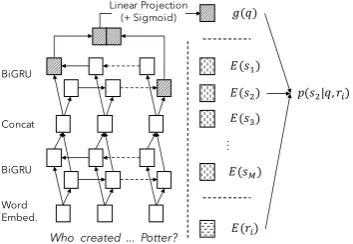
E(r) is the trainable embedding of the relation (randomly initialized in this work) andf(q) com-putes the semantic question embedding. Specifi-cally, the questionq is represented as a sequence of tokens (potentially with unknown ones). Then, the question embedding model f consists of a word embedding layer to transform tokens into distributed representations, a two-layer BiGRU to capture the question semantics, and a linear layer to project the final hidden states of the BiGRU into the same vector space asE(r).
Subject network As introduced in section 3, the factor p(s|q, r) models the fitness of a subject s
appearing in the questionq, given the main topic is about the relation r. Thus, two forces a) the raw context expressed byq, andb) the candidate topic described byr, jointly impact the fitness of
the subjects. For simplicity, we use two additive terms to model the joint effect
pθs(s|q, r) = exp u(s, r, q) P
s0exp u(s0, r, q)
(11)
whereu(s, r, q)is thesubject scoring function,
u(s, r, q) =g(q)>E(s) +αh(r, s) (12)
g(q) is another semantic question embedding, E(s)is a vector representation of a subject,h(r, s) is the subject-relation score, and α is the weight parameter used to trade off the two sources.
Firstly, thecontext scoreg(q)>E(s)models the
intrinsic plausibility that the subject sappears in the question q using vector space similarity. As
g(q)>E(s) has the same form as equation (10),
we let g adpot the same model structure as f. However, initializing E(s) randomly and training it with supervised signal, just like training E(r), is insufficient in practice — while a large-scale KB has millions of subjects, only thousands of question-triple pairs are available for training. To alleviate the problem, we seek two potential solu-tions: a) pretrained embeddings, andb) type vec-torrepresentation.
The pretrained embedding approach utilizes un-supervised method to train entity embedings. In particular, we employ theTransE(Bordes et al., 2013), which trains the embedings of entities and relations by enforcing E(s) + E(r) = E(o) for every observed triple (s, r, o) ∈ K. As there exists other improved variants (Gu et al., 2015),
TransEscales the best when KB size grows. Alternatively, type vector is a fixed (not train-able) vector representation of entities using type information. Since each entity in the KB has one or more predefined types, we can encode the en-tity as a vector (bag) of types. Each dimension of a type vector is either 1 or 0, indicating whether the entity is associated with a specific type or not. Thus, the dimensionality of a type vector is equal to the number of types in KB. Under this setting, withE(s)being a binary vector, letg(q)be a con-tinuous vector with arbitrary value range can be problematic. Therefore, when type vector is used asE(s), we add a sigmoid layer upon the final lin-ear projection ofg, squashing each element ofg(q)
to the range[0,1].
Who created ... Potter? 𝐸(𝑟$)
𝐸(𝑠')
𝐸(𝑠()
𝐸(𝑠))
𝐸(𝑠*)
…
Linear Projection
(+ Sigmoid) 𝑔(𝑞)
𝑝(𝑠(|𝑞, 𝑟$)
BiGRU
[image:5.595.93.270.65.187.2]Word Embed. Concat BiGRU
Figure 1: Overall structure of the subject network. Sigmoid layer is added only when type vector is used asE(s). fewer parameters are needed. Also, given the type information is discriminative enough, using type vector will lead to easier generalization. However, containing only type information can be very re-strictive.
In addition to the context score, we use the
subject-relation scoreh(r, s)to capture the com-patibility thatsandrshow up together. Intuitively, for an entity to appear in a topic characterized by a relation, a necessary condition will be that the entity has the relation connected to it. Inspired by this structural regularity, in the simplest manner, we instantiate the idea with an indicator function,
h(r, s) =1(s→r) (13)
As there exists other more sophisticated statistical parameterizations, the proposed approach is able to capture the core idea of the structural regularity without any parameter. Finally, putting two scores together, Fig.1 summarizes the overall structure of the subject network.
4.3 Focused Pruning
As discussed in section 3.2, N-Gram pruning is still subject to large amount of noise in inference due to many non-subject-mention n-grams. Moti-vated by this problem, we propose to reduce such noise by focusing on more probable candidates us-ing a special-purpose sequence labelus-ing network. Basically, a sequence labeling model is trained to tag some consecutive tokens as the subject men-tion. Following this idea, during inference, only the most probable n-gram predicted by the model will be retained, and then used as the subject men-tion to generate the candidate poolC. Hence, we refer to this method asfocused pruning. Formally, let W(q) be all the n-grams of the question q,
p(w|q)be the probability that the n-gramwis the subject mention ofq, the focused pruning function
Hsis defined as
ˆ
w= arg max
w∈W(q) pκ(w|q)
C={(s, r) :M(s,wˆ), s→r} (14)
whereM(s,wˆ)represents some predefined match between the subject s and the predicted subject mention wˆ. Intuitively, this pruning method re-sembles the human behavior of first identifying the subject mention with the help of context, and then using it as the key word to search the KB.
To illustrate the effectiveness of this idea, we parameterizepκ(w|q)with a general-purpose
neu-ral labeling model, which consists of a word em-bedding layer, two layers of BiGRU, and a linear-chain conditional random field (CRF). Thus, given a questionq of lengthT, the score of a sequence label configurationy∈RT is
s(y, q) =XT
t=1
H(q)t,yt+ T X
t=2
Ayt−1,yt
whereH(q) is the hidden output of the top-layer BiGRU,Ais the transition matrix possesed by the CRF, and[·]i,jindicates the matrix element on row
icollumj.
Finally, the match function M(s,wˆ) is simply defined as either strict match between an alias of
s and wˆ, or approximate match provided by the Freebase entity suggest API 1. Note that more
elaborative match function can further boost the performance, but we leave it for future work.
5 Parameter Estimation
In this section, we discuss the parameter estima-tion for the neural models presented in secestima-tion 4.
With standard parameterization, the focused la-beling model pκ(w|q) can be directly trained by
maximum likelihood estimation (MLE) and back-propagation. Thus, we omit the discussion here, and refer readers to (Huang et al., 2015) for de-tails. Also, we leave the problem of how to obtain the training data to section 6.
5.1 Decomposable Log-Likelihood
To estimate the parameters of pθr(r|q) and
pθs(s|r, q), MLE can be utilized to maximize the empirical (log-)likelihood of subject-relation pairs
1The approximate match is used only when there is no
given the associated question. Following this idea, let {s(i), r(i), q(i)}N
i=1 be the training dataset, the MLE solution takes the form
θMLE = arg max
θr,θs N X
i=1
logpθr(r(i)|q(i))
+ logpθs(s(i)|r(i), q(i))
(15)
Note that there is no shared parameter between
pθs(s|q, r)andpθr(r|q).2 Therefore, the same so-lution can be reached by separately optimizing the two log terms, i.e.
θMLE
r = arg max θr
N X
i=1
logpθr(r(i)|q(i))
θsMLE= arg max
θs N X
i=1
logpθs(s(i)|r(i), q(i)) (16)
It is important to point out that the decomposabil-ity does not always hold. For example, when the parametric form ofh(s, r)depends on the embed-ding ofr, the two terms will be coupled and joint optimization must be performed. From this per-spective, the simple form ofh(s, r)also eases the training by inducing the decomposability.
5.2 Approximation with Negative Samples
As the two problems defined by equation (16) take the standard form of classification, theoretically, cross entropy can used as the training objective. However, computing the partition function is often intractable, especially for pθs(s|r, q), since there can be millions of entities in the KB. Faced with this problem, classic solutions include contrastive estimation (Smith and Eisner, 2005), importance sampling approximation (Bengio et al., 2003), and hinge loss with negative samples (Collobert and Weston, 2008).
In this work, we utilize the hinge loss with nega-tive samples as the training objecnega-tive. Specifically, the loss function w.r.tθrhas the form
L(θr) = N X
i=1
Mr X
j=1
max0, γr−v(r(i), q(i))
+v(r(j), q(i))
(17)
wherer(j)is one of theMrnegative samples (i.e.
s(i) 6→r(j)) randomly sampled fromR, andγ
ris 2Word embeddings are not shared across models.
the predefined margin. Similarly, the loss function w.r.tθstakes the form
L(θs) = N X
i=1
Ms X
j=1
max0, γs−u(s(i), r(i), q(i))
+u(s(j), r(i), q(i)) (18) Despite the negative sample based approximation, there is another practical difficulty when type vec-tor is used as the subject representation. Specifi-cally, computing the value ofu(s(j), r(i), q(i)) re-quires to query the KB for all types of each nega-tive samples(j). So, whenMs is large, the train-ing can be extremely slow due to the limited band-width of KB query. Consequently, under the set-ting of type vector, we instead resort to the follow-ing type-wise binary cross-entropy loss
˜
L(θs) =− N X
i=1
K X
k=1
E(s(i))klogg(q(i))k
+1−E(s(i))klog1−g(q(i))k (19)
whereK is the total number of types, g(q)k and
E(s(i))k are thek-th element of g(q) and E(s(i)) respectively. Intuitively, with sigmoid squashed output, g(q) can be regarded as K binary classi-fiers, one for each type. Hence,g(q)kreprents the
predicted probability that the subject is associated with thek-th type.
6 Experiments
In this section, we conduct experiments to evaluate the proposed system empirically.
6.1 Dataset and Knowledge Base
We train and evaluate our method on the SIMPLE -QUESTIONSdataset3— the largest question-triple dataset. It consists of 108,442 questions written in English by human annotators. Each question is paired with a subject-relation-object triple from Freebase. We follow the same splitting for train-ing (70%), validation (10%) and testtrain-ing (20%) as (Bordes et al., 2015). We use the same subset of Freebase (FB5M) as our knowledge base so that the results are directly comparable. It includes 4,904,397 entities, 7,523 relations, and 22,441,880 facts.
There are alternative datasets available, such as WebQuestions (Berant et al., 2013) and
3https://research.facebook.com/
Free917 (Cai and Yates, 2013). However, these datasets are quite restricted in sample size — the former includes 5,810 samples (train + test) and the latter includes 917 ones. They are fewer than the number of relations in Freebase.
To train the focused labeling model, the infor-mation about whether a word is part of the sub-ject mention is needed. We obtain such informa-tion by reverse linking from the ground-truth sub-ject to its mention in the question. Given a ques-tion q corresponding to subject s, we match the name and aliases of sto all n-grams that can be generated from q. Once a match is found, we la-bel the matched n-gram as the subject mention. In the case of multiple matches, only the longest matched n-gram is used as the correct one.
6.2 Evaluation and Baselines
For evaluation, we consider the same metric in-troduced in (Bordes et al., 2015), which takes the prediction as correct if both the subject and rela-tion are correctly retrieved. Based on this met-ric, we compare CFO with a few baseline systems, which include both the Memory Network QA sys-tem (Bordes et al., 2015), and syssys-tems with al-ternative components and parameterizations from existing work (Yih et al., 2014; Yih et al., 2015). We did not compare with alternative subject net-works because the only existing method (Yih et al., 2014) relies on unique textual name of each entity, which does not generally hold in knowledge bases (except in REVERB). Alternative approaches for pruning method, relation network, and entity rep-resentation are described below.
Pruning methods We consider two baseline methods previously used to prune the search space. The first baseline is the N-Gram pruning method introduced in Section 3, as it has been suc-cessfully used in previous work (Yih et al., 2014; Yih et al., 2015). Basically, it establishes the candidate pool by retaining subject-relation pairs whose subject can be linked to one of the n-grams generated from the question. The second one is N-Gram+, a revised version of the N-Gram pruning with additional heuristics (Bordes et al., 2015). In-stead of considering all n-grams that can be linked to entities in KB, heuristics related to overlapping n-grams, stop words, interrogative pronouns, and so on are exploited to further shrink the n-gram pool. Accordingly, the search space is restricted to subject-relation pairs whose subject can be linked
to one of the remaining n-grams after applying the heuristic filtering.
Relation scoring network We compare our pro-posed method with two previously used models. The first baseline is the embedding average model (Embed-AVG) used in (Bordes et al., 2014a; Bor-des et al., 2014b; BorBor-des et al., 2015). Basically, it takes the element-wise average of the word em-beddings of the question to be the question rep-resentation. The second one is the letter-tri-gram CNN (LTG-CNN) used in (Yih et al., 2014; Yih et al., 2015), where the question and relation are separately embedded into the vector space by two parameter shared LTG-CNNs.4 In addition, (Yih
et al., 2014; Yih et al., 2015) observed better per-formance of the LTG-CNN when substituting the subject mention with a special symbol. Naturally, this can be combined with the proposed focused labeling, since the latter is able to identify the po-tential subject mention in the question. So, we train another LTG-CNN with symbolized ques-tions, which is denoted as LTG-CNN+. Note that this model is only tested when the focused labeling pruning is used.
Entity representation In section 4.2, we de-scribe two possible ways to improve the vector representation of the subject,TransEpretrained embedding and type vectors. To evaluate their ef-fectiveness, we also include this variation in the experiment, and compare their performance with randomly initialized entity embeddings.
6.3 Experiment Setting
During training, all word embeddings are initial-ized using the pretrained GloVe (Pennington et al., 2014), and then fine tuned in subsequent train-ing. The word embedding dimension is set to 300, and the BiGRU hidden size 256. For pre-training the entity embeddings usingTransE(see section 4.2), only triples included in FB5M are used. All other parameters are randomly ini-tialized uniformly from [−0.08,0.08], following (Graves, 2013). Both hinge loss margins γs and
γr are set to0.1. Negative sampling sizesMsand
Mrare both 1024.
For optimization, parameters are trained using mini-batch AdaGrad (Duchi et al., 2011) with Mo-mentum (Pham et al., 2015). Learning rates are
4In Freebase, each predefined relation has asingle
Pruning
Method RelationNetwork Random Pretrain Type VecEntity Representation Memory Network 62.9 63.9∗ N-Gram Embed-AVGLTG-CNN 39.432.8 42.236.8 50.945.6
BiGRU 43.7 46.7 55.7
N-Gram+ Embed-AVGLTG-CNN 53.846.3 57.050.9 58.756.0
BiGRU 58.3 61.6 62.6
Focused Pruning
Embed-AVG 71.4 71.7 72.1
LTG-CNN 67.6 67.9 68.6
LTG-CNN+ 70.2 70.4 71.1
BiGRU 75.2 75.5 75.7
Table 1: Accuracy on SIMPLEQUESTIONStesting set.∗ indi-cates using ensembles. N-Gram+ uses additional heuristics. The proposed CFO (focused pruning + BiGRU + type vector) achieves the top accuracy.
tuned to be 0.001 for question embedding with type vector, 0.03 for LTG-CNN methods, and 0.02 for rest of the models. Momentum rate is set to 0.9 for all models, and the mini-batch size is 256. In addition, vertical dropout (Pham et al., 2014; Zaremba et al., 2014) is used to regularize all Bi-GRUs in our experiment.5
6.4 Results
Trained on 75,910 questions, our proposed model and baseline methods are evaluated on the testing set with 21,687 questions. Table 1 presents the ac-curacy of those methods. We evaluated all combi-nations of pruning methods, relation networks and entity representation schemes, as well as the result from memory network, as described in Section 6.1. CFO (focused pruning + BiGRU + type vec-tor) achieves the best performance, outperforming all other methods by substantial margins.
By inspecting vertically within each cell in Ta-ble 1, for the same pruning methods and entity rep-resentation scheme, BiGRU based relation scor-ing network boosts the accuracy by 3.5 % to 4.8% compared to the second best alternative. This ev-idence suggests the superiority of RNN in captur-ing semantics of question utterances. Surpriscaptur-ingly, it turns out that Embed-AVG achieves better per-formance than the more complex LTG-CNN.
By inspecting Table 1 horizontally, type vec-tor based representation constantly leads to bet-ter performance, especially when N-Gram pruning is used. It suggests that under sparse supervision, training high-quality distributed knowledge
repre-5For more details, source code is available athttp://
zihangdai.github.io/cfofor reference.
sentations remains a challenging problem. That said, pretraining entity embeddings withTransE
indeed gives better performance compared to ran-dom initialization, indicating the future potential of unsupervised methods in improving continuous knowledge representation.
In addition, all systems using our proposed fo-cused pruning method outperform their counter-parts with alternative pruning methods. Without using ensembles, CFO is already better than the memory network ensembles by 11.8%. It sub-stantiates the general effectiveness of the focused pruning with subject labeling method regardless of other sub-modules.
6.5 Effectiveness of Pruning
According to the results in section 6.4, the focused pruning plays a critical role in achieving the best performance. To get a deeper understanding of its effectiveness, we analyze how the pruning meth-ods affect the accuracy of the system. Due to space limit, we focus on systems with BiGRU as the re-lation scoring function and type vector as the en-tity representation.
Table 2 summarizes the recall — the percent-age of pruned subject-relation candidates contain-ing the answer — and the resultcontain-ing accuracy. The single-subject case refers to the scenario that there is only one candidate entity in Cs
(possi-bly with multiple relations), and the multi-subject case means there are multiple entities in Cs. As
the table shows, focused pruning achieves com-parable recall rate to N-Gram pruning.6 Given
the state-of-the-art performance of sequence la-beling systems, this result should not be surpris-ing. Thus, the difference in performances entirely comes from their resulting accuracy. Notice that there exists a huge accuracy gap between the two cases. Essentially, in the single-candidate case, the system only need to identify the relation based on the more robust modelpθr(r|q). In contrast, under the multi-candidate case, the system also relies on
pθs(s|q, r), which has significantly more parame-ters to estimate, and thus is less robust. Conse-quently, by only focusing on the most probable sub-string, the proposed focused pruning produces much more single-candidate situations, leading to a better overall accuracy.
6Less than 3% of the recalled candidates rely on
Pruning method Pruningrecall Inference accuracy within the recalled Overallaccuracy Single-subject case Multi-subject case
[image:9.595.330.506.171.247.2]N-Gram 94.8% 18 / 21 = 85.7% 12051 / 20533 = 58.7% 55.7% N-Gram+ 92.9% 126 / 138 = 91.3% 13460 / 20017 = 67.2% 62.6% Focused pruning 94.9% 9925 / 10705 = 92.7% 6482 / 9876 = 65.6% 75.7%
Table 2: Comparison of different space pruning methods. N-Gram+ uses additional heuristics. Single- and multi-subject refers to the number of distinct subjects in candidates. The proposed focused pruning achieves best scores.
6.6 Additional Analysis
In the aforementioned experiments, we have kept the focused labeling model and the subject scoring network fixed. To further understand the impor-tance and sensitivity of this specific model design, we investigate some variants of these two models.
Alternative focus with CRF RNN-CRF based models have achieved the state-of-the-art perfor-mance on various sequence labeling tasks (Huang et al., 2015; Lu et al., 2015). However, the la-beling task we consider here is relatively unso-phisticated in the sense that there are only two categories of labels - part of subject string (SUB) or not (O). Thus, it’s worth investigating whether RNN (BiGRU in our case) is still a critical com-ponent when the task gets simple. Hence, we es-tablish a CRF baseline which uses traditional fea-tures as input. Specifically, the model is trained withStanford CRF-NERtoolkit7on the same
reversely linked labeling data (section 6.1). For evaluation, we directly compare the sentence level accuracy of these two models on the test portion of the labeling data. A sentence labeling is con-sidered correct only when all tokens are correctly labeled.8 It turns out the RNN-CRF achieves an
accuracy of 95.5% while the accuracy of feature based CRF is only 91.2%. Based on the result, we conclude that BiGRU plays a crucial role in our focused pruning module.
Subject scoring with average embedding As discussed in section 4.2, the subject networkgis chosen to be the same as f, mainly relying on a two-layer BiGRU to produce the semantic ques-tion embeding. Although it is a natural choice, it remains unclear whether the final performance is sensitive to this design. Motivated by this ques-tion, we substitute the BiGRU with an Embed-AVG model, and evalute the system performance.
7http://nlp.stanford.edu/software/
CRF-NER.shtml
8AsF-1 score is usually used as the metric for sequence
labeling, sentence level accuracy is more informative here.
Relation Network Subject Network Embed-AVG BiGRU
Embed-AVG 71.6 72.1
LTG-CNN 68.0 68.6
LTG-CNN+ 70.4 71.1
BiGRU 75.4 75.7
Table 3: System performance with different subject network structures.
For this experiment, we always use focused prun-ing and type vector, but vary the structure of the relation scoring network to allow high-order inter-action across models. The result is summarized in Table 3. Insepcting the table horizontally, when BiGRU is employed as the subject network, the accuracy is consistently higher regardless of re-lation network structures. However, the margin is quite narrow, especially compared to the effect of varying the relation network structure the same way. We suspect this difference reflects the fact that modelingp(s|r, q) is intrinsically more chal-lenging than modelingp(r|q). It also suggests that learning smooth entity representations with good discriminative power remains an open problem.
7 Conclusion
References
Yoshua Bengio, R´ejean Ducharme, Pascal Vincent, and Christian Janvin. 2003. A neural probabilistic lan-guage model.The Journal of Machine Learning Research, 3:1137–1155.
Jonathan Berant and Percy Liang. 2014. Semantic pars-ing via paraphraspars-ing. InProceedings of ACL, volume 7, page 92.
Jonathan Berant and Percy Liang. 2015. Imitation learning of agenda-based semantic parsers.Transactions of the As-sociation for Computational Linguistics, 3:545–558. Jonathan Berant, Andrew Chou, Roy Frostig, and Percy
Liang. 2013. Semantic parsing on freebase from question-answer pairs. InProceedings of the 2013 Con-ference on Empirical Methods in Natural Language Pro-cessing, pages 1533–1544.
Kurt Bollacker, Colin Evans, Praveen Paritosh, Tim Sturge, and Jamie Taylor. 2008. Freebase: a collaboratively created graph database for structuring human knowledge. InProceedings of the 2008 ACM SIGMOD international conference on Management of data, pages 1247–1250. ACM.
Antoine Bordes, Nicolas Usunier, Alberto Garcia-Duran, Ja-son Weston, and Oksana Yakhnenko. 2013. Translating embeddings for modeling multi-relational data. In Ad-vances in Neural Information Processing Systems, pages 2787–2795.
Antoine Bordes, Sumit Chopra, and Jason Weston. 2014a. Question answering with subgraph embeddings. In Pro-ceedings of the 2014 Conference on Empirical Methods in Natural Language Processing, pages 615–620.
Antoine Bordes, Jason Weston, and Nicolas Usunier. 2014b. Open question answering with weakly supervised embed-ding models. InMachine Learning and Knowledge Dis-covery in Databases, pages 165–180. Springer.
Antoine Bordes, Nicolas Usunier, Sumit Chopra, and Ja-son Weston. 2015. Large-scale simple question answering with memory networks. arXiv preprint arXiv:1506.02075.
Qingqing Cai and Alexander Yates. 2013. Large-scale se-mantic parsing via schema matching and lexicon exten-sion. InACL (1), pages 423–433. Citeseer.
Andrew Carlson, Justin Betteridge, Bryan Kisiel, Burr Set-tles, Estevam R Hruschka Jr, and Tom M Mitchell. 2010. Toward an architecture for never-ending language learn-ing. InAAAI, volume 5, page 3.
Kyunghyun Cho, Bart van Merrienboer, C¸aglar G¨ulc¸ehre, Dzmitry Bahdanau, Fethi Bougares, Holger Schwenk, and Yoshua Bengio. 2014. Learning phrase representations using RNN encoder-decoder for statistical machine trans-lation. In Proceedings of the 2014 Conference on Em-pirical Methods in Natural Language Processing, pages 1724–1734.
Ronan Collobert and Jason Weston. 2008. A unified archi-tecture for natural language processing: Deep neural net-works with multitask learning. InProceedings of the 25th international conference on Machine learning, pages 160– 167. ACM.
John Duchi, Elad Hazan, and Yoram Singer. 2011. Adaptive subgradient methods for online learning and stochastic op-timization. The Journal of Machine Learning Research, 12:2121–2159.
Anthony Fader, Luke S Zettlemoyer, and Oren Etzioni. 2013. Paraphrase-driven learning for open question answering. InACL (1), pages 1608–1618. Citeseer.
Alex Graves. 2013. Generating sequences with recurrent neural networks.arXiv preprint arXiv:1308.0850. Kelvin Gu, John Miller, and Percy Liang. 2015. Traversing
knowledge graphs in vector space. InProceedings of the 2015 Conference on Empirical Methods in Natural Lan-guage Processing, pages 318–327.
Karl Moritz Hermann, Tomas Kocisky, Edward Grefenstette, Lasse Espeholt, Will Kay, Mustafa Suleyman, and Phil Blunsom. 2015. Teaching machines to read and com-prehend. InAdvances in Neural Information Processing Systems, pages 1684–1692.
Zhiheng Huang, Wei Xu, and Kai Yu. 2015. Bidirec-tional LSTM-CRF models for sequence tagging. CoRR, abs/1508.01991.
Mohit Iyyer, Jordan Boyd-Graber, Leonardo Claudino, Richard Socher, and Hal Daum´e III. 2014. A neural net-work for factoid question answering over paragraphs. In
Empirical Methods in Natural Language Processing. Ankit Kumar, Ozan Irsoy, Jonathan Su, James Bradbury,
Robert English, Brian Pierce, Peter Ondruska, Ishaan Gul-rajani, and Richard Socher. 2015. Ask me anything: Dy-namic memory networks for natural language processing.
arXiv preprint arXiv:1506.07285.
Tom Kwiatkowski, Eunsol Choi, Yoav Artzi, and Luke Zettlemoyer. 2013. Scaling semantic parsers with on-the-fly ontology matching. In Proceedings of the 2013 Conference on Empirical Methods in Natural Language Processing.
Moontae Lee, Xiaodong He, Wen-tau Yih, Jianfeng Gao, Li Deng, and Paul Smolensky. 2015. Reasoning in vector space: An exploratory study of question answering.arXiv preprint arXiv:1511.06426.
Jens Lehmann, Robert Isele, Max Jakob, Anja Jentzsch, Dimitris Kontokostas, Pablo N Mendes, Sebastian Hell-mann, Mohamed Morsey, Patrick van Kleef, S¨oren Auer, et al. 2014. Dbpedia-a large-scale, multilingual knowl-edge base extracted from wikipedia. Semantic Web Jour-nal, 5:1–29.
Percy Liang, Michael I Jordan, and Dan Klein. 2011. Learn-ing dependency-based compositional semantics. In Asso-ciation for Computational Linguistics (ACL), pages 590– 599.
Percy Liang, Michael I Jordan, and Dan Klein. 2013. Learn-ing dependency-based compositional semantics. Compu-tational Linguistics, 39(2):389–446.
Zefu Lu, Lei Li, and Wei Xu. 2015. Twisted recurrent net-work for named entity recognition. InBay Area Machine Learning Symposium.
Jeffrey Pennington, Richard Socher, and Christopher D. Manning. 2014. Glove: Global vectors for word repre-sentation. InProceedings of the 2014 Conference on Em-pirical Methods in Natural Language Processing, pages 1532–1543.
Vu Pham, Th´eodore Bluche, Christopher Kermorvant, and J´erˆome Louradour. 2014. Dropout improves recurrent neural networks for handwriting recognition. InFrontiers in Handwriting Recognition (ICFHR), 2014 14th Interna-tional Conference on, pages 285–290. IEEE.
Hieu Pham, Zihang Dai, and Lei Li. 2015. On optimiza-tion algorithms for recurrent networks with long short-term memory. InBay Area Machine Learning Symposium. Siva Reddy, Mirella Lapata, and Mark Steedman. 2014. Large-scale semantic parsing without question-answer pairs. Transactions of the Association for Computational Linguistics, 2:377–392.
Noah A Smith and Jason Eisner. 2005. Contrastive estima-tion: Training log-linear models on unlabeled data. In
Proceedings of the 43rd Annual Meeting on Association for Computational Linguistics, pages 354–362. Associa-tion for ComputaAssocia-tional Linguistics.
Fabian M Suchanek, Gjergji Kasneci, and Gerhard Weikum. 2007. Yago: a core of semantic knowledge. In Proceed-ings of the 16th international conference on World Wide Web, pages 697–706. ACM.
Lappoon R Tang and Raymond J Mooney. 2001. Using mul-tiple clause constructors in inductive logic programming for semantic parsing. InMachine Learning: ECML 2001, pages 466–477. Springer.
Jason Weston, Sumit Chopra, and Antoine Bordes. 2015. Memory networks. InInternational Conference on Learn-ing Representations (ICLR2015).
Jason Weston, Antoine Bordes, Sumit Chopra, and Tomas Mikolov. 2016. Towards ai-complete question answer-ing: A set of prerequisite toy tasks. InInternational Con-ference on Learning Representations (ICLR2016). Min-Chul Yang, Nan Duan, Ming Zhou, and Hae-Chang
Rim. 2014. Joint relational embeddings for knowledge-based question answering. In Proceedings of the 2014 Conference on Empirical Methods in Natural Language Processing, pages 645–650.
Xuchen Yao and Benjamin Van Durme. 2014. Information extraction over structured data: Question answering with freebase. InProceedings of ACL.
Wen-tau Yih, Xiaodong He, and Christopher Meek. 2014. Semantic parsing for single-relation question answering. InProceedings of ACL.
Wen-tau Yih, Ming-Wei Chang, Xiaodong He, and Jianfeng Gao. 2015. Semantic parsing via staged query graph generation: Question answering with knowledge base. In
Proceedings of ACL.
Wojciech Zaremba, Ilya Sutskever, and Oriol Vinyals. 2014. Recurrent neural network regularization. CoRR, abs/1409.2329.