Munich Personal RePEc Archive
The Success of the Deferred Acceptance
Algorithm under Heterogenous
Preferences with Endogenous Aspirations
Saglam, Ismail
TOBB ETU
15 January 2019
The Success of the Deferred Acceptance Algorithm under
Heterogenous Preferences with Endogenous Aspirations
Ismail Saglam
TOBB University of Economics and Technology, Department of Economics, Sogutozu Cad. No.43, Sogutozu 06560, Ankara, Turkey
Abstract. In this paper, we consider a one-to-one matching model with two phases; an adolescence phase where individuals meet a number of dates and learn about their
aspirations, followed by a matching phase where individuals are matched according
to a version of Gale and Shapley’s (1962) deferred acceptance (DA) algorithm. Using
simulations of this model, we study how the likelihoods of matching and divorce, and
also the balancedness and the speed of matching associated with the outcome of the
DA algorithm are affected by the size of correlation in the preferences of individuals
and by the frequency individuals update their aspirations in the adolescence phase.
1
Introduction
In a seminal paper, Gale and Shapley (1962) showed that for every two-sided marriage
population where individuals have complete and transitive preferences over potential
mates there always exists (between men and women) a one-to-one matching which
is stable in the sense that no individual prefers being single to his/her mate and
no pair of individuals prefer each other to their mates. They proved this result
by proposing an algorithm, namely the deferred acceptance (DA) algorithm, which
always produces a stable matching. In this algorithm, which has two symmetric
versions with respect to the roles of men and women, individuals in one side of the
population, say men, make proposals and individuals in the other side, women, give
deferred acceptances or rejections. The algorithm with men proposing stops after
any step where no man is rejected or every single man has already proposed to every
acceptable women in his preference list.
The DA algorithm, with various extensions for many-to-one matching, has been
used in many markets, even before it was proposed by Gale and Shapley (1962).1
Many of these works have put meaningful restrictions on preferences of individuals
who aim to match with each other. For example, in the student placement problem
(Balinski and S¨onmez, 1999) where a centralized clearinghouse implements a stable
matching between colleges and students using some version of the DA algorithm,
preferences of colleges over students are usually assumed to commonly derive from
some general exam scores of students. On the other hand, in the same problem
stu-dents are typically allowed to have imperfectly correlated preferences over colleges,
1
reflecting —in addition to the publicly known performance rankings of colleges—
students’ subjective assessments about the various attributes of colleges, such as
academic rigor, research opportunities, job market placements, campus size and
lo-cation, student body, cost of edulo-cation, scholarships, accommodations, etc. However,
despite the fact that many works in the matching theory assume, like in the case of
student placement problem, different degrees of preference correlations for the two
sides of the matching population, the impacts of a change in preference correlations
on stable matchings is still unexplored. A second gap in the matching literature is
that it is lacking an explanation as to how individuals decide on which potential
mates in the population they find acceptable as a spouse. Rather, the existing
lit-erature implicitly assumes that each individual is born with the knowledge about
the set of unacceptable mates and this knowledge remains unchanged during mate
search. Obviously, this assumption is too strong and also unrealistic. In practice,
an individual can simply decide whether a potential mate is acceptable or not by
checking whether the estimated ‘value’ of this potential mate, i.e., a real number
reflecting the aggregated quality of all his/her traits, is above or below his/her own
aspiration level, which the individual can learn about during a pre-matching stage
where he/she can randomly interact with a number of potential mates.
Motivated by the aforementioned gaps in the stable matching theory, in this
paper we will study how the stable matching outcome of the DA algorithm (where
men propose and women accept/reject) is affected by the degree of correlation in the
preferences of individuals and by the intensity of their learning about their aspirations
(and correspondingly about the set of unacceptable mates) during a pre-matching
stage. While our research question is, to the best of our knowledge, novel for the
literature on stable matchings, a related question has already been studied in a strand
of literature on mutual sequential mate search where the focus is only the random
formation of ‘acceptable’ matchings consistent with some demographic patterns. One
we will borrow some part of our model.
Basically, the mate search model of Todd and Miller (1999) involves two phases,
an adolescence phase followed by a mating (or matching) phase. In the adolescence
phase, individuals randomly meet a number of dates of the opposite gender and
af-ter each meeting they mutually exchange information as to whether they have found
each other acceptable; i.e., whether each individual finds the mate value of the
in-teracted date above his/her own aspiration level. Using the exchanged information,
individuals update their aspirations after each instance of dating, following an
ad-justment (updating) rule commonly adopted by the whole population. After the
adolescence phase is over, individuals enter the mating phase, where they randomly
interact with potential mates, and using their aspirations finalized at the end of the
adolescence phase they decide on whether to make a proposal to any interacted
in-dividual. Individuals mutually proposing to each other become mated and they are
removed from the pool of unmated individuals. The mating phase ends after a stage
in which the pool of unmated individuals becomes empty or shrinks to a set in which
no man and woman are mutually acceptable (and can form a mated couple). Todd
and Miller (1999) used the mate search model outlined above to find socially
desir-able and simple mate search rules (or heuristics) that can be used by individuals in a
given matching population to update their aspirations after each dating in the
ado-lescence phase. To compare the performances of several search rules they proposed,
they introduced three success measures, namely the mating likelihood measured by
the number of mated pairs in the population, the mating balancedness measured by
the average mate value of all mated pairs, and the (potential) stability of mating
measured by the mean within-pair difference in mate value.
In the past, several works have investigated whether mate search models similar
to that of Todd and Miller (1999) can produce demographic patterns consistent with
the real data (see, for example, Hills and Todd, 2008; Todd et al. 2005; Sim˜ao and
Todd and Miller’s model (1999) or with its improvement. For example, Shiba (2013)
and Saglam (2014) studied whether the findings of Todd and Miller (1999) are robust
with respect to a change in their assumption that the whole matching population uses
the same adjustment rule in the adolescence phase. In another robustness study that
is also related to ours, Saglam (2019) relaxed Todd and Miller’s (1999) assumption of
homogenous (or perfectly correlated) preferences to study the effect of heterogeneity
in preferences on the performances of several aspiration adjustment rules. In the
same literature, a second study that is closely related to our paper is due to Saglam
(2018), who proposed a new adjustment rule, called Take the Weighted Average with
the Next Desiring Date (TWAND), and compared its performance to those of the
rules proposed by Todd and Miller (1999) for mutual sequential mate search with
random acceptable matchings. For his analysis, Saglam (2018) also added the speed
of mating to the list of success measures considered by Todd and Miller (1999), and
showed that even though his new rule, TWAND, does not perform well with respect
to mating stability, it is more balanced than the majority of the adjustment rules of
Todd and Miller (1999), and moreover “... in terms of mating likelihood almost as
good as, and in terms of mating speed always better than, the most successful —yet
also unrealistic— heuristic of Todd and Miller (1999), namely the Mate Value-5 rule,
which assumes that individuals in the mating population completely know their own
mate values before interacting with any date.” (Saglam, 2018b; p. 122)
In this paper, we consider a mate search model integrating various structures
in Todd and Miller (1999), Saglam (2019), and Saglam (2018) with the one-to-one
matching model of Gale and Shapley (1962). Basically, our model involves two
phases, namely the adolescence and matching phases. We borrow the adolescence
phase from the mate search model of Todd and Miller (1999); however, instead of
their (aspiration) adjustment rules we adopt the adjustment rule of Saglam (2018b),
TWAND, because of its aforementioned superior features. On the other hand, we
we assume that matchings in our model are obtained by the application of the DA
algorithm (with men proposing); hence matchings are always stable in our model
(with respect to the stability notion of Gale and Shapley (1962) described
previ-ously), unlike in the matching model of Todd and Miller (1999), where matchings
are obtained through the mutual acceptable proposals of randomly meeting
individ-uals in the matching phase and hence they are not necessarily stable. Also, we allow
for, like in Saglam (2019), heterogenous as well as homogenous preferences to study
—through some Monte Carlo simulations— the effects of the degree of correlation
in preferences and the frequency of aspiration adjustments on the performance of
the DA algorithm using four performance measures, three of which we borrow from
Todd and Miller (1999) and the remaining one from Saglam (2018b).
The rest of our paper is organized as follows. Section 2 introduces our mate search
model, and Section 3 presents our simulation results. Finally, Section 4 concludes.
2
Model
We consider a population involving n men and n women each of whom searches for a mate from the opposite sex. Mate search consists of two phases: an adolescence
(dating and learning) phase and a matching phase. In the adolescence phase each
individual dates a number of potential mates and learns about his/her own aspiration,
a threshold mate value which is equal to the utility of being single. Using the acquired
knowledge about his/her aspiration each individual identifies the set of individuals
he/she finds acceptable as a spouse, and using his/her knowledge about the mate
values of potential mates each individual forms a preference ordering of potential
mates. Individuals, given their preference orderings and their identifications about
the set of acceptable mates, are then matched in the next phase according to the DA
algorithm of Gale and Shapley (1962) where (iteratively) men propose and women
In the described setup, let vi(j) denote the value (a nonnegative real number)
individual i assigns for the mate value of individual j before the adolescence phase begins. This value remains constant during mate search. We say that individual i
strictly (weakly) prefers individualj to individualk ifvi(j)>(≥)vi(k). We assume
that no individual knows his/her own mate value; i.e., vi(i) is unknown to each
in-dividual i. (As a matter of fact, each individual will approximate his/her own mate
value by his/her aspiration he/she will form in the adolescence phase.) Moreover,
the mate values assigned for any individual i by two distinct potential mates j and
k may or may not be independent. This last assumption will allow us to study distinct situations where the preferences of men (women) about women (men) are
completely correlated, completely uncorrelated, as well as partially correlated. Now,
we are ready to present the two phases of our model in more detail.
Adolescence Phase. During this phase, each individual —by randomly dating some potential mates— learns about his/her aspiration, which is assumed to be
equal to the utility he/she would derive from being unmatched. Each individual
will later use his/her aspiration just before the matching phase to identify the set
of acceptable mates, i.e., the set of individuals each of whom he/she will prefer as a
spouse to being single.
The adolescence phase involvesS consecutive stages of interactions (dating), with
S being an integer between 1 andn. Individual i enters the adolescence phase with
an initial aspiration, denoted bya(i,0), and then randomly meets a date (a potential mate) of the opposite sex in each stage. More formally, at stage s individual i
interacts with the date d(i, s). Comparing the mate value vi(d(i, s)) of this date
with his/her aspirationa(i, s−1) formed in the previous stage, individual i decides on whether the date d(i, s) is acceptable as a spouse. (In the same way, his/her
date independently decides on whether individual i is acceptable.) Next, individual
each other acceptable. Taking into account the exchanged information and his/her
previous aspiration a(i, s−1), individual i then calculates his/her aspiration a(i, s) for stage s. Individual i makes this calculation with the help of an adjustment (or
feedback) rule which is assumed to be commonly used by the whole population.
This rule isTake the Weighted Average with the Next Desiring Date Rule(TWAND)
proposed by Saglam (2018b) for mutual sequential mate search. According to this
rule, if individual i learns that his/her date, d(i, s), in stage s of the adolescence phase found him/her acceptable, i.e., vd(x,s)(i) ≥ a(d(i, s), s−1), then individual i
sets his/her aspiration, a(i, s), in stage s to the weighted average of the mate value ofd(i, s), which isvi(d(i, s)), and his/her aspiration a(i, s−1) in the previous stage,
using the respective weights of 1/(p+ 1) and p/(p+ 1) wherep denotes the number of stages (befores) in which individual i was found acceptable. On the other hand,
if individual i learns that he/she was not found acceptable by his/her date d(i, s) in stage s, i.e., vd(i,s)(i) < a(d(i, s), s−1), then individual i makes no adjustment.
More formally, for each individual i and for each stage of dating s = 1, . . . , S, this
adjustment satisfies
a(i, s) =
1
p+ 1vi(d(i, s)) +
p
p+ 1a(i, s−1) if vd(i,s)(i)≥a(d(i, s), s−1),
a(i, s−1) otherwise,
where a(i,0) is given.
Saglam (2018b) observes that in situations where the preferences of men (women)
over women (men) are homogenous and all initial aspirations are zero, the aspiration
of each individual can be expected to be positive with probability one after the first
stage of dating, provided that all mate values are positive. Therefore, as the
adoles-cence phase proceeds, each individual faces the probability of being non-acceptable
by some of his/her dates. Because this probability will be higher for individuals with
This means that the lower the mate value of the date, the higher the probability
that an individual will be found acceptable. Consequently, the first row of the
ad-justment rule expressed above will be more frequently called when the date of an
individual has a lower mate value, implying that a(i, s) will tend to be lower than
a(i, s−1). Given these observations, Saglam (2018) predicts, and also verifies, that
under homogenous preferences the average level of adjusted aspirations (calculated
for the whole population) will be, after some early stage, always below the
aver-age level of mate values and will decrease as the dating and learning proceed. We
will check whether this prediction holds under non-homogeneous preferences, as well.
Matching Phase. In this phase, a matching between men and women occur. Formally, a matching is a one-to-one function from the matching population to itself
such that for each man and woman pair (m, w) in the matching population it is true that m is the mate of w if and only if w is the mate of m; the mate of m is not a
woman if and only if m is single, and the mate of wis not a man if and only if w is
single. We will call any two individuals a matched pair if they are the mate of each
other.
A matching µ is said to be acceptable for an individual if this individual weakly prefers his/her mate at µ to being single. Any two individuals are called a blocking
pairfor a matching µif they are not matched to one another at µbut strictly prefer one another to their mates at µ. Given these definitions, a matching is called stable
if it is acceptable for each individual and there exists no blocking pair for it.
A well-known theorem proposed by Gale and Shapley (1962) shows that there
always exists a stable matching for any matching population with complete and
transitive preferences. They prove this result by showing that a particular proposal
and acceptance algorithm, when used by both sides of the marriage population (men
and women), always produces a stable matching. This algorithm is known as the
make proposals and women give (deferred) acceptances, while in the other version
women make proposals and men give (deferred) acceptances.2 Of these two versions,
we will restrict ourselves to the DA algorithm with men proposing (or simply
DA-MP algorithm), which can be described as follows. (Clearly, the DA algorithm with
women proposing can be obtained by interchanging the roles of men and women in
the below steps.)
Step 1: Each man proposes to his most preferred woman in his list of acceptable
women (if any). Each woman rejects any unacceptable proposals, and if she has
received more than one acceptable proposal, she holds the most preferred one and
rejects the others. Then, each rejected man eliminates the woman who rejected him
from his list of acceptable women.
Step k ≥ 2: Any man who was rejected in step k−1 makes a proposal to his
most preferred woman in his updated list of acceptable women (if any). (If his list
is empty, he makes no proposal.) Each woman holds her most preferred acceptable
proposal she has received until now and rejects the others. Then, each man rejected
in this step eliminates the woman who rejected him from his list of acceptable women.
The algorithm terminates when no further proposal is made by any man, and finally
each woman is matched to the man (if any) whose proposal she holds.
In any step of the above algorithm if any man (woman) is indifferent between
any two women (men), he (she) is allowed to break the tie arbitrarily.
2
3
Results
We will study the effects of correlation in preferences and the frequency of updating
aspirations on the matching outcome of the DA-MP algorithm using computer
sim-ulations with the help of GAUSS Software Version 3.2.34 (Aptech Systems, 1998).
(The program code of the simulations and the resulting data are available from the
author upon request.)
For our simulations, we set n, the number of individuals in each sex, to 50 while
we varyS, the number of dating stages in the adolescence phase, from 1 to 48 (omit-ting the values 49 and 50 for geometrically increasing computation time), and for
each value of S, we conduct 100 Monte Carlo simulations. In all simulations, we
set initial aspirations to zero, i.e., a(i,0) = 0 for each individual i. Also, we model the preferences of individuals, and the mate values inducing these preferences, like
in Saglam (2019), where the mate values —each individual assigns for the potential
mates before the beginning of the adolescence phase— contain in general a common
component and a private component. To formalize this, we first pick for each
indi-viduali in the matching population a randomly drawn value, denoted by vc(i), from
a uniform distribution of values in [0,100]. We call this particular value the mate value of agent i commonly observed/assigned by all potential mates in the case of
completely homogenous (perfectly correlated) preferences. Next, we pick any
indi-vidualiand any potential mate j from the opposite sex, and set the observation ofj
about the mate value ofi to a randomly drawn value from a uniform distribution of
values in [0,100]. We denote this value byvpj(i), namely the mate value of individual
iprivately observed/assigned by individual j in the case of completely heterogenous
(perfectly idiosyncratic) preferences. Finally, we pick a real number ω in [0,1] and define for each individuali and for each potential mate j the value
under partially heterogenous preferences associated with the common correlation
parameter ω. We should note that the correlation between individuals’ preferences is increasing in ω over the interval [0,1]. In our simulations, we vary the correlation
parameter inside the set of values {0,1/3, 2/3, 1}. Note that ω = 0 and ω = 1 respectively correspond to the cases of uncorrelated (heterogenous) and perfectly
correlated (homogenous) preferences, while the other values ofω correspond to some
cases of imperfectly correlated preferences.
To analyze how the stable matching outcome of the DA-MP algorithm is affected
by a change in the correlation parameter ω or the number of dates S in the adoles-cence phase, we will consider four performance measures. We borrow these measures
from the two-sided mutual search literature that studies the success of various search
heuristics. In particular, we borrow the first three of our performance measures from
Todd and Miller (1999) and the last one from Saglam (2018b). Before we analyze
the success of the DA-MP algorithm according to our performance measures, we
will first investigate how the mean aspirations change as individuals interact with a
higher number of dates in the adolescence phase.
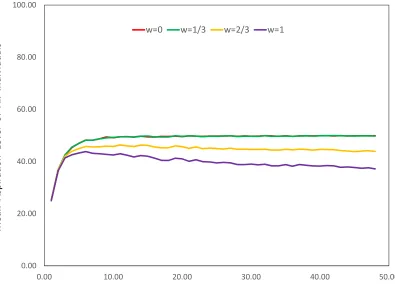
Our simulations illustrated in Figure 1 show that irrespective of the number of
dates, S, the level of correlation in preferences has in general a monotonic, and also negative, effect on the mean aspiration of all individuals. That is, the more
corre-lated the preferences, the lower the mean aspirations. However, the observed effect is
negligibly small when the degree of correlation in preferences is not sufficiently high.
In Figure 1, we should also observe that the prediction of Saglam (2018b) about
the evolution of aspirations can hold in our matching model only if the correlation
in preferences is extremely high. In that case, the mean aspiration level rapidly
in-creases during a few initial dating instances and mildly dein-creases as the number of
dating becomes higher. When the correlation in preferences is not sufficiently high
0, the mean aspiration level rapidly converges to the mean mate value, 50, of the
population after a few dating.
M
ea
n
A
sp
ira
tio
n
Le
ve
l
of
A
ll
In
di
vi
du
al
s
Number of Dates in the Adolescence Phase
0.00 20.00 40.00 60.00 80.00 100.00
0.00 10.00 20.00 30.00 40.00 50.00
[image:14.612.123.518.173.459.2]w=0 w=1/3 w=2/3 w=1
Figure 1.
Below, we will measure the performance of the DA-MP algorithm with respect
to our first measure, namely the likelihood of matching, as represented by the
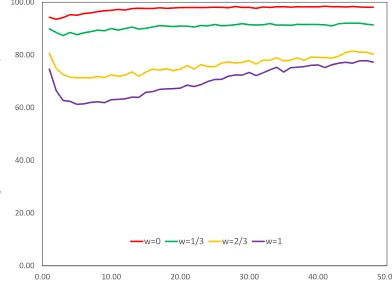
per-centage of matched in pairs in our population. When the correlation in preferences
measured by ω increases, we expect it to produce two effects on the likelihood of matching: a direct effect and an indirect effect. The direct effect works through the
increased competition among men over their potential mates due to the nature of
expanding the set of acceptable mates for individuals in both sides of the market and
increasing thereby their likelihood of matching. Our simulation results, illustrated
in Figure 2, show that of these opposite effects the direct effect always dominates
the indirect effect. That is, irrespective from the number of dates in the adolescence
phase the likelihood of matching is always higher if the preferences of individuals are
less correlated (i.e., ω is smaller).
Pe
rc
en
ta
ge
of
M
at
ch
ed
Pa
irs
in
P
op
ul
at
io
n
Number of Dates in the Adolescence Phase
0.00 20.00 40.00 60.00 80.00 100.00
0.00 10.00 20.00 30.00 40.00 50.00
[image:15.612.125.517.271.556.2]w=0 w=1/3 w=2/3 w=1
Figure 2.
Figure 2 also shows that when the correlation in individuals’ preferences are
suf-ficiently small, the matching likelihood remains fairly stable at a very high level as
the preferences are sufficiently correlated (i.e., ω is sufficiently high), the matching
likelihood initially decreases abruptly with the number of dates over a very small
range and mildly increases elsewhere.
M
ea
n
M
at
e
V
al
ue
o
f
Al
l
M
at
ch
ed
I
nd
iv
id
ua
ls
Number of Dates in the Adolescence Phase
0.00 20.00 40.00 60.00 80.00 100.00
0.00 10.00 20.00 30.00 40.00 50.00
[image:16.612.131.517.203.490.2]w=0 w=1/3 w=2/3 w=1
Figure 3.
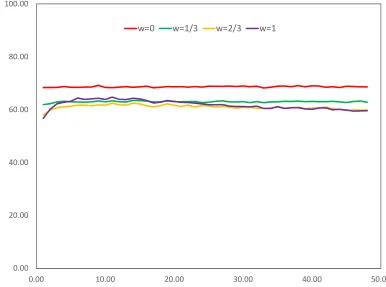
Our second performance measure is based on the mean mate value of all matched
individuals. According to this measure, a matching is considered more successful
(more egalitarian or balanced) if the mean mate value of all matched individuals is
closer to the mean mate value of the whole population, which is 50 by the assumed
distribution of mate values in our simulation. If this measure has a higher (lower)
correlation in preferences and the number of dates in the adolescence phase, the
mean mate value of all matched individuals is always (significantly) higher than
the middle value 50, indicating that the DA-MP algorithm always produces a
non-egalitarian, or unbalanced, matching at which the lower segments of the population
(in terms of mate values) are more likely to be unmatched than the higher segments.
Figure 3 also suggests that the most unbalanced matching is always obtained when
there is no correlation in preferences (i.e., ω= 0). On the other hand, when there is some correlation in preferences, the balancedness of matching is found to be affected
by both the degree of this correlation and the number of dates interacted in the
adolescence phase. As a matter of fact, we observe a positive relationship between
the degree of correlation in preferences and the balancedness of the matching outcome
only if the number of dates is sufficiently high.
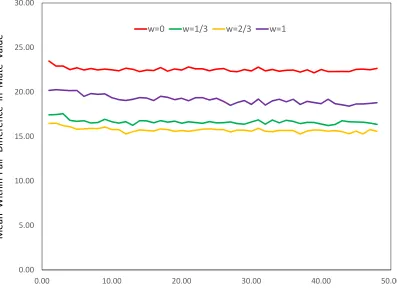
Our third performance measure is the mean within-pair difference in mate value,
which can be argued to positively affect the probability of divorce (or the expected
divorce rate in the population).3 Matchings with lower scores with respect to this
measure are considered to be more successful as the individuals paired under these
matchings are assumed to be less likely to divorce in the future. Our results in Figure
4 illustrate that the number of dates in the adolescence phase has almost negligible
impacts on the likelihood of divorce. Moreover, although the degree of correlation
in preferences has a remarkable effect on this likelihood irrespective of the number
of dates, this effect is not monotonic. As could be predicted, we obtain the worst
performance, with the highest within-pair difference in mate values on average, when
the preferences are uncorrelated. Surprisingly, the second highest scores arise when
the preferences are perfectly correlated. We find that the matching outcome of the
DA-MP algorithm becomes more successful in terms of the reduced risk of divorce in
cases where preferences are partially correlated than in cases where they are perfectly
3
correlated or uncorrelated at all.
M
ea
n
W
ith
in
-P
ai
r
Di
ffe
re
nc
e
in
M
at
e
V
al
ue
Number of Dates in the Adolescence Phase
0.00 5.00 10.00 15.00 20.00 25.00 30.00
0.00 10.00 20.00 30.00 40.00 50.00
[image:18.612.121.518.165.453.2]w=0 w=1/3 w=2/3 w=1
Figure 4.
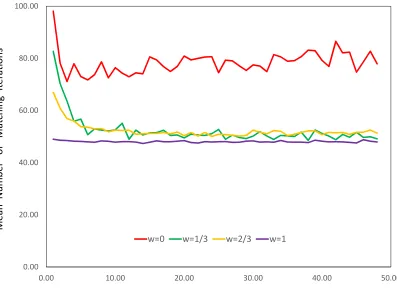
Our last performance measure is the speed of matching, i.e., the speed of the
con-vergence of the DA-MP algorithm, which is simply represented by the mean number
of steps (iterations) in this algorithm. When this number is smaller, we say that the
given matching is faster. Figure 5 illustrates that the slowest performance is always
obtained when the individuals’ preferences are uncorrelated. Moreover, the number
of dates, unless it is extremely small, has always small, but also non-predictable,
required by the DA-MP algorithm to generate a stable matching becomes very close
to the maximal number of potential couples, which is 50 in our simulations.
M
ea
n
N
um
be
r
of
M
at
ch
in
g
It
er
at
io
ns
Number of Dates in the Adolescence Phase
0.00 20.00 40.00 60.00 80.00 100.00
0.00 10.00 20.00 30.00 40.00 50.00
[image:19.612.121.518.172.461.2]w=0 w=1/3 w=2/3 w=1
Figure 5.
Figure 5 also shows that the presence of even a small correlation in preferences
(ω = 1/3) drastically improves the speed of convergence of the DA-MP algorithm
—as compared to the case of no-correlation— unless the number of dates in the
adolescence phase is extremely small.
4
Conclusion
In this paper, we have considered a matching model with two phases, an adolescence
by Todd and Miller (1999) and studied by Saglam (2018a,b) among many others—
followed by a matching phase where iteratively made proposals by men and
(de-ferred) acceptances by women, according to the DA-MP algorithm proposed by Gale
and Shapley (1962), produce one-to-one stable matchings. To evaluate the success of
the DA-MP algorithm under several cases of interest, we have considered four
perfor-mance measures, namely the likelihood of matching, the balancedness of matching,
the likelihood of divorce, and the speed of matching; and studied how these measures
are affected by the changes in (i) the degree of correlation between the preferences
of individuals, and (ii) the frequency individuals date potential mates in the
adoles-cence phase and update their aspirations according to the rule of TWAND proposed
by Saglam (2018b).
We have found that irrespective of the number of dates in the adolescence phase
the likelihood of finding a mate under a stable matching is always higher if the
preferences of individuals are less correlated (or more heterogenous). Moreover, the
DA-MP algorithm always produces a non-egalitarian/unbalanced stable matching at
which the lower segments of the population (in terms of mate values) are more likely
to be unmatched than the higher segments. However, there also exists a positive
relationship between the degree of correlation in preferences and the balancedness of
matching when the number of dates in the adolescence phase is sufficiently high. In
particular, the most unbalanced matching always arises when individuals’ preferences
are uncorrelated.
As to the likelihood of divorce, we have found that the number of dates in the
adolescence phase has negligible effects while the degree of correlation in preferences
has considerable, but also non-monotonic, effects. Interestingly, divorce becomes
significantly less likely when preferences are partially correlated than when they are
perfectly correlated or uncorrelated at all. In particular, the worst case arises when
the preferences are uncorrelated. Finally, we have studied the speed of matching
in the DA-MP algorithm, and found that this number always attains its highest
values (the worst scores) when the preferences of individuals are uncorrelated, while
these values are in general not much affected by the number of dates. On the other
hand, the fastest stable matchings are generated when the preferences are perfectly
correlated.
We should note that in situations where all individuals have strict preferences over
potential mates, we can in fact measure, in at least three dimensions, the performance
of any stable matching by measuring the performance of the stable matching
gener-ated by the DA-MP algorithm, only. The reason is that all performance measures
in our study, except for the speed of matching, are calculated using (linear functions
of) the mate values of all matched individuals, and these values must be the same
for all stable matching outcomes for a given population since a theorem by McVitie
and Wilson (1970) shows that under strict preferences the set of unmatched (and
therefore the set of matched) men and women must be the same at every stable
matching.
Future research may extend our work by comparing the effects of alternative
(as-piration) adjustment rules like in Todd and Miller (1999) or Saglam (2018a,b) or by
allowing the two sides of the matching population (men and women) to adopt
differ-ent adjustmdiffer-ent rules like in Shiba (2013). Another extension could fruitfully focus
on the evolution of the aspiration adjustment rules like in Saglam (2014) and study
whether any (aspiration) adjustment rule could arise as a Nash (1950) equilibrium
in our model when individuals are allowed to choose any adjustment rule among a
References
Abdulkadiro˜glu, A., Pathak, P. A. & Roth, A. E. (2005) The New York City high
school match. American Economic Review, Papers and Proceedings, 95(2), 364–367.
Aptech Systems (1998) GAUSS version 3.2.34. Maple Valley, WA: Aptech Systems,
Inc.
Balinski, M. & S¨onmez, T. (1999) A tale of two mechanisms: Student Placement.
Journal of Economic Theory, 84, 73-94.
Gale, D. & Shapley, L. S. (1962) College admissions and the stability of marriage.
American Mathematical Monthly, 69, 9–15.
Hills, T. & Todd, T. (2008) Population heterogeneity and individual differences in
an assortative agent-based marriage and divorce model (MADAM) using search with
relaxing expectations. Journal of Artificial Societies and Social Simulation, 11(4), 5.
McVitie, D. G. & Wilson, L. B. (1970) Stable marriage assignments for unequal sets.
BIT Numerical Mathematics, 10(3), 295–309.
Nash, J. (1950) Equilibrium points in n-person games. Proceedings of the National
Academy of Sciences, 36, 48-49.
Pathak, P. A. & S¨onmez, T. (2008) Leveling the playing field: Sincere and
sophisti-cated players in the Boston mechanism. American Economic Review, 98(4), 1636–
1652.
Roth, A. E. (2008) Deferred acceptance algorithms: History, theory, practice, and
open questions. A collection of papers dedicated to David Gale on the occasion
of his 85th birthday, special issue. International Journal of Game Theory, 36(3-4),
Roth, A. E. (2002) The economist as engineer: Game theory, experimental economics
and computation as tools of design economics. Econometrica, 70(4), 1341–1378.
Roth, A. E. (1984) The evolution of the labor market for medical interns and
resi-dents: A case study in game theory. Journal of Political Economy, 92, 991–1016.
Saglam, I. (2019) The mutual sequential mate search model under non-homogenous
preferences. Marriage & Family Review, forthcoming.
Saglam, I. (2018) A new heuristic in mutual sequential mate search. International
Journal of Microsimulation, 11(2), 122–145.
Saglam, I. (2014) Simple heuristics as equilibrium strategies in mutual sequential
mate search. Journal of Artificial Societies and Social Simulation, 17 (1), 12.
Shiba, N. (2013) Analysis of asymmetric two-sided matching: Agent-based simulation
with theorem-proof approach. Journal of Artificial Societies and Social Simulation,
16(3), 11.
Sim˜ao, J. & Todd, P. M. (2003) Emergent patterns of mate choice in human
popu-lations. Artificial Life, 9, 403–417.
Todd, P. M., Billari, F.C. & Sim˜ao, J. (2005) Aggregate age-at-marriage patterns
from individual mate-search heuristics. Demography, 42, 559–574.
Todd, P. M. & Miller, G. F. (1999) From pride and prejudice to persuasion:
Satis-ficing in mate search. In G. Gigerenzer, P. M. Todd & the ABC Research Group
(Eds.), Simple Heuristics That Make Us Smart(pp. 287–308). New York: Oxford