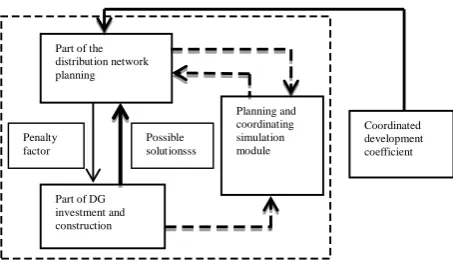
Overall Framework and Module of Distribution Network
Coordinated Planning Considering Distributed
Generation
Qianjin Liu, Huanghuang Liu
School of Electric power,South China University of Technology, Guangzhou, China Email: [email protected]
Received 2013
ABSTRACT
Combining with the characteristics of China’s energy and the strategy of sustainable development, analyzing the pros and cons which caused by the appearance of DG and their operation connecting to grid, this paper points out that the two sides can achieve win-win under a reasonable combination between DG and distribution system, so as to optimize the allocation of resources, improve the utilization ratio of resource, and obtain maximum social benefit, harmoniously promote the development of power industry, economy and environment. As a word, this paper puts forward a new model of distribution network planning including DG and brings in penalty factorto guide the investment and construc-tion of DG. Last of all, this paper presents the adopconstruc-tion of the coordinaconstruc-tion development coefficients which is to eva-luate the power planning.
Keywords: Distributed Generation; Distribution Network; Planning; vPenalty Factor; Coordinated Development
Coefficient
1. Introduction
Most ofdistributed generations (DG)arethe clean and renewable energy, they can enjoy priority scheduling rights under the domestic energy-saving scheduling rules [1]. Distributed generations also have a lot of advantages including low investment, low loss, high system reliability, easy siting, short construction cycle, reducing transmis- sion congestion, delay the lifetime of distribution equip- ment and environmental protection,etc. [2-3].There is no doubt that DG is the key to solve the energy crisis, large environmental pressure and many other critical issues [4]. In recent years, in order to cope with the problem of en- ergy shortages and environmental pollution, most coun- tries around the world have enacted laws, regulation or action plan in succession, and present clear objectives and development paths of renewable energy development. China clearly plans to build 3TW hydropower and 30GW wind power, 30GW raw biomass power generation, 1.8GW solar energy, and makes the consumption of re- newable energy achieve to 15% in energy consumption of the total by 2020.All of these give distributed power generation vast business opportunities, in particular, which are based on the distributed generations of renew- able energy.
According to some survey, data indicate that the trend of DG connecting to grid is becoming more and more
obvious under the policy of encouraging and supporting the generation of renewable energy connecting to grid, and often run directly in the distribution network[5], so DG brings many other impact on the economy of power system, planning and designing, operation, control, pro- tection, security and stability. Therefore, the power sup- ply companies is necessary to prospectively and scien- tifically predict the possible construction situation of future DG in the regulation planning stage, deeply re- search and analysis the influence which DG may bring to the distribution network systems, ensure the high flexi- bility of planning scheme for the development of DG.
in this model to assess distribution planning comprehend- sively and systematically and gives the estimate results back to a new round of planning, so that to build com- plete overall framework which taking into account the coordination of DG distribution planning.
2. Harmonious Development Analysis
Between DG and Distribution System
According to different investment subjects, there are two kinds of DG configuration modes: a. Power suppliers invest DG configuration in distribution network to meet new load growing demand, While saving the investment costs of the expansion of the distribution network and substation equipment; b. DG investors (including Power Generation Group, power users, etc.) configure the DG near the distribution network users’ load, this configure- tion mode makes the installation limit condition reduce greatly, and expand the DG investment sources [8]. Power Generation Group has more enthusiasm to build- ing DG than Grid Corporation, thus the second kind of configuration mode is mainly used at this stage in our country. But DG investors and the power company are the different beneficiaries in this model, unreasonable DG building may affect the power company’s economic interest, and hinder the smooth promotion of DG.
As previously mentioned, the emergence of DG which largely connecting to the grid can give the grid company some interests on the one hand, for example: reasonable DG arrangement is able to reduce the energy loss, trans- mission and distribution costs, etc. [9]; DG also can pro- vide emergency back-up energy or ancillary services to system, improve the reliability and stability of power supply. In addition, reasonable DG appearing will post- pone or reduce the investment of power grid expansion. On the other hand, due to DG investors and power supply companies are the different market entity, there are some conflict interest between them, such as, they may cause the grid to produce stranded costs, increase standby costs, and that unreasonable DG connecting to network opera- tion may lead to the increase of energy loss, and even make power system’s reliability, stability and power quality serious deterioration [10].
Power supply companies are necessary and have the means to take positive and effective measures to guide the rational distribution of DG, promote the resources rational development and optimal allocation in their areas of jurisdiction, reduce the uncertainty to the distribution network planning by the appearance of DG, lowering the investment risk, improving efficiency, and achieving “win-win”.
3. The Overall Framework for Distribution
Network Coordinated Planning
Considering DG
Before you begin to format your paper, first write and save the content as a separate text file. Keep your text and graphic files separate until after the text has been formatted and styled. Do not use hard tabs, and limit use of hard returns to only one return at the end of a para- graph. Do not add any kind of pagination anywhere in the paper. Do not number text heads—the template will do that for you.
Finally, complete content and organizational editing before formatting. Please take note of the following items when proofreading spelling and grammar:
The main task of traditional distribution system plan- ning is based on load forecasting results in the network and the basic conditions of the existing network during the planning period to determine the optimal system- building programs under the premise of meeting the load growth and supplying power safely and reliably, making the cost of distribution construction and operation to the minimum [11]. However, with the emergence of DG, the traditional distribution network planning can’t adapt to the needs of power industry development in the new pe- riod. The distribution network planning is no longer just the simple and traditional power system planning, but becomes the resource allocation optimization which closely links to national energy policy, sustainable development strategic initiatives.
The overall framework for distribution network coor- dinated planning considering DG presented in this paper includes two parts in detail: the distribution network planning and DG investment construction. Both of them interrelate and influence each other by penalty factor. The power companies affect and guide the investment planning of DG by penalty factorwhile the planning and construction of DG investors also have an impact on the penalty factor. The planning and coordinating process is shown in Figure 1.
3.1. Power Supply Company’s Distribution
Network Planning Section
In this new model, apart from the annual load levels and
Penalty factor
Possible solutionsss Part of the
distribution network planning
Planning and coordinating simulation module Part of DG
investment and construction
Coordinated development coefficient
[image:2.595.309.536.579.709.2]distribution of scientific forecast in futureneed to be referred, but also the various national energy policy should be activelyresponded and fully implemented in time, considering the energy characteristics and investors information of DG in the jurisdiction of the area, fully exploiting the potential for using the renewable energy under the premise what ensures a reasonable profit for the power companies, encouraging and supporting the development of DG.
First of all, in order to prevent the conflict of interest between DG investors and the power supply companies, and to avoid producing stranded costs and increased standby costs and so on, the most powerful way for the power companies is to grasp the determinate information of the DG investment and construction during the next planning period as much as possible. For example, to encourage the DG investors to actively participate in the grid planning, and to spontaneously submit development strategies of a self-research optimized electricity genera- tion plan, as well as the information and data of DG in- vestment construction during the to-be planning period, meanwhile encourage the DG investors which sign agreement and contract with power companies to share risk with the power companies after determining the to-be investing plan.
Secondly, the gradual promotion of DG technologies will have an impact on the node voltage, circuital flow, short circuit current, network reliability etc. in the distri- bution network, and its incidence is closely related to the location and capacity of distributed power. Therefore, in order to reduce or avoid the disorderly construction of DG do damage to the security and stability of distribution system, it is necessary for the power companies to take effective measures to guide the investors to choose the reasonable location and capacity of distributed power. In this framework, the power companies, which will effect and guide the DG’s layout and capacitive construction by adopting the economic index, namely penalty factor, bring into the construction of the DG investment section
3.2. DG Investment and Construction Section
Before making the final decision, the DG investors must embark an individual study of the power generation planning project, which mainly includes the expected cost of the investment, the cost of operation,the existed risks, network combined problem and the possible im- pact on the power generation and so on. In addition, pen- alty factor must be taken into account which has an im- portant affection on the DG investment profit under new planning mode. Finally, decisions are made by compare- ing with the several comprehensive information of the feasible DG layout points.
4. Model of Distribution Network Planning
and Coordination of DG
4.1. Penalty Factor
Coordination factor, the key to operate this mode, is the convergence factor in the whole planning process, which is organically combined with DG investment planning and distribution network planning. The concept of coor- dinated factor is to reflect the comprehensiveeconomic indicator, bringing out by the impact of the feasible con- struction of the layout point to the comprehensive plan- ning program, which refers two sectors including global coordination factor and local coordination factor. The essence is to direct the DG site selection and constant volume by using price leverage to restrict DG invested construction when the DG installation adversely affects the position of the power distribution system restricts, and to encourage the reasonable DG investment con- struction where the position has a favorable impact on the distribution network.
4.2. Coordination Optimization Model
In order to promote the harmonious development of the economy and environment, and to encourage and support the DG development, under the object of optimized resources of regional allocation which belongs to the power companies, this paper establishes DG construction and distribution network planning coordinated planning model as the minimum target cost investment.
1) Objective function ofdistribution network planning The cost of distribution network planning investment includes comprehensive costs of the investment of building the substation, fixedly circuital investment, de- preciation and overhaul, as well as the network loss. Grid planning model of the power supply companies men- tioned in this paper is transformed from the investment model proposed in paper [12]:
, ,
1 1 1 1
*
1 1 1 1
8760
SS TU TN M
i u i u ij ij
i u i j
z
T TN M M
ij l
e j j
l i j ij j
J C C
V
pfc D
Z
δ δ
β α
= = = =
= = = =
= +
∆
+ +
∑∑
∑∑
∑ ∑∑
∑
(1)
In this formula, T, M, TN, SS, TU respectively represent the planned time, load point, all nodes of the distribution system, all substations of the distribution system, all transformers of the distribution system (in-cluding the to be built); Ce refers to the purchasing power price; δi u, , Ci u, , δij, Cij respectively indicate the binary decision variables and comprehensive costs of the transformer u inside the substation i, circuit of the node i and load point j; *
j
feasible layout point.
2)The objective function of construction planning for DG investment
DG investors typically proceed investments planning by the maximize profittarget, while the minimum total investment cost (including overall equipment cost and installation cost) means more competitive. As a result, this paper aims to decide whether to invest in the DG construction by the assessment indicators of the total investment cost. The mathematical model is transformed from the model proposed in paper [13]:
*
1 2
1
[( ) ]
DG
n
n n DGi j
i
F C C p D
=
=
∑
+ + (2)In this formula, nDG is the amount of the feasible layout point of the installed DG; pDGi is the compre-hensive cost and installation cost of each equipment of the numberi node.
3) The simplified mathematical model of distribution network planning including DG
In order to reflect the characteristics of the coordina-tion model and reflect the risk of the planning, the for-mula (1) and (2) are simplify to (3). The objective func-tion of the new model is a mathematical model of typical dual output.
min { *} *
min { *} (1 ) *
F F KD
J J K D
= +
= + −
(3)
In the formula, { *}F and { *}J respectively indi-cate the DG without considering penalty factor and in-vestment costs ofindependent planning inthe distribution network; D* is the reference value of the penalty fac-tor in the wholedistribution network(namely, the equiva-lent reference value of the power planning risk in this round);K is the equivalent weight factor of the whole distribution networkwhich ranges [0, 1], the purpose of which is to coordinate the DG and distribution network planning.
4) Calculation of the penalty factor
The global coordination factor reflects pros and cons under the situation that the volume and capacity of the DG is on the largest scale in the current planning scheme. In accordance with related national and local energy pol-icy, planning and DG investors’ information, from the macro perspective, the grid planning personnel will try their best to estimate the DG investment construction with the area during the planning period as much as possible.Therefore, the calculation of the index can be easily obtained for its equivalent to the deterministic one.
Local coordination factor reflects the pros and cons caused by the construction of the investment to system in every feasible layout point. From the microscopic point of view, the possibility of the DG’s appearance in every feasible layout point is random and difficult to predict, so
the calculation of index, which is more complex, must be obtained by other means.In this paper, calculations of local coordinated factor are determined by two steps. For one thing is the reliable index caused by the influence of every feasible layout point to the distribution network; then by another impact, that is transfer function trans- form the index from benefit to the economy.
Some researchersestablished a comprehensive evalua-tion coefficient (IMO) of the posievalua-tion and capacity, which is an effective evaluation of multiple indexes involving network loss, voltage, short circuit current. Details of the computational method can be found in paper [14] and [15].Inspired by that paper, suppose DG installation do more harm to the distribution network (namely, the IMO is lower), the greater efficiency losses will cause. There-fore, the local coordination factor can be determined based on global coordination factor and comprehensive reliable index. That is:
*
1 *
DG
j j n
i i D IMO D
IMO =
=
∑
(4)In the formula, D* and * j
D respectively refer to the global coordination factor and the local coordination factor; IMOj refers to the index which is the impact of distribution system caused by the number j feasible layout point; nDG is the total of the feasible layout points with DG installation.
5. Coordinated Development Factor
With the further development of power market and per-formance of all the aspects of energy policy, the increas-ing number of DG and connectincreas-ing to the grid, all of which enhance the uncertainty of this distribution net-work planning, reducing investment risk, so as to have a clear guidance on the whole distribution system and DG coordinated planning system.The paper [7] introduces the concept of coordinated development coefficient, which uses the ratio of planning risk cost and actual risk cost as
λ, that is, the coefficient of DG and the coordinated
de-velopment of the distribution network. λ, bounded to 1, is divided into three states representing the poor, qualified and good. The power planning will be made a full range
of system assessment in this round after λ determined,
and make the appropriate guidance and adjustment to the next round of planning.
6. Conclusion
coordi-nation and planning, the safety benefits of each other, the economic benefits as well as environmental effective will improve, at last, to maximize the social benefit. The model of distribution network planning considering DG presented above will optimize the allocation of resources to be a higher level, at the same time, transform the un-certainty into the un-certainty in the new grid planning pe-riod, and make planning approachas the way of certainty. Besides the presented penalty factor and coordinated development coefficient which effectively guide con-struction of investment and distribution network planning, are easy to achieve a rational distribution and constant volume of geographical and time-domain as well as to reduce the investment risk of the DG investors and the power supply companies, in line with the sustainable development needs of environmental protection and energy in the new era, to realize the social benefits to maximize accompany with the healthy and harmonious development of the DG construction, distribution net-work planning, the economy and the environment, so as to provide a foundation of further study on distribution network planning considering DGfor the new era.For the reason that the distribution network planning including DGrelates to the stationing and constant volume of DG, the planning and design of distribution network, as well as the calculation and introduction of penalty factor, which will be a challenging and innovative work in the future.
REFERENCES
[1] Wang Shouxiang, Wang Hui, CaiShengxia,“Review of Distributed Generation Optimal Allocation,”Automation of electricity power system, Vol. 33, No. 18, 2009, pp. 110-114.
[2] Naderi, E., Seifi,H., Sepasian,M.S., “A Dynamic Ap-proach for Distribution System Planning Considering Distributed Generation,” Power Delivery, IEEE Transac-tions on, Vol. 27, No. 3,2012, pp. 1313-1322.
[3] Srivastava, A.K, Zamora,R.,Bowman,D.,“Impact of Dis-tributed Generation with Storage on Electric Grid Stabili-ty,”Power and Energy Society General Meeting IEEE, San Diego, CA, 2011, pp. 1437-1442.
[4] Wang Menglin, Zhang Yongjun, Lin Jianxin, “The De-velopment of Distributed Generation Technology Re-view,” Electrotechnical Application, Vol. 9, 2011, pp.
37-39.
[5] CaiLixia, Sun Ying,”A Study on Distribution Network Planning with Distributed Generation,”Jinan: Shandong University 2009, pp. 1-58.
[6] ZhangYongjun,LiuHanlin,JiangJinliang,LiangJinzhao, “Research on Evaluation Index and Method of Coordi-nated Planning Between Main System and Distribution Network,” Automation of Electric Power Systems, Vol. 34, No. 15, 2010, pp. 34-41.
[7] Zhang Wuyang, YaoJiangang, “A New GlobalFramework and Model to Promote the Coordination Planning of In-dustrial Power Network,” The Electric Network Tech-nology,Vol. 30, No. 1, 2006,pp: 50-54.
[8] HuShu. WuYaowu, Lou Suhua, etc. “A Game Between the Users Who Generate Their Own Distributed Power and Supplier,”Automation of Electric Power Systems, Vol. 30, No. 20, 2006, pp. 21-25.
[9] Driesen, J., Katiraei, F., “Design for Distributed Energy Resources,”IEEEPower and Energy Magazine,Vol. 6, 2007, pp. 30-40.
[10] Ayuyev, B.I.,Yerokhin, P.M.,Shubin, N.G.,etc.“The Software Complex of Optimal Power Flow Solution for United Power System of Russia in a Terms of Competi-tive Electricity Market,”Power Tech, 2005 IEEE Rus-sia,2005,pp. 1324-1329.
[11] Zeng Li, Jin Zhaoxia, “Distribution Network Planning Based on Strategy,”Guangzhou: South China University of Technology, 2011, pp. 1-57.
[12] WalidEI-Khattam,Hegazy YG,Salama MMA, “AnInte-gratedDistributed Generation Optimization Model for Distribution System Planning,”IEEETransactions on Power Systems,Vol. 20,2005, pp. 1158-1165.
[13] ChenHaiyan, Chen Jinfu, YangXiongping, etc. “Distri-buted Power Generation Planning of the Distribution Networks Including the Short-circuit Current Con-straints,”Automation of Electric Power Systems, Vol. 30, No. 21, 2006, pp. 16-21.
[14] OCHOA L F, PADILHA F A, HARRISON G P.,“Evaluating Distributed Generation Impacts with a Muhiobjeetive Index,”IEEE Trans on Power Delivery,Vol. 21, No. 3, 2006,pp. 1452-1458.