Proceedings of the 55th Annual Meeting of the Association for Computational Linguistics (Short Papers), pages 347–351 Vancouver, Canada, July 30 - August 4, 2017. c2017 Association for Computational Linguistics
Proceedings of the 55th Annual Meeting of the Association for Computational Linguistics (Short Papers), pages 347–351 Vancouver, Canada, July 30 - August 4, 2017. c2017 Association for Computational Linguistics
Cardinal Virtues: Extracting Relation Cardinalities from Text
Paramita Mirza1, Simon Razniewski2, Fariz Darari2, Gerhard Weikum1
1Max Planck Institute for Informatics 2 Free University of Bozen-Bolzano
{paramita, weikum}@mpi-inf.mpg.de
{razniewski, darari}@inf.unibz.it
Abstract
Information extraction (IE) from text has largely focused on relations between in-dividual entities, such as who has won which award. However, some facts are never fully mentioned, and no IE method has perfect recall. Thus, it is beneficial to also tap contents about the cardinalities of these relations, for example, how many awards someone has won. We introduce this novel problem of extracting cardinali-ties and discuss specific challenges that set it apart from standard IE. We present a dis-tant supervision method using conditional random fields. A preliminary evaluation results in precision between 3% and 55%, depending on the difficulty of relations.
1 Introduction
Motivation Information extraction (IE) can in-fer relations between named entities from text (e.g., (Mitchell et al., 2015; Del Corro and Gemulla, 2013; Mausam et al., 2012)), yield-ing for example which awards an athlete has won, or instances of family relations like spouses, children, etc. These methods can be harnessed for summarization, question answering (QA), and more. For populating knowledge bases (KBs), the IE output is usually cast into subject-predicate-object (SPO) triples, such as hBarackObama,
hasChild, Maliai, or sometimes n-ary tuples
such as hMichaelPhelps, hasWon, OlympicGold, 200mButterfly, 2016i.
IE has focused on capturing full SPO triples (or
n-ary facts) with all arguments bound to entities
for relation P. However, news, biographies or dis-cussion forums often contain numeric expressions that reveal cardinalities of relations. Phrases such as “her two children” or “his 28th medal” are
valu-able cues for quantifying thehasChildandhasWon
relations. This can be harnessed in QA for cases like “Who won the most Olympic medals?”
An important application of relation cardinali-ties is KB curation. KBs are notoriously incom-plete, contain erroneous triples, and are limited in keeping up with the pace of real-world changes. For example, a KB may contain only 10 of the 28 Olympic medals that Phelps has won, or may in-correctly list 3 children for Obama. Extracting the cardinalities of relations for given subject entities can address all of these issues.
Relation cardinalities are disregarded by virtu-ally all IE methods. Open IE methods (Mausam et al., 2012;Del Corro and Gemulla, 2013) cap-ture triples (or quadruples) such ashObama, has, two childreni. However, there is no way to
in-terpret the numeric expression in the O slot of this triple. While IE methods that hinge on pre-specified relations for KB population (e.g., NELL (Mitchell et al., 2015)) can already capture nu-meric values for explicitly stated attributes such ashBerlin2016attack, hasNumOfVictims, 32i, they are currently not able to learn them.
This paper addresses the novel task of extracting relation cardinalities. For a given subject entity
sand predicatep, we aim to infer the cardinality
|{hS, P, Oi |S = s, P = p}|directly from text, without having to observe anyOentities. This task
poses several challenges:
• IE Training. Most IE methods build on
seed-based distant supervision. However, if the un-derlying KB is not complete, taking the counts of SPO triples for a given SP pair may result in wrong seeds, which can lead to poor patterns.
• Compositionality.The cardinality of an SP pair for a relation may depend on several cardinality mentions. For example, when observing “An-gelina hastwo sons andthree daughters”, one could infer the children cardinality by summing.
• Linguistic Variance. In addition to cardinal numbers, cardinality IE should also pay atten-tion to number-related terms, e.g., “Angelina gives birth to twins”, or ordinal information, e.g., “Angelina’sfourthchild”, which can reveal lower bounds on relation cardinalities.
Approach and Contribution Our method learns patterns of phrases that contain cardinal numbers, relying on the distant supervision approach by counting facts for given SP pairs. Our technical contributions are as follows: (i)
we provide a statistical analysis of numeric information in Wikipedia articles;(ii)we develop a CRF-based extraction method for relation cardinalities that achieves precision scores of up to 55%;(iii)we analyze further challenges in this research and outline possible solutions.
2 Related Work
Knowledge Bases and Information Extraction
Automated KB construction is a major effort for quite a while. Some approaches, such as YAGO (Suchanek et al., 2007) or DBpedia (Auer et al.,
2007), focus on structured parts of Wikipedia, while other approaches such as OLLIE (Mausam et al., 2012), ClauseIE (Del Corro and Gemulla,
2013) or NELL (Mitchell et al., 2015), focus on unstructured contents across the whole Web. In the latter, usually the schema is also not predefined, thus such approaches are called Open IE. Most state-of-the-art systems now rely on distant super-vision (Craven and Kumlien, 1999;Mintz et al.,
2009).
Despite all efforts, KBs are immensely incom-plete. For instance, the average number of children per person in Wikidata (Vrandeˇci´c and Kr¨otzsch,
2014) is just 0.02 (Razniewski et al.,2016).
Numbers and Relation Cardinalities Numbers in text are an important source of information. Much work has been done on understanding num-bers that express temporal information (Ling and Weld,2010;Str¨otgen and Gertz,2010), and more recently, on numbers that express physical quan-tities or measures, either mentioned in text ( Cha-ganty and Liang,2016) or in the context of web ta-bles (Ibrahim et al.,2016;Neumaier et al.,2016).
In contrast, numbers that express relation cardi-nalities have received little attention so far. State-of-the-art Open-IE systems either hardly extract cardinality information or fail to extract
cardinal-NE Tag Frequency
DATE,TIME,DURATION,SET(temporal) 54.28%
NUMBER 40.13%
Relation cardinality 18.86%
PERCENT 2.92%
MONEY 2.25%
PERSON,LOCATION,ORGANIZATION 0.26%
[image:2.595.323.514.59.153.2]ORDINAL 0.16%
Table 1: NE-tags of numbers in Wikipedia.
ities at all. While NELL, for instance, knows 13 relations about the number of casualties and in-juries in disasters, they all contain only seed facts and no learned facts. The only prior work we are aware of is of Mirza et al.(2016), who use manu-ally created patterns to mine children cardinalities from Wikipedia. It is shown that with 30 manually crafted patterns and simple filters it is possible to extract 86,227 children-cardinality-assertions with a precision of 94.3%.
3 Relation Cardinalities
Definition We define a mention that expresses relation cardinalities as the following: “A cardi-nal number that states the number of objects that stand in a specific relation with a certain subject.”
Using this definition, we analyzed how often relation cardinalities occur in Wikipedia. Rely-ing on the part-of-speech (PoS) tagger of Stan-ford CoreNLP (Manning et al., 2014), we ex-tracted numbers–i.e., words tagged as CD (cardi-nal number)–from 10,000 random Wikipedia arti-cles. The distribution of their named-entity (NE) tags, according to Stanford NE-tagger, is shown in Table1. While temporal-related numbers are the most frequent, around 40% are classified only as unspecific NUMBER. By manually checking 100 random NUMBERs, we observed that 47 are rela-tion cardinalities,1 i.e., approximately 18.86% of
all numbers in Wikipedia are relation cardinalities. We also analyzed the nouns frequently modified by NUMBERs, based on their dependency paths, finding people, games, children, times, members
andseasonsamong the top nouns. Coarse topic-grouping of the nouns shows that mostNUMBERs are about sport (games, goals), followed by art-work (seasons, books), politics and organization (members,countries), and family (children).
1Among the others are measures, age, or expressions like
4 Relation Cardinality Extraction
Ideally, we would like to make sense of all car-dinality statements found in text. However, this would require us to resolve the meaning of a large set of vague predicates, which is in general a dif-ficult task. We thus turn the problem around: given a well defined relation/predicate p, a
sub-jects and a corresponding text about s, we now
try to estimate the relation cardinality (i.e., the count ofhs, p,∗itriples), based on cardinality as-sertions found in the text. We chose four Wikidata predicates that span various domains,child(P40),
spouse(P26), has part (P527) of a series of cre-ative works (restricted to novel, book and film se-ries), andcontains administrative territorial entity
(P150). As the text source for subjects of each predicate, we consider sentences containing num-bers taken from their respective English Wikipedia articles.
Methodology We approach the problem via se-quence labelling, i.e., given a sentence containing at least one number, we aim to determine whether each number in the sentence corresponds to the cardinality of a certain relation. We build a Con-ditional Random Field (CRF) based model with CRF++ (Kudo,2005) for each relation, taking as features the context lemmas (window size of 5) around the observed tokent, along with bigrams
and trigrams containingt.
To generate the training data, we rely on dis-tant supervision, annotating candidate numbers2
in the text as correct cardinalities whenever they correspond to the exact triple count (count > 0) found in the knowledge base. Otherwise, they are labelled as O (for Others), like the rest of non-number tokens. Table2contains for each consid-ered relation (p), the number of subjects (#s) in
Wikidata, which have links to English Wikipedia pages and have at least onehs, p,∗itriple.
We predict the relation cardinality of a given
hs, pipair by selecting the number positively
an-notated with marginal probability–resulting from forward-backward inference–higher than 0.1, and choosing the one with the highest probability if there are several.
Experiments Two experimental settings are considered: vanilla refers to the distant supervi-sion approach explained above, while for
only-2Numbers that are not labelled as DATE, TIME, DURA
-TION,SET,MONEYandPERCENTby Stanford NE-tagger.
nummod, we only annotate a candidate number as correct cardinality if it modifies a noun, i.e., there is an incoming dependency relation of label num-modaccording to the Stanford Dependency Parser. This is to exclude numbers as in “oneof the rea-sons...” from training examples. We also con-sidered a naive baseline, which chooses a random number from a pool of numbers existing in each text about a certain subject.
Furthermore, to estimate how well KB counts are suited as ground truth, we compare them on the the child relation with the manually-created num-ber of children(P1971) property from Wikidata.
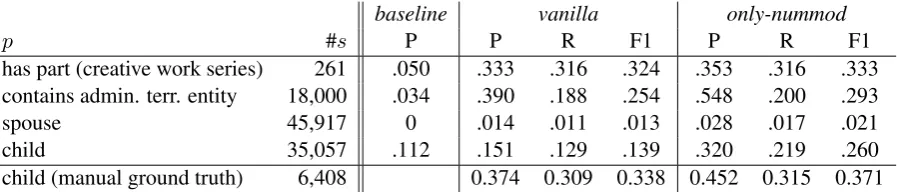
Evaluation Results We manually annotated the evaluation data with the true relation counts, since the knowledge base is highly incomplete, and thus, the triple counts are often incorrect. Whenever the cardinality matches the true count, we also manu-ally inspected how relevant the textual evidence– the context surrounding the cardinal number–is for the observed relation. Table2 shows the perfor-mance of our CRF-based method in finding the correct relation cardinality, evaluated on manually annotated 20 (has part), 100 (admin. terr. entity) and 200 (childandspouse) randomly selected sub-jects that have at least one object.
The random-number baseline achieves a preci-sion of 5% (has part), 3.5% (admin. territ. entity), 0% (spouse) and 11.2% (child). Compared to that, especially using only-nummod, our method gives encouraging results forhas part, admin. territ. en-tity and child, with 30-50% precision and around 30% F1-score. For spouse, the performance is significantly lower, reasons are discussed below. Furthermore, we can observe that using manual ground truth as training data for the child rela-tion can boost performance considerably. Still, the performance is significantly below the state-of-the-art in fact extraction, wherechildtriples can be extracted from Wikipedia text with 96% preci-sion (Palomares et al.,2016).
5 Analysis
A qualitative analysis of the training data and eval-uation results revealed three aspects that make ex-tracting relation cardinalities difficult.
baseline vanilla only-nummod
p #s P P R F1 P R F1
has part (creative work series) 261 .050 .333 .316 .324 .353 .316 .333
contains admin. terr. entity 18,000 .034 .390 .188 .254 .548 .200 .293
spouse 45,917 0 .014 .011 .013 .028 .017 .021
child 35,057 .112 .151 .129 .139 .320 .219 .260
[image:4.595.77.526.62.158.2]child (manual ground truth) 6,408 0.374 0.309 0.338 0.452 0.315 0.371
Table 2: Number of Wikidata entities as subjects (#s) of each predicate (p), and evaluation results on
manually annotated randomly selected subjects that have at least an object.
found in knowledge bases as ground truth gener-ally gives wrong results. For example, our manual evaluation ofchildshows that the triple count from Wikidata is 46% lower than what the texts assert.
As shown by the last row of Table 2, higher quality of training data can considerably boost the performance of cardinality extraction. Unfortu-nately, manually curated data is generally difficult to obtain. We see two avenues to tackle training data quality:
1. Filtering ground truth. Instead of taking the counts of all entities as ground truth, one might trade size for quality, e.g., using popular enti-ties only, as for these there are chances that KBs are more complete.
2. Incompleteness-resilient distant supervision.
Triple counts in KBs are often lower than what is correct, but rarely too high. Thus, an avenue might be to label all numbers equal or higher than the KB count as correct, instead of only considering the equal ones. Given that differ-ent cardinalities could then be labelled as cor-rect, this would require a postprocessing step in which conflicting counts are consolidated.
Compositionality Around 16% of false posi-tives in extracting child cardinalities can be at-tributed to failures in identifying the correct count for, e.g., ”They have two sons and onedaughter together; he hasfour children from an earlier re-lationship.” This was also observed for other rela-tions, e.g., “The Qidong county has4subdistricts,
17 towns and 3 townships under its juridiction.” We see two avenues to tackle this problem: 1. Aggregating numbers. In training data
genera-tion, one could label a sequence of number as correct cardinalities if the sum of the numbers is equal to the relation count. In the prediction step, one might sum up all consecutive cardi-nalities that are labelled with sufficient confi-dence.
2. Learning composition rules. One may try to learn the composition of counts, for instance, that children are composed of sons and daugh-ters, then try to extract the composing cardinal-ities.
Linguistic Variance We observe that for the
spouse relation, expressing the count with car-dinal numbers (“He has married four times”) is only found for 4% of subjects. It is more com-mon to express the count with ordinal numbers, e.g., “John’sfirstwife, Mary, ...”, which allows us to conclude that the spouse-count for John is at least–and most probably more than–one. An ap-proach to such relations might be to identify or-dinals numbers that express lower bounds of rela-tions. Subsequently, one could reason over these bounds and try to infer relation counts.
Our initial motivation was to make sense of the so far ignored large fraction of numbers that ex-press relation cardinalities. However, we noticed quickly that relation cardinalities are frequently also expressed without numbers at all. This is es-pecially true for the case of count zero, which is mostly expressed using negation (“He never mar-ried”), and the count one, which is expressed us-ing indefinite articles (“They have a child”) or the signal-wordonly(“Their only child, James”). Terms such as twins or trilogy are also ways to express domain-specific relation cardinalities. We see two avenues to approach this variance: 1. Translation to numbers. For the 0’s and 1’s, a
possible approach is to translate certain kinds of negation and indefinite articles into explicit numbers (e.g., “donot have anychildren” →
“have 0 children”).
6 Conclusion
In this paper we have introduced the problem of relation cardinality extraction. We believe that re-lation cardinalities can be useful in a variety of tasks. Our next goal is to make distant supervision incompleteness-resilient and to deal with compo-sitionality, hoping that these can improve the pre-cision of our approach. We also aim to take ordi-nals into account and to experiment with linguistic transformation for the cases of cardinalities 0 and 1, hoping that these could boost the recall.
A limitation of our work is also that we only focus on Wikipedia articles, assume that all state-ments are about the article’s subject, and just take the statement with the highest confidence. In fu-ture work we aim to include a larger article base in combination with named entity recognition, coref-erence resolution and a truth consolidation step.
Acknowledgments
We thank Werner Nutt and Sebastian Rudolph for their feedback on an earlier version of this work. We thank the anonymous reviewers for their help-ful comments. This work has been partially sup-ported by the project “The Call for Recall”, funded by the Free University of Bozen-Bolzano.
References
S¨oren Auer, Christian Bizer, Georgi Kobilarov, Jens Lehmann, Richard Cyganiak, and Zachary Ives.
2007. DBpedia: A nucleus for a web of open data.
Springer.
Arun Chaganty and Percy Liang. 2016. How much is 131 million dollars? putting numbers in perspec-tive with compositional descriptions. InACL. pages 578–587.
Mark Craven and Johan Kumlien. 1999. Constructing biological knowledge bases by extracting
informa-tion from text sources. InProceedings of the
Sev-enth International Conference on Intelligent Systems for Molecular Biology. pages 77–86.
Luciano Del Corro and Rainer Gemulla. 2013. ClausIE: clause-based open information extraction.
InWWW. ACM, pages 355–366.
Yusra Ibrahim, Mirek Riedewald, and Gerhard Weikum. 2016. Making sense of entities and quan-tities in web tables. InCIKM. pages 1703–1712.
Taku Kudo. 2005. CRF++: Yet another CRF toolkit.
Software available at http://crfpp. sourceforge.net.
Xiao Ling and Daniel S Weld. 2010. Temporal
in-formation extraction. In AAAI. volume 10, pages
1385–1390.
Christopher D Manning, Mihai Surdeanu, John Bauer, Jenny Rose Finkel, Steven Bethard, and David Mc-Closky. 2014. The Stanford CoreNLP natural
lan-guage processing toolkit. ACL (System
Demonstra-tions)pages 55–60.
Mausam, Michael Schmitz, Stephen Soderland, Robert Bart, and Oren Etzioni. 2012. Open language
learn-ing for information extraction. In EMNLP. pages
523–534.
Mike Mintz, Steven Bills, Rion Snow, and Daniel Ju-rafsky. 2009. Distant supervision for relation ex-traction without labeled data. InACL. pages 1003– 1011.
Paramita Mirza, Simon Razniewski, and Werner Nutt. 2016. Expanding Wikidatas parenthood informa-tion by 178%, or how to mine relainforma-tion cardinalities.
ISWC Posters & Demos.
Tom M. Mitchell, William W. Cohen, Estevam R. Hr-uschka Jr., Partha Pratim Talukdar, Justin Bet-teridge, Andrew Carlson, Bhavana Dalvi Mishra, Matthew Gardner, Bryan Kisiel, Jayant Krishna-murthy, Ni Lao, Kathryn Mazaitis, Thahir Mo-hamed, Ndapandula Nakashole, Emmanouil Anto-nios PlataAnto-nios, Alan Ritter, Mehdi Samadi, Burr Set-tles, Richard C. Wang, Derry Tanti Wijaya, Abhi-nav Gupta, Xinlei Chen, Abulhair Saparov, Malcolm Greaves, and Joel Welling. 2015. Never-ending
learning. InAAAI. pages 2302–2310.
Sebastian Neumaier, J¨urgen Umbrich, Josiane Xavier Parreira, and Axel Polleres. 2016. Multi-level
se-mantic labelling of numerical values. In ISWC.
pages 428–445.
Thomas Palomares, Youssef Ahres, Juhana Kan-gaspunta, and Christopher R´e. 2016. Wikipedia
knowledge graph with DeepDive. InICWSM. pages
65–71.
Simon Razniewski, Fabian M. Suchanek, and Werner
Nutt. 2016. But what do we actually know?
Pro-ceedings of AKBCpages 40–44.
Jannik Str¨otgen and Michael Gertz. 2010. Heideltime: High quality rule-based extraction and normaliza-tion of temporal expressions. InSemEval Workshop. pages 321–324.
Fabian M. Suchanek, Gjergji Kasneci, and Gerhard Weikum. 2007. YAGO: a core of semantic
knowl-edge. WWWpages 697–706.
Denny Vrandeˇci´c and Markus Kr¨otzsch. 2014.
Wiki-data: a free collaborative knowledgebase.