J. Range Manage.
55: 260-265 May 2002
Irrigation impact on harvest efficiency in grazed Old World bluestem
W.R. TEAGUE AND S.L. DOWHOWER
Authors are Associate Professor and senior Research Associate, Texas Agricultural Experiment Station, P.O. Box 1658, Vernon, Tex. 76385.
Abstract
In 1992 and 1993, pastures of WW-Spar Old World bluestem (Bothriochloa ischaemum L.) were maintained at 2 levels of soil water, rainfall and rainfall plus 25 mm/week of supplementary irrigation. At both moisture levels the grass was maintained at 2
levels of standing crop, averaging 1,548 and 2,154 kg ha'1, using continuous variable stocking. Measurements were made to deter- mine how different levels of soil moisture interacted with grazing intensity to change leaf area index, leaf-stem and live-dead ratios, tiller density, and the proportion of gross leaf production that was grazed (harvest efficiency). The proportions of live to dead, and leaf and stem biomass, remained constant under the differ- ent levels of soil water content. Soil water content alone had no effect on leaf area index, tiller density and the proportion of live or dead, leaf and stem. Winter tiller survival was significantly higher in the pastures with higher soil water content. Increasing soil water content and increasing grazing intensity interacted to reduce the proportion of dead leaf, increase production of new tillers, and increase the proportion of leaf grazed by decreasing leaf that died and was not grazed. This study indicates that if continuously grazed Old World bluestem was maintained at a standing crop of 1,500 kg ha'1, harvest efficiency would be higher in wet years or under irrigation than if standing crop was higher.
Key Words: Bothriochloa ischaemum, continuous variable stock- ing, herbage allowance
Resumen
En 1992 y 1993 poteros de WW-Spar "Old World bluestem"
(Bothriochloa ischaemum L.) se mantuvieron en dos niveles de humedad del suelo, humedad proveniente de la lluvia y humedad producto de la lluvia mas 25 mm/semana de irrigacion suple- mentaria. En ambos niveles de humedad el zacate se mantuvo en 2 niveles de cosecha en pie, 1,548 y 2,154 kg ha'' en promedio, para to cual se utilizo una carga animal continua variable. Las mediciones se hicieron para determinar como los diferentes nive- les de humedad del suelo interactuaron con in intensidad de apacentamiento para cambiar el indice de area foliar, las rela- ciones tallo-hoja y biomasa viva-muerta, la densidad de hijuelos y la proporcion de produccion total de hojas que fue apacentada (eficiencia de cosecha). Las proporciones de biomasa viva-muer- ta y tallo-hoja permanecieron constantes bajo los diferentes nive- les de humedad del suelo. El contenido de humedad del suelo solo no tuvo efecto en el indice de area foliar, la densidad de hijuelos y las proporciones de biomasa viva-muerta y tallo-hoja. La sobrevivencia de los hijuelos en invierno fue significativamente mayor en los potreros con alto contenido de agua en el suelo. El aumento del contenido de agua en el suelo y la intensidad de apacentamiento interactuaron para reducir la proporcion de hojas muertas, incrementar la produccion de nuevos hijuelos e
incrementar la proporcion de hojas apacentadas at disminuir las hojas muertas y no fueron apacentadas. Este estudio indica que
Si las praderas de "Old World bluestem" apacentadas continua- mente se mantuvieron con una biomasa en pie de 1,500 kg ha',
la eficiencia de cosecha seria mayor en los anos humedos o bajo irrigacion que si la cosecha en pie fuera mayor.
Old World bluestem (Bothriochloa ischaemum L.) pastures are widely used to enhance production and profitability of range- based beef systems in the southern plains of North America (Sims and Dewald 1982, Coyne and Bradford 1985). This species is easy to establish, drought hardy, resistant to defoliation and produces moderate quality forage in spring and summer, but for- age quality in late summer through winter is very low (Eck and Sims 1984, Dabo et al. 1987). Diet quality, intake, and animal performance of animals grazing Old World bluestem are particu-
We gratefully acknowledge the facilities and livestock made available to us by Dr. Marvin Sharp and the financial support of the E. Paul and Helen Buck Waggoner Foundation, Inc. We thank Jeff Estes, Paula Martinez, Chad Sosolik and Jan Worrall for technical support. David Briske, Jerry Cox, Mort Kothmann, Don Robinson and Darek Malinowski kindly reviewed this manuscript.
Manuscript accepted 22 Aug. 2001.
larly sensitive to the proportion and density of green leaf mass and the leaf to stem ratio (Forbes and Coleman 1986, Teague et al. 1996).
Under continuous grazing, the rapid turnover of leaves on tillers has meant that maximizing yield per hectare (amount har- vested by grazing) does not depend on maximizing photosynthe- sis and the gross rate of tissue production, since such manage- ment also results in high rates of leaf senescence. Maximum yield per hectare is achieved when the pasture is maintained at a rela- tively low leaf area index (LAI), which is usually at lower gross tissue production (Grant et al. 1983, Parsons et al. 1983a, 1983b).
Lower LAI increases harvest efficiency, since a greater percent- age of leaf is consumed before it dies and different pasture struc- ture provides the grazing animal greater leaf densities and a diet
260 JOURNAL OF RANGE MANAGEMENT 55(3) May 2002
proportionally greater in leaf and nutrients (Grant et al. 1983, Parsons et al. 1983a, 1983b). Photosynthetic rates are greater in younger leaf and the respiratory burden and shading of older plant material is avoided (Johnson and Parsons 1985, Parsons et al. 1988, Murphy 1990). In addition, production is enhanced through more rapid nutrient cycling (McNaughton 1979). These factors all result in more growth, an extended growing season and greater levels of water-use-efficiency in pastures that are grazed to maintain rela- tively low leaf area indices.
This study examines the leaf and tiller dynamics and harvest efficiency of Old World bluestem pasture under different lev- els of soil water and intensities of continu- ous stocking. In an adjacent study, Old World bluestem was maintained at 1,500, 1,900 and 2,400 kg ha' with continuous variable stocking during 1992 and 1993 with normal rainfall (Teague et al. 1996).
This concurrent study with irrigation was conducted to determine if a higher level of soil moisture would alter parameters influ- encing the proportion of leaf produced that is harvested (harvest efficiency). We hypothesize that under continuous stocking of Old World bluestem, increasing soil water level and grazing intensity will increase the leaf to stem and live to dead ratios, increase tiller density, and increase harvest efficiency. This basic information is needed to determine if grazing management to sustain efficient pasture and animal pro- ductivity needs to be different in dry com- pared to wet years or under irrigation.
Grazing was used in this study since esti- mates of the seasonal pattern of grass pro- duction, using intermittent cutting at regu- lar intervals, differ substantially from those generated by studying the pasture under grazing (Barnes 1972, Coughenour et al.
1984, Blackburn and Kothmann 1989).
Materials and Methods Study Site
The study was conducted on a 4-year- old, weed-free pasture of WW-Spar Old World bluestem (B. ischaemum (L.) Ken var ischaemum (WW-573). The study was located at a site 5 km east of Vernon (34°
10' N, 100° 16' W) in north-central Texas.
The climate is continental with an average 220 frost-free, growing days. Mean annual precipitation is 550 mm, varying from 490 mm to 1,000 mm, that is bimodally dis-
tributed with peaks in May (102 mm) and September (81 mm). Evaporation averages 1,835 mm per annum (607 mm diameter pan). Rainfall was recorded on-site and temperature was recorded 15 km NW at the Vernon airport. Annual mean monthly temperature is 17.4° C ranging from 36.4°
C in July to -2.3° C in January. Elevation is 390 m at the research site and slope is 1-3%.
Soil was a Wichita clay loam (fine, mixed, thermic Typic Paleustalf) with an
`A' horizon permeability of 5-12 mm hr'
(USDA 1997). These soils are moderately alkaline (pH = 7.8-8.5) and at the begin- ning of the experiment had no measurable nitrogen, moderate levels of phosphorus (12 ppm), high potassium (290 ppm), high calcium (4,540 ppm), high magnesium (600 ppm), no salinity, and very low sodi- um (< 10 ppm) and sulphur (< 1 ppm) based on dry soil weights.
Pasture Management
Two levels of soil moisture were main- tained within each of 2 grazing intensity treatments outlined below, between May and August in both 1992 and 1993. These levels were: a control receiving incoming rainfall, and an irrigated treatment receiv- ing rainfall plus 25 mm per week. Water was applied in 1 application per week using an overhead sprinkler irrigation sys- tem at a rate of approximately 12 mm/hour. Each irrigation treatment had 2
replicates allocated at random. Grazing intensity was not replicated. Within each grazing intensity area the irrigation plots were not separately fenced off. Each irri- gated replicate plot was 4 x 4 m. Soil moisture was monitored volumetrically each week using a neutron probe to a depth of 1.2 m at intervals to the following depths 15, 30, 60, 90, and 120 cm. The access tube was located in the center of each moisture level plot.
The 2 different grazing intensities were maintained using continuous, variable stocking. Each area was 0.25 ha in size.
Stock numbers on the grazed pastures were adjusted weekly following pasture height measurement using a pasture disc- meter (Bransby et al. 1977). The number of steers per pasture ranged from 3 to 8.
The target disc-meter heights were 35-40 mm (heavy) and 46-55 mm (light). The mean stocking rates for the treatments were 2.1 AUD/ha (heavy), and 1.4 AUD/ha (light). Average standing crops were 1,548, and 2,154 kg ha"' for the
heavy and light pastures, respectively. A multiple regression model was developed, including disc-meter height and the per- centage of live and dead leaf and culm to describe the relations between standing crop and disc-meter height. The R2 values were 0.93 and 0.92 for heavy and light pastures, respectively (Teague et al. 1996).
In 1992, the pastures were fertilized with 112 kg ha' of nitrogen, as urea, in 2 equal dressings prior to expected rainfall in late April and late June. In 1993, only the April fertilizer application (56 kg ha"') was applied since the trial was terminated at the end of July. To remove residual standing crop from the previous season, all pastures were either burned (1992) or mowed (1993) in late winter. The pastures were stocked with steers on 4 May 1992 and 19 May 1993.
Tiller Density and Leaf Area Index
In 1992, dry weight, leaf and sheath area and number of tillers per unit ground area in the pastures were measured weekly on each treatment replicate by clipping 20 randomly located quadrats (100 cm2) at ground level. Lamina area was measured with an area meter (LiCor LI-3000, Lincoln, Nebr.). Samples were separated after drying into live or dead, lamina and stem (reproductive). To record possible winter mortality differences after these treatments, a total tiller count was made on 20 tufts in each treatment replicate in the fall of 1992. The tillers on these tufts were counted again after green-up in
spring.
Turnover and Fate of Leaves
In 1993, leaf extension and death were measured in each of the treatment repli- cate plots. Tillers were marked with col- ored wire ties and measured weekly for a period of 6 weeks from 30 June 1993. A total of 40 tillers were marked per repli- cate. These were located 10 per line at ran- dom along 4 line transects radiating out from the center to each plot corner. Tillers with 5 to 6 leaves were chosen, 2 of which were usually fully expanded. At each ran- domly located point, the nearest tiller with 5 to 6 leaves was selected. Each lamina on each tiller was measured weekly to record lamina extension, lamina defoliation, lam- ina senescence, the emergence of a new leaf or the emergence of a daughter tiller.
The same parameters were recorded for each daughter tiller that appeared on any mother tiller.
JOURNAL OF RANGE MANAGEMENT 55(3) May 261
Leaf senescence occurred on the older
leaves and proceeded progressively from 300 the tip towards the lamina base and finally A.
the leaf sheath. Defoliation occurred on 250 the younger, more elevated leaves and was r
noted by a clean removal of a part of the E 200
lamina. In most cases, these younger defo-
liated laminae continued to expand for a 150 week or 2. Recent defoliations were easy
to distinguish from week-old or older 100 -
defoliations, owing to the development of
a dry necrotic edge on the end of the defo- 50 liated laminae.
Data Analysis
Since irrigation but not grazing intensi- ty was replicated, the significance of the main effects for irrigation and the irriga- tion by grazing intensity interaction were tested as a split plot with the soil moisture replicate as split plot error. Data were ana- lyzed using ANOVA for soil moisture, standing crop, LAI and tiller density, and repeated measures analysis of variance for lamina extension, lamina defoliation and lamina senescence. For analysis of plant parts, standing crops and tiller survival, a General Linear Model (GLM) was used, with tiller density (tillers CM-2 ) as a covari- ant. Percentage values covered a wide range and did not require transformation.
All analyses were carried out using the SAS statistical package (SAS 1988). Least
significant difference tests (Steel and Torrie 1960) were used to separate means.
Results and Discussion Climate and Soil Moisture
POW
-'- LTMM
L 1992
- 1993
J F M A M J J A S O N D
J F M A M J J A S O N D
C.
400
The temperatures in the 1992 growing 3001 period were slightly lower than the long-
term means but 1993 temperatures were
very close to the long-term means (Fig. 1). ',0"
Evaporation in 1992 was similar to the long-term mean while that in 1993 was somewhat greater, particularly in July.
Precipitation prior to growth in May 1992 and 1993 was above average. May was drier but June was wetter than average in 1992. In 1993, both May and June precipi- tation were slightly above average. July
through September precipitation was aver- J F M A M J J A S O N D
age in both years. Fig. 1. Mean monthly weather data at the experimental site for 1992 and 1993 compared to Over the period that plant growth was long-term mean monthly (LTMM) data. (A) rainfall, (B) temperature, and (C) evaporation.
measured in both 1992 and 1993, the non-
irrigated control had significantly lower (P roots occur (Coyne and Bradford 1986), ly grazed treatment than the heavily
< 0.05) soil moisture than the irrigated showed similar differences and levels of grazed treatment (P < 0.10), probably due treatment (Fig. 2). Differences in soil significance as illustrated for the full 120 to the higher leaf area and live biomass in moisture in all treatments in the top 60 cm cm profile presented in Fig. 2. In both the lightly grazed treatment (Teague et al.
of soil, where 90% of old world bluestem years, soil moisture was lower in the light- 1996).
262 JOURNAL OF RANGE MANAGEMENT 55(3) May 2002
Table 2. Density of primary tillers (cm 2) and leaf area index during the 1992 growing sea- son at 2 levels of soil moisture and the num- ber of tillers (cm'2) surviving winter in Old World bluestem pastures.
200
130 140 150 160 170 1.80 190 200 210 220 230
130 1.40 150 160 170 180 190 200 210 220 230
Julian day
Fig. 2. Total soil moisture (mm) to 1.2 m depth for the irrigated treatment and non-irrigated control from mid May to the end of August for 1992 and 1993.
Leaf and Stem Proportions, Tiller Density and Leaf Area Index
Although the proportion of live and dead, leaf and stem was different at differ- ent dates during the experiment (P < 0.05), there was no overall difference in propor- tions of these plant organ categories due to soil moisture per se (P > 0.10) (Table 1) and no interaction between soil moisture and grazing intensity (P > 0.10) regarding live and dead organ proportions. Tiller densities and leaf area index were not dif- ferent between irrigation treatments (P >
0.10) (Table 2), and there were no interac- tions between soil moisture and grazing intensity regarding tiller density and leaf area index (P > 0.10).
Winter tiller survival was significantly higher (P < 0.05) in the irrigated treat- ments (Table 2) in a winter that was aver- age for the area regarding temperature and soil moisture. However, there was no interaction between moisture level and grazing intensity (P >0.10) regarding win- ter tiller survival.
Harvest Efficiency
Increasing soil moisture significantly increased overall plant height and total live leaf extension (P < 0.10)(data not shown). Additional soil moisture also stimulated total leaf extension (P < 0.10) but it had no measurable effect on the pro-
Table 1. Contribution of different plant organs to standing crop of Old World bluestem pastures at 2 levels of soil moisture in 1992.
Standing crop Moisture
Level
Live leaf leaf stem stem
Wet' 94.Oa 25.1a
Dry 94.Oa 24.2a
Pooled s.e. 3.5 1.9
Means within columns with same subscripts are not significantly different (P > 0.05).
Moisture Wet Dry
level se.
Tiller density' 3.81a 3.82a Leaf area index 1.22a 1.14a Tiller survival 2.03a 1.70b
Means within rows with different subscripts are signifi- cantly different (P < 0.05).
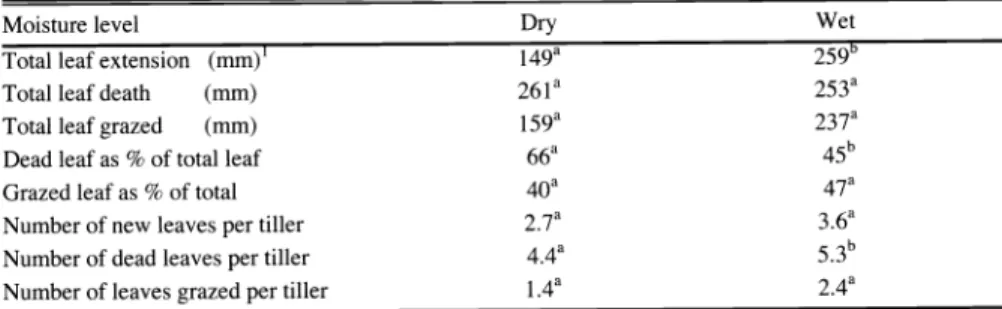
portion of dead leaf (P > 0.10) even though the number of dead leaves per tiller was higher with increasing soil moisture (P < 0.10) (Table 3). However, a greater percentage of total leaf (length) died in the low soil moisture treatment (P < 0.10) so decreasing soil moisture had the effect of increasing the proportion of leaf that died and was not grazed, resulting in a lower harvesting efficiency. The amount of leaf (length) that was grazed increased with increasing soil moisture (P < 0.10), but the percentage of total leaf grazed was similar at different soil moisture levels (P > 0.10).
Increased soil moisture had no effect on the number of new leaves per tiller (P >
0.10) (Table 3).
There were interactions between soil moisture and grazing treatments regarding length of live leaf and dead leaf produced (data not shown). Increasing soil moisture interacted with increasing grazing pressure to increase live leaf production (P < 0.01).
High soil moisture and heavier grazing also interacted to reduce the proportion of dead leaf (P < 0.10) and increase produc- tion of new tillers (P < 0.05).
The low level of response by Old World bluestem to the irrigation treatments is surprising since there was a significantly lower level of soil moisture in the non-irri- gated control compared to the irrigated treatment. It is possible that the close to average precipitation during this study, resulted in insufficient water stress in the lower moisture treatment to cause signifi- cant differences, since a response to differ- ent levels of soil moisture is probably con- tingent upon differences in moisture stress exceeding a certain level (Busso and Richards 1995). However, grass response to irrigation alone may be smaller than other treatments and the greatest increases in plant growth occur when irrigation is combined with other treatments (Risser et al 1981).
JOURNAL OF RANGE MANAGEMENT 55(3) May 263
Table 3. The effect of different levels of irrigation on plant stature and the turnover and fate of leaves on Old World bluestem pastures.
Moisture level Dry Wet
Total leaf extension (mm)' 149a
Total leaf death (mm) 261a
Total leaf grazed (mm) 159a
Dead leaf as % of total leaf 66a 45b
Grazed leaf as % of total 40a 47a
Number of new leaves per tiller 2.7a 3.6'
Number of dead leaves per tiller 4.4' 5.3b
Number of leaves grazed per tiller 1.4a 2.4'
Means within rows with different subscripts are significantly different (P < 010).
In a species such as Old World bluestem, which is adapted to a semi-arid environment (Sims and Dewald 1982), an inherent ability to maintain a low density of tillers may increase survival and fitness.
A feature of Old World bluestem in the field is that there are distinctive tufts sur- rounded by bare ground, resulting in the low tiller densities and LAIs reported here.
There may be adaptive significance to having lower tiller densities and less or slower growth to survive and compete successfully under more stressful and vari- able conditions. Lower densities of peren- nial grasses are believed to be more com- petitive with invading grass species in semi-arid environments (Buman et al.
1988, Pyke and Archer 1991).
Species differ markedly in how they respond above and below ground to differ- ent levels of herbivory (Briske 1993).
Those that have demonstrated the ability to withstand severe herbivory and prosper, generally require a high level of resources, i.e. water and nutrients, to do so (Maschinski and Whitham 1989, Holland et al. 1992, Briske 1991). Nitrogen fertiliz- er levels in this study were moderately low (Taliaferro et al. 1975, Teague et al. 1996) and nitrogen was, therefore, probably moderately limiting. Coyne and Bradford (1986, 1987) report that with Old World bluestem, greater levels of nitrogen increase photosynthetic efficiency per unit leaf area and maintain a higher and more constant growth rate. Nitrogen deficiency also reduced growth and competitive abili- ty in a number of other species by slowing leaf appearance rate and limiting tillering capacity (Wilson and Brown 1983, Thomas et al. 1990, Tallowin and Brookman 1996).
It is possible that low nitrogen may have resulted in low tiller densities and the lack of response to the irrigation treatment in this study.
Conclusions
Maximizing the amount of secondary productivity per hectare involves balanc- ing the efficiency of capturing incoming solar radiation and forage production with forage quality and harvesting efficiency.
Leaf area index and tiller density influence capture of solar radiation and forage pro- duction per hectare, while density of live leaf and the ratios of live to dead, and leaf and stem, influence diet quality and har- vesting efficiency. In the companion, rain fed study where Old World bluestem was maintained at 1,500, 1,900, and 2,400 kg
ha', the shorter pastures had a greater pro- portion of leaf, live stem, percentage of crude protein, and weight gain per hectare (Teague et al. 1996). The results of this study indicate that increasing soil moisture level and grazing intensity interacted to increase the proportion of leaf produced that was harvested (harvest efficiency), reduce the proportion of dead leaf, and increase production of new tillers and win- ter tiller survival. However, increasing soil water level did not increase tiller density during the summer growing period. In addition, increasing soil water level did not increase the leaf to stem and live to dead ratios as hypothesized. This study indicates that if continuously grazed Old World bluestem is maintained at a stand- ing crop of 1,500 kg ha', harvesting effi- ciency is higher in wet years or under irri- gation than if standing crop is higher.
Literature Cited
Barnes, D.L. 1972. Defoliation effects on perennial ryegrass-continuing confusion.
Proc. of the Grassl. Soc. of Southern Africa 7:138-145.
Blackburn, H.D. and M.M. Kothmann.1989.
A forage dynamics model for use in range or pasture environments. Grass and Forage Sci.
44: 283-294.
Bransby, D.I., A.G. Matches, and G.F.
Krause. 1977. Disc meter for rapid estima- tion of herbage yield in grazing trials. Agron.
J. 69:393-396.
Briske, D.D. 1991. Developmental morpholo- gy and physiology of grasses, p. 85-108. In:
R.K. Heitschmidt and J.W. Stuth, (eds.), Grazing management: an ecological perspec- tive. Timber Press, Portland, One.
Briske, D.D. 1993. Grazing optimization: a plea for a balanced perspective. Ecol. Appl.
3:24-26.
Buman, R.D. S.B. Monsen, and R.H.
Abernethy. 1988. Seedling competition between mountain rye, `Hycrest' crested wheatgrass and downy brome. J. Range Manage. 41:30-34.
Busso, C.A. and J.H. Richards. 1995.
Drought and clipping effects on tiller demog- raphy and growth of two tussock grasses in Utah. J. Arid Environ. 29:239-251.
Coughenour, N.B., S.J. McNaughton, and L.L. Wallace.1984. Modelling primary pro- duction of perennial graminoids. Ecol.
Model. 23:101-134.
Coyne, P.I, and J.A. Bradford. 1985. Some growth characteristics of four Old World bluestems. J. Range Manage. 38:27-32.
Coyne, P.I. and J.A. Bradford. 1986. Biomass partitioning in 'Caucasian' and 'WW-Spar' Old World bluestems. J. Range Manage.
39:303-310.
Coyne, P.I. and J.A. Bradford. 1987.
Nitrogen and carbohydrate partitioning in 'Caucasian' and 'WW-Spar' Old World bluestems. J. Range Manage. 40:353-360.
Dabo, S.M., C.M. Taliaferro, S.W. Coleman, F.P. Horn, and P.L. Claypool.1987. Yield and digestibility of Old World bluestem grasses as affected by cultivar, plant part and maturity. J. Range Manage. 40:10-15.
Eck, H.V. and P.L. Sims 1984. Grass species adaptability in the Southern High Plains- 36-year assessment. J. Range Manage.
37:211-217.
Forbes, T.D.A. and S.W. Coleman. 1986.
Herbage intake and ingestive behavior of grazing cattle as influenced by variation in sward characteristics, p. 141-152. In: F.P Horn, (ed.), Grazinglands research at the plant animal interface. Winrock Int., Morrilton, Ark.
Grant, S.A., G.T. Barthram, L. Torvell, J.
King, and K. Smith. 1983. Sward manage- ment, lamina turnover and tiller population density in continuously stocked Lolium perenne dominated swards. Grass and Forage Sci. 38:333-344.
Holland, E.A.W., W.J. Parton, J.K. Detling, and D.L. Coppock. 1992. Physiological responses of plant populations to herbivory and their consequences for ecosystem nutri- ent flow. American Naturalist 142:685-706.
Johnson, I.R. and A.J. Parsons. 1985. Use of a model to analyze the effects of continuous grazing managements on seasonal patterns of grass production. Grass and Forage Sci.
40:449-458.
264 JOURNAL OF RANGE MANAGEMENT 55(3) May 2002
Maschinski, J. and T.G. Whitham. 1989. The continuum of plant responses to herbivory:
the influence of plant association, nutrient availability, and timing. Amer. Natur.
134:1-19.
McNaughton, S.J. 1979. Grazing as an opti- mization process: grass-ungulate relation- ships in the Serengeti. Ameri. Natur.
113:691-703.
Murphy, B. 1990. Pasture Management, p.
231-262. In: C.A. Francis, C.B. Butler and L.D. King, (eds.), Sustainable Agriculture in
Temperate Zones. Wiley-Interscience, New York.
Parsons, A.J., I.R. Johnson, and A. Harvey.
1988. Use of a model to optimize the interac- tion between frequency and severity of inter- mittent defoliation and to provide a funda- mental comparison of the continuous and intermittent defoliation of grass. Grass and Forage Sci. 43:49-59.
Parsons, A.J., E.L. Leafe, B. Collett, and W.
Stiles 1983a. The physiology of grass growth under grazing. I. Characteristics of leaf and canopy photosynthesis of continuously grazed swards. J. Appl. Ecol. 20:117-126.
Parsons, A.J., E.L. Leafe, B. Collett, P.D.
Penning, and J. Lewis. 1983b. The physiol- ogy of grass growth under grazing. II.
Photosynthesis, crop growth and animal intake of continuously grazed swards. J.
Appl. Ecol. 20:127-139.
Pyke D.A. and S. Archer. 1991. Plant-plant interactions affecting plant establishment and persistence on revegetated rangeland. J.
Range Manage. 44:550-557.
Risser, P.G., E.C. Birney, H.D. Blocker, S.W. May, W.J. Parton and J.A. Wiens.
1981. Ecosystem responses to stress, p. 332- 436. In: P.G. Risser, E.C. Birney, H.D.
Blocker, S.W. May, W.J. Parton and J.A.
Wiens, (eds). The True Prairie Ecosystem, US/IBP Synthesis Series 16.
Sims, P.L. and C.L. Dewald. 1982. Old World bluestems and their forage potential for the Southern Great Plains. USDA Agr Res.
Serv., Agr. Revi. and Manuals, ARM-S-28.
SAS Institute. 1988. SAS/STAT User's Guide.
SAS Institute Inc., Cary, N.C.
Steel, R.G.D. and Torrie, J.H. 1960.
Principles and procedures of statistics, McGraw-Hill, New York.
Taliaferro, C.M., F.P. Horn, B.B. Tucker, R.
Totusek, and R.D. Morrison. 1975.
Performance of three warm-season perennial grasses and a native range mixture as influ- enced by N and P fertilization. Agron. J.
67:289-292.
Tallowin, J.R.B. and S.K.E. Brookman.
1996. The impact of differences in nitrogen content, nitrogen utilization and loss from laminae on competition between four grasses in an old pasture. J. Agr. Sci. 126:25-35.
Teague, W.R., S.L. Dowhower, W.E.
Pinchak, D.R. Tolleson and L.J. Hunt.
1996. Increasing utilization efficiency of continuously grazed Old World bluestem pasture. J. Range Manage. 49:535-540.
Thomas, R.J., K.A.B Logan, A.D. Ironside, and G.R. Bolton. 1990. The effects of graz- ing with and without excretal returns on the accumulation of nitrogen by ryegrass in a continuously grazed upland sward. Grass and Forage Sci. 45:65-75.
USDA. 1997. USDA-NRCS Official Soil Series Description 6/97. Available online at -
http://www.statlab.iastate.edu/cgi-
bin/osd/osdname.cgi.
Wilson, J.R. and R.H. Brown. 1983. Nitrogen response of Panicuni species differing in CO2 fixation pathways. 1. Growth analysis and carbohydrate accumulation. Crop Sci.
23:1148-1153.
granite
SEED
Your one-stop supplier for:
Pasture and range grasses Alfalfa, shrubs, & wildflowers Custom seed blends
Erosion control materials Environmental consulting
services
Ask for our catalog featuring over 600 native species and named varieties.
or fax r our Catalog (801) 768-4422, fax (801) 768-3967
Grart to Seed Co., 1697 W. 2100 North, Lehi, UT 84043 www.graniteseed.com
JOURNAL OF RANGE MANAGEMENT 55(3) May 265