Proceedings of the 55th Annual Meeting of the Association for Computational Linguistics (Short Papers), pages 7–13 Vancouver, Canada, July 30 - August 4, 2017. c2017 Association for Computational Linguistics
Proceedings of the 55th Annual Meeting of the Association for Computational Linguistics (Short Papers), pages 7–13 Vancouver, Canada, July 30 - August 4, 2017. c2017 Association for Computational Linguistics
AMR-to-text Generation with Synchronous Node Replacement Grammar
Linfeng Song, Xiaochang Peng, Yue Zhang, Zhiguo Wang and Daniel Gildea
Department of Computer Science, University of Rochester, Rochester, NY 14627 IBM T.J. Watson Research Center, Yorktown Heights, NY 10598
Singapore University of Technology and Design
Abstract
This paper addresses the task of AMR-to-text generation by leveraging synchronous node replacement grammar. During train-ing, graph-to-string rules are learned us-ing a heuristic extraction algorithm. At test time, a graph transducer is applied to collapse input AMRs and generate output sentences. Evaluated on a standard bench-mark, our method gives the state-of-the-art result.
1 Introduction
Abstract Meaning Representation (AMR) ( Ba-narescu et al., 2013) is a semantic formalism en-coding the meaning of a sentence as a rooted, directed graph. AMR uses a graph to represent meaning, where nodes (such as “boy”, “want-01”) represent concepts, and edges (such as “ARG0”, “ARG1”) represent relations between concepts. Encoding many semantic phenomena into a graph structure, AMR is useful for NLP tasks such as machine translation (Jones et al.,2012;Tamchyna et al.,2015), question answering (Mitra and Baral,
2015), summarization (Takase et al., 2016) and event detection (Li et al.,2015).
AMR-to-text generation is challenging as func-tion words and syntactic structures are abstracted away, making an AMR graph correspond to mul-tiple realizations. Despite much literature so far on text-to-AMR parsing (Flanigan et al., 2014;
Wang et al.,2015;Peng et al.,2015;Vanderwende et al.,2015; Pust et al., 2015;Artzi et al., 2015;
Groschwitz et al., 2015; Goodman et al., 2016;
Zhou et al.,2016;Peng et al.,2017), there has been little work on AMR-to-text generation (Flanigan et al.,2016;Song et al.,2016;Pourdamghani et al.,
2016).
#X1#
the boy wants to go #X1#
ARG1 go-01 boy
want-01 ARG0
ARG0 ARG1
#X2# #X3#
go-01 #X2#
ARG0 #X3#
ARG1 go-01 want-01 ARG0
[image:1.595.314.523.221.355.2]ARG0
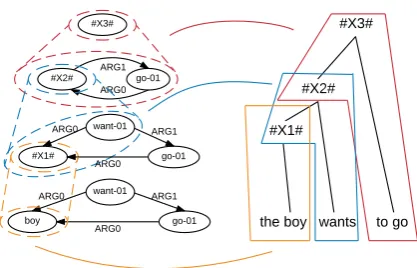
Figure 1: Graph-to-string derivation.
Flanigan et al. (2016) transform a given AMR graph into a spanning tree, before translating it to a sentence using a tree-to-string transducer. Their method leverages existing machine transla-tion techniques, capturing hierarchical correspon-dences between the spanning tree and the surface string. However, it suffers from error propagation since the output is constrained given a spanning tree due to the projective correspondence between them. Information loss in the graph-to-tree trans-formation step cannot be recovered. Song et al.
(2016) directly generate sentences using graph-fragment-to-string rules. They cast the task of finding a sequence of disjoint rules to transduce an AMR graph into a sentence as a traveling sales-man problem, using local features and a language model to rank candidate sentences. However, their method does not learn hierarchical structural cor-respondences between AMR graphs and strings.
We propose to leverage the advantages of hier-archical rules without suffering from graph-to-tree errors by directly learning graph-to-string rules. As shown in Figure 1, we learn a synchronous node replacement grammar (NRG) from a cor-pus of aligned AMR and sentence pairs. At test time, we apply a graph transducer to collapse input
go-01
boy want-01
ARG1
ARG0
ARG0 go-01
#X2# ARG1
ARG0 (root)
go-01
#X3# want-01
ARG1
ARG0
ARG0
#S# #X1#
{#S#} {#X1#} {#X2# to go} {#X3# wants to go} {the boy wants to go} (a)
AMR:
String:
[image:2.595.94.503.66.135.2](b) (c)
Figure 2: Example deduction procedure
ID. F E
(a) (b / boy) the boy (b) (w / want-01:ARG0 (X / #X#)) #X# wants
(c) (X / #X#:ARG1 (g / go-01 #X# to go :ARG0 X))
[image:2.595.92.271.176.273.2](d) (w / want-01:ARG0 (b / boy)) the boy wants
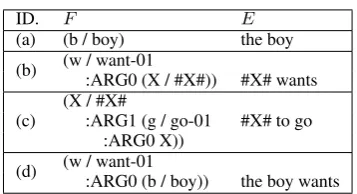
Table 1: Example rule set
AMR graphs and generate output strings accord-ing to the learned grammar. Our system makes use of a log-linear model with real-valued fea-tures, tuned using MERT (Och,2003), and beam search decoding. It gives a BLEU score of 25.62 on LDC2015E86, which is the state-of-the-art on this dataset.
2 Synchronous Node Replacement Grammar
2.1 Grammar Definition
A synchronous node replacement grammar (NRG) is a rewriting formalism: G = hN,Σ,∆, P, Si, whereN is a finite set of nonterminals,Σand∆ are finite sets of terminal symbols for the source and target sides, respectively. S ∈ N is the start
symbol, andP is a finite set of productions. Each
instance ofP takes the form Xi → (hF, Ei,∼),
where Xi ∈ N is a nonterminal node, F is a
rooted, connected AMR fragment with edge labels overΣand node labels overN∪Σ,Eis a
corre-sponding target string overN∪∆and∼denotes the alignment of nonterminal symbols betweenF
andE. A classic NRG (Engelfriet and Rozenberg,
1997, Chapter 1) also definesC, which is an
em-bedding mechanism defining howF is connected
to the rest of the graph when replacing Xi with
F on the graph. Here we omit defining C and allow arbitrary connections.1 Following Chiang 1This may over generate, but does not affect our case, as
in our bottom-up decoding procedure (section3) whenFis replaced withXi, nodes previously connected toF are
re-connected toXi
Data:training corpusC
Result:rule instancesR 1 R←[];
2 for(Sent, AM R,∼)inCdo
3 Rcur←FRAGMENTEXTRACT(Sent,AM R,∼); 4 forriinRcurdo
5 R.APPEND(ri) ; 6 forrjinRcur/{ri}do 7 ifri.CONTAINS(rj)then 8 rij←ri.COLLAPSE(rj); 9 R.APPEND(rij) ;
10 end
11 end
12 end
13 end
Algorithm 1:Rule extraction
(2005), we use only one nonterminal X in
addi-tion toS, and use subscripts to distinguish
differ-ent non-terminal instances.
Figure 2 shows an example derivation process for the sentence “the boy wants to go” given the rule set in Table 1. Given the start symbol S,
which is first replaced withX1, rule (c) is applied
to generate “X2 to go” and its AMR counterpart.
Then rule (b) is used to generate “X3 wants” and
its AMR counterpart from X2. Finally, rule (a)
is used to generate “the boy” and its AMR coun-terpart from X3. Our graph-to-string rules are
inspired by synchronous grammars for machine translation (Wu,1997;Yamada and Knight,2002;
Gildea,2003; Chiang, 2005;Huang et al., 2006;
Liu et al.,2006;Shen et al.,2008;Xie et al.,2011;
Meng et al.,2013). 2.2 Induced Rules
There are three types of rules in our system, namely induced rules, concept rules and graph glue rules. Here we first introduce induced rules, which are obtained by a two-step procedure on a training corpus. Shown in Algorithm 1, the first step is to extract a set of initial rules from train-inghsentence, AMR,∼i2pairs (Line 2) using the phrase-to-graph-fragment extraction algorithm of
Peng et al. (2015) (Line 3). Here an initial rule 2
[image:2.595.309.512.181.333.2]contains only terminal symbols in bothF andE. As a next step, we match between pairs of initial rulesri andrj, and generaterij by collapsingri
withrj, ifricontainsrj (Line 6-8). Hereri
con-tains rj, ifrj.F is a subgraph ofri.F and rj.E
is a sub-phrase ofri.E. When collapsingri with
rj, we replace the corresponding subgraph inri.F
with a new non-terminal node, and the sub-phrase inri.Ewith the same non-terminal. For example,
we obtain rule (b) by collapsing (d) with (a) in Ta-ble1. All initial and generated rules are stored in a rule listR(Lines 5 and 9), which will be further
normalized to obtain the final induced rule set.
2.3 Concept Rules and Glue Rules
In addition to induced rules, we adopt concept rules (Song et al.,2016) and graph glue rules to en-sure existence of derivations. For a concept rule,F
is a single node in the input AMR graph, andEis a
morphological string of the node concept. A con-cept rule is used in case no induced rule can cover the node. We refer to the verbalization list3 and AMR guidelines4for creating more complex con-cept rules. For example, one concon-cept rule created from the verbalization list is “(k / keep-01 :ARG1 (p / peace))|||peacekeeping”.
Inspired by Chiang (2005), we define graph glue rules to concatenate non-terminal nodes con-nected with an edge, when no induced rules can be applied. Three glue rules are defined for each type of edge label. Taking the edge label “ARG0” as an example, we create the following glue rules:
ID. F E
r1 (X1 / #X1# :ARG0 (X2 / #X2#)) #X1# #X2#
r2 (X1 / #X1# :ARG0 (X2 / #X2#)) #X2# #X1#
r3 (X1 / #X1# :ARG0 X1) #X1#
where for both r1 and r2, F contains two
non-terminal nodes with a directed edge connecting them, and E is the concatenation the two
non-terminals in either the monotonic or the inverse order. Forr3, F contains one non-terminal node
with a self-pointing edge, and E is the
non-terminal. With concept rules and glue rules in our final rule set, it is easily guaranteed that there are legal derivations for any input AMR graph.
3 Model
We adopt a log-linear model for scoring search hy-potheses. Given an input AMR graph, we find
3
http://amr.isi.edu/download/lists/verbalization-list-v1.06.txt
4https://github.com/amrisi/amr-guidelines
the highest scored derivation t∗ from all possible derivationst:
t∗= argmax
t exp
X
i
wifi(g, t), (1)
where g denotes the input AMR, fi(·,·) and wi
represent a feature and the corresponding weight, respectively. The feature set that we adopt in-cludes phrase-to-graph and graph-to-phrase trans-lation probabilities and their corresponding lexi-calized translation probabilities (section3.1), lan-guage model score, word count, rule count, re-ordering model score (section 3.2) and moving distance (section3.3). The language model score, word count and phrase count features are adopted from SMT (Koehn et al.,2003;Chiang,2005).
We perform bottom-up search to transduce in-put AMRs to surface strings. Each hypothesis con-tains the current AMR graph, translations of col-lapsed subgraphs, the feature vector and the cur-rent model score. Beam search is adopted, where hypotheses with the same number of collapsed edges and nodes are put into the same beam.
3.1 Translation Probabilities
Production rules serve as a basis for scoring hy-potheses. We associate each synchronous NRG rule n → (hF, Ei,∼)with a set of probabilities. First, phrase-to-fragment translation probabilities are defined based on maximum likelihood estima-tion (MLE), as shown in Equaestima-tion2, wherechF,Ei
is the fractional count ofhF, Ei.
p(F|E) = PchF,Ei
F0chF0,Ei (2)
In addition, lexicalized translation probabilities are defined as:
pw(F|E) =
Y
l∈F
X
w∈E
p(l|w) (3)
Herelis a label (including both edge labels such
as “ARG0” and concept labels such as “want-01”) in the AMR fragment F, and w is a word in
the phrase E. Equation 3 can be regarded as a
“soft” version of the lexicalized translation prob-abilities adopted by SMT, which picks the align-ment yielding the maximum lexicalized probabil-ity for each translation rule. In addition top(F|E) andpw(F|E), we use features in the reverse
direc-tion, namelyp(E|F)andpw(E|F), the definitions
Equations2and3, respectively. The probabilities associated with concept rules and glue rules are manually set to 0.0001.
3.2 Reordering Model
Although the word order is defined for induced rules, it is not the case for glue rules. We learn a reordering model that helps to decide whether the translations of the nodes should be monotonic or inverse given the directed connecting edge label. The probabilistic model using smoothed counts is defined as:
p(M|h, l, t) =
1.0 +PhPtc(h, l, t, M)
2.0 +Po∈{M,I}PhPtc(h, l, t, o) (4)
c(h, l, t, M)is the count of monotonic translations
of headhand tailt, connected by edgel.
3.3 Moving Distance
The moving distance feature captures the dis-tances between the subgraph roots of two consec-utive rule matches in the decoding process, which controls a bias towards collapsing nearby sub-graphs consecutively.
4 Experiments
4.1 Setup
We use LDC2015E86 as our experimental dataset, which contains 16833 training, 1368 dev and 1371 test instances. Each instance contains a sentence, an AMR graph and the alignment generated by a heuristic aligner. Rules are extracted from the training data, and model parameters are tuned on the dev set. For tuning and testing, we filter out sentences with more than 30 words, resulting in 1103 dev instances and 1055 test instances. We train a 4-gram language model (LM) on gigaword (LDC2011T07), and use BLEU (Papineni et al.,
2002) as the evaluation metric. MERT is used (Och, 2003) to tune model parameters on k-best
outputs on the devset, wherekis set 50.
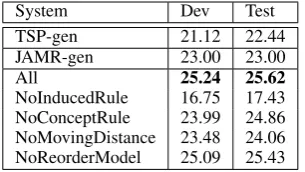
We investigate the effectiveness of rules and features by ablation tests: “NoInducedRule” does not adopt induced rules, “NoConceptRule” does not adopt concept rules, “NoMovingDistance” does not adopt the moving distance feature, and “NoReorderModel” disables the reordering model. Given an AMR graph, if NoConceptRule cannot produce a legal derivation, we concatenate
System Dev Test
TSP-gen 21.12 22.44
JAMR-gen 23.00 23.00
All 25.24 25.62
[image:4.595.341.494.62.148.2]NoInducedRule 16.75 17.43 NoConceptRule 23.99 24.86 NoMovingDistance 23.48 24.06 NoReorderModel 25.09 25.43
Table 2: Main results.
existing translation fragments into a final transla-tion, and if a subgraph can not be translated, the empty string is used as the output. We also com-pare our method with previous works, in particu-lar JAMR-gen (Flanigan et al.,2016) and TSP-gen (Song et al.,2016), on the same dataset.
4.2 Main results
The results are shown in Table 2. First, All out-performs all baselines. NoInducedRule leads to the greatest performance drop compared withAll, demonstrating that induced rules play a very im-portant role in our system. On the other hand, No-ConceptRuledoes not lead to much performance drop. This observation is consistent with the ob-servation ofSong et al.(2016) for their TSP-based system. NoMovingDistanceleads to a significant performance drop, empirically verifying the fact that the translations of nearby subgraphs are also close. Finally, NoReorderingModel does not af-fect the performance significantly, which can be because the most important reordering patterns are already covered by the hierarchical induced rules. Compared with TSP-gen and JAMR-gen, our fi-nal model All improves the BLEU from 22.44 and 23.00 to 25.62, showing the advantage of our model. To our knowledge, this is the best result reported so far on the task.
4.3 Grammar analysis
We have shown the effectiveness of our syn-chronous node replacement grammar (SNRG) on the AMR-to-text generation task. Here we further analyze our grammar as it is relatively less studied than the hyperedge replacement grammar (HRG) (Drewes et al.,1997).
Statistics on the whole rule set
We first categorize our rule set by the number of terminals and nonterminals in the AMR fragment
F, and show the percentages of each type in
0 1 2 3 4 >4 Number of terminals
0
1
Number of non-terminals
[image:5.595.305.528.57.346.2]0.00 0.03 0.06 0.09 0.12 0.15 0.18 0.21 0.24
Figure 3: Statistics on the right-hand side.
Glue Nonterminal Terminal 1-best 30.0% 30.1% 39.9%
Table 3: Rules used for decoding.
of all, the percentage of rules containing minals are much more than those without nonter-minals, as we collapse each pair of initial rules (in Algorithm1) and the results can be quadratic the number of initial rules. In addition, most rules are small containing 1 to 3 terminals, meaning that they represent small pieces of meaning and are easier to matched on a new AMR graph. Finally, there are a few large rules, which represent com-plex meaning.
Statistics on the rules used for decoding
In addition, we collect the rules that our well-tuned system used for generating the 1-best output on the testset, and categorize them into 3 types: (1) glue rules, (2) nonterminal rules, which are not glue rules but contain nonterminals on the right-hand side and (3) terminal rules, whose right-right-hand side only contain terminals. Over the rules used on the 1-best result, more than 30% are non-terminal rules, showing that the induced rules play an im-portant role. On the other hand, 30% are glue rules. The reason is that the data sparsity for graph grammars is more severe than string-based gram-mars (such as CFG), as the graph structures are more complex than strings. Finally, terminal rules take the largest percentage, while most areinduced rules, but notconcept rules.
Rule examples
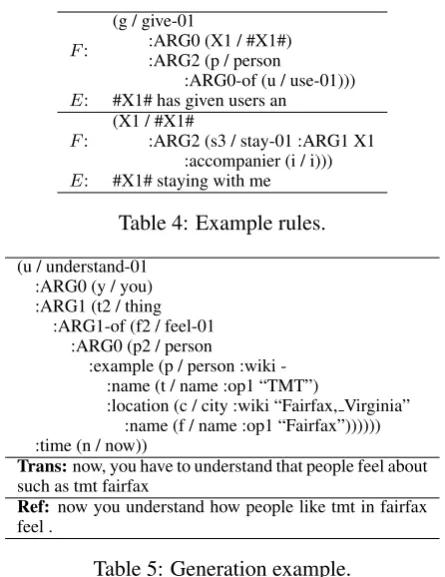
Finally, we show some rules in Table4, where F
andEare the right-hand-side AMR fragment and
phrase, respectively. For the first rule, the root of
F is a verb (“give-01”) whose subject is a
nonter-minal and object is a AMR fragment “(p / person :ARG0-of (u / use-01))”, which means “user”. So it is easy to see that the corresponding phraseE
conveys the same meaning. For the second rule, “(s3 / stay-01 :accompanier (i / i))” means “stay
F:
(g / give-01
:ARG0 (X1 / #X1#) :ARG2 (p / person
:ARG0-of (u / use-01)))
E: #X1# has given users an
F: (X1 / #X1#:ARG2 (s3 / stay-01 :ARG1 X1 :accompanier (i / i)))
E: #X1# staying with me Table 4: Example rules.
(u / understand-01 :ARG0 (y / you) :ARG1 (t2 / thing
:ARG1-of (f2 / feel-01 :ARG0 (p2 / person
:example (p / person :wiki -:name (t / name :op1 “TMT”)
:location (c / city :wiki “Fairfax, Virginia” :name (f / name :op1 “Fairfax”)))))) :time (n / now))
Trans:now, you have to understand that people feel about such as tmt fairfax
Ref: now you understand how people like tmt in fairfax feel .
Table 5: Generation example.
with me”, which is also covered by its phrase.
4.4 Generation example
Finally, we show an example in Table5, where the top is the input AMR graph, and the bottom is the generation result. Generally, most of the meaning of the input AMR are correctly translated, such as “:example”, which means “such as”, and “thing”, which is an abstract concept and should not be translated, while there are a few errors, such as “that” in the result should be “what”, and there should be an “in” between “tmt” and “fairfax”.
5 Conclusion
We showed that synchronous node replacement grammar is useful for AMR-to-text generation by developing a system that learns a synchronous NRG in the training time, and applies a graph transducer to collapse input AMR graphs and gen-erate output strings according to the learned gram-mar at test time. Our method performs better than the previous systems, empirically proving the ad-vantages of our graph-to-string rules.
Acknowledgement
This work was funded by a Google Faculty
Research Award. Yue Zhang is funded by
[image:5.595.100.263.64.146.2]References
Yoav Artzi, Kenton Lee, and Luke Zettlemoyer. 2015. Broad-coverage CCG semantic parsing with AMR. In Conference on Empirical Methods in Natural Language Processing (EMNLP-15). pages 1699– 1710.
Laura Banarescu, Claire Bonial, Shu Cai, Madalina Georgescu, Kira Griffitt, Ulf Hermjakob, Kevin Knight, Philipp Koehn, Martha Palmer, and Nathan Schneider. 2013. Abstract meaning representation
for sembanking. InProceedings of the 7th
Linguis-tic Annotation Workshop and Interoperability with Discourse. pages 178–186.
David Chiang. 2005. A hierarchical phrase-based
model for statistical machine translation. In
Pro-ceedings of the 43rd Annual Meeting of the Associ-ation for ComputAssoci-ational Linguistics (ACL-05). Ann Arbor, Michigan, pages 263–270.
Frank Drewes, Hans-J¨org Kreowski, and Annegret Ha-bel. 1997. Hyperedge replacement, graph
gram-mars. Handbook of Graph Grammars1:95–162.
J. Engelfriet and G. Rozenberg. 1997. Node replace-ment graph grammars. In Grzegorz Rozenberg, edi-tor,Handbook of Graph Grammars and Computing by Graph Transformation, World Scientific Publish-ing Co., Inc., River Edge, NJ, USA, pages 1–94.
Jeffrey Flanigan, Chris Dyer, Noah A. Smith, and Jaime Carbonell. 2016. Generation from abstract meaning representation using tree transducers. In
Proceedings of the 2016 Meeting of the North Amer-ican chapter of the Association for Computational Linguistics (NAACL-16). pages 731–739.
Jeffrey Flanigan, Sam Thomson, Jaime Carbonell, Chris Dyer, and Noah A. Smith. 2014. A discrim-inative graph-based parser for the abstract meaning
representation. InProceedings of the 52nd Annual
Meeting of the Association for Computational Lin-guistics (ACL-14). pages 1426–1436.
Daniel Gildea. 2003. Loosely tree-based alignment
for machine translation. InProceedings of the 41th
Annual Conference of the Association for Computa-tional Linguistics (ACL-03). Sapporo, Japan, pages 80–87.
James Goodman, Andreas Vlachos, and Jason Narad-owsky. 2016. Noise reduction and targeted explo-ration in imitation learning for abstract meaning
rep-resentation parsing. InProceedings of the 54th
An-nual Meeting of the Association for Computational Linguistics (ACL-16). Berlin, Germany, pages 1–11.
Jonas Groschwitz, Alexander Koller, and Christoph Te-ichmann. 2015. Graph parsing with s-graph
gram-mars. In Proceedings of the 53rd Annual
Meet-ing of the Association for Computational LMeet-inguistics (ACL-15). Beijing, China, pages 1481–1490.
Liang Huang, Kevin Knight, and Aravind Joshi. 2006. Statistical syntax-directed translation with extended
domain of locality. In Proceedings of Association
for Machine Translation in the Americas (AMTA-2006). pages 66–73.
Bevan Jones, Jacob Andreas, Daniel Bauer,
Karl Moritz Hermann, and Kevin Knight. 2012. Semantics-based machine translation with
hyper-edge replacement grammars. In Proceedings of
the International Conference on Computational Linguistics (COLING-12). pages 1359–1376.
Philipp Koehn, Franz Josef Och, and Daniel Marcu.
2003. Statistical phrase-based translation. In
Pro-ceedings of the 2003 Meeting of the North American chapter of the Association for Computational Lin-guistics (NAACL-03). pages 48–54.
Xiang Li, Thien Huu Nguyen, Kai Cao, and Ralph Gr-ishman. 2015. Improving event detection with
ab-stract meaning representation. InProceedings of the
First Workshop on Computing News Storylines. Bei-jing, China, pages 11–15.
Yang Liu, Qun Liu, and Shouxun Lin. 2006. Tree-to-string alignment template for statistical machine
translation. InProceedings of the 44th Annual
Meet-ing of the Association for Computational LMeet-inguistics (ACL-06). Sydney, Australia, pages 609–616. Fandong Meng, Jun Xie, Linfeng Song, Yajuan L¨u,
and Qun Liu. 2013. Translation with source
con-stituency and dependency trees. In Conference on
Empirical Methods in Natural Language Process-ing (EMNLP-13). Seattle, Washington, USA, pages 1066–1076.
Arindam Mitra and Chitta Baral. 2015. Addressing a question answering challenge by combining statisti-cal methods with inductive rule learning and
reason-ing. InProceedings of the National Conference on
Artificial Intelligence (AAAI-16).
Franz Josef Och. 2003. Minimum error rate
train-ing in statistical machine translation. In
Proceed-ings of the 41st Annual Meeting of the Association for Computational Linguistics (ACL-03). Sapporo, Japan, pages 160–167.
Kishore Papineni, Salim Roukos, Todd Ward, and Wei-Jing Zhu. 2002. BLEU: a method for automatic
evaluation of machine translation. InProceedings of
the 40th Annual Meeting of the Association for Com-putational Linguistics (ACL-02). pages 311–318. Xiaochang Peng, Linfeng Song, and Daniel Gildea.
2015. A synchronous hyperedge replacement
gram-mar based approach for AMR parsing. In
Pro-ceedings of the Nineteenth Conference on Compu-tational Natural Language Learning (CoNLL-15). pages 731–739.
Xiaochang Peng, Chuan Wang, Daniel Gildea, and Ni-anwen Xue. 2017. Addressing the data sparsity
15th Conference of the European Chapter of the As-sociation for Computational Linguistics (EACL-17). Valencia, Spain, pages 366–375.
Nima Pourdamghani, Kevin Knight, and Ulf
Herm-jakob. 2016. Generating English from abstract
meaning representations. In International
Confer-ence on Natural Language Generation (INLG-16). Edinburgh, UK, pages 21–25.
Michael Pust, Ulf Hermjakob, Kevin Knight, Daniel Marcu, and Jonathan May. 2015. Parsing English into abstract meaning representation using
syntax-based machine translation. In Conference on
Em-pirical Methods in Natural Language Processing (EMNLP-15). pages 1143–1154.
Libin Shen, Jinxi Xu, and Ralph Weischedel. 2008. A new string-to-dependency machine translation algo-rithm with a target dependency language model. In
Proceedings of the 46th Annual Meeting of the As-sociation for Computational Linguistics (ACL-08). Columbus, Ohio, pages 577–585.
Linfeng Song, Yue Zhang, Xiaochang Peng, Zhiguo Wang, and Daniel Gildea. 2016. AMR-to-text
gen-eration as a traveling salesman problem. In
Con-ference on Empirical Methods in Natural Language Processing (EMNLP-16). Austin, Texas, pages 2084–2089.
Sho Takase, Jun Suzuki, Naoaki Okazaki, Tsutomu Hirao, and Masaaki Nagata. 2016. Neural head-line generation on abstract meaning representation. In Conference on Empirical Methods in Natural Language Processing (EMNLP-16). Austin, Texas, pages 1054–1059.
Aleˇs Tamchyna, Chris Quirk, and Michel Galley.
2015. A discriminative model for
semantics-to-string translation. In Proceedings of the 1st
Workshop on Semantics-Driven Statistical Machine Translation (S2MT 2015). Beijing, China, pages 30– 36.
Lucy Vanderwende, Arul Menezes, and Chris Quirk. 2015. An AMR parser for English, French, German, Spanish and Japanese and a new AMR-annotated
corpus. InProceedings of the 2015 Meeting of the
North American chapter of the Association for Com-putational Linguistics (NAACL-15). pages 26–30. Chuan Wang, Nianwen Xue, and Sameer Pradhan.
2015. A transition-based algorithm for AMR
pars-ing. In Proceedings of the 2015 Meeting of the
North American chapter of the Association for Com-putational Linguistics (NAACL-15). pages 366–375. Dekai Wu. 1997. Stochastic inversion transduction grammars and bilingual parsing of parallel corpora.
Computational linguistics23(3):377–403.
Jun Xie, Haitao Mi, and Qun Liu. 2011. A novel dependency-to-string model for statistical machine
translation. InConference on Empirical Methods in
Natural Language Processing (EMNLP-11). Edin-burgh, Scotland, UK., pages 216–226.
Kenji Yamada and Kevin Knight. 2002. A decoder for
syntax-based statistical MT. InProceedings of the
40th Annual Meeting of the Association for Compu-tational Linguistics (ACL-02). Philadelphia, Penn-sylvania, USA, pages 303–310.
Junsheng Zhou, Feiyu Xu, Hans Uszkoreit, Weiguang QU, Ran Li, and Yanhui Gu. 2016. AMR parsing
with an incremental joint model. InConference on