Proceedings of the 57th Annual Meeting of the Association for Computational Linguistics, pages 4454–4464 4454
Zero-Shot Semantic Parsing for Instructions
Ofer Givoli1 and Roi Reichart2 1 Faculty of Computer Science, Technion, IIT
2Faculty of Industrial Engineering and Management, Technion, IIT
[email protected], [email protected]
Abstract
We consider a zero-shot semantic parsing task: parsing instructions into compositional logical forms, in domains that were not seen during training. We present a new dataset with 1,390 examples from 7 application domains (e.g. a calendar or a file manager), each example con-sisting of a triplet: (a) the application’s initial state, (b) an instruction, to be carried out in the context of that state, and (c) the state of the application after carrying out the instruc-tion. We introduce a new training algorithm that aims to train a semantic parser on exam-ples from a set of source domains, so that it can effectively parse instructions from an un-known target domain. We integrate our algo-rithm into the floating parser ofPasupat and Liang(2015), and further augment the parser with features and a logical form candidate fil-tering logic, to support zero-shot adaptation. Our experiments with various zero-shot adap-tation setups demonstrate substantial perfor-mance gains over a non-adapted parser.1
1 Introduction
The idea of interacting with machines via natural language instructions and queries has fascinated
researchers for decades (Winograd,1971). Recent
years have seen an increasing number of applica-tions that have a natural language interface, either in the form of chatbots or via “intelligent personal assistants” such as Alexa (Amazon), Google As-sistant, Siri (Apple), and Cortana (Microsoft).
In the near future, we may find ourselves in a world where even more functionality could be accessed via a natural language user interface (NLUI). If so, we better seek answers to the fol-lowing questions: Will every developing team need to hire NLP experts to develop a NLUI for
1Our code and data are available at:
https://github.com/givoli/TechnionNLI.
their specific application? Can we hope for a gen-eral framework that once trained on annotated data from a set of domains, does not require annotated data from a newly presented domain? Previous work on tasks related to NLUI for applications
mostly relied on in-domain data (e.g. Artzi and
Zettlemoyer(2013); Long et al. (2016)), and pa-pers that did not rely on in-domain data did not at-tempt to parse instructions into compositional
log-ical forms (Kim et al.,2016).
To fill this gap, we address the task of
zero-shot semantic parsing for instructions: training a parser so that it can parse instructions into compo-sitional logical forms, where the instructions are from domains that were not seen during training.
Formally, our task assumes a setD={d1, ..., dn}
of source domains, each corresponding to a sim-ple application (e.g. a calendar or a file manager) and an application program interface (API)
con-sisting of a set of interface methods. Each
inter-face method is augmented with a list of
descrip-tion phrases that are expected to be used by the users of the application to ask for the invocation of that method. These instructions are to be parsed into logical forms that denote a method call with specific arguments.
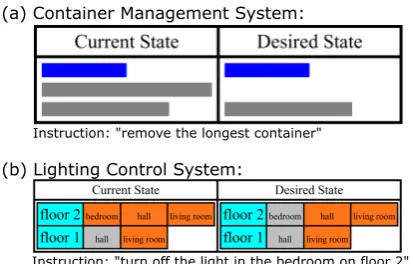
We collected a new dataset of 1,390 examples from 7 domains. Each example in the dataset is a triplet consisting of (a) the application’s initial state, (b) an instruction, to be carried out in con-text of that state, and (c) the state of the application after carrying out the instruction, also referred to
as the desired state. The instructions were
pro-vided by MTurk workers, one for each pair of
ini-tial and desired states. Figure1demonstrates
algo-Figure 1: Two examples from our dataset. Annotators are presented with a visualization of initial and desired states, and are asked to write an instruction that will transfer the system from the former state to the latter.
(a)Shipping containers can be either empty (gray) or full (blue), and have varying length. (b) Rooms can have their lights on (orange) or off (gray).
rithm is motivated by the goal of optimizing the weights for unseen domains rather than for the source domains, and is integrated into the
float-ing parser (Pasupat and Liang,2015): a parser that
was designed for question answering, but is easy
to adjust to instruction execution (see§4.1).
To further assist the parser in dealing with the zero-shot setup, we extract additional features, mostly based on co-occurrence of primitive log-ical forms and the description phrases that are provided for the interface methods. We also use the application logic to dismiss candidate logical forms that represent a method call which does not modify the application state or results in an excep-tion being thrown from the applicaexcep-tion logic.
Our training algorithm yields an averaged accu-racy of 44.5%, compared to 39.1% of the parser when trained with its original AdaGrad training
algorithm (Duchi et al., 2011), but with our
fea-tures and filtering logic. Further exclusion of our features and filtering logic decreases accuracy to 28.3%. We demonstrate that, relative to the base-line, our training algorithm yields smaller weights to some features in a way that can be expected to benefit previously unseen domains.
2 Previous Work
Previous work on executable semantic parsing can be classified as either work on question
answer-ing (e.g. Clarke et al.(2010);Pasupat and Liang
(2015); Krishnamurthy et al. (2017)) or
instruc-tion parsing (e.g. Artzi and Zettlemoyer(2013);
Long et al.(2016)). The result of executing a
log-ical form is either an answer or a change in some state, respectively. Our work is the first to address the novel semantic parsing task of mapping natu-ral language instructions into compositional logi-cal forms in zero-shot settings.
While in our task each example contains a single sentence instruction, there are works on semantic parsing for instruction sequences (MacMahon et al., 2006; Long et al., 2016), but not in a zero-shot setup. We keep zero-shot pars-ing of instruction sequences for future research.
A lot of work has been done on slot tagging
and goal-oriented dialog (Kim et al.,2016;Gaˇsi´c
et al.,2017;Zhao and Eskenazi,2018) which, sim-ilarly to our work, involves automatically enabling an NLUI to a given system. Unlike in our task, the tasks that are investigated in those papers do not require the mapping of natural language to a meaning representation over a space of composi-tional logical forms. Other tasks related to ours
include program synthesis (Raza et al.,2015;
De-sai et al.,2016) and mapping natural language to
bash code (Lin et al.,2018), but these also did not
consider zero-shot setups and did not synthesize code in the context of an application state.
Semantic Parsing with In-domain Data
Among the semantic parsing work that relied on in-domain data, many relied on a domain-specific
lexicon (Kwiatkowski et al., 2010; Gerber and
Ngomo,2011;Krishnamurthy and Mitchell,2012;
Zettlemoyer and Collins, 2005; Cai and Yates,
2013) which maps natural language phrases to
primitive logical forms. Many of these works au-tomatically constructed a domain-specific lexicon using some additional domain-specific resources that are associated with the entities and relations of the given domain. Such a resource can be either
a very large corpus (Gerber and Ngomo, 2011;
Krishnamurthy and Mitchell,2012), search results
from the Web (Cai and Yates,2013) or pairs of a
sentence and an associated logical form (
Zettle-moyer and Collins, 2005; Kwiatkowski et al.,
2010). In our task none of the above resources
is assumed to be available but instead we use the description phrases of the interface methods.
Cross-domain and Zero-shot Semantic Parsing
Previous semantic parsers use supervised
train-ing, either with (Zettlemoyer and Collins, 2005;
Kwiatkowski et al.,2010) or without (Clarke et al.,
[image:2.595.78.285.60.192.2]annota-tion, in addition to unsupervised training ( Gold-wasser et al., 2011). We take the supervised ap-proach with no logical form annotations.
While most semantic parsing work trains on
in-domain data, there are some exceptions. Cai and
Yates (2013) and Kwiatkowski et al. (2013) in-troduced semantic parsers for question answering
that can parse utterances from Free917 (Cai and
Yates,2013) such that no Freebase entities or re-lations appear in both training and test examples. We also note the relevance of the dataset presented inPasupat and Liang(2015) which contains ques-tions about Wikipedia tables, such that the con-text of each question is a single table. They eval-uate a parser on questions about tables that have not been observed during training. Their work does not fully constitute zero-shot semantic pars-ing due to table columns across the train/test split that share column headers (which correspond to primitive logical forms that represent relations). Our parser is based on the floating parser intro-duced in that paper, and the space of logical forms
we use is very similar to theirs (see§4.1).
Recently, Herzig and Berant (2017) and Su
and Yan(2017) experimented with the Overnight
dataset (Wang et al., 2015) in cross-domain
set-tings. These papers did not experiment with zero-shot setups (i.e. training without any data from the target domain), and they both observed that the less in-domain training data was used, the more training data from other domains was valuable.
RecentlyHerzig and Berant(2018) explored
zero-shot semantic parsing with the Overnight dataset. Their framework, unlike ours, requires logical form annotation, and is designed for question an-swering rather than instruction parsing.
Another zero-shot semantic parsing task was
introduced in Yu et al. (2018a). The task
re-quires mapping natural language questions to SQL queries, and includes a setting in which no databases appear in both the training and test sets
(as attempted inYu et al.(2018b)).
3 Task and Data
We now describe our task and dataset.
3.1 Task
Our task involves parsing a natural language in-struction, in the context of a small application, into a method call that corresponds to the application’s
API. For example, the LIGHTING domain
corre-sponds to a lighting control system application that allows the user to turn the lights on and off in each room in their house.
Formally, a domain has a set ofinterface
meth-ods (e.g. turnLightOn and turnLightOff) that
can be invoked with some arguments. Each
argument is a set of entities (e.g. a set of
Room entities). There are two kinds of entity
types: domain-specific (e.g. Room) and non
domain-specific (Integer,String). Each interface
method is augmented with 1-3 description phrases
that correspond to its functionality. For
exam-ple, the interface methodremoveEventsfrom the
CALENDAR domain has the description phrases
removeandcancel.
Astatedefines a knowledge base, consisting of
a set of(e1, r, e2)triplets, wheree1ande2are
en-tities and r is a relation. For example, a
knowl-edge base in the LIGHTINGdomain might contain
the triplet (room3,floor,2) which indicates that
room3is on the second floor of the house. In
fig-ure1(b) we demonstrate two possible states in the
LIGHTINGdomain. In the first one, there is a bed-room on the second floor with the lights turned on.
If that room is represented in the state s by the
entityroom1, the following triplets will be in the
knowledge base ofs: (room1,name,bedroom),
(room1,floor,2)and(room1,lightMode,ON). Our task is limited to mapping an utterance
into a single method call. A method call
for-mally consists of an [interface method, argument
list] pair. The invocation of the method call
changes the application state according to the deterministic application logic.
Our dataset consists of examples from 7
ap-plication domains. Each example is a triplet
(s, x, s0), wheresis an initial application state,x
is a natural language instruction ands0is a desired
application state, resulting from carrying out the
instructionxon the states. The task is to train a
parser with examples from a given subset of do-mains (the source dodo-mains), so that it can effec-tively parse instructions from a different domain (the target domain), which is unseen at training.
3.2 Data
Our task requires a dataset that consists of ples from multiple domains, such that each exam-ple corresponds to an instruction in the context of
an application state. FollowingLong et al.(2016),
annotators with visualizations of initial and de-sired state pairs. The annotators were then asked to write an English instruction that can be executed in order to transfer the application from the initial
state to the desired state (see figure1).
Given a domain and an interface method, we randomly generate a state pair with the following steps:
1. Randomly generating an initial state. For
ex-ample, in the LIGHTING domain (see figure
1 (b) of the main paper), we randomly se-lect the number of floors, number of rooms in each floor, and for each room we randomly
select a name (e.g. bedroom) from a list
of possible names, and a light mode (either ONorOFF).
2. Randomly selecting arguments for the
inter-face methods. For example, in the LIGHTING
domain we randomly select a set of rooms as an argument for the interface method (turnLightOnorturnLightOff).
3. Invoking the interface method with the se-lected arguments on the initial state. If the result is a state that is identical to the initial state, or if an error occurred during execution, we go back to step 2. After 1,000 failed at-tempts we deem the random initial state as problematic and go back to step 1.
With this process, we collected 1,390 examples
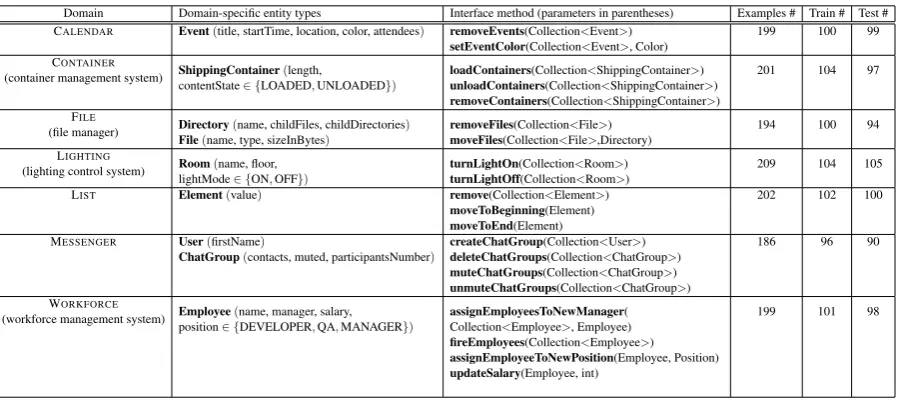
from 7 domains (Table 1). We used the MTurk
platform and recruited annotators located in the US with at least 1,000 approved tasks and a task approval rate of at least 95%. Our dataset contains utterances written by 53 unique annotators.
Throughout the dataset construction we blocked 16 annotators that generated utterances that did not correspond to our instructions (mostly, referring to irrelevant details of the provided figure which are not part of the domain represented by the visu-alized states). Annotators were paid 15-23 cents
per task (i.e. per utterance they write given a
state pair).
Each initial and desired state pair was given to a single annotator. We filtered out examples with utterances that consist of more than one sentence (we instructed annotators to write only one sen-tence). The average instruction length in the train-ing set is 8.1 words.
We consider 7 domains: (a) CALENDAR:
re-moving calendar events and setting their color;
(b) CONTAINER: loading, unloading and
re-moving shipping containers; (c) FILE:
remov-ing files and movremov-ing them from one directory
to another; (d) LIGHTING: turning lights on
and off in rooms inside a house; (e) LIST:
re-moving elements and re-moving an element to the
beginning/end of a list; (f) MESSENGER:
cre-ating/deleting chat groups and muting/unmuting
them; and (g) WORKFORCE: assigning employees
to a new manager, firing employees, assigning an employee to a new position and updating an em-ployee’s salary.
Our choice of domains aims to include a vari-ety of linguistic phenomena. These include
su-perlatives (e.g. remove the longest container in
CONTAINER, figure 1(a)), spatial language (e.g.
turn off the light in the bedroom on floor 2 in LIGHTING, figure1 (b)), and temporal language
(e.g. delete my last two appointments on
Thurs-day, from CALENDAR). Also, the domains are
chosen to be rich enough to allow utterances with highly compositional logical forms.
4 Zero-Shot Semantic Parsing For Instructions
We modify the floating parser (henceforth denoted with FParser), to address zero-shot learning in three ways: (a) presenting a new training algo-rithm; (b) filtering logical form candidates based on the application logic; and (c) adding new fea-tures. We begin with a brief description of the FParser and then go on to describe our approach.
4.1 The Floating Parser
The FParser was designed to handle unseen predi-cates, in the context of answering questions about Wikipedia tables that did not appear during
train-ing.2 It is hence a natural starting point for our
zero-shot setup. We now describe the FParser
and its inference algorithm (with necessary model modifications to support instruction parsing).
For each inference, the input of the parser is
an initial application state s, a set of interface
methods and their description phrases, and a
nat-ural language instructionx. The statesdefines a
knowledge baseKs of(entity, relation, entity)
triples. The parser generates a set of logical
form candidatesZxthat can be executed over the
knowledge base Ks to produce a method call c
Domain Domain-specific entity types Interface method (parameters in parentheses) Examples # Train # Test # CALENDAR Event(title, startTime, location, color, attendees) removeEvents(Collection<Event>)
setEventColor(Collection<Event>, Color)
199 100 99
CONTAINER
(container management system) ShippingContainer(length,
contentState∈ {LOADED,UNLOADED})
loadContainers(Collection<ShippingContainer>)
unloadContainers(Collection<ShippingContainer>)
removeContainers(Collection<ShippingContainer>)
201 104 97
FILE
(file manager) Directory(name, childFiles, childDirectories)
File(name, type, sizeInBytes)
removeFiles(Collection<File>)
moveFiles(Collection<File>,Directory)
194 100 94
LIGHTING
(lighting control system) Room(name, floor, lightMode∈ {ON,OFF})
turnLightOn(Collection<Room>)
turnLightOff(Collection<Room>)
209 104 105
LIST Element(value) remove(Collection<Element>)
moveToBeginning(Element)
moveToEnd(Element)
202 102 100
MESSENGER User(firstName)
ChatGroup(contacts, muted, participantsNumber)
createChatGroup(Collection<User>)
deleteChatGroups(Collection<ChatGroup>)
muteChatGroups(Collection<ChatGroup>)
unmuteChatGroups(Collection<ChatGroup>)
186 96 90
WORKFORCE
(workforce management system) Employee(name, manager, salary, position∈ {DEVELOPER,QA,MANAGER})
assignEmployeesToNewManager( Collection<Employee>, Employee)
fireEmployees(Collection<Employee>)
assignEmployeeToNewPosition(Employee, Position)
updateSalary(Employee, int)
[image:5.595.76.525.61.263.2]199 101 98
Table 1: The domains in our dataset. The interface method parameters are presented in Java syntax. In the second column, the properties of the non-primitive entities appear in parentheses.
formulated as an (interface method, argument list)
pair. The method callccan be invoked in the
con-text ofswith the provided application logic,
pro-ducing thedenotationy=JzKs, the resulting state.
For each logical form z ∈ Zx the parser
ex-tracts a feature vectorφ(x, s, z). The probability
assigned to a logical form candidatez∈Zxis
de-fined by a log-linear model:
pθ(z|x, s) =
exp(θTφ(x, s, z)) P
z0∈Z
xexp(θ
Tφ(x, s, z0))
where θ is the weight vector. The logical form
with maximal probability is chosen as the dicted logical form, and its denotation is the pre-dicted desired state. Our logical form space is
based onλ-DCS (Liang,2013), as in the original
FParser, but we use an additional derivation rule
that derives the logical formf(z1, ..., zn),
denot-ing a method call, given the primitive logical form
f (denoting an interface method) and the logical
formsz1, ..., zn(each denoting a set of entities that
correspond to an argument off).
The objective function is the L1 regularized log-likelihood of the correct denotations across the training data:
J(θ) = 1 N
N
X
i=1
logpθ(yi|xi, si)−λkθk1 (1)
where pθ(y|x, s) is the sum of the probabilities
assigned to all the candidate logical forms with
the denotationy.
4.2 Zero-Shot Parsing
We now present our modified FParser. We start with our training algorithm, and proceed to the ap-plication logic filtering and our new features.
4.2.1 Training: Gap Minimization via Domain Partitioning (GMDP)
We start with some notations and definitions. Let
us denote the set of training domains with D =
d1, ..., dn. LetD=D1∪D2 be some partition of
the setD. The target domain is denoted withdn+1.
Let us now describe the training algorithm,
formu-lated in figure2.
The GMDP algorithm consists of two steps. In the first step, an initial estimate of the model
pa-rameters, denoted withθD1, is learned on the
train-ing examples from the source domain subsetD1.
θD1 is then used as an initialization for the second
step, in which the parser is re-trained, this time on
the training examples of the domains inD2.
In each of the two steps we update the weights
with AdaGrad (Duchi et al.,2011), the training
al-gorithm of the original FParser, using the objective
function in equation1. Since this objective is
non-convex and hence sensitive to its starting point (pa-rameter initialization), the weights learned at the
first step (θD1) have an impact on the final
param-eters of the parser (θD1,D2).
Algorithm 1: Gap Minimization via Domain Partitioning(GMDP)
Input:Domains partitioning:{D1, D2} Output: Weight vector:θD1,D2
Initializeθ0
θD1 ←AdaGrad(D1, θ0)
θD1,D2 ←AdaGrad(D2, θD1) returnθD1,D2
Figure 2: The GMDP algorithm.
with respect to one set of domains (D1) and then
adjusts those parameters to fit a second set of
do-mains (D2) that have not been available at the first
training step. We refer to this adjustment process asgap minimization.
The parser parameters learned by GMDP
strongly depend on the domains included in D1
and D2, and on the extent to which the
adapta-tion from D1 to D2 mimics the adaptation from
D = D1 ∪D2 to the target domain dn+1. In
this paper we treat the division of domains to the
D1andD2subsets as a hyper-parameter and tune
it together with the other hyper-parameters of the parser. Because this tuning process has to do with the important division of the training domains to
D1andD2, we detail it here as part of the
descrip-tion of the algorithm.
For every target domain dn+1 we iterate over
the training domainsD=d1, ..., dnin a leave one
out manner, each time holding out one of the
do-mainsdi∈D, training on the other domains (D¬i)
with various hyper-parameter configurations and
testing on the training data of di. We consider
as a hyper-parameter the order of the domains in
D, assigning the first M domains to D1 and the
rest to D2 (di is excluded from the ordered list),
whereM is another parameter. The
hyper-parameter configuration that works best in thosen
iterations (achieves the highest average accuracy on the held-out domains) is the one selected for
the training of the final parser for dn+1. When a
parser fordn+1is then trained, we increase by one
the size of eitherD1 orD2, whichever is larger,
because this way the ratio between the size ofD1
andD2 is kept as similar as possible to the ratio
during the hyper-parameter tuning.
4.2.2 Logical Form Filtering
The Fparser is a bottom-up beam-search parser, in which a dynamic programming table is filled with
derivations. Each cell in the table corresponds to a derivation size and a logical form category, where the size is defined as the number of rules applied when generating the logical form.
We add an additional stage to the inference step of the parser. In this stage we filter logical form candidates based on the application logic, which is part of the domain definition. This filtering stage dismisses incorrect candidate logical forms when
they represent a method callcthat either does not
modify the application state or results in an
excep-tion being thrown. To do that,cis invoked on the
initial statesand if the result is a state identical to
s, or if an exception has been thrown by the
ap-plication logic, we dismiss the candidate logical form. This added stage is especially important for zero-shot settings, in which the application logic of the target domain does not have any impact on the learned weights.
As an example to application logic based
filter-ing, consider the LIGHTING domain in which the
lights in some rooms can be turned on and off. A method call that turns off the lights in rooms where the lights are already off does not change the ap-plication state, and in such cases the
correspond-ing logical form will be dismissed. In the WORK
-FORCEdomain, attempting to assign employees to report to an employee who is not a manager results in an exception being thrown.
4.2.3 Features
Given a state, an instruction and a logical form, we extract the relevant features of the FParser
(phrase-predicate co-occurrence features3 and
missing-predicate features) and add our own features. We extract features based on the description phrases: the phrases that are provided for each inter-face method as part of the domain definition. The description phrases are used to extract addi-tional phrase-predicate co-occurrence features and missing-predicate features. For example, consider
the utteranceDelete the largest filefrom the FILE
domain, with the logical form:
removeFiles(argmax(R[type].File,
R[sizeInBytes]))
The interface methodremoveFiles has the
de-scription phrasedelete, which matches the phrase
3We use the term
Deletein the utterance, resulting in the extraction of the corresponding co-occurrence features. Con-versely, when the parser considers logical forms
that contain the method moveFiles instead of
removeFiles, it will extract features indicating
that a match between the unigram Delete and a
primitive logical form is possible but does not oc-cur in the candidate logical form. We note the
re-sembles of this technique to the wayTafjord et al.
(2018) handled properties that were unseen during
training, using a list of provided words that are as-sociated with the property.
We also extract features that correspond to the size of a candidate logical form (the number of derivation rules applied). The extracted features
indicate that the logical form size is larger thann,
for anyn≥2. These features captures a
domain-independent preference for simplicity.
5 Experimental Setup
Models and Baselines We compare eight com-binations of parsers. Four models use our GMDP training algorithm: (a) GMDP: the full model
(§ 4.2); (b) GMDP−A: where we do not
ap-ply the application logic filtering (§ 4.2.2); (c)
GMDP−F: where we do not use our features
(§ 4.2.3); and (d) GMDP−FA: where we omit both our new features and the application logic fil-tering. The other four models are identical, but
they use the original ADAGRAD training. Note
that ADAGRAD−FA corresponds to the original
FParser (with minimal modifications to support in-struction parsing).
Notice that in some real-world settings our ap-plication logic filtering, which requires invoking interface methods hundreds of times per inference, might be impractical (e.g. if executing the inter-face methods is computationally intensive). This motivates us to consider the results of the ablated model that does not use the application logic.
Experiments In each experiment we train the parsers on examples from 6 application domains and test them on the remaining domain. Our evalu-ation metric is accuracy: the fraction of the test ex-amples where a correct denotation (desired state) is predicted. For examples where multiple log-ical forms achieve maximum score, we consider the fraction that yields the desired state.
While in our main results we report the accu-racy of the parsers on the target domain’s test set, for the error and qualitative analyses we report the
accuracy on the target domain’s training set. We do that in order to avoid multiple runs on the test sets; we do not use the target domain’s training set for other purposes (e.g. hyper-parameter tuning). The average number of training and test examples per domain is 101 and 97.6, respectively.
Hyper-parameter tuning We use a grid search and leave-one-out cross-validation over the source domains to tune the hyper-parameters. We tune the following hyper-parameters: the L1 regular-ization coefficient, the initial step-size, the num-ber of training iterations (for the GMDP algo-rithm: the number of training iterations in the sec-ond step), and for the GMDP algorithm also: the number and identity of training domains used in
the first (D1) and second (D2) steps, and the
num-ber of training iterations during the first step. We use a beam size of 200 and limit the number of rule applications per derivation to 15. We provide more details about the values of the hyper-parameters we consider in the appendix.
6 Results
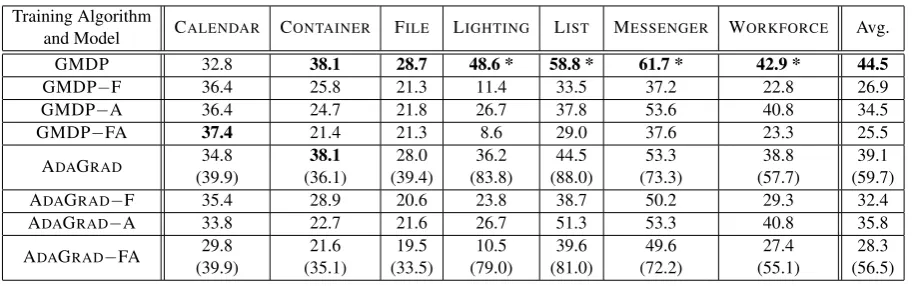
Our results are summarized in Table 2. GMDP
outperforms ADAGRAD−FA, the original
FParser, in all the domains, and by 16.2%
on average accuracy. We next analyze the
importance of each of our zero-shot compo-nents: the training algorithm, new features and application logic filtering.
Training Algorithms GMDP (our full model) yields an averaged accuracy of 44.5%,
outper-forming ADAGRAD, which is identical to our full
model except that training is performed with Ada-Grad, by 5.4%. In four domains GMDP
outper-forms ADAGRAD by more than 4%. The gap is
most notable in the LISTand LIGHTINGdomains
where GMDP outperforms ADAGRADby 14.3%
and 12.4%, respectively, but the improvements on MESSENGERand WORKFORCEare also
substan-tial (8.4% and 4.1%, respectively). In the other
three domains, GMDP and ADAGRAD perform
identically (CONTAINER) or demonstrate
differ-ences of up to 2% (CALENDARand FILE).
Inter-estingly, for the CALENDAR domain, performing
GMDP training without the features and filtering
(GMDP−FA) yields the best accuracy.
Features and Application Logic Removing our
new features (GMDP−F and ADAGRAD−F)
Training Algorithm
and Model CALENDAR CONTAINER FILE LIGHTING LIST MESSENGER WORKFORCE Avg.
GMDP 32.8 38.1 28.7 48.6 * 58.8 * 61.7 * 42.9 * 44.5
GMDP−F 36.4 25.8 21.3 11.4 33.5 37.2 22.8 26.9
GMDP−A 36.4 24.7 21.8 26.7 37.8 53.6 40.8 34.5
GMDP−FA 37.4 21.4 21.3 8.6 29.0 37.6 23.3 25.5
ADAGRAD 34.8
(39.9)
38.1 (36.1)
28.0 (39.4)
36.2 (83.8)
44.5 (88.0)
53.3 (73.3)
38.8 (57.7)
39.1 (59.7)
ADAGRAD−F 35.4 28.9 20.6 23.8 38.7 50.2 29.3 32.4
ADAGRAD−A 33.8 22.7 21.6 26.7 51.3 53.3 40.8 35.8
ADAGRAD−FA 29.8 (39.9)
21.6 (35.1)
19.5 (33.5)
10.5 (79.0)
39.6 (81.0)
49.6 (72.2)
27.4 (55.1)
[image:8.595.73.531.61.204.2]28.3 (56.5)
Table 2: Test set accuracy. In parenthesis: result for the in-domain setup (training with the 96-104 training ex-amples of the target domain). GMDP results marked with * represent a statistically significant difference from ADAGRAD(α= 0.05, using the paired bootstrap test (Efron and Tibshirani,1994), followingDror et al.(2018)), we do not mark the cell in the Average column as statistically significant due to it being the average of accuracy values from seven different distributions.
(from 44.5% to 26.9% for GMDP) or 6.7% (from
39.1% to 32.4% for ADAGRAD). Removing the
application logic filtering yields an averaged
de-crease of 10.0% (GMDP vs. GMDP−A) or 3.3%
(ADAGRADvs. ADAGRAD−A). Finally,
remov-ing both the features and the application logic yields an additional average degradation: a total
of 19% for GMDP and of 10.8% for ADAGRAD.
Combined Effect The impact of our features and application logic filtering is much more sub-stantial for GMDP models, both on average and for the four domains where GMDP outperforms
ADAGRAD(four rightmost domain columns of the
table). Particularly, while in these four setups the combination of GMDP training with the features and filtering yields a substantial improvement over AdaGrad training with these additions, excluding either the features or the filtering often results in an advantage for AdaGrad training. In the other
three setups, where GMDP and ADAGRAD
per-form similarly, excluding the features or the fil-tering yields similar effects (with the exception of
GMDP−FA in the CALENDARdomain).
This observation provides an important insight about our modeling decisions. At their best, our three zero-shot components provide a complemen-tary effect and these are the cases where our full model, GMDP, is most useful. When this com-plementary effect is not observed, AdaGrad and GMDP training are equally effective.
Comparison with In-domain Training In or-der to better quantify the impact of zero-shot train-ing, we report results for AdaGrad training in the
in-domain setup, i.e. when the parser is trained with the target domain’s training set. Note that while the zero-shot models are trained with 603-611 training examples (all the training examples of the source domains), the in-domain models are trained with 96-104 examples only.
As shown in Table 2, the accuracy of ADA
-GRAD with in-domain training is 15.2% higher
than that of GMDP with zero-shot training (59.7% vs. 44.5%), despite the smaller number of
train-ing examples. A comparison between ADAGRAD
and ADAGRAD−FA reveals that in the in-domain
setup, our new features and filtering logic yields only a modest performance gain that corresponds to 3.2% on average (59.7% vs. 56.5%). This is an-other induction for the relevance of our zero-shot components to zero-shot adaptation.
Error analysis. For each domain we sample 10 training examples per interface method, and an-alyze the performance of the parsers that are ap-plied to this domain. This accumulates to 200 ex-amples, that are used for the below error analysis. For GMDP, 30.4% of the error is in examples where the instruction is incorrect, which is the case in 33 out of the 200 sampled examples (16.5%). Another major source of errors is the lexical gap
between the domains. Consider the utterance
re-move the longest containerfrom the CONTAINER
domain, with the correct logical form:
removeContainers(argmax(
R[type].ShippingContainer,R[length]))
The wordlongestdid not appear in any example in
lexicalized features associated withargmaxwere useful. In future work, we hence plan to extend our parser to take word similarity into account.
Moreover, we found that 12.8% of the error is due to incorrect parsing of utterances that
ref-erence an entity by its index. An example of
such an error is the mapping of the utterance
un-load the container in terminal four to the logical form unloadContainers(R[length].4) instead of unloadContainers(R[index].4).
Qualitative analysis. We observe that GMDP yields smaller weights for features that can be ex-pected to correlate with incorrect logical forms due to the zero-shot setup. For example, in the CONTAINER domain annotators often referred to
entities by their index (e.g. Remove the
con-tainer in the third terminal), while in the LIST
domain annotators mostly refer to entities
(inte-gers) by their numeric value. When LIST is the
target domain, we observe that in GMDP the lex-icalized phrase-predicate features that indicate
co-occurrence between the logical formR[index]and
phrases that do not indicate an index based refer-ence, receive smaller weights when compared to
ADAGRAD. For example, we find that the feature
that indicates a co-occurrence between R[index]
and the phrase in corresponds to the largest
de-crease in weight percentile rank: 88.7 points. At the same time, the feature that indicates a
co-occurrence with the phrasethe first(which should
correlate withR[index]being in the logical form)
corresponds to the largest increase in weight per-centile rank: 86.1 points.
As a result of this change in feature
weight-ing, for LISTutterance such as: Remove the
num-ber 2 from the list, GMDP tends to yield
cor-rect logical forms (e.g. remove(R[value.2])),
unlike ADAGRAD that tends to query
enti-ties by their index instead of by their value
(e.g.remove(R[index.2])).
7 Conclusion
We presented a novel task of zero shot seman-tic parsing for instructions, and introduced a new dataset. We proposed a new training algorithm as well as features and filtering logic that should enhance zero-shot learning, and integrated them
into the FParser (Pasupat and Liang,2015). Our
new parser substantially outperforms the original parser and we further show that each of our zero-shot components is vital for this improvement.
We hope this work will inspire readers to use our framework for collecting a larger dataset and experimenting with more approaches. Our frame-work is designed to allow the definition of new do-mains and collecting examples with minimal ef-fort. Promising future directions include experi-menting with our zero-shot adaptation methods in the context of neural semantic parsing (after in-creasing the number of examples per domain) and extending the dataset to include more complicated applications and multi-utterance instructions.
Acknowledgements
We would like to thank the members of the IE@Technion NLP group for their valuable feed-back and advice. This research has been funded by an ISF personal grant on ”Domain Adaptation in NLP: Combining Deep Learning with Domain and Task Knowledge”.
References
Yoav Artzi and Luke Zettlemoyer. 2013. Weakly su-pervised learning of semantic parsers for mapping instructions to actions.Transactions of the Associa-tion for ComputaAssocia-tional Linguistics, 1:49–62.
Jonathan Berant, Andrew Chou, Roy Frostig, and Percy Liang. 2013. Semantic parsing on freebase from question-answer pairs. In Proceedings of the 2013 Conference on Empirical Methods in Natural Lan-guage Processing, pages 1533–1544. Association for Computational Linguistics.
Qingqing Cai and Alexander Yates. 2013. Large-scale semantic parsing via schema matching and lexicon extension. InProceedings of the 51st Annual Meet-ing of the Association for Computational LMeet-inguistics (Volume 1: Long Papers), pages 423–433. Associa-tion for ComputaAssocia-tional Linguistics.
James Clarke, Dan Goldwasser, Ming-Wei Chang, and Dan Roth. 2010. Driving semantic parsing from the world’s response. InProceedings of the Four-teenth Conference on Computational Natural Lan-guage Learning, pages 18–27. Association for Com-putational Linguistics.
Aditya Desai, Sumit Gulwani, Vineet Hingorani, Nidhi Jain, Amey Karkare, Mark Marron, Sailesh R, and Subhajit Roy. 2016. Program synthesis using nat-ural language. InProceedings of the 38th Interna-tional Conference on Software Engineering, ICSE ’16, pages 345–356, New York, NY, USA. ACM.
Association for Computational Linguistics (Volume 1: Long Papers), pages 1383–1392. Association for Computational Linguistics.
John Duchi, Elad Hazan, and Yoram Singer. 2011.
Adaptive subgradient methods for online learning and stochastic optimization. J. Mach. Learn. Res., 12:2121–2159.
Bradley Efron and Robert J Tibshirani. 1994. An intro-duction to the bootstrap. CRC press.
Milica Gaˇsi´c, Nikola Mrkˇsi´c, Lina M Rojas-Barahona, Pei-Hao Su, Stefan Ultes, David Vandyke, Tsung-Hsien Wen, and Steve Young. 2017. Dialogue man-ager domain adaptation using gaussian process rein-forcement learning. Computer Speech & Language, 45:552–569.
Daniel Gerber and A-C Ngonga Ngomo. 2011. Boot-strapping the linked data web. In1st Workshop on Web Scale Knowledge Extraction at ISWC.
Dan Goldwasser, Roi Reichart, James Clarke, and Dan Roth. 2011. Confidence driven unsupervised seman-tic parsing. InProceedings of the 49th Annual Meet-ing of the Association for Computational LMeet-inguis- Linguis-tics: Human Language Technologies, pages 1486– 1495. Association for Computational Linguistics.
Jonathan Herzig and Jonathan Berant. 2017. Neu-ral semantic parsing over multiple knowledge-bases. In Proceedings of the 55th Annual Meeting of the Association for Computational Linguistics (Volume 2: Short Papers), pages 623–628. Association for Computational Linguistics.
Jonathan Herzig and Jonathan Berant. 2018. Decou-pling structure and lexicon for zero-shot semantic parsing. InProceedings of the 2018 Conference on Empirical Methods in Natural Language Process-ing, pages 1619–1629. Association for Computa-tional Linguistics.
Young-Bum Kim, Alexandre Rochette, and Ruhi Sarikaya. 2016.Natural language model re-usability for scaling to different domains. InProceedings of the 2016 Conference on Empirical Methods in Nat-ural Language Processing, pages 2071–2076. Asso-ciation for Computational Linguistics.
Jayant Krishnamurthy, Pradeep Dasigi, and Matt Gard-ner. 2017. Neural semantic parsing with type con-straints for semi-structured tables. InProceedings of the 2017 Conference on Empirical Methods in Natural Language Processing, pages 1516–1526, Copenhagen, Denmark. Association for Computa-tional Linguistics.
Jayant Krishnamurthy and Tom Mitchell. 2012.
Weakly supervised training of semantic parsers. In
Proceedings of the 2012 Joint Conference on Empir-ical Methods in Natural Language Processing and Computational Natural Language Learning, pages 754–765. Association for Computational Linguis-tics.
Tom Kwiatkowski, Eunsol Choi, Yoav Artzi, and Luke Zettlemoyer. 2013. Scaling semantic parsers with on-the-fly ontology matching. InProceedings of the 2013 Conference on Empirical Methods in Natural Language Processing, pages 1545–1556. Associa-tion for ComputaAssocia-tional Linguistics.
Tom Kwiatkowski, Luke Zettlemoyer, Sharon Gold-water, and Mark Steedman. 2010. Inducing proba-bilistic ccg grammars from logical form with higher-order unification. InProceedings of the 2010 Con-ference on Empirical Methods in Natural Language Processing, pages 1223–1233. Association for Com-putational Linguistics.
Percy Liang. 2013. Lambda dependency-based com-positional semantics. CoRR, abs/1309.4408.
Xi Victoria Lin, Chenglong Wang, Luke Zettlemoyer, and Michael D. Ernst. 2018. Nl2bash: A corpus and semantic parser for natural language interface to the linux operating system. In Proceedings of the Eleventh International Conference on Language Resources and Evaluation LREC 2018, Miyazaki (Japan), 7-12 May, 2018.
Reginald Long, Panupong Pasupat, and Percy Liang. 2016. Simpler context-dependent logical forms via model projections. InProceedings of the 54th An-nual Meeting of the Association for Computational Linguistics (Volume 1: Long Papers), pages 1456– 1465. Association for Computational Linguistics.
Matt MacMahon, Brian Stankiewicz, and Benjamin Kuipers. 2006. Walk the talk: Connecting language, knowledge, and action in route instructions. In Pro-ceedings of the 21st National Conference on Artifi-cial Intelligence - Volume 2, AAAI’06, pages 1475– 1482. AAAI Press.
Panupong Pasupat and Percy Liang. 2015. Compo-sitional semantic parsing on semi-structured tables. In Proceedings of the 53rd Annual Meeting of the Association for Computational Linguistics and the 7th International Joint Conference on Natural Lan-guage Processing (Volume 1: Long Papers), pages 1470–1480. Association for Computational Linguis-tics.
Mohammad Raza, Sumit Gulwani, and Natasa Milic-Frayling. 2015. Compositional program synthesis from natural language and examples. In Proceed-ings of the 24th International Conference on Artifi-cial Intelligence, IJCAI’15, pages 792–800. AAAI Press.
Yu Su and Xifeng Yan. 2017. Cross-domain seman-tic parsing via paraphrasing. InProceedings of the 2017 Conference on Empirical Methods in Natural Language Processing, pages 1235–1246. Associa-tion for ComputaAssocia-tional Linguistics.
Yushi Wang, Jonathan Berant, and Percy Liang. 2015.
Building a semantic parser overnight. In Proceed-ings of the 53rd Annual Meeting of the Association for Computational Linguistics and the 7th Interna-tional Joint Conference on Natural Language Pro-cessing (Volume 1: Long Papers), pages 1332–1342. Association for Computational Linguistics.
Terry Winograd. 1971. Procedures as a representation for data in a computer program for understanding natural language. Technical report, Massachusetts Institute of Technology, Project MAC.
Tao Yu, Michihiro Yasunaga, Kai Yang, Rui Zhang, Dongxu Wang, Zifan Li, and Dragomir Radev.
2018b. SyntaxSQLNet: Syntax tree networks
for complex and cross-domain text-to-SQL task. In Proceedings of the 2018 Conference on Em-pirical Methods in Natural Language Processing, pages 1653–1663, Brussels, Belgium. Association for Computational Linguistics.
Tao Yu, Rui Zhang, Kai Yang, Michihiro Yasunaga, Dongxu Wang, Zifan Li, James Ma, Irene Li, Qingning Yao, Shanelle Roman, Zilin Zhang,
and Dragomir Radev. 2018a. Spider: A
large-scale human-labeled dataset for complex and cross-domain semantic parsing and text-to-SQL task. In Proceedings of the 2018 Conference on Em-pirical Methods in Natural Language Processing, pages 3911–3921, Brussels, Belgium. Association for Computational Linguistics.
Luke S. Zettlemoyer and Michael Collins. 2005.
Learning to map sentences to logical form: Struc-tured classification with probabilistic categorial grammars. InProceedings of the Twenty-First Con-ference on Uncertainty in Artificial Intelligence, UAI’05, pages 658–666, Arlington, Virginia, United States. AUAI Press.
Tiancheng Zhao and Maxine Eskenazi. 2018. Zero-shot dialog generation with cross-domain latent ac-tions. In Proceedings of the 19th Annual SIGdial Meeting on Discourse and Dialogue, pages 1–10. Association for Computational Linguistics.
A Hyper-parameter Tuning
The hyper-parameters we consider in the grid search are as follows. L1 regularization
coeffi-cient:{0.001,0.01}; initial step-size:{0.01,0.1};
number of training iterations (for the GMDP algo-rithm, the number of training iterations in the
sec-ond step):{1,2,3}. For the GMDP algorithm, the
grid search also included the number of training
domains used for the first step (D1):{3,4}(the
re-maining domains are used in the second step,D2)
with three random domain orderings for
determin-ing theD1, D2partition (see the last paragraph of
Section 4.2.1 for how these hyper-parameters are
used), and the number of training iterations during