4258
Improving Question Answering over Incomplete KBs
with Knowledge-Aware Reader
Wenhan Xiong†, Mo Yu∗, Shiyu Chang∗, Xiaoxiao Guo∗, William Yang Wang†
†University of California, Santa Barbara ∗IBM Research
{xwhan, william}@cs.ucsb.edu, [email protected],{shiyu.chang, xiaoxiao.guo}@ibm.com
Abstract
We propose a new end-to-end question swering model, which learns to aggregate an-swer evidence from an incomplete knowledge base (KB) and a set of retrieved text snip-pets. Under the assumptions that the structured KB is easier to query and the acquired knowl-edge can help the understanding of unstruc-tured text, our model first accumulates knowl-edge of entities from a question-related KB subgraph; then reformulates the question in the latent space and reads the texts with the accu-mulated entity knowledge at hand. The evi-dence from KB and texts are finally aggregated to predict answers. On the widely-used KBQA benchmark WebQSP, our model achieves con-sistent improvements across settings with dif-ferent extents of KB incompleteness.1
1 Introduction
Knowledge bases (KBs) are considered as an es-sential resource for answering factoid questions. However, accurately constructing KB with a well-designed and complicated schema requires lots of human efforts, which inevitably limits the cover-age of KBs (Min et al.,2013). As a matter of fact, KBs are often incomplete and insufficient to cover full evidence required by open-domain questions.
On the other hand, the vast amount of unstruc-tured text on the Internet can easily cover a wide range of evolving knowledge, which is commonly used for open-domain question answering (Chen et al.,2017;Wang et al.,2018). Therefore, to im-prove the coverage of KBs, it is straightforward to augment KB with text data. Recently, text-based QA models along (Seo et al.,2016;Xiong et al.,
2017;Yu et al.,2018) have achieved remarkable performance when dealing with a single passage that is guaranteed to include the answer. However, they are still insufficient when multiple documents
1https://github.com/xwhan/Knowledge-Aware-Reader.
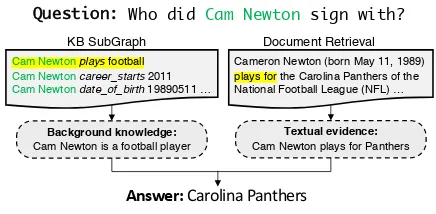
Question: Who did Cam Newton sign with? Document Retrieval
Cam Newton plays football Cam Newton career_starts2011 Cam Newton date_of_birth19890511 …
KB SubGraph
Answer: Carolina Panthers
Cameron Newton (born May 11, 1989) plays for the Carolina Panthers of the National Football League (NFL) …
Background knowledge: Cam Newton is a football player
[image:1.595.307.525.223.330.2]Textual evidence: Cam Newton plays for Panthers
Figure 1: A real example from WebQSP. Here the an-swer cannot be directly found in the KB. But the knowl-edge provided by the KB,i.e.,Cam Newton is a foot-ball player, indicates hesigned withthe team he plays for. This knowledge can be essential for recognizing the relevant text piece.
are presented. We hypothesize this is partially due to the lack of background knowledge while distin-guishing relevant information from irrelevant ones (see Figure1for a real example).
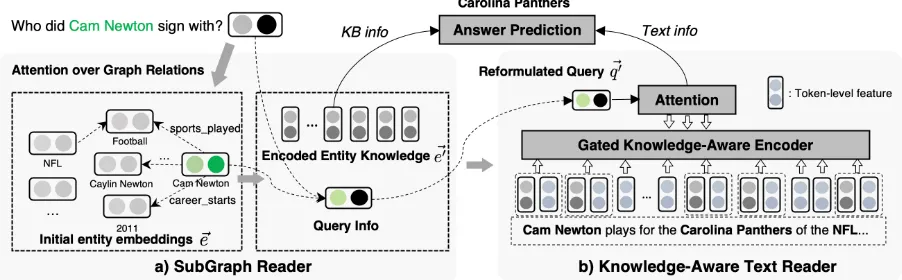
Figure 2: Model Overview. The subgraph readera) first utilizes graph attention networks (Veliˇckovi´c et al.,2017) to collect information for each entity in the question-related subgraph. The learned knowledge of each entity (e~0) is then passed to the text readerb) to reformulate the question representation (q~0) and encode the passage in a knowledge-aware manner. Finally, the information from the text and the KB subgraph is aggregated for answer entity prediction.
2 Task Definition
The QA task we consider here requires answer-ing questions by readanswer-ing knowledge base tuples
K = {(es, r, eo)} and retrieved Wikipedia
docu-ments D. To build a scalable system, we follow
Sun et al.(2018) and only consider a subgraph for each question. The subgraph is retrieved by run-ning Personalized PageRank (Haveliwala, 2002) from the topic entities2(entities mentioned by the question:E0={e|e∈Q}). The documentsDare retrieved by an existing document retriever (Chen et al.,2017) and further ranked by Lucene index. The entities in documents are also annotated and linked to KB entities. For each question, the model tries to retrieve answer entities from a candidate set including all KB and document entities.
3 Model
The core components of our model consist of a graph-attention based KB reader (§3.1) and a knowledge-aware text reader (§3.2). The interac-tion between the modules is shown in Figure2.
3.1 SubGraph Reader
This section describes the KB subgraph reader (SGREADER), which employs graph-attention techniques to accumulate knowledge of each sub-graph entity (e) from its linked neighbors (Ne).
The graph attention mechanism is particularly de-signed to take into account two important aspects: (1) whether the neighbor relation is relevant to the question; (2) whether the neighbor entity is a topic
2Annotated by STAGG (Yih et al.,2014).
entity mentioned by the question. After the prop-agation, the SGREADERfinally outputs a vector-ized representation for each entity, encoding the knowledge indicated by its linked neighbors.
Question-Relation Matching To match the
question and KB relation in an isomorphic latent space, we apply a shared LSTM to encode the question {w1q, w2q, ..., wql
q} and the tokenized
re-lation{w1r, w2r, ..., wrlr}. With the derived hidden states hq ∈ Rlq×dh and hr ∈
Rlr×dh for each
word, we first compute the representation of rela-tions with a self-attentive encoder:
~
r=X
i
αi~hri, αi∝exp(w~r·~hri),
where~hri is thei-th row ofhrandw~ris a trainable
vector. Since a question needs to be matched with different relations and each relation is only de-scribed by part of the question, instead of match-ing the relations with a smatch-ingle question vector, we calculate the matching score in a more fine-grained way. Specifically, we first use~r to attend each question token and then model the matching
srby a dot product as follows:
sr=~r·
X
j
βj~hqj, βj∝exp(~r·~hqj).
Extra Attention over Topic Entity Neighbors
In addition to the question-relation similarities, we find another binary indicator feature derived from the topic entity is very useful. This indicator is defined asI[ei ∈ E0]for a neighbor(ri, ei)of an
the corresponding tuple (e, ri, ei) could be more
relevant than other non-topic neighbors for ques-tion answering. Formally, the final attenques-tion score
˜
s(ri,ei)over each neighbor(ri, ei)is defined as:
˜
s(ri,ei)∝exp(I[ei∈ E0] +sri).
Information Propagation from Neighbors To
accumulate the knowledge from the linked tuples, we define the propagation rule for each entitye:
~ e0=γe
~
e+ (1−γe) X
(ei,ri)∈Ne ˜
s(ri,ei)σ(We[r~i;e~i]),
where ~e and e~i are pre-computed knowledge
graph embeddings, We ∈ Rhd×2hd is a
train-able transformation matrix and σ(·) is an acti-vation function. In addition, γe is a trade-off
parameter calculated by a linear gate function asγe = g(~e,P
(ei,ri)∈Nes˜(ri,ei)σ(We[~ri;e~i])) 3 ,
which controls how much information in the orig-inal entity representation should be retained.4
3.2 Knowledge-Aware Text Reader
With the learned KB embeddings, our model en-hances text reading with KAREADER. Briefly, we use an existing reading comprehension model (Chen et al., 2017) and improve it by learning more knowledge-aware representations for both question and documents.
Query Reformulation in Latent Space First,
we update the question representation in a way that the KB knowledge of the topic entity can be in-corporated. This allows the reader to discriminate relevant information beyond text matching.
Formally, we first take the original question en-coding hq and apply a self-attentive encoder to get a stand-alone question representation: ~q = P
ibi~hqi. We collect the topic entity knowledge of
the question bye~q=P
e∈E0e~0/|E0|. Then we
ap-ply a gating mechanism to fuse the original ques-tion representaques-tion and the KB knowledge:
~ q0=γq
~
q+ (1−γq) tanh(Wq[q, ~~eq, ~q−e~q]),
where Wq ∈ Rhd×3hd, and γq =
sigmoid(Wgq[~q, ~eq, ~q−e~q])is a linear gate.
3g(x, y) =sigmoid(W[x;y])∈(0,1). 4
The above step can be viewed as a gated version of the graph encoding techniques in NLP, e.g., (Song et al.,2018; Xu et al.,2018). These general encoders and graph-attention techniques may help when the questions require more hops and we leave the investigation to future work.
Knowledge-aware Passage Enhancement To
encode the retrieved passages, we use a stan-dard bi-LSTM, which takes several token-level features5. With the entity linking annotations in passages, we fuse the entity knowledge with the token-level features in a similar fashion as the query reformulation process. However, instead of applying a standard gating mechanism (Yang and Mitchell, 2017; Mihaylov and Frank, 2018), we propose a new conditional gating function that ex-plicitly conditions on the questionq~0. This simple modification allows the reader to dynamically se-lect the inputs according to their relevance to the question. Considering a passage tokenwdi with its token features f~wdi and its linked entity ewi
6, we
define the conditional gating function as:
~id wi =γ
d~
e0
wi+ (1−γ d
)f~wdi,where
γd=sigmoid(Wgd[~q·e~0
wi;~q·f~ d wi]).
~ e0
wi denotes the entity embedding learned by our
SGREADER.
Entity Info Aggregation from Text Reading
Finally we feed the knowledge-augmented inputs
~id
wiinto the biLSTM and use the output token-level
hidden state~hdwi to calculate the attention scores
λi = q~0 T
~hd
wi. Afterwards, we get each
docu-ment’s representation asd~=P
iλi~hdwi. For a
cer-tain entitye and all the documents containinge:
De = {d|e ∈ d}, we simply aggregate the
infor-mation by averaging the representations of linked documents as~ed= |D1e|
P d∈Ded~.
3.3 Answer Prediction
With entities representations (e~0 ande~d), we
pre-dict the probability of an entity being the answer by matching the query vectors and the entity rep-resentations:se =σs(q~0TW
s[~e0;e~d]).
4 Experiment
4.1 Setup
Dataset Our experiments are based on the
We-bQSP dataset (Yih et al.,2016). To simulate the real-world scenarios, we test our models following the settings of (Sun et al.,2018), where the KB is
5
We use the same set of features as in (Chen et al.,2017) except for the tagging labels.
Model 10% KB 30% KB 50% KB 100% KB Hit@1 F1 Hit@1 F1 Hit@1 F1 Hit@1 F1
KV-KB 12.5 4.3 25.8 13.8 33.3 21.3 46.7 38.6
GN-KB 15.5 6.5 34.9 20.4 47.7 34.3 66.7 62.4
SGREADER(Ours) 17.1 7.0 35.9 20.2 49.2 33.5 66.5 58.0
KV-KB+TEXT 24.6 14.4 27.0 17.7 32.5 23.6 40.5 30.9
GN-LF 29.8 17.0 39.1 25.9 46.2 35.6 65.4 56.8
GN-EF 31.5 17.7 40.7 25.2 49.9 34.7 67.8 60.4
SGREADER+ KAREADER(Ours) 33.6 18.9 42.6 27.1 52.7 36.1 67.2 57.3
[image:4.595.98.498.64.185.2]GN-LF+EF (ensemble) 33.3 19.3 42.5 26.7 52.3 37.4 68.7 62.3
Table 1: Comparisons with Key-Value Memory Networks and GRAFT-Nets under different KB settings.
downsampled to different extents. For a fair com-parison, the retrieved document set is the same as the previous work.
Baselines and Evaluation Key-Value (KV)
Memory Network (Miller et al., 2016) is a sim-ple baseline that treats KB trisim-ples and documents as memory cells. Specifically, we consider its two variants, KV-KB andKV-KB+Text. The former is a KB-only model while the latter uses both KB and text. We also compare to the latest method
GraftNet (GN) (Sun et al., 2018), which treats
documents as a special genre of nodes in KBs and utilizes graph convolution (Kipf and Welling,
2016) to aggregate the information. Similar to the KV-based baselines, we denoteGN-KBas the KB-only version. Further, both GN-LF (late fu-sion) andGN-EF(early fusion) consider both KB and text. The former one considers KB and texts as two separate graphs, and then ensembles the answer scores. GN-EF is the existing best single model, which considers KB and texts as a single heterogeneous graph and aggregate the evidence to predict a single answer score for each entity. F1 and His@1 are used for evaluation since multiple correct answers are possible.
The implementation details of our model can be found in the Appendix.
4.2 Results and Analysis
We show the main results of different incomplete KB settings in Table 1. For reference, we also show the results under full KB settings (i.e., 100%, all of the required evidence is covered by KB). The row of SGREADERshows the results of our
model using only KB evidence. Compared to the previous KBQA methods (KV-KB and GN-KB), SGREADERachieves better results in incomplete
KB settings and competitive performance with the full KB. Here we do not compare with exist-ing methods that utilize semantic parsexist-ing
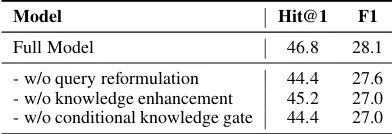
anno-Model Hit@1 F1
Full Model 46.8 28.1
- w/o query reformulation 44.4 27.6 - w/o knowledge enhancement 45.2 27.0 - w/o conditional knowledge gate 44.4 27.0
Table 2: Ablation on dev under the 30% KB setting.
tations (Yih et al., 2016; Yu et al., 2017). It is worth noting that SGREADERonly needs one hop of graph propagation while the compared methods typically require multiple hops.
Augmenting the SGREADER with our knowledge-aware reader (KAREADER) re-sults in consistent improvements in the settings with incomplete KBs. Compared to other base-lines, although our model is built upon a stronger KB-QA base model, it achieves the largest ab-solute improvement. It is worth mentioning that our model is still a single model, but it achieves competitive results to the existing ensemble model (GN-LF+EF). The results demonstrate the advantage of our knowledge-aware text reader.
Ablation Study To study the effect of each
KAREADER component, we conduct ablation analysis under the 30% KB setting (Table2). We see that both query reformulation and knowledge enhancement are essential to the performance. Additionally, we find the conditional gating mech-anism proposed in§3.2is important. When replac-ing it with a standard gate function (see the row
[image:4.595.317.513.216.283.2]1) Question: Which airport to fly into Rome?
Groundtruth:Leonardo da Vinci-Fiumicino Airport (fb:m.01ky5r), Ciampino-G. B. Pastine International Airport (fb:m.033 52)
SGREADER: Italian Met Office Airport (fb:m.04fngkc)
SGREADER+ KAREADER:Leonardo da Vinci-Fiumicino Airport (fb:m.01ky5r) Missing knowledge of the incomplete KB: No airport info about Rome.
1) Question: Where did George Herbert Walker Bush go to college? Groundtruth:Yale (fb:m.08815)
SGREADER: United States of America (fb:m.09c7w0) SGREADER+ KAREADER:Yale (fb:m.08815)
Missing knowledge of the incomplete KB: No college info about George Herbert Walker Bush.
2) Question: When did Juventus win the champions league?
Groundtruth:1996 UEFA Champions League Final (fb:m.02pt 57) SGREADER: 1996 UEFA Super Cup (fb:m.02rw0yt)
SGREADER+ KAREADER:1996 UEFA Champions League Final (fb:m.02pt 57)
Missing knowledge of the incomplete KB: UEFA Super Cup is not UEFA Champions League Final (fb:m.05nblxt)
2) Question: What college did Albert Einstein go to?
Groundtruth:ETH Zurich (fb:m.01dyk8), University of Zurich (fb:m.01tpvt) SGREADER: Sri Krishnaswamy matriculation higher secondary school (fb:m.0127vh33) SGREADER+ KAREADER:ETH Zurich (fb:m.01dyk8)
Missing knowledge of the incomplete KB: the answer should be a college (fb:m.01y2hnl)
3) Question: When is the last time the Denver Broncos won the Superbowl? Groundtruth:Super Bowl XXXIII (fb:m.076y0)
SGREADER:Super Bowl XXXIII (fb:m.076y0)
SGREADER+ KAREADER: 1999 AFC Championship game (fb:m.0100z7bp)
3) Question: What was Lebron James first team? Groundtruth:Cleveland Cavaliers (fb:m.0jm7n) SGREADER:Cleveland Cavaliers (fb:m.0jm7n)
[image:5.595.75.531.60.386.2]SGREADER+ KAREADER: Toronto Raptors (fb:m.0jmcb)
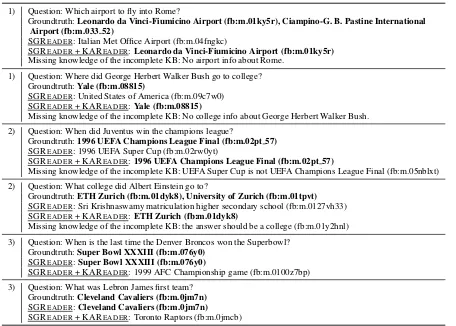
Table 3: Human analysis on test samples in the 30% KB settingo. 1) and 2) show some typical examples of the case (83.2% of all test samples) where the KAREADERimproves upon our SGREADER. 3) shows some examples where using KB alone is better than using both KB and Text (16.8%). The Freebase IDs of the entities are also included for reference.
Qualitative Analysis In Table 3, there are two
major categories of questions that can be better answered using our full model. In the first cate-gory, indicated by 1), the answer fact is missing in the KB, mainly because there are no links from the question entities to the answer entity. In these cases, the SGREADERsometimes can predict an answer with a correct type, but the answers are mostly irrelevant to the question.
The second category, denoted as 2), indicates examples where the KB provides relevant in-formation but does not cover some of the con-straints on answers’ properties (e.g., answers’ en-tity types). In the two examples shown above, we can see that SGREADERis able to give some rea-sonable answers but the answers do not satisfy the constraints indicated by the question.
Finally, when the KB is sufficient to an-swer a question, there are some cases where the KAREADER introduces wrong answers into the
top-ranked answer list. We list two examples at the bottom of the Table 3. These newly in-cluded incorrect answers are usually relevant to
the original questions but come from the noises in machine reading. These cases suggest that our concatenation-based knowledge aggregation still has some room for improvement, which we leave for future work.
5 Conclusion
References
Danqi Chen, Adam Fisch, Jason Weston, and Antoine Bordes. 2017. Reading wikipedia to answer
open-domain questions. InProceedings of the 55th
An-nual Meeting of the Association for Computational Linguistics, ACL 2017, Vancouver, Canada, July 30 - August 4, Volume 1: Long Papers, pages 1870– 1879.
Chuang Gan, Yandong Li, Haoxiang Li, Chen Sun, and Boqing Gong. 2017. Vqs: Linking segmentations to questions and answers for supervised attention in vqa and question-focused semantic segmentation. In ICCV, pages 1811–1820.
Taher H Haveliwala. 2002. Topic-sensitive pagerank. InProceedings of the 11th international conference on World Wide Web, pages 517–526. ACM.
Ronghang Hu, Anna Rohrbach, Trevor Darrell, and Kate Saenko. 2019. Language-conditioned graph networks for relational reasoning. arXiv preprint arXiv:1905.04405.
Thomas N. Kipf and Max Welling. 2016. Semi-supervised classification with graph convolutional
networks.CoRR, abs/1609.02907.
Jiayuan Mao, Chuang Gan, Pushmeet Kohli, Joshua B Tenenbaum, and Jiajun Wu. 2019. The neuro-symbolic concept learner: Interpreting scenes, words, and sentences from natural supervision. arXiv preprint arXiv:1904.12584.
Todor Mihaylov and Anette Frank. 2018. Knowledge-able reader: Enhancing cloze-style reading
compre-hension with external commonsense knowledge. In
ACL 2018, pages 821–832.
Alexander H. Miller, Adam Fisch, Jesse Dodge, Amir-Hossein Karimi, Antoine Bordes, and Jason We-ston. 2016. Key-value memory networks for
di-rectly reading documents. In Proceedings of the
2016 Conference on Empirical Methods in Natural Language Processing, EMNLP 2016, Austin, Texas, USA, November 1-4, 2016, pages 1400–1409.
Bonan Min, Ralph Grishman, Li Wan, Chang Wang, and David Gondek. 2013. Distant supervision for relation extraction with an incomplete knowledge base. In Proceedings of the 2013 Conference of the North American Chapter of the Association for Computational Linguistics: Human Language Tech-nologies, pages 777–782.
Minjoon Seo, Aniruddha Kembhavi, Ali Farhadi, and Hannaneh Hajishirzi. 2016. Bidirectional attention flow for machine comprehension. arXiv preprint arXiv:1611.01603.
Linfeng Song, Yue Zhang, Zhiguo Wang, and Daniel Gildea. 2018. A graph-to-sequence model for amr-to-text generation. arXiv preprint arXiv:1805.02473.
Haitian Sun, Bhuwan Dhingra, Manzil Zaheer, Kathryn Mazaitis, Ruslan Salakhutdinov, and William W. Cohen. 2018. Open domain question answering
us-ing early fusion of knowledge bases and text. In
Proceedings of the 2018 Conference on Empirical Methods in Natural Language Processing, Brussels, Belgium, October 31 - November 4, 2018, pages 4231–4242. Association for Computational Linguis-tics.
Petar Veliˇckovi´c, Guillem Cucurull, Arantxa Casanova, Adriana Romero, Pietro Lio, and Yoshua Bengio. 2017. Graph attention networks. arXiv preprint arXiv:1710.10903.
Shuohang Wang, Mo Yu, Xiaoxiao Guo, Zhiguo Wang, Tim Klinger, Wei Zhang, Shiyu Chang, Gerry Tesauro, Bowen Zhou, and Jing Jiang. 2018. R 3: Reinforced ranker-reader for open-domain question answering. InThirty-Second AAAI Conference on Artificial Intelligence.
Caiming Xiong, Victor Zhong, and Richard Socher. 2017. DCN+: mixed objective and deep
resid-ual coattention for question answering. CoRR,
abs/1711.00106.
Kun Xu, Lingfei Wu, Zhiguo Wang, and Vadim Sheinin. 2018. Graph2seq: Graph to sequence learning with attention-based neural networks. arXiv preprint arXiv:1804.00823.
Bishan Yang and Tom Mitchell. 2017. Leveraging knowledge bases in lstms for improving machine reading. In Proceedings of the 55th Annual Meet-ing of the Association for Computational LMeet-inguistics (Volume 1: Long Papers), volume 1, pages 1436– 1446.
Wen-tau Yih, Xiaodong He, and Christopher Meek. 2014. Semantic parsing for single-relation question answering. InACL 2014, volume 2, pages 643–648.
Wen-tau Yih, Matthew Richardson, Chris Meek, Ming-Wei Chang, and Jina Suh. 2016. The value of se-mantic parse labeling for knowledge base question answering. InProceedings of the 54th Annual Meet-ing of the Association for Computational LMeet-inguistics (Volume 2: Short Papers), volume 2, pages 201–206.
Adams Wei Yu, David Dohan, Minh-Thang Luong, Rui Zhao, Kai Chen, Mohammad Norouzi, and Quoc V. Le. 2018. Qanet: Combining local convolution with global self-attention for reading comprehen-sion.CoRR, abs/1804.09541.
Mo Yu, Wenpeng Yin, Kazi Saidul Hasan, C´ıcero Nogueira dos Santos, Bing Xiang, and Bowen Zhou. 2017. Improved neural relation
detection for knowledge base question answering.
Implementation Details Throughout our exper-iments, we use the 300-dimension GloVe embed-dings trained on the Common Crawl corpus. The hidden dimension of LSTM and the dimension of entity embeddings are both 100. We use the same pre-trained entity embeddings as used bySun et al.