5564
Generating Fluent Adversarial Examples for Natural Languages
Huangzhao Zhang1∗ Hao Zhou2 Ning Miao2 Lei Li2
1Institute of Computer Science and Technology, Peking University, China 2ByteDance AI Lab, Beijing, China
zhang [email protected]
{miaoning,zhouhao.nlp,lileilab}@bytedance.com
Abstract
Efficiently building an adversarial attacker for natural language processing (NLP) tasks is a real challenge. Firstly, as the sentence space is discrete, it is difficult to make small pertur-bations along the direction of gradients. Sec-ondly, the fluency of the generated examples cannot be guaranteed. In this paper, we pro-pose MHA, which addresses both problems by performing Metropolis-Hastings sampling, whose proposal is designed with the guidance of gradients. Experiments on IMDB and SNLI show that our proposed MHA outperforms the baseline model on attacking capability. Adver-sarial training with MHA also leads to better robustness and performance.
1 Introduction
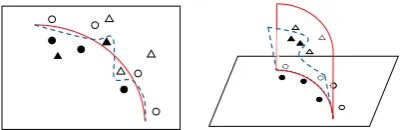
Adversarial learning has been a popular topic in deep learning. Attackers generate adversarial ex-amples by perturbing the sex-amples and use these examples to fool deep neural networks (DNNs). From the perspective of defense, adversarial ex-amples are mixed into the training set to improve performance and robustness of the victim models. However, building an attacker for NLP mod-els (such as a text classifier) is extremely chal-lenging. Firstly, it is difficult to perform gradient-based perturbations since the sentence space is dis-crete. However, gradient information is critical – it leads to the steepest direction to more effective ex-amples. Secondly, adversarial examples are usu-ally not fluent sentences. Unfluent examples are less effective in attacking, as victim models can easily learn to recognize them. Meanwhile, adver-sarial training on them usually does not perform well (see Figure1for detailed analysis).
Current methods cannot properly handle the two problems. Ebrahimi et al. (2018) (HotFlip)
∗
Work done while Huangzhao Zhang was a research intern in ByteDance AI Lab, Beijing, China.
(a) Adversarial training with fluent adversarial examples
[image:1.595.318.519.227.292.2](b) Adversarial training with unfluent adversarial exam-ples
Figure 1: Effect of adversarial training on (a) fluent and (b) unfluent adversarial examples. ◦ and• represent positive and negative samples in the training set, while MandNare the corresponding adversarial examples. Solid and Dotted lines represent decision boundaries before and after adversarial training, respectively. As unfluent adversarial examples are not in the manifold of real sentences, the victim model only needs to adjust its decision boundary out of the sentence manifold to fit them. As a result, fluent adversarial examples may be more effective than unfluent ones.
propose to perturb a sentence by flipping one of the characters, and use the gradient of each pertur-bation to guide sample selection. But simple char-acter flipping often leads to meaningless words (eg.“mood” to “mooP”). Genetic attack (Alzantot et al.,2018) is a population-based word replacing attacker, which aims to generate fluent sentences by filtering out the unreasonable sentences with a language model. But the fluency of examples gen-erated by genetic attack is still not satisfactory and it is inefficient as the gradient is discarded.
really
i like this movie i like this movie
i truely like the movie SentimentClassifier we truely like the
we truely like the movie
show truely
99% Positive
82% Positive
76% Positive
68% Positive
[image:2.595.87.281.63.125.2]59% Negative
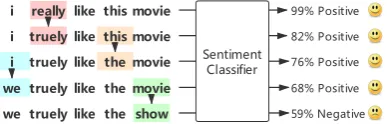
Figure 2: A simple example of adversarial attack on a sentimental classifier by performing word replacement.
tasks, such as natural language generation ( Ku-magai et al., 2016), constrained sentence genera-tion (Miao et al.,2018), guided open story gener-ation (Harrison et al.,2017),etc. We propose two variants of MHA, namely a black-box MHA (b -MHA) and a white-box MHA (w-MHA). Specifi-cally, in contrast to previous language generation models using M-H,b-MHA’s stationary distribu-tion is equipped with a language model term and an adversarial attacking term. The two terms make the generation of adversarial examples fluent and effective. w-MHA even incorporates adversarial gradients into proposal distributions to speed up the generation of adversarial examples.
Our contributions include that we propose an ef-ficient approach for generating fluent adversarial examples. Experimental results on IMDB (Maas et al., 2011) and SNLI (Bowman et al., 2015) show that, compared with the state-of-the-art ge-netic model, MHA generates examples faster, achieving higher success rates with much fewer in-vocations. Meanwhile, adversarial samples from MHA are not only more fluent but also more ef-fective to improve the adversarial robustness and classification accuracy after adversarial training.
2 Preliminary
Generally, adversarial attacks aim to mislead the neural models by feeding adversarial examples with perturbations, while adversarial training aims to improve the models by utilizing the perturbed examples. Adversarial examples fool the model into producing erroneous outputs, such as irrele-vant answers in QA systems or wrong labels in text classifiers (Figure2). Training with such ex-amples may enhance performance and robustness. Definitions of the terms in this paper are as fol-low. The victim models are word-level classi-fiers, which take in tokenized sentences and output their labels. Theattackersgenerate sentences by perturbing the original ones, in order to mislead the victim model into making mistakes. Adver-sarial attacksinclude two categories: (a)
black-box attackonly allows the attackers to have
ac-cess to model outputs, while (b)white-box attack
allows full access to the victim model, including model outputs, gradients and (hyper-)parameters.
Foradversarial training, the same victim model
is trained from scratch on an updated training set with adversarial examples included.
3 Proposed Method: MHA
In this section, we first introduce M-H sampling briefly, and then describe how to apply M-H sam-pling efficiently to generate adversarial examples for natural language.
3.1 Metropolis-Hastings Sampling
The M-H algorithm is a classical Markov chain Monte Carlo sampling approach. Given the sta-tionary distribution (π(x)) and transition proposal, M-H is able to generate desirable examples from π(x). Specifically, at each iteration, a proposal to jump fromx tox0 is made based on the proposal distribution (g(x0|x)). The proposal is accepted with a probability given by the acceptance rate:
α(x0|x) = min{1,π(x
0)g(x|x0)
π(x)g(x0|x)} (1)
Once accepted, the algorithm jumps tox0. Other-wise, it stays atx.
3.2 Black-Box Attack
In black-box attack (b-MHA), we expect the ex-amples to meet three requirements: (a) to read flu-ently; (b) to be able to fool the classifier; (c) to invoke the classifier for as few times as possible.
Stationary distribution. To meet these
require-ments, the stationary distribution is designed as:
π(x|y˜)∝LM(x)·C(˜y|x) (2)
where LM(x) is the probability of the sentence (x) given by a pre-trained language model (LM) andC(˜y|x)is the probability of an erroneous label (y˜) given by the victim model.LM(x)guarantees fluency, whileC(˜y|x)is the attack target.
Transition proposal. There are three word-level
w∗ =
(
wi+1, if i6=n
w1, otherwise
The transition function for replacement is as Equation3, wherewm is the selected word to be replaced, and Q is a pre-selected candidate set, which will be explained later. Theinsertion oper-ation (TiB(x0|x)) consists of two steps – inserting a random word into the position and then perform-ing replacement upon it. Thedeletionoperation is rather simple. TdB(x0|x) = 1ifx0 =x−m, where
x−m is the sentence after deleting them-th word (wm), orTdB(x0|x) = 0otherwise.
TrB(x0|x) =I{wc∈ Q}· (3)
π(w1,· · · , wm−1, wc, wm+1,· · · , wn|y˜) P
w∈Qπ(w1,· · ·, wm−1, w, wm+1,· · · , wn|y˜)
The proposal distribution is a weighted sum of the transition functions:
g(x0|x) =prTrB(x0|x)+piTiB(x0|x)+pdTdB(x0|x)
wherepr,piandpdare pre-defined probabilities of the operations.
Pre-selection. The pre-selector generates a
candidate set for TrB(x0|x) and TiB(x0|x). It chooses the most possible words according to the score (SB(w|x)) to form the candidate word set
Q. SB(w|x)is formulated as:
SB(w|x) =LM(w|x[1:m−1])·LMb(w|x[m+1:n])
wherex[1:m−1] = {w1,· · · , wm−1}is the
pre-fix of the sentence, x[m+1:n] is the suffix of the
sentence, andLMb is a pre-trained backward lan-guage model. Without pre-selection, Q will in-clude all words in the vocabulary, and the classifier will be invoked repeatedly to compute the denom-inator of Equation3, which is inefficient.
3.3 White-Box Attack
The only difference between white-box attack (w -MHA) andb-MHA lies in the pre-selector.
Pre-selection. In w-MHA, the gradient is
in-troduced into the pre-selection score (SW(w|x)). SW(w|x)is formulated as:
SW(w|x) =SB(w|x)·S( ∂L˜
∂em
, em−e)
whereS is the cosine similarity function, L˜ =
L(˜y|x, C) is the loss function on the target label, emandeare the embeddings of the current word (wm) and the substitute (w). The gradient ( ∂
˜ L
∂em)
leads to the steepest direction, andem−eis the ac-tual changing direction ifemis replaced bye. The cosine similarity term (S(∂w∂L˜
m,∆w)) guides the samples to jumping along the direction of the gra-dient, which raisesC(˜y|x)andα(x0|x), and even-tually makesw-MHA more efficient.
Note that insertion and deletion are excluded in w-MHA, because it is difficult to com-pute their gradients. Take the insertion oper-ation for instance. One may apply a similar technique in b-MHA, by first inserting a ran-dom word forming intermediate sentence x∗ =
{w1,· · · , wm, w∗, wm+1,· · ·, wn} and then per-forming replacement operation uponx∗. Comput-ing∂L(˜∂wy|x∗∗,C)is easy, but it is not the actual
gradi-ent. Computing of the actual gradient (∂L(˜∂wy|x,C∗ ))
is hard, since the change fromxtox∗ is discrete and non-differential.
4 Experiments
Datasets. Following previous works, we
vali-date the performance of proposed MHA on IMDB and SNLI datesets. The IMDB dataset includes 25,000 training samples and 25,000 test samples of movie reviews, tagged with sentimental labels (positive or negative). The SNLI dataset con-tains 55,000 training samples, 10,000 validation samples and 10,000 test samples. Each sample contains a premise, a hypothesis and an infer-ence label (entailment, contradiction or neutral). We adopt a single layer bi-LSTM and the BiDAF model (Seo et al., 2016) (which employs bidirec-tional attention flow mechanism to capture rela-tionships between sentence pairs) as the victim models on IMDB and SNLI, respectively.
Baseline Genetic Attacker. We take the
state-of-the-art genetic attack model (Alzantot et al.,
0 2000 4000 6000 Invocation # 0.0
0.2 0.4 0.6 0.8 1.0
Succ rate Genetic b-MHA w-MHA
(a) IMDB
0 2000 4000 6000 Invocation # 0.0
0.2 0.4 0.6 0.8 1.0
Succ rate Genetic b-MHA w-MHA
[image:4.595.307.528.65.287.2](b) SNLI
Figure 3: Invocation-success curves of the attacks.
Task Approach Succ(%) Invok# PPL α(%)
IMDB
Genetic 98.7 1427.5 421.1 –
b-MHA 98.7 1372.1 385.6 17.9
w-MHA 99.9 748.2 375.3 34.4
SNLI
Genetic 76.8 971.9 834.1 –
b-MHA 86.6 681.7 358.8 9.7
[image:4.595.78.286.66.191.2]w-MHA 88.6 525.0 332.4 13.3
Table 1: Adversarial attack results on IMDB and SNLI. The acceptance rates (α) of M-H sampling are in a rea-sonable range.
filtered by the victim classifier and a language model, which leads to the next generation.
Hyper-parameters. As in the work ofMiao et al.
(2018), MHA is limited to make proposals for at most 200 times, and we pre-select 30 candidates at each iteration. Constraints are included in MHA to forbid any operations on sentimental words (eg. “great”) or negation words (eg. “not”) in IMDB experiments with SentiWordNet (Esuli and Sebas-tiani,2006;Baccianella et al.,2010). All LSTMs in the victim models have 128 units. The vic-tim model reaches 83.1% and 81.1% test accura-cies on IMDB and SNLI, which are acceptable re-sults. More detailed hyper-parameter settings are included in the appendix.
4.1 Adversarial Attack
To validate the attacking efficiency, we randomly sample 1000 and 500 correctly classified examples from the IMDB and SNLI test sets, respectively. Attacking success rate and invocation times (of the victim model) are employed for testing effi-ciency. As shown in Figure3, curves of our pro-posed MHA are above the genetic baseline, which indicates the efficiency of MHA. By incorporat-ing gradient information in proposal distribution,
w-MHA even performs better than b-MHA, as the curves rise fast. Note that the ladder-shaped
Case 1
Premise:three men are sitting on a beach dressed in or-ange with refuse carts in front of them.
Hypothesis:empty trash cans are sitting on a beach.
Prediction:hContradictioni
Genetic:emptiestrash cans are sitting on a beach.
Prediction:hEntailmenti
b-MHA:thetrash cans are sittingina beach.
Prediction:hEntailmenti
w-MHA:thetrash cans are sitting on a beach.
Prediction:hEntailmenti
Case 2
Premise:a man is holding a microphone in front of his mouth.
Hypothesis:a male has a device near his mouth.
Prediction:hEntailmenti
Genetic:amasculinehas a device near his mouth.
Prediction:hNeutrali
b-MHA:a man has a device near hiscar.
Prediction:hNeutrali
w-MHA:a man has a device near hishome.
Prediction:hNeutrali
Table 2: Adversarial examples generated on SNLI.
curves of the genetic approach is caused by its population-based nature.
We list detailed results in Table1. Success rates are obtained by invoking the victim model for at most 6,000 times. As shown, the gaps of suc-cess rates between the models are not very large, because all models can give pretty high success rate. However, as expected, our proposed MHA provides lower perplexity (PPL) 1, which means the examples generated by MHA are more likely to appear in the corpus of the evaluation language model. As the corpus is large enough and the lan-guage model for evaluation is strong enough, it in-dicates the examples generated by MHA are more likely to appear in natural language space. It even-tually leads to better fluency.
Human evaluations are also performed. From the examples that all three approaches success-fully attacked, we sample 40 examples on IMDB. Three volunteers are asked to label the generated examples. Examples with false labels from the victim classifier and with true labels from the vol-unteers are regarded as actual adversarial exam-ples. The adversarial example ratios of the genetic approach,b-MHA andw-MHA are 98.3%, 99.2% and 96.7%, respectively, indicating that almost all generated examples are adversarial examples. Vol-unteers are also asked to rank the generated exam-ples by fluency on SNLI (“1” indicating the most
1We use the open released GPT2 (Radford et al.) model
[image:4.595.72.289.231.312.2]Model Attack succ (%) Genetic b-MHA w-MHA
Victim model 98.7 98.7 99.9
[image:5.595.73.288.63.134.2]+ Genetic adv training 93.8 99.6 100.0 +b-MHA adv training 93.0 95.7 99.7 +w-MHA adv training 92.4 97.5 100.0
Table 3: Robustness test results on IMDB.
Model Acc (%)
Train # = 10K 30K 100K
Victim model 58.9 65.8 73.0
+ Genetic adv training 58.8 66.1 73.6 +w-MHA adv training 60.0 66.9 73.5
Table 4: Accuracy results after adversarial training.
fluent while “3” indicating the least fluent). 20 examples are sampled in the same manners men-tioned above. The mean values of ranking of the genetic approach, b-MHA andw-MHA are 1.93, 1.80 and 2.03, indicating that b-MHA generates the most fluent samples. Samples generated by
w-MHA are less fluent than the genetic approach. It is possibly because the gradient introduced into the pre-selector could influence the fluency of the sentence, from the perspective of human beings.
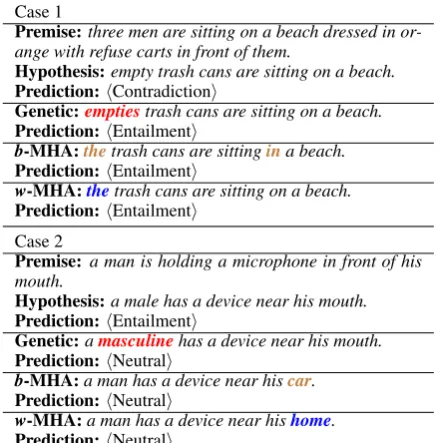
Adversarial examples from different models on SNLI are shown in Table2. The genetic approach may replace verbs with different tense or may re-place nouns with different plurality, which can cause grammatical mistakes (eg. Case 1), while MHA employs the language model to formulate the stationary distribution in order to avoid such grammatical mistakes. MHA does not have con-straints that word replacement should have simi-lar meanings. MHA may replace entities or verbs with some irrelevant words, leading to meaning changes of the original sentence (eg. Case 2). More cases are included in the appendix.
4.2 Adversarial Training
In order to validate whether adversarial training is helpful for improving the adversarial robustness or classification accuracy of the victim model, a new model is trained from scratch after mixing the gen-erated examples into the training set.
To test the adversarial robustness, we attack the new models with all methods on IMDB. As shown in Table3, the new model after genetic adversar-ial training can not defend MHA. On the contrary, adversarial training with b-MHA or w-MHA de-creases the success rate of genetic attack. It shows
that the adversarial examples from MHA could be more effective than unfluent ones from genetic at-tack, as assumed in Figure1.
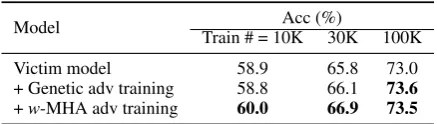
To test whether the new models could achieve accuracy gains after adversarial training, experi-ments are carried out on different sizes of training data, which are subsets of SNLI’s training set. The number of adversarial examples is fixed to 250 during experiment. The classification accuracies of the new models after the adversarial training by different approaches are listed in Table4. Adver-sarial training withw-MHA significantly improves the accuracy on all three settings (with p-values less than 0.02). w-MHA outperforms the genetic baseline with 10K and 30K training data, and gets comparable improvements with 100K train-ing data. Less traintrain-ing data leads to larger accu-racy gains, and MHA performs significantly better than the genetic approach on smaller training set.
5 Future Works
Current MHA returns the examples when the la-bel is changed, which may lead to incomplete sen-tences, which are unfluent from the perspective of human beings. Constraints such as forcing the model to generatehEOSiat the end of the sentence before returning may address this issue.
Also, entity and verb replacements without lim-itations have negative influence on adversarial ex-ample generations for tasks such as NLI. Limita-tions of similarity during word operaLimita-tions are es-sential to settle the problem. Constraints such as limitation of the embedding distance may help out. Another solution is introducing the inverse of em-bedding distance in the pre-selection source.
6 Conclusion
In this paper, we propose MHA, which gener-ates adversarial examples for natural language by adopting the MH sampling approach. Experimen-tal results show that our proposed MHA could generate adversarial examples faster than the ge-netic baseline. Obtained adversarial examples from MHA are more fluent and may be more ef-fective for adversarial training.
7 Acknowledgments
[image:5.595.72.291.169.231.2]References
Moustafa Alzantot, Yash Sharma, Ahmed Elgohary, Bo-Jhang Ho, Mani Srivastava, and Kai-Wei Chang. 2018. Generating natural language adversarial ex-amples. InProceedings of the 2018 Conference on Empirical Methods in Natural Language Process-ing, pages 2890–2896.
Stefano Baccianella, Andrea Esuli, and Fabrizio Sebas-tiani. 2010. Sentiwordnet 3.0: an enhanced lexical resource for sentiment analysis and opinion mining. InLrec, volume 10, pages 2200–2204.
Samuel R Bowman, Gabor Angeli, Christopher Potts, and Christopher D Manning. 2015. A large anno-tated corpus for learning natural language inference.
arXiv preprint arXiv:1508.05326.
Siddhartha Chib and Edward Greenberg. 1995. Un-derstanding the metropolis-hastings algorithm. The american statistician, 49(4):327–335.
Javid Ebrahimi, Anyi Rao, Daniel Lowd, and Dejing Dou. 2018. Hotflip: White-box adversarial exam-ples for text classification. In Proceedings of the 56th Annual Meeting of the Association for Compu-tational Linguistics (Volume 2: Short Papers), vol-ume 2, pages 31–36.
Andrea Esuli and Fabrizio Sebastiani. 2006. Senti-wordnet: A publicly available lexical resource for opinion mining. In LREC, volume 6, pages 417– 422. Citeseer.
Brent Harrison, Christopher Purdy, and Mark O Riedl. 2017. Toward automated story generation with markov chain monte carlo methods and deep neural networks. In Thirteenth Artificial Intelligence and Interactive Digital Entertainment Conference.
WK HASTINGS. 1970. Monte carlo sampling meth-ods using markov chains and their applications.
Biometrika, 57(1):97–109.
Kaori Kumagai, Ichiro Kobayashi, Daichi Mochihashi, Hideki Asoh, Tomoaki Nakamura, and Takayuki Nagai. 2016. Human-like natural language gener-ation using monte carlo tree search. InProceedings of the INLG 2016 Workshop on Computational Cre-ativity in Natural Language Generation, pages 11– 18.
Andrew L Maas, Raymond E Daly, Peter T Pham, Dan Huang, Andrew Y Ng, and Christopher Potts. 2011. Learning word vectors for sentiment analysis. In
Proceedings of the 49th annual meeting of the as-sociation for computational linguistics: Human lan-guage technologies-volume 1, pages 142–150. Asso-ciation for Computational Linguistics.
Nicholas Metropolis, Arianna W Rosenbluth, Mar-shall N Rosenbluth, Augusta H Teller, and Ed-ward Teller. 1953. Equation of state calculations by fast computing machines. The journal of chemical physics, 21(6):1087–1092.
Ning Miao, Hao Zhou, Lili Mou, Rui Yan, and Lei Li. 2018. Cgmh: Constrained sentence generation by metropolis-hastings sampling. arXiv preprint arXiv:1811.10996.
Alec Radford, Jeffrey Wu, Rewon Child, David Luan, Dario Amodei, and Ilya Sutskever. Language mod-els are unsupervised multitask learners.