6008
Generating Sentences from Disentangled Syntactic and Semantic Spaces
Yu Bao1∗ Hao Zhou2∗ Shujian Huang1† Lei Li2 Lili Mou3
Olga Vechtomova3 Xinyu Dai1 Jiajun Chen1
1National Key Laboratory for Novel Software Technology, Nanjing University, China
2ByteDance AI Lab, Beijing, China
3University of Waterloo, Canada
{baoy,huangsj,dxy,chenjj}@nlp.nju.edu.cn
{zhouhao.nlp,lileilab}@bytedance.com
[email protected], [email protected]
Abstract
Variational auto-encoders (VAEs) are widely used in natural language generation due to the regularization of the latent space. How-ever, generating sentences from the continu-ous latent space does not explicitly model the syntactic information. In this paper, we pro-pose to generate sentences from disentangled syntactic and semantic spaces. Our proposed method explicitly models syntactic informa-tion in the VAE’s latent space by using the lin-earized tree sequence, leading to better perfor-mance of language generation. Additionally, the advantage of sampling in the disentangled syntactic and semantic latent spaces enables us to perform novel applications, such as the un-supervised paraphrase generation and syntax-transfer generation. Experimental results show that our proposed model achieves similar or better performance in various tasks, compared with state-of-the-art related work.‡
1 Introduction
Variational auto-encoders (VAEs, Kingma and
Welling, 2014) are widely used in language
gen-eration tasks (Serban et al., 2017; Kusner et al.,
2017; Semeniuta et al., 2017; Li et al., 2018b).
VAE encodes a sentence into a probabilistic latent space, from which it learns to decode the same sentence. In addition to traditional reconstruc-tion loss of an autoencoder, VAE employs an ex-tra regularization term, penalizing the Kullback– Leibler (KL) divergence between the encoded pos-terior distribution and its prior. This property en-ables us to sample and generate sentences from the continuous latent space. Additionally, we can
∗
Equal contributions. †
Corresponding author. ‡
We release the implementation and models at https:// github.com/baoy-nlp/DSS-VAE
even manually manipulate the latent space, inspir-ing various applications such as sentence interpo-lation (Bowman et al.,2016) and text style trans-fer (Hu et al.,2017).
However, the continuous latent space of VAE blends syntactic and semantic information to-gether, without modeling the syntax explicitly. We argue that it may be not necessarily the best in the text generation scenario. Recently, researchers have shown that explicitly syntactic modeling improves the generation quality in sequence-to-sequence models (Eriguchi et al., 2016; Zhou et al.,2017;Li et al.,2017;Chen et al.,2017). It is straightforward to adopt such idea in the VAE set-ting, since a vanilla VAE does not explicitly model the syntax. A line of studies (Kusner et al.,2017;
G´omez-Bombarelli et al.,2018;Dai et al.,2018)
propose to impose context-free grammars (CFGs) as hard constraints in the VAE decoder, so that they could generate syntactically valid outputs of programs, molecules, etc.
However, the above approaches cannot be ap-plied to syntactic modeling in VAE’s continuous latent space, and thus, we do not enjoy the two benefits of VAE, namely,samplingand manipula-tion, towards the syntax of a sentence.
In this paper, we propose to generate sentences from a disentangled syntactic and semantic spaces of VAE (called DSS-VAE). DSS-VAE explicitly models syntax in the continuous latent space of VAE, while retaining the sampling and manipu-lation benefits. In particular, we introduce two continuous latent variables to capture semantics and syntax, respectively. To separate the seman-tic and syntacseman-tic information from each other, we borrow the adversarial approaches from the text style-transfer research (Hu et al., 2017;Fu et al.,
2018; John et al., 2018), but adapt it into our
and therefore further propose an adversarial recon-struction loss to regularize the syntactic and se-mantic spaces.
Our proposed DSS-VAE takes following advan-tages:
First, explicitly syntactic modeling in VAE’s la-tent space improves the quality of unconditional language generation. Experiments show that, compared with traditional VAE, DSS-VAE gen-erates more fluent sentences (lower perplexity), while preserving more amount of encoded infor-mation (higher BLEU scores for reconstruction). Comparisons with a state-of-the-art syntactic lan-guage model (Shen et al.,2017) are also included. Second, the advantage of manipulation in the syntactic and semantic spaces of DSS-VAE pro-vides a natural way of unsupervised paraphrase generation. If we sample a vector in the syntactic space but perform max a posterior (MAP) infer-ence in the semantic space, we are able to gener-ate a sentence with the same meaning but different syntax. This is known asunsupervised paraphrase generation, as no parallel corpus is needed during training. Experiments show that DSS-VAE outper-forms the traditional VAE as well as a state-of-the-art Metropolis-Hastings sampling approach (Miao et al.,2019) in this task.
Additionally, with the disentangled syntactic and semantic latent spaces, we propose an inter-esting application that transfers the syntax of one sentence to another. Both qualitative and quan-titative experimental results show that DSS-VAE could graft the designed syntax to another sen-tence under certain circumstances.
2 Related Work
The variational auto-encoders (VAEs) is proposed
by Kingma and Welling(2014) for image
gener-ation. Bowman et al. (2016) successfully applied VAE in the NLP domain, showing that VAE im-proves recurrent neural network (RNN)-based lan-guage modeling (RNN-LM,Mikolov et al.,2010); that VAE allows sentence sampling and sentence interpolation in the continuous latent space. Later, VAE is widely used in various natural language generation tasks (Gupta et al.,2018;Kusner et al.,
2017;Hu et al.,2017;Deriu and Cieliebak,2018).
Syntactic language modeling, to the best of our knowledge, could be dated back to Chelba
(1997). Charniak (2001) and Clark (2001)
pro-pose to utilize a top-down parsing mechanism for
language modeling. Dyer et al. (2016) and
Kun-coro et al.(2017) introduce the neural network to
this direction. The Parsing-Reading-Predict Net-work (PRPN, Shen et al., 2017), which reports a state-of-the-art results on syntactic language mod-eling, learns a latent syntax by training with a lan-guage modeling objective. Different from their work, our approach models syntax in a continu-ous space, facilitating sampling and manipulation of syntax.
Our work is also related to style-transfer text generation (Fu et al.,2018;Li et al.,2018a;John
et al., 2018). In previous work, the style is
usu-ally defined by categorical features such as sen-timent. We move one step forward, extending their approach to the sequence level and dealing with more complicated, non-categorical syntactic spaces. Due to the complication of syntax, we fur-ther design adversarial reconstruction losses to en-courage the separation of syntax and semantics.
3 Approach
In this section, we present our proposed DSS-VAE in detail. We first introduce the variational au-toencoder in §3.1. Then, we describe the gen-eral architecture of DSS-VAE in §3.2, where we explain how we generate sentences from disen-tangled syntactic and semantic latent spaces and how we disentangle information from the two sep-arated spaces. Model training is discussed in§3.3.
3.1 Variational Autoencoder
A traditional VAE employs a probabilistic latent variablezto encode the information of a sentence
x, and then decodes the originalx fromz. The probability of a sentencexcould be computed as:
p(x) =
Z
p(z)p(x|z) dz (1)
where p(z) is the prior, and p(x|z) is given by the decoder. VAE is trained by maximizing the evidence lower bound(ELBO):
logp(x)≥ELBO
= E
q(z|x)
logp(x|z)−KL q(z|x)p(z)
(2)
3.2 Proposed Method: DSS-VAE
syntactic information, respectively. Specifically, we assume that the probability of a sentencexin DSS-VAE could be computed as:
p(x) =
Z
p(zsem,zsyn)p(x|zsem,zsyn) dzsemdzsyn
=
Z
p(zsem)p(zsyn)p(x|zsem,zsyn) dzsemdzsyn
where p(zsem) and p(zsyn) are the priors; both
are set to be independent multivariate Gaussian
N(0,I).
Similar to (2), we optimize theevidence lower bound(ELBO) for training:
logp(x)≥ELBO
= E
q(zsem|x)q(zsyn|x)
log p(x|zsem,zsyn)
−KL q(zsem|x)
p(zsem)
−KL q(zsyn|x)
p(zsyn)
where q(zsem|x) and q(zsyn|x) are posteriors
for the two latent variables. We further as-sume the variational posterior families,q(zsem|x)
and q(zsyn|x), are independent, taking the form
N(µsem,σsem2 ) and N(µsyn,σ2syn), respectively,
We use RNN to parameterize the posteriors (also called the encoder). Here, µsem, σsem, µsyn, and σsyn are predicted by the encoder network,
de-scribed as follows.
Encoding In the encoding phase, we first ob-tain the sentence representation rx by an RNN
with the gated recurrent units (GRUs, Cho et al.,
2014); then, rx is evenly split into two spaces rx= [rsemx ;r
syn x ].
For the semantic encoder, we compute the mean and variance ofq(zsem|x)fromrxsemas:
µsem σsem
=
Wsemµ
Wsemσ
ReLU(Wsemrxsem+bsem)
where the activation function is the rectified linear unit (ReLU, Nair and Hinton, 2010). Wsemµ ,Wsemσ ,Wsem, andbsem are the parameters of
the semantic encoder.
Likewise, a syntactic encoder predictsµsynand σsynforq(zsyn|x)in the same way, with
parame-tersWsynµ ,Wsynσ ,Wsyn, andbsyn.
Decoding in the Training Phase We first sam-ple from the posterior distributions by the repa-rameterization trick (Kingma and Welling,2014),
S
NP VP (.,.)
(PRP,This) (VBZ,is) NP
(DT,an) (JJ,interesting) (NN,idea)
Constituency parse tree
Linearized representation
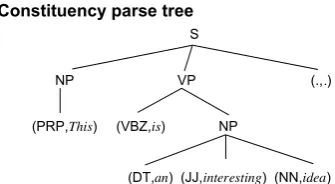
[image:3.595.329.497.64.156.2]S NP PRP /NP VP VBZ NP DT JJ NN /NP /VP . /S
Figure 1: The parse tree and its linearized tree sequence of a sentence “This is an interesting idea.”
obtaining sampled semantic and syntactic repre-sentations,zsem andzsyn; then, they are
concate-nated asz= [zsem;zsyn]and fed as the initial state
of the decoder for reconstruction.
Decoding in the Test Phase The treatment de-pends on applications. If we would like to syn-thesize a sentence from scratch, both zsyn and zsem are sampled from prior. If we would like
to preserve/vary semantics/syntax, max a poste-rior (MAP) inference or sampling could be applied in respective spaces. Details are provided in§4.
In the following part, we will introduce how syntax is modeled in our approach and how syn-tax and semantics are ensured to be separated.
3.2.1 Modeling Syntax by Predicting Linearized Tree Sequence
While previous studies have tackled the problem of categorical sentiment modeling in the latent space (Hu et al., 2017; Fu et al., 2018), syntax is much more complicated and not finitely cate-gorical. We propose to adopt the linearized tree sequence to explicitly model syntax in the latent space of VAE.
Figure 1 shows the constituency parse tree of the sentence “This is an interesting idea.” The lin-earized tree sequence can be obtained by travers-ing the syntactic tree in a top-down order; if the node is non-terminal, we add a backtracking node (e.g.,/NP) after its child nodes are traversed. We ensure thatzsyncontains syntactic
informa-tion by predicting the linearized tree sequence. In training, the parse tree for sentences are ob-tained by the ZPar1 toolkit, and serves as the groundtruth training signals; in testing, we do not need external syntactic trees. We build an RNN
1https://www.sutd.edu.sg/cmsresource/faculty/yuezhang/
S NP .. . /S
This is ...
This is ...
S NP .. . /S
[image:4.595.81.270.63.221.2]This is ... This is ...
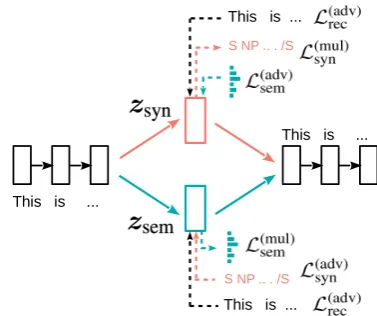
Figure 2: Overview of our DSS-VAE. Forward dashed arrows are multi-task losses; backward dashed arrows are adversarial losses.
(independent of the VAE’s decoder) to predict such linearized parse trees, where each parsing to-ken is represented by an embedding (similar to a traditional RNN decoder). Notice that, a node and its backtracking, e.g.,NPand/NP, have different embeddings.
The linearized tree sequence has achieved promising parsing results in a traditional con-stituency parsing task (Vinyals et al., 2015; Liu et al.,2018;Vaswani et al.,2017), which shows its ability of preserving syntactic information. Ad-ditionally, the linearized tree sequence works in a sequence-to-sequence fashion, so that it can be used to regularize the latent spaces.
3.2.2 Disentangling Syntax and Semantics into Different Latent Spaces
Having solved the problem of syntactic modeling, we now turn to the question: how could we disen-tangle syntax and semantics from each other?
We are inspired by the research in text style transfer and apply auxiliary losses to regularize the latent space (Hu et al.,2017;Fu et al.,2018).
In particular, we adopt the multi-task and adver-sarial losses inJohn et al.(2018), but extend it to the sequence level. In§3.2.3, we further propose two adversarial reconstruction losses to discour-age the model to encode a sentence from a single subspace.
Multi-Task Loss Intuitively, a multi-task loss ensures that each space (zsynorzsem) should
cap-ture respective information.
For the semantic space, we predict the bag-of-words (BoW) distribution of a sentence fromzsem
with softmax, whose objective is the cross-entropy loss against the groundtruth distribution t, given by:
L(mul)sem =−X
w∈Vtwlogp(w|zsem) (3)
where p(w|zsyn) is the predicted distribution.
BoW has been explored by previous work (Weng et al.,2017;John et al.,2018), showing good abil-ity of preserving semantics.
For the syntactic space, the multi-task loss trains a model to predict syntax onzsyn. Due to
our proposal in§3.2.1, we could build a dedicated RNN, predicting the tokens in the linearized parse tree sequence, whose loss is:
L(mul)syn =−Xn
i=1logp(si|s1· · ·si−1,zsyn) (4)
where si is a token in the linearized parse tree
(with a total length ofn).
Adversarial Loss The adversarial loss is widely used for aligning samples from different distri-butions. It has various applications, including style transfer (Hu et al., 2017; Fu et al., 2018;
John et al.,2018) and domain adaptation (Tzeng
et al., 2017). To apply adversarial losses, we
add extra model components (known as adver-saries) to predict semantic information tw based
on the syntactic spacezsyn, but to predict
syntac-tic informations1· · ·sn−1 based on the semantic
spacezsem. They are denoted bypadv(w|zsyn)and
padv(si|s1· · ·si−1,zsem).
The training of these adversaries are similar to (3) and (4), except that the gradient only trains the adversaries themselves, and does not back-propagate to VAE.
Then, VAE is trained to “fool” the adversaries by maximizing their losses, i.e., minimizing the following terms:
L(adv)sem =X
w∈Vtwlogpadv(w|zsyn) (5)
L(adv)syn =Xn
i=1logpadv(si|s1· · ·si−1,zsem) (6)
In this phase, the adversaries are fixed and their parameters are not updated.
3.2.3 Adversarial Reconstruction Loss
Our next intuition is that syntax and semantics are more interwoven to each other than other informa-tion such as style and content.
§3.2.2, where zsem could predict BoW well, but
does not contain any information about the syn-tactic tree. Even in this ideal case, the decoder can reconstruct the original sentence fromzsemby
simply learning to re-order words (as zsem does
contain BoW). Such word re-ordering knowledge is indeed learnable (Ma et al., 2018), and does not necessarily contain the syntactic information. Therefore, the multi-task and adversarial losses for syntax and semantics do not suffice to regularize DSS-VAE.
We now propose anadversarial reconstruction lossto discourage the sentence being predicted by a single subspace zsynorzsem. When combined,
however, they should provide a holistic view of the entire sentence. Formally, let zs be a latent
variable (zs = zsyn orzsem). A decoding
adver-sary is trained to predict the sentence based onzs,
denoted byprec(xi|x1· · ·xi−1,zs). Then, the
ad-versarial reconstruction loss is imposed by mini-mizing
L(adv)rec (zs) = XM
i=1logprec(xi|x<i,zs) (7)
Such adversarial reconstruction loss is applied to both the syntactic and semantic spaces, shown by black bashed arrows in Figure2.
3.3 Training Details
Overall Training Objective The overall train-ing loss is a combination of the VAE loss (2), the multi-task and adversarial losses for syntax and se-mantics (3–6), as well as the adversarial recon-struction losses (7), , i.e., minimizing
L=Lvae+Laux
=− E
q(zsem|x)q(zsyn|x)
logp(x|zsem,zsyn)
+λKLsemKL q(zsem|x)
p(zsem)
+λKLsynKL q(zsyn|x)
p(zsyn)
+λmulsemL(mul)sem +λadvsemL(adv)sem +λrecsemL(adv)rec (zsem)
+λmulsynL(mul)syn +λadvsynL(adv)syn +λrecsynL(adv)rec (zsyn)
(8)
where theλKL
sem,λKLsyn,λmulsem,λadvsem,λrecsem,λmulsyn,λadvsyn,
andλrecsynare the hyperparameters to adjust the im-portance of each loss in overall objective.
Hyperparameter Tuning We select the param-eter values with the lowest ELBO value on the validation set in all experiments. They are tuned by (grouped) grid search on the validation set, but
due to the large hyperparameter space, we conduct tuning mostly for sensitive hyperparameters and admit that it is empirical. We choose the VAE as our baseline, and the KL weight of VAE is tuned in the same way. We list the hyperparameters in AppendixA.
The training objective is optimized by Adam (Kingma and Ba, 2015) with β1 = 0.9, β2 = 0.995, and the initial learning rate is
0.001. Word embeddings are 300-dimensional and initialized randomly. The dimension of each latent space (namely,zsynandzsem) is 100.
KL Annealing and Word Dropout We adopt the tricks of KL annealing and word dropout
fromBowman et al.(2016) to avoid KL collapse.
We annealλKL
synand λKLsyn from zero to predefined
values in a sigmoid manner. Besides, the word dropout trick randomly replaces the ground-truth token with<unk>with a fixed probability of 0.50 at each time step of the decoder during training.
4 Experiments
We evaluate our method on reconstruction and un-conditional language generation (§4.1). Then, we apply it two applications, namely, unsupervised paraphrase generation (§4.2) and syntax-transfer generation (§4.3).
4.1 Reconstruction and Unconditional Language Generation
First, we compare our model in reconstruc-tion and uncondireconstruc-tional language generareconstruc-tion with a traditional VAE and a syntactic language model (PRPN,Shen et al.,2017).
Dataset We followed previous work (Bowman
et al., 2016) and used a standard benchmark, the
WSJ sections in the Penn Treebank (PTB) (
Mar-cus et al., 1993). We also followed the standard
split: Sections 2–21 for training, Section 24 for validation, and Section 23 for test.
Settings We trained VAE and DSS-VAE, both with 100-dimensional RNN states. For the vo-cabulary, we chose 30k most frequent words. We trained PRPN with the default parameter in the code base.2
Evaluation We evaluate model performance with the following metrics:
KL-Weight BLEU↑ Forward PPL↓
1.3 7.26 34.01
1.2 7.41 35.00
1.0 8.19 36.53
0.7 8.98 42.44
0.5 9.07 44.11
0.3 9.26 48.70
[image:6.595.103.260.61.146.2]0.1 9.36 49.73
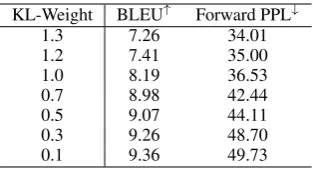
Table 1: BLEU and Forward PPL of VAE with vary-ing KL weights on the PTB test set. The larger↑ (or lower↓), the better.
1. Reconstruction BLEU. The reconstruction task aims to generate the input sentence it-self. In the task, both syntactic and se-mantic vectors are chosen as the predicted mean of the encoded distribution. We eval-uate the reconstruction performance by the BLEU score (Papineni et al.,2002) with in-put as the reference.3 It reflects how well the model could preserve input information, and is crucial for representation learning and “goal-oriented” text generation.
2. Forward PPL. We then perform uncondi-tioned generation, where both syntactic and semantic vectors are sampled from prior. For-ward perplexity (PPL) (Zhao et al., 2018) is the generated sentences’ perplexity score predicted by a pertained language model.4 It shows the fluency of generated sentences from VAE’s prior. We computed Forward PPL based on 100K sampled sentences.
3. Reverse PPL. Unconditioned generation is further evaluated by Reverse PPL (Zhao et al.,2018). It is obtained by first training a language model5on 100K sampled sentences
from a generation model; then, Reverse PPL is the perplexity of the PTB test sets with the trained language model. Reverse PPL evalu-ates the diversity and fluency of sampled sen-tences from a language generation model. If sampled sentences are of low diversity, the language model would be trained only on similar sentences; if the sampled sentences are of low fluency, the language model would
3
We evaluate the corpus BLEU implemented inhttps:// www.nltk.org/ modules/nltk/translate/bleu score.html
4We used an LSTM language model trained on the One-Billion-Word Corpus (http://www.statmt.org/
lm-benchmark).
5Tied LSTM-LM with 300 dimensions and two lay-ers, implemented in https://github.com/pytorch/examples/ tree/master/word language model
1
VAE
34.01 7.26 31.82 8.01
35 7.41 32.09 8.71
36.53 8.19 35.29 9.29
42.44 8.98 35.54 9.55
44.11 9.07 42.36 11.69
48.7 9.26 42.5 11.12
47.33 8.98 45.6 9.6
49.73 9.36 49.79 11.09
syntax-VAE
BLEU
7 8 9 10 11 12
Forward-PPL
31 36 41 46 51
VAE DSS-VAE
1
Figure 3: Comparing DSS-VAE and VAE in language generation with different KL weight. We performed linear regression for each model to show the trend. The upper-left corner (larger BLEU but smaller PPL) indi-cates a better performance.
be trained on unfluent sentences. Both will lead to higher Reverse PPL. For comparing VAE and DSS-VAE, we sample latent vari-ables from the prior, and feed them to the de-coder for generation; for LSTM-LM, we first feed the start sentence token<s>to the de-coder, and sample the word at each time step by predicted probabilities (i.e., forward sam-pling).
Results We see in Table1 that BLEU and PPL are more or less contradictory. Usually, a smaller KL weight makes the autoencoder less “varia-tional” but more “deterministic,” leading to less fluent sampled sentences but better reconstruction. If the trade-off is not analyzed explicitly, the VAE variant could have arbitrary results based on KL-weight tuning, which is unfair.
We therefore present the scatter plot in Figure3, showing the trend of forward PPL and BLEU scores with different KL weights. Clearly, DSS-VAE outperforms a plain DSS-VAE in BLEU if For-ward PPL is controlled, and in ForFor-ward PPL if BLEU is controlled. The scatter plot shows that our proposed DSS-VAE outperforms the original counterpart in language generation with different KL weights.
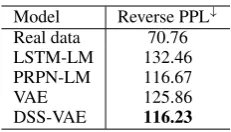
In terms of Reverse PPL (Table 2), DSS-VAE also achieves better Reverse PPL than a tradi-tional VAE. Since DSS-VAE leverages syntax to improve the sentence generation, we also include a state-of-the-art syntactic language model
(PRPN-LM, Shen et al., 2017) for comparison.
[image:6.595.311.531.64.200.2]Model Reverse PPL↓ Real data 70.76 LSTM-LM 132.46 PRPN-LM 116.67
VAE 125.86
[image:7.595.123.239.60.126.2]DSS-VAE 116.23
Table 2: Reverse PPL reflect the diversity and fluency of sampling data, the lower↓, the better. Training on the model sampled and evaluated on the real test set. We set the same KL weight for DSS-VAE and VAE here.(KL weight=1.0)
PRPN-LM. It is also seen that explicitly model-ing syntactic structures does yield better gener-ation results—DSS-VAE and PRPN consistently outperform VAE and LSTM-LM in sentence gen-eration.
We also include the Reverse PPL of the real training sentences. As expected, training a lan-guage model on real data outperforms training on sampled sentences from a generation model, showing that there is still much room for improve-ment for all current sentence generators.
4.2 Unsupervised Paraphrase Generation
Given an input sentence, paraphrase generation aims to synthesize a sentence that appears differ-ent from the input, but conveys the same mean-ing. We propose a novel approach to unsupervised paraphrase generation with DSS-VAE. Suppose a DSS-VAE is well trained according to §3.3, our approach works in the inference stage.
For a particular input sentence x∗, let q(zsyn|x∗) and q(zsem|x∗) be the encoded
pos-terior distributions of the syntactic and semantic spaces, respectively. The inferred latent vectors are:
z∗sem= argmaxzsem q(zsem|x∗) (9)
zsyn∗ ∼q(zsyn|x∗) (10)
and are further combined as:
z∗ =z∗syn;zsem∗ (11)
Finally, z∗ is fed to the decoder and perform a greedy decoding for paraphrase generation.
The intuition behind is that, when generating the paraphrase, semantics should remain the same, but the syntax of a paraphrase could (and should) vary. Therefore, we sample azsyn∗ vector from its probabilistic distribution, while fixingzsem∗ .
Model BLEU-ref↑ BLEU-ori↓ Origin Sentence† 30.49 100 VAE-SVG-eq (supervised)‡ 22.90 – VAE (unsupervised)† 9.25 27.23
CGMH† 18.85 50.18
[image:7.595.309.524.61.129.2]DSS-VAE 20.54 52.77
Table 3: Performance of paraphrase generation. The larger↑(or lower↓), the better. Some results are quoted from†Miao et al.(2019) and‡Gupta et al.(2018).
Dataset We used the established Quora dataset6 to evaluate paraphrase generation, following pre-vious work (Miao et al.,2019). The dataset con-tains 140k pairs of paraphrase sentences and 260k pairs of non-paraphrase sentences. In the stan-dard dataset split, there are 3k and 30k held-out validation and test sets, respectively. In this ex-periment, we consider the unsupervised setting
as Miao et al. (2019), using all non-paraphrase
sentences as training samples. It is also noted that we only valid our model on the non-paraphrase held-out validation set by selecting with the lowest validation ELBO.
Evaluation Since the test set contains a refer-ence paraphrase for each input, it is straightfor-ward to compute the BLEU against the refer-ence, denoted by BLEU-ref. However, this metric alone does not model whether the generated sen-tence is different from the input, and thus, Miao
et al.(2019) propose to measure this by
comput-ing BLEU against the original sentence (denoted as BLEU-ori), which ideally should be low. We only consider the DSS-VAE that yields a BLEU-ori lower than 55, which is empirically suggested
by Miao et al. (2019) that ensures the obtained
sentence is different from the original to at least a certain degree.
Results Table 3 shows the performance of un-supervised paraphrase generation. In the first row of Table3, simply copying the original sentences yields the highest BLEU-ref, but is meaningless as it has a BLEU-ori score of 100. We see that DSS-VAE outperforms the CGMH and the orig-inal VAE in BLEU-ref. Especially, DSS-VAE achieves a closer BLEU-ref compared with super-vised paraphrase methods (Gupta et al.,2018).
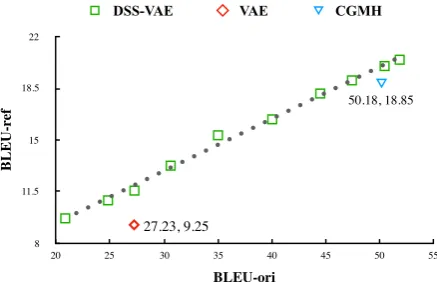
We admit that it is hard to present the trade-off by listing a single score for each model in the Ta-ble 3. We therefore have the scatter plot in
1
40.04 16.4 27.23 9.25 50.18 18.85
syntax-VAE
27.26 11.57
24.81 10.91
30.62 13.26
VAE
35.01 15.32
20.84 9.69
51.86 20.44
44.49 18.15
47.43 19.04
50.46 20.01
CGMH
BLEU
-r
ef
8 11.5 15 18.5 22
BLEU-ori
20 25 30 35 40 45 50 55
50.18, 18.85
27.23, 9.25
DSS-VAE VAE CGMH
[image:8.595.75.294.71.212.2]1
Figure 4: Trade-off between BLEU-ori (the lower, the better) and BLEU-ref (the larger, the better) in unsu-pervised paraphrase generation. Again, the upper-left corner indicates a better performance.
ure4to further compare these methods. As seen, the trade-off is pretty linear and less noisy com-pared with Figure 3. It is seen that the line of DSS-VAE is located to the upper-left of the com-peting methods. In other words, the plain VAE and CGMH are “inadmissible,” meaning that DSS-VAE simultaneously outperforms them in both BLEU-ori and BLEU-ref, indicating that DSS-VAE outperforms previous state-of-the-art meth-ods in unsupervised paraphrase generation.
4.3 Syntax-Transfer Generation
In this experiment, we propose a novel application of syntax-transfer text generation, inspired by pre-vious sentiment-style transfer studies (Hu et al.,
2017;Fu et al.,2018;John et al.,2018). Consider two sentences:
x1: There is a dog behind the door.
x2: The child is playing in the garden.
If we would like to generate a sentence having the syntax of “there is/are” asx1but conveying the meaning ofx2, we could graft the respective
syntactic and semantic vectors as:
zsem∗ = argmaxzsemq(zsem|x2)
z∗syn= argmaxzsyn q(zsyn|x1)
z =
z∗sem;zsyn∗
and then feedzto the decoder to obtain a syntax-transferred sentence.
Dataset and Evaluation To evaluate this task, we constructed a subset of the Stanford Natural
Language Inference (SNLI), containing 1000 non-paraphrase pairs. SNLI sentences can be thought of as a simple domain-specific corpus, but were all written by humans. In each pair we constructed, one sentence serves as the semantic provider (de-noted by Refsem), and the other serves as the
syn-tactic provider (denoted by Refsyn). The goal of
syntax-transfer text generation is to synthesize a sentence that resembles Refsem but not Refsyn in
semantics, and resembles Refsynbut not Refsem in
syntax. For the semantic part, we use the tradi-tional word-based BLEU scores to evaluate how the generated sentence is close to Refsem but
dif-ferent from Refsyn. For syntactic similarity, we use
the zss package7 to calculate the Tree Edit Dis-tance (TED,Zhang and Shasha,1989). TED is es-sentially the minimum-cost sequence of node edit operations (namely, delete, insert, and rename) be-tween two trees, which reflects the difference of two syntactic trees.
Since we hope the generated sentence has a higher word-BLEU score compared with Refsem
but a lower word-BLEU score compared with Refsyn, we compute their difference, denoted by
∆word-BLEU, to consider both. Likewise,∆TED is also computed. We further take the geometric mean of ∆word-BLEU and ∆TED to take both into account.
Results We see from Table 4 that a traditional VAE cannot accomplish the task of syntax transfer. This is because Refsynand Refsem—even if we
ar-tificially split the latent space into two parts—play the same role in the decoder. With the multi-task and adversarial losses for syntactic and semantic latent spaces, the total difference is increased by 12.09, which shows the success of syntax-transfer sentence generation. This further implies that ex-plicitly modeling syntax is feasible in the latent space of VAE. We incrementally applied the ad-versarial reconstruction loss, proposed in§3.2.3.
As seen, an adversarial reconstruction loss dras-tically strengthens the role of the other space. For example, +L(adv)rec (zsem) repels information to the
syntactic space and achieves the highest∆TED. When applying the adversarial reconstruction losses to both semantic and syntactic spaces, we have a balance between ∆word-BLEU and
∆TED, both ranking second in the respective columns. Eventually, we achieve the highest total difference, showing that our full DSS-VAE model
Model word-BLEU (corpus) ∆word-BLEU↑ Average TED (per sentence) ∆TED↑ Geo Mean∆↑
Refsem↑ Refsyn↓ Refsem↑ Refsyn↓
VAE 6.81 6.68 0.13 149.22 148.59 0.63 0.29 L(mul)sem +L(mul)syn +L(adv)sem +L(adv)syn 12.14 6.22 5.92 159.51 134.80 24.71 12.09
+L(adv)
rec (zsem) 11.83 6.60 5.23 163.40 131.27 32.13 12.96
+L(adv)
rec (zsyn) 14.33 6.07 8.26 159.20 134.22 24.98 14.36
[image:9.595.72.528.63.140.2]+L(adv)rec (zsyn) +L(adv)rec (zsem) 13.74 6.15 7.59 161.94 131.09 30.85 15.30
Table 4: Performance of syntax-transfer generation. The larger↑(or lower↓), the better. The results of VAE are obtained by averaging interpolation.∆word-BLEU=word-BLEU(Refsem)−word-BLEU(Refsyn). We also com-pute the difference as∆TED=TED(Refsem)−TED(Refsyn)to measure if the generated sentence is syntactically similar to Refsynbut not Refsem. Due to the difference of scale between BLEU and TED, we compute the geometric
mean of∆word-BLEU and∆TED reflect the total differences.
achieves the best performance of syntax-transfer generation.
Discussion on syntax transfer between incom-patible sentences We provide a few case stud-ies of syntax-transfer generation in Appendix B. We empirically find that the syntactic transfer be-tween “compatible” sentences give more promis-ing results than transfer between “incompatible” sentences. Intuitively, this is reasonable because it may be hard to transfer a sentence with a length of 5, say, to a sentence with a length of 50.
5 Conclusion
In this paper, we propose a novel DSS-VAE model, which explicitly models syntax in the dis-tributed latent space of VAE and enjoys the ben-efits of sampling and manipulation in terms of the syntax of a sentence. Experiments show that DSS-VAE outperforms the VAE baseline in recon-struction and unconditioned language generation. We further make use of the sampling and manipu-lation advantages of DSS-VAE in two novel ap-plications, namely unsupervised paraphrase and syntax-transfer generation. In both experiments, DSS-VAE achieves promising results.
Acknowledgments
We would like to thank the anonymous review-ers for their insightful comments. This work is supported by the National Science Foundation of China (No. 61772261 and No. 61672277) and the Jiangsu Provincial Research Foundation for Basic Research (No. BK20170074).
References
Samuel R. Bowman, Luke Vilnis, Oriol Vinyals, An-drew Dai, Rafal Jozefowicz, and Samy Bengio.
2016. Generating sentences from a continuous space. InCoNLL, pages 10–21.
Eugene Charniak. 2001. Immediate-head parsing for language models. InACL, pages 124–131.
Ciprian Chelba. 1997. A structured language model. InACL, pages 498–500.
Huadong Chen, Shujian Huang, David Chiang, and Ji-ajun Chen. 2017. Improved neural machine trans-lation with a syntax-aware encoder and decoder. In
ACL, pages 1936–1945.
Kyunghyun Cho, Bart van Merrienboer, Caglar Gul-cehre, Dzmitry Bahdanau, Fethi Bougares, Holger Schwenk, and Yoshua Bengio. 2014. Learning phrase representations using RNN encoder–decoder for statistical machine translation. InEMNLP, pages 1724–1734.
Alexander Clark. 2001. Unsupervised induction of stochastic context-free grammars using
distribu-tional clustering. In Proceedings of the ACL
2001 Workshop on Computational Natural Lan-guage Learning.
Hanjun Dai, Yingtao Tian, Bo Dai, Steven Skiena, and Le Song. 2018. Syntax-directed variational autoen-coder for structured data. InICLR.
Jan Milan Deriu and Mark Cieliebak. 2018. Syntac-tic manipulation for generating more diverse and in-teresting texts. InProceedings of the 11th Interna-tional Conference on Natural Language Generation, pages 22–34.
Chris Dyer, Adhiguna Kuncoro, Miguel Ballesteros, and Noah A Smith. 2016. Recurrent neural network
grammars. InNAACL, pages 199–209.
Akiko Eriguchi, Kazuma Hashimoto, and Yoshimasa Tsuruoka. 2016. Tree-to-sequence attentional neu-ral machine translation. InACL, pages 823–833.
Rafael G´omez-Bombarelli, Jennifer N Wei, David Duvenaud, Jos´e Miguel Hern´andez-Lobato, Ben-jam´ın S´anchez-Lengeling, Dennis Sheberla, Jorge Aguilera-Iparraguirre, Timothy D Hirzel, Ryan P Adams, and Al´an Aspuru-Guzik. 2018. Automatic chemical design using a data-driven continuous
rep-resentation of molecules. ACS Central Science,
4(2):268–276.
Ankush Gupta, Arvind Agarwal, Prawaan Singh, and Piyush Rai. 2018. A deep generative framework for paraphrase generation. InAAAI, pages 5149–5156.
Zhiting Hu, Zichao Yang, Xiaodan Liang, Ruslan Salakhutdinov, and Eric P. Xing. 2017. Toward
con-trolled generation of text. In ICML, pages 1587–
1596.
Vineet John, Lili Mou, Hareesh Bahuleyan, and Olga Vechtomova. 2018. Disentangled representation
learning for text style transfer. arXiv preprint
arXiv:1808.04339.
Diederik P. Kingma and Jimmy Ba. 2015. Adam: A method for stochastic optimization. InICLR.
Diederik P Kingma and Max Welling. 2014. Auto-encoding variational Bayes. InICLR.
Adhiguna Kuncoro, Miguel Ballesteros, Lingpeng Kong, Chris Dyer, Graham Neubig, and Noah A Smith. 2017. What do recurrent neural network
grammars learn about syntax? In EACL, pages
1249–1258.
Matt J. Kusner, Brooks Paige, and Jos´e Miguel Hern´andez-Lobato. 2017. Grammar variational
au-toencoder. InICML, pages 1945–1954.
Juncen Li, Robin Jia, He He, and Percy Liang. 2018a.
Delete, Retrieve, Generate: a simple approach to sentiment and style transfer. InACL, pages 1865– 1874.
Junhui Li, Deyi Xiong, Zhaopeng Tu, Muhua Zhu, Min Zhang, and Guodong Zhou. 2017. Modeling source syntax for neural machine translation. InACL, pages 688–697.
Juntao Li, Yan Song, Haisong Zhang, Dongmin Chen, Shuming Shi, Dongyan Zhao, and Rui Yan. 2018b.
Generating classical chinese poems via conditional variational autoencoder and adversarial training. In
EMNLP, pages 3890–3900.
Lemao Liu, Muhua Zhu, and Shuming Shi. 2018. Im-proving sequence-to-sequence constituency parsing. InAAAI, pages 4873–4880.
Shuming Ma, Xu Sun, Yizhong Wang, and Junyang Lin. 2018. Bag-of-words as target for neural ma-chine translation. InACL, pages 332–338.
Mitchell P Marcus, Mary Ann Marcinkiewicz, and Beatrice Santorini. 1993. Building a large annotated
corpus of english: The Penn Treebank.
Computa-tional linguistics, 19(2):313–330.
Ning Miao, Hao Zhou, Lili Mou, Rui Yan, and Lei Li. 2019. CGMH: Constrained sentence generation by Metropolis-Hastings sampling. InAAAI.
Tom´aˇs Mikolov, Martin Karafi´at, Luk´aˇs Burget, Jan ˇ
Cernock`y, and Sanjeev Khudanpur. 2010.
Recur-rent neural network based language model. In
IN-TERSPEECH.
Vinod Nair and Geoffrey E Hinton. 2010. Rectified linear units improve restricted boltzmann machines. InICML, pages 807–814.
Kishore Papineni, Salim Roukos, Todd Ward, and Wei-Jing Zhu. 2002. BLEU: A method for automatic
evaluation of machine translation. In ACL, pages
311–318.
Stanislau Semeniuta, Aliaksei Severyn, and Erhardt Barth. 2017. A hybrid convolutional variational
au-toencoder for text generation. In EMNLP, pages
627–637.
Iulian Vlad Serban, Alessandro Sordoni, Ryan Lowe, Laurent Charlin, Joelle Pineau, Aaron C Courville, and Yoshua Bengio. 2017. A hierarchical latent variable encoder-decoder model for generating
di-alogues. InAAAI, pages 3295–3301.
Yikang Shen, Zhouhan Lin, Chin-Wei Huang, and Aaron Courville. 2017. Neural language modeling by jointly learning syntax and lexicon. InICLR.
Eric Tzeng, Judy Hoffman, Kate Saenko, and Trevor Darrell. 2017. Adversarial discriminative domain adaptation. InCVPR, pages 7167–7176.
Ashish Vaswani, Noam Shazeer, Niki Parmar, Jakob Uszkoreit, Llion Jones, Aidan N Gomez, Łukasz Kaiser, and Illia Polosukhin. 2017. Attention is all you need. InNIPS, pages 5998–6008.
Oriol Vinyals, Łukasz Kaiser, Terry Koo, Slav Petrov, Ilya Sutskever, and Geoffrey Hinton. 2015.
Gram-mar as a foreign language. In NIPS, pages 2773–
2781.
Rongxiang Weng, Shujian Huang, Zaixiang Zheng, XIN-YU DAI, and CHEN Jiajun. 2017. Neural ma-chine translation with word predictions. InEMNLP, pages 136–145.
Kaizhong Zhang and Dennis Shasha. 1989. Simple fast algorithms for the editing distance between trees
and related problems. SIAM journal on computing,
18(6):1245–1262.
Junbo Jake Zhao, Yoon Kim, Kelly Zhang, Alexan-der M. Rush, and Yann LeCun. 2018. Adversarially
regularized autoencoders. In ICML, pages 5897–
5906.
Hao Zhou, Zhaopeng Tu, Shujian Huang, Xiaohua Liu, Hang Li, and Jiajun Chen. 2017. Chunk-based
bi-scale decoder for neural machine translation. In
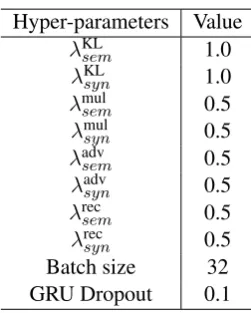
A Hyperparameter Details
We list the hyperparaemters in Tables5and6. Ev-ery 500 batch, we save the model if it achieves a lowerevidence lower bound (ELBO) on the vali-dation set.
B Case Study of Syntax Transfer
We provide a few examples in Table7. We see in all cases that a plain VAE “interpolates” two sen-tences without the consideration of syntax and se-mantics, whereas our DSS-VAE is able to transfer the syntax without changing the meaning much. In the first example, DSS-VAE successfully trans-fer a “subject-be-predicative” sentence to a “there is/are” sentence. For the second example, the se-mantic reference has the same syntactic structure as the syntax reference, and as a result, DSS-VAE generates the same sentence as Refsem. For the last
Hyper-parameters Value λKL
sem 1.0
λKLsyn 1.0 λmul
sem 0.5
λmulsyn 0.5 λadv
sem 0.5
λadvsyn 0.5 λrec
sem 0.5
[image:12.595.110.236.161.318.2]λrecsyn 0.5 Batch size 32 GRU Dropout 0.1
Table 5: The hyper-parameters we used in PTB dataset
Hyper-parameters Value λKL
sem 1/3
λKLsyn 2/3 λmul
sem 5.0
λmulsyn 1.0 λadv
sem 0.5
λadvsyn 0.5 λrec
sem 1.0
[image:12.595.337.467.163.317.2]λrecsyn 0.05 Batch size 50 GRU Dropout 0.3
Table 6: The hyper-parameters we used in Quora dataset.
Semantic and Syntactic Providers Syntax-Transfer Output
Refsyn: There is an apple on the table.
Refsem: The airplane is in the sky.
VAE: The man is in the kitchen.
DSS-VAE: There is a airplane in the sky.
Refsyn: The shellfish was cooked in a wok.
Refsem: The stadium was packed with people.
VAE: The man was filled with people.
DSS-VAE: The stadium was packed with people.
Refsyn: The child is playing in the garden.
Refsem: There is a dog behind the door.
VAE: There is a person in the garden.
DSS-VAE: A dog is walking behind the door.
[image:12.595.74.525.562.639.2]