Proceedings of the 57th Annual Meeting of the Association for Computational Linguistics, pages 44–50 44
Constructing Interpretive Spatio-Temporal Features for Multi-Turn
Responses Selection
Junyu Lu†, Chenbin Zhang†, Zeying Xie, Guang Ling, Chao Zhou, Zenglin Xu† †SMILE Lab, University of Electronic Science and Technology of China, Sichuan, China
{cs.junyu, aleczhang13, swpdtz, zacharyling}@gmail.com, [email protected], [email protected]
Abstract
Response selection plays an important role in fully automated dialogue systems. Given the dialogue context, the goal of response se-lection is to identify the best-matched next-utterance (i.e., response) from multiple can-didates. Despite the efforts of many previ-ous useful models, this task remains challeng-ing due to the huge semantic gap and also the large size of candidate set. To address these issues, we propose a Spatio-Temporal Matching network (STM) for response selec-tion. In detail, soft alignment is first used to obtain the local relevance between the con-text and the response. And then, we con-struct spatio-temporal features by aggregating attention images in time dimension and make use of 3D convolution and pooling operations to extract matching information. Evaluation on two large-scale multi-turn response selec-tion tasks has demonstrated that our proposed model significantly outperforms the state-of-the-art model. Particularly, visualization anal-ysis shows that the spatio-temporal features enables matching information in segment pairs and time sequences, and have good inter-pretability for multi-turn text matching.
1 Introduction
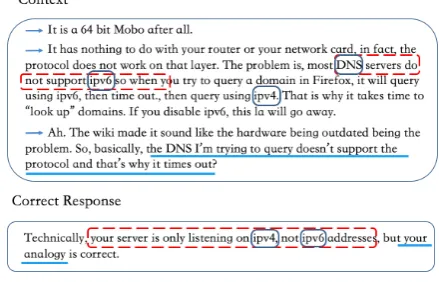
Fully automated dialogue systems (Litman and Silliman,2004;Banchs and Li,2012;Lowe et al., 2017; Zhou et al., 2018) are becoming increas-ingly important area in natural language process-ing. An important research topic in dialogue sys-tems is response selection, as illustrated in Figure 1, which aims to select an optimal response from a pre-defined pool of potential responses (Kum-merfeld et al., 2018). Practical methods to re-sponse selection are usually retrieval-based, that focus on matching the semantic similarity between the response and utterances in the dialogue his-tory (Shang et al.,2015;Zhang et al.,2018).
Recently, convolutional operation, as a useful attempt to explore local correlation, has been
in-Figure 1: Examples of the Ubuntu dataset provided by
NOESIS1. Text segments with the same color symbols
across context and response can be seen as matched pairs.
vestigated to extract the matching features from the attention grid (Wu et al., 2017; Zhou et al., 2018). Unfortunately, these methods usually do not perform well when there are many candidate responses.
In fact, in multi-turn dialogues, the next sen-tence is generally based on what was presented be-fore and tends to match a recent local context. This is because the topic in a conversation may change over time, and the effective matching between the dialogue may only appear in a local time period. This phenomena generally appear in video pro-cessing (Hara et al.,2018;Tran et al.,2014), im-age caption (Chen et al.,2017) and action recog-nition (Girdhar and Ramanan,2017).
Therefore, it is natural to adopt convolutional structure or attention mechanism to extract lo-cal matching information from the sentence se-quences. Analogously, each turn of dialogue can be regarded as a frame of a video. This moti-vates us to propose the Spatio-Temporal Match-ing block (STM) to construct the spatio-temporal
1Noetic End-to-End Response Selection Challenge is
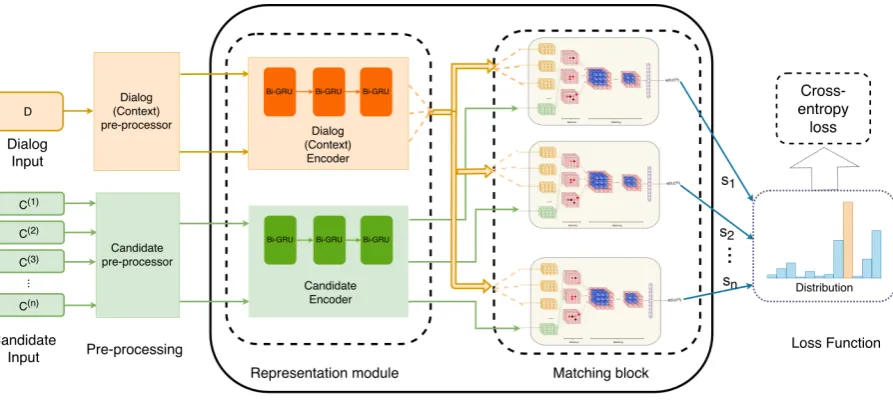
[image:1.595.305.525.209.350.2]Figure 2: The proposed spatio-temporal matching framework for response selection.
features of local semantic relation between each turn of dialog and candidates by soft-attention mechanism. In detail, we model the response selection problem as a multi-class classification problem with sequences as input, where the la-bel of the true response is set to one and the other candidates are set to zero. As illustrated in Figure 2, the proposed STM framework in-cludes two parts: (i)representation module and (ii) matching block. Specifically, representa-tions of the dialogue context and candidate an-swers are first learned through from dual en-coders, and deep 3D ConvNets (Ji et al., 2013) are then used to match attentions between the di-alogue contexts and candidate answers. Evalua-tion on the NOESIS datasets has demonstrated the outstanding performance of our proposed model against other well-known frameworks. Further-more, our model enjoys a merit of good inter-pretation with the visualization of the attention weight as a thermal map. Our code is released
under https://github.com/CSLujunyu/
Spatio-Temporal-Matching-Network.
2 Our model
Before presenting the model, we first provide the problem formulation. Suppose that we have a di-alogue dataset{(D,C,R)i}N
i=1, we denotesD = {d0, d1, ..., dm}as a conversation context with
ut-terancesdiandC={c0, c1, ..., cn}as the next
ut-terance candidate set.Rrepresents the correct re-sponse ID in the corresponding candidate set. Our goal is to learn a matching model between the
di-alog context D and the candidates ci which can
measure the matching degree and predict the best matched response.
2.1 Representation Module
Given a dialog contextD = {d0, d1, ..., dm} and
candidatesC={c0, c1, ..., cn}, we employL
lay-ers of bidirectional GRUs (Bi-GRU) (Cho et al., 2014) to extract sequential information in a sen-tence. The representations we used are deep, in the sense that they are a function of all of the internal layers of the Bi-GRU (Devlin et al., 2018; Peters et al., 2018a) We denote lth GRU layer dialog and candidate representation asHlµ=
{µl0, µl1, ..., µlm} and Hγl = {γ0l, γ1l, ..., γnl} re-spectively.
2.2 Spatio-Temporal Matching block
An illustration of the matching block is shown in Figure 3. We use attention mechanism to con-struct local related features for every candidate. In order to avoid the influence of gradient explo-sion caused by large dot product, matching ma-trices are constructed at each layer using scale-attention (Vaswani et al.,2017), which is defined as:
Mlµm,γn = (µ
l m)
T
γnl
√
d , (1)
wherel ∈ [1, L],µlm ∈ Rd×nµ denotesmth turn of dialog representation at lth GRU layer, γl
n ∈ Rd×nγ denotesnth candidate representation atlth
attention images,dis the dimension of word em-bedding,nµ andnγdenotes the number of words
[image:3.595.75.291.119.256.2]in dialog utterances and candidates respectively.
Figure 3: A close-up of the matching block
Moreover, in order to retain the natural tempo-ral relationship of the matching matrices, we ag-gregate them all into a 4D-cube by expanding in time dimension. We call 4D-matching as spatio-temporal features and define images ofnth candi-date asQ(n):
Q(n)={Qi,j,k(n) }m×nµ×nγ, (2)
Q(i,j,kn) ={Mµli,γn[j, k]}Ll=0, (3)
where Q(n) ∈ Rm×nµ×nγ×L, Mµli,γn[j, k] ∈ R
andQ(i,j,kn) ∈RLis a pixel inQ(n).
Motivated by C3D network (Tran et al.,2014), it is natural to apply a 3D ConvNet to extract local matching information fromQ(n). The operation of 3D convolution with max-pooling is the exten-sion of typical 2D convolution, whose filters and strides are 3D cubes. Our matching block has four convolution layers and three pooling layers (First two convolution layers are both immediately fol-lowed by pooling layer, yet the last pooling layer follows two continuous convolution layers). All of 3D convolution filters are3×3×3with stride
1×1×1. With the intention of preserving the temporal information in the early phase, 3D pool-ing layers are set as3×3×3with stride3×3×3
except for the first pooling layer which has kernel size of1×3×3and stride1×3×3.
One fully-connected layer is used to predict the matching score between dialog context and poten-tial responses. Finally, we compute softmax cross entropy loss,
sn=Wfconv(Q(n)) +b, (4)
wherefconv is the 3D ConvNet we used, W and bare learned parameters.
3 Experiments
3.1 Dataset
The ongoing DSTC series starts as an initiative to provide a common testbed for the task of Di-alog State Tracking, and the most recent event, DSTC7 in 2018, mainly focused on end-to-end systems (Williams et al., 2013; Yoshino et al., 2019). We evaluate our model on two new datasets that released by the NOESIS (DSTC7 Track1): (1) the Ubuntu Corpus: Ubuntu IRC (Lowe et al., 2015a) consists of almost one million two-person conversations extracted from the Ubuntu chat logs , used to receive technical support for various Ubuntu-related problems. The newest version lies in manually annotations with a large set of can-didates (Kummerfeld et al., 2018). The train-ing data includes over 100,000 complete conversa-tions, and the test data contains 1,000 partial con-versations. (2)the Advising Dataset: It collects advisor dialogues for the purpose of guiding the student to pick courses that fit not only their cur-riculum, but also personal preferences about time, difficulty, career path, etc. It provides 100,000 par-tial conversations for training, obtained by cutting 500 conversations off randomly at different time points. Each conversation has a minimum of 3 turns and up to 100 candidates.
3.2 Metrics
We use the same evaluation metrics as in previ-ous works and the recommendation of the NOE-SIS (Wu et al.,2017;Zhou et al., 2018;Yoshino et al., 2019). Each comparison model is asked to selectk best-matched utterances fromn avail-able candidates. We calculate the recall of the true positive responses among thekselected ones
and denote it as Rn@k= Pk
i=0yi
Pn
i=0yi, whereyi is the binary label for each candidate. In addition, we use MRR (Mean reciprocal rank) (Voorhees et al., 1999;Radev et al.,2002) to evaluate the confident ranking of the candidates returned by our model.
3.3 Experimental Setting
We consider at most 9 turns and 50 words for each utterance and responses in our experiments. Word embeddings are initialized by GloVe1(Pennington
Model R100@1 R100@10 MRR
Baseline 0.083 0.359 -DAM 0.347 0.663 0.356 DAM+Fine-tune 0.364 0.664 0.443 DME 0.383 0.725 0.498 DME-SMN 0.455 0.761 0.558
STM(Transform) 0.490 0.764 0.588
STM(GRU) 0.503 0.783 0.597
STM(Ensemble) 0.521 0.797 0.616∗
[image:4.595.85.276.63.180.2]STM(BERT) 0.548∗ 0.827∗ 0.614
Table 1: Experiment Result on the Ubuntu Corpus.
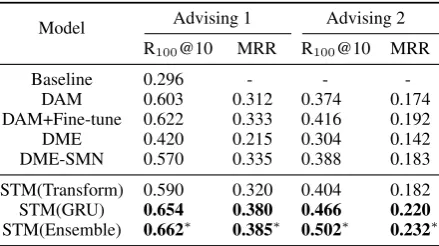
Model Advising 1 Advising 2 R100@10 MRR R100@10 MRR
Baseline 0.296 - - -DAM 0.603 0.312 0.374 0.174 DAM+Fine-tune 0.622 0.333 0.416 0.192 DME 0.420 0.215 0.304 0.142 DME-SMN 0.570 0.335 0.388 0.183
STM(Transform) 0.590 0.320 0.404 0.182 STM(GRU) 0.654 0.380 0.466 0.220
STM(Ensemble) 0.662∗ 0.385∗ 0.502∗ 0.232∗
Table 2: Experiment Results on the Advising Dataset.
et al.,2014) and updated during training. We use Adam (Kingma and Ba,2014) as the optimizer, set the initial learning rate is 0.001, and we employ early-stopping(Caruana et al., 2001) as a regular-ization strategy.
3.4 Comparison Methods
In this paper, we investigate the current state-of-the-art model in response selection task. In order to make it compatible to the task of NOESIS, we have made some changes as following: (1) Base-lineThe benchmark released by DSTC7 is an ex-tension of the Dual LSTM Encoder model2(Lowe et al.,2015b).(2) Dual Multi-turn Encoder Dif-ferent from Baseline, we use a multi-turn encoder to embed each utterance respectively and calcu-late utterance-candidate matching scores using dot product at the last hidden state of LSTM.(3) Se-quential Matching NetworkWe employ Sequen-tial Matching Network (Wu et al.,2017) to mea-sure the matching score of each candidate, and then calculate categorical cross entropy loss across all of them. We name it as DME-SMN in Ta-ble 1, 2. (4) Deep Attention Matching Net-work The DAM (Zhou et al., 2018) trained on undersampling data (Chawla, 2009), which use a
2
https://github.com/IBM/dstc7-noesis/tree/master/noesis-tf
1:1 ratio between true responses and negative re-sponses for training, is represented as DAM in Ta-ble1,2. Furthermore, we also construct context-related negative responses to train the model. We observe that using only this context-related neg-ative responses to train the model will result in divergence. So this data is only used for fine-tuning. In this way, DAM is firstly trained on un-dersampling data then get fine-tuned with context-related negative responses. We name this model as DAM+Fine-tune in Table1,2.
3.5 Ablation Study
As it is shown in Table1, we conduct an ablation study on the testset of the Ubuntu Corpus, where we aim to examine the effect of each part in our proposed model.
Firstly, we verify the effectiveness of dual multi-turn encoder by comparing Baseline and DME in Table 1. Thanks to dual multi-turn en-coder, DME achieves 0.725 at R100@10 which is 0.366 better than the Baseline (Lowe et al., 2015b).
Secondly, we study the ability of representation module by testing LSTM, GRU and Transformer with the default hyperparameter in Tensorflow. We note that GRU is better for this task. After re-moving spatio-temporal matching block, the per-formance degrades significantly.
In order to verify the effectiveness of STM block further, we design a DME-SMN which uses 2D convolution for extracting spatial attention in-formation and employ GRU for modeling tempo-ral information. The STM block makes a 10.54% improvement at R100@1.
Next, we replace GRU with Transformer in STM. Supposed the data has maximal m turns and n candidates, the time complexity of cross-attention (Zhou et al., 2018), O(mn), is much higher than that of the Dual-Encoder based model,
O(m+n). Thus, cross-attention is an impracti-cal operation when the candidate set is large. So we remove cross-attention operations in DAM and extend it with Dual-Encoder architecture. The re-sult in Table1shows that using self-attention only may not be enough for representation.
[image:4.595.72.292.214.337.2]Figure 4: Attention feature across positive and negative matching in the first layer.
highest results and outperforms other methods by a significant margin.
3.6 Visualization
In order to demonstrate the effectiveness of spatio-temporal information matching mechanism, we visualize attention features across positive and negative examples.
To clarify how our model identifies important matching information between context and candi-dates, we visualize the attention matching matri-ces in Figure4. The first row is positive ing matrices and the sencond is negative match-ing example. We denote they-axis of Figure4as response sentence and thex-axis as utterances in context. Each colored grid represents the match-ing degree or attention score between two words. Deeper color represents better matching. Atten-tion images in the first row are related to posi-tive matching while those of the second row are related to negative matching. Intuitively, We can see that important words such as “vlc”, “wma” are recognized and carried to match “drm” in correct response. In contrast, the incorrect response has no correlation and thus little matching spaces.
Note that our model can not only match word-level information, but also can match
segment-Figure 5: Attention feature in different granularities. Left picture represents the second layer matching ma-trix for segment granularities, while right picture match at the third layer.
level or sentence level information using 3D con-volution. As it shows in Figure5, the second layer tends to concentrate on segment-level information for which “wma patch” in utterance highly match “the home page drm” and “nasty nasty standard drm” in response. Furthermore, we find in our ex-periment that third layer tends to focus on sentence topic and more abstract meaning of the segments, which achieve better performance. However, more than three layers will destroy model ability in our experiments.
4 Conclusion and Future Work
In this paper, we proposed an End-to-End spatio-temporal matching model for response selection. The model uses a dual stacked GRU or pre-trained BERT to embed utterances and candidates respec-tively and apply spatio-temporal matching block to measure the matching degree of a pair of context and candidate. Visualization of attention layers il-lustrates that our model has the good interpretative ability, and has the ability to pick out important words and sentences.
In the future, we would like to explore the ef-fectiveness of various attention methods to solve indefinite choices task with interpretive features.
5 Acknowledgement
[image:5.595.307.524.63.177.2]References
Rafael E Banchs and Haizhou Li. 2012. Iris: a chat-oriented dialogue system based on the vector space model. In Proceedings of the ACL 2012 System Demonstrations, pages 37–42. Association for Com-putational Linguistics.
Rich Caruana, Steve Lawrence, and C Lee Giles. 2001. Overfitting in neural nets: Backpropagation, conju-gate gradient, and early stopping. pages 402–408.
Nitesh V Chawla. 2009. Data mining for imbalanced datasets: An overview. InData mining and knowl-edge discovery handbook, pages 875–886. Springer.
Long Chen, Hanwang Zhang, Jun Xiao, Liqiang Nie, Jian Shao, Wei Liu, and Tat-Seng Chua. 2017. Sca-cnn: Spatial and channel-wise attention in convolu-tional networks for image captioning. pages 5659– 5667.
Kyunghyun Cho, Bart Van Merri¨enboer, Dzmitry Bah-danau, and Yoshua Bengio. 2014. On the properties of neural machine translation: Encoder-decoder ap-proaches. arXiv preprint arXiv:1409.1259.
Jacob Devlin, Ming-Wei Chang, Kenton Lee, and Kristina Toutanova. 2018. Bert: Pre-training of deep bidirectional transformers for language understand-ing. arXiv preprint arXiv:1810.04805.
Rohit Girdhar and Deva Ramanan. 2017. Attentional pooling for action recognition. Neural Information Processing Systems (NIPS), pages 34–45.
Kensho Hara, Hirokatsu Kataoka, and Yutaka Satoh. 2018. Can spatiotemporal 3d cnns retrace the his-tory of 2d cnns and imagenet? pages 6546–6555.
Shuiwang Ji, Wei Xu, Ming Yang, and Kai Yu. 2013. 3d convolutional neural networks for human action recognition. IEEE transactions on pattern analysis and machine intelligence, 35(1):221–231.
Diederik P Kingma and Jimmy Ba. 2014. Adam: A method for stochastic optimization. arXiv preprint arXiv:1412.6980.
Jonathan K Kummerfeld, Sai R Gouravajhala, Joseph Peper, Vignesh Athreya, Chulaka Gunasekara, Jatin Ganhotra, Siva Sankalp Patel, Lazaros Poly-menakos, and Walter S Lasecki. 2018. Analyz-ing assumptions in conversation disentanglement re-search through the lens of a new dataset and model. arXiv preprint arXiv:1810.11118.
Diane J Litman and Scott Silliman. 2004. Itspoke: An intelligent tutoring spoken dialogue system. In Demonstration papers at HLT-NAACL 2004, pages 5–8. Association for Computational Linguistics.
Ryan Lowe, Michael Noseworthy, Iulian V Serban, Nicolas Angelard-Gontier, Yoshua Bengio, and Joelle Pineau. 2017. Towards an automatic turing test: Learning to evaluate dialogue responses. arXiv preprint arXiv:1708.07149.
Ryan Lowe, Nissan Pow, Iulian Serban, and Joelle Pineau. 2015a. The ubuntu dialogue corpus: A large dataset for research in unstructured multi-turn dia-logue systems.CoRR, abs/1506.08909.
Ryan Lowe, Nissan Pow, Iulian V. Serban, and Joelle Pineau. 2015b. The ubuntu dialogue corpus: A large dataset for research in unstructured multi-turn dia-logue systems. Proceedings of the SIGDIAL 2015 Conference, page 285294.
Jeffrey Pennington, Richard Socher, and Christo-pher D. Manning. 2014. Glove: Global vectors for word representation. InEmpirical Methods in Nat-ural Language Processing (EMNLP), pages 1532– 1543.
Matthew E Peters, Mark Neumann, Mohit Iyyer, Matt Gardner, Christopher Clark, Kenton Lee, and Luke Zettlemoyer. 2018a. Deep contextualized word rep-resentations. arXiv preprint arXiv:1802.05365.
Matthew E. Peters, Mark Neumann, Mohit Iyyer, Matt Gardner, Christopher Clark, Kenton Lee, and Luke Zettlemoyer. 2018b. Deep contextualized word rep-resentations.CoRR, abs/1802.05365.
Dragomir R Radev, Hong Qi, Harris Wu, and Weiguo Fan. 2002. Evaluating web-based question answer-ing systems. InLREC.
Lifeng Shang, Zhengdong Lu, and Hang Li. 2015. Neural responding machine for short-text conversa-tion. arXiv preprint arXiv:1503.02364.
Du Tran, Lubomir D. Bourdev, Rob Fergus, Lorenzo Torresani, and Manohar Paluri. 2014. C3D: generic features for video analysis.CoRR, abs/1412.0767.
Ashish Vaswani, Noam Shazeer, Niki Parmar, Jakob Uszkoreit, Llion Jones, Aidan N. Gomez, Lukasz Kaiser, and Illia Polosukhin. 2017. Attention is all you need.CoRR, abs/1706.03762.
Ellen M Voorhees et al. 1999. The trec-8 question an-swering track report. InTrec, volume 99, pages 77– 82. Citeseer.
Jason Williams, Antoine Raux, Deepak Ramachan-dran, and Alan Black. 2013. The dialog state track-ing challenge. InProceedings of the SIGDIAL 2013 Conference, pages 404–413.
Yu Wu, Wei Wu, Chen Xing, Zhoujun Li, and Ming Zhou. 2017. Sequential matching network: A new architecture for multi-turn response selection in retrieval-based chatbots.Proceedings ofthe 55th An-nual Meeting ofthe Association for Computational Linguistics, pages 496–505.
Dialog system technology challenge 7. CoRR, abs/1901.03461.
Rui Zhang, Honglak Lee, Lazaros Polymenakos, and Dragomir Radev. 2018. Addressee and response se-lection in multi-party conversations with speaker in-teraction rnns.