Proceedings of the 56th Annual Meeting of the Association for Computational Linguistics (Short Papers), pages 619–625 619
Parser Training with Heterogeneous Treebanks
Sara Stymne, Miryam de Lhoneux, Aaron Smith, and Joakim Nivre
Department of Linguistics and Philology Uppsala University
Abstract
How to make the most of multiple hetero-geneous treebanks when training a mono-lingual dependency parser is an open ques-tion. We start by investigating previously suggested, but little evaluated, strategies for exploiting multiple treebanks based on concatenating training sets, with or with-out fine-tuning. We go on to propose a new method based on treebank embed-dings. We perform experiments for several languages and show that in many cases fine-tuning and treebank embeddings lead to substantial improvements over single treebanks or concatenation, with average gains of 2.0–3.5 LAS points. We argue that treebank embeddings should be pre-ferred due to their conceptual simplicity, flexibility and extensibility.
1 Introduction
In this paper we investigate how to train mono-lingual parsers in the situation where several tree-banks are available for a single language. This is quite a common occurrence; in release 2.1 of the Universal Dependencies (UD) treebanks (Nivre et al., 2017), 25 languages have more than one treebank. These treebanks can differ in several respects: they can contain material from differ-ent language variants, domains, or genres, and written or spoken material. Even though the UD project provides guidelines for consistent annota-tion, treebanks can still differ with respect to an-notation choices, consistency and quality of anno-tation. Some treebanks are thoroughly checked by human annotators, whereas others are based en-tirely on automatic conversions. All this means that it is often far from trivial to combine multiple treebanks for the same language.
The 2017 CoNLL Shared Task on Universal De-pendency Parsing (Zeman et al., 2017) included 15 languages with multiple treebanks. An addi-tional parallel test set of 1000 sentences, PUD, was also made available for a selection of lan-guages. Most of the participating teams did not take advantage of the multiple treebanks, however, and simply trained one model per treebank instead of one model per language. There were a few ex-ceptions to this rule, but these teams typically did not investigate the effect of their proposed strate-gies in detail.
In this paper we begin by performing a thorough investigation of previously proposed strategies for training with multiple treebanks for the same lan-guage. We then propose a novel method, based on treebank embeddings. Our new technique has the advantage of producing a single flexible model for each language, regardless of the number of tree-banks. We show that this method leads to sub-stantial improvements for many languages. Of the competing methods, training on the concatenation of treebanks, followed by fine-tuning for each tree-bank, also performed well, but this method results in longer training times and necessitates multiple unwieldy models per language.
2 Training with Multiple Treebanks
dev data for most languages, results were mixed on the actual PUD test sets. For the two Nor-wegian language variants, concatenation has been proposed (Velldal et al.,2017), but it hurts results unless combined with machine translation.
Training on concatenated treebanks can be im-proved by a subsequent fine-tuning step. In this set-up, after training the model on concatenated data, it is refined for each treebank by training only on its own training set for a few additional epochs. This enables the models to learn differences be-tween treebanks, but it requires more training, and results in separate models for each treebank. When the parser is applied to new data, there is thus a choice of which fine-tuned version to use. This approach was used byChe et al.(2017) and Shi et al.(2017) for languages with multiple tree-banks in the CoNLL 2017 Shared Task.Che et al. (2017) apply fine-tuning to all but the largest tree-bank for each language, and show average gains of 1.8 LAS for a subset of nine treebanks. Shi et al. (2017) show that the choice of treebank for pars-ing the PUD test set is important, but do not have any specific evaluation of the effect of fine-tuning.
Another approach, not explored in this paper, is shared gated adversarial networks, proposed by Sato et al. (2017) for the CoNLL 2017 Shared Task. They use treebank prediction as an adver-sarial task. In this model, treebank-specific BiL-STMs are constructed for all treebanks in addition to a shared BiLSTM which is used both for parsing and for the adversarial task. This method requires knowing at test time which treebank the input be-longs to. Sato et al. (2017) show that this strat-egy can give substantial improvements, especially for small treebanks. For large treebanks, however, there are mostly no or only minor improvements.
Our approach for taking advantage of multiple treebanks is to use a treebank embedding to repre-sent the treebank to which a repre-sentence belongs. In our proposed model, all parameters of the model are shared; the treebank embedding facilitates soft sharing between treebanks at the word level, and allows the parser to learn treebank-specific phe-nomena. At test time, a treebank identifier has to be given for the input data. A key benefit of using treebank embeddings is that we can train a single model for each language using all avail-able data while remaining sensitive to the differ-ences between treebanks. The addition of treebank embeddings requires only minor modifications to
the parser (see section 3.1). To the best of our knowledge this approach is novel when applied to the monolingual case as treebank embeddings. The most similar approach we have found in the literature is Lim and Poibeau (2017), who used one-hot treebank representations to combine data for improving monolingual parsing for three tiny treebanks, with improvements of 0.6–1.9 LAS. It is also related to work on domain embeddings for machine translation (Kobus et al., 2017), and language embeddings for parsing (Ammar et al., 2016).
We previously used a similar architecture for combining languages with very small training sets with additional languages (de Lhoneux et al., 2017a). Language embeddings have also been ex-plored for other cross-lingual tasks such as lan-guage modeling (Tsvetkov et al., 2016; Ostling¨ and Tiedemann, 2017) and POS-tagging (Bjerva and Augenstein, 2018). Cross-lingual parsing, however, often requires substantially more com-plex models. They typically include features such as multilingual word embeddings (Ammar et al., 2016), linguistic re-write rules (Aufrant et al., 2016), or machine translation (Tiedemann,2015). Unlike much work on cross-lingual parsing, we do not focus on a low-resource scenario.
3 Experimental Setup
We perform experiments for 24 treebanks from 9 languages, using UUParser (de Lhoneux et al., 2017a,b). We compare concatenation (CONCAT),
concatenation with fine-tuning (C+FT), and tree-bank embeddings (TB-EMB). In addition we com-pare these results to using only single treebanks for training (SINGLE). While some of these meth-ods were previously suggested in the literature, no proper evaluation and comparison between them has been performed. For the PUD test data, there is no corresponding training set, so we need to choose a model or set a treebank embedding based on some other treebank. We call this aproxy tree-bank.
For evaluation we use labeled attachment score (LAS). Significance testing is performed using a randomization test, with the script from the CoNLL 2017 Shared Task.1
1https://github.com/udapi/
3.1 The Parser
We use UUParser2 (de Lhoneux et al., 2017a), which is based on the transition-based parser of Kiperwasser and Goldberg (2016), and adapted to UD. It uses the arc-hybrid transition system from Kuhlmann et al. (2011) extended with a SWAP transition and a static-dynamic oracle, as
described in de Lhoneux et al. (2017b). This model allows the construction of non-projective dependency trees (Nivre,2009).
A configuration c is represented by a feature function φ(·) over a subset of its elements and, for each configuration, transitions are scored by a classifier. In this case, the classifier is a multi-layer perceptron (MLP) and φ(·) is a concatena-tion of the BiLSTM vectorsviof words on top of
the stack and at the beginning of the buffer. The MLP scores transitions together with the arc labels for transitions that involve adding an arc.
For an input sentence of length n with words
w1, . . . , wn, the parser creates a sequence of
vec-torsx1:n, where the vector xi representing wi is
the concatenation of a word embeddinge(wi)and
a character vector, obtained by running a BiLSTM over themcharactersch1, . . . , chmofwi:
xi=e(wi)◦BILSTM(ch1:m)
Note that no POS-tags or morphological features are used in this parser.
In the TB-EMB setup, we also concatenate a
treebank embedding tb(wi) to the representation
ofwi:
xi=e(wi)◦BILSTM(ch1:m)◦tb(wi)
Finally, each input element is represented by a BiLSTM vector,vi:
vi =BILSTM(x1:n, i)
All embeddings are initialized randomly, and trained together with the BiLSTMs and MLP. For hyperparameter settings we used default values from de Lhoneux et al. (2017a). The dimension of the treebank embedding is set to 12 in our ex-periments; we saw only small and inconsistent changes when varying the number of dimensions. We train the parser for 30 epochs per setting. For
C+FT we apply fine-tuning for an additional 10 epochs for each treebank. We pick the best epoch
2https://github.com/UppsalaNLP/
uuparser
based on LAS score on the dev set, using average dev scores when training on more than one tree-bank, and apply the model from this epoch to the test data.
3.2 Data
We performed all experiments on UD version 2.1 treebanks (Nivre et al.,2017), using gold sentence and word segmentation. We selected 9 languages, based on the criteria that they should have at least two treebanks with fully available training data and a PUD test set. The sizes of the training cor-pora for the 9 languages are shown in Table 1. The situation is quite different across languages with either treebanks of roughly the same size, as for Spanish, or very skewed data sizes with a mix of large and small treebanks, as for Czech. In all cases we use all available data, except for Czech, where we randomly choose a maximum of 15,000 sentences per treebank per epoch for effi-ciency reasons.
4 Results
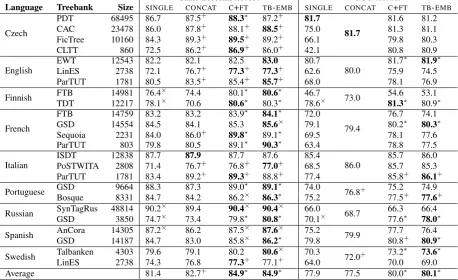
Table1 shows the results on the test sets of each training treebank and on the PUD test sets. Over-all we observe substantial gains when using either
C+FTorTB-EMB. On average bothC+FTandTB
-EMB beat SINGLE by 3.5 LAS points and CON
-CAT by over 2.0 LAS points when testing on the
test sets of the treebanks used for training, and both methods beat both baselines by over 2.0 LAS points for the PUD test set, if we consider the best proxy treebank.
We see positive gains across many scenarios when using C+FT and TB-EMB. First, there are gains for both balanced and unbalanced data sizes, as in the cases of Spanish and French, respectively. Secondly, there are cases with different language variants, as for Portuguese, and different domains, as for Finnish where FTB only contains grammar examples and TDT contains a mix of domains. There are also cases of known differences in an-notation choices, as for the Swedish treebanks.
When the data is very skewed, as for Russian, the effect of adding a small treebank to a large one is minor, as expected. While our results are not directly comparable to the adversarial learning in Sato et al.(2017) who used a different parser and test set, the improvements of C+FT and TB
im-Same treebank test set PUD test set
Language Treebank Size SINGLE CONCAT C+FT TB-EMB SINGLE CONCAT C+FT TB-EMB
Czech
PDT 68495 86.7 87.5+ 88.3∗ 87.2+ 81.7
81.7
81.6 81.2 CAC 23478 86.0 87.8+ 88.1+ 88.5+
75.0 81.3 81.1
FicTree 10160 84.3 89.3+ 89.5+ 89.2+ 66.1 79.8 80.3
CLTT 860 72.5 86.2+ 86.9+ 86.0+ 42.1 80.8 80.9
English
EWT 12543 82.2 82.1 82.5 83.0 80.7
80.0
81.7∗ 81.9∗
LinES 2738 72.1 76.7+ 77.3+ 77.3+ 62.6 75.9 74.5 ParTUT 1781 80.5 83.5+ 85.4+ 85.7+ 68.0 78.1 76.9
Finnish FTB 14981 76.4 ×
74.4 80.1∗ 80.6∗ 46.7
73.0 54.6 53.1 TDT 12217 78.1× 70.6 80.6∗ 80.3∗ 78.6× 81.3∗ 80.9∗
French
FTB 14759 83.2 83.2 83.9∗ 84.1∗ 72.0
79.4
76.7 74.1
GSD 14554 84.5 84.1 85.3 85.6× 79.1 80.2∗ 80.3∗
Sequoia 2231 84.0 86.0+ 89.8∗ 89.1∗ 69.5 78.1 77.6
ParTUT 803 79.8 80.5 89.1∗ 90.3∗ 63.4 78.8 77.5
Italian
ISDT 12838 87.7 87.9 87.7 87.6 85.4
86.0
85.7 86.0 PoSTWITA 2808 71.4 76.7+ 76.8+ 77.0+ 68.5 85.7 85.3 ParTUT 1781 83.4 89.2+ 89.3+ 88.8+ 77.4 85.8+ 86.1+
Portuguese GSD 9664 88.3 87.3 89.0 ∗
89.1∗ 74.0
76.8+ 75.2 74.9
Bosque 8331 84.7 84.2 86.2× 86.3∗ 75.2 77.5+ 77.6+
Russian SynTagRus 48814 90.2 ×
89.4 90.4× 90.4× 66.0
68.7 66.3 66.4 GSD 3850 74.7× 73.4 79.8∗ 80.8∗ 70.1× 77.6∗ 78.0∗
Spanish AnCora 14305 87.2 ×
86.2 87.5× 87.6× 75.2
79.9 77.7 76.4 GSD 14187 84.7 83.0 85.8× 86.2∗ 79.8 80.8+ 80.9∗
Swedish Talbanken 4303 79.6 79.1 80.2 80.6 ×
70.3
72.0+ 73.2 ∗
73.6∗
LinES 2738 74.3 76.8 77.3+ 77.1+ 64.0 70.0 69.0
[image:4.595.73.532.70.350.2]Average 81.4 82.7+ 84.9∗ 84.9∗ 77.9 77.5 80.0∗ 80.1∗
Table 1: LAS scores when testing on the training treebank and on the PUD test set with training treebank as proxy. For each test set, the best result is marked with bold. Treebank size is given as number of sentences in the training data. Statistically significant differences, at the 0.05-level, from SINGLEare marked with +, fromCONCAT with×and from both these systems with *. For clarity, significance for PUD is only shown for the proxy treebank with the highest score.
provements are, unsurprisingly, largest for smaller treebanks, we do also see some improvements for large treebanks, in contrast toSato et al.(2017).
Some variation can be observed between lan-guages. In two cases, Italian ISDT and Czech PUD, CONCAT performs marginally better than
the more advanced methods, but these differences are not statistically significant. In several cases, especially for small treebanks,CONCAT helps
no-ticeably overSINGLE, whereas it actually hurts for Finnish and Russian. It is, however, nearly always better to combine treebanks in some way than to use only a single treebank. The differences be-tween the two best methods, C+FT and TB-EMB
are typically small and not statistically significant, with the exception of Czech PDT, and for some of the small proxy treebanks for PUD.
The PUD test set can be seen as an example of applying the proposed models to unseen data, without matching training data. For all languages, except Czech, the results for C+FT and TB-EMB
with the best proxy treebank are significantly bet-ter than the equivalent result forSINGLE, and for
six of the nine languages, TB-EMBperforms
sig-nificantly better than CONCAT. It is clear that some treebanks are bad fits to PUD, most notably Finnish FTB and Russian SynTagRus. However, even when a treebank is a bad fit, TB-EMB and
C+FT can still improve substantially over using only the single model for the treebank with the best fit, as for Russian where there is a gain of nearly 8 LAS points for TB-EMB over SINGLE, when using GSD as a proxy. For some languages, however, most notably Italian, the choice of proxy treebank makes little difference for TB-EMB and
C+FT. It is also interesting to see that in many cases it is not the largest treebank that is the best proxy for PUD. The large difference in results for PUD, depending on which treebank was used as proxy, also seems to point at potential inconsisten-cies in the UD annotation for several languages.
5 Error Analysis
Ett vittne ber¨attade f¨or polisen att offret hade attackerat den misst¨ankte i april . A witness related for the-police that the-victim had attacked the suspected in April .
det nsubj case
obl
mark nsubj
aux
ccomp
acl:relcl
det obj
case obl
[image:5.595.89.514.64.157.2]punct
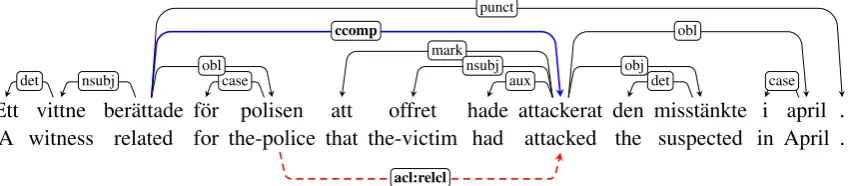
Figure 1: Example sentence from the Swedish PUD treebank with parsing error represented by dashed arc. Translation: “A witness told the police that the victim had attacked the suspect in April.”
using different methods and proxy treebanks. The two Swedish treebanks, Talbanken and LinES, are known to differ in the annotation of a few constructions, notably relative clauses and prepo-sitions that take subordinate clauses as comple-ments. The error analysis reveals that the treebank embedding approach allows the model to learn the distinctive “style” of each treebank, while con-catenation, even with fine-tuning, results in more inconsistencies in the output. A typical example is shown in Figure 1. When trained with tree-bank embeddings (and Taltree-banken as the proxy treebank), the parser produces the correct tree de-picted above the sentence. When trained with fine-tuning instead, the parser incorrectly analyzes the subordinate clause as a relative clause (as shown by the dashed arc below the sentence), because themarkrelation is also used for relative pronouns in the LinES treebank, despite the fact that such structures never occur in Talbanken.
6 Conclusion and Future Work
We have conducted the first large-scale study on how best to combine multiple treebanks for a sin-gle language, when all treebanks use the same an-notation scheme but may be heterogeneous with respect to domain, genre, size, language variant, annotation style, and quality, as is the case for many languages in the UD project. We propose using treebank embeddings, which represent the treebank a sentence comes from. This method is simple, effective, and flexible, and performs on par with a previously suggested method of using con-catenation in combination with fine-tuning, which, however, requires longer training, and produces more models.
We show that both these methods give substan-tial gains for a variety of languages, including dif-ferent scenarios with respect to the mix of avail-able treebanks. Our results are also at least on
par with a previously proposed, but more complex model, based on adversarial learning (Sato et al., 2017). To improve parsing accuracy, it is cer-tainly worth combining multiple treebanks, when available, for a language, using more sophisticated methods than simple concatenation. We recom-mend the treebank embedding model due to its simplicity.
The proposed methods work well with a transition-based parser with BiLSTM feature ex-tractors without POS-tags or pre-trained embed-dings. In future work, we want to investigate how these methods interact with other parsers, and if the combination methods are useful also for tasks like POS-tagging and morphology prediction.
We did not yet investigate methods for choos-ing a proxy treebank when parschoos-ing new data. The results on the PUD test set could indicate which treebank is likely to be the best proxy for the lan-guages explored here. Other factors that could be taken into account when making this choice in-clude degree of domain match and treebank qual-ity. The user may also simply choose the de-sired annotation style by selecting the correspond-ing proxy treebank. For theTB-EMBapproach, in-terpolation of the various treebank embeddings is another possibility.
In the current paper, we explore only the mono-lingual case, using several treebanks for a sin-gle language. Preliminary experiments show that we can combine treebank and language embed-dings and add other languages to the mix. Includ-ing closely related languages typically gives addi-tional gains, which we will explore in future work.
Acknowledgments
References
Waleed Ammar, George Mulcaire, Miguel Ballesteros,
Chris Dyer, and Noah Smith. 2016. Many
lan-guages, one parser. Transactions of the Association of Computational Linguistics, 4:431–444.
Lauriane Aufrant, Guillaume Wisniewski, and Franc¸ois
Yvon. 2016. Zero-resource dependency parsing:
Boosting delexicalized cross-lingual transfer with linguistic knowledge. InProceedings of the 26th In-ternational Conference on Computational Linguis-tics (COLING), pages 119–130, Osaka, Japan.
Johannes Bjerva and Isabelle Augenstein. 2018. Track-ing typological traits of Uralic languages in
dis-tributed language representations. In Proceedings
of the Fourth International Workshop on Computati-nal Linguistics of Uralic Languages, pages 78–88, Helsinki, Finland.
Anders Bj¨orkelund, Agnieszka Falenska, Xiang Yu, and Jonas Kuhn. 2017. IMS at the CoNLL 2017 UD shared task: CRFs and perceptrons meet
neu-ral networks. In Proceedings of the CoNLL 2017
Shared Task: Multilingual Parsing from Raw Text to Universal Dependencies, pages 40–51, Vancouver, Canada.
Wanxiang Che, Jiang Guo, Yuxuan Wang, Bo Zheng, Huaipeng Zhao, Yang Liu, Dechuan Teng, and Ting Liu. 2017. The hit-scir system for end-to-end
pars-ing of universal dependencies. In Proceedings of
the CoNLL 2017 Shared Task: Multilingual Pars-ing from Raw Text to Universal Dependencies, pages 52–62, Vancouver, Canada.
Ayan Das, Affan Zaffar, and Sudeshna Sarkar. 2017. Delexicalized transfer parsing for low-resource lan-guages using transformed and combined treebanks. In Proceedings of the CoNLL 2017 Shared Task: Multilingual Parsing from Raw Text to Universal Dependencies, pages 182–190, Vancouver, Canada.
Eliyahu Kiperwasser and Yoav Goldberg. 2016. Sim-ple and accurate dependency parsing using
bidi-rectional LSTM feature representations.
Transac-tions of the Association of Computational Linguis-tics, 4:313–327.
Catherine Kobus, Josep Crego, and Jean Senellart. 2017. Domain control for neural machine transla-tion. InProceedings of the International Conference Recent Advances in Natural Language Processing, RANLP’17, pages 372–378, Varna, Bulgaria.
Marco Kuhlmann, Carlos G´omez-Rodr´ıguez, and Gior-gio Satta. 2011. Dynamic programming algorithms
for transition-based dependency parsers. In
Pro-ceedings of the 49th Annual Meeting of the ACL: Human Language Technologies, pages 673–682, Portland, Oregon, USA.
Miryam de Lhoneux, Yan Shao, Ali Basirat, Eliyahu Kiperwasser, Sara Stymne, Yoav Goldberg, and Joakim Nivre. 2017a. From raw text to universal
dependencies - look, no tags! In Proceedings of
the CoNLL 2017 Shared Task: Multilingual Pars-ing from Raw Text to Universal Dependencies, pages 207–217, Vancouver, Canada.
Miryam de Lhoneux, Sara Stymne, and Joakim Nivre. 2017b. Arc-hybrid non-projective dependency pars-ing with a static-dynamic oracle. InProceedings of the 15th International Conference on Parsing Tech-nologies, pages 99–104, Pisa, Italy.
KyungTae Lim and Thierry Poibeau. 2017. A system for multilingual dependency parsing based on bidi-rectional lstm feature representations. In Proceed-ings of the CoNLL 2017 Shared Task: Multilingual Parsing from Raw Text to Universal Dependencies, pages 63–70, Vancouver, Canada.
Joakim Nivre. 2009. Non-projective dependency
pars-ing in expected linear time. In Proceedings of the
Joint Conference of the 47th Annual Meeting of the ACL and the 4th International Joint Conference on Natural Language Processing of the AFNLP, pages 351–359, Suntec, Singapore.
Joakim Nivre, ˇZeljko Agi´c, Lars Ahrenberg, Lene
Antonsen, Maria Jesus Aranzabe, Masayuki
Asa-hara, Luma Ateyah, Mohammed Attia,
Marheinecke, H´ector Mart´ınez Alonso, Andr´e Mar-tins, Jan Maˇsek, Yuji Matsumoto, Ryan McDon-ald, Gustavo Mendonc¸a, Niko Miekka, Anna Mis-sil¨a, C˘at˘alin Mititelu, Yusuke Miyao, Simonetta Montemagni, Amir More, Laura Moreno Romero, Shinsuke Mori, Bohdan Moskalevskyi, Kadri Muis-chnek, Kaili M¨u¨urisep, Pinkey Nainwani, Anna
Nedoluzhko, Gunta Neˇspore-B¯erzkalne, Luong
Nguyen Thi., Huyen Nguyen Thi. Minh, Vitaly Nikolaev, Hanna Nurmi, Stina Ojala, Petya Osen-ova, Robert ¨Ostling, Lilja Øvrelid, Elena Pascual, Marco Passarotti, Cenel-Augusto Perez, Guy Per-rier, Slav Petrov, Jussi Piitulainen, Emily Pitler, Barbara Plank, Martin Popel, Lauma Pretkalnin¸a, Prokopis Prokopidis, Tiina Puolakainen, Sampo Pyysalo, Alexandre Rademaker, Loganathan Ra-masamy, Taraka Rama, Vinit Ravishankar, Livy Real, Siva Reddy, Georg Rehm, Larissa Rinaldi, Laura Rituma, Mykhailo Romanenko, Rudolf Rosa, Davide Rovati, Benoˆıt Sagot, Shadi Saleh, Tanja Samardˇzi´c, Manuela Sanguinetti, Baiba Saul¯ıte, Se-bastian Schuster, Djam´e Seddah, Wolfgang Seeker, Mojgan Seraji, Mo Shen, Atsuko Shimada, Dmitry Sichinava, Natalia Silveira, Maria Simi, Radu Simionescu, Katalin Simk´o, M´aria ˇSimkov´a, Kiril Simov, Aaron Smith, Antonio Stella, Milan Straka, Jana Strnadov´a, Alane Suhr, Umut Sulubacak, Zsolt Sz´ant´o, Dima Taji, Takaaki Tanaka, Trond Trosterud, Anna Trukhina, Reut Tsarfaty, Francis Tyers, Sumire Uematsu, Zdeˇnka Ureˇsov´a, Larraitz Uria, Hans Uszkoreit, Sowmya Vajjala, Daniel van Niekerk, Gertjan van Noord, Viktor Varga, Eric Villemonte de la Clergerie, Veronika Vincze, Lars Wallin, Jonathan North Washington, Mats Wir´en,
Tak-sum Wong, Zhuoran Yu, Zdenˇek ˇZabokrtsk´y,
Amir Zeldes, Daniel Zeman, and Hanzhi Zhu. 2017.
Universal dependencies 2.1. LINDAT/CLARIN digital library at the Institute of Formal and Ap-plied Linguistics ( ´UFAL), Faculty of Mathematics and Physics, Charles University.
Robert ¨Ostling and J¨org Tiedemann. 2017. Continuous
multilinguality with language vectors. In
Proceed-ings of the 15th Conference of the European Chap-ter of the Association for Computational Linguistics: Volume 2, Short Papers, pages 644–649, Valencia, Spain.
Motoki Sato, Hitoshi Manabe, Hiroshi Noji, and Yuji Matsumoto. 2017. Adversarial training for
cross-domain universal dependency parsing. In
Proceed-ings of the CoNLL 2017 Shared Task: Multilingual Parsing from Raw Text to Universal Dependencies, pages 71–79, Vancouver, Canada.
Tianze Shi, Felix G. Wu, Xilun Chen, and Yao Cheng. 2017. Combining global models for parsing
uni-versal dependencies. InProceedings of the CoNLL
2017 Shared Task: Multilingual Parsing from Raw Text to Universal Dependencies, pages 31–39, Van-couver, Canada.
J¨org Tiedemann. 2015. Cross-lingual dependency
parsing with universal dependencies and predicted
PoS labels. In Proceedings of the Third
In-ternational Conference on Dependency Linguistics (Depling 2015), pages 340–349, Uppsala, Sweden. Uppsala University, Uppsala, Sweden.
Yulia Tsvetkov, Sunayana Sitaram, Manaal Faruqui,
Guillaume Lample, Patrick Littell, David
Mortensen, Alan W Black, Lori Levin, and Chris Dyer. 2016. Polyglot neural language models: A case study in cross-lingual phonetic representation
learning. InProceedings of the 2016 Conference of
the NAACL: Human Language Technologies, pages 1357–1366, San Diego, California, USA.
Erik Velldal, Lilja Øvrelid, and Petter Hohle. 2017. Joint UD parsing of Norwegian Bokm˚al and
Nynorsk. InProceedings of the 21st Nordic
Con-ference on Computational Linguistics (NODAL-IDA’17), pages 1–10, Gothenburg, Sweden.
Daniel Zeman, Martin Popel, Milan Straka, Hajiˇc Jan, Joakim Nivre, Filip Ginter, Juhani Luotolahti, Sampo Pyysalo, Slav Petrov, Martin Potthast, Fran-cis Tyers, Elena Badmaeva, Memduh Gokirmak, Anna Nedoluzhko, Silvie Cinkova, Jan Hajiˇc jr., Jaroslava Hlavacova, V´aclava Kettnerov´a, Zdenka Uresova, Jenna Kanerva, Stina Ojala, Anna Mis-sil¨a, Christopher D. Manning, Sebastian Schuster, Siva Reddy, Dima Taji, Nizar Habash, Herman Le-ung, Marie-Catherine de Marneffe, Manuela San-guinetti, Maria Simi, Hiroshi Kanayama, Valeria de-Paiva, Kira Droganova, H´ector Mart´ınez Alonso, C¸ a˘grı C¸ ¨oltekin, Umut Sulubacak, Hans Uszkor-eit, Vivien Macketanz, Aljoscha Burchardt, Kim Harris, Katrin Marheinecke, Georg Rehm, Tolga Kayadelen, Mohammed Attia, Ali Elkahky, Zhuoran Yu, Emily Pitler, Saran Lertpradit, Michael Mandl, Jesse Kirchner, Hector Fernandez Alcalde, Jana Str-nadov´a, Esha Banerjee, Ruli Manurung, Antonio Stella, Atsuko Shimada, Sookyoung Kwak, Gustavo Mendonca, Tatiana Lando, Rattima Nitisaroj, and
Josie Li. 2017. CoNLL 2017 shared task:
Mul-tilingual parsing from raw text to universal
depen-dencies. InProceedings of the CoNLL 2017 Shared