1489
Knowledge Diffusion for Neural Dialogue Generation
Shuman Liu†,§∗, Hongshen Chen‡, Zhaochun Ren‡, Yang Feng†, Qun Liu♦, Dawei Yin‡,
†Key Laboratory of Intelligent Information Processing
Institute of Computing Technology, Chinese Academy of Sciences
‡Data Science Lab, JD.com
♦ADAPT centre, School of Computing, Dublin City University
§University of Chinese Academy of Sciences
[email protected], chenhongshen,[email protected], fengyang,[email protected], [email protected]
Abstract
End-to-end neural dialogue generation has shown promising results recently, but it does not employ knowledge to guide the generation and hence tends to generate short, general, and meaningless responses. In this paper, we propose a neural knowl-edge diffusion (NKD) model to intro-duce knowledge into dialogue generation. This method can not only match the rele-vant facts for the input utterance but dif-fuse them to similar entities. With the help of facts matching and entity diffu-sion, the neural dialogue generation is augmented with the ability of convergent and divergent thinking over the knowledge base. Our empirical study on a real-world dataset proves that our model is capable of generating meaningful, diverse and natural responses for both factoid-questions and knowledge grounded chi-chats. The ex-periment results also show that our model outperforms competitive baseline models significantly.
1 Introduction
Dialogue systems are receiving more and more attention in recent years. Given previous ut-terances, a dialogue system aims to generate a proper response in a natural way. Compared with the traditional pipeline based dialogue system, the new method based on sequence-to-sequence model (Shang et al.,2015;Vinyals and Le,2015;
Cho et al., 2014) impressed the research com-munities with its elegant simplicity. Such meth-ods are usually in an end-to-end manner: utter-ances are encoded by a recurrent neural network
∗
Work done when the first author was an intern at Data Science Lab, JD.com.
while responses are generated sequentially by an-other (sometimes identical) recurrent neural net-work. However, due to lack of universal back-ground knowledge and common senses, the end-to-end data-driven structure inherently tends to generate meaningless and short responses, such as “haha” or “I don’t know.”
To bridge the gap of the common knowledge between human and computers, different kinds of knowledge bases ( e.g., the freebase (Google,
2013) and DBpedia (Lehmann et al., 2017) ) are leveraged. A related application of knowledge bases is question answering, where the given ques-tions are first analyzed, followed by retrieving re-lated facts from knowledge bases (KBs), and fi-nally the answers are generated.The facts are usu-ally presented in the form of “subject-relation-object” triplets, where the subject and object are entities. With the aid of knowledge triplets, neural generative question answering systems are capa-ble of answering facts related inquiries (Yin et al.,
2016;Zhu et al.,2017;He et al.,2017a),WH ques-tions in particular, like “who is Yao Ming’s wife ?”. Although answering enquiries is essential for dialogue systems, especially for task-oriented di-alogue systems (Eric et al., 2017), it is still far behind a natural knowledge grounded dialogue system, which should be able to understand the facts involved in current dialogue session (so-called facts matching), as well as diffuse them to other similar entities for knowledge-based chit-chats (i.e. entity diffusion):
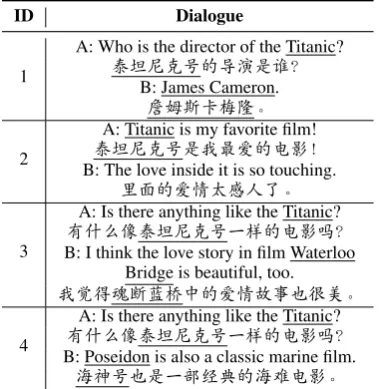
ID Dialogue
1
A: Who is the director of the Titanic?
泰坦尼克号的导演是谁?
B: James Cameron.
詹姆斯卡梅隆。
2
A: Titanic is my favorite film!
泰坦尼克号是我最爱的电影!
B: The love inside it is so touching.
里面的爱情太感人了。
3
A: Is there anything like the Titanic?
有什么像泰坦尼克号一样的电影吗?
B: I think the love story in film Waterloo Bridge is beautiful, too.
我觉得魂断蓝桥中的爱情故事也很美。
4
A: Is there anything like the Titanic?
有什么像泰坦尼克号一样的电影吗?
B: Poseidon is also a classic marine film.
海神号也是一部经典的海难电影。
Table 1: Examples of knowledge grounded con-versations. Knowledge entities are underlined.
Table1shows an example: Item 1 and 2 are talk-ing about the film “Titanic”, Unlike item 1, which is a typical question answering conversation,item 2 is a knowledge related chit-chat without any ex-plicit relation. It is difficult to define the exact fact match for item 2.
2) entity diffusion: another noticeable phe-nomenon is that the conversation usually drifts from one entity to another. In Table1, utterances in item 3 and 4 are about entity “Titanic”, how-ever, the entity of responses are other similar films. Such entity diffusion relations are rarely captured by the current knowledge triplets. The response in item 3 shows that the two entities “Titanic” and “Waterloo Bridge” are relevant through “love sto-ries”. Item 4 suggests another similar shipwreck film of “Titanic”.
To deal with the aforementioned challenges, in this paper, we propose a neural knowledge
diffusion (NKD) dialogue system to benefit the neural dialogue generation with the ability of both convergent and divergent thinking over the knowl-edge base, and handle factoid QA and knowlknowl-edge grounded chit-chats simultaneously. NKD learns to match utterances to relevant facts; the matched facts are then diffused to similar entities; and fi-nally, the model generates the responses with re-spect to all the retrieved knowledge items.
In general, our contributions are as follows:
• We identify the problem of incorporating knowledge bases and dialogue systems as facts matching and entity diffusion.
• We manage both facts matching and entity diffusion by introducing a novel knowledge diffusion mechanism and generate the re-sponses with the retrieved knowledge items, which enable the convergent and divergent thinking over the knowledge base.
• The experimental results show that the pro-posed model effectively generate more di-verse and meaningful responses involving more accurate relevant entities compared with the state-of-the-art baselines.
The corpus will be released upon publication.
2 Model
Figure 1: Neural Knowledge Diffusion Dialogue System.
Given the input utterance X =
(x1, x2, ..., xNX), NKD produces a response Y = (y1, y2, ..., yNY)containing the entities from
the knowledge base K. NX and NY are the number of tokens in the utterance and response re-spectively. The knowledge baseK is a collection of knowledge facts in the form of triplets(subject, relation, object). In particular, both subjects and objects are entities in this work. As illustrated in Figure 1, the model mainly consists of four components:
1. An encoder encodes the input utterance X
[image:2.595.87.278.63.258.2] [image:2.595.308.524.290.504.2]2. A context RNN keeps the dialogue state along a conversation session. It takes the ut-terance representation as input, and outputs a vector guiding the response generation each turn.
3. A decoder generates the final responseY.
4. A knowledge retriever performs the facts matching and diffuses to similar entities at each turn.
Our work is built on hierarchical recurrent encoder-decoder architecture (Sordoni et al.,
2015a), and a knowledge retriever network inte-grates the structured knowledge base into the dia-logue system.
2.1 Encoder
The encoder transforms discrete tokens into vec-tor representations. To capture information at dif-ferent aspects, we learn utterance representations with two independent RNNs resulting with two hidden state sequences HC = (hC1, hC2, ..., hCNX)
andHK = (hK1 , hK2 , ..., hKNX) respectively. One final hidden statehCNX is used as the input of con-text RNN to track the dialogue state. The other final hidden state hKNX is utilized in knowledge retriever and is designed to encode the knowl-edge entities and relations within the input utter-ances. For instance, in Figure1, “director” and
“Titanic”inX1are knowledge elements.
2.2 Knowledge Retriever
Knowledge retriever extracts a certain number of facts from knowledge base and specifies their im-portance. It enables the knowledge grounded neu-ral dialogue system with convergent and divergent thinking ability through facts matching and entity diffusion. Figure2illustrates the process.
2.2.1 Facts Matching
Given the input utterance X and hKNX, relevant facts are extracted from both the knowledge base and the dialogue history. A predefined number of relevant facts F = {f1, f2, ..., fNf} are
ob-tained through string matching, entity linking or named entity recognition. As shown in Figure
2, in the first sentence, “Titanic” is recognized as an entity, all the relevant knowledge triplets are extracted. Then, these entities and knowledge triplets are transformed into fact representations
hf = {hf1, hf2, ...hf Nf} by averaging the
en-tity embedding and relation embedding. The rele-vance coefficientrf between a fact and the input utterances, ranging from0to1, is calculated by a nonlinear function or a sub neural network. Here, we apply a multi-layer perceptron (MLP):
rfk =M LP([hKNX, hf k]).
For the multi-turn conversation, entities in pre-vious utterances are also inherited and reserved as depicted in Figure 2 the dotted lines. For in-stance, in the second sentence of Figure 2 (right one), no new fact is extracted from the input utter-ance. Thus it is necessary to record the history en-tities“Titanic”and“James Cameron”. We sum-marize the facts asrelevant fact representationCf
through a weighted average of fact representations
hf:
Cf = PNf
k=1r f khf k PNf
k=1r f k
.
2.2.2 Entity Diffusion
To retrieve other relevant entities, which are typ-ically not mentioned in the dialogue utterance, we diffuse the matched facts. We calculate the similarity between the entities (except the enti-ties that have occurred in previous utterances) in the knowledge base and the relevant fact represen-tation through a multi-layer perceptron, resulting with a similarity coefficientre, ranging from0to
1:
rek=M LP([hKNX, Cf, ek]),
where ek is the entity embedding. The top Ne
number of entities E = {e1, e2, ..., eNe} are se-lected as similar entities. Then, thesimilar entity representationCsis formalized as:
Cs= PNe
k=1rkeek PNe
k=1rek .
Back to the example in Figure 2, in the first turn, the matched fact of the input utterance
… … … entity entity relation Billy Zane Leonardo DiCaprio release_time_is Titanic Titanic -1997 Titanic act_by Titanic act_by direct_by act_by Titanic Kate Winslet Titanic -James Cameron ··· ··· entity Resident Evil The Notebook Poseidon Waterloo Bridge … 0.001 0.001 score 0.001 1 0.001 0.001 … … score 0.001 0.05 0.15 0.1 … … … entity entity relation Kate Winslet James Cameron -Titanic James Cameron -Titanic act_by Titanic act_by release_time_is direct_by Titanic Leonardo DiCaprio Titanic -1997 ··· ··· entity Resident Evil The Notebook Poseidon Waterloo Bridge … 0.75 0.001 score 0.001 0.001 0.001 0.05 … … score 0.05 0.45 0.95 0.85
Figure 2: Knowledge Retriever. Facts related to input utterance are extracted by facts matching. Similar entities are then figured out by entity diffusion. The dotted lines show the inheritance of previous facts.
diffusion”, the similar entities“Waterloo Bridge”
and “Poseidon” get relatively higher similarity weights than in the first turn.
2.3 Context RNN
Context RNN records the utterance level dialogue state. It takes in the utterance representation and the knowledge representations. The hidden state of the context RNN is updated as:
hTt =RN N(hCt ,[Cf, Cs], hTt−1).
hTt is then conveyed to the decoder to guide the response generation.
2.4 Decoder
The decoder generates the response sequentially through a word generator conditioned onhTt,Cf
andCs. LetC denotes the concatenation ofhTt,
Cf andCs. Knowledge items coefficientRis the concatenation of relevance coefficientrf and sim-ilarity coefficientre. We introduce two variants of word generator:
Vanilla decodersimply generates the response
Y = (y1, y2, ..., yNy) according to C, R. The
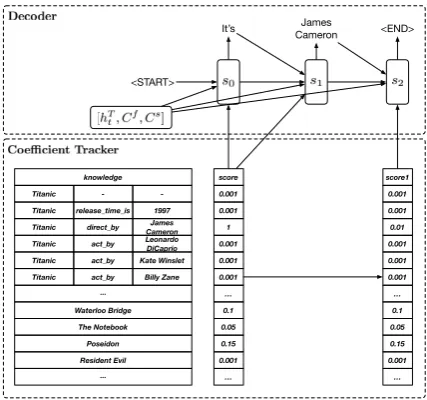
<START> James Cameron <END> act_by James Cameron Kate Winslet - -Titanic direct_by Titanic act_by Billy Zane release_time_is Titanic Leonardo DiCaprio Titanic Titanic 1997 act_by Titanic … 0.001 0.15 0.05 0.1 … 0.001 0.001 score 0.001 1 0.001 0.001 ··· ··· Resident Evil The Notebook Poseidon Waterloo Bridge knowledge … 0.001 0.15 0.05 0.1 … 0.001 0.001 score1 0.001 0.01 0.001 0.001 It’s
Figure 3: The decoder generates words from both vocabulary and knowledge base. A score updater keeps tracking of the knowledge item coefficients to ensure its coverage during response generation.
probability ofY is defined as
p(y1, .., yNy|C, R;θ)
=p(y1|C, R;θ) Ny Y
[image:4.595.309.523.420.620.2]whereθdenotes the model parameters. The con-ditional probability ofytis specified by
p(yt|y1, ..., yt−1, C, R;θ) =p(yt|yt−1, st, C, R;θ),
where yt is the embedding of the vocabulary or object entities of retrieved knowledge items,stis
the decoder RNN hidden state .
Probabilistic gated decoder utilizes a gating variable zt (Yin et al., 2016) to indicate whether the tth word is generated from common vocabu-lary or knowledge entities. The probability of gen-erating thetthword is given by:
p(yt|yt−1, st, C, R;θ)
=p(zt= 0|st;θ)p(yt|yt−1, st, C, R, zt= 0;θ) +p(zt= 1|st;θ)p(yt|R, zt= 1;θ),
wherep(zt|st;θ)is computed by a logistic regres-sion, p(yt|R, zt = 1;θ)is approximated with the
knowledge items coefficientR, andθis the model parameter.
During response generation, if an entity is overused, the response diversity will be reduced. Therefore, once a knowledge item occurred in the response, the corresponding coefficient should be reduced in case that an item occurs multiple times. To keep tracking the coverage of knowl-edge items, we update the knowlknowl-edge items coef-ficientR at each time step. We also explore two coverage tracking mechanisms: 1) Mask coeffi-cient trackerdirectly reduces the coefficient of the chosen knowledge item to0to ensure it can never be selected as the response word again. 2) Coeffi-cient attenuation trackercalculates an attenuation scoreitbased onst,R0,Rt−1andyt−1:
it=DN N(st, yt−1, R0, Rt−1), and then update the coefficient as:
Rt=it·Rt−1,
whereitranges from0to1to gradually decrease the coefficient.
2.5 Training
The model parameters include the embedding of vocabulary, entities, relations, and all the model components. The model is differential and can be optimized in an end-to-end manner using back-propagation. Given the training data
D={(X1Nd, Y1Nd, F1Nd, E1Nd)}
where Nd is the max turns of a dialogue, F
de-notes the set of relevant knowledge andEdenotes the set of similar knowledge in response, the ob-jective function is to minimize the negative log-likelihood:
`(D, θ) =−X ND X
i=1
logp(Yi|Xi, Fi, Ei)
3 Experiment
3.1 Dataset
Most existing knowledge related datasets are mainly focused on single-turn factoid question answering (Yin et al., 2016; He et al., 2017b). We here collect a multi-turn conversation cor-pus grounded on the knowledge base, which in-cludes not only facts related inquiries but also knowledge-based chit-chats. The data is publicly available online1.
We first obtain the element information of each movie, including the movie’s title, publication time, directors, actors and other attributes from
https://movie.douban.com/, a popular Chinese
social network for movies. Then, entities and re-lations are extracted as triplets to build the knowl-edge baseK.
To collect the question-answering dialogues, we crawled the corpus from a question-answering forum https://zhidao.baidu.com/. To
gather the knowledge related chit-chat corpus, we mined the dataset from the social forum
https://www.douban.com/group/. Users post
their comments, feedbacks, and impressions of films and televisions on it.
The conversations are grounded on the knowl-edge using NER, string match, and artificial scor-ing and filterscor-ing rules. The statistical informa-tion of the dataset is shown in Table 2. We ob-served that the conversations follow the long tail distribution, where famous films and televisions are discussed repeatedly and the low rating ones are rarely mentioned.
3.2 Experiment Detail
The total 32977 conversations consisting of
104567 utterances are divided into training (32177) and testing set (800). Bi-directional LSTM (Schuster and Paliwal, 1997) is used for encoder, and the dimension of the LSTM hidden
1
Knowledge base Community QA Multi-round dialogue
[image:6.595.151.452.62.97.2]#entities #relations #triplets #QA pairs #dialogues #sentences 152568 4 766854 8121 24856 88325
Table 2: Statistics of knowledge base and conversations.
layer is set to512. For the context RNN, the di-mension of the LSTM unit is set to 1024. The dimension of word embedding shared by the vo-cabulary, entities and relations is also set to 512
empirically. We use Adam learning (Kingma and Ba,2014) to update the gradient and clip the gra-dient in5.0. It takes 140 to 150 epochs to train the model with a batch size of80.
3.3 Baselines
We compare our neural knowledge diffusion model with three state-of-the-art baselines:
• Seq2Seq: a sequence to sequence model with vanilla RNN encoder-decoder (Shang et al.,
2015;Vinyals and Le,2015).
• HRED: a hierarchical recurrent encoder-decoder model.
• GenDS: a neural generative dialogue system that is capable of generating responses based on input message and related knowledge base (KB) (Zhu et al.,2017) .
Three variants of the neural diffusion dialogue generation model are implemented to verify dif-ferent configurations of decoders.
• NKD-oriis the original model with a vanilla decoder and a mask coefficient tracker.
• NKD-gatedis augmented with a probabilis-tic gated decoder and a mask coefficient tracker.
• NKD-atteutilizes a vanilla decoder and the coefficient attenuation tracker.
3.4 Evaluation Metric
Both automatic and human evaluation metrics are used to analyze the model’s performance. To val-idate the effectiveness of facts matching and dif-fusion, we calculate entity accuracy and recall
on factoid QA data set as well as the whole data set. Human evaluation rates the model in three aspects: fluency, knowledge relevanceand cor-rectness of the response. All these metrics range from 0 to 3, where 0 represents complete error, 1
model accuracy(%) recall(%)
LSTM 7.8 7.5
HRED 3.7 3.9
GenDS 70.3 63.1
NKD-ori 67.0 56.2 NKD-gated 77.6 77.3
[image:6.595.333.499.138.211.2]NKD-atte 55.1 46.6
Table 3: Evaluation results on factoid question answering dialogues.
model accuracy(%) recall(%) entity number
LSTM 2.6 2.5 1.65
HRED 1.4 1.5 1.79
GenDS 20.9 17.4 1.34
NKD-ori 22.9 19.7 2.55
NKD-gated 24.8 25.6 1.59 NKD-atte 18.4 16.0 3.41
Table 4: Evaluation results on entire dataset.
for partially correct, 2 for almost correct, 3 for ab-solutely correct.
3.5 Experiment Result
Table3displays the accuracy and recall of entities on factoid question answering dialogues. The per-formance of NKD is slightly better than the spe-cific QA solution GenDS, while LSTM and HRED which are designed for chi-chat almost fail in this task. All the variants of NKD models are capa-ble of generating entities with an accuracy of60%
to70%, and NKD-gated achieves the best perfor-mance with an accuracy of77.6%and a recall of
77.3%.
Table4 lists the accuracy and recall of entities on the entire dataset including both the factoid QA and knowledge grounded chit-chats. Not surpris-ingly, both NKD-ori and NKD-gated outperform GenDS on the entire dataset, and the relative provement over GenDS is even higher than the im-provement in QA dialogues. It confirms that al-though NKD and GenDS are comparable in an-swering factoid questions, NKD is better at in-troducing the knowledge entities for knowledge grounded chit-chats.
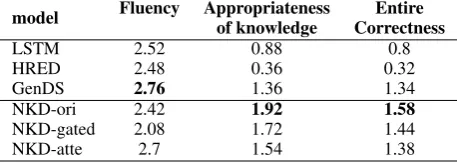
model Fluency Appropriateness Entire of knowledge Correctness
LSTM 2.52 0.88 0.8
HRED 2.48 0.36 0.32
GenDS 2.76 1.36 1.34
NKD-ori 2.42 1.92 1.58
NKD-gated 2.08 1.72 1.44
[image:7.595.72.301.64.146.2]NKD-atte 2.7 1.54 1.38
Table 5: Human evaluation result.
accuracies and recalls. We also noticed that NKD-gated achieves the highest accuracy and recall, but generates fewer entities compared with NKD-ori and NKD-gated, whereas NKD-atte generates more entities but also with relatively low accu-racies and recalls.This demonstrates that NKD-gated not only learns to generate more entities but also maintains the quality ( with a relatively high accuracy and recall ).
The results of human evaluation in Table5also validate the superiority of the proposed model, es-pecially on appropriateness. Responses generated by LSTM and HRED are of high fluency, but are simply repetitions, or even dull responses as “I don’t know.”, “Good.”. NKD-gated is more adept at incorporating the knowledge base with respect to appropriateness and correctness, while NKD-atte generates more fluent responses. NKD-ori is a compromise, and obtains the best correctness in completing an entire dialogue. Four evaluators rated the scores independently. The pairwise Co-hen’s Kappa agreement scores are 0.67 on fluency, 0.54 on appropriateness, and 0.60 on entire cor-rectness, which indicate a strong annotator agree-ment.
To our surprise, one of the variant model of NKD, which utilized both probabilistic gated de-coder and coefficient attenuation tracker does not perform well on entire dataset. The accuracy of the model is quite high, but the recall is very low compared to others. We speculate that this is due to the method of minimizing negative log-likelihood during the training process, which makes the model tend to generate completely cor-rect answers, and therefore reduces the number of generated entities.
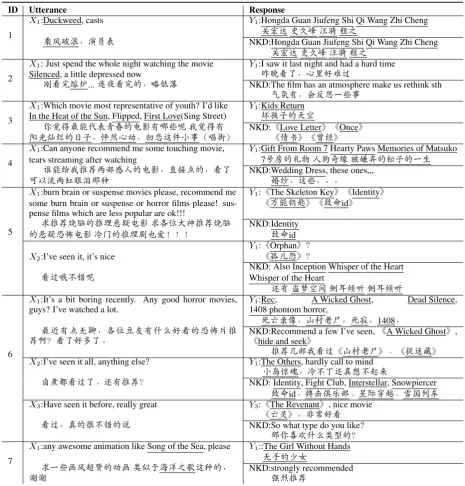
3.6 Case Study
Table 6shows typical examples of the generated responses. Both Item 1 and 2 are based on facts relevant utterances. NKD handles these questions by facts matching. Item 3 asks for a
recommen-dation. NKD obtains similar entities by diffus-ing the entities. For item 4, 5 and 6, no explicit entity appears in the utterances. NKD is able to output appropriate recommendations through en-tity diffusion. The entities are recorded during the whole dialogue session, so NKD keeps recom-mending for several turns. Item 7 fails to gener-ate an approprigener-ate response because the entity in the golden response does not appear in the train-ing set, which suggests the future work for out-of-vocabulary cases.
4 Related Work
The successes of sequence-to-sequence architec-ture (Cho et al.,2014;Sutskever et al.,2014) mo-tivated investigation in dialogue systems that can effectively learn to generate a response sequence given the previous utterance sequence (Shang et al.,2015;Sordoni et al.,2015b;Vinyals and Le,
2015). The model is trained to minimize the nega-tive log-likelihood of the training data. Despite the current progress, the lack of response diversity is a notorious problem, where the model inherently tends to generate short, general responses in spite of different inputs. Li et al.(2016a);Serban et al.
(2017);Cao and Clark(2017) suggested that the-ses boring responthe-ses are common in training data and shorter responses are more likely to be given a higher likelihood. To tackle the problem, Li et al.(2016a) introduced a maximum mutual in-formation training objective.Serban et al.(2017),
Cao and Clark(2017) andChen et al.(2018) used latent variables to introduce stochasticity to en-hance the response diversity. Vijayakumar et al.
(2016),Shao et al. (2017) and Li et al. (2016b) recognized that the greedy search decoding pro-cess, especially beam-search with a wide beam size, leads the short responses possess higher like-lihoods. They reserved more diverse candidates during beam-search decoding. In this paper, we present that the absence of background knowledge and common sense is another source of lacking di-versity. We augment the knowledge base to end-to-end dialogue generation.
Another research line comes from the utiliz-ing of knowledge bases. A typical application is question-answering (QA) systems. The end-to-end QA also resort to the encoder-decoder frame-work (Yin et al.,2016;He et al.,2017a).Yin et al.
ID Utterance Response
1
X1:Duckweed, casts Y1:Hongda Guan Jiufeng Shi Qi Wang Zhi Cheng
关宏达史久峰汪漪程之
乘风破浪,演员表 NKD:Hongda Guan Jiufeng Shi Qi Wang Zhi Cheng
关宏达史久峰汪漪程之
2
X1: Just spend the whole night watching the movie Y1:I saw it last night and had a hard time Silenced, a little depressed now 昨晚看了,心里好难过
刚看完熔炉...连夜看完的,略低落 NKD:The film has an atmosphere make us rethink sth
气氛有,会反思一些事
3
X1:Which movie most representative of youth? I’d like Y1:Kids Return In the Heat of the Sun, Flipped, First Love(Sing Street) 坏孩子的天空
你觉得最能代表青春的电影有哪些呢我觉得有 NKD:《Love Letter》《Once》
阳光灿烂的日子,怦然心动,初恋这件小事(唱街) 《情书》《曾经》
4
X1:Can anyone recommend me some touching movie, Y1:Gift From Room 7 Hearty Paws Memories of Matsuko tears streaming after watching 7号房的礼物人狗奇缘被嫌弃的松子的一生
谁能给我推荐两部感人的电影,直接点的,看了 NKD:Wedding Dress, these ones,,,
可以流两缸眼泪那种 婚纱,这些,,,
5
X1:burn brain or suspense movies please, recommend me Y1:《The Skeleton Key》《Identity》
some burn brain or suspense or horror films please! sus-pense films which are less popular are ok!!!
《万能钥匙》《致命id》
求推荐烧脑的推理悬疑电影求各位大神推荐烧脑 NKD:Identity
的悬疑恐怖电影冷门的推理剧也爱!!! 致命id
Y1:《Orphan》? X2:I’ve seen it, it’s nice 《孤儿怨》?
NKD: Also Inception Whisper of the Heart
看过哦不错呢 Whisper of the Heart
还有盗梦空间侧耳倾听侧耳倾听
6
X1:It’s a bit boring recently. Any good horror movies, guys? I’ve watched a lot.
Y1:Rec, A Wicked Ghost, Dead Silence, 1408 phontom horror,
死亡录像,山村老尸,死寂,1408,
最近有点无聊,各位豆友有什么好看的恐怖片推 荐啊?看了好多了。
NKD:Recommend a few I’ve seen,《A Wicked Ghost》,
《hide and seek》
推荐几部我看过《山村老尸》、《捉迷藏》 X2:I’ve seen it all, anything else? Y1:The Others, hardly call to mind
小岛惊魂,冷不丁还真想不起来
卤煮都看过了。还有推荐? NKD: Identity, Fight Club, Interstellar, Snowpiercer 致命id、搏击俱乐部、星际穿越、雪国列车 X3:Have seen it before, really great Y3:《The Revenant》, nice movie
《亡灵》,非常好看 看过,真的很不错的说 NKD:So what type do you like?
那你喜欢什么类型的?
7
X1:any awesome animation like Song of the Sea, please Y1::The Girl Without Hands
无手的少女
求一些画风超赞的动画类似于海洋之歌这种的, NKD:strongly recommended
[image:8.595.70.536.62.549.2]谢谢 强烈推荐
Table 6: Examples of the generated response. Entities are underlined andYidenotes the gold response.
by referring to the fact. He et al. (2017a) ex-tended this approach by augmenting the copying mechanism and enabled the output words to copy from the original input sequence.Eric et al.(2017) noticed that neural task-oriented dialogue systems often struggle to smoothly interface with a knowl-edge base and they addressed the problem by aug-menting the end-to-end structure with a key-value retrieval mechanism where a separate attention is performed over the key of each entry in the KB.
Ghazvininejad et al. (2017) represented the un-structured text as bag of words representation and
rele-vant knowledge items.
5 Conclusion
In this paper, we identify the knowledge diffusion in conversations and propose an end-to-end neu-ral knowledge diffusion model to deal with the problem. The model integrates the dialogue sys-tem with the knowledge base through both facts matching and entity diffusion, which enable the convergent and divergent thinking over the knowl-edge base. Under such mechanism, the factoid question answering and knowledge grounded chit-chats can be tackled together. Empirical results show the proposed model is able to generate more meaningful and diverse responses, compared with the state-of-the-art baselines. In future work, we plan to introduce reinforcement learning and knowledge base reasoning mechanisms to improve the performance.
Acknowledgements
This work is supported by the National Natu-ral Science Foundation of China (No.61662077, No.61472428). We also would like to thank all the reviewers for their insightful and valuable com-ments and suggestions.
References
Kris Cao and Stephen Clark. 2017. Latent variable di-alogue models and their diversity. InProceedings of the 15th Conference of the European Chapter of the Association for Computational Linguistics: Volume 2, Short Papers, pages 182–187, Valencia, Spain. Association for Computational Linguistics.
Hongshen Chen, Zhaochun Ren, Jiliang Tang, Yi-hong Eric Zhao, and Dawei Yin. 2018. Hierarchi-cal variational memory network for dialogue gener-ation. InProceedings of the 2018 World Wide Web Conference on World Wide Web, pages 1653–1662. International World Wide Web Conferences Steering Committee.
Kyunghyun Cho, Bart van Merrienboer, Caglar Gul-cehre, Dzmitry Bahdanau, Fethi Bougares, Holger Schwenk, and Yoshua Bengio. 2014. Learning phrase representations using rnn encoder–decoder for statistical machine translation. InProceedings of the 2014 Conference on Empirical Methods in Nat-ural Language Processing (EMNLP), pages 1724– 1734, Doha, Qatar. Association for Computational Linguistics.
Bhuwan Dhingra, Lihong Li, Xiujun Li, Jianfeng Gao, Yun-Nung Chen, Faisal Ahmed, and Li Deng. 2017.
Towards end-to-end reinforcement learning of dia-logue agents for information access. InProceedings of the 55th Annual Meeting of the Association for Computational Linguistics.
Mihail Eric, Lakshmi Krishnan, Francois Charette, and Christopher D. Manning. 2017. Key-value retrieval networks for task-oriented dialogue. InProceedings of the 18th Annual SIGdial Meeting on Discourse and Dialogue, pages 37–49. Association for Com-putational Linguistics.
Marjan Ghazvininejad, Chris Brockett, Ming-Wei Chang, Bill Dolan, Jianfeng Gao, Wen-tau Yih, and Michel Galley. 2017. A knowledge-grounded neural conversation model. arXiv preprint arXiv:1702.01932.
Google. 2013. Freebase data dumps.
Shizhu He, Cao Liu, Kang Liu, Jun Zhao, Shizhu He, Cao Liu, Kang Liu, and Jun Zhao. 2017a. Generat-ing natural answers by incorporatGenerat-ing copyGenerat-ing and re-trieving mechanisms in sequence-to-sequence learn-ing. In Meeting of the Association for Computa-tional Linguistics, pages 199–208.
Wei He, Kai Liu, Yajuan Lyu, Shiqi Zhao, Xinyan Xiao, Yuan Liu, Yizhong Wang, Hua Wu, Qiaoqiao She, Xuan Liu, Tian Wu, and Haifeng Wang. 2017b. Dureader: a chinese machine reading comprehen-sion dataset from real-world applications. arXiv eprint arXiv:1711.05073.
Diederik P. Kingma and Jimmy Ba. 2014. Adam: A method for stochastic optimization. CoRR, abs/1412.6980.
Jens Lehmann, Robert Isele, Max Jakob, Anja Jentzsch, Dimitris Kontokostas, Pablo N. Mendes, Sebastian Hellmann, Mohamed Morsey, Patrick van Kleef, S¨oren Auer, and Christian Bizer. 2017. Db-pedia – a large-scale, multilingual knowledge base extracted from wikipedia.
Jiwei Li, Michel Galley, Chris Brockett, Jianfeng Gao, and Bill Dolan. 2016a. A diversity-promoting ob-jective function for neural conversation models. In
Proceedings of the 2016 Conference of the North American Chapter of the Association for Computa-tional Linguistics: Human Language Technologies, pages 110–119, San Diego, California. Association for Computational Linguistics.
Jiwei Li, Will Monroe, and Jurafsky Dan. 2016b. A simple, fast diverse decoding algorithm for neural generation.arXiv preprint arXiv:1611.08562.
M. Schuster and K. K. Paliwal. 1997.Bidirectional re-current neural networks. IEEE Transactions on Sig-nal Processing, 45(11):2673–2681.
Iulian Serban, Alessandro Sordoni, Ryan Lowe, Lau-rent Charlin, Joelle Pineau, Aaron Courville, and Yoshua Bengio. 2017. A hierarchical latent variable encoder-decoder model for generating dialogues. In
Lifeng Shang, Zhengdong Lu, and Hang Li. 2015. Neural responding machine for short-text conver-sation. In Proceedings of the 53rd Annual Meet-ing of the Association for Computational LMeet-inguistics and the 7th International Joint Conference on Natu-ral Language Processing (Volume 1: Long Papers), pages 1577–1586, Beijing, China. Association for Computational Linguistics.
Louis Shao, Stephan Gouws, Denny Britz, Anna Goldie, and Brian Strope. 2017. Generating long and diverse responses with neural conversation mod-els. arXiv preprint arXiv:1701.03185.
Alessandro Sordoni, Yoshua Bengio, Hossein Vahabi, Christina Lioma, Jakob Grue Simonsen, and Jian-Yun Nie. 2015a. A hierarchical recurrent encoder-decoder for generative context-aware query sugges-tion. InProceedings of the 24th ACM International on Conference on Information and Knowledge Man-agement, pages 553–562. ACM.
Alessandro Sordoni, Michel Galley, Michael Auli, Chris Brockett, Yangfeng Ji, Margaret Mitchell, Jian-Yun Nie, Jianfeng Gao, and Bill Dolan. 2015b. A neural network approach to context-sensitive gen-eration of conversational responses. In Proceed-ings of the 2015 Conference of the North Ameri-can Chapter of the Association for Computational Linguistics: Human Language Technologies, pages 196–205, Denver, Colorado. Association for Com-putational Linguistics.
Ilya Sutskever, Oriol Vinyals, and Quoc V Le. 2014. Sequence to sequence learning with neural net-works. InAdvances in neural information process-ing systems, pages 3104–3112.
Ashwin K Vijayakumar, Michael Cogswell, Ram-prasath R Selvaraju, Qing Sun, Stefan Lee, David Crandall, and Dhruv Batra. 2016. Diverse beam search: Decoding diverse solutions from neural se-quence models. arXiv preprint arXiv:1610.02424.
Oriol Vinyals and Quoc Le. 2015. A neural conversa-tional model. arXiv preprint arXiv:1506.05869.
Jun Yin, Xin Jiang, Zhengdong Lu, Lifeng Shang, Hang Li, and Xiaoming Li. 2016. Neural generative question answering. InInternational Joint Confer-ence on Artificial IntelligConfer-ence, pages 2972–2978.